Author: Frank Schuler

No Increased Cardiovascular Risk For Stroke Patients Following Prescription Cannabis Use

Public health officials estimate that as many as 15 million strokes occur annually around the globe. Of that estimated 15 million, roughly one-third of them result in the person dying and another one-third leave the patient permanently disabled.

The main cause of someone experiencing a stroke is high blood pressure, which can be caused by a number of factors including poor diet, lack of exercise, other health conditions, and genetics.

With the rise in safe access to medical cannabis and products derived from medical cannabis, researchers are examining cannabis use and stroke survivors to gauge whether or not there are any elevated risks. Fortunately for stroke patients, a recent study in Italy is providing some promising news. Below is more information about it via a news release from NORML:

Genova, Italy: Patients with a history of stroke are not at an increased risk of cardiovascular complications following the use of nabiximols (a/k/a Sativex – an oromucosal spray containing a balanced ratio of plant-derived THC and CBD), according to clinical trial data published in the journal Frontiers in Cardiovascular Medicine. Nabiximols is available by prescription in various countries, but not in the United States, for patients suffering from symptoms of multiple sclerosis.

Italian researchers compared the cardiovascular impact of nabiximols versus placebo in a cohort of 34 stroke survivors. Subjects in the study suffered from symptoms of spasticity. Patients in the study took either nabiximols or placebo in addition to their standard medications for a period of one-month.

Investigators reported: “No … adverse drug effects emerged during nabiximols treatment, namely no significant fluctuation of blood pressure and heart rate, nor ischemic or hemorrhagic events occurred. During nabiximols treatment, self-assessed blood pressure and heart rate did not change compared to the baseline condition. No patients showed significant acceleration or decrease in heart rate or change in rhythm and none required an additional ECG or cardiological evaluation during the study.”

Authors concluded: “The present study is the first to evaluate the effects of a cannabinoid drug (nabiximols) in patients with post-stroke spasticity. … This ancillary study adds evidence that, in patients who already underwent a cerebrovascular accident, nabiximols does not determine significant blood pressure and heart rate variation or cardiovascular complications. These data support the cardiovascular safety of nabiximols, encouraging more extensive studies involving cannabinoids characterized by slow absorption rates.”

Numerous studies demonstrate the ability of cannabinoids to influence blood pressure and other cardiovascular responses. However, data is inconsistent with respect to whether the frequent use of cannabis may increase one’s risk of stroke, heart attack, or other adverse cardiovascular events. While some studies report an increased risk of stroke and other cardiovascular diseases among marijuana consumers, others report either no risk or provide evidence of possible cardioprotection. A 2021 literature review of 67 studies published in The American Journal of Medicine concluded, “[M]arijuana itself does not appear to be independently associated with excessive cardiovascular risk factors.” Authors did caution, however, that “it can be associated with other unhealthy behaviors such as alcohol use and tobacco smoking that can be detrimental” to cardiovascular health.

Full text of the study, “Nabiximols effect on blood pressure and heart rate in post-stroke patients: A randomized controlled study,” appears in Frontiers in Cardiovascular Medicine.

Israeli Tourette Syndrome Patients Report Improvements Following Cannabis Therapy

Global statisticians estimate that around 0.5-1% of the planet’s population has been diagnosed with some level of Tourette Syndrome, although the true diagnosis rate of people suffering from the condition could be larger due to gaps in identification and treatment in some parts of the globe.

According to the National Institute of Neurological Disorders and Stroke, “Tourette Syndrome (TS) is a neurological disorder characterized by sudden, repetitive, rapid, and unwanted movements or vocal sounds called tics.” Currently, there is no cure for the condition.

Various treatments for Tourette Syndrome exist, with common ones being dopamine blockers, Botox injections, ADHD medications, anti-depressants, and anti-seizure medications. All of those treatments can yield possible undesirable side effects. Fortunately, a recent study in Israel found that cannabis may help. Below is more information about it via a news release from NORML:

Tel Aviv, Israel: Tourette Syndrome (TS) patients report improvements in their quality of life and reductions in their use of prescription medications following cannabis therapy, according to data published in the journal Cannabis and Cannabinoid Research.

Israeli investigators surveyed patients prior to and six-months following cannabis treatment. Subjects in the study consumed products containing roughly twice as much THC as CBD.

Participants reported statistically significant improvements in their quality of life and employment status following cannabis treatment. Most subjects also reported reduced symptoms of anxiety and obsessive-compulsive tendencies. Patients reduced their use of prescription medicines.

By contrast, subjects did not report statistically significant improvements in their frequency of either vocal or motor tics during the study period.

Authors concluded: “Subjective reports from TS patients suggest that medical cannabis may improve their quality of life and comorbidities. More studies are needed to evaluate the efficacy and safety of medical cannabis.”

A limited number of clinical trials have shown both oral THC and inhaled cannabis to be associated with symptom improvements in TS patients, including decreased tic severity and reductions in obsessive-compulsive behaviors. The results of a randomized, placebo-controlled trial published last month in the journal Psychiatry Research reported that patients with more severe TS symptoms experienced symptomatic improvements following the consumption of a balanced formulation of oral THC and CBD.

Full text of the study, “Using medical cannabis in patients with Gilles de la Tourette’s Syndrome in a real-world setting” appears in Cannabis and Cannabinoid Research. Additional information on cannabinoids and TS is available from NORML’s publicationClinical Applications for Cannabis and Cannabinoids.

Cannabis Sales In Canada Are Not Associated With An Increase In Crash Hospitalizations

Earlier this week we covered a report that was recently issued by the Traffic Injury Research Foundation titled, “Recreational Cannabis Consumption Spaces in Canada.” The report was published with support from the Canada Safety Council and DRIVE SOBER®.

In many ways, the report failed to provide proper context and seemed to try to portray cannabis in the most negative light possible, with a heavy focus on public roadway fearmongering. The results of a recent traffic-injury study are proving to be quite timely, as the findings of this new study seem to contradict many points that were recently offered up by cannabis opponents.

A new study based out of Canada examined traffic-injury hospitalization data in an attempt to see if the launch of legal adult-use sales in Canada was associated with an increase in traffic-injury hospitalization rates. Below is more information about it via a news release from NORML:

Toronto, Canada: The implementation of adult-use marijuana sales in Canada is not associated with any increase in traffic injury-related hospitalizations, according to data published in the journal Addiction.

Investigators assessed nationwide rates of emergency department visits and hospitalizations in the years before and immediately following legalization.

Authors concluded, “Overall, there is no clear evidence that RCL [recreational cannabis laws] had any effect on rates of ED visits and hospitalizations for either motor vehicle or pedestrian/cyclist injury across Canada.”

The findings are consistent with those of a 2021 Canadian study that similarly “found no evidence that the implementation of the Cannabis Act was associated with significant changes in post-legalization patterns of all drivers’ traffic-injury ED visits or, more specifically, youth-driver traffic-injury ED presentations.”

Several studies from the United States also found no significant changes in traffic safety in the years immediately following the enactment of adult-use legalization. However, other assessments evaluating longer-term trends in traffic safety following legalization have yielded inconsistent results.

Full text of the study, “The effect of recreational cannabis legalization on rates of traffic injury in Canada,” appears in Addiction. Additional information is available from the NORML Fact Sheet, ‘Marijuana and Psychomotor Performance.

Limited Adult-Use Cannabis Sales Project Is Moving Forward In Zurich

Switzerland’s experiment with adult-use cannabis pilot programs is reportedly expanding, with Zurich’s city government and the Zurich University Hospital indicating today that the Federal Office of Public Health has given the ‘greenlight’ for the local pilot program to proceed later this year.

A cannabis pilot program is, in theory, designed to permit limited local cannabis commerce for the purpose of gaining insight and helping craft potential national cannabis industry laws, rules, and regulations. It gives lawmakers and regulators the opportunity to see what works and what does not work at the local level to help them be better suited to create and implement national policies.

Zurich will not be the first jurisdiction in Switzerland to launch limited adult-use sales as part of a pilot program. Back in early February Basel, Switzerland launched its pilot program with 180 participants after experiencing various delays. The Basel program will eventually involve 374 people total, all aged between 18 and 76.

The pilot program in Zurich, which is the result of a legal amendment adopted by the Swiss parliament in 2020 allowing for adult-use cannabis trials, will be considerably larger than the one in Basel. However, it will still be very limited in size compared to other legal adult-use markets around the globe. Per Swiss Info:

The project, Zuri Can – Cannabis with Responsibility, is intended to study the impact of regulated cannabis supply on the consumption and health of consumers.

The project was delayed last October following objections by the health office.

The sale of cannabis products from pharmacies and social clubs to control groups is now due to begin next August.

A maximum of 2,100 participants can take part in the large-scale pilot project in Switzerland’s biggest city.

Meanwhile, right on the other side of the border between Switzerland and Germany, adult-use cannabis legalization is on the move at the national level. It will be very interesting to see if/when Germany legalizes cannabis for adult use and launches regulated sales nationwide how it may affect Switzerland’s pilot programs.

Presumably, at least some amount of consumers that would have otherwise participated in a Switzerland pilot program will instead go to Germany to make their cannabis purchases.

Even for those that participate in the program at home, many will still travel to Germany for various reasons and consume cannabis there instead of back in Switzerland, and that may skew the results of the cannabis trials, at least to some degree. Switzerland would be better served by passing its own national cannabis legalization measure.

Australian Researchers Find Cannabis Oils To Be Effective For Symptom Management In Older Patients

Neurological disorders affect many people around the globe. In fact, it is estimated that as many as 1 billion people across the globe suffer from some type of neurological disorder. People over 50 years old are more likely to develop a neurological condition compared to younger people.

Neurological disorders are diseases that affect the central and peripheral nervous systems, including the brain, spinal cord, cranial nerves, peripheral nerves, nerve roots, autonomic nervous system, neuromuscular junction, and muscles.

Various pharmaceutical medications are regularly prescribed to help address symptoms of neurological conditions among elderly patients. Just as symptoms are wide-ranging, so too are the medications. One medication that is showing promise is cannabis, as demonstrated in a recent study out of Australia. Below is more information about it via a news release from NORML:

Sydney, Australia: The use of plant-derived cannabis oils containing balanced ratios of THC and CBD is generally safe and effective for patients suffering from neurological diseases, according to observational trial data published in the Journal of Clinical Medicine.

Australian researchers assessed the sustained use of cannabis extracts in 157 patients with treatment-resistant neurological, musculoskeletal, autoimmune, or anti-inflammatory disorders. (Under Australian law, physicians may only authorize medical cannabis to patients that have been unresponsive to conventional prescription treatments.)

Investigators reported that patients age 65 or older and/or those suffering from neurological disorders, such as Parkinson’s disease, peripheral neuropathy, and multiple sclerosis, perceived the greatest overall benefits from cannabis therapy. Their findings are consistent with those of several other studies reporting health-related quality of life benefits among older patients who consume cannabis.

Subjects were most likely to report cannabis to be effective for improving sleep and for reducing pain – findings that are consistent with other studies. By contrast, patients suffering from spondylosis were least likely to perceive benefits from cannabis therapy.

Authors concluded: “This retrospective medical record review describes the population characteristics of patients using medicinal cannabis at a clinic in Sydney, Australia and provides data on the effectiveness and safety of medicinal cannabis treatment on patient conditions and indications. … [Its findings] indicate that medicinal cannabis, in a balanced formulation, may address a variety of non-cancer conditions and indications concurrently and can be safely prescribed by a medical doctor.”

Full text of the study, “A retrospective medical record review of adults with non-cancer diagnoses prescribed medical cannabis,” appears in the Journal of Clinical Medicine. Additional information on cannabis use among older populations is available from NORML Fact Sheet ‘Cannabis Use by Older Populations.’

Another Study Finds That Cannabis Products Improve Health-Related Quality Of Life

The cannabis plant is helping more and more suffering patients every day thanks to cannabis policies being reformed in a growing number of jurisdictions around the globe. While there is still much work to do, more patients are receiving safe access to medical cannabis, and that is a great thing.

Cannabis studies are increasing in frequency, and the knowledge that is being unlocked in the process will help humans for generations to come. A recent study from the United Kingdom is part of that growing body of evidence. Below is more information about it via a news release from NORML:

London, United Kingdom: Patients’ consumption of medical cannabis products is well-tolerated and is associated with significant improvements in their health-related quality of life, according to observational data published in the journal Expert Review of Clinical Pharmacology.

British investigators assessed the safety and efficacy of cannabis-derived products in 2,833 patients enrolled in the UK Medical Cannabis Registry. All of the participants possessed a doctor’s authorization to access cannabis products. (Since 2018, specialists have been permitted to prescribe cannabis-based medicinal products to patients unresponsive to conventional medications.)

Patients enrolled in the registry suffered from a variety of disorders, including chronic painanxietypost-traumatic stressdepressionmigraineinflammatory bowel disease, and other afflictions. Study participants consumed cannabis by either vaporizing marijuana flowers or by ingesting plant-derived extracts containing both THC and CBD. Researchers assessed subjects’ symptoms compared to baseline at one, three, six, and twelve months.

Authors reported that the majority of patients experienced sustained improvements following cannabis therapy. Adverse events associated with cannabis were typically mild, with the most frequently reported side-effects being dry mouth and fatigue.

They concluded: “This observational study suggests that initiating treatment with CBMPs [cannabis-based medicinal products] is associated with an improvement in general HRQoL [health-related quality of life], as well as sleep- and anxiety-specific symptoms up to 12 months in patients with chronic illness. … Most patients tolerated the treatment well, however, the risk of AEs [adverse events] should be considered before initiating CBMPs. In particular, female and cannabis-naïve patients are at increased likelihood of experiencing adverse events. These findings may help to inform current clinical practice, but most importantly, highlights the need for further clinical trials to determine causality and generate guidelines to optimize therapy with CBMPs.”

Full text of the study, “An observational study of safety and clinical outcome measures across patient groups in the United Kingdom Medical Cannabis Registry,” appears in Expert Review of Clinical Pharmacology.

Cannabis Use Is Effective In Chronic Pain And Anxiety Patients According To UK Study

Chronic pain and anxiety are two of the most common health conditions diagnosed around the world. In fact, it is estimated that as many as 20% of people on the planet suffer from chronic pain to some degree.

Anxiety also affects a large number of people globally, with it being estimated that over 264 million people around the world are now diagnosed with some form of anxiety disorder. It’s quite possible that the number is actually higher due to the lack of healthcare access in many parts of the planet.

For both conditions, the prescribing of pharmaceutical medications is standard, which is unfortunate. Many pharmaceutical drugs are not only ineffective – they can be harmful and addictive. This is not to say that is the case every time, however, it’s definitely a cause for concern.

The cannabis plant is significantly safer compared to many pharmaceutical drugs, and for many patients, cannabis can be more effective. Below is information regarding a recent study in the United Kingdom that found that cannabis is effective in treating chronic pain and anxiety, via a news release from NORML:

London, United Kingdom: The use of cannabis products is associated with symptomatic improvements in pain patients with and without comorbid anxiety, according to observational trial data published in the journal Expert Review of Neurotherapeutics.

British investigators assessed the safety and efficacy of cannabis-derived products in 1,254 chronic pain patients. Of these, 711 subjects were also diagnosed with anxiety. Study subjects were participants in the UK Medical Cannabis Registry, and each of them possessed a doctor’s authorization to access cannabis. Study participants consumed cannabis by either vaporizing marijuana flower or by ingesting plant-derived extracts containing both THC and CBD. Researchers assessed subjects’ symptoms compared to baseline at one, three, and six-months.

Cannabis treatment was associated with “significant improvements in all primary outcomes … at all timepoints,” authors reported. Those with comorbid anxiety reported greater improvements in health-related quality of life as compared to those subjects diagnosed with chronic pain only. Both cohorts achieved significant reductions in their opioid consumption over the course of the study – a finding that is consistent with dozens of other observational trials.

Authors concluded: “A potential association between initiation of CBMPs [cannabis-based medicinal products] and improvements in pain and HRQoL [health-related quality of life], as well as reductions in opioid consumption and an acceptable AE [adverse events] profile in both cohorts was found, complimenting previous UKMCR studies. Moreover, CP [chronic pain] patients with co-morbid anxiety may achieve better HRQoL outcomes and potentially pain outcomes due to CBMPs’ peripheral and central effects.”

Several placebo-controlled trials document the ability of either inhaled or vaporized herbal cannabis to significantly mitigate pain in various patient populations, including those suffering from HIVdiabetesspinal cord injury, or severe treatment-resistant neuropathy (nerve pain). Several observational trials similarly show reduced anxiety in patients taking medical cannabis. Data published earlier this year in the journal JAMA Network Open reported that nearly one in four pain patients residing in states where medical cannabis access is legal self-identify as marijuana consumers.

In recent months, British researchers have published findings from several observational studies involving patients enrolled in the UK Medical Cannabis Registry, including those diagnosed with post-traumatic stressdepressionrefractory epilepsyheadaches, and inflammatory bowel disease.

Full text of the study, “Comparing the effects of medical cannabis for chronic pain patients with and without comorbid anxiety: A cohort study,” appears in Expert Review of NeurotherapeuticsAdditional information on cannabis and pain management is available from NORML’s publication, Clinical Applications for Cannabis and Cannabinoids.

Recent Cannabis Study Provides Hope For Tinnitus Patients

Tinnitus involves people hearing a ringing or other noise in their ears. Sometimes it is constant, and sometimes it comes and goes. However, as any tinnitus sufferer will be quick to point out, it’s annoying every time.

For people that do not suffer from tinnitus, it may sound like a mild annoyance. Yet, tinnitus can actually prove to be debilitating in extreme cases. Imagine trying to fall asleep at night and get a good night’s rest when you have a constant sound in your ear that you cannot stop. Now, imagine what life is like without proper sleep. It doesn’t take a medical professional to see the problem.

Thankfully, recent research out of Canada suggests that the cannabis plant may be able to help people that suffer from tinnitus. Below is more information about it via a news release from NORML:

Ottawa, Canada: Patients suffering from tinnitus (ringing in the ears) frequently report using cannabis products for symptom relief, according to survey data published in the Journal of Otolaryngology – Head & Neck Surgery.

A team of Canadian scientists surveyed 45 patients with the affliction. Over one in five identified as current cannabis consumers and 80 percent of them reported it to be beneficial in treating symptoms of the disorder, including dizziness, anxiety, pain, and sleep disturbances.

Over 90 percent of those surveyed said that they “would consider cannabis as a treatment for their tinnitus.”

Authors concluded: “This is the first study to assess perspectives and usage patterns of cannabis in patients experiencing tinnitus. The results of this study demonstrate an active interest amongst patients with tinnitus to consider cannabis as a potential adjunctive treatment for symptom management. Moreover, cannabis use is both common and can be beneficial in this patient population. … This data may lay the groundwork for future research and clinical trials on cannabis use for tinnitus alleviation.”

Full text of the study, “Cannabis use among tinnitus patients: Consumption patterns and attitudes,” appears in the Journal of Otolaryngology – Head & Neck Surgery.

Yukon Has The Highest Per Person Cannabis Sales Ratio In Canada

Statistics Canada released new sales data pertaining to the nation’s emerging legal cannabis industry for the period of April 1, 2021 to March 31, 2022. During that time period, Canada’s legal adult-use cannabis industry generated roughly $1.6 billion for federal and provincial governments.

To put the $1.6 billion figure into perspective, Canada’s alcohol industry generated roughly $13.6 billion during the same time period. The figures for both alcohol and cannabis include taxes at all jurisdictional levels, as well as fees related to licenses and permits.

Overall, sales for adult-use cannabis products across Canada (provincial cannabis authorities and other retail outlets) totaled roughly $4 billion between April 1, 2021 to March 31, 2022, which is “equivalent to $131 per person of legal age to consume cannabis” according to Statistics Canada.

Yukon, which is the smallest and westernmost of Canada’s three territories, had the largest per-person cannabis sales ratio at $291. Yukon was followed by Alberta ($210), Saskatchewan ($185), Nova Scotia ($125), and Manitoba ($107). Quebec had the lowest ratio at $89 per person of legal age. Data from certain jurisdictions is apparently ‘suppressed to meet the confidentiality requirements of the Statistics Act.’

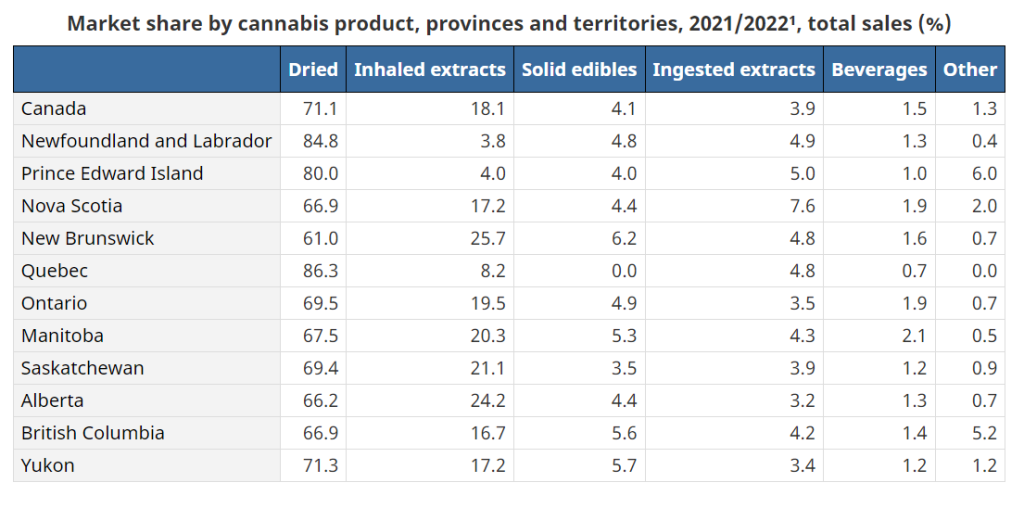
Dried cannabis flower was by far the most popular form of cannabis sold during the specified time frame, accounting for 71.1% of all adult-use cannabis sales in Canada during the calendar year. Inhaled extracts made up 18.1% of overall sales and edibles gained 4.1% of the market share according to the available data. Below is a breakdown of market share by cannabis product, provinces, and territories according to Statistics Canada:

Canada cannabis sales breakdown 2021 2022

The data released by Statistics Canada comes around the same time findings were published from a very insightful survey analysis dealing with reported cannabis consumer spending habits.

According to the study, which was conducted by investigators affiliated with the University of Waterloo School of Public Health, “In 2021, the percentage of consumers sourcing all their products legally in the past 12 months ranged from 49 percent of solid concentrate consumers in 2021 to 82 percent of cannabis drink consumers.”

The growing success of adult-use cannabis legalization in Canada will not only benefit consumers within the nation’s boundaries but also consumers in other jurisdictions where lawmakers are pursuing legalization and keeping a close eye on Canada to see how things continue to develop.