Author: Hazel Norman

Parliamentary Report: Cannabis Reform In NSW Is “Only Rational Course”

A new parliamentary report issued in New South Wales calls for cannabis reform in the Australian state. The 148-page report, which was tabled by the premier and finance committee, called cannabis reform the “only rational course of action.”

“The committee strongly believes that this must not deter the government from pursuing a rational, staged and evidence-based policy that addresses the growing need for legal and regulated cannabis markets,” Legalise Cannabis MP Jeremy Buckingham stated after the report was tabled according to local reporting by Cannabiz.

“The majority of committee members are persuaded that at least initial reforms should be considered by government.” Buckingham also stated.

Currently in New South Wales, cannabis possession without intent to distribute is punishable by up to two years in prison, and ‘gifting’ cannabis is treated as distribution. The tabled parliamentary report recommended that the penalty for possession be reduced to a maximum of three months, or to penalize such activity with only a fine.

Additionally, the report recommended that ‘gifting’ cannabis without consideration should be treated as possession, and that medical cannabis patients should be afforded an affirmative defense when they test positive for THC but do not exhibit signs of intoxication when operating a motor vehicle on public roadways.

In the Australian Capital Territory, where the country’s capital is located, cannabis is already decriminalized and has been since January 2020. Driving while under the influence of cannabis is still prohibited in the territory, as is cannabis commerce and public cannabis consumption.

Cannabis remains prohibited at the federal level in Australia, although medical cannabis is legal in some instances.

UK Government Announces Reforms To Hemp License Regulations

Government officials in the United Kingdom announced this week that regulators are changing hemp licensing regulations in the country. Starting in 2025, hemp license holders in the UK will no longer have to identify a specific area on a farm property where they intend to cultivate hemp. Rather, the farmers can produce hemp anywhere on the licensed farm.

Furthermore, starting in 2026, the maximum period for a hemp production license will be increased from the current 3 years to 6 years. Hemp producers in the UK will also be able to defer the start date of cultivation by up to one year.

“These reforms will bring an important boost to this industry and cut down the unnecessary burdens that have been placed on businesses.” Dame Diana Johnson, Minister for Crime and Policing, said. “This government will always listen and engage with industry experts, and we want to make it easier for licence holders to capitalise on the economic potential of legally growing hemp.”

“These improvements to the licensing regime for industrial hemp are a positive step for farmers.” Daniel Zeichner, Minister for Food Security and Rural Affairs, said. “Recognising that industrial hemp is a field-grown agricultural crop, these reforms will simplify the license application process and provide greater flexibility within the crop rotation, enabling farmers to fully realise the economic and environmental benefits of the crop.”

In other recent hemp industry news in the United Kingdom, a government-appointed advisory panel, the Advisory Council on the Misuse of Drugs (ACMD), recommended that the UK increase the amount of tetrahydrocannabinol (THC) allowed in hemp from 0.2% to 0.3%.

“The ACMD is supportive of the proposed change to increase the maximum THC content of industrial hemp grown outdoors for seed production or in order to use the non-controlled parts of the plant to produce fibre for use in the construction and textile industries from 0.2% to 0.3%, as the potential benefits outweigh an increased risk of harms.” the panel stated.

“The ACMD recommends the Home Office to conduct an assessment of the impact of the legislative change after 2 years. The ACMD foresees no issues with applying the lower fee of £580 to a raised level of THC not exceeding 0.3%, to align with other international examples.” the panel also stated.

According to the United Kingdom government, the number of hemp licenses in the UK increased from six licenses in 2013 to 136 in 2023. A first-time hemp license in the United Kingdom costs £580. Hemp producers who apply for subsequent licenses pay £326, or less than £109 per year.

Turkey Sets Hemp Quota For Medical Products

In 2016, hemp cultivation became legal in 19 provinces in Turkey for industrial purposes. Aspiring hemp producers must obtain the country’s Ministry of Food, Agriculture, and Livestock permission before beginning operations. Hemp product permits are valid for a maximum of three years in Turkey.

Regulators in Turkey recently announced that annual hemp cultivation in the country will be limited to 5,000 square meters and 120,000 plants ‘for the production of pharmaceutical active ingredients.’ Many medical cannabis products around the globe incorporate cannabidiol derived from hemp plants.

“Exempt from these restrictions are universities, research institutes within the Ministry of Agriculture and Forestry, and organizations with research permits, which may conduct scientific and R&D projects without being subject to the quota. The Ministry of Agriculture and Forestry will oversee the allocation of the quota.” stated Daily Sabah in its local reporting.

The modern push to boost Turkey’s emerging hemp industry came in 2019 when Turkey’s president, Recep Tayyip Erdoğan, announced that the country would take steps to increase production. Turkey was experiencing an economic crisis, and increased hemp production for the purpose of medical cannabis product exports was established to try to address the problem.

Turkey has a long history of cannabis and hashish production going back many centuries, and it wasn’t until the 1970s that the country outlawed production due to pressure from the United States.

According to a recent market analysis by Spherical Insights LLP, the global industrial hemp market is projected to be worth an estimated $24.30 billion by 2033.

“The Global Industrial Hemp Market Size is to Grow from USD 5.38 Billion in 2023 to USD 24.30 Billion by 2033, at a Compound Annual Growth Rate (CAGR) of 16.27% during the projected period.” the researchers stated in a press release.

62% Of Canadians Still Approve Of Cannabis Legalization

Canada became the second country on the planet and the first G-7 nation to adopt a national adult-use legalization measure in 2018. The only country to do so before Canada was Uruguay, where lawmakers approved a national adult-use legalization measure in 2013.

However, unlike Uruguay where legal recreational cannabis sales are limited to residents only, Canada permits recreational cannabis sales across the country to anyone of legal age. The legal age for cannabis purchases in Canada at the federal level is 18 years old, although provinces and territories can set a higher age limit.

The recreational cannabis commerce system in Canada is the most robust on earth. In addition to Uruguay and Canada, cannabis is also legal for recreational purposes at a national level in Malta, Luxembourg, Germany, and South Africa. Canada is the only nation on that list that permits nationwide sales to adult non-residents.

Investigators affiliated with Research Co. recently surveyed Canadians to determine the level of support for legalization six years after implementation. The survey results are based on an online survey conducted from October 13 to October 15, 2024, among 1,001 adults in Canada.

“In the online survey of a representative national sample, 62% of Canadians (-2 since a similar Research Co. poll conducted in October 2023) agree with marijuana being legal in Canada, while 33% disagree and 4% are undecided.” Research Co. stated about the results.

“Agreement with legal cannabis in Canada is highest in Quebec (66%), followed by Alberta (64%), Ontario (also 64%), British Columbia (60%), Atlantic Canada (56%) and Saskatchewan and Manitoba (53%).” the researchers also stated.

Research Co. also determined the following:

  • 33% of Canadians report having tried cannabis before it was legal
  • 14% only did so after legalization
  • 51% of consumers report making all of their purchases through licensed retailers
  • 74% support expunging charges for people convicted of possession of cannabis for personal use

Recreational cannabis is currently legal in two dozen states in the U.S. and in Washington D.C. Regional adult-use cannabis commerce pilot trials are operating in the Netherlands and Switzerland, and courts in a handful of other nations have rendered decisions providing some level of protection to adult cannabis consumers.

How Many Countries In Africa Have Legalized Commercial Cannabis Cultivation?

As cannabis policy modernization has spread across the globe, one continent that has experienced a significant amount of reform in recent years is Africa. Currently, the only nation in Africa that has adopted a national adult-use legalization measure is South Africa. However, several other African nations have adopted laws that permit commercial medical cannabis and hemp cultivation.

According to a recent study conducted by researchers from Ukraine and France, and published by the U.S. National Institute of Health, 57 countries have adopted medical cannabis legalization measures.

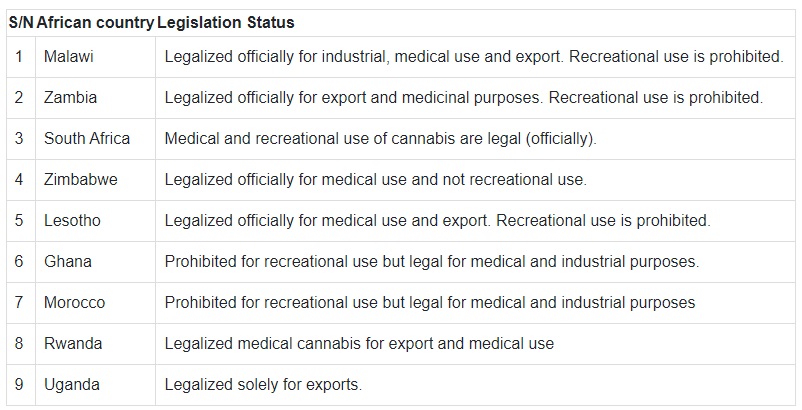
According to a recent report titled “Medical Use of Cannabis in Africa: The Pharmacists’ Perspective” which was published by the National Library of Medicine, nine African countries have adopted laws to regulate commercial cannabis and hemp cultivation, as well as the processing, storage, sales, and/or exports of harvests. Per recent reporting by Business Insider:

africa commercial cannabis cultivation regulation

In addition to the dozens of countries around the world that have adopted medical cannabis legalization measures, Uruguay, Canada, Malta, Luxembourg, and Germany have implemented adult-use legalization measures, as well as South Africa, as previously mentioned in this article.

The legal global cannabis industry is set for significant expansion in the coming years, with a recent report by Skyquest Technology Consulting projecting that the regulated worldwide cannabis market will surpass $148.4 billion in value by 2031.

“Cannabis market was valued at USD 36.4 Billion in 2022 and is poised to grow from USD 42.6 Billion in 2023 to USD 148.4 Billion by 2031, growing at a CAGR of 16.9% during the forecast period (2024-2031).” the market analysts stated.

“Legalization and regulation are among the primary factors contributing to the development of the cannabis market. The market is expanding beyond the capacity of understanding and awareness as an increasing number of countries have legalized cannabis for medical and recreational purposes.” the analysts also stated.

German Survey Finds 80% Would Rather Open A Specialty Cannabis Store

Earlier this year, on April 1, 2024, Germany adopted the historic CanG law that legalized cannabis possession, cultivation, and use by adults. Germany may have not been the first country in Europe to do so, but legalization in Germany is undeniably the most significant cannabis policy modernization victory in Europe’s history.

Due to European Union agreements, legalization in Germany differs in many aspects compared to legalization in the Western Hemisphere. Whereas adult-use cannabis products can be sold nationwide in Uruguay and Canada at retail outlets, legalization in Europe focuses more on boosting public health outcomes and research.

Starting on July 1, 2024, people could start applying to launch German adult-use cannabis cultivation associations. The associations are member-based and are one of the main ways that cannabis can be legally obtained by adults in Germany.

The German Cannabis Business Association (BvCW) recently conducted a poll of its members asking if people in Germany would rather open a cannabis cultivation association or a specialty cannabis store.

“In our non-representative survey, which we shared in our newsletter, we asked from 07.10.2024 – 15.10.2024: “If you had the choice, would you rather set up a cultivation association or open a specialty store or licensed point of sale for cannabis as part of a model project?” BvCW stated in a recent newsletter.

“The respondents voted as follows: 50% definitely wanted a specialist shop/licensed point of sale, 30% rather wanted a specialist shop/licensed point of sale, 10% rather wanted a growers’ association, 5% definitely wanted a growers’ association and 5% partly/partly.” BvCW stated about the results of the survey.

“Thus, over 80% said they rather or definitely wanted to open a specialist shop/licensed point of sale.” BvCW also stated.

In addition to home cultivation and cannabis cultivation associations, Germany’s legalization model will eventually also incorporate regional adult-use cannabis commerce pilot trials, similar to what is already in place in the Netherlands and Switzerland but on a much larger scale.

Unfortunately, until European Union agreements are modernized, nationwide sales at retail outlets like what is in place in Uruguay and Canada will have to wait. With that being said, Germany will continue to lead the charge to achieve such policy modernization at the continental level, and a more robust commerce system will no doubt be permitted in Germany in the future.

EU Court Of Justice Approves Indoor Hemp Cultivation

Humans have cultivated hemp under the sun for centuries, making use of their hemp harvests in several ways from making rope to paper to textiles. In recent years, the hemp plant has become the focus of significant research aimed at developing medications and other therapies.

Additionally, consumable hemp products have risen in popularity and availability across the globe thanks to regulatory changes and product innovations. ‘Floral hemp’ or ‘cannabis light’ products are particularly popular on the European continent.

How hemp is cultivated has evolved in recent decades. While hemp is still cultivated in large fields under the sun, many cultivators are growing hemp indoors under artificial lighting and incorporating cutting-edge techniques. According to a recent decision by the European Union Court of Justice, indoor hemp cultivation using hydroponics is permitted. Per excerpts from reporting by EU News:

According to the EU Court of Justice, member states cannot ban hemp cultivation in indoor hydroponic systems. The only limitation is respect for public health, that is, compliance with the legal limit of THC not exceeding 0.2 per cent.

According to the Court’s findings, hydroponic cultivation increases agricultural productivity, develops technical progress, and ensures better use of inputs. In addition, it ensures the security of supply, as it is not subjected to direct weathering, and reasonable prices to the consumer. Not allowing hemp farmers to benefit from the CAP with this innovative technique would cause significant economic damage (taking into account that the criteria for receiving funding are strict and well-defined at the European level to avoid illicit cultivation).

Hemp policy in the European Union remains hazy, with many regulations either involving a lot of grey areas, or nation-level regulations conflicting with EU-level policies and regulations. The current situation creates a lot of uncertainty for entrepreneurs, investors, and consumers.

The European Union is not the only jurisdiction to struggle with modernizing its hemp policies and regulations. Every other continent is also struggling to create sensible hemp policies and regulations as the global hemp market continues to evolve.

Spain’s Ministry Of Health Publishes Medical Cannabis Draft Royal Decree

The road to properly regulated medical cannabis in Spain has been long and full of twists and turns. However, the effort to bring Spain’s medical cannabis policies into the modern age passed a major milestone with the nation’s Ministry of Health publishing a draft royal decree focused on medical cannabis.

“After three years of delays, Spain’s Ministry of Health published on Monday 30 September the draft royal decree to allow the prescription of cannabis preparations, a text that will now be submitted for hearing and information before its final approval.” reported Sur in its domestic coverage.

“The draft establishes broad restrictions on the medical use of cannabis and specifies very specifically the pathologies for which it can be used: multiple sclerosis (stiffness and muscle spasms associated with the condition); severe forms of refractory epilepsy (certain types of epilepsy that do not respond to conventional treatments); nausea and vomiting caused by chemotherapy; and refractory chronic pain (persistent pain that is not relieved by the usual treatments). In all these cases, experts believe that there is “scientific evidence” of the benefits of medical cannabis.” the media outlet also reported.

Back in February 2024, Spain started the process of crafting the draft royal decree that was recently published. As we reported at the time, before a royal decree is officially issued, the public is afforded the opportunity to provide input, with Spain’s government having previously set up an email address dedicated to receiving such input (normativa.aemps@aemps.es).

“The Ministry addresses this regulation based on the conclusions of the Subcommittee of the Congress of Deputies for the analysis of experiences with the regulation of cannabis for medicinal use, which called on the Spanish Agency for Medicines and Health Products to prepare a roadmap to approve the regulation.” Spain’s government stated in a press release (translated from Spanish to English) at the time.

“The proposed regulation guarantees the quality of the products and the safety of patients, enabling the legal avenues available to have therapeutic compounds based on standardized cannabis preparations that have shown evidence in relieving pain and the suffering of patients, considering the oral administration of these compounds as it is the most appropriate in terms of therapeutic effectiveness and safety for patients.” the government’s press release stated.

“This regulation is designed to evolve dynamically, allowing new elements to be incorporated as more information and the experience of the therapeutic cannabis program becomes available. In addition, it will contribute to generating more and better evidence on the use of cannabinoids for therapeutic purposes.” Spain’s government also stated.

Despite the lack of proper regulations in Spain, the nation’s cannabis industry is thriving, albeit not within a regulated system. Suffering patients deserve to have safe access to safe medical cannabis therapies, and entrepreneurs and investors deserve to operate in a business environment that is built on a strong foundation of certainty.

CBD Nutraceuticals Market Projected To Be Worth $29.1 Billion By 2030

The emerging cannabidiol (CBD) nutraceuticals sector is expected to experience tremendous growth through the remainder of this decade, with a recent report by Research and Markets projecting that the CBD nutraceuticals market alone will be worth an estimated $29.1 billion by 2030. The market analysis estimates that the CBD nutraceuticals market is worth $9.7 billion in 2024.

“Worldwide, the market for CBD Nutraceuticals is poised to record an above-average growth over the analysis period, the crucial reasons for which are the increase in demand for plant-based foods, growing awareness concerning benefits of CBD nutraceuticals, innovative products in the pipeline and CBD nutraceuticals in capsule & softgel forms undergoing further advancements.” the researchers stated in their analysis.

“North America represents the primary global market for CBD Nutraceuticals, the reasons for which include introduction of the 2018 Farm Bill that legalized hemp cultivation and processing of hemp-derived products, demand from consumers after getting to know the benefits of CBD-based Nutraceuticals, major companies active in the region and a significant rise in geriatric population.” Research and Markets stated.

“Asia-Pacific, though, is anticipated to be the fastest growing global region for CBD Nutraceuticals, factors for which comprise entry of leading global players, an increase in lifestyle-associated diseases & other health disorders and greater knowledge pertaining to healthier eating routines.” the market researchers also stated.

“CBD Oils account for the largest share, as they have great versatility in being used in a range of applications, such as capsules, tinctures and cosmetics. However, the global demand for CBD Isolates is likely to maintain the fastest growth, since these are considered to offer high purity, making them ideal as CBD formulations in products that need exact concentrations of CBD.” the researchers stated about subsectors of the market.

“A high demand has been evident for CBD Tinctures, since they widely utilized in treating insomnia, cancer cell growth, seizures, anxiety, depression and chronic pain, as well as hyperglycemia, muscle spasms, psychosis and bone degeneration. However, the demand for CBD Capsules & Softgels is expected to exhibit the fastest growth over the analysis period, since they are more convenient to consume and are also travel-friendly.” the researchers concluded.

A previous market analysis conducted by Market Research Future estimated that the global CBD industry was worth $18.43 billion in 2023 and that the market would reach a projected $59.43 billion by 2030.