Author: Johnny Green

London Mayor Supports Commission’s Recommendation To Decriminalize Cannabis

In 2022, London Mayor Sadiq Khan established the independent London Drugs Commission (LDC), tasking the Commission with examining cannabis policies in England’s capital city and other jurisdictions. The commission recently published its findings and recommended that personal cannabis possession be decriminalized, a recommendation that Mayor Khan reportedly supports.

“The report follows detailed analysis of written and oral evidence from over 200 experts and academics from London, the UK and around the world. Lord Falconer and his Deputies were assisted by leading experts from criminal justice, public health, community relations and drug policy and supported by academics from University College London (UCL).” The London Drugs Commission stated about its methodology.

“Inclusion of cannabis as a Class B drug in the Misuse of Drugs Act is disproportionate to the harms it can pose relative to other drugs controlled by the Act. The sentencing options currently available, especially for personal possession, cannot be justified when balanced against the longer-term impacts of experience of the justice system, including stop and search, or of serving a criminal sentence can have on a person.” The Commission stated about its report.

“Sir Sadiq Khan said current rules “cannot be justified”, adding that the commission’s findings had provided “a compelling, evidence-based case” for decriminalisation.” reported BBC in its local coverage.

The outlet also pointed out that the Commission recommended supporting “fair access to medical cannabis, including addressing cost barriers and expanding research.” The cannabis policy modernization recommendations are not supported by the Metropolitan Police Commissioner, who stated that cannabis reform is “a matter for parliament” and his officers would “keep working to our current law.”

Adult-use cannabis legalization in the United Kingdom could generate as much as £1.5 billion in revenue and savings, according to a previous report by the advocacy group Transform Drug Policy Foundation.

The report, which was posted on the organization’s social media account back in March, determined that over £1.2 billion would be generated from taxes and fees annually, and an additional £284 million would be saved annually by the nation’s criminal justice system no longer enforcing cannabis prohibition policies.

“There would be costs incurred for Govt by regulatory infrastructure – inspection, monitoring, compliance, trading standards etc – but largely covered by licensing/other fees.” the organization stated on social media.

Transform Drug Policy Foundation also determined that “up to 15,500 full-time jobs could be created in cultivation, manufacturing, retail & related services, (depending on the model implemented).”

The report also found that “a regulated market could displace 80% of the illegal trade in five years (based on trends in Canada).” The organization’s proposed legalization model involves permitting home cultivation, cultivation associations, and a government retail monopoly.

A separate analysis published last year by UK-based advocacy group CLEAR determined that legalizing cannabis for adult use in the United Kingdom and taxing and regulating sales could generate as much as £9.5 billion per year based on their proposed model.

According to a poll conducted by YouGov UK, the level of support for cannabis legalization among adults in the United Kingdom is greater than the level of support for adult-use legalization among lawmakers.

“The results show that 50% of MPs are opposed to cannabis legalisation when asked in a support/oppose format, compared to 39% who would be in support.” YouGov UK stated about their poll’s results. “The large majority of MPs do, however, believe that doctors should be allowed to prescribe cannabis for medical use (83%). Only 7% are opposed.”

“On the binary question of legalising cannabis, the British public are split, with 45% in favour and 42% opposed, making the public slightly more pro-legalisation than MPs.” YouGov UK also stated about the poll results.

German Medical Cannabis Imports Increased Over 457% In One Year

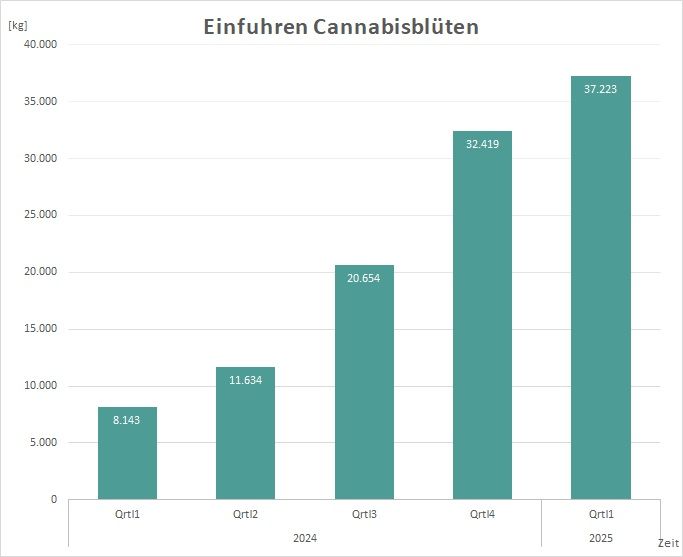
Germany’s legal medical cannabis industry continues to expand at a staggering rate, as demonstrated by new medical cannabis import numbers. In the first quarter of 2025, Germany imported over 37.223 metric tonnes of medical cannabis products.

To put that figure into perspective, the total imports for Q1 2025 increased by roughly 14.8% compared to the Q4 2024 total (32.419 metric tonnes), which was itself a record at the time. Q1 2025’s import total is an increase of over 457% compared to the same period one year ago. Germany imported 8.143 metric tonnes of medical cannabis products in Q1 2024.

Alfredo Pascual, CFA, Executive Director at Seed Innovations Ltd (LON: SEED), posted the updated statistics on his LinkedIn page earlier today:

germany medical cannabis imports q1 2025

The updated import numbers bring the total amount of legally imported medical cannabis products to Germany during the last 12 months to 101.9 metric tonnes. Demand for medical cannabis continues to increase in Germany, with no slowdown currently in sight.

“A conservative projection, assuming Q1 2025 levels persist through Q2-Q4, would result in ~150 tonnes imported for the full year. However, given the consistent strong quarterly growth observed recently, the actual CY 2025 import volume could be significantly higher.” wrote Alfredo Pascual in his social media post.

“The primary downside risk is the ongoing political discussion in Germany regarding potential restrictions on online medical cannabis prescriptions, which could influence patient access and market development.” Pascual also wrote.

Canada remained the top source for imported medical cannabis products to Germany at 16.1 tonnes during Q1 2025. Portugal was the second leading source for medical cannabis imports during that timeframe at 12.1 tonnes, and Denmark was third at 2.6 tonnes.

Cannabis And Hemp Tourism Is A Growth Engine

The concept of people traveling to faraway destinations to enjoy consuming food and wine is not a new thing. Television shows are dedicated to the activity, and massive subsectors of the tourism industry are built around the concept. The same is proving to be true for cannabis and hemp tourism at an increasing rate.

A multi-year survey conducted by MMGY Travel Intelligence discovered that the cannabis travel audience in the United States alone includes roughly 72 million Americans, or 37% of the active leisure travel audience in the United States.

“Half of these interested travelers would consider visiting a cannabis shop, and a quarter of them are not regular cannabis users but are open to such experiences while traveling.” reported Travel Age West about the survey results.

In 2023, inbound tourism spending in Europe was an estimated 645 billion euros. At the intersection of these industries – cannabis, hemp, and travel – are opportunities for growth and creative differentiation.

Medical tourism, leisure travel, events, and business travel, including group meetings and conferences, are all part of it. Cannabis travel expert Brian Applegarth of Applegarth Strategies recently moderated a panel dedicated to cannabis and hemp tourism at the International Cannabis Business Conference in Berlin. Mr. Applegarth was joined by:

  • Mara Gordon – Co-Founder, Aunt Zelda’s, Octopi Wellness, Zelira Therapeutics
  • Jim Zielinski – General Manager, The Bulldog Hotel
  • Cristina Sánchez – Full Professor of Biochemistry and Molecular Biology at Complutense University
  • Ivan Ross Vrána – Managing Partner, Diplomat Consulting
  • Teddy Cabugos – President, Director, Sunstone Winery

Click here to watch a video of the ninety-minute presentation and panel discussion unpacking the tourism opportunities for cannabis and hemp businesses and brands in the European market.

Australian Study: Far-Red Light Use May Increase Cannabis Yields

Cannabis cultivation has become more sophisticated in recent years due to various factors. One major factor is advancements in cultivation technology, including climate control, lighting, and feeding technology, to name a few areas.

Another contributing factor is sheer necessity born out of modern cultivation and harvest policies and regulations. Many jurisdictions around the world require cannabis to be cultivated outside of public view, and in some cases, in locked indoor facilities.

Several jurisdictions, particularly European markets, have end-product standards that make outdoor cultivation difficult from a product compliance standpoint. Cannabis products to be sold in regulated European markets must be GMP compliant, and that is a hard threshold to meet when the raw cannabis inputs for products are cultivated completely outdoors.

A team of researchers affiliated with the New South Wales Department of Primary Industries and Regional Development and Southern Cross University in Australia recently examined the use of far-red light technology and cannabis cultivation to see how far-red light affects plant yields. The study’s findings were published in the academic journal Scientific Reports.

“Far-red (FR) light elicits two distinct processes in plants. First, a shade avoidance response which is triggered when the ratio of red to FR (R: FR) declines. Second, it interacts synergistically with higher frequency wavelengths of light (e.g. red or white) which improves the efficiency of photosynthesis.” the researchers wrote.

“We investigated whether we could harness these phenomena in medicinal Cannabis to improve yields so that the duration of the photoperiod could be reduced to 10 h (“10L”) whilst returning similar or improved yields compared to a 12 h photoperiod (“12L”).” the researchers also wrote.

Energy consumption is an increasing concern for the emerging global cannabis industry from a sustainability standpoint. It is also a financial concern for legal cannabis producers being as the cost of energy is rising around the world. With that in mind, reducing photoperiod time while maintaining, or even better increasing, overall yield is significant.

“The THC concentrations were elevated in both high THC varieties by the different FR treatments. In Hindu Kush the concentration of THC was elevated by the addition of 4 h of total FR (“10L_2_2D”), and in Northern Lights total cannabinoid yields were increased by nearly 70% over the 12 L control (0.43 versus 0.25 g Plant− 1) by the addition of 2 h of FR in darkness after 10 h of light (“10L_2D”).” the researchers determined.

“Our results show a strong yield and quality advantage in high THC lines treated with end-of-day FR treatments. Furthermore, a lighting schedule of 10L_2D instead of 12 L would result in a saving of 5.5% in power usage and resultant emissions.” the researchers concluded.

It is worth noting that this study was fairly limited in size and scope, and that further research needs to be performed before there is a final answer regarding the benefits of incorporating far-red light into cultivation strategies. However, the results of this study are still insightful and give producers things to consider.

A Reversal Of German Cannabis Legalization Is “Off The Table”

The German Cannabis Industry Association (BvCW) recently held a parliamentary evening event, at which current German Bundestag member Carmen Wegge appeared and spoke. Ms. Wegge is a German politician of the Social Democratic Party (SDP) who has served in the Bundestag since 2021. At the event, Ms. Wegge reportedly indicated that abolition of the CanG law is “off the table.”

“At yesterday’s parliamentary evening of the German Cannabis Industry Association (BvCW), Carmen Wegge promised those present that the Cannabis Act would not be repealed. In return, she hoped for improvements in the right direction.” wrote Moritz Förster for Krautinvest (translated from German to English).

“Wegge emphasizes that the SPD “tirelessly” defended the Cannabis Act during the coalition negotiations. She also points to the improvements that have already been made, for example, in terms of prevention, economic development, and greater justice.” Förster stated in his original reporting.

Ms. Wegge’s comments are similar to those made by leading German cannabis policy expert attorney Peter Homberg of gunnercooke at the recent International Cannabis Business Conference in Berlin last month.

“Attorney Homberg predicts that the reversal of partial legalization and thus of the previous measures of the traffic light coalition is unlikely. The effort involved in completely reversing the partial legalization of cannabis and reclassifying cannabis as a narcotic is far too great.” reported Pharmazeutische Zeitung about Mr. Homberg’s presentation at the conference in Berlin.

“And of course, you would need a clear majority, not only in Parliament, but also in the Federal Council.” Homberg stated about a potential reversal. “It’s very difficult to put the genie back in the bottle. Who’s going to monitor this now?”

Leading up to the last German federal election, domestic politicians opposed to modernized cannabis policies expressed a strong desire to completely reverse the CanG legalization measure. However, last month, the new governing coalition announced that, at least for the time being, there would be no changes made to Germany’s cannabis policies, and the CanG law would remain in place as is.

Part of the statements made by the governing coalition last month did involve the announcement of future evaluations, which will occur as part of the coalition agreement. The new governing coalition is expected to revisit the topic when the results of ongoing evaluations become available in Q4 2025.

A complete reversal of the German CanG law is not a popular proposal among German voters. A recent YouGov poll found that a minority (38%) of the nation’s citizens support reversing German adult-use cannabis legalization.

Additionally, according to the results of a Forsa survey commissioned by the KKH Kaufmännische Krankenkasse, 55% of surveyed Germans do not want to repeal the nation’s CanG adult-use legalization law. Only 36% of the Forsa survey respondents indicated that they want to repeal legalization, with the rest being undecided.

Various German organizations have also expressed opposition to a CanG reversal. The New Association of Judges (NRV) in Germany previously expressed a positive conclusion regarding legalization and warned newly elected German lawmakers against reversing the CanG law.

“Rolling back the law would mean that the judiciary would have to pursue small consumers on a large scale again. This would mean there would be no time to take action against organized crime.” reported Deutschlandfunk in its local coverage.

“In addition, according to the NRV, the state faces high compensation payments in the event of withdrawal. If the cultivation and consumption of cannabis were to be completely banned again, this would amount to expropriation of the cannabis clubs, it was said. This would enable the clubs to make claims for compensation against the state. The investment in cannabis cultivation is high and the licenses are valid for seven years according to the law.” the outlet also stated.

The Institute for Competition Economics at the Heinrich Heine University in Düsseldorf previously conducted an analysis, finding that adult-use legalization could yield as much as 1.3 billion euros per year in savings for Germany’s police and judicial system.

German pharmacist Florian Sedlmeier and other members of Germany’s pharmacy industry also publicly pushed back on the effort by cannabis opponents in Germany to reclassify cannabis as a narcotic drug in the European nation.

“Pharmacist Florian Sedlmeier warns against reclassifying medicinal cannabis as a narcotic drug (BtM). Such a step would increase the bureaucratic burden and make it more difficult to provide patients with rapid care, ” stated the German Cannabis Business Association (BvCW) in a recent newsletter, citing an article from apotheke-adhoc. “He considers the concern expressed by SPD Health Minister Clemens Hoch that medicinal cannabis can be ordered too easily online to be understandable, but stresses that pharmacies carefully check prescriptions and licenses.”

The German Medical Cannabis Industry Is The Main European Market Driver

Germany first legalized medical cannabis in 2017, and its distribution model involves permitting legal sales at registered pharmacies. Germany’s medical cannabis industry has become the largest legal market in Europe, boosting the nation’s pharmacy sector in the process. Since the launch of initial sales, safe access to medical cannabis via Germany’s pharmacies has increased dramatically, as demonstrated by statistics that were included in a recent newsletter by the German Cannabis Business Association (BvCW).

“Patients can order cannabis online with a private prescription and have it delivered to their home. Nationwide, around 2,500 of the 17,000 pharmacies now offer medical cannabis,” BvCW stated (translated from German to English). “The industry’s revenue is now estimated at around half a billion euros.”

A major contributing factor to Germany’s recent medical cannabis industry growth was the enactment of the CanG law in April 2024, which removed cannabis from the nation’s Narcotics List. The rise of telemedicine has also contributed to the medical cannabis industry’s growth in Germany. A recent newsletter by leading international cannabis economist Beau Whitney, founder of Whitney Economics, provides some reliable market data regarding the current estimated number of medical cannabis patients in Germany.

“There has been a consistent number of between 200k – 300k medical patients.” Beau Whitney writes. “As a result of this new innovation, there is now an additional 500k – 600k self-paying consumers participating in the legal market.”

“When combined with 100k cultivation association members, there is approximately 800k legal consumers in the German market right now. For perspective, 800k consumers represents between 10% and 20% of the total market, while the supply and capacity at the end of 2024 represented nearly 15% of all of the supply that the market needs.” Whitney stated.

At the recent International Cannabis Business Conference in Berlin, a team of experts from Germany’s emerging medical cannabis industry examined how the nation’s medical market is the main overall market driver in Europe. The panel was moderated by Canadian medical cannabis pioneer Alex Revich and included:

  • Torsten Greif, CEO, Four 20 Pharma
  • Benedikt Sons, Co-Founder and CEO, Cansativa Group
  • Matthias Fischer, Founder and Managing Director, Canymed, CCO, Grünhorn
  • Dr. rer. nat. Adrian Fischer, Physician and Natural Scientist, Co-Founder and Managing Director, DEMECAN

Click here to watch a video of the panel discussion.

Hemp Fiber May Be A Viable Cotton-Compatible Textile Input

The hemp fiber industry holds tremendous economic potential. According to a recent market projection by MarkNtel Advisors, “the global hemp fiber market stood at USD 11 billion in 2024 and is projected to reach USD 36 billion by 2030, growing at a CAGR of 22%.”

“The surge in hemp fiber adoption reflects broader shifts in consumer behavior, policy frameworks, and material science innovation. Hemp’s fast growth rate, minimal pesticide requirements, and carbon sequestration properties are positioning it as a bio-based solution for climate-conscious industries.” MarkNtel Advisors stated.

One logistical issue that is holding the hemp fiber sector back, to some degree, is limited infrastructure. In the wider textile industry, hemp is largely seen as a niche material input requiring specialized machinery to create end products. However, a recent study is providing new insight into hemp’s potential as a cotton-compatible textile input.

A team of researchers affiliated with Universitat Politècnica de Catalunya-BarcelonaTech (Spain) and Dresden University of Technology (Germany) recently conducted a study examining non-textile hemp by using mechanical-chemical cottonization. The results of the study were published in the academic journal Cellulose.

“The raw material used was an agricultural residue that is mainly employed for paper manufacturing. These fibers were subjected to an alkaline chemical treatment followed by an oxidizing treatment (H2O2) to reduce non-cellulosic components.” the researchers stated about their methodology. “Subsequently, a mechanical process was carried out to increase fiber elementarization and obtain suitable slivers for spinning.”

“The potential of open-end rotor spinning was evaluated for both the 100% treated hemp and blends of 25% hemp/75% cotton. The selection criteria included a low reduction of the degree of cellulose polymerization, a low mass loss during the process, an appropriate tensile strength of the resulting yarns, an absence of breakage during spinning, and a low twist.” the researchers also wrote.

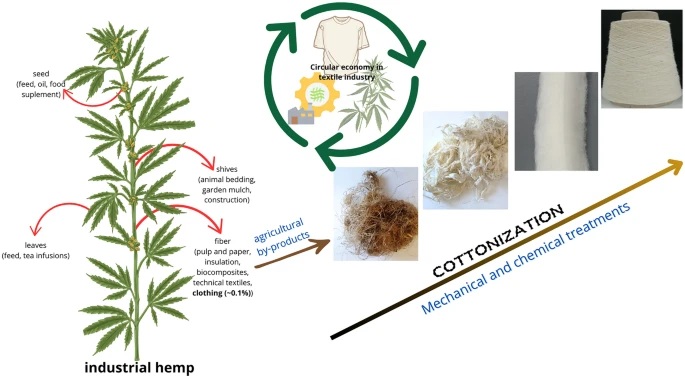
Below is a graphical abstract provided in the researchers’ article listed on Springer Nature:

industrial hemp cottonization mechanical and chemical treatments

“The hemp treated with a high level of H2O2 stabilizer, according to the established experimental design for the oxidizing process, exhibited superior performance when blended with cotton and spun with a count of 40 tex and a twist coefficient (αm) of 170. These outcomes are of industrial interest for the production of fine yarns because they can be easily implemented using existing machinery devoted to processing cotton.” the researchers determined.

“Furthermore, it contributes to the circular economy within the textile industry by adding value to a waste material that can serve as an alternative source of more environmentally friendly cellulosic fibers.” the researchers concluded.

The results of this recent study come at a time when Europe’s industrial hemp industry potential is being researched at an increasing rate. For example, a team of researchers affiliated with the University of Göttingen recently examined industrial hemp from the perspective of its prospects as a sustainable crop for modern agriculture in Germany.

“Industrial hemp offers promising prospects for agriculture. Its ecological advantages, such as improved soil structure and CO2 sequestration, as well as the economic potential offered by dual-use land and low or no need for pesticides, make it a sustainable addition to crop rotation.” the researchers concluded. “With the right strategy, industrial hemp can make a valuable contribution to sustainable agriculture, especially when economies of scale, stable sales contracts, and effective integration into crop rotation systems are considered.”

The University of Göttingen’s findings built on other recent hemp-focused sustainability research, including a study led by researchers affiliated with the University of Banja Luka, the University of Belgrade, and the University of Niš, which found that raw hemp can be used as an effective and eco-friendly alternative for removing toxic dye chemicals from wastewater.

During a recent presentation at the International Cannabis Business Conference in Berlin, leading international cannabis industry economist Beau Whitney, founder of Whitney Economics, provided data demonstrating that the value of the global industrial hemp industry could be as much as $456.2 billion.

Excitement Level In Berlin Demonstrates Surging Interest In The Global Industry

On April 29th-30th, 2025, the International Cannabis Business Conference held its flagship event at the Estrel Berlin, Germany’s largest hotel and conference center. The event was nothing short of electric, and it was the conference’s biggest and best event to date.

Interest in the emerging global cannabis industry, particularly in Germany and Europe, is experiencing exponential growth right now, and that was evident throughout the two-day conference in Berlin. Roughly 5,000 people attended the conference, with over 80 countries and every major legal market represented. Click here to see an after-movie video of the conference.

One readily apparent fact at the conference was that Europe has now become the top focus of industry members across the world, particularly for industry members wanting to gain a meaningful footprint in Germany’s market. As leading European policy and legal expert Peter Homberg of gunnercooke pointed out in his keynote presentation, imports of medical cannabis products to Germany nearly quadrupled in the last quarter of 2024 compared to the first quarter.

The expansion of Germany’s legal industry in recent years was accelerated in April 2024 with the adoption of the nation’s CanG law, which legalized personal cannabis cultivation, possession, and consumption by adults. The CanG law also permits adult-use cannabis associations to operate, with 211 associations having already received approval.

Arguably, the most significant component of Germany’s CanG law was the removal of cannabis from the nation’s Narcotics List. The declassification of cannabis dramatically improved Germany’s medical cannabis industry. Germany’s medical cannabis patient base is increasing in size with every passing day, as proven by the fact that more than 1 out of every 7 of the nation’s pharmacies now sell medical cannabis products.

A common theme throughout the Berlin conference was the parallels and interplay of the Western Hemisphere’s legal markets and Europe’s emerging markets. What Europe is currently experiencing is reminiscent in various ways of what happened in North America starting in 2012 with the initial adoption of state-level legalization in the U.S. The ‘green rush’ in the U.S. and Canada provides lessons that entrepreneurs, investors, policymakers, and industry service providers in the Eastern Hemisphere can learn from.

Kicking off the conference was a keynote presentation by Charlie Bachtell, CEO and Founder of Cresco Labs. Charlie Bachtell has served as Cresco Labs’ [CSE:CL] Chief Executive Officer since February 2015 after co-founding the company in 2013. Cresco Labs operates in several U.S. markets, and the insight that Mr. Bachtell provided in his presentation was invaluable for attendees.

Following Bachtell’s presentation was a keynote address by gunnercooke’s Peter Homberg. Mr. Homberg examined the current state of Germany’s industry and political landscape, including the fresh announcement of the appointments of incoming German Minister of Health Nina Warken and Federal Ministry of Food and Agriculture Alois Rainer. Both incoming ministers will play a major role in shaping what happens next for Germany’s emerging industry, and with it, the wider European cannabis economy. Mr. Homberg’s thorough presentation on day 1 of the conference in Berlin could not have been more timely.

Another timely presentation was a panel discussion focusing on European pilot projects. Pilot projects are currently operating in the Netherlands and Switzerland and are also part of Germany’s legalization model. The panel was moderated by German policy expert Kai-Friedrich Niermann, Founder of KFN+ Law Office. Joining Mr. Niermann was:

  • Paul-Lukas Good, President, Swiss Cannabis Research Association
  • Daniel S. Hübner, Senior Science Manager, Cannabis Research Lab Humboldt-Universität zu Berlin
  • Finn A. Hänsel, Managing Director, Sanity Group
  • Deepak Anand, Principal, ASDA Consultancy Services

Current European Union agreements prohibit national commerce models like those found in the Western Hemisphere. However, EU agreements do permit regional adult-use cannabis commerce pilot trials for public health research purposes, and the panel of leading experts analyzed current and future European pilot trials.

The next panel, moderated by Jamie Pearson, President of New Holland Group, focused on investing in the evolving global cannabis industry. Ms. Pearson was joined on the panel by:

  • Raj Grover, CEO, High Tide Inc.
  • Will Muecke, Co-Founder, Artemis Growth Partners
  • George Bellow, Co-Founder, SOMAÍ Pharmaceuticals
  • David Hyde, CEO, Hyde Advisory & Investments Inc.
  • Margaret Brodie, CEO, Rubicon Organics

Effectively investing in the emerging global cannabis industry is more complex than ever, and the panel’s insights were invaluable. Additional day 1 panels and presentations included such topics as:

  • Medical cannabis in Germany
  • Germany’s evolving cannabis industry
  • Advanced cultivation technologies
  • The latest trends and innovations in cannabis logistics
  • German cannabis industry data
  • Establishing international brands
  • Unlocking new markets
  • Cannabis research
  • The evolving industrial hemp industry

The first day of the conference’s curriculum was followed by an intimate VIP after-party headlined by none other than cannabis industry and culture icon DJ Muggs of Cypress Hill and Soul Assassins. International Cannabis Business Conference events are known for combining industry, policy, and entertainment, and the 2025 event in Berlin was no exception. DJ Muggs put on a show for the VIP crowd that will be talked about for years to come.

Day 2 of the Berlin conference started with a keynote presentation by Dr. jur. Can Ansay, CEO of DR. ANSAY LTD. Dr. Ansay is a notable figure in Germany’s medical cannabis sector and the founder of the popular telemedicine platform DrAnsay.com. He examined safe access to medical cannabis in Germany and discussed changes and trends in Europe’s largest medical cannabis market.

Following the day 2 keynote address, the following topics were discussed at length by panels of leading experts:

  • Forming strategic partnerships
  • Industry compliance strategies
  • Cannabis and hemp tourism
  • Genetics
  • Opportunities in emerging markets
  • Compliant cannabinoid importation in Japan’s evolving market
  • Evolving consumer preferences
  • Digital innovation, programmed automation, and virtual trends
  • Cannabis extraction
  • GMP compliance
  • Cannabis packaging

The International Cannabis Business Conference has served as the top gathering place for the emerging global cannabis industry for over a decade, with events being held in several countries on multiple continents. The Berlin installment is the largest cannabis B2B event in the Eastern Hemisphere, and will continue to provide the best opportunity for members of the worldwide cannabis industry to learn, network, and explore potentially lucrative collaborations.

To find out more about upcoming International Cannabis Business Conference events, go to: Internationalcbc.com

Thailand Health Minister: ‘Cannabis Users Will Need Medical Certificates’

In recent years, Thailand’s cannabis industry has increased in size and scope thanks to a cannabis policy change in 2022. However, Thailand’s Health Minister Somsak Thepsutin stated at a press conference today that the nation’s government is likely to implement new regulations soon, including requiring cannabis retailers to limit sales to customers who have a medical prescription.

“Public Health Minister Somsak Thepsutin says cannabis users in Thailand will be required to have medical certificates to make sure that the plant is used for medical purposes only.” reported Bangkok Post in its local coverage.

“I will improve regulations on cannabis use in Thailand. For example, cannabis smokers may have to show medical certificates. Foreign and Thai cannabis users must have medical certificates,” Minister Somsak said, according to the media outlet.

Starting in 1979, cannabis was scheduled as a class-5 narcotic under Thailand’s Narcotic Act. The Act prohibited smoking, possessing, and selling cannabis. Thailand later legalized medical cannabis in 2019, and in 2022, Minister of Public Health Anutin Charnvirakul issued a ministerial regulation removing cannabis from Thailand’s list of narcotic drugs.

Thailand’s historic cannabis policy shift in 2022 was supposed to pave the way for the nation’s emerging cannabis industry to become a regional and international powerhouse, and to some degree, that is what happened.

At one point, every household in the entire country could sign up to legally cultivate low-THC cannabis plants, which a reported 1.1 million citizens of Thailand did. Public Health Minister Charnvirakul indicated that there would be no plant limit for the government’s cannabis cultivation program. Thailand’s government also gave away over 1 million cannabis seeds directly to households that signed up for the program.

broad spectrum of government agencies in Thailand agreed to do their part to push Thailand’s emerging cannabis industry forward after the 2022 policy change. But that was under the previous government. Thailand’s new government has taken a much different position on cannabis policy.

The ruling Pheu Thai Party has pushed to recriminalize cannabis in Thailand since it took power, although the push has faced opposition from its coalition partner. Changes to Thailand’s cannabis policies have seemingly been announced multiple times over the last year, but actual changes have yet to occur. Only time will tell what happens next, and with it, how Thailand’s emerging industry will be impacted.