Author: Johnny Green

Cannabis DUI Laws Must Be Based On Science, Not Political Fearmongering

If there is one area of public policy that cannabis opponents and responsible cannabis advocates can agree on, at least at a macro level, it is that people should not operate a motor vehicle on a public roadway when impaired by cannabis use. Public roadways should remain safe at all times, and that extends to all forms of substance impairment, not just cannabis.

Unfortunately, cannabis opponents and advocates diverge when it comes to the details of what driving under the influence (DUI) of cannabis enforcement should entail. Cannabis opponents typically fall into one of two cannabis DUI enforcement camps.

The first is a zero-tolerance approach in which any amount of tetrahydrocannabinol (THC) in a person’s system results in a penalty, including THC that entered the person’s system weeks or months ago and has long since metabolized.

A second approach that is called for, both by opponents and policymakers who do not have a solid understanding of cannabis, is to have a per se limit. Per se limits involve a set threshold similar to what is in place for alcohol. Using the United States as an example, the per se threshold for alcohol is a .08 blood alcohol level. If someone is found to be above that threshold, they are automatically charged with a DUI.

Both of the previously mentioned approaches to cannabis DUI enforcement are flawed for multiple reasons due to what cannabis impairment involves and how human biology works as it pertains to cannabis consumption. Implementing either model is bad for consumers, taxpayers, and ultimately bad for governments, including members of law enforcement and courts who have to oversee the flawed approaches to cannabis DUI enforcement.

The obvious goal when it comes to effective cannabis DUI enforcement is to deter impaired drivers from operating a motor vehicle on public roadways and to penalize truly impaired people. Lawmakers must recognize that there is no one-size-fits-all answer to ‘how long is someone impaired after using cannabis’ and implement laws and rules that calculate for that fact.

In 2021, a team of researchers affiliated with the Lambert Initiative for Cannabinoid Therapeutics at the University of Sydney (among others) conducted a comprehensive analysis involving 80 scientific studies to identify the ‘window of impairment’ for cannabis. The researchers’ findings were published in the academic journal Neuroscience & Biobehavioral Reviews.

“The increasing legal availability of cannabis has important implications for road safety. This systematic review characterised the acute effects of Δ9-THC on driving performance and driving-related cognitive skills, with a particular focus on the duration of Δ9-THC-induced impairment. Eighty publications and 1534 outcomes were reviewed.” the investigators stated about their research.

“Several measures of driving performance and driving-related cognitive skills (e.g. lateral control, tracking, divided attention) demonstrated impairment in meta-analyses of “peak” Δ9-THC effects (p’s<0.05). Multiple meta-regression analyses further found that regular cannabis users experianced less impairment than ‘other’ (mostly occasional) cannabis users (p = 0.003) and that the magnitude of oral (n = 243 effect estimates [EE]) and inhaled (n = 481 EEs) Δ9-THC-induced impairment depended on various factors (dose, post-treatment time interval, the performance domain (skill) assessed) in other cannabis users (p’s<0.05).” the researchers also stated.

“The latter model predicted that most driving-related cognitive skills would ‘recover’ (Hedges’ g=–0.25) within ∼5-hs (and almost all within ∼7-hs) of inhaling 20 mg of Δ9-THC; oral Δ9-THC-induced impairment may take longer to subside. These results suggest individuals should wait at least 5 -hs following inhaled cannabis use before performing safety-sensitive tasks.” the researchers concluded.

The study’s results demonstrate that just because someone has THC in their system, it doesn’t automatically equate to the person being impaired at the time of the testing. It is individual and situation-specific and depends on many factors.

Furthermore, the study also demonstrates that more frequent cannabis consumers are less impaired than infrequent consumers when the same amount of cannabis is consumed due to varying tolerance levels.

That latter part is particularly problematic for per se DUI laws because per se laws disproportionately penalize frequent consumers who are less likely to be actually impaired, yet almost always test above the per se THC threshold. Meanwhile, infrequent cannabis users who are more easily impaired and may pose a true danger to public roadways often test below the per se limit because they do not have the built-up metabolized THC in their systems compared to frequent users.

In laypeople’s terms, per se limits often penalize people who are not impaired, while simultaneously often failing to catch the people who are actually impaired. In addition to that being illogical and dangerous, per se laws can have negative impacts on a nation’s criminal justice system by wasting the time of law enforcement and courts with challenged cases often being disaffirmed once they are adjudicated. Those cases are a waste of law enforcement’s time, the courts’ time, and a waste to taxpayers.

A per se limit makes sense for alcohol because of how the body metabolizes alcohol. Whereas consumed alcohol is typically detected in a person’s bodily fluids for 1-3 days, cannabis can stay in a person’s system for as long as 100 days, long after impairment has worn off. Per the previously cited study from the University of Sydney, cannabis impairment lasts for 3-10 hours, depending on the consumer.

Should people who consume alcohol on the first day of the year be charged with a DUI several weeks or even months later? Of course not. Assuming that they refrained from consuming alcohol again after that first day of the year, the impairment had long since subsided. However, that is basically what is happening when the same principle is applied to cannabis due to how the human body metabolizes THC and how long THC stays in a person’s system.

Per se THC limit policies and zero-tolerance THC limit policies are not based on sound science. Policymakers who push for them are either basing their opinions on political fearmongering or a lack of knowledge about how cannabis consumption and human biology actually work (or both).

The rise of the consumption of cannabidiol (CBD) products has created another problem for policymakers, law enforcement, courts, and taxpayers. CBD use is not associated with impairment for the purpose of DUI enforcement. However, quality cannabidiol products typically contain trace amounts of THC, and if someone consumes enough CBD products containing those trace amounts of THC, the THC can build up in a person’s system over time.

If tested, the person in that situation will violate a zero-tolerance DUI law, and possibly a per se DUI law depending on the THC threshold involved, even though the person was presumably never impaired at any time. DUI public policy and enforcement are far more nuanced than many people may think, and that is why it needs to be based on science, and not based on political fearmongering and/or ignorance.

The best approach to cannabis DUI enforcement is a comprehensive approach involving field sobriety tests and situation-specific circumstances. Law enforcement should be allowed the flexibility to consider all of the factors, including whether the driver truly appears to be intoxicated or not, there is the presence of obvious recent cannabis use, etc.

Conversely, the accused must always have the right to proper due process and be able to appeal their charge(s) if they feel that they are being falsely accused. The facts and science should lead the way, ensuring that the right determination is made regarding whether the driver was truly impaired at the time of the incident.

Just because someone has metabolized THC in their system does not automatically mean that they were impaired at the time of testing, just as someone testing below an arbitrary THC per se threshold does not automatically mean that they were not impaired at the time.

Those approaches should be coupled with robust government and industry-led awareness campaigns that educate patients and consumers about the facts of driving under the influence of cannabis. Part of those education efforts should harness advanced technology to help patients and consumers determine ahead of time if they are impaired, such as the development of apps that incorporate questionnaires about the type and amount of use involved, individual criteria, such as how often the person consumes cannabis, and various activities to help the app gauge the person’s reaction time and other useful information.

As with most things cannabis-related, we are all in this together. Responsible cannabis advocates should want to keep themselves and others safe, governments should want to make efficient use of limited public resources, and members of the industry should want patients and consumers to consume cannabis responsibly.

More Than 1 Out Of Every 7 German Pharmacies Offers Medical Cannabis

Germany has served as the largest legal medical cannabis market in Europe for several years, with cannabis pharmacies being the foundation of Germany’s emerging industry. Legal medical cannabis sales first launched in German pharmacies in 2017.

Since the launch of initial sales, safe access to medical cannabis via Germany’s pharmacies has increased dramatically, as demonstrated by statistics that were included in the German Cannabis Business Association’s (BvCW) most recent newsletter.

“Patients can order cannabis online with a private prescription and have it delivered to their home. Nationwide, around 2,500 of the 17,000 pharmacies now offer medical cannabis,” BvCW stated (translated from German to English). “The industry’s revenue is now estimated at around half a billion euros.”

Having recently traveled to Berlin, Germany, for the International Cannabis Business Conference Week, I witnessed the level of excitement and interest that has engulfed Germany’s emerging medical cannabis industry. Industry members worldwide are clamoring to try to get into the growing German market, and to a lesser extent, other European markets.

Leading international cannabis economist Beau Whitney, founder of Whitney Economics, provided a keynote presentation at the International Cannabis Business Conference in which he highlighted cannabis product import data that helps quantify the level of international interest in Germany’s market:

beau whitney international cannabis business conference 2025 (1)

As large as Germany’s medical cannabis industry is becoming, it is still in the early stages by many measures. Consider the fact that many medical cannabis product sales found in other legal markets, most notably edibles, are not currently permitted in Germany. Only cannabis flower and extracts are being sold in the legal German market.

Cannabis edibles are particularly popular with patients and consumers who would otherwise not consume cannabis. Many consumers and patients prefer edibles and other consumables because they are smokeless cannabis delivery methods.

Typically, when you read about ‘increases in cannabis consumption’ following cannabis policy reform enactment, the increase is due to older individuals who have either never consumed cannabis or are coming back to it after a long hiatus, and their cannabis products of choice are often edibles, drinks, and/or topicals.

To get an idea of what Germany’s industry is currently missing out on when it comes to product variety and availability, consider sales data from the United States. According to a recent article by Honeysuckle Magazine, only 41% of products sold in the U.S. on the cannabis holiday April 20th were for cannabis flower.

Vape products were responsible for 27% of national sales on 4/20, edibles made up 14% of sales, pre-rolls were 10% of sales, and extracts were 6% of sales. The remaining sales were presumably for topical products.

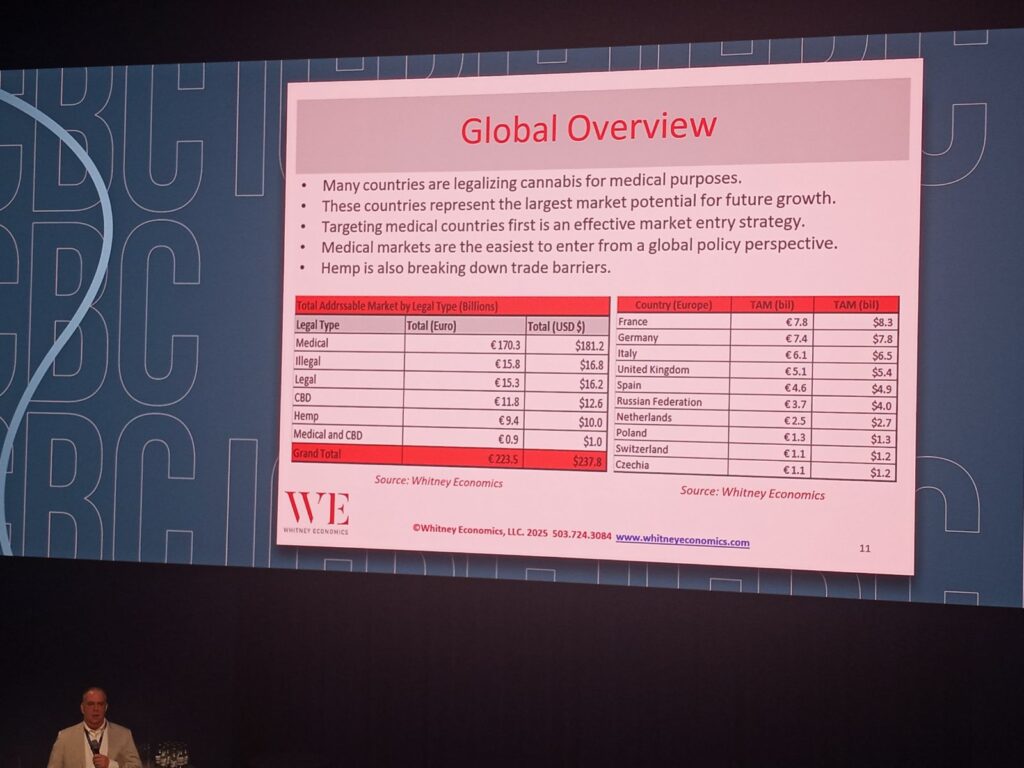
Below is another data chart that Mr. Whitney shared during his presentation in Berlin, which contains the total addressable market for Germany and other European markets. As you can see, the previously cited half a billion euro estimation for Germany’s current industry, referenced earlier in this article, is a mere fraction of the true potential of Germany’s cannabis industry:

beau whitney international cannabis business conference 2025 global market overview

One of the professed goals of German cannabis policy modernization efforts is to sufficiently combat the nation’s unregulated cannabis market to boost public health outcomes. The only way that goal will be achieved is by lawmakers in Europe’s largest market instituting a robust commerce system that allows consumers and patients to legally access the cannabis products that they want to purchase.

Until that happens, the unregulated market in Germany will continue to thrive, the nation will continue to miss out on the economic boost that a sufficient legal market yields, and public health outcomes will pay the price, with consumers and patients making their purchases of untested products from unregulated sources.

One thing is for sure – consumers and patients will not stop consuming cannabis just because such activity is prohibited. History is very clear on that. Lawmakers and regulators in Germany and throughout Europe would be wise to recognize that reality and to pursue sensible, balanced public policies.

Total Number Of German Cultivation Associations Rises To 211

Starting on July 1st, 2024, adults in Germany can apply to launch a member-based cannabis cultivation association. Cultivation associations are a key component of Germany’s adult-use model, and according to a recent newsletter by the German Cannabis Business Association (BvCW), the total number of approved associations has risen to 211.

“So far, out of 624 applications nationwide, 211 have been approved and 25 have been rejected.” stated BvCW in its most recent newsletter (translated from German to English). “A detailed overview can be found on the BCAv website.”

Policymakers and industry members in Germany originally pushed for a national adult-use cannabis legalization model that was broader compared to what is currently in place. However, after discussions and consultations with the European Union, it was determined that nationwide cannabis sales, like what is implemented in Uruguay and Canada, are prohibited under current EU agreements.

What is permitted in EU member nations is the adult-use model that Germany has adopted, which involves permitting personal consumer rights such as the cultivation, possession, and consumption of personal amounts of cannabis, as well as licensing member-based cultivation associations. Both components fall under the ‘boosting public health outcomes’ provisions of the current EU agreements.

Malta also permits cultivation associations as part of its modern adult-use cannabis policy model, and the number of associations there provides some insight into how many cultivation associations may eventually launch in Germany.

Currently, according to the Malta Authority for the Responsible Use of Cannabis’ website, there are 19 ‘cannabis harm reduction associations’ that have obtained an operating permit. It is worth noting that not all of those are dispensing cannabis to members right now, with some still being in the early stages of operation.

Malta has an estimated population of roughly 569,900, which works out to roughly one association for every 29,995 citizens. Germany currently has an estimated population of roughly 84,075,075. If we apply the same association-to-population ratio from Malta to Germany’s population, it would work out to about 2,803 total associations.

There is additional context that must be considered, and Malta and Germany are not an apples-to-apples comparison, so to speak. However, the basic calculation and comparison demonstrate how much potential for growth there is for Germany’s emerging cultivation association sector, at least at a macro level.

Another contextual factor to consider is that Malta’s association numbers are presumably going to rise as time goes on, and are not fixed at 19, so the 2,803 estimate for Germany will likely prove to be a low-end figure.

International Interest In Europe’s Cannabis Market Is Surging

As cannabis entrepreneurs, investors, policymakers, regulators, and industry service providers descended upon Germany in recent days for the International Cannabis Business Conference week, one thing is very evident: worldwide interest in Europe’s emerging legal cannabis market is surging.

I am based in the United States (Oregon), and having spent the last week in Germany surrounded by representatives from nearly every legal cannabis market on earth, and witnessing things on the ground firsthand, I can safely say that Europe’s status as being the most exciting place for cannabis policy and industry is officially here.

People from every corner of the globe are scrambling to gain a meaningful footprint in Germany and other legal markets in Europe, and rightfully so. Europe’s Green Rush era is in full swing.

In a lot of ways, what is happening in Europe right now reminds me of what occurred in the United States from 2012-2016 when the first of our states approved modernized adult-use cannabis laws. As many of us from the U.S. who attended The Talman House and International Cannabis Business Conference events this week in Berlin discussed, it felt like going back in time, and that we were re-watching a movie that we had already seen.

Yet, in other ways, the emergence of the modernized European cannabis industry is completely unique with its own nuances, opportunities, and challenges. There are certainly many components of the legal German cannabis industry’s rise, and to a lesser extent, other European markets, that are similar to what happened in the United States and Canada years ago. But some things are entirely new.

Knowing what the similarities are between North America’s experience and Europe’s, and equally important, what is not similar, is paramount for everyone who wants to succeed. Right now, Europe has the chance to incorporate the best of what has happened in the U.S. and Canadian markets and to learn from North America’s mistakes and failings.

Members of Europe’s legal cannabis community, along with policymakers and regulators, have a golden opportunity to create something better than the world has ever witnessed before. It is up to all of us, from entrepreneurs to investors to government officials, to capitalize on this historic moment and not squander it.

The biggest positive lesson that has come out of the United States and Canada that Europe must learn from is that when given the legal option to do so, consumers and patients will make their purchases from regulated cannabis channels instead of making those purchases from unregulated sources, provided that policies and regulations are sensible.

What constitutes ‘sensible’ is subjective and leaves a lot of room for interpretation. However, we now objectively know that in legal North American markets, robust access to reasonably regulated legal cannabis commerce will decimate the unregulated industry. Consumers and patients clearly prefer to make their purchases from commerce channels that have set hours of operation, on-time delivery and/or storefronts, and tested products. Unregulated sources do not offer any of those things.

Conversely, in North American markets where overburdensome regulations and illogical policies were implemented, the unregulated market continues to thrive. The data is clear that consumers and patients are willing to pay a little extra for regulated products. But there comes a point when regulations and taxes drive up costs to such an extent that it deters legal purchases, at which point people continue to buy their cannabis products from unregulated sources.

In my ongoing discussions with top European legal cannabis expert Peter Homberg of gunnercooke, he often points out that there are three goals of German cannabis policy modernization efforts. The three goals, which Mr. Homberg touched on in his keynote address on day 1 of the International Cannabis Business Conference in Berlin, also extend to other EU markets (paraphrased below):

  1. To protect children.
  2. To boost public health outcomes.
  3. To hinder the unregulated market.

The first two items on the above list flow from the third, and success can only be achieved by recognizing the reality that consumers and patients are going to purchase and consume cannabis products, and they must be afforded the legal options to do so.

European lawmakers and regulators who wish to stick their heads in the sand and act as if prohibition or overburdensome regulations will somehow magically reduce European cannabis consumption do so at their own peril, and at the peril of public health and other outcomes. That is particularly true in Germany, where the launch of regional adult-use cannabis commerce pilot trials has experienced several delays, and where conservative members of the newly elected governing coalition have expressed a desire to scrap pilot trials and other legalization provisions entirely.

Such members of the German governing coalition are, presumably as a political strategy, refusing to recognize a key point – that regional adult-use cannabis commerce pilot trials are not a new thing and are already successfully operating in the Netherlands and Switzerland. Just as the sky has not fallen over those EU nations, the same will prove to be true if the incoming German Minister of Health Nina Warken, and the recently announced Federal Ministry of Food and Agriculture (BMEL) Alois Rainer, allow already-submitted pilot trial applications to proceed.

For an insightful and thorough examination of both Nina Warken and Alois Rainer, both of whom will be instrumental in overseeing Germany’s emerging cannabis industry in the near future, check out a recent article by krautinvest.

A major difference between the North American markets and what is being built in Germany and Europe is the European Union (EU), as well as the EU’s politically independent executive arm, the European Commission (EC). All member nations are bound by EU agreements and EC policies and processes, and while state-level markets in the U.S. operate under the federal umbrella, it is not the same dynamic compared to the EU/EC.

EU agreements prohibit adult-use commerce models found at the state level in the United States and what is in place in Canada at a national level. Medical cannabis commerce is permitted in the European market, but adult-use commerce is limited to models that are based in research and designed to help boost public health outcomes, such as pilot trials and cultivation associations.

Those limitations need to be addressed via continued lobbying of continental decision-makers, and while many of them may be committed to ignoring demands to modernize EU agreements, the demands and pressure must be consistently applied nonetheless.

A significant lesson learned from ongoing policy and regulatory implementation in the United States is that a ‘patchwork’ approach is inefficient and chaotic, and ultimately doesn’t work for anyone. In the U.S., every legal state operates in a siloed fashion, with each jurisdiction having its own laws and regulations, and yet each state is also governed by conflicting federal law.

The same dysfunctional dynamic is on display in the EU to some degree, where individual nations have their own set of industry rules, which are then overlapped by an additional layer of EU-level rules that are either vague, conflicting, or in some cases, outright harmful. It is vital that the EU modernize and harmonize agreements and other policies in such a way that it recognizes reality and provides better certainty for patients, consumers, industry members, and ultimately, governments.

Europe’s cannabis industry and advocacy communities must continue to educate the rest of European society about the benefits of sensible policy modernization and the harms of senseless cannabis prohibition laws and regulations.

All the eyes of the global cannabis community are fixated on what is happening in Germany and other emerging European markets right now, including and especially the eyes of policymakers and regulators. Members of Europe’s emerging industry need to be mindful and strive to be good stewards of the opportunity that is being afforded to them. Germany’s industry and other legal markets in Europe are under a microscope right now, and that will remain the case for the foreseeable future.

I was asked many times while I was in Berlin for the International Cannabis Business Conference week what I consider to be the biggest lesson that entrepreneurs and investors can learn from the U.S., and my answer was always the same: don’t let your emotions get the best of you. Always perform your due diligence and make your decisions based on a sound process that you would apply to any other large, emerging industry.

Cannabis is exciting, and Europe’s industry potential is enormous. But if you don’t anticipate how fierce the competition will be, and recognize that industry success will not involve a straight path, you can lose a lot of money really fast.

I will end this article with a word of caution, as someone who had a front-row seat to how things unfolded in the United States years ago. We are all in this era of European cannabis together, and a single wrong move by one person or entity will no doubt be applied by cannabis opponents to the rest of Europe’s industry.

This special and historic moment in time can never be repeated, and we need to learn from the mistakes made in North America and ensure that things are done right in Europe to help put in place a foundation and framework that will set the stage for years to come. Proceed accordingly.

Hemp-Lime Building Blocks Could Revolutionize Construction

Humans have used the hemp plant for thousands of years, with the first evidence of human use dating back to 8,000 BCE in modern-day Taiwan, where archeologists found pottery remains containing hemp cord. Humans have also used hemp as a source for medicine since at least 2,800 BC, with the hemp plant being listed in the Chinese Emperor Shen Nung’s pharmacopoeia.

These days, hemp is still used for fiber and making various textiles, and is a source for medical products on a level never witnessed before in human history. However, hemp is also used for a wide array of other things, including bioremediation to clean up toxic sites around the world, for creating batteries, and to create the building material hempcrete.

The latter of those, hempcrete, is a bio-composite made of the inner woody core of the hemp plant mixed with a lime-based binder. The inner woody core or ‘shiv’ is high in silica content, and that allows it to naturally bind really well with lime. It is a property that is seemingly unique to hemp among all of the known natural fibers.

Currently, hempcrete is primarily used as an insulating and fill-in material. It weighs about a seventh or an eighth of the weight of concrete, floats in water when fully cured, has a negative CO2 footprint, and is nearly fireproof (at least compared to other popular building materials). One limitation of hempcrete is that it is not used as a structural element because it is not a load-bearing material.

The limitation of hemp as a source for load-bearing construction material could soon become a thing of the past, with the Cologne University of Applied Sciences reportedly having developed new hemp-lime building blocks potentially capable of being used as a material for load-bearing structures.

“These zones, like conventional hemp limestone blocks, are to be composed exclusively of biomass and mineral binders. According to the project participants, the aim is to create a climate-positive alternative to aerated concrete blocks or lightweight vertically perforated bricks, enabling single-shell masonry construction from rapidly renewable raw materials.” reported Allgemeine Bauzeitung in its local coverage (translated from German to English).

The Institute for Construction and Agricultural Machinery Technology at the Cologne University of Applied Sciences is reportedly developing a device that will be designed to produce compacted bricks made of hemp on a large scale. The resulting bricks will undergo testing to further explore their efficiency and application feasibility.

“In the second half of our project, we will devote ourselves to practical tests with our masonry blocks. We will erect several wall modules and examine their structural properties. In addition to properties such as load-bearing capacity, thermal insulation, and moisture behavior, we want to determine which materials, such as plaster and mortar, are compatible with the blocks and demonstrate that the blocks can be easily processed using conventional tools,” said project leader Prof. Dr. Arne Künstler from the Faculty of Architecture at the Cologne University of Applied Sciences according to Allgemeine Bauzeitung.

If the project’s research can prove that hemp-lime building blocks can be used as a load-bearing construction material, it would revolutionize the construction industry. Producing hemp is exponentially more sustainable compared to the production of most traditional construction materials. Cement production, for example, is a significant source of pollution around the globe.

German Scientists Call For Further Development Of Legalization

Roughly a year after Germany’s government implemented the first provisions of a national adult-use cannabis legalization measure, members of Germany’s scientific community are urging lawmakers and regulators to make further improvements to the nation’s legalization model.

“In light of the evaluation of the cannabis law announced in the coalition agreement, experts from health and legal sciences are clearly speaking out against reversing partial legalization, according to the Süddeutsche Zeitung.” the German Cannabis Business Association (BvCW) stated in a recent newsletter (translated from German to English).

“They recommend maintaining decriminalization, legally protecting cultivation clubs, and scientifically investigating the long-term effects of the law. Legalization limited to personal possession and acquisition without a legal production and distribution system makes neither health nor security policy sense.” BvCW wrote in its newsletter.

“Instead of commercialization following the North American model, they see the German model as an opportunity to research distribution through cannabis clubs—for the first time on this scale worldwide—and thus gain reliable new insights for evidence-based cannabis policy.” BvCW also stated.

Cannabis is currently legal for adult use at a national level in Uruguay, Canada, Malta, Luxembourg, Germany, and South Africa. Additionally, regional adult-use cannabis commerce pilot trials are operating in the Netherlands and Switzerland, and two dozen states in the U.S. have adopted recreational legalization.

Out of all of the legal recreational jurisdictions on the planet, none of them have the exact same legalization model. Current European Union agreements prohibit member nations from allowing robust adult-use cannabis sales like what is found in the Western Hemisphere.

However, EU agreements do permit member nations to allow adult-use cannabis activity to boost public health and research efforts. As of April 1st, 2024, adults in Germany can cultivate, possess, and consume a personal amount of cannabis. They can also join one of the nation’s licensed cultivation associations, and soon, they will be able to enroll in a regional adult-use pilot trial.

Berlin Cannabis Offenses Down Almost 75% Since Legalization

One year after the initial components of adult-use cannabis legalization took effect in Germany, cannabis offenses are down nearly 75 percent in Berlin. Starting on April 1st, 2024, adults in Berlin can possess up to 25 grams of cannabis when away from their homes, up to 50 grams in their private residences, and they can cultivate up to three plants in private for personal use.

“Since the partial legalization of cannabis in Berlin, the number of related crimes has decreased significantly. Between April 2024 and March 2025, the police registered approximately 2,300 offenses. In the same period last year, there were approximately 8,430 cases, according to a response from the Berlin Health Administration.” reported t-online in its local coverage translated from German to English.

“Most violations concerned illicit trafficking (1,175 cases) and the illicit distribution and transfer of cannabis (550 offenses). In addition, around 120 administrative offenses were recorded, such as smoking marijuana near playgrounds.” the outlet also reported.

Adult consumers, German courts and law enforcement, and ultimately German taxpayers, have all greatly benefited from the CanG law. Consumers no longer face prosecution for personal cannabis activity, the nation’s court system is no longer jammed up with needless cannabis consumer cases, German law enforcement is freed up to focus on fighting real crime, and taxpayers no longer have to foot the bill for enforcing harmful, ineffective cannabis consumer prohibition policies.

The Institute for Competition Economics at the Heinrich Heine University in Düsseldorf previously conducted an analysis finding that adult-use legalization could yield as much as 1.3 billion euros per year in savings for Germany’s police and judicial system.

The Biggest Winners Of German Legalization So Far

More than a year after the first provisions of Germany’s adult-use legalization law took effect, domestic and international cannabis policy and industry observers continue to evaluate the impact of the policy modernization change.

Starting on April 1st, 2024, adults in Germany can cultivate, possess, and consume a personal amount of cannabis. Additionally, cannabis was removed from Germany’s Narcotics List as part of the nation’s CanG law. The changes in German public policy have had a positive effect on society, industry, and government.

“One year of the cannabis law is already a complete success for me, because it’s a year without criminalization and unnecessary persecution. Access to support services has been made easier, and there’s more education going on, which is precisely one of the health policy goals. The fact that cannabis clubs are now also emerging shows that there’s a movement here as well. This will noticeably reduce the black market, similar to home cultivation.” stated Dirk Heidenblut (former member of the Bundestag), according to Merkur (translated from German to English).

Earlier this month, the new governing coalition in Germany announced that, at least for the time being, there will be no changes to the CanG law. Evaluations of German cannabis policy and regulations will be ongoing, but the coalition’s announcement was welcomed news for cannabis advocates and industry members.

The coalition announcement comes after polling found little support for a CanG reversal. A recent YouGov poll has found that a minority (38%) of the nation’s citizens support reversing German adult-use cannabis legalization.

Additionally, according to the results of a Forsa survey commissioned by the KKH Kaufmännische Krankenkasse, 55% of surveyed Germans do not want to repeal the nation’s CanG adult-use legalization law. Only 36% of the Forsa survey respondents indicated that they want to repeal legalization, with the rest being undecided.

Arguably, the biggest winner of German adult-use legalization so far is the nation’s medical cannabis industry and the patients it serves. According to a recent report by the Bloomwell Group, prescriptions for medical cannabis in Germany increased by roughly 1,000% between March 2024 and December 2024. The report also found that prices for medical cannabis products are decreasing in Europe’s largest medical cannabis market.

During the first three full months following Germany’s enactment of the CanG adult-use legalization law (Q3 2024), legal medical cannabis imports increased by over 70% compared to the previous period.

Another major winner is Germany’s home cultivation sector. According to a recent survey by the German Cannabis Business Association (BvCW), consumers reported that ‘seeds and accessories (e.g. grow box sets) for home cultivation and cannabis flowers, followed by humidity regulators for storing cannabis,’ were the most frequently sold out items in their area.

Adult consumers, German courts and law enforcement, and ultimately German taxpayers, have all greatly benefited from the CanG law. Consumers no longer face prosecution for personal cannabis activity, the nation’s court system is no longer jammed up with needless cannabis consumer cases, German law enforcement is freed up to focus on fighting real crime, and taxpayers no longer have to foot the bill for enforcing harmful, ineffective cannabis consumer prohibition policies.

The Institute for Competition Economics at the Heinrich Heine University in Düsseldorf previously conducted an analysis that found that adult-use legalization could yield as much as 1.3 billion euros per year in savings for Germany’s police and judicial system.

Germany’s legalization model is not perfect, and advocates must continue to push for improvements. With that being said, the CanG law is clearly better than cannabis prohibition, and it is superior to other policies in place in other European nations.

Slovenian Parliament Introduces Europe’s Most Progressive Medical Cannabis Law

The International Cannabis Business Conference team has received confirmation that Slovenia’s Parliament has officially introduced a medical cannabis policy modernization measure that, once adopted, will make Slovenia home to Europe’s most progressive medical cannabis model. Below are components of the proposed model:

Full Legalization for Medical and Scientific Use
The bill legalizes the cultivation, production, distribution, and use of Cannabis sativa L. for medical and scientific purposes, under a regulated and controlled system.

Open Licensing: Everyone Who Qualifies Can Apply
The bill introduces a non-restrictive licensing system: any individual or company that fulfills the conditions can obtain a license. There will be no public tender and no state monopoly. Both public and private entities can produce and distribute medical cannabis.

Strict Quality and Production Standards
All cannabis for medical use must be grown and processed according to GACP (Good Agricultural and Collection Practice), GMP (Good Manufacturing Practice), and European Pharmacopoeia standards, ensuring high-quality, safe products for patients.

Cannabis and THC Removed From Prohibited Drugs List for Medical and Scientific Purposes
Cannabis (plant, resin, extracts) and THC will be removed from Slovenia’s list of prohibited substances within the regulated medical and scientific framework.

Standard Prescription Process
Medical cannabis will be available on regular medical (MD and DMD) or veterinary prescriptions, like other medications. Special narcotic prescription protocols will no longer be required.

Ensured Patient Access
The law ensures a stable and continuous supply of cannabis through pharmacies, licensed wholesalers, and healthcare providers, so that patients are not dependent on imports or irregular access.

Recognizing Public Support For Referendum
The law follows the results of the 2024 advisory referendum, where 66.7% of voters supported medical cannabis cultivation. It received majority support in every voting district, indicating strong public backing.

Economic Opportunity
Slovenia’s medical cannabis market is projected to grow by 4% annually, reaching over €55 million by 2029. The bill opens the sector to domestic innovation, job creation, and export potential.

In Line With International Law and European Practices
The bill is aligned with UN drug conventions and builds on successful models from countries like Germany, the Netherlands, Austria, and the Czech Republic, ensuring legal sufficiency and international compatibility.

(This is breaking news, and this article will be updated as further details of the coalition agreement are identified.)