Author: Johnny Green

Legal Medical Cannabis Imports Surged In Q3 In Germany

During the first three full months following Germany’s enactment of the CanG adult-use legalization law (Q3), legal medical cannabis imports increased by over 70% compared to the previous period. The first provisions of Germany’s CanG law, which removed cannabis from the nation’s Narcotics List, took effect on April 1st, 2024.

Germany’s Federal Institute for Drugs and Medical Devices (BfArM) recently published medical cannabis import data for Q3 2024, with the BfArM graph below showing “the total amount of cannabis imported quarterly from abroad to Germany for medical and medical-scientific purposes in the form of dried flowers (in kg )”:
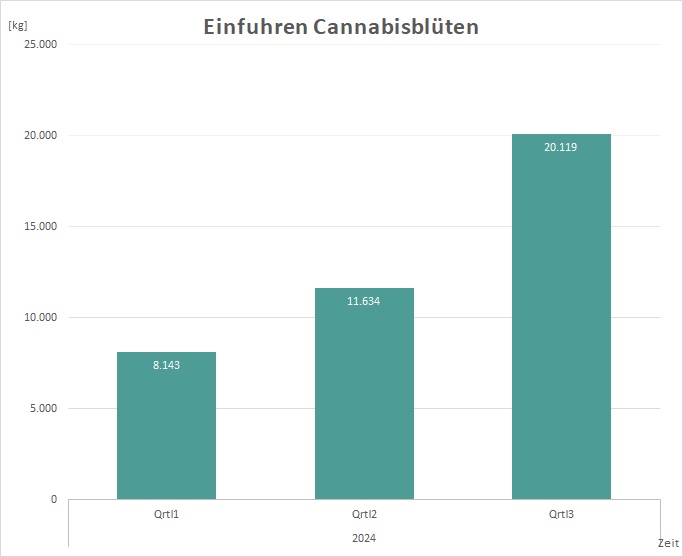
BfArM dried flower cannabis imports germany Q3

“The following figure shows the total amount of cannabis imported into Germany from abroad for medical and scientific purposes in the form of dried flowers and extracts on a quarterly basis. The dried cannabis flowers are included as a weight quantity (in kg ), the extracts as a weight quantity of dried cannabis flowers (in kg ) that were required to produce the respective extracts.” states BfArM (translated from German to English):
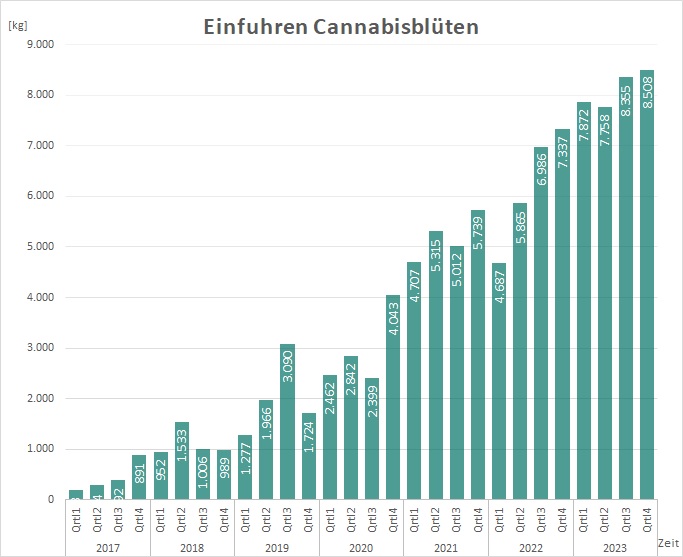
BfArM dried flower and extracts cannabis imports germany Q3

Germany adopted a national adult-use cannabis legalization measure earlier this year. The first provisions of the law permitting personal cultivation, possession, and use went into effect on April 1st, 2024. Additionally, as another part of ‘Pillar 1’ of German legalization, cultivation associations became legal on July 1st, 2024.

‘Pillar 2’ of the nation’s legalization model involves launching regional adult-use cannabis commerce pilot trials. Such trials already operate in the Netherlands and Switzerland and are allowed under European Union law.

The German Cannabis Business Association (BvCW) recently called for no further delays in launching pilot trials in Germany to combat Germany’s unregulated market and for the nation’s new government to not regress on cannabis policies and regulations.

“Legal access options such as home cultivation, cultivation associations, but also commercial models with licensed specialist shops are the best solution to push back the black market. Therefore, a new federal government should ensure that these legal accesses to cannabis are created and maintained,” says Michael Greif, Managing Director of the BvCW. “There is no protection for young people on the black market, dealers do not ask for ID. But there are dangerous additives there. The best way to ensure youth and consumer protection is through a legal and regulated market.”

The German cannabis market is home to 4-8 million consumers with a total potential market value of between €7.8 billion and €15.6 billion according to data provided by leading economist firm Whitney Economics.

To completely supply German demand, and thus eliminate the unregulated market, Germany’s cannabis industry would need to produce over 948,000 kg of flower annually according to Whitney Economics.

U.K. Cannabidiol Market Projected To Reach Over $5 Billion In Value By 2032

According to a market analysis by Vantage Market Research, the value of the United Kingdom’s emerging cannabidiol (CBD) industry is projected to reach over $5 billion by 2032. The analysis valued the U.K.’s CBD industry at $1.355 billion in 2023.

A separate analysis published in September 2024 by CLEAR found that legalizing all forms of cannabis for adult use in the United Kingdom and taxing and regulating sales could generate as much as £9.5 billion per year. However, non-CBD cannabis products are only legal in the U.K. in limited medical circumstances.

“One of the top trends in the U.K. cannabidiol market is the increasing popularity of CBD-infused wellness products, such as skincare and beauty items, driven by consumer demand for holistic health solutions.” researchers at Vantage Market Research previously stated.

Below are other findings from Vantage:

• The U.K. CBD market is rapidly expanding, driven by consumer demand for natural health solutions
• CBD-infused wellness products and beverages are gaining significant popularity
• Transparency and quality assurance are becoming crucial for consumer trust
• There is an increasing integration of CBD into traditional pharmaceuticals
• The therapeutic potential of CBD continues to drive market interest and research investments

Cannabis remains the most commonly used controlled substance in the United Kingdom, with 7.4% of adults between 16 and 59 years old in the UK reporting having used cannabis within the past year according to a 2022 report by the Office for National Statistics.

The National Centre for Social Research recently conducted a poll of United Kingdom citizens in which members of UK society were asked about their opinions regarding cannabis policy modernization efforts in the UK. The poll found a strong majority of support for legalizing cannabis sales in nearly every age group.

According to a separate analysis by The Dales Report, Germany and the United Kingdom are projected to control an estimated 77% of Europe’s emerging legal medical cannabis market by 2028.

“This growth is driven by both expanding legal frameworks and an increasing acknowledgment of the therapeutic benefits of cannabis. As both nations continue to refine their policies and commercial strategies, the focus remains on balancing patient needs with scientific and public health priorities.” The Dales Report stated about both national markets.

Advocates Call For Cannabis Industry Expansion In Germany

The German Cannabis Business Association (BvCW) is calling for the German government to embrace the nation’s emerging legal industry rather than treating people like criminals for consuming cannabis responsibly. The urging by BvCW comes amidst calls by some conservative lawmakers to roll back Germany’s recent cannabis policy changes.

“If the Union factions want to dry up the black market and fight organized crime, the cannabis industry is on their side. However, if this is to be done by criminalizing patients and consumers, this is the wrong way. It is not the users who are criminal, but the actors of the black market,” said Dirk Heitepriem, President of the BvCW, in a recent newsletter.

Germany adopted a national adult-use cannabis legalization measure earlier this year, with the first provisions of the law permitting personal cultivation, possession, and use going into effect on April 1st, 2024. Additionally, as another part of ‘Pillar 1’ of German legalization, cultivation associations became legal on July 1st, 2024.

‘Pillar 2’ of the nation’s legalization model involves launching regional adult-use cannabis commerce pilot trials. Such trials already operate in the Netherlands and Switzerland and are allowed under European Union law. BvCW is calling for no further delays in launching pilot trials in Germany to combat Germany’s unregulated market.

“Legal access options such as home cultivation, cultivation associations, but also commercial models with licensed specialist shops are the best solution to push back the black market. Therefore, a new federal government should ensure that these legal accesses to cannabis are created and maintained,” says Michael Greif, Managing Director of the BvCW. “There is no protection for young people on the black market, dealers do not ask for ID. But there are dangerous additives there. The best way to ensure youth and consumer protection is through a legal and regulated market.”

Lawmakers in Germany adopted the CanG law to boost public health outcomes by permitting adult consumers to obtain, or cultivate their own, cannabis products legally.  EU law does not permit national recreational cannabis commerce, however, it does permit regional pilot trials since they are research-based.

The German cannabis market is home to 4-8 million consumers with a total potential market value of between €7.8 billion and €15.6 billion according to data provided by leading economist firm Whitney Economics.

To completely supply German demand, and thus eliminate the unregulated market, Germany’s cannabis industry would need to produce over 948,000 kg of flower according to Whitney Economics. That would be impossible if Germany’s cannabis laws regressed.

“Reversing the CanG would also set Germany back considerably in international competition and in research opportunities related to cannabis,” explains Dr. Stefan Meyer, Vice President of the BvCW. “The cannabis industry in Germany has created hundreds of jobs in recent years, provided thousands of patients with access to urgently needed therapies and proven that high-quality and safe products can also be produced in Germany.”

“Regulate instead of prohibit – this should also be the motto for a new federal government. The cannabis industry is ready to work together to dry up the black market. This requires commercial opportunities to grow and sell cannabis in Germany, legal access to home-grown cannabis for consumption, safety and reliability for patients, and liberalization of industrial hemp,” said Dirk Heitepriem.

BvCW suggests that as a first step, “the Federal Ministry of Food and Agriculture could now issue the Consumer Cannabis Science Responsibility Ordinance (KCanWV).”

In the middle of the ongoing debate in Germany, the nation is hosting a multi-national conference where various leaders will share their experiences with modernizing cannabis policies and regulations, as first reported by Marijuana Moment.

“Representatives from Luxembourg, Malta, the Netherlands, the Czech Republic and Switzerland were invited by German Commissioner for Addiction and Drug Issues Burkhard Blienert to the meeting in Berlin on Monday and Tuesday to “exchange experiences in regulating cannabis for non-medical purposes.” the outlet reported.

Australian Lawmakers To Vote On Cannabis Legalization This Month

Australia’s parliament is set to vote on an adult-use cannabis legalization bill later this month. The Australian Greens are championing the recreational legalization measure, which will receive a vote on November 27th, 2024.

“The bill, introduced by Shoebridge in the upper house in August 2023, would allow adult recreational use and pave the way for legal home grow of up to six plants and a commercial cannabis market across the country.” stated Cannabiz in its local reporting.

If approved, the bill would create “the Cannabis Australia National Agency as a statutory agency to register cannabis strains and regulate activities relating to cannabis including: growing and possessing cannabis plants; manufacturing and selling cannabis products; operating cannabis cafes; and importing and exporting cannabis products.”

At the local level, a recent parliamentary report issued in New South Wales calls for cannabis reform in the Australian state. The 148-page report, which was tabled by the premier and finance committee, called cannabis reform the “only rational course of action.”

In the Australian Capital Territory, where the country’s capital is located, cannabis is already decriminalized and has been since January 2020. Driving while under the influence of cannabis is still prohibited in the territory, as is cannabis commerce and public cannabis consumption.

Cannabis remains prohibited at the federal level in Australia, although medical cannabis is legal in some instances.

Australia’s Parliamentary Budget Office (PBO) estimates that a legalized domestic adult-use cannabis market would generate $28 billion in tax revenue in the first decade. However, researchers at The Conversation “think the PBO’s estimate is too high, and based on the current patterns of cannabis use, $13 billion is a more credible estimate.”

The Conversation estimates “that a new legalised market could attract 3.4 million cannabis users in its first year” and that “Australia consumes 441 tonnes of cannabis per year.”

The researchers at The Conversation note that the “Parliamentary Budget Office supposes a price of $16.95 per gram, of which $3.55 would be tax – 10% GST and 15% excise” and that the “Australian Criminal Intelligence Commission (ACIC) estimates that one gram typically costs $22.50.”

However, The Conversation indicates that “we base our estimated tax revenues on a retail price of $12 per gram, of which $2.51 would be tax” and using those figures is how they arrived at the $13 billion figure.

“The Australia legal cannabis market size was valued at USD 66.0 million in 2022 and is expected to expand at a compound annual growth rate (CAGR) of 29.6% from 2023 to 2030.” Grand View Research stated about Australia’s emerging cannabis industry.

“In July 2020, 41.0% of citizens supported legalization, according to the Australian Institute of Health and Welfare.” Grand View Research also stated.

French Parliamentary Group Pushes For Cannabis Legalization

An escalation of violence linked to organized crime in France is leading to calls by a parliamentary group for the European nation to legalize cannabis for adult use. La France Insoumise (LFI) has criticized the government’s current approach to cannabis policy.

“According to the unveiled “fight plan,” the government’s repressive response is not only insufficient, but it fuels insecurity, pushing citizens and officials into a cycle of violence.” stated Newsweed in its local reporting. “LFI advocates for a comprehensive, community-based approach to combating organized crime in France, including the legalization of cannabis.”

LFI’s reported position is that cannabis prohibition is a failed public policy and that leaving the nation’s cannabis market to be controlled by organized crime empowers such entities by giving them a source of revenue from which to fund their activities.

The parliamentary group points out that cannabis prohibition has not reduced cannabis consumption in France, nor has it reduced violence associated with organized crime.

Currently, cannabis is prohibited at the federal level in France, although the nation does have a limited operational medical cannabis experimental program. In March 2021, France launched a limited medical cannabis experiment involving between 2,000 and 3,000 suffering patients to gain insight into crafting national medical cannabis policies and regulations.

The French medical cannabis experiment received initial approval from the federal Senate back in 2019, however, the launch of the trial was delayed until the spring of 2021 due to various reasons. Cannabis producer LaFleur was eventually selected as the cultivator for the program and has supplied participating patients since the launch of the experiment.

Initially slated for two years, France’s medical cannabis experiment was eventually granted a one-year extension and was set to end in 2024. The program is now expected to end in 2025.

According to a recent newsletter sent out by international cannabis economist Beau Whitney of Whitney Economics, France is home to the largest total addressable cannabis market in the European Union with a value of $11.3 billion (midpoint).

“The French government has estimated the number of potential medical patients, if the program expands it could be 320k – 400k patients, whereas the Whitney Economics estimation is 125k – 208k patients.” Whitney stated in his newsletter.

Polish Legislative Committee Takes Step Toward Decriminalizing Cannabis

A legislative committee in Poland recently sent a cannabis reform proposal to Prime Minister Donald Tusk for his consideration. Members of the Polish Parliamentary Committee on Petitions moved forward with the proposal which would decriminalize up to 15 grams of cannabis for personal use by adults in addition to decriminalizing home cultivation of one plant.

“Tusk has 30 days to respond to the petition, which is not legally binding as it would be for a formal bill. The petition, or “dezyderat,” is more of a request from the legislative body for action on the issue.” stated Marijuana Moment in its initial coverage.

“The prime minister will be required to provide a written response with details about any steps the administration will take, an explanation if they don’t intend to act on it or a referral to another agency.” the outlet also stated.

“The committee has just finished considering the petition I submitted to the Sejm, together with a bill assuming the decriminalization of possession of up to 15 g and the cultivation of 1 plant for one’s own needs.” stated Polish activist Przemysław Zawadzki about the proposal in a social media post (translated from Polish to English). Zawadzki  is the CEO & co-founder of Freedom Farms SA.

“Everything went basically according to plan and with the support of MP Marcin Józefaciuk – Your MP who, contrary to the suggestion contained in the absurd opinion of the Sejm Expertise Office to reject my project, requested that a desideratum be sent to Prime Minister Donald Tusk in this matter and the Commission agreed to this. Thanks also to Łukasz Rydzik for his support on the Commission.” Zawadzki said.

“We are therefore waiting for the position of the Prime Minister, who has recently spoken publicly several times that it is worth ending the punishment for a joint and will not interfere with this, and at the same time we are working on other fronts. This path is one of many because we want to clearly indicate that cannabis users exist and their problem related to the penalization of possession of herb is real and serious.” Zawadzki also stated.

Cannabis is currently legal for adult use in Malta, Luxembourg, and Germany, as well as in Uruguay, Canada, and South Africa. Cannabis is also legal for adult use in roughly half of the states in the U.S. and regional adult-use cannabis commerce pilot trials are operating in the Netherlands and Switzerland.

Cannabis Industry In Central And South America Is Worth An Estimated $8 Billion

Central and South America have long served as top sources for agricultural crops, and in recent years, the two regions have also emerged as top sources for legal medical cannabis products. According to leading international cannabis economist Beau Whitney, the region’s growing cannabis market is worth a considerable amount of money.

“Central and South America together are an $8 billion total market; however, its low-cost manufacturing and drive towards EU GMP and GAP certifications is making the region an attractive source of supply for the EU.” Whitney stated in a recent newsletter.

Whitney’s analysis was originally provided as part of his presentation at the inaugural Andean Hemp and Cannabis Trade Summit in October where he presented on the Central and South American hemp and cannabis markets.

In addition to the overall market value analysis, Whitney Economics also provided the following market information as part of his presentation:

  • Five countries in Central and South America make up 89% of the regional demand
  • Brazil is home to the largest domestic market ($2.5 billion)
  • Total Central and South American market demand requires 6.3 million pounds of cultivated output
  • Peru is an estimated $0.8 – $2.2 billion domestic market
  • Peru’s hemp industry has strong opportunities in fibers, grains, and isolated cannabinoids

South America will forever be home to the first country on earth to adopt a national adult-use cannabis legalization measure. Lawmakers in Uruguay approved a national recreational cannabis legalization measure in 2013, with legal sales launching in 2017. Legal adult-use sales are limited to residents of Uruguay.

Due to low labor costs and an ideal climate for outdoor cannabis cultivation, cannabis can be produced in Central and South America at a fraction of what it costs to produce in larger emerging cannabis markets, particularly in Europe. As such, legal cannabis from Central and South America will presumably be dominant in the global export market going forward.

European Union Reportedly Ready To Supply Medical Cannabis To Ukraine

According to Ukraine Deputy Health Minister Maryna Slobodnichenko, the European Union is ready to supply medical cannabis to Ukraine. The nation’s Deputy Health Minister made the announcement in a recent interview with the Ukrainian News Agency.

“They (the European Union) are very happy about our progress in this area. They say – show the consumers, because they have warehouses of medical cannabis that they are ready to supply to us. But we are talking about medicine, and therefore the consumer is not every person, but patients who suffer from clearly defined diseases,” the official of the Ministry of Health said (translated from Ukrainian to English).

Earlier this year, in August 2024, Ukraine’s medical cannabis program officially launched. Ukraine’s Parliament first approved medical cannabis reform in December 2023, with President Volodymyr Zelensky signing the measure on February 15th, 2024.

Cannabis resin, extracts, and tinctures are excluded from the list of ‘dangerous substances’ in Ukraine under the new policy. The production of medical cannabis, development of medical cannabis therapies, and distribution of medical cannabis products are to be tightly regulated in the European nation.

“In order to implement the Law, the Ministry of Health team, together with the Ministry of Agrarian Policy, the State Medical Service, the Ministry of Internal Affairs, the National Police and other executive authorities, have developed by-laws that regulate all processes in detail and will allow the patient to receive medicine from medical cannabis.” Ukraine’s Ministry of Health stated in a news release announcing medical cannabis legalization’s implementation (translated from Ukrainian to English).

“In order to ensure the cultivation of medical cannabis in Ukraine, Licensing conditions have been developed, which will soon be considered by the Cabinet of Ministers.” the Ministry of Health also stated. “Also, the entire chain of circulation of medical cannabis, from import or cultivation to dispensing to a patient in a pharmacy, will be subject to license control.”

Ukrainian medical cannabis cultivation facilities are required to be operated in ‘closed soil conditions’ with ’round-the-clock video surveillance.’ Additionally, national police must have ‘free access’ to all facilities under the new regulations.

“For cultivation, there is a procedure for purchasing plant seeds – they must have a quality certificate and be registered in the State Register of plant varieties suitable for distribution in Ukraine.” the Ministry of Health stated in its news release in August 2024.

“Medicines from medical cannabis will be made in a pharmacy setting and prescribed by prescription to patients for whom conventional medicines do not have a therapeutic effect or cause adverse reactions that are poorly tolerated.” according to the Ministry of Health. “It will be possible to buy such medicines in Ukraine only with an electronic prescription, which will indicate the dosage form and dosage, the names of the active substances included in their composition. It is expected that medicinal products from medical cannabis will be available to patients in the form of oral drops, hard capsules, and dental pastes.”

“The law allows people entering or leaving Ukraine or transiting through its territory to carry medicinal products based on medical cannabis for their own use in an amount that does not exceed the amount prescribed by a doctor’s prescription.” the Ministry of Health also stated at the time.

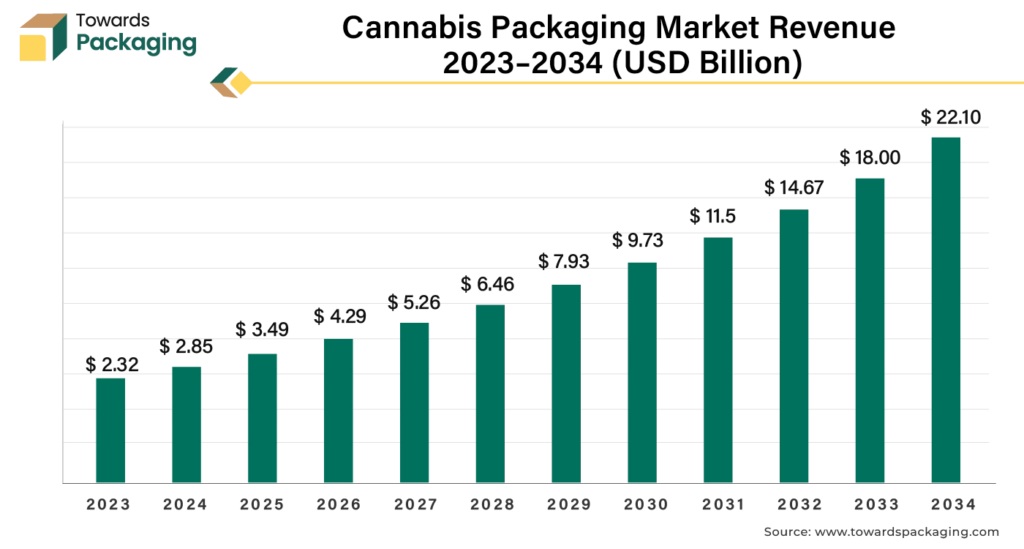
Global Cannabis Packaging Market Projected To Reach $22.10 Billion By 2034

The worldwide cannabis packing market is projected to reach $22.10 billion in value by 2034 according to a recent study conducted by Precedent Statistics. The market analysis values the cannabis packaging market at $3.49 billion in 2025.

“The market was estimated at USD 2.85 billion in 2024 and is projected to expand at a double-digit CAGR of 22.74% between 2024 and 2034.” the analysts stated.

cannabis packaging market projection 2024 to 2034

“The cannabis packaging market revolves around strong and tamper-evident packaging which provides child-resistance protection. Along with this, providing accurate information with labels and providing temperature and humidity resistance are the leading objectives of the market.” Precedent Statistics stated. The market researchers also determined the following:

  • North America holds the largest share and dominates the market due to its well-established regulations and advancement in cannabis packaging
  • Europe is a significant and mature market that drives the cannabis packaging industry by focusing on improving and adopting child-resistant features
  • Asia-Pacific is the fastest-growing market due to its versatile use and demand for the cannabis packaging market

The cannabis packaging sector of the emerging legal cannabis market is one of the most promising sectors due to every legal market requiring that cannabis products be in compliant packaging that includes such labeling information as cannabinoid content, harvest date, and/or production source.