Author: Johnny Green

Thailand’s Health Ministry Wants To Legalize Cannabis In Certain Areas

Thailand is rapidly becoming an international leader when it comes to cannabis policy. For many years the nation prohibited cannabis in all forms, with harsh penalties being handed out to people caught possessing, cultivating, and/or distributing cannabis.

That has changed a great deal in recent years after Thailand became the first country in its entire region to legalize cannabis for medical use. It was a tectonic public policy shift at the time given that over half of the countries that have a death penalty for cannabis are located in the same region as Thailand.

Currently, any household in Thailand can sign up to cultivate cannabis for medical purposes and sell it to government-licensed cannabis retailers. Aspiring cultivators can even obtain a government loan to help fund their pursuits, with interest rates being extremely low.

If Thailand’s Health Ministry has its way, cannabis reform will not stop at medical cannabis. Thailand’s Health Ministry recently announced a desire to legalize cannabis for adult use in certain parts of the country. Per Bangkok Post:

The health ministry plans to legalise cannabis for recreational use in designated areas as part of a new draft proposal.

Dr Paisarn Dankum, secretary-general of the Food and Drug Administration (FDA), said the ministry wants to maximise the benefits of the plant following its removal from the latest list of prohibited drugs (B.E 2564).

The proposals will allow the use of cannabis for recreational purposes in designated sandbox areas. However, there has so far been no guidance as to what will constitute a sandbox and which areas might be eligible.

Thailand is a beautiful country and has long served as a top international tourism destination. Cannabis enthusiasts from around the world have traveled to Thailand for many years to consume local cannabis varieties, albeit in a fashion that was not necessarily legal.

It’s tough to say at this point if the cannabis ‘sandbox’ regions will be geared towards boosting tourism, however, that’s likely to factor in. Legalizing cannabis for adult use will create jobs, create tax revenues and fees, and boost local economies. That is true in Thailand and anywhere else that embraces adult-use cannabis reform.

Did Cannabis Reform In Europe Increase Use Among Young People?

One of the most popular talking points for cannabis prohibitionists is the ‘what about the children?’ talking point. Cannabis opponents go to that talking point early and often whenever cannabis reform is being proposed in any jurisdiction, including in Europe.

In recent years medical cannabis reform has spread across the European continent, with countless patients now being able to safely access medical cannabis products where they live. Not all countries’ medical cannabis programs are created equal, as proven by a comparison between the United Kingdom and Germany.

Germany is home to the most well-established medical cannabis program in Europe and the largest medical cannabis industry on the continent. Patients can easily acquire medical cannabis products from licensed pharmacies. Compare that to the United Kingdom where only three patients had received any medical cannabis products as of last summer.

With so much medical cannabis reform sweeping the European continent, many are wondering if it had any impact on youth consumption rates on the continent? After all, cannabis opponents tried so hard to convince people that reforming cannabis laws would lead to a doomsday scenario in Europe. A study was recently conducted that sought to answer that question, and spoiler alert – it was not favorable to the claims of cannabis opponents.

Youth Consumption Rates Spanning 20+ Years

A team of researchers in Sweden recently examined data of self-reported cannabis use spanning a period from 1994 to 2017. During that span of time many countries in Europe reformed their cannabis laws in one way or another, including the countries where data was sourced from (Belgium, Czech Republic, Germany, Italy, Netherlands, Norway, Portugal, Slovakia, Spain, Sweden, and United Kingdom).

“Cannabis policy varies greatly across European countries, but evidence of how such policy impacts on recreational cannabis use among young people is conflicting. This study aimed to clarify this association by investigating how changes in cannabis legislation influenced cannabis use.” the study’s authors stated.

“Available data on self-reports of recreational cannabis use among individuals aged 15-34 years was retrieved from EMCDDA. Information on cannabis policy changes was categorized as more lenient (decriminalisation or depenalisation) or stricter (criminalisation, penalisation). Countries that had implemented changes in cannabis legislation or had information on prevalence of use for at least eight calendar years, were eligible for inclusion. We used interrupted time-series linear models to investigate changes in country-specific trajectories of prevalence over calendar time and in relation to policy changes.” the researchers stated regarding their methodology.

The researchers concluded that “Our findings do not support any considerable impact of cannabis legislation on the prevalence of recreational cannabis use among youth and young adults in Europe.”

The Same Will Likely Prove True For Adult-Use Legalization

Europe’s cannabis community experienced a major milestone at the end of last year when Malta became the first country on the continent to legalize cannabis for adult use. The new law makes it legal for adults to cultivate, possess, and consume cannabis. The measure will also legalize cannabis clubs, although it will not legalize adult-use sales.

Legalization efforts are well underway in other European countries as well, with Luxembourg, Germany, and possibly Italy legalizing cannabis for adult use in the near future. That will increase pressure on other countries, including Spain where our next event will be held in March, to ramp up adult-use legalization efforts as well.

Unfortuantely, that ramping up of legalization efforts across the continent will likely be paralleled by claims from cannabis opponents that cannabis legalization will result in a stoned youth epidemic. Feel free to point to the results of the study contained in this article to debunk their claims. Just as those claims proved to be unfounded when it came to medical cannabis reform, the same will likely be true for adult-use reform.

Adult-Use Sales In Germany May Go Beyond Pharmacy Distribution

Germany is currently home to Europe’s largest legal cannabis industry. Part of that is due to Germany’s population of roughly 83 million people and part of that is also due to Germany being home to the fourth-largest economy on earth.

Another contributing factor is Germany’s approach to medical cannabis policy and the nation’s medical cannabis industry framework. Germany has embraced the medical cannabis industry in ways that most other countries have yet to do, both in Europe and abroad.

Every passing year results in Germany’s medical cannabis industry becoming larger, and that is being accelerated by domestic cannabis production. Initially, Germany imported all of its medical cannabis products which resulted in Germany being the world’s largest importer of medical cannabis (over 9,000 kilograms in 2020 alone).

Germany is no longer the largest importer of medical cannabis. Israel recently took over that title. However, the industry is as strong as ever, and when Germany legalizes cannabis for adult use and launches an adult-use industry in the near future, the nation’s emerging cannabis industry will be enormous.

Hints Of Regulations

Germany’s Federal Justice Minister Marco Buschmann (FDP) recently participated in an interview during which he provided quite a bit of insight into what Germany’s eventual adult-use cannabis industry may look like.

The governing coalition previously indicated a desire to legalize cannabis for adult use, and part of the policy change would include regulations for adult-use sales. Below are additional emerging details via Radio Eins (translated from German):

The goal agreed by the SPD, Greens and FDP in the coalition agreement is clear: “It should be legally possible for adults to buy cannabis in licensed shops,” said the Minister of the German Press Agency. This could be pharmacies, for example, “but we may also continue to draw the circle”. A prerequisite could be a “required expertise of the sales staff”. This would enable the salespeople to “provide information about the products and counteract risky cannabis use, especially in the case of recognizable addicts”.

For him, as Minister of Justice, it is clear: “If there are shops that are legally allowed to sell cannabis, then there must also be producers who are allowed to grow and sell it legally”. Possession must then also be legal for adults up to a maximum limit to be stipulated in the law. And cannabis will be “subject to some form of taxation, like other consumer products”.

Adult-Use Cannabis Taxation

Cannabis taxes were also discussed during the interview, and the Minister indicated that he was not worried about taxation making it harder to compete with the unregulated market.

As long as the taxation is not too burdensome, most consumers will not care about higher prices up to a point. The benefit of being able to go into a fixed location during set business hours to choose from a variety of products in a legal setting is well worth an additional cost within reason.

Spain Needs To Take Its Rightful Place As A Global Cannabis Leader

Spain, particularly Barcelona, has been home to a vibrant cannabis community for many years. Cannabis is very easy to acquire throughout most of Spain where roughly 1 out of every 10 adults consumes cannabis annually, and it’s no secret that Spain has long served as the top destination for world-class Moroccan hashish.

When it comes to cannabis clubs, Spain has some of the best on the entire planet. Home to roughly 47 million people, Spain is also home to hundreds of cannabis clubs with a majority of them operating in the Barcelona area. The clubs are private and require a membership, however, they are extremely popular and most people have been able to join if they are willing to jump through the necessary hoops.

Barcelona is one of the most beautiful cities on earth, and we are very excited to once again be teaming up with Spannabis to put on the world’s largest cannabis superconference this March. Barcelona is a hotbed for cannabis clubs due to a 2016 regulation approved by the Barcelona City Council which permitted cannabis clubs to operate in the city.

Unfortunately, that regulation was overturned in 2021 by Catalonia’s Superior Court, leaving Barcelona’s entire social cannabis club scene in a state of limbo. Technically, such clubs are considered to be illegal under Spanish law, however, with so many cannabis clubs already in operation shutting them all down is likely to prove to be an impossible task. Even if some get shut down, more will presumably open up.

Lawmakers Need To Accept Reality

Cannabis prohibition does not work, and there is zero evidence that it stops humans from consuming the cannabis plant. Instead, people just do it in the shadows, all the while living in fear. This also applies to cannabis clubs. The clubs in Spain serve a vital function for suffering patients by providing them safe access, and they provide a safer alternative for consumers compared to many other substances that are legal in Spain, including and especially alcohol. Prohibiting them will not make them go away. Rather, it will just make them less safe.

Spain is world-famous for its cannabis, its cannabis community, and specifically, its cannabis clubs. Rather than sticking their heads in the sand and acting as if the clubs will go away, lawmakers in Spain need to embrace cannabis clubs and let Spain take its rightful place as a global cannabis industry tourism leader.

Such a move would create jobs, generate public revenue via fees and taxes, and eliminate any costs to taxpayers that are tied to enforcing cannabis club prohibitions. Cannabis clubs are going to exist in Spain no matter what. Spain might as well regulate them and reap the benefits from doing so.

Spain Needs Adult-Use Legalization

Full adult-use cannabis legalization has obviously failed to pass in Spain as of this article’s posting. For many years it was easy for lawmakers in Spain to drag their feet, to refuse to take action, and to point their fingers elsewhere. That approach is going to be harder to stick with as cannabis legalization spreads across the European continent.

At the end of 2021, Malta became the first country in Europe to pass an adult-use legalization measure. Malta’s legalization model will include legalizing cannabis clubs, which will serve as the primary source for people to acquire cannabis beyond cultivating it themselves. Luxembourg, Italy, and Germany are all on the cusp of legalization. Certain jurisdictions in Switzerland and the Netherlands are participating in a legalization pilot program. All of that reform puts pressure on lawmakers in Spain to step up.

Spain is at a vital crossroads right now. Lawmakers in Spain can continue to cling to failed cannabis prohibition policies and only allow a very limited medical cannabis industry to operate, or they can embrace the emerging cannabis industry and benefit in ways that many other countries cannot due to how well-known Spain is for cannabis. Only time will tell which one it ends up being.

The International Cannabis Business Conference Is Coming Back To Germany

BERLIN, Germany – The International Cannabis Business Conference is coming back to Berlin, Germany on July 19-20, 2022. Offering world-class industry networking opportunities, the Berlin International Cannabis Business Conference is the largest B2B cannabis trade event in Europe and is also the longest-running cannabis B2B conference on the continent. The conference will once again feature a unique blend of cannabis policy, advocacy, industry, and networking.

“We are particularly excited about this year’s conference in Berlin given the favorable political climate for cannabis legalization. It is going to be extra special for our team to offer world-class cannabis industry and policy education, networking, and entertainment to attendees at such a crucial juncture for Europe’s emerging cannabis industry,” says Alex Rogers, founder of the International Cannabis Business Conference.

In addition to the Berlin B2B event, the International Cannabis Business Conference will also offer a one-day Global Investment Forum (GIF) on July 18, 2022. The International Cannabis Business Conference Global Investment Forum in Berlin will feature hand-picked cannabis companies participating in a pitch session in front of top investors on the International Cannabis Business Conference Main Stage. It is a tremendous opportunity for cannabis companies in the emerging cannabis industry to showcase their products/services in front of seasoned industry investors. The pitch session is also open to service providers looking for reliable and high-end clients.

Germany is home to the largest economy in the European Union and is poised to serve as the cannabis industry capital of Europe going forward. The cannabis industry is evolving rapidly in Germany, with the country’s medical cannabis program increasing in size with every passing day.

Cannabis industry opportunities that are popping up in Germany and on the European continent have tremendous profit potential, and the Global Investment Forum is the perfect place for entrepreneurs to try to secure capital to take their pursuits to the next level. It is also an unparalleled opportunity for investors to learn more about pre-vetted investment opportunities and for industry service providers to find reliable and high-end clients.

“We know how hard it is for quality investors to link up with vetted cannabis industry companies offering valuable investment opportunities,” Rogers stated. “That is why we are bringing the Global Investment Forum back to Berlin. It will be a prime networking opportunity for cannabis industry investors, entrepreneurs, and industry service providers alike.”

The International Cannabis Business Conference is the leading B2B cannabis event series on earth. Events have been held in the United States, Canada, Spain, Germany, and Switzerland. Additional locations in other countries are being identified and will be announced in the future. The topics covered at the Global Investment Forum and conference via panels and presentations will be led by the top cannabis experts in the global cannabis space. To see which topics will be discussed at the B2B conference, check out the event’s schedule. Below is a sampling of the presenters:

  • Kristine Lütke – Member of the German Bundestag, Free Democratic Party
  • Peter Homberg – Partner, Dentons
  • Karl Bär – Member of the German Bundestag, Bündnis’90/Die Grünen
  • Jessica Billingsley – Chief Executive Officer, Akerna
  • Antonia Menzel – Public Affairs, Sanity Group
  • Ben Dronkers – President, Dronkers B.V. Group
  • Silvia Alunni – Advisor EU Affairs, Hague Corporate Affairs and Deputy-Secretary General, Medicinal Cannabis Europe

Over 5,000 attendees and 350 companies sponsors and exhibitors are expected at the Berlin International Cannabis Business B2B Conference alone. International Cannabis Business Conference events are attended by leading policymakers, executives, and entrepreneurs from all over the world, with over 80 countries being represented at previous events. The event series is the best way for innovators and inventors to get their products or services in front of the top influencers and decision-makers in the cannabis space, as well as for investors to network with aspiring entrepreneurs.

The conference series consistently features world-class speakers that cannabis entrepreneurs, advocates, and consumers from all backgrounds can learn from and be entertained by. International Cannabis Business Conference events include after-party festivities that feature some of the most entertaining musical acts and celebrities from across the globe.

A cannabis industry revolution is sweeping Europe, and Germany is at the center of it. If you’re serious about succeeding in the cannabis industry, check out the International Cannabis Business Conference’s flagship program in Berlin in July. Leading cannabis entrepreneurs and policymakers from around the world will be in attendance and the networking and educational opportunities will be unparalleled.

You can secure tickets now and take advantage of the early bird pricing discount.

###

About the International Cannabis Business Conference

The International Cannabis Business Conference in Berlin is Europe’s longest-running and largest industry B2B tradeshow and conference. For more information, including how to register for International Cannabis Business Conference Barcelona, Berlin, and Zurich, please visit: Internationalcbc.com. Find out more on LinkedIn, Twitter, Facebook, YouTube, and Instagram.

For more information or media inquiries, please email noelle@internationalcbc.com or call 541.864.0090.

The International Cannabis Business Conference Is Coming Back To Barcelona

BARCELONA, Spain (December 27, 2021) – The International Cannabis Business Conference is the leading cannabis B2B (business to business) event series on the planet, with previous conferences occurring in several countries on multiple continents. The event series is owned and operated by cannabis advocates that believe in celebrating cannabis culture, in addition to providing world-class cannabis industry education and networking opportunities.

The rich cannabis history and culture in Barcelona, Spain make it the perfect backdrop for the next International Cannabis Business Conference being held on March 10, 2022. The International Cannabis Business Conference has once again partnered with Spannabis, Europe’s top cannabis expo, to form another superconference that is a must-attend for anyone that is serious about succeeding in the emerging cannabis industry. At the conclusion of the superconference the International Cannabis Business Conference will host one of its world-famous after-parties. This year’s after-party will be sponsored by Juicy Fields.

“We needed to collaborate with a leading company in the cannabis business sector, with experience also in Europe, and International Cannabis Business Conference has all the knowledge to be able to make such an event in Spain. We have no doubt that our combined event will be a success and many of our attendees will be grateful to have a B2B event of this quality.” Spannabis organizers stated.

Spannabis organizers went on to say, “Feria del Cáñamo (Spannabis) has been in the cannabis sector for more than 18 years and is much more than just a fair. The Spanish cannabis industry has more potential every day, and is taking firm steps to improve Spain’s laws. Spannabis organizers believe that the time is right to offer reliable information on the economic potential of the cannabis sector and the viability that Spain would have to become one of the key countries in Europe.”

Spannabis previously teamed up with the International Cannabis Business Conference in 2019 to form a superconference, and the collaboration was a tremendous success. The 2022 superconference will be bigger and better than ever, with the collaboration event being the largest of its type in Spain.

“Spannabis is not only the biggest Cannabis fair in Europe, but the biggest in the world. The Spannabis brand name is iconic, and we are honored to be partnering with such a long-time and important institution,” states Alex Rogers, Executive Producer of the International Cannabis Business Conference.

“Spannabis is the meeting point for the entire European cannabis scene. It is first and foremost a consumer event, however, many folks who attend are also looking for a B2B element. The International Cannabis Business Conference’s partnership with Spannabis fills this gap and satisfies a clear need for major cannabis industry players to meet, network, and to progress and advance the industry as cannabis laws are liberalized in Spain and across the continent.” Rogers said.

Spain is home to arguably the best cannabis culture on earth, with 70% of Spain’s cannabis clubs being located in Barcelona. Roughly 90% of Spain voters support medical cannabis according to a recent survey by the Center for Sociological Research. Medical cannabis patients in Spain are expected to purchase over 1,700 kilograms of cannabis flower in 2022, and an estimated 10% of Spain’s adult population consumes cannabis annually.

Over 60 countries will be represented at the superconference this March in Barcelona and will include representatives from every sector of the industry as well as leading international cannabis policymakers and industry service providers. Attend the superconference in Barcelona to network with investors, entrepreneurs, industry regulators, and international policymakers and take your industry pursuits to the next level. 

Announcements regarding speakers, panels, and the conference schedule will be coming soon. The International Cannabis Business Conference also has additional upcoming events in Berlin in July 2022 and Zurich in September 2022. You can secure tickets now and take advantage of the early bird pricing discount.

###

About the International Cannabis Business Conference

The International Cannabis Business Conference in Berlin is Europe’s longest-running and largest industry B2B tradeshow and conference. For more information, including how to register for International Cannabis Business Conference Barcelona, Berlin, and Zurich, please visit: Internationalcbc.com. Find out more on LinkedIn, Twitter, Facebook, YouTube, and Instagram.

For more information or media inquiries, please email noelle@internationalcbc.com or call 541.864.0090.

Does CBD Impair Driving Ability?

Cannabidiol (CBD) is one of the several dozens of cannabinoids that are contained within the cannabis plant.

When it comes to popularity, not all cannabinoids are created equal, and that is particularly true when comparing CBD to other cannabinoids.

For many years the most popular and well-known cannabinoid was THC. However, in recent years THC’s popularity has lost ground to CBD, at least when it comes to Google searches.

CBD’s popularity has also risen dramatically when it comes to products due to its ability to treat various ailments. The rise in popularity is also due in large part to CBD policy reforms around the globe.

The ever-increasing rate at which consumers and patients are using CBD products is leading to concerns in some regulatory circles regarding if it causes too much impairment.

CBD And Driving

A team of researchers in Switzerland recently explored the relationship between the use of CBD products (cigarettes) and a consumer’s ability to safely operate a motor vehicle.

“To investigate effects of smoking cannabidiol (CBD)-rich marijuana on driving ability and determine free CBD and Δ9-tetrahydrocannabinol (THC) concentrations in capillary blood samples, a randomised, double-blind, placebo-controlled, two-way crossover pilot study was conducted with 33 participants.” the researchers stated.

“Participants smoked a joint containing 500 mg of tobacco and either 500 mg of CBD-rich marijuana (16.6% total CBD; 0.9% total THC) or 500 mg of a placebo substance, then performed three different dimensions of the Vienna Test System TRAFFIC examining reaction time, behaviour under stress, and concentration performance. For further assessment of participants’ fitness to drive, three tests of balance and coordination were evaluated and vital signs (blood pressure and pulse) were measured.” the researchers went on to say.

“The results revealed no significant differences between the effects of smoking CBD-rich marijuana and placebo on reaction time, motor time, behaviour under stress, or concentration performance.” the researchers concluded.

Beware Per Se DUII Laws

Regulators around the globe are crafting cannabis policies specific to driving under the influence of intoxicants (DUII). It is one of many facets of public policy that gets reviewed when cannabis laws change.

DUII laws, for any intoxicating substance, fall into two ‘method of detection’ categories. One is detecting DUII via a comprehensive set of field sobriety tests.

The other category for the method of detection is relying on a per se limit. For instance, most jurisdictions have a per se limit for alcohol, such as .08 BAC in the United States.

Many regulators try to rely on a per se limit for THC, falsely believing that cannabis affects the human body the same as alcohol.

With that in mind, CBD consumers could in theory have THC built up in their bodily fluids, and if they have too much and get caught driving in a jurisdiction that has a per se law, it could result in some unfortunate consequences.

Relative Majority Favors Legalizing Cannabis In Germany For The First Time

Cannabis reform has more momentum on the European continent right now than ever before since the start of prohibition, and Germany is at the heart of it.

Medical cannabis is already legal in Germany, and legal sales have been underway for a handful of years now. Every passing year sees a new record set for German medical cannabis sales.

A new type of reform, adult-use legalization, is on the horizon in Germany, with the new coalition government has expressed a desire to legalize cannabis for all adults in the near future.

When news of the legalization plan surfaced it instantly took over the international news cycle, beyond just cannabis news, and that didn’t come as any surprise to long-time cannabis policy observers.

Support For Legalization Is Strong

Many polls have been conducted over the course of several years in Germany to try to gauge public support for full cannabis legalization.

While some of those polls showed strong support for legalization, they almost entirely relied upon online methods for people to participate in the polls.

That methodology is very hard to rely upon and is largely why polling results out of Germany were all over the board, with many polls showing overwhelming support and other polls showing the exact opposite depending on which outlet/entity was conducting the online poll.

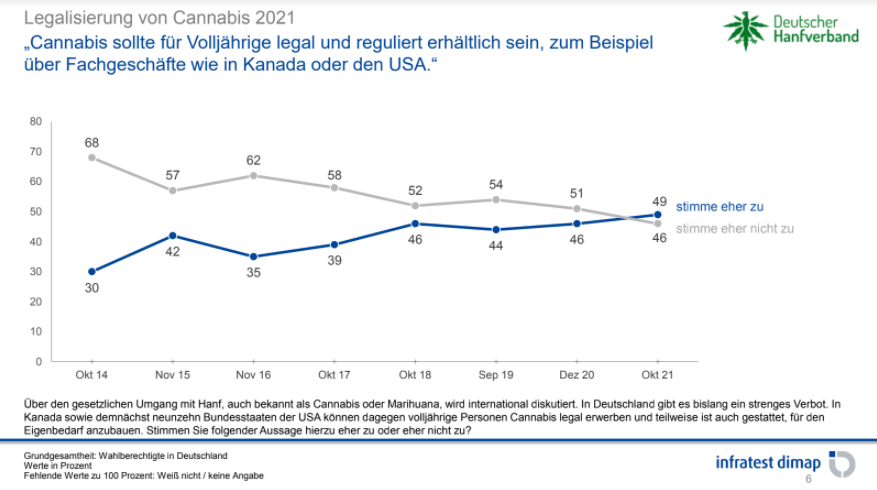
Deutscher Hanfverband recently conducted a poll in conjunction with an established, well-known institute that incorporated both telephone and online polling. 

The poll was part of a similar annual survey, which is an important distinction compared to other polls because it provides tremendous insight regarding shifting views in Germany regarding adult-use legalization.

As you can see from the chart below, provided by Deutscher Hanfverband, support for legalization is now at 49%, which is greater than support for keeping prohibition in place. This is a first for Germany:

Germany Cannabis Legalization Poll

“There is no majority in the population in favor of banning cannabis. For more than 200,000 criminal proceedings per year, not only is there a lack of scientific basis, but also democratic legitimation. It’s time for legalization.” stated Georg Wurth, spokesman for the German Hemp Association.

The Most Significant Legalization Domino So Far

As of this article’s posting, there are only two countries that have legalized cannabis for adult use – Uruguay in 2013 and Canada in 2018.

A laundry list of countries has indicated that they plan to make a major push for legalization in 2022, including Germany.

Malta appears to be on the verge of legalizing cannabis for adult use for cultivation and possession purposes, with the final passage and the president’s signature expected to happen this week. 

If that happens, Malta would become the first country to legalize cannabis for adult use in Europe, and the third country to do so on the planet.

With that being said, legalization in Germany would be a bigger deal from political momentum and emerging cannabis industry standpoints compared to Uruguay, Canada, and Malta combined.

Germany has a population of over 80 million people and is home to the fourth-largest economy on planet earth. By comparison, Canada, Uruguay, and Malta only have a combined population of roughly half that of Germany, and those nations do not wield nearly as much political power as Germany on the international level.

Whereas Malta, and reportedly also Luxembourg, plans on only legalizing cannabis cultivation and possession for adults, Germany is planning on implementing a robust, regulated adult-use industry nationwide.

Given Germany’s place in the political and industry arenas in Europe and throughout the rest of the world, legalization there will be more significant than can be expressed in words, and according to recent polling, it’s a move supported by more Germans than not for the first time in history.

Is The FDA Going To Issue Commercial CBD Regulations Soon?

Three years ago the United States Congress, via the 2018 Farm Bill, legalized hemp nationwide, and with it, cannabidiol (CBD) products derived from hemp. Given how long domestic hemp cultivation was previously illegal in the United States, it was a very big deal.

Since that time domestic CBD products have proliferated store shelves all across the United States, with products coming in all types and forms, from shampoo to drinks to toothpicks (literally).

However, comprehensive regulations for over-the-counter commercial CBD products have yet to be implemented, and from what it sounds like, no one should expect regulations any time soon. Below is more about it via our friends at NORML:

Washington, DC: Nearly three years following the passage of federal legislation legalizing hemp production, the US Food and Drug Administration (FDA) has yet to promulgate rules regulating the marketing and sale of commercial products containing hemp-derived CBD.

Speaking last month at the National Industrial Hemp Business Summit in Washington, DC, FDA representative Gail Sipes said that the agency cannot move forward with regulations without more data on the safety of CBD products. She reiterated the agency’s position that companies which market CBD-infused products as either food products or as dietary supplements are violating the Food, Drugs, and Cosmetics Act.

NORML and other groups have urged the FDA to provide regulatory guidelines overseeing the production, testing, labeling, and marketing of hemp-derived CBD products. Analyses conducted by the FDA and others have consistently reported that many over-the-counter (OTC) CBD products are of variable quality and potency, and that they may contain contaminants or elevated levels of heavy metals.

Survey data compiled last year by the National Consumers League reported that more than eight in ten US voters desire greater federal regulatory oversight over the labeling and marketing of commercially available CBD products.

In a report provided by the FDA to Congress in 2020, the agency said that regulating OTC CBD products presents unique challenges because the substance is already available as a FDA-approved medicine (Epidiolex).

Additional information is available from the NORML fact sheet, “FAQs About Cannabidiol (CBD).”