Author: Johnny Green

Survey Finds That People Prefer To Live In Legal Cannabis Jurisdictions

The adult-use cannabis reform ‘experiment’ has been underway in the United States since 2012 when voters in Colorado and Washington State approved legalization initiatives on Election Day.

Leading up to the successful votes in 2012 opponents pulled out all of the stops in an attempt to keep prohibition in place, including hurling unfounded theories that cannabis legalization and the industry it created would ruin both states.

Since 2012, many other states have also legalized cannabis for adult use and obviously, the sky has not fallen over any of them. In fact, a plurality of survey participants recently indicated that they prefer to live in legalized jurisdictions.

Below is more information about it via a news release from our friends at NORML:

A plurality of US adults desire to reside in a jurisdiction where “marijuana is fully legal.”

In a survey of new movers compiled by the real estate brokerage firm Redfin, 46 percent of respondents said that they would either “prefer” to live in a jurisdiction where cannabis was legal or that they would “only” live in a legalization state. Twenty-two percent of respondents did not want to reside in a legal state. Thirty-two percent of respondents had no opinion.

Studies have previously reported that cannabis legalization is correlated with increased property values. Data reported in July concluded, “[T]here is strong evidence that legalization drives higher property values — particularly in areas that allow recreational marijuana and welcome retail dispensaries. … These investments can improve quality of life in communities across the nation while attracting tourism and new residents who drive real estate demand.”

Separate data have shown that states experienced spikes in tourism following adult-use legalization.

Additional information is available in the NORML fact sheet, ’Marijuana Regulation: Impact on Health, Safety, Economy.’

NBA To Continue To Not Test Players For Cannabis

The National Basketball Association (NBA) is one of the most popular professional sports leagues on earth and is made up of players and coaches from literally every corner of the planet.

Unfortunately, the NBA has had a cannabis prohibition policy in place for multiple decades, which has resulted in needless harm being caused towards a number of players including and especially International Cannabis Business Conference alumni Clifford ‘Uncle Cliffy’ Robinson (RIP).

Testing players for cannabis made no sense prior to any state/country legalizing cannabis for medical and/or adult use, and it makes even less sense now that reform is spreading.

Every NBA team is now located in a state that has legalized cannabis for at least medical use, and many teams are also located in states that have legalized for adult use. In the case of the Toronto Raptors, the team is located in a country that has legalized cannabis entirely.

Thankfully, the NBA announced that it will continue to refrain from testing players for cannabis, which is a continuance of a temporary policy that was originally put in place at the start of the pandemic.

The NBA needs to make the policy permanent, as well as apologize to every player that was needlessly harmed by the NBA’s historic cannabis policy. Anything less is unacceptable.

Below is more information about the NBA’s recent decision via a news release from our friends at NORML:

For the second season in a row, the National Basketball Association has announced that it will suspend the practice of randomly testing players for marijuana.

A spokesperson for the league announced last week that it will “extend the suspension of random testing for marijuana for the 2021-22 season and focus our random testing program on performance-enhancing products and drugs of abuse.”

Commenting on the policy, NORML’s Political Director Justin Strekal said: “The NBA, like a number of sports leagues, has wisely recognized that it is inappropriate to subject players to drug detection testing for their off-the-court use of cannabis. Their actions are part of a growing trend, and we anticipate that their decision will propel other organizations and companies to make similar changes to their drug screening policies.”

Recently, both the NFL and MLB have amended their drug testing policies so that use of the substance is no longer an offense resulting in a suspension. Last month, the World Anti-Doping Agency (WADA) announced that it would be reviewing its marijuana-related drug testing guidelines for international athletic competitors.

literature review published in September in the journal Sports Medicine reported that athletes do not perform better under the influence of either cannabis or THC, but that the use of marijuana and/or CBD may aid in their recovery following competition.

Also last month, the nation’s second largest private employer – Amazon.com - announced that it had dropped pre-employment screening for marijuana and that it was reinstating eligibility for former applicants who were denied consideration under its former policies.

Since 2015, cannabis-related testing in the workplace has fallen over five percent, with jurisdictions where marijuana use is legal for adults experiencing a more significant decline.

Several states - Nevada, New Jersey, New York, and Montana - now limit employers’ ability to pre-screen certain job applicants for past marijuana use, as do a growing number of municipalities, including AtlantaPhiladelphia, and Washington, DC.

Additional information is available from NORML’s fact sheet, ‘Marijuana Legalization and Impact on the Workplace.’

U.S. Cannabis Arrests Reduced More Than 30 Percent In 2020

Cannabis prohibition is one of the most harmful public policies in human history. Prohibition negatively impacts lives wherever it exists, including and especially within the criminal justice system.

Thankfully, cannabis prohibition is dwindling across the globe, including in the United States. All but two states have some type of legal cannabis on the books now, whether it’s medical or adult-use.

Cannabis still remains illegal at the federal level in the United States, and people are still getting arrested for cannabis, however, it’s at a decreasing rate.

That is good news for cannabis consumers and taxpayers. Below is more information about it from our friends at NORML via a news release:

The estimated number of persons arrested in the United States for violating marijuana laws declined precipitously in 2020, according to data released this week by the US Federal Bureau of Investigation.

According to the FBI’s Uniform Crime Report, police made an estimated 350,150 arrests for marijuana-related violations in 2020. This total is a 36 percent decrease from 2019, when police made an estimated 545,602 marijuana-related arrests. Not since the early 1990s has the FBI reported so few marijuana-related arrests in a single year.

Marijuana arrests are down more than 50 percent from their peak in 2008, when police made over 800,000 marijuana-related arrests. Since 2012, 18 states and Washington, DC have enacted laws legalizing the possession of small amounts of cannabis by adults.

“As more states move toward the sensible policy of legalizing and regulating cannabis, we are seeing a decline in the arrest of non-violent marijuana consumers nationwide,” NORML Executive Director Erik Altieri said.

He added: “The fight for legalization is a fight for justice. While these numbers represent a historic decline in arrests, even one person being put into handcuffs for the simple possession of marijuana is too many.”

Of those arrested for cannabis-related activities, some 91 percent (317,793) were arrested for marijuana possession offenses only. Marijuana-related arrests represented 30.3 percent of all drug-related arrests in the United States in 2020.

Marijuana-related arrests were least likely to occur in western states — most of which have legalized the possession of the substance — and were most prevalent in the northeast, where they constituted an estimated 50 percent of all drug arrests. This will likely change going forward, as several northeastern states, including Connecticut, New Jersey, and New York have all legalized their marijuana markets in recent months.

‘Overwhelming Majority’ Of Feedback For Legalization Bill In Malta Is Positive

When it comes to the next country to legalize cannabis for adult use, Malta is probably not the first country that comes to mind. However, momentum for cannabis legalization is extremely strong in Malta right now.

A cannabis legalization measure has been introduced in Malta, and the government is seeking feedback from the public. According to at least one government official, the feedback has been very favorable towards the measure. Per Lovin Malta:

Feedback to the recently proposed bill to legalise the personal use of cannabis up to 7g has been received positively across the island.

Published by Reforms Minister Owen Bonnici, Bill No. 241 has been welcomed by criminal justice activists calling for a better and more appropriate approach to cannabis use on the island. The island has been known to be notoriously harsh on cannabis users, with people being sent to prison for nearly a decade over the plant.

This is certainly welcome news. Any time a government official speaks favorably about cannabis reform it’s a good thing, and that’s especially true when it is happening in a country that has historically cracked down hard on cannabis.

With that being said, the words are just that – words. Those words have to be backed up by action, otherwise, it’s just governing officials gaslighting the public like they often do when it comes to cannabis policy.

The fact that a bill has already been introduced is helpful, and the limited legalization model will hopefully boost its chances of being completely passed and implemented sooner rather than later.

Legalizing the personal possession of up to 7 grams of cannabis is something that everyone in Malta should be on board with. After all, why would anyone want to waste limited public resources going after personal amounts of cannabis? (or any amount of cannabis, but I digress).

If/when Malta passes their legalization bill, it will be a far cry compared to Uruguay and Canada. However, the limited reform is clearly better than Malta’s current complete prohibition law.

Czech Republic Is Wrongfully Trying To Punish Cannabis Educators

Cannabis media resources play a vital role in the cannabis community and beyond. For many years, efforts to spread the truth about the cannabis plant were difficult because mainstream media outlets around the world helped perpetuate misleading, and in some cases, blatantly false information about cannabis.

The motivation behind those efforts was obviously political in nature, with global mainstream media outlets helping further the reefer madness agendas of political leaders. There were also business interests at play, with people and entities that financially benefitted from cannabis prohibition working hand-in-hand with lawmakers and media outlets to keep the truth about cannabis hidden.

For many decades, that reefer madness coalition had a virtual monopoly on cannabis information, which is why it wasn’t a coincidence that many people around the globe thought that cannabis was harmful. In many cases, older people still think that is the case because they were conditioned to think so over the course of so many years.

Thankfully, due in large part to better access to media printing and the rise of the internet, there are now various cannabis-focused media outlets operating around the globe, including in the Czech Republic where Legalizace magazine is based. Legalizace magazine is a bimonthly periodical focused on cannabis, as well as drug policy relating to human rights and environmental issues.

It’s an amazing resource for people in the Czech Republic and elsewhere. Their unbiased reporting and the educational information that they publish adds tremendous value to society. Unfortunately, Legalizace magazine and its editor-in-chief Robert Veverka are now facing charges for doing nothing more than educating people. Below is more information about it via a press release from Legalizace:

September 29, 2021 – Prague, Czech Republic

Education is not a crime!

Legalizace magazine and its editor-in-chief, Robert Veverka have been formally accused of “inciting and promoting toxicomania”, with penalties of up to five years of imprisonment. The first court hearing will take place on Tuesday, October 5 at 8:30 AM at the district court in the town of Bruntál, Czech Republic.

According to Czech law, cannabis is considered a regular agricultural crop plant and also possesses the status of a medicinal plant, and its cultivation and processing is permitted in compliance with Act No. 167/1998 Czech Law Coll. without special permission. Given this fact, Legalizace magazine considers the criminal charges of “inciting and promoting toxicomania” not only an instance of systematic failure and demonstrable ignorance of cannabis legislation by the prosecuting authorities but also a gross infringement of freedom of expression and the right to information guaranteed by the Czech Charter of Fundamental Rights and Freedoms.

“The prosecution, which is calculated, stigmatizing, borderline untruthful, and based on fallacious conjectures and limited interpretation by the police that the cultivation and processing of cannabis is automatically illegal or that any mention of cannabis automatically equates ‘inciting toxicomania’, comprises a dangerous precedent comparable to totalitarian repression and censorship. I consider it my duty to fight not only for the right of Legalizace magazine to exist, but also for the rights of all print and electronic media who have ever dared mention the word ‘cannabis’ – or plan to do so in the future,” said Robert Veverka, the editor-in-chief, regarding the indictment.

What Are The Best Cannabis Events In Germany?

It is an extremely exciting time to be a cannabis enthusiast. Thanks to the hard work of countless cannabis activists, cannabis reform continues to spread across the planet. Cannabis is now legally accessible for medical and/or adult-use purposes in more jurisdictions than ever before since the dawn of prohibition.

Momentum for cannabis reform is particularly strong in Europe where safe access to medical cannabis can be found in most countries, especially in Germany. Germany is now the cannabis capital of the European continent, at least from an industry standpoint. Adult-use legalization in Germany will hopefully happen sooner rather than later.

The rise in cannabis reform has been paralleled by a rise in interest in all things cannabis. People want to learn how to cultivate cannabis, about cannabis science, the latest cannabis products, how to get into the cannabis industry, and much more. It can be very difficult for people to know what information is valuable and what is not, and it’s particularly difficult to network in a real-life setting with other like-minded cannabis enthusiasts in a meaningful way.

The best way to learn a lot about cannabis in a short amount of time while making a lot of new cannabis friends and colleagues is to attend an in-person event. There’s really no adequate substitute for attending an in-person cannabis event, as so much happens when cannabis-curious newbies, leading experts, and folks that are in between are all under one roof socializing, teaching, and learning.

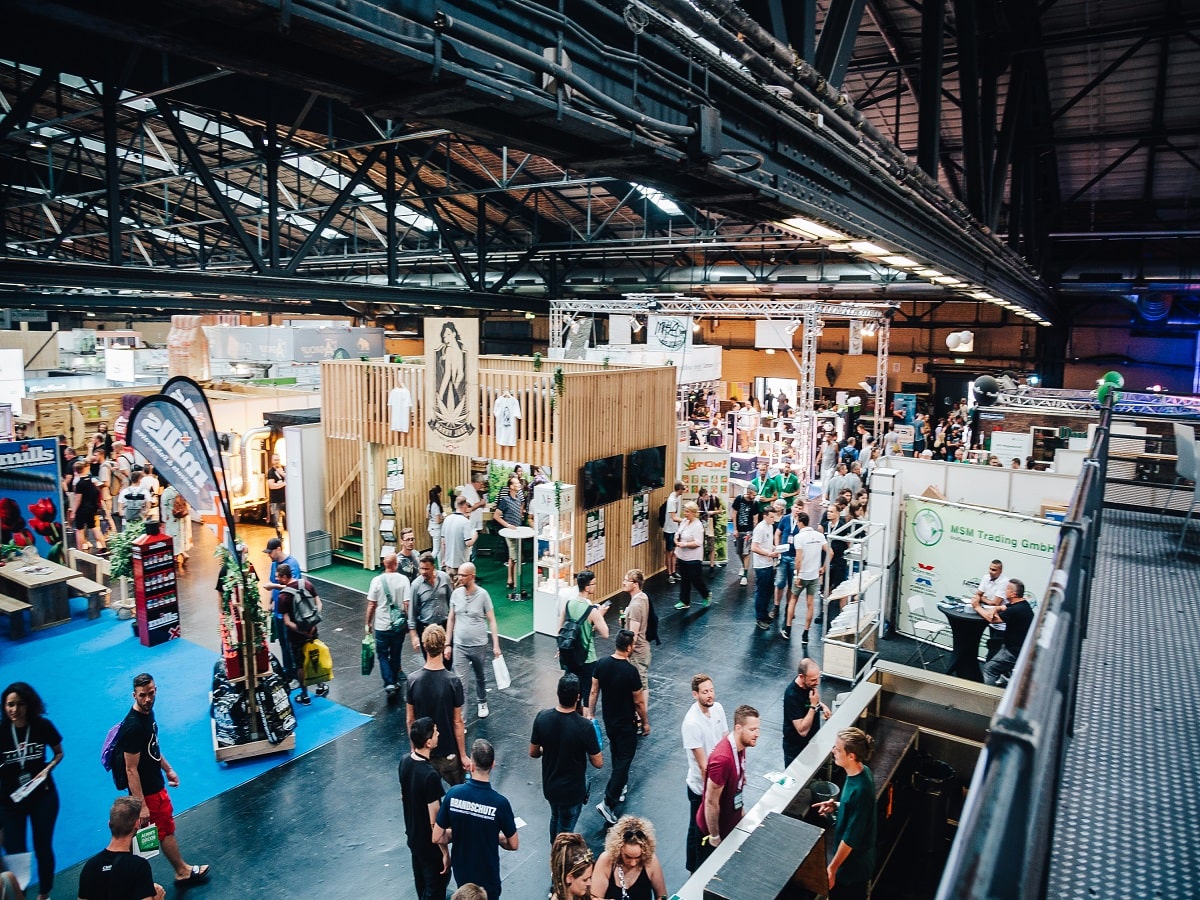
International Cannabis Business Conference Berlin 2021

There are many cannabis events out there these days of all types and sizes, however, not all of them are created equal. Some events are the real deal while many prove to be nothing more than hype. If someone attends a cannabis event they obviously want it to be worth the effort on their part. The last thing that someone wants to do is to buy tickets and travel to a cannabis event just for it to turn out to be lackluster (or worse).

The recent International Cannabis Business Conference in Berlin, which included our Global Investment Forum, brought together entrepreneurs, investors, and policymakers from all over the planet. Below is a recap video of our 2021 conference in Berlin:

One of the many highlights from our conference in Berlin was a truly historic bipartisan political panel featuring current German lawmakers discussing cannabis policy The panel can be viewed below (the panel was held in the German language):

Another event that we are particularly excited about is the Mary Jane Berlin hemp fair coming up on October 22-24, 2021. Mary Jane Berlin is a C2C event and festival and includes an extensive cultural and entertainment program that is offered in conjunction with exhibitors, food stands, live concerts, and congresses on therapeutic properties.

Mary Jane Berlin Hemp Fair 2019

Below is a video recap of Mary Jane Berlin’s last event:

We are very excited about the strong bond that our two events have created and the strategic partnership that we have formed. Mary Jane Berlin is Europe’s fastest-growing C2C cannabis fair and pairs perfectly with our flagship B2B conference in Berlin to provide a comprehensive cannabis experience.

If you want to learn more about cannabis and network with like-minded cannabis enthusiasts, make sure to check out the upcoming Mary Jane Berlin hemp fair and festival. The event is expected to have over 35,000 cannabis-related products on display and it’s almost guaranteed that there will be something that very few cannabis enthusiasts have ever seen before. You can find out more about Mary Jane Berlin, including how to purchase tickets, at their website: https://maryjane-berlin.com/

In addition to the Mary Jane event, also make sure to mark July 19-20, 2022 on your calendars because the International Cannabis Business Conference will be coming back to Berlin and bringing with it our signature blend of industry, policy, and entertainment. Attend both the Mary Jane Berlin C2C fair and our B2B conference in Berlin to take your cannabis pursuits to the next level!

From Taboo To Typical: Global Cannabis Comes Of Age

by Shane MacGuill and Spiros Malandrakis

As global cannabis industry leaders gathered at the International Cannabis Business Conference in Berlin in late August our overarching reflection was of an industry that is – if not maturing – entering the end of its beginning as a legitimate mainstream commercial force. Ultimately, the nature and potency of that force will be determined as much by the industry’s collective ability to address consumer needs as by the intricacies of compliance and complexities of operations.

At a high level, there is no question that this is an industry on the rise, projected by Euromonitor to reach a global legal value of around USD100 billion across its adult-use, medical and CBD pillars within the next half-decade. US adult-use undoubtedly drives this growth albeit there is a haze of uncertainty there which is only partially lifting. However, regardless of the evolution of reform at a federal level, it is all but inevitable that in the near future tens of millions of more Americans will gain legal access to the full spectrum of modern cannabis products.

And globally, the steady rolling wave of liberalisation continues, propelled by the increased acceptance and tacit activism of the general public. In our recent cannabis survey, more than half of all respondents expressed support for the positive economic argument in favour of full cannabis legalisation, believing that commercialisation would be economically beneficial. Even more strikingly, two-thirds of the sample (consisting of a balance of all kinds of relationships with cannabis, and none) expect adult-use of cannabis to be legalised in their country within the next decade.
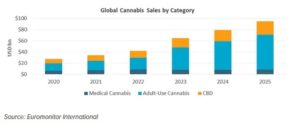
Global Cannabis Sales By Category

Expectation. Benefit. Belief. This is clearly no longer the language of taboo, of hope against the odds. However, for the industry to truly graduate into mainstream fmcg status it will need to be responsive to the drivers of its emerging consumer base.

It will need to be adventurous with the formats and brand purposes it is elevating to the market. And ensuring that cannabinoid products deliver on their intrinsic promise of offerings that are tailored to our individual goals and are improving our lives – sometimes in small, sometimes in large – ways on a daily basis.

The industry needs to embed sustainability and social justice at its core, and into its brand propositions. Not just because this is the right thing to do but because in doing so it will differentiate itself with a consumer population increasingly concerned with the wider impact of its consumption.

Its pricing strategies will also need to be refined: Unpretentious affordability and a competitive price point will be essential. On the other hand, bling retains a certain degree of penetration to this day but such historic approaches towards aspirational consumption are increasingly transitioning towards a focus on authenticity, craftmanship and artisanal credentials instead.

Nevertheless, it is not merely about the efficacy or competitive intoxicating attributes new formats will bring to the table. Creating new rituals or shedding fresh light on established ones will cement ever-elusive brand equity. While beverages and edibles have monopolised headlines under the Cannabis 2.0 umbrella of launches, the answer can sometimes be simpler. For example, dogwalkers are cannabis pre-rolls “inspired by the simple pleasure of leisurely strolls with one’s dog”.

Celebrity endorsements, tie-ins and collaborations have also been an instrumental part of key branding initiatives across fmcg industries. However celebrity sparkle is not a panacea – shared values, direct involvement and a long-term strategic symbiosis will separate sustainable business propositions from short-lived gimmicks

On the retailing front, utilitarian and stoner-chic stereotypes of the Dutch coffeeshop paradigm belong to the 1990s and do not reflect the evolution and outreach of the industry in 2021. As the industry matures, clear and differentiated propositions that aspire to facilitate retailing experiences focusing on specific demographics will be the winners over more “me too” Apple store copycats.

Beyond retailing, there can be no overstating the importance of on-trade venues and occasions in providing momentum to normalisation, establishing new consumption rituals and occasions and, ultimately, cementing the fledgling cannabis industry as a key competitor for the alcoholic drinks industry.

Tailoring brand propositions to attract specific focus demographics will be key. From identifying the cannacurious cohort to expand penetration and reach to focusing on seasoned consumers to allow for connoisseurship and premiumisation to add value, diligent segmentation will be another sign of the industry’s transition into mature fmcg territory. Euromonitor International’s surveys are also shedding light into key perceptions, concerns and patterns. For example, 79% of cannabis consumers in US legal states consider strength to be an important product attribute followed by price (70%) and strain (66%)- a fact that highlights the still simplistic and embryonic nature of buying behaviours, a situation that is in many ways akin to alcohol consumers choosing brands purely based on abv content . But on the CBD front education also remains essential with 43% of global respondents saying that they do not see a clear need to use CBD.

Beyond the haze of hype and dramatic share price fluctuations, the cannabis industry is shifting into the realms of fmcg through the adoption of innovative formats, design sophistication and evolving language and semiotics. As it sheds its mantle of illicit associations, branding through lifestyle cues and positioning, retailing strategy and demographic breakdowns will shape its future and its transition from novelty to an industry that has come of age.

For more insights see our cannabis research at: https://www.euromonitor.com/cannabis

In conjunction with this article, make sure to also check out this link to download the related presentation slides: https://bit.ly/2VRrvTu

This article first appeared on Euromonitor.com and is syndicated with special permission

Zurich Officials Release Cannabis Legalization Pilot Program Details

Switzerland is at the forefront of cannabis policy in many ways, not the least of which is the widespread availability of low-THC cannabis products.

Starting in 2017 cannabis consumers have been able to legally purchase cannabis products that contain less than 1% THC. In 2019 a Swiss Federal Administrative Court ruled that the taxation of such products was legal, further paving the way for a booming industry.

The low-THC products may not be as strong as cannabis available in some other countries, however, they are still extremely popular with consumers and even some patients, and stronger products are on their way to some markets in Switzerland.

Back in May amendments to Switzerland’s Narcotics Act took effect. The amendments provided for legal adult-use cannabis pilot programs in Switzerland. Zurich is one of the cities that is taking part in the pilot research programs and its pilot will begin next year.

The pilot program in Zurich will run for three and a half years as part of a greater research program to help lawmakers craft federal policies and industry regulations. Basel, Bern, Lucerne, and Geneva are also launching their own related pilot programs.

For Zurich specifically, the City of Zurich is partnering with the Psychiatric University Clinic Zurich and the Zurich Pharmacy Network, with study participants acquiring their cannabis from pharmacies and ‘social clubs.’

As part of the study, cannabis producers will be required to obtain a production permit from the Switzerland Federal Office of Public Health. Below is more information via a press release from the City of Zurich (translated to English):

Regulated Cannabis Sales: The Zurich Study

Once the legal basis is in place, the City of Zurich is launching the “Züri Can – Cannabis with Responsibility” pilot project together with the Zurich University Psychiatric Clinic. The effects of regulated cannabis use are being researched in a three-and-a-half year study. The cannabis study is intended to provide the basis for appropriate cannabis legislation at the federal level.

For years, the City of Zurich and the Psychiatric University Clinic in Zurich have been committed to an objective and low-risk approach to cannabis use. In mid-May 2021, amendments to the Narcotics Act came into force, which enable pilot tests for regulated cannabis sales. On this legal basis, the Psychiatric University Clinic Zurich, in cooperation with the City of Zurich, wants to research models of the regulated procurement of cannabis and its effects on the health and consumption behavior of the consumer. The aim of the Zurich study is to provide relevant knowledge on the best possible use of cannabis. The study is intended to promote public health, maintain public safety and support the protection of minors.

Responsibility for production, prevention and consumption

The Zurich cannabis study “Züri Can – Cannabis with Responsibility” is intended to show what effects the sale of standardized and tested cannabis products at approved outlets with health and prevention concepts has on cannabis users. The study creates framework conditions that promote the responsible use of cannabis at all levels – production, prevention and consumption.

Reference points with a focus on health promotion

The study participants will be able to obtain their study cannabis from pharmacies and social clubs. Variously designed purchase options allow valuable conclusions to be drawn about the different consumer groups. The points of reference should be given a great deal of leeway so that the most realistic forms of regulated access to cannabis can be researched. The Psychiatric University Clinic Zurich is investigating which sales outlets can be used to achieve the long-term goal of promoting public and individual health and safety. At all purchase points, value is placed on personal and health-promoting advice and on responding to individual needs. The aim is always to keep the health risks for consumers as low as possible.

Tested products for responsible consumers

The producers of the study cannabis must have a production permit from the Federal Office of Public Health. Only cannabis that meets high quality standards is produced. The aim is organic quality and local production. Various cannabis products are offered in the study, each with a different THC / CBD content. This makes it possible to switch to lower-risk products during the study period. The participants can consume cannabis more health-consciously and responsibly, because the ingredients of the products are of impeccable quality and are shown transparently. In order to record the health and social situation and its developments, the participants are questioned at regular intervals.

Looking for pharmacies and social clubs

The study management is now looking for interested pharmacies and interested parties who would like to found and operate a social club. They can contact the head of studies by the end of the year and apply for participation as a reference point (stadt-zuerich.ch/cannabisprojekt). Cannabis is expected to be available to study participants from autumn 2022.

(Joint media release by the City of Zurich, the Psychiatric University Clinic Zurich and the Zurich Pharmacy Network)

Leading German Politician Erwin Rüddel On Cannabis: “Attitude Is More Open”

Until now, the CDU seemed to be quite isolated with its position on a possible new regulation. While the SPD, the Greens, the FDP and the Left all call for legalization, or at least model projects, in their election campaign programs, the CDU does not mention a possible new regulation of cannabis in a single syllable. Also to an inquiry of krautinvest.de the press office of the CDU answers only with short reference to the current government program.

A few weeks before the election, the CDU member of parliament Erwin Rüddel, who is also the chairman of the health committee of the German Bundestag, sits on a panel with Dirk Heidenblut (SPD), Werner Graf (Greens), Dr. Wieland Schinnenburg (FDP) and Niema Movassat (Left) at the International Cannabis Business Conference – in a rather lost position, one would think.

Far from it. In the interview with krautinvest.de Rüddel makes possible coalition partners hope for compromises, suggests at least model projects as solution. Especially when the CDU would have to negotiate with two other parties, the CDU politician does not seem to believe in maintaining the status quo. And: Even the great challenges of our time – such as Corona, Afghanistan or Corona – he does not let pass as an excuse to put off a possible cannabis re-regulation: “We are a parliament based on the division of labor and accordingly there are also the necessary capacities.”

It will be interesting to see whether possible coalition partners agree to model projects (or push for fundamental legalization) and what these would look like in detail. Should it come to that, a first small market for recreational cannabis is likely to develop in Germany under state control. After all, flowers have to be cultivated or imported, stored and distributed.

krautinvest.de: Five parties are currently being considered for a new government. In all conceivable coalitions, the CDU is the only party that is against any form of legalization. Is legalization completely out of the question if the CDU is in government?

Erwin Rüddel: The CDU/CSU is somewhat isolated in its stance on this issue. That’s why I’d be surprised if the issue didn’t come up in the coalition negotiations after the upcoming federal elections, especially if the CDU/CSU were to negotiate with two other parties. In my view, model projects would be a conceivable compromise.

krautinvest.de: You personally have already hinted at such model projects recently. Can you briefly specify the conditions?

Erwin Rüddel: In any case, such a project would have to be implemented in a well-selected region with a defined group of people entitled to access it, and the dispensing would have to be linked to addiction prevention and counseling. This is done in a similar way in Uruguay, for example. It is important that the THC content of the cannabis distributed is controlled. The biggest problem I see is the involvement of 15- to 18-year-olds. Of course, they should not be able to legally purchase cannabis for consumption, but this group is exactly the one where prevention work is most important and should therefore be taken into account in the evaluation.

krautinvest.de: Could you imagine further new regulations beyond the model projects?

Erwin Rüddel: For me, such a model project would be an open-ended introduction to the topic: Either we get confirmation of the reservations about cannabis or we learn that things should be approached somewhat differently than is the case today. After an appropriate evaluation, further steps can then follow.

krautinvest.de: Hand on heart: How strongly do opinions differ on this topic within the CDU?

Erwin Rüddel: There are certainly very different opinions in our group. In general, however, I have the feeling that the attitude to this issue is more open than it was a few years ago.

krautinvest.de: In addition, the challenges are currently great: climate change, Corona, Afghanistan – does a new regulation of cannabis fall completely under the table, because the concerns are much greater elsewhere and the parties prioritize other areas?

Erwin Rüddel: The fact that we are facing very great challenges does not mean that we cannot tackle other issues. We are a parliament based on the division of labor, and the necessary capacities exist accordingly.

This interview has been first published on krautinvest.de and syndicated with special permission.