Morocco Exports First Legal Medical Cannabis To Australia

Cannabis being exported from Morocco to markets in other countries is not a new thing. After all, Morocco has served as a top source for unregulated cannabis for decades. However, policymakers and regulators in Morocco have worked in recent years to transition the nation’s cannabis industry into a regulated system.

In March 2021, the government of Morocco approved a proclamation allowing the legal production of medical cannabis. The proclamation was followed by additional policies and the creation of a national agency to oversee Morocco’s emerging legal cannabis industry.

A significant focus of the cannabis policy modernization effort in Morocco was to promote international exports of medical cannabis products to other countries, aiming to boost the domestic Moroccan economy. This effort reached a major milestone this month, with Morocco’s legal cannabis industry completing its first export to Australia.

“Morocco has officially entered the international medical cannabis market with its first export to Australia.” reported APA News in its local coverage. “This initial shipment marks a significant milestone for the country, which is rapidly formalizing its cannabis industry.”

“A 50-kilogram batch of the local Baldiya cannabis variety was shipped to Australia this week, following a successful quality control sample sent in June.” the outlet also reported.

A recent study conducted in Morocco found that the Baldiya cannabis strain exhibits a higher level of chemical stability compared to other strains commonly cultivated in Morocco. The study was performed by researchers affiliated with various academic institutions in Morocco, and the findings of the study were published in the journal Food Chemistry Advances.

“In this study, a comprehensive analysis of Cannabis sativa L. cultivars was conducted, focusing on the phytocannabinoid profiles of resin from one local cultivar ‘Beldiya’ and four exotic cultivars over three consecutive crop years.” stated the researchers about the focus of their investigation.

“The cannabinoid composition of the resin from the studied cultivars was analyzed using liquid chromatography-mass spectrometry coupled with a triple-stage quadrupole mass spectrometer (LC-MS/TSQ Endura) to evaluate the chemical variability in phytocannabinoid compounds among the cultivars and across the harvest years.” the researchers wrote about their methodology.

“The results showed significant chemical polymorphism among the studied cultivars, with the clustering of phytocannabinoids, indicating three distinct chemical groups based on the concentrations of the major cannabinoids.” the researchers concluded. “In addition, only the local Northern Moroccan cultivar Beldiya demonstrated chemical stability across the three harvest years, whereas the exotic cultivars exhibited heterogeneity from one year to another.”

A market analysis from last year found that Morocco’s emerging legal cannabis industry could reach between $420 million and $630 million in value annually.

The Science Of Cannabis Extraction

It is unclear when humans first started extracting cannabinoids from the cannabis plant to make concentrated forms of cannabis. The topic is somewhat difficult to pin down due to various reasons, not the least of which is answering the question, ‘what constitutes extracting cannabis?’

Cannabis extracts can come in many forms, including cannabis oils and hashish, both of which humans have created for centuries. Regardless of when humans first started extracting cannabinoids from the cannabis plant, these days, cannabis extracts are one of the most in-demand forms of cannabis around the world.

The cannabis extraction sector of the emerging global cannabis industry is currently undergoing significant changes from nearly every angle, including regulations, technology, and shifting consumer and patient demands.

As the international cannabis import/export market continues to develop, products using cannabis extracts as inputs will increase in popularity, including solventless extract products and new products involving lesser-known cannabinoids.

The science behind cannabis extraction was the focus of a panel discussion at the recent International Cannabis Business Conference in Berlin, Germany. The panel was moderated by Michael Knodt, a freelance journalist and author of Cannabis-Extraktion. Mr. Knodt was joined on the panel by:

  • Nick Brousianos, CEO of Cannabreeze
  • Yogesh Jhamtani, CEO and Co-Founder of Buffalo Extraction Systems
  • Serge Korovitsyn, Founder of LabCradle
  • Steve Fuhr, Director of Sales and Business Development at SciPhy Systems

You can view the panel discussion in its entirety at this link here.

German SPD Will Not Support Draft Cannabis Amendment “Under Any Circumstances”

Last month, Germany’s Health Ministry released a draft medical cannabis amendment that seeks to roll back Germany’s medical cannabis regulations significantly. The proposed changes contained within the draft amendment include:

  • Mandatory in-person doctor consultations
  • A ban on mail-order medical cannabis dispensing
  • Stricter rules for medical cannabis prescriptions

Fortunately, not everyone in Germany’s governing coalition is in favor of the proposed changes. Leadership of the Social Democratic Party (SPD) was recently asked what the SPD’s position on the draft amendment is, and what the SPD will do to oppose the announced amendment.

“The Federal Ministry of Health wants to restrict telemedicine and prescribe only after personal contact and no longer allow mail delivery.” a concerned member of the public asked on the platform Abgeordnetenwatch (translated from German to English), as originally reported by krautinvest. “What is the SPD’s position on this? And what, if anything, does it intend to do to oppose the change?”

“The Ministry of Health, under the new Union Minister Warken, has now presented a draft bill intended to address the increase in imports of medical cannabis. According to the Federal Ministry of Health, this is primarily due to the increased use of private prescriptions for self-payers via online platforms, without any doctor-patient contact. Therefore, misuse of medical cannabis is assumed. The ministry has stated that, for patient protection, it intends to ensure consultation before consumption and therefore restrict online sales.” Ms. Carmen Wegge, SPD member of the German Bundestag, stated in her response to the inquiry (translated from German to English).

As alluded to by Ms. Wegge in her response to the inquiry, Germany’s Federal Institute for Drugs and Medical Devices (BfArM) recently published medical cannabis import data for the second quarter of 2025, and once again, Germany’s emerging legal medical cannabis industry set a new record for import totals.

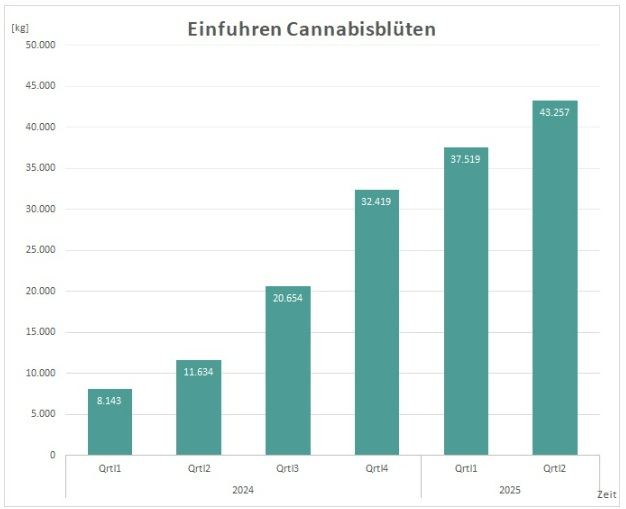
In the second quarter of 2025, Germany imported 43.257 tonnes of medical cannabis products according to BfArM’s data. That is an increase over the previous record set in Q1 2025 of 37.519 tonnes, and a significant increase compared to Q2 2024 when Germany imported 11.634 tonnes of medical cannabis products. Below is a graph of historical import totals from BfArM:

germany medical cannabis imports 2024 and 2025

“For us as the SPD, however, in addition to protecting and adequately advising patients, it is crucial to ensure reliable, local, and accessible care. Digital care is particularly important for people with chronic and/or serious illnesses, as well as in areas with inadequate primary care. Therefore, we will not support the current version of the bill under any circumstances.” Ms. Wegge also stated.

In the upcoming discussions, we will therefore develop a solution that will ensure that medicinal cannabis remains readily accessible to all patients who need it, while simultaneously ensuring patient protection. The initial draft bill from the Federal Ministry of Health will now be discussed with experts in the ministry and subsequently debated in the cabinet before a decision is made there and a potential draft bill from the ministry is submitted to the Bundestag. In the Bundestag, it will be discussed in the relevant specialist committees, and Struck’s Law applies, which stipulates that no bill leaves committee deliberations in the same condition as it was submitted. Many negotiation steps will therefore still take place before a possible decision is made in the Bundestag, and we as the SPD will advocate for a good solution for patients.” Ms. Wegge added.

“Even though we must primarily defend the drug policy achievements of the last legislative period, we will not lose sight of the goal. I remain convinced that full legalization of cannabis, in compliance with European law, and its sale in licensed specialist stores is the best way forward, and that medical care must be made as simple as possible. I can assure you that I will fight for political majorities that make this possible, and I will not shy away from discussions with the Union.” Ms. Carmen Wegge concluded.

(The featured image of this article of Bundestag member Carmen Wegge is a photo by Anna Voelske.)

High Tide To Become Major Player In German Medical Cannabis Market

High Tide, Inc. is a leading community-grown, retail-forward international cannabis company. Its wholly owned subsidiary, Canna Cabana, is the second-largest cannabis retail brand globally. In a major move for the company, High Tide has acquired a majority stake in Germany-based Remexian Pharma GmbH.

Founded in 2018 and headquartered just outside of Berlin, Germany, Remexian is an established medical cannabis pharmaceutical company specializing in the importation and wholesale of medical cannabis. As part of its business model, Remexian has a fully certified EU GDP warehouse.

Remexian is currently licensed to import medical cannabis products into Germany from 19 countries, including Canada, which represents approximately 33% of their total imports into Germany. Given its over $1.9 billion in Canadian cannabis sales since adult-use legalization, High Tide is well-positioned to further increase the Canadian share of medical cannabis imports into Germany.

“Remexian is an ideal match for us—not only in its commitment to discount pricing, but also in its operational approach, which mirrors our lowest price guarantee in Canada. We took our time evaluating potential partners and couldn’t be more excited to join forces with the best-in-class team that built Remexian into a national leader. Together, our complementary strengths and deep procurement expertise will create a stronger foundation for growth and further enhance the fundamentals of this business,” said Raj Grover, Founder and Chief Executive Officer of High Tide.

“With this highly accretive acquisition adding approximately C$100 million in topline revenue and significant EBITDA annually, we will meaningfully strengthen our financials, positioning us well to establish a strong foothold in Germany, which will serve as a springboard into other European markets in due course. Our goal in Germany remains clear: to provide the highest quality medical cannabis at the most affordable prices, led by our Canadian house of brands and supplemented by medical cannabis imports from all across the globe,” added Mr. Grover.

“We are truly energized by the strong synergy we’ve found with High Tide, whose impressive scale amplifies our impact in Germany,” said Markus Wenner, Co-Founder of Remexian. “Both of our companies have taken a deliberate, strategic approach to becoming leaders in our respective markets. By combining one of Germany’s largest cannabis distribution networks with High Tide’s unmatched access to Canadian supply, we are setting the stage for unprecedented growth. We at Remexian are looking forward to building this exciting future together with Raj and the talented High Tide team.”

Germany’s Federal Institute for Drugs and Medical Devices (BfArM) recently published medical cannabis import data for the second quarter of 2025, and once again, Germany’s emerging legal medical cannabis industry set a new record for import totals.

In the second quarter of 2025, Germany imported 43.257 tonnes of medical cannabis products according to BfArM’s data. That is an increase over the previous record set in Q1 2025 of 37.519 tonnes, and a significant increase compared to Q2 2024 when Germany imported 11.634 tonnes of medical cannabis products. Below is a graph of historical import totals from BfArM:

germany medical cannabis imports 2024 and 2025

Remexian has an annualized revenue and Adjusted EBITDA of €70 million and €15 million, respectively, for the six months ending March 2025. Remexian is currently one of the largest distributors of medical cannabis flower in Germany in terms of total grams sold, distributing the equivalent of 7 tonnes in Q2 2025, representing 16% of the 43 tonnes imported into Germany during the quarter.

Activists Gather Signatures For Cannabis Legalization Vote In Belize

Back in May 2025, cannabis advocates in Caye Caulker, Belize, launched a petition seeking to place an adult-use cannabis legalization measure on an upcoming local ballot. Caye Caulker is a small island off the coast of Belize in the Caribbean Sea.

The petition, led by Caye Caulker Village Councillor Ilya Rosado, needed to collect hundreds of signatures from registered voters to place it on the ballot in an upcoming election. Organizers were aiming for the Village Council elections on June 29, 2025, and missed that deadline, although they may have succeeded in getting it in front of voters in October 2025.

“The group, Legalize It Caye Caulker, has secured a major victory in its push for legislation to create a responsible, regulated, and taxable legal cannabis industry. The group’s petition aimed at triggering a referendum on marijuana legalization has been certified as successful by the Elections and Boundaries Department. The petition garnered 365 approved signatures, surpassing the required threshold of 25% of registered electors.” reported LoveFM in its local coverage.

“In a letter to Governor General Dame Froyla Tzalam, on July 31, the department stated that out of the 1,360 registered electors in Caye Caulker Village, 25% or 340 signatures were needed to validate the petition. A total of 380 signatures were submitted, and after a thorough review, 365 were approved, accounting for 26.84% of the total registered electors.” the outlet also reported.

When voters in Caye Caulker get the chance to vote on the petition, they will be asked, “Should the Government of Belize pass legislation to create a responsible, regulated, and taxable legal cannabis industry on the island of Caye Caulker, with a portion of the revenue going directly for the benefit of Caye Caulker and its residents?”

If the vote is held and the measure is approved, it doesn’t necessarily mean that it will become law automatically, even at a local level. Leadership from the Belize Ministry of the Public Service, Constitutional and Political Reform and Religious Affairs has already pushed back on the measure since it will be a local vote on a national issue.

“We have national laws. We don’t have laws that are specific to areas, to regions, and so on. And so certainly there is a school of thought that’s saying that a local election can only deal with local issues. It should not deal with national issues.” stated Henry Charles Usher, Minister of Governance. “We certainly will have to be guided by the attorney general. As I said, these are national issues that would have to be looked at, looking at national laws, looking at the national budget and so on. And so the attorney general will have to advise the government on the way forward.”

South African Researchers Detect “Rare Compounds” In Cannabis Leaves

The leaves of cannabis plants are often considered to be waste by some cannabis cultivators and destroyed. However, recent research conducted in South Africa is shedding new light on why cannabis leaves may contain useful compounds.

Two researchers affiliated with the Department of Chemistry and Polymer Science at the University of Stellenbosch conducted a “comprehensive two-dimensional liquid chromatographic analysis of cannabis phenolics,” with their findings being published in the Journal of Chromatography A.

“Compared to the well-studied cannabinoids and terpenoids, characterization of the phenolic composition of Cannabis has received little attention.” the researchers stated about their investigation. “With studies reporting synergistic effects in Cannabis, the importance of investigating polyphenols in Cannabis is becoming more apparent.”

“We report an on-line comprehensive 2D HILIC × RP-LC method hyphenated to high resolution (HR) MS for the detailed characterization of polar phenolics in Cannabis inflorescence and leaf samples of three commercial strains.” the researchers wrote. “Optimal HILIC × RP-LC conditions were derived using an automated method optimization program, and provided excellent separation performance (peak capacity > 3000) and high orthogonality. Diode array and HR-MS data enabled tentative identification of 79 compounds, comprising mainly flavone and (hydroxy)cinnamic acid derivatives.”

“The presence of three C-glycosylated flavones, as well as several of their O-glycosylated derivatives, distinguished one of the strains from the other two. In the same strain, flavoalkaloids were detected, mainly in the leaf extracts. The structures of the alkaloid moieties could not be unambiguously assigned based on the available HR-MS data, but four classes of flavoalkaloids comprising 16 flavone derivates could be tentatively identified.” the researchers found.

“This is the first time that this relatively rare and chemically interesting class of compounds has been detected in Cannabis. These findings highlight the diversity of Cannabis, and the utility of HILIC × RP-LC-HR-MS for the in-depth study of its phenolic composition.” the researchers concluded.

The results of this study in South Africa demonstrate that while humans know more about the cannabis plant now than ever before, there is still a lot left to be discovered, and that is true for the leaves of cannabis plants just as much as it is for other parts of the plant.

“Our analysis again highlights the medicinal potential of cannabis plant material, currently regarded as waste. Cannabis exhibits a rich and unique non-cannabinoid phenolic profile, which could be relevant from a biomedical research perspective,” stated Prof. André de Villiers, one of the authors of the study.

How Is Advanced Technology Transforming The Cannabis Industry?

Few other large international industries are being transformed by advanced technology at the same rate and scope as the emerging legal cannabis industry. Cannabis businesses worldwide are embracing advanced technology to optimize output and efficiency, which, in turn, is propelling the global industry forward.

Advanced technology can take on many forms, and for the emerging cannabis industry specifically, it often manifests itself as automated technology that helps cannabis producers and product manufacturers create the end products that consumers and patients purchase in legal markets. Programmed automation is drastically changing the way that cannabis is cultivated, how cannabis products are created, and how those products are stored and transported.

Another area where advanced technology is being integrated by cannabis companies is in the area of communications. Recent digital innovations have revolutionized how cannabis companies communicate with their customers and develop their brands.

How advanced technology is being harnessed by the emerging international cannabis industry was the focus of a panel discussion at the recent International Cannabis Business Conference in Berlin. The panel discussion was moderated by Canadian medical cannabis pioneer Alex Revich. Mr. Revich was joined on the panel by:

  • David Sandelman, Serial Inventor, Entrepreneur, and the Creator of Cannatrol Systems
  • Eral Osmanoglou, Co-Founder and Head of R&D at Becanex GmbH
  • Charlie Wang, Co-Founder and CEO of Cannvital NV LLC
  • Peter Machalek, Chief Revenue Officer of Greentank

You can view the panel discussion via this link here.

Autumn 2025 Could Be Pivotal For German Cannabis

As the summer months of 2025 are coming to an end and the autumn season approaches, the eyes of the international cannabis community will continue to be fixed on Germany, where policymakers, regulators, and researchers are expected to make some major announcements that could prove to be pivotal for the future of Germany’s industry.

The first interim report from the ongoing EKOCAN evaluation of Germany’s Consumer Cannabis Act (KCanG) is scheduled for release on October 1, 2025. The evaluation will consider, among other things:

  • Consumption rates and behaviors of various age groups
  • Cannabis use prevention among youth
  • Impact on public health outcomes, including mental health
  • Public roadway safety
  • Impacts on criminal activity
  • Impacts on Germany’s court system

“To this end, a wide variety of data will be compiled (e.g., from ongoing studies on the topic or from public administration), our own surveys will be conducted (e.g., with public organizations directly involved in the topic, as well as consumers and cultivation associations), and the data will finally be evaluated with regard to the aforementioned overarching objectives.” states the Federal Ministry of Health (BMG) on its website (translated from German to English).

“The evaluation will make an important contribution to answering the question of how the law is being implemented in everyday life and whether the intended effects of the law are being achieved. Furthermore, the evaluation should provide reliable evidence for potentially necessary legislative adjustments.” BMG also states.

Some initial findings from the EKOCAN project and its project manager, Dr. Jakob Manthey, have already surfaced via original reporting by krautinvest. One of the major takeaways from the initial findings is that reported cannabis consumption rates were already on the rise in Germany leading up to the enactment of the CanG law, and Dr. Manthy determined that the rise was due to older individuals reporting cannabis use.

Regarding younger consumers, which is a demographic often focused on by cannabis opponents in their talking points, Dr. Manthy “sees no anomalies since the Cannabis Act came into force,” according to krautinvest’s reporting, and that Dr. Manthy doesn’t assume “that any changes can be attributed to the Cannabis Act.”

Other high-level takeaways from the initial evaluation findings are that there aren’t enough cannabis cultivation associations in Germany, that there are no “short-term changes” regarding public roadway safety, legalization has not increased reported mental illnesses, and that the CanG law has significantly lowered cannabis-related criminal offenses in Germany. It will be interesting to see if those initial findings are included in the upcoming interim report in October.

Another major item that members of the cannabis community inside and outside of Germany need to have on their radars relates to decisions on pending applications for regional adult-use cannabis commerce pilot projects. The pending applications and looming decisions were touched on in the German Cannabis Business Association’s (BvCW) recent newsletter.

“To date, 58 applications for research projects have been submitted under Section 2 (4) of the KCanG, 32 of which are so-called model projects. The first decisions on applications by the Federal Office for Agriculture and Food are expected in the third quarter of 2025.” BvCW wrote in its newsletter this week (translated from German to English).

Regional adult-use cannabis commerce pilot trials are part of the second phase of Germany’s legalization model, and were initially expected to launch by the end of 2024. However, German pilot launches have experienced a series of delays.

Hopefully the delays have run their course, and approvals will be announced soon. Adult-use pilot trials are already operating in the Netherlands and Switzerland, with no major issues being reported.

Half Of Guernsey’s Deputies Support Cannabis Decriminalization

Guernsey is the second-largest island located in the English Channel, and a self-governing British Crown dependency. Guernsey, which is located near the French coast, has experienced increasing momentum for cannabis policy modernization in recent years.

A survey of policymakers in Guernsey was conducted back in 2022, asking if they supported cannabis reform, and more than half expressed support for at least taking a look at how cannabis is governed. A more recent survey has found that half of Guernsey’s deputies currently support reform.

“Half of Guernsey’s deputies support decriminalising cannabis, according to research by the BBC.” reported BBC in its local coverage. “Eleven of the island’s 38 politicians have said they are either undecided on the issue, or will wait to see any proposals before making a decision.”

“While four have expressed their opposition, while (sic) 19 supported plans to decriminalise the Class B drug locally.” the outlet also reported.

Even if the current push to update Guernsey’s cannabis laws proves to be successful at a local level, there is no guarantee that the modernized policy approach will be enacted. This is due to the concept of ‘royal assent.’ A somewhat recent example of the royal assent concept blocking cannabis policy reform can be found in the unfortunate case of Bermuda.

A historic cannabis reform measure was passed by lawmakers in Bermuda in 2022. However, because Bermuda is a British Overseas Territory, all new laws have to receive royal assent, signifying the monarchy’s approval of the locally approved law.

The Governor of Bermuda at the time, who was appointed by the United Kingdom, did not provide royal assent to Bermuda’s measure, effectively vetoing the approved measure. In 2023, the denial of royal assent was hinted at in Guernsey, and there is currently no evidence that the monarchy’s opinions have changed on the matter.