Hydrophobic Protective Layer Could Open New Applications For Hemp

The hemp plant is arguably the most useful and versatile crop in existence, with humans having made use of it for thousands of years for a wide array of applications. Yet, there is still a lot more to be learned about how humans can make the most out of hemp harvests, as demonstrated by the findings of a recent study in China.

A team of researchers based in China recently examined how incorporating a silicone-containing, water-based polyurethane coating impacts hemp fabric and paper’s level of water resistance and their mechanical stability.

“Hemp fabric and cellulose paper are sustainable materials with high application potential – but their limited water resistance and mechanical resilience hinder their wider industrial use.” reported European Coatings in its original coverage of the research. “A research team from China has now developed a functionalised coating that addresses these weaknesses: A water-based polyurethane acrylate coating with silicone components (WPUASi) increases both the hydrophobicity and the strength of the substrates.”

“The emulsion, which is based on an interpenetrating polymer network (IPN), was applied to hemp textiles and filter paper. The water contact angle (WCA) increased from 0° to 127.5° for hemp and to 113.2° for paper. The mechanical characteristics also improved significantly: the tensile strength of the hemp fabric increased by 19 % and the folding strength of the filter paper increased 23-fold.” European Coatings also wrote.

The researchers also applied the protective layer to other materials, including cotton and wood, and it yielded similar results. For hemp specifically, the emulsion seemed to properly adhere, as proven by the treated hemp material retaining ‘most of its hydrophobic and mechanical properties’ after ‘several washing cycles.’

Further research will need to be conducted to see what new ways hemp can be used after being treated with a coating like the one at the heart of this investigation in China. Entrepreneurs and innovators around the globe will no doubt explore a multitude of possibilities, both for industrial applications and beyond.

A team of researchers affiliated with Universitat Politècnica de Catalunya-BarcelonaTech (Spain) and Dresden University of Technology (Germany) recently conducted a separate study that examined hemp and mechanical-chemical cottonization. The results of the study were published in the academic journal Cellulose.

“The hemp treated with a high level of H2O2 stabilizer, according to the established experimental design for the oxidizing process, exhibited superior performance when blended with cotton and spun with a count of 40 tex and a twist coefficient (αm) of 170. These outcomes are of industrial interest for the production of fine yarns because they can be easily implemented using existing machinery devoted to processing cotton.” the researchers determined.

Advances in hemp research increase the potential for the global hemp market. During a recent presentation at the International Cannabis Business Conference in Berlin, leading international cannabis industry economist Beau Whitney, founder of Whitney Economics, provided data demonstrating that the value of the global industrial hemp industry could be as much as $456.2 billion.

South African Authority Warns Against Fraudulent Service Providers

As South Africa’s emerging legal cannabis industry continues to increase in size and scope, the nation’s regulators are warning against fraudulent service providers. People and entities are reportedly falsely claiming to be accredited by the South African Health Products Regulatory Authority (SAHPRA).

“The watchdog says it has learned about a troubling trend of individuals and businesses using falsified licences to deceive the public and carry out unregulated operations, putting lives at risk. The warning comes amid the booming popularity of cannabis-infused products in South Africa, from beverages and snacks to baked goods.” reported Health E-News.

“SAHPRA CEO Dr Boitumelo Semete-Makokotlela says in a statement that the rapid spread of cannabis dispensaries in shopping malls, many of which are openly displaying copies of alleged SAHPRA licences, is concerning.” the outlet also reported.

South Africa is on a short list of countries that have adopted national adult-use cannabis legalization measures. South Africa is joined on the list by Uruguay, Canada, Malta, Luxembourg, and Germany. The Czech Republic also recently announced plans to adopt a national measure.

Additionally, two dozen states in the U.S. have adopted recreational cannabis legalization measures, and regional adult-use cannabis commerce pilot trials are operating in both the Netherlands and Switzerland.

The legal cannabis industry in South Africa is still in its infancy by many measures. However, it has the potential to become a continental and international leader, as discussed in a recent article authored by Johann Slabber, CEO of South Africa-based Nexus Pharma.

“Our unique combination of favourable climate conditions, low-cost agricultural production, and access to skilled labour positions us as a highly competitive player. However, what’s still largely missing is a coherent and visible national narrative.” Mr. Slabber recently wrote for CannaBiz Africa after attending the International Cannabis Business Conference in Berlin, Germany.

“With the right frameworks, storytelling, and international engagement, we have the potential to become a powerhouse in the global cannabis economy.” he also wrote.

Approved German Cannabis Cultivation Association Total Increases To 234

Starting on July 1, 2024, adults in Germany can apply to launch a member-based cannabis cultivation association. Cultivation associations are one of the main legal channels from which German adults can legally source recreational cannabis, along with home cultivation.

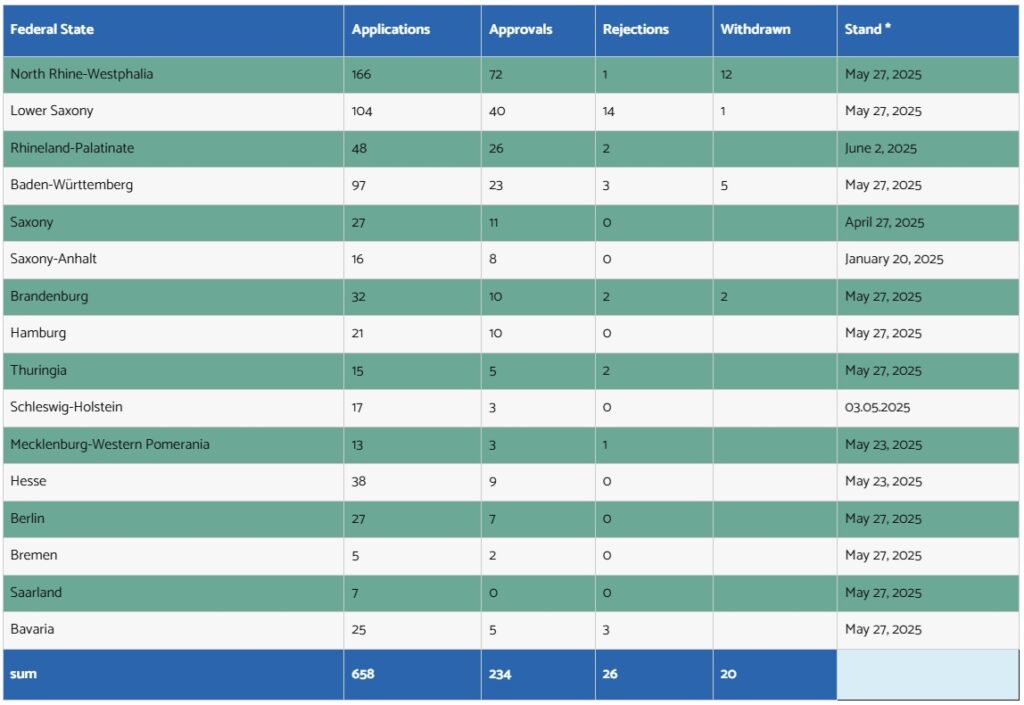
According to the most recent statistics from the Federal Association of Cannabis Cultivation Associations (BCAv), there are now 234 cultivation associations in Germany that have received approval out of 658 applications submitted.

The updated statistic was included in the organization’s most recent newsletter as part of the table below, which provides a breakdown of associations approved by region:

BCAv German cultivation associations approved as of June 13 2025

As you can see from the data listed in the table, North Rhine-Westphalia has issued the most approvals, while Lower Saxony has issued the most rejections. Unfortunately, cultivation association approvals in Bavaria have proven to be a persistent challenge.

“In Bavaria, the licensing process for cannabis clubs remains restrictive. Although more than 200 cultivation associations have already been approved nationwide, the Bavarian State Office for Health and Food Safety has only issued three licenses – including the “CSC Inntal Raubling”“Exotic Kingdom CSC Fulda” and “The Marihuana Club Kirchdorf”according to the FAZ .” BCAv stated.

“The majority of Bavarian applications, however, are still being processed, which is putting financial strain on numerous initiatives or forcing them to abandon them.” BCAv also wrote in its recent newsletter. “Critics accuse the state government of political obstruction. While the number of cannabis offenses in Bavaria has declined significantly, the black market continues to benefit from the lack of legal access.”

Pakistan Is Allocating Funds For Medical Cannabis And Hemp Production

Over a year ago, Pakistan’s government approved the creation of a cannabis regulatory agency to oversee the nation’s emerging legal industry. The Cannabis Control and Regulatory Authority Ordinance 2024 resulted in the creation of the Cannabis Control and Regulatory Authority, which reportedly involves a 13-member board of governors, chaired by Pakistan’s Secretary of the Defense Division.

Pakistan’s emerging legal medical cannabis and hemp industries received a boost recently with the announcement that the nation’s government will be allocating a significant amount of public funding, Rs. 1.95 billion, toward medical cannabis and hemp production.

“The project, approved by the Departmental Development Working Party (DDWP) in December 2021, aims to lay the foundation for a regulated and science-driven cannabis industry in Pakistan.” reported Propakistani in its local coverage.

“It includes the development of advanced greenhouses for medical cannabis cultivation, the establishment of a national analytical laboratory to ensure quality and compliance, and the formation of a central authority to oversee industrial hemp and medicinal cannabis activities.” the outlet also reported.

Cannabis industry licenses in Pakistan are expected to be valid for five-year periods, and a maximum harvest threshold of .3% THC will be enforced. Pakistan first approved hemp farming and related industrial processing back in September 2020.

Pakistan’s main exports are currently textiles, cotton, yarn, rice, and leather products. An industry projection from August 2022 estimated that a thriving hemp industry in Pakistan could be worth multiple billions of dollars annually. Many kush cannabis strains originated in the Pakistan region.

At the recent International Cannabis Business Conference in Berlin, leading international cannabis industry economist Beau Whitney, founder of Whitney Economics, estimated that the potential global medical and adult-use cannabis market is roughly $237.8 billion. Mr. Whitney estimated that the value of the global industrial hemp industry could be $456.2 billion.

LEAP Germany Calls For Expanding Legal Options For Obtaining Cannabis

The organization Law Enforcement Against Prohibition (LEAP) originated in the United States, where it has been highly effective in advocating for sensible cannabis reform. LEAP is made up of current and former members of law enforcement who recognize that cannabis prohibition is harmful and a failed public policy, and that regulation is a better approach.

LEAP has expanded internationally and launched chapters in other countries, including Germany, where leadership recently issued a public letter addressed to the nation’s new Federal Government Commissioner for Addiction and Drugs, Hendrik Streeck. Below is LEAP Germany’s letter (translated from German to English):

Dear Mr. Streeck,

on behalf of the entire board of LEAP Germany, I, along with many others, congratulate you on your appointment as the new Federal Government Commissioner for Addiction and Drugs and wish you every success and every success in this role. We would be delighted to continue the constructive and trusting collaboration we began with your predecessor in shaping addiction and drug policy in Germany.

LEAP Germany is a non-profit association founded in 2015 that recruits its members primarily from law enforcement agencies, the criminal justice system, and the criminal justice system.

With this professional background, we advocate for an evidence-based addiction and drug policy that recognizes that prosecuting drug users is the wrong approach to adequately protect the health of this group of people. There is broad consensus among experts that drug policy based on prohibition
has completely failed in terms of its own objectives. In particular, the general preventive effect intended by criminal prosecution has not been achieved, according to all available figures and findings.

The Consumption Cannabis Act, which came into force on April 1, 2024, and the further development of the use of cannabis for medicinal purposes were a first, albeit insufficient, step towards a
scientifically sound drug policy. As LEAP Germany, we had numerous opportunities to contribute our professional expertise during this legislative process. In just the first nine months, this law resulted in more than 110,000 fewer police investigations being initiated by the police nationwide than in the previous year, according to the police crime statistics. 110,000 fewer suspects and thus those affected by stigmatization – a true success.

Much remains to be done, not only with regard to the upcoming evaluation of the Consumption Cannabis Act. As law enforcement officials, we have a strong interest in significantly expanding the options for legally obtaining cannabis for consumers. Effectively reducing the black market in a context of continued high demand is urgently needed for criminological and health policy reasons.

We would be happy to discuss these and other issues with you, Mr. Streeck, in due course. Since you have advocated for an evidence-based addiction and drug policy without a warning finger in your initial public statements, we see a good basis for professional exchange. We would be pleased to receive an invitation to your office in Berlin.

Sincerely,

Hubert Wimber for the board of LEAP Germany

German Lawmaker: Raising THC Limit For CBD Flowers Is “A Sensible Step”

As governments and courts around the world seem to continue to struggle with policies and regulations pertaining to hemp-derived cannabidiol (CBD) products, especially ‘cannabis light’ flowers, one lawmaker in Germany recently expressed her support for raising the THC limit for CBD flowers in her country.

Carmen Wegge is a German politician from the Social Democratic Party (SDP). Ms. Wegge has served as a member of the Bundestag since 2021. She was recently asked a question about Germany’s THC limit for CBD flowers on the platform Abgeordnetenwatch.

“What is the current position of the federal government on CBD flowers with tax stamps?” asked Johannes H. “Furthermore, the question arises as to whether an increase in the maximum permitted THC content in CBD flowers to 1% is being considered – as is already the practice in Switzerland and Italy.”

The individual posing the questions pointed out that “around 95% of the natural CBD flowers” being sold in Germany originate from Switzerland or Italy, and that increasing the THC limit for CBD flowers in Germany “would make sense both from a health policy and economic perspective.”

Late last month, a company in Germany (Sanaleo) received the nation’s first-ever tax stamp from the General Customs Directorate of Neustadt an der Weinstraße for its THC-free flowers. Sanaleo’s CBD flower products are now subject to Germany’s tobacco tax in addition to the 19% VAT. However, it remains to be seen what impact the tax stamp issuance will have on the wider CBD flower sector.

Germany implemented the first provisions of its CanG adult-use legalization law on April 1st, 2024, which permits the nation’s adults to cultivate, possess, and consume cannabis flowers with no THC limit. However, CBD flowers remain popular in the European country.

“Personally, I consider the scientifically justified increase in the permissible THC content in industrial hemp products – including CBD flowers – to 1% to be a sensible step. The example of Switzerland shows that such a limit is possible without creating a significant potential for abuse. The EU Commission has also already decided to increase the permissible THC content for industrial hemp grown in the field from 0.2% to 0.3% – which was a first small step in the right direction.” Ms. Wegge stated in her response to the inquiry (translated from German to English).

“I believe legally secure and health-oriented regulation for CBD products is urgently needed. This includes a discussion about raising the THC limit for industrial hemp if scientific findings show that this does not pose an increased potential for abuse. Such an adjustment could not only create legal clarity but also strengthen the domestic economy and facilitate imports – without compromising consumer safety. I will therefore continue to advocate in parliament for a coherent, fact-based, and Europe-compatible hemp policy in Germany.” Carmen Wegge concluded.

(The featured image of this article of Bundestag member Carmen Wegge is a photo by Anna Voelske.)

Study: Cannabis Legalization Not Associated With Increased Adolescent Use

Modern cannabis prohibition policies were enacted starting in the early 1900s, and since that time, cannabis advocates around the world have worked very hard to reform laws that prohibit cannabis activity, including cannabis commerce.

Leading up to cannabis reform votes and implementation, cannabis opponents often make predictions that such reforms will result in increased cannabis use by adolescents. A team of international researchers based in Australia and the Czech Republic recently conducted a study focusing on the topic of cannabis reform and adolescent usage rates.

The study’s findings were published in the academic publication International Journal of Drug Policy.

“Several jurisdictions have pursued reforms that regulate cannabis production and/or sale for adult (non-medical) use. Looking at outcomes of such reforms across multiple jurisdictions may help to identify outcomes that are inherent to non-criminal cannabis supply, as well as provide insight into the outcomes of specific regulation models.” the researchers wrote about their study.

“We identified nine indicators of cannabis policy outcomes and aggregated them into three domains (social outcomes, outcomes in cannabis use, health-related outcomes). We assessed these outcomes across five jurisdictions with different models of regulating cannabis supply (Netherlands, Spain, U.S. states that legalized cannabis, Uruguay, and Canada).” the researchers wrote about their methodology.

“We used a three-level systematic literature review, prioritising studies with quasi-experimental design (i.e. comparative and longitudinal). We categorised the studies according to their design and the type of outcome (increase, decrease, or no outcome).” they also wrote.

Currently, recreational cannabis sales are limited to adult residents in Uruguay. Canada permits recreational cannabis sales to anyone of legal age. The Netherlands limits legal sales to participants of regional adult-use cannabis commerce pilot trials, fewer than half of the states in the U.S. permit adult-use sales, and sales in Spain operate in a ‘legal grey area.’

“Across long-standing as well as recent cannabis supply regimes, and across different models of cannabis supply, our review identified common outcomes: a decrease in cannabis-related arrests, an increase in adult (but not adolescent) cannabis use, and increase in healthcare utilization (not traffic-related).” the researchers found.

“Regulating cannabis supply may be associated with benefits in the social area and with potential harms regarding public health; there may though be trade-offs depending on the choice of a cannabis regulation model. Jurisdictions may attempt to mix and match the present models of cannabis regulation to achieve the best ratio of benefits and harms.” the study’s authors concluded.

Cannabis is also legal for adult use at a national level in Malta, Luxembourg, Germany, and South Africa. However, of those countries, only Malta and Germany currently provide legal channels for acquiring recreational cannabis beyond home cultivation. Both Malta and Germany are home to legal member-based cultivation associations. Adult-use cannabis legalization is also expected to be implemented soon in the Czech Republic.

Switzerland is another jurisdiction where regional adult-use cannabis commerce pilot trials are operating. The largest regional adult-use cannabis pilot trial in Switzerland is operating in Zurich, where a total of 4,400 people between the ages of 18 and 80 are participating.

“Over 90 percent of participants now obtain their cannabis products from legal sources, i.e. from one of the three specialist stores or one of the nine pharmacies taking part.” Blue News reported about Zurich’s pilot trial.

Another jurisdiction in Switzerland participating in regional adult-use cannabis commerce pilot trials is Basel. The results of a previous study, which was the first academic reporting of its kind, were published on the University of Basel’s website in addition to being published in the academic journal Addiction.

“Public health-oriented recreational cannabis access may decrease cannabis use and cannabis-related harms, especially among those using other drugs.” the researchers of that study concluded.

“Furthermore, the study was able to dispel fears that legalization could exacerbate the psychopathological symptoms associated with cannabis consumption in addition to consumption itself: after the first six months, there was no difference between the two study groups in terms of depression, anxiety or other symptoms.” stated the University of Basel on its website.

“The interim assessment after two years of study shows a significant improvement in the mental state of the approximately 300 or so participants who are still taking part.” the University also wrote.

Earlier this year, Marijuana Moment reported that a government-commissioned report found that  Switzerland’s adult-use cannabis legalization pilot program is “running smoothly,” with “no indication of any disturbances to public order.”

“About two years after the pilot program launched in seven municipalities across the country, the Federal Office of Public Health (FOPH) study—carried out by the University of Lausanne and the University of Applied Sciences Northwestern Switzerland—generally determined that the initiative has been a success.” the outlet also reported.

Previously published government data from the United States found that in jurisdictions where adult-use cannabis legalization was adopted, consumption rates among minors had reduced post-legalization compared to pre-legalization. The results of a Canadian study that was published earlier this year found that while reported overall cannabis use in Canadian society increased post-legalization, “misuse decreased.”

Cannabidiol Found To Be An Effective Antifungal Treatment

A team of academic researchers based in Australia and the United Kingdom recently collaborated on a study examining cannabinoids and their ability to be used in antifungal treatment regimens. The researchers found cannabidiol (CBD) and cannabidivarin (CBDV) to be particularly effective.

“Fungal infections pose a major threat to human health with increasing incidence of antifungal resistance globally. Despite the need for novel antifungal drugs, few are currently in clinical development.” the researchers wrote. The study’s findings were published in the academic database PLOS.

The cannabis plant is made up of dozens of cannabinoids, with CBD being a particularly popular cannabinoid in recent years for researchers. CBDV is a lesser-known cannabinoid, and research focused on it is more limited compared to CBD and tetrahydrocannabinol (THC).

“Here we evaluate the antifungal activity of five phytocannabinoids against several clinically relevant fungal pathogens, with a focus on the priority pathogen Cryptococcus neoformans.” the team of researchers stated in their published review. “Our results demonstrate that Cannabidiol (CBD), and particularly Cannabidivarin (CBDV), have broad activity against C. neoformans and other fungal pathogens, including dermatophytes that cause common tinea.”

“We found that both CBD and CBDV acted in a fungicidal manner and prevented biofilm formation in C. neoformans. Phytocannabinoid treatment impeded factors important for virulence and antifungal resistance, including reduced capsule size and disruption of mature biofilms. Proteomics analysis revealed that the antifungal activity of CBD and CBDV was linked to destabilisation of the membrane, alterations in ergosterol biosynthesis, disruption of metabolic pathways, as well as selective involvement of mitochondrial-associated proteins.” they also wrote.

“We next tested the ability of CBD to topically clear a C. neoformans fungal infection in vivo using the Galleria mellonella burn wound model, and we observed greatly improved survival in the CBD treated larvae. This study illustrates the potential of phytocannabinoids as antifungal treatments and opens up new routes towards development of novel antifungal drugs.” the study’s authors concluded.

A recent market analysis by Emergen Research determined that “the Cannabidiol (CBD) Consumer Health Market is expected to grow from USD 20.52 billion in 2024 to an estimated USD 81.76 billion by 2033, at a compound annual growth rate (CAGR) of 16.60%.”

Albania Government Approves Medical Cannabis Cultivation

As medical cannabis policy and regulatory reform continues to sweep across the European continent, the latest country to witness modernization approval by lawmakers is Albania, where the nation’s government reportedly approved licenses for a significant amount of medical cannabis and industrial hemp cultivation.

“The Albanian government has approved the cultivation of cannabis for medical and industrial purposes, issuing licenses covering 29,000 hectares of land stretching from the north to the south of the country — a move hailed by officials as a boost to the economy but sharply criticized by the opposition and experts as a potential gateway to state capture by organized crime.” reported Tirana Times in its local coverage.

“While the official legal cap for cultivation remains 200 hectares, the government’s preliminary license allocations suggest a far greater scope — one that opposition figures claim could result in the planting of over 1.4 billion cannabis plants.” the outlet also reported.

According to the European Monitoring Centre for Drugs and Drug Addiction (EMCDDA), Albania is “the largest outdoor producer of cannabis in the region and there has recently been an increase in indoor cannabis cultivation.”

“In Albania, following a peak in 2017 when over 78 tonnes of herbal cannabis were seized, a steep downward trend was noted, with only 4.3 tonnes seized in 2020 and, according to preliminary data, approximately 3.6 tonnes in 2021.” EMCDDA also reported.

The emerging legal cannabis and hemp industries allow Albania’s farmers to cultivate their crops legally and to have their harvests provided to domestic and international medical patients rather than the unregulated market. However, that opportunity is only as good as the laws and regulations that are implemented in the Balkan country.

At the recent International Cannabis Business Conference in Berlin, leading international cannabis industry economist Beau Whitney, founder of Whitney Economics, estimated that the potential global medical and adult-use cannabis market is roughly $237.8 billion. Mr. Whitney estimated that the value of the global industrial hemp industry could be $456.2 billion.