U.S. Cannabis Industry Capital Is Tighter, But Still Flowing

The emerging legal cannabis industry in the United States continues to mature and evolve, and that is particularly evident when it comes to businesses raising capital. Investors are being more strategic than ever when it comes to funding cannabis companies in the U.S., and that, in turn, is resulting in industry operators having to update their approaches and strategies.

Fortunately, cannabis industry capital is still flowing in the U.S., albeit in a more competitive environment. It is more important than ever for cannabis startups and established companies to perform adequate due diligence, craft pitches that resonate with investors, and network effectively.

Attending worthwhile conferences is a must these days, and the upcoming Benzinga Cannabis Capital Conference is a great opportunity for members of the United States cannabis space. The event is taking place on June 8th-10th, 2025, in Chicago, Illinois, at the Marriott Magnificent Mile. Top industry leaders, entrepreneurs, and investors will gather to learn about the new fundraising landscape, build meaningful industry relationships, and ultimately get deals done.

The United States cannabis industry is continuing to increase in size and potential. Leading international cannabis economist Beau Whitney, founder of Whitney Economics, estimates that legal cannabis sales in the U.S. topped $30 billion in 2024. That figure does not include sales involving hemp-derived cannabinoids. Whitney projects that legal sales will top $34 billion in 2025, a roughly 13.1% increase compared to 2024.

“Even in today’s environment, capital is getting deployed. It’s just happening differently,” says Javier Hasse, strategic advisor at Benzinga. “Founders are pivoting, investors are more strategic, and new deal structures are emerging. This year’s conference will bring those conversations to the forefront and help the entire ecosystem adjust and thrive.”

The Benzinga Cannabis Capital Conference will feature:

  • 2,000+ attendees
  • 120+ speakers across business, investment, branding, and policy
  • 3,000+ meetings booked in advance
  • 40+ curated networking tables
  • A buzzing 7th-floor exhibit hall where deals and conversations happen nonstop
  • Hundreds of investors in the room, from early-stage VCs to institutional firms

The event is packed with expert speakers and presenters, including (but not limited to):

  • Kim Rivers (Trulieve)
  • George Archos & Aaron Miles (Summer)
  • Charlie Bachtell (Cresco Labs)
  • Beena Goldenberg (Organigram Global)
  • Vic Mensa (93 Boyz)
  • Matt Hawkins (Entourage Effect Capital)
  • Christelle Gedeon (Canopy Growth)
  • Kristi Palmer (Kiva Confections)
  • Tim Seymour (CNBC / Seymour Asset Management)
  • Cameron Forni (Adaptaphoria)
  • Paul Weaver (Boston Beer Co. – TeaPot)
  • Dan Ahrens (AdvisorShares)
  • Brady Cobb (Sunburn Cannabis)
  • Dr. Chanda Macias (Women Grow)
  • Ricardo Baca (Grasslands)
  • Rachelle Gordon (GreenState)
  • Rachel Wright, CPA (Verdant Strategies / 420 CPA)
  • Leah Heise, Irina Dashevsky, Gary Santo, Samantha Gleit, Cy Scott, and many more

To enhance the conference experience and help effectively map out their plans, a new conference app was launched. It includes the following features, which are built for business:

  • Access and message the full attendee list
  • Book meetings directly
  • Build custom schedules
  • Receive real-time updates
  • Enter raffles for prizes (winners announced at the closing party)

Through partnerships with organizations like Women Grow and BIPOCann, Benzinga provides earned opportunities for women and minority-owned cannabis businesses to access stage time, exhibit space, and investor connections.

“Benzinga has opened the doors of access for our community, and we are ready to drive innovation and growth.” stated Dr. Chanda Macias, CEO of Women Grow.

The conference will also involve a closing night afterparty titled ‘The Final Spark’ on June 10th from 9 pm to after midnight. The afterparty, to be held at the Tunnel Treehouse Rooftop and hosted by Dickinson Write, gives attendees one last chance to close deals with a skyline view of Chicago.

To find out more about the conference and to book your tickets before the event sells out, go to: www.benzinga.com/cannabis-conference

CBD Associated With Improved Memory In Preclinical Models

Worldwide, Alzheimer’s disease is the most common cause or type of dementia, with an estimated 60-70% of global dementia cases involving an Alzheimer’s diagnosis. That works out to roughly 34.2 million to 39.9 million cases. The condition is characterized by progressive memory loss and cognitive decline.

A team of researchers affiliated with several health and academic institutions in Spain recently conducted a study examining the use of cannabidiol (CBD) and its potential as a treatment for Alzheimer’s disease. The study’s findings were published in the academic journal Alzheimer’s Research and Therapy.

“This study employs in vitro and in vivo methodologies to validate CBD’s potential as a treatment for Alzheimer’s disease (AD) by addressing key hallmarks of the condition and promoting neuroprotective effects on spatial memory.” the researchers stated about their methodology.

“Our findings demonstrate CBD’s ability to decrease pTau and Aβ aggregation and to mitigate their axonal transport between cortical and hippocampal neurons.” the researchers wrote. “Moreover, CBD treatment was shown to reduce neuroinflammation, as CBD was able to skew microglia towards a neuroprotective M2 phenotype while attenuating proinflammatory cytokine release in the 5xFAD AD mouse model.”

“Notably, daily CBD injections (10 mg/Kg) for 28 days in 5xFAD mice resulted in significant improvements in both short- and long-term spatial memory. The study also reveals CBD’s capacity to partially revert neurite formation loss induced by Aβ, Tau, and pTau proteins, suggesting a potential role in promoting neuronal plasticity.” the researchers added. “Additionally, CBD treatment led to a reduction in reactive oxygen species (ROS) formation and increased neuronal viability in the presence of AD-associated protein aggregates.”

The full structure of cannabidiol was first identified in 1964 by Raphael Mechoulam and his colleagues in Israel. Since that time, cannabis prohibition policies have largely hindered CBD research, however, the cannabinoid has become the focus of investigations at an increasing rate in recent years.

“These multifaceted effects of CBD, ranging from molecular-level modulation to behavioral improvements, underscore its potential as a comprehensive therapeutic approach for AD.” the Spanish researchers concluded about their study. “The findings not only support CBD’s neuroprotective properties but also highlight its ability to target multiple pathological processes simultaneously, offering a promising avenue for future AD treatment strategies.”

According to a recent CBD industry analysis by Grand View Research, “the global cannabidiol market size is expected to reach USD 22.05 billion by 2030,” which is “a CAGR of 15.8% from 2025 to 2030.”

UK Poll Finds Majority Support For Decriminalizing Cannabis

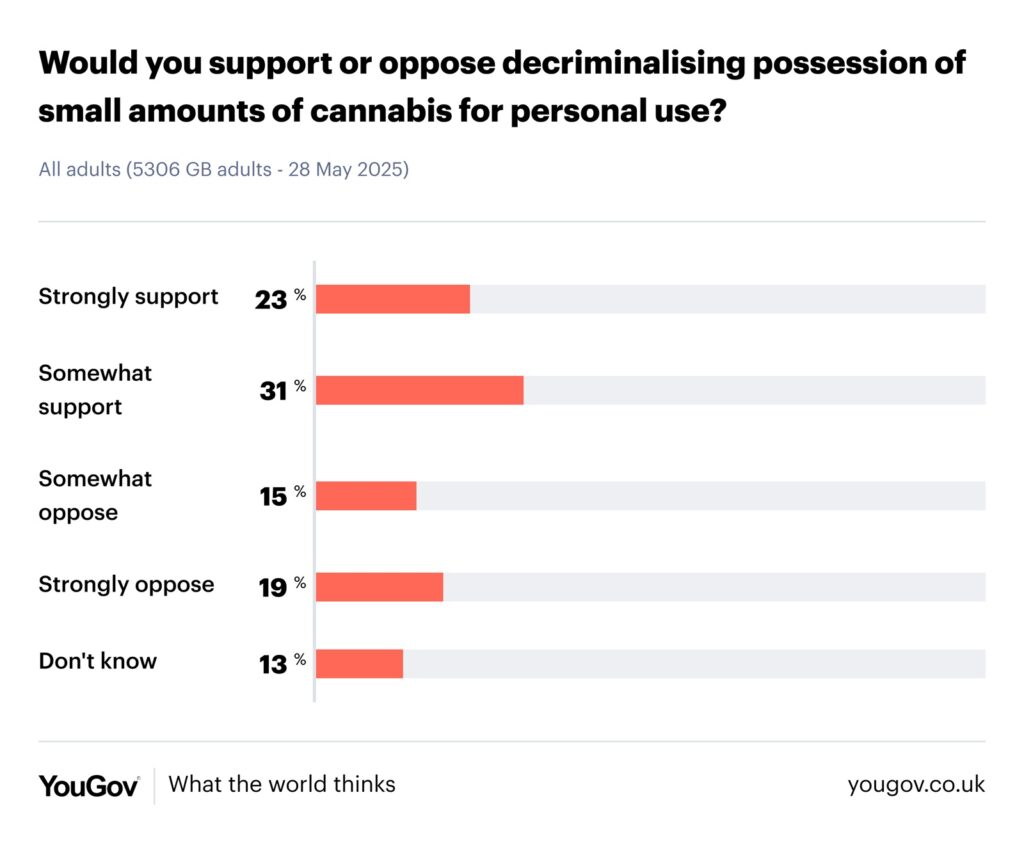
A YouGov UK poll was conducted on May 28th, 2025, the same day that news broke about the London Drugs Commission recommending that cannabis be decriminalized. London Mayor Sir Sadiq Khan, who established the Commission in 2022, quickly endorsed the cannabis decriminalization recommendation.

The YouGov UK poll asked adults in the United Kingdom, “Would you support or oppose decriminalising possession of small amounts of cannabis for personal use?” Below are the results of the poll:YouGov UK Cannabis Decriminalization Poll Results May 28 2025

As you can see from the YouGov UK poll data above, a combined 54% of poll respondents expressed support for the public policy change. Only 34% of poll respondents directly opposed cannabis decriminalization in the United Kingdom, with 13% being undecided.

When the results are filtered by region, support for cannabis decriminalization is even stronger in London, with a combined 56% of survey respondents expressing support for decriminalization, and only 30% of respondents directly opposing it. As is often the case with cannabis policy modernization polls, younger respondents were more likely to support decriminalization compared to older respondents.

“Inclusion of cannabis as a Class B drug in the Misuse of Drugs Act is disproportionate to the harms it can pose relative to other drugs controlled by the Act. The sentencing options currently available, especially for personal possession, cannot be justified when balanced against the longer-term impacts of experience of the justice system, including stop and search, or of serving a criminal sentence can have on a person.” The London Drugs Commission stated about its report earlier this week.

“Sir Sadiq Khan said current rules “cannot be justified”, adding that the commission’s findings had provided “a compelling, evidence-based case” for decriminalisation.” reported BBC in its local coverage.

A previous YouGov UK poll found that the level of support for cannabis legalization among adults in the United Kingdom is greater than the level of support for adult-use legalization among lawmakers.

“The results show that 50% of MPs are opposed to cannabis legalisation when asked in a support/oppose format, compared to 39% who would be in support.” YouGov UK stated about their January 2025 poll results. “The large majority of MPs do, however, believe that doctors should be allowed to prescribe cannabis for medical use (83%). Only 7% are opposed.”

“On the binary question of legalising cannabis, the British public are split, with 45% in favour and 42% opposed, making the public slightly more pro-legalisation than MPs.” YouGov UK also stated.

Adult-use cannabis legalization in the United Kingdom could generate as much as £1.5 billion in revenue and savings, according to a previous report by the advocacy group Transform Drug Policy Foundation.

The report, which was posted on the organization’s social media account back in March, determined that over £1.2 billion would be generated from taxes and fees annually, and an additional £284 million would be saved annually by the nation’s criminal justice system no longer enforcing cannabis prohibition policies.

“There would be costs incurred for Govt by regulatory infrastructure – inspection, monitoring, compliance, trading standards etc – but largely covered by licensing/other fees.” the organization stated on social media.

Transform Drug Policy Foundation also determined that “up to 15,500 full-time jobs could be created in cultivation, manufacturing, retail & related services, (depending on the model implemented).”

The report also found that “a regulated market could displace 80% of the illegal trade in five years (based on trends in Canada).” The organization’s proposed legalization model involves permitting home cultivation, cultivation associations, and a government retail monopoly.

A separate analysis published last year by UK-based advocacy group CLEAR determined that legalizing cannabis for adult use in the United Kingdom and taxing and regulating sales could generate as much as £9.5 billion per year based on their proposed model.

Analysis Finds ‘Few Changes In Cognitive Performance’ Post-Cannabis Use

One of the main talking points used by cannabis opponents is that ‘cannabis is bad for the brain’ and that its use will result in significant declines in cognitive performance. The talking point is often applied to public policies as they pertain to driving under the influence.

A team of researchers affiliated with the University of the Sunshine Coast and the University of Queensland, both in Australia, recently performed an analysis examining cognitive performance after patients have used medical cannabis products. The results of the analysis were posted in the academic journal Drug and Alcohol Review.

“This program of research investigated the acute effects of orally ingested (Study 1) and vaporised (Study 2) cannabis containing delta-9-tetrahydrocannabinol (THC) on cognitive functions relevant for driving in two samples of medicinal cannabis patients (Study 1 N = 41 oral users; Study 2 N = 37 flower users).” the researchers wrote.

“Participants completed counterbalanced baseline (no cannabis) and cannabis consumption (post-cannabis) appointments scheduled approximately 1 week apart. During each session, participants were administered a cognitive battery assessing information processing speed, sustained and divided attention, inhibitory control and mental flexibility. In the post-cannabis condition, the battery was completed 90 min after consuming one dose of cannabis oil (Study 1) or 15 min after vaporising one dose of cannabis flower (Study 2).” the researchers stated about their methodology.

Many jurisdictions where medical cannabis is legal, including Australia, are struggling with how to strike the right balance between keeping people from operating motor vehicles when they are too impaired and not persecuting medical cannabis patients who are not impaired and simply have metabolized THC in their systems.

“In both samples, acute cannabis oil and flower administration did not induce a change in information processing speed, divided and sustained attention, or inhibitory control performance (after excluding participants with a positive drug indication at the start of either session), highlighting the moderating role of tolerance.” the researchers found.

It is worth noting that the population size of this analysis was not large, and further research is needed. However, the results of this analysis in Australia are in line with findings from other studies that have examined medical cannabis use and cognitive performance.

A 2018 meta-analysis conducted in the United Kingdom also found that “the acute effects of single cannabinoid administration are less prominent in regular cannabis users compared to non-regular users” and that “repeated cannabinoid administration more consistently suggest less prominent effects upon repeated exposure.”

In laypeople’s terms, patients who use cannabis more regularly are less likely to be impaired after cannabis consumption compared to infrequent consumers. That is an important distinction because per se cannabis DUI laws are such that they penalize frequent consumers for having built up metabolized THC in their system, even though those consumers are less likely to be impaired at the time of testing.

Conversely, the metabolized THC thresholds of per se cannabis laws often result in infrequent cannabis consumers testing below the THC threshold, even though they are more likely to be impaired after cannabis use. As such, cannabis DUI laws need to be based on sound science, and not arbitrary metabolized THC thresholds that ultimately do not detect true intoxication levels.

European Cannabis Pilot Projects

Certain European markets are home to a unique public policy and commerce concept known as pilot trials. These research-based projects permit regional adult-use cannabis commerce at a local level to help lawmakers and regulators gather data and information to be better informed when crafting national laws and industry policies.

Current European Union agreements prohibit national commerce models like what is found in the Western Hemisphere, however, EU agreements do permit recreational commerce projects for public health research purposes. Pilot trials are currently operating in the Netherlands and Switzerland, and soon, trials are expected to launch in Germany.

In the video at this link, you can watch a recent presentation from the International Cannabis Business Conference in Berlin about European cannabis pilots. The panel was moderated by leading cannabis policy expert and attorney Kai-Friedrich Niermann, Founder of KFN+ Law Office. The panel also included:

  • Daniel S. Hübner, Senior Science Manager at the Cannabis Research Lab Humboldt-Universität zu Berlin
  • Finn A. Hänsel, Managing Director and a Founder of Sanity Group
  • Deepak Anand, Principal at ASDA Consultancy Services

Until EU agreements are modernized, cannabis pilot trials will continue to serve as an important legal commerce concept for EU member nations to consider.

Czechia Takes Historic Step Toward Cannabis Policy Modernization

Lawmakers in the Czech Republic have reportedly approved a historic measure today that will legalize home cultivation for adult use. Part of the measure also legalizes the possession of a personal amount of dried cannabis, and reduces penalties for possessing larger amounts. The historic measure’s approval was announced by longtime Czech cannabis activist Lukas Hurt on LinkedIn:

The approved legalization model in Czechia involves a possession limit that is considerably greater than in other legalized European countries. Malta became the first country to legalize cannabis for adult use in 2021. Adult households in Malta can cultivate up to 4 plants in private, and adults can possess up to 50 grams of cannabis.

In Luxembourg, where lawmakers adopted a national cannabis reform measure in 2023, adult households can cultivate up to 4 plants in private, but possess just three grams of cannabis. Germany, which legalized cannabis for adult use in 2024, allows adults to cultivate up to three plants in private residences and possess up to 50 grams of cannabis.

European Cannabis Reform Demonstrations Scheduled For May 31st

Cannabis activism comes in many forms. Working to modernize cannabis policies in any jurisdiction where prohibition is in place is not easy and requires a diversity of tactics. One of those tactics that activists have incorporated for decades is public demonstrations and protests.

Peaceful protests and demonstrations are necessary in jurisdictions where people in power refuse to be sensible about cannabis policy and reform discussions. When policymakers are committed to ignoring or gaslighting cannabis advocates when they call for sensible laws and regulations, it is time for the masses to take to the public spaces, have their voices heard, and remind society that the cannabis movement is large and passionate.

There are at least two demonstrations scheduled to take place on Saturday, May 31st, in Europe. The first is a demonstration in Rome, Italy. DolceVita describes the demonstration as (translated from Italian to English) “the demands against the Security decree join those of hemp in demonstration with the presence of the Million Marijuana March.”

“Thousands of people will descend on Piazza Vittorio to say no to the Security decree, which, among other things, risks wiping out the Italian industrial hemp sector with a single stroke.” DolceVita also reported. “The one organized by Rete No Ddl Sicurezza and Million Marijuana March is much more than a demonstration. But one of the last opportunities to try to stop a law that, if definitively approved, would decree the closure of over 3 thousand companies and the dismissal of over 22 thousand workers.”

“The reasons for this massive mobilization are rooted in deep concerns about what will happen to the country’s hemp sector. The issue is not only economic, but also social. Announced crackdown on hemp could lead to closure of thousands of legal businesses; it may result in job losses and a subsequent rise of the black market.” reports Soft Secrets about the upcoming demonstration in Rome.

“Italy’s government passed the new Decree Law on Citizen Security on April 4, 2025, promoted by the leading Fratelli d’Italia conservative right-wing party and Prime Minister, Giorgia Meloni. The measure imposes rigid restrictions that will severely impact Italy’s industrial hemp sector and CBD products – one of the biggest in Europe.” the outlet also wrote.

The second demonstration will be held in Lisbon, Portugal. The Lisbon demonstration is reportedly organized by the March for Cannabis Collective, and is scheduled to start at 15:30 pm at Jardim das Amoreiras. Attendees will be advocating for the full legalization and regulation of recreational, medical, and industrial cannabis use.

“The March for Cannabis will be taking place in the heart of Lisbon next Saturday, in an event that usually brings together a large part of society that advocates for a change in the framework of cannabis.” reports CannaReporter. “The event, scheduled for 15:30 pm, will be held at Jardim das Amoreiras. At 16:20 pm, the March will begin its route towards Largo de Camões, in a walk that unites activists, patients, hemp farmers and even tourists in a single voice calling for legislative change.”

Check with local activists and organizations in your area to see if any demonstrations are being planned in your region on May 31st, and as always, keep fighting for sensible cannabis policies and regulations where you live by educating policymakers and nonpolicymakers about the benefits of modernized cannabis policies and the harms of prohibition.

Study Finds That Cannabis Legalization Could “Stabilize Finland’s GDP”

As the emerging legal cannabis industry continues to spread throughout Europe, one nation that is a bit of a holdout is Finland. Cannabis is not a new thing in Finland, as demonstrated by pollen samples found in Sakinlampi in 1994 that were dated to as far back as 4,000 B.C.

However, cannabis is currently prohibited in Finland outside of very limited medical cannabis use. A researcher affiliated with the Metropolia University of Applied Sciences recently analyzed the potential economic, societal, and fiscal impacts that cannabis legalization may have on Finland. The researcher’s findings were published on the academic database Thesus.

“This thesis will dive into the economic, societal and fiscal impact of the legalisation of Cannabis in the Nordic country of Finland.” wrote the study’s author, Jay Desilva. “By looking into other countries with similar economic, environmental, and societal aspects that have already gone through the process of legalisation, such as Canada, Thailand, and Uruguay…we can identify the trends that occurred after the legalisation process as well as the different structures implemented in order to regulate the negative effects of cannabis legalisation.”

Cannabis is currently legal at a national level for adult use in Uruguay, Canada, Malta, Luxembourg, Germany, and South Africa. Thailand has also adopted a national measure that somewhat legalized cannabis, two dozen states in the U.S. have adopted recreational cannabis measures, and regional adult-use cannabis commerce pilot trials are operating in the Netherlands and Switzerland.

The researcher in Finland analyzed “the important aspects of the economy,” such as Finland’s GDP and unemployment rate. Mr. Desilva also determined that “since Finland is a country with a cold climate for most of the year, the method of cultivation used would most likely have to be indoors,” which is not the case in some of the nations used as comparators in the analysis.

Mr. Desilva pointed out that “Uruguay has no specific excise tax on Cannabis as it’s trying to keep prices competitive with the black market” and that a corporate income tax “is applied at a rate of 25% for producers.” The researcher surmised that “a similar structure could be applied for Finland with an additional VAT applied on consumers,” which would “be viable as the cost of production is low,” and that such a tax proposal “would still keep prices competitive with the black market.”

“Economically, shifting the cannabis market from the unregulated black market to a regulated legal industry could stabilize Finland’s GDP as all the other countries who have done have seen a substantial increase in their GDP in the years following their legalisation,” the researcher found. “The taxation model suggested and used by Canada and Uruguay demonstrates how governments can effectively regulate pricing and safe cultivating methods, while keeping the legal market competitive against illicit trade.”

“Furthermore, Finland’s unique position and commitment to renewable energy could position the country as a leader in sustainable cannabis production.” Mr. Desilva added.

“The results of this research paper have found that the legalisation of Cannabis provides a substantial potential benefit for Finland as it would open up a whole new industry as well as economically the tax revenue gained from this new industry would be used to tackle the limited negative impact that legalisation would have on society as well as potential help tackle other societal challenges Finland faces such as overconsumption of alcohol.” the study’s author concluded.

At the recent International Cannabis Business Conference in Berlin, leading international cannabis economist Beau Whitney, founder of Whitney Economics, estimated that the potential global medical and adult-use cannabis market is roughly $237.8 billion, in addition to his projected value of the global industrial hemp industry of $456.2 billion.

Examining Germany’s Evolving Legal Cannabis Industry

Germany continues to be the continental leader for Europe’s emerging legal cannabis industry. Legal sales of medical cannabis products started in Germany in 2017, and the country’s medical sector has since become an international juggernaut and a top market for medical cannabis exports.

In the first quarter of 2025, Germany imported over 37.223 metric tonnes of medical cannabis products. To put that figure into perspective, the total imports for Q1 2025 increased by roughly 14.8% compared to the Q4 2024 total (32.419 metric tonnes), which was itself a record at the time.

Q1 2025’s import total is an increase of over 457% compared to the same period one year ago. Germany imported 8.143 metric tonnes of medical cannabis products in Q1 2024. The updated import numbers bring the total amount of legally imported medical cannabis products to Germany during the last 12 months to 101.9 metric tonnes.

Around 2,500 of Germany’s 17,000 pharmacies now offer medical cannabis. According to the most recent data from the German Federal Association of Cannabis Cultivation Associations (BCAv), a total of 215 cultivation association applications have been approved out of 626 submissions nationwide.

Business is booming in Germany, although the political and regulatory landscape overseeing Germany’s emerging industry continues to evolve. A panel of leading experts from multiple sectors of Germany’s industry recently participated in a discussion about strategies and approaches for adapting to recent changes in Germany, and what industry members should anticipate in the coming years.

The panel was moderated by Dirk Heitepriem, President and Chairman of the German Cannabis Industry Association (BvCW). Mr. Heitepriem was joined by:

  • Lisa Haag, Founder of MJ_Universe
  • Timo Bongartz, CEO of CANNAVIGIA
  • Marijn Roersch van der Hoogte, Co-Founder of Hemp-Impact.com and Co-Founder and VP of BvCW
  • Henry Wieker, Board Member of BvCW and Coordinator of BCAv
  • Sita Schubert, EUMCA’s General Secretary

The discussion, which was held at the International Cannabis Business Conference in Berlin last month, provided valuable insights to help industry members navigate the future of cannabis in Germany. Click here to watch the panel presentation.