
Relative Majority Favors Legalizing Cannabis In Germany For The First Time

Cannabis reform has more momentum on the European continent right now than ever before since the start of prohibition, and Germany is at the heart of it.

Medical cannabis is already legal in Germany, and legal sales have been underway for a handful of years now. Every passing year sees a new record set for German medical cannabis sales.

A new type of reform, adult-use legalization, is on the horizon in Germany, with the new coalition government has expressed a desire to legalize cannabis for all adults in the near future.

When news of the legalization plan surfaced it instantly took over the international news cycle, beyond just cannabis news, and that didn’t come as any surprise to long-time cannabis policy observers.

Support For Legalization Is Strong

Many polls have been conducted over the course of several years in Germany to try to gauge public support for full cannabis legalization.

While some of those polls showed strong support for legalization, they almost entirely relied upon online methods for people to participate in the polls.

That methodology is very hard to rely upon and is largely why polling results out of Germany were all over the board, with many polls showing overwhelming support and other polls showing the exact opposite depending on which outlet/entity was conducting the online poll.

Deutscher Hanfverband recently conducted a poll in conjunction with an established, well-known institute that incorporated both telephone and online polling. 

The poll was part of a similar annual survey, which is an important distinction compared to other polls because it provides tremendous insight regarding shifting views in Germany regarding adult-use legalization.

As you can see from the chart below, provided by Deutscher Hanfverband, support for legalization is now at 49%, which is greater than support for keeping prohibition in place. This is a first for Germany:
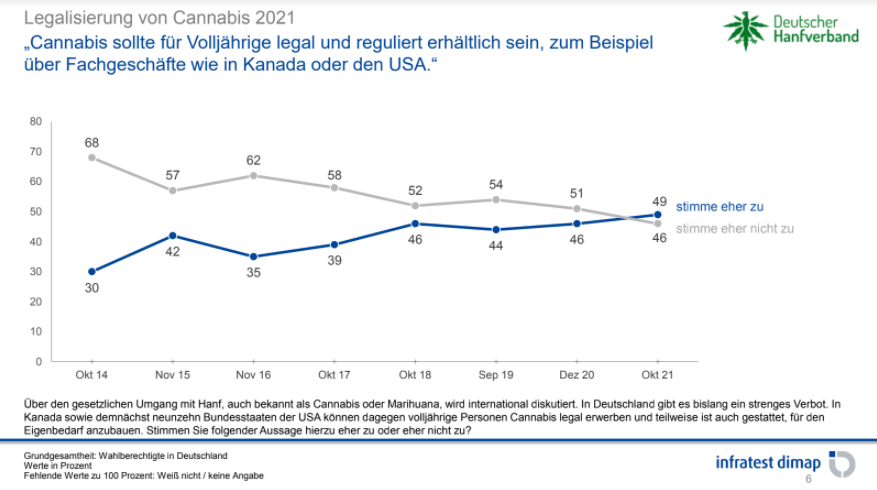
Germany Cannabis Legalization Poll

“There is no majority in the population in favor of banning cannabis. For more than 200,000 criminal proceedings per year, not only is there a lack of scientific basis, but also democratic legitimation. It’s time for legalization.” stated Georg Wurth, spokesman for the German Hemp Association.

The Most Significant Legalization Domino So Far

As of this article’s posting, there are only two countries that have legalized cannabis for adult use – Uruguay in 2013 and Canada in 2018.

A laundry list of countries has indicated that they plan to make a major push for legalization in 2022, including Germany.

Malta appears to be on the verge of legalizing cannabis for adult use for cultivation and possession purposes, with the final passage and the president’s signature expected to happen this week. 

If that happens, Malta would become the first country to legalize cannabis for adult use in Europe, and the third country to do so on the planet.

With that being said, legalization in Germany would be a bigger deal from political momentum and emerging cannabis industry standpoints compared to Uruguay, Canada, and Malta combined.

Germany has a population of over 80 million people and is home to the fourth-largest economy on planet earth. By comparison, Canada, Uruguay, and Malta only have a combined population of roughly half that of Germany, and those nations do not wield nearly as much political power as Germany on the international level.

Whereas Malta, and reportedly also Luxembourg, plans on only legalizing cannabis cultivation and possession for adults, Germany is planning on implementing a robust, regulated adult-use industry nationwide.

Given Germany’s place in the political and industry arenas in Europe and throughout the rest of the world, legalization there will be more significant than can be expressed in words, and according to recent polling, it’s a move supported by more Germans than not for the first time in history.

Former President Of France Francois Hollande Supports Adult Use Cannabis

While not willing to say he is “in favour” of consumption, he does believe that better control of the drug can be handled by legalization

In a sign that things are changing on the cannabis conversation even in France, which just this year reluctantly moved forward on a highly limited medical trial, Francois Hollande, who led the country between 2012 and 2017, came out with a statement in favour of the establishment of an adult-use market in the country.

Citing less his support for the industry and more as a common-sense one, designed to regulate the industry, prevent it from getting into the wrong hands, and making a dent on the black market.

The German Example

Citing the decision of Germany’s new “Traffic Light” Coalition to move forward with a recreational use plan, Hollande stressed that cannabis reform could not just be limited to a national discussion but rather tackled on a European level.

Hollande also believes that just decriminalizing the drug without providing for a regulated, legal market makes no sense. As he said in an interview with a European news organization, “As soon as it is legalized, there is no longer any reason to penalize, except those who could drive while having smoked or those who harm their health and the health of others by overconsuming.”

How Fast Will Reform Move in France?

France is one of the slowest moving European countries on the issue of formal reform – or at least it has been so far. Current President, Emanual Macron proposed earlier this year to launch a national debate on the issue. Perhaps the German decision to move forward will also speed this up now too.

Regardless, for a prominent former politician to take a stand on cannabis reform is a significant step, particularly given the fact that he pinned his logic on the German example.

The Great Teutonic Tipping Point for Cannabis?

It is very clear, regardless of how fast reform actually moves in France, or anywhere else in Europe for that matter, that recreational reform has now entered the mainstream debate. The German market will continue to drive the discussion forward – both on the medical and now on the recreational front. 

And even if it is not next year, or the next several after that, the writing is on the wall. France will follow suit.

Make sure to stay on top of European developments in the fast-paced and changing cannabis industry by attending the International Cannabis Business Conference when it returns to Barcelona, Berlin and Zurich next year.

Former National Leaders Call For Global Cannabis Reform

Nick Clegg, the former Liberal Democratic leader, calls for legalization in the UK, following global trends

Citing the German and American cannabis market reforms, Nick Clegg, the former British Prime Minister, has now gone public with his support for cannabis legalization in the UK. In doing so, he is joining other public figures globally including four Nobel Laureates, in calling for a radical overhaul of not just British but global cannabis policy. Indeed, leaders from countries including New Zealand (former PM Helen Clark), Columbia (former president Juan Manuel Santos), Switzerland (Ruth Dreifuss, former president) and others have also added their voices of support in a new report called Time to End Prohibition.

Clegg’s comments come not only just after the momentous news that Germany’s new government will move forward on recreational reform as early as next year and as the UK unveils a new Ten-Year Strategy to combat drug crime and related issues that will target users and dealers with a hefty price tag of about $330 million.

Time For a Global Change

There is clearly a renewed call for such reforms now that Germany, Europe’s largest economy has announced a forward motion on the legalization topic as of next year. 

Further, as the debate continues to escalate (including at the UN level), there is a clear trade-off emerging in policy approaches to reform. Many countries, now cash-strapped because of Covid, are looking at the cannabis sector to create economic development opportunities.

The UK, while behind other countries is unlikely to sit this one out for the long term. Starting with the fact that despite onerous cannabis policies, the UK is still a cannabis exporting country.

International vs. Sovereign Reform

For the last ten years, cannabis reform has been very much a sovereign discussion. However, with Europe now entering the fray on a regional level and multiple countries around the world putting at least medical reform on the front burner, the conversation has clearly shifted. Further, the Covid Pandemic has also clearly shown the industry is an essential one – and further one that so far, has proven to be, if not Pandemic Proof, growing despite the global health crisis.

It is undoubtedly easier for those out of office now to lead the call for political change – but as Germany has shown this is also beginning to shift – particularly as new governments come into power. Indeed, Germany is not the first coalition government to enter office on the promise of cannabis reform. See Luxembourg in 2018.

However, the fact that so many former leaders are now calling on those who replaced them to move the conversation forward is just another sign that the globe is moving in a green direction and will certainly not turn back.

The International Cannabis Business Conference returns to Europe in 2022! Stay tuned.

Is The FDA Going To Issue Commercial CBD Regulations Soon?

Three years ago the United States Congress, via the 2018 Farm Bill, legalized hemp nationwide, and with it, cannabidiol (CBD) products derived from hemp. Given how long domestic hemp cultivation was previously illegal in the United States, it was a very big deal.

Since that time domestic CBD products have proliferated store shelves all across the United States, with products coming in all types and forms, from shampoo to drinks to toothpicks (literally).

However, comprehensive regulations for over-the-counter commercial CBD products have yet to be implemented, and from what it sounds like, no one should expect regulations any time soon. Below is more about it via our friends at NORML:

Washington, DC: Nearly three years following the passage of federal legislation legalizing hemp production, the US Food and Drug Administration (FDA) has yet to promulgate rules regulating the marketing and sale of commercial products containing hemp-derived CBD.

Speaking last month at the National Industrial Hemp Business Summit in Washington, DC, FDA representative Gail Sipes said that the agency cannot move forward with regulations without more data on the safety of CBD products. She reiterated the agency’s position that companies which market CBD-infused products as either food products or as dietary supplements are violating the Food, Drugs, and Cosmetics Act.

NORML and other groups have urged the FDA to provide regulatory guidelines overseeing the production, testing, labeling, and marketing of hemp-derived CBD products. Analyses conducted by the FDA and others have consistently reported that many over-the-counter (OTC) CBD products are of variable quality and potency, and that they may contain contaminants or elevated levels of heavy metals.

Survey data compiled last year by the National Consumers League reported that more than eight in ten US voters desire greater federal regulatory oversight over the labeling and marketing of commercially available CBD products.

In a report provided by the FDA to Congress in 2020, the agency said that regulating OTC CBD products presents unique challenges because the substance is already available as a FDA-approved medicine (Epidiolex).

Additional information is available from the NORML fact sheet, “FAQs About Cannabidiol (CBD).”

European Parliament Agrees To Raise THC In Hemp – Equivalent Of US Farm Bill

The European Parliament has agreed to raise the THC limits in hemp to .03%, bringing the EU into line with the US. Will this mean a growing new international hemp trade between the US and Europe?

Late last week, the European Parliament agreed on a new Common Agricultural Policy for the region, which goes into effect on January 1st, 2023. Namely hemp grown in EU countries can have a THC content of up to 0.3%. This is up from the current limit of 0.2% (at least at the EU level). National regulations within the region are already all over the place. 

This change has been bubbling for some time. However now that it has been formally adopted into something so fundamental as regional agricultural policy, there is little chance of the tide turning back on CBD. Namely as has also been widely feared that CBD would again be ruled a narcotic and at a regional level. With this announcement, there is little chance of that happening.

Implications

This is a very important moment for the hemp industry across Europe – and will invigorate the industry much like the passage of the federal hemp bill in the United States in 2018. What this means is that there is a regional minimum standard. Obviously, sovereign laws take precedence. However, what this does is set a bar that latecomers to the discussion will essentially have at least considered as a reference guide as they wrestle with full and final cannabis reform.

A Magic Cure-all?

While highly significant, this is not, however, the end of the hemp industry’s problems in Europe. Chief among those, starting in Germany, is the remaining inclusion of even CBD in national narcotics acts. For this reason, while a very big step that the hemp lobby, for one, is rightly celebrating, it is still not one that entirely overcomes the many issues even this part of the industry is still facing.

Indeed, the only real way to normalize the CBD discussion is to reconnect it, once again, to the THC one as multiple countries in Europe now wrestle with full and final legalization, even if only of the home grow kind.

However, luckily for everyone in every part of the industry, that is now a conversation that is fully underway.

Be sure to stay tuned to the International Cannabis Business Conference blog for the latest cannabis reform developments in Europe.

Is‌ ‌European‌ ‌Recreational‌ ‌Cannabis‌ ‌Legalization‌ ‌Starting‌ ‌With‌ ‌Home‌ ‌Grow‌ ‌First?‌ ‌

A trend is developing – Italy, Luxembourg and now Malta, are on the verge of “recreational reform” that only allows for the personal cultivation of a limited number of cannabis plants. Is this the new “normal” until Germany leads the way?

If there is such a thing as a “trend” afoot in the European recreational cannabis reform discussion, then this is clearly one. Home grow is a hot topic in multiple European countries right now that are all publicly claiming to be implementing “recreational reform.” 

This is of course a huge irony considering not quite so recent developments. Namely, of course, that just as the Swiss are gearing up to launch their rec trial in 2022, Germany will probably legalize some kind of commercial marketplace and infrastructure, even if they kick the can down the road for a market start. Furthermore, it is precisely because the Germans did NOT want to tangle with the issue of patient home growing for medical use that the Bundestag passed the medical reform bill they did in 2017.

How four years ago. Not to mention, how much has changed.

In Germany right now, despite rising patient numbers, the pushback from the insurers and MDK is still considerable, in part because of the cost of cannabis treatment (still, sadly) and because cannabis is still considered a “drug of last resort.” Patients who cannot prove this, of course, are in the deep end of hell.

This is why the revived European home grow trend is so interesting. It also means that there will probably be some kind of home grow provision in the German recreational reform language. There must be. Nobody wants to penalize patients who still cannot get prescribing doctors or healthcare approval.

Regardless, this is a very, very interesting trend indeed. It means that there will be a huge interest in the mom-and-pop grassroots, even if such efforts have little chance of becoming legit. The Canadian model, for starters, showed that the commercial market’s largest competitor was patients.

The fact that this trend is now starting to take place in Europe is also a testament to the perhaps late realization by the powers that be that if medical reform takes place, there is little to stop the ball from rolling forward, starting with the fact that those who are sick and cannot get the drug any other way, will also almost always resort to “other” channels to get the only drug that seems to make a difference. 

With a focus on stamping out the black market, this also then pushes the discussion, in European countries right now at any rate, into a gentle slope that may start with home grow but in fact is a tipping point for full and final reform.

Be sure to keep up with European cannabis business trends – attend the International Cannabis Business Conference when it returns to Europe next spring and summer.

A Very Big Company Just Jumped Into Canada’s Cannabis Industry

News broke last week that Uber Technologies Inc is teaming up with Canadian cannabis retailer Tokyo Smoke.

The news was first reported by Reuters and initial reports misstated that Uber would allow cannabis to be ordered through the Uber app and delivered.

However, that initial reporting was later updated to reflect that orders can be placed through the app, although, customers will still need to obtain their cannabis the old-fashioned way.

Still, even Uber’s limited entry into the cannabis space is a big deal given how large the company is and that it previously had no known ties to the cannabis industry.

Part A Larger Trend

Uber Technologies Inc is not the first large company to enter the cannabis space. It is part of the continued mainstreaming of the legal cannabis industry.

As the emerging legal cannabis industry continues to evolve, and more notably continues to generate enormous revenue, there will be a steady flow of large companies entering the space.

That could be bad news for operators in entire sectors of the cannabis industry that have benefitted from big technology companies shying away from cannabis due to stigma and continued prohibition in some areas.

Cannabis delivery services are very popular in some areas because they fill a void. Once the Ubers of the world start performing that same service, it will obviously be much harder for smaller delivery companies to compete.

The same will be true for many technological concepts that are currently operating in the cannabis space.

Finding A Niche

Cannabis entrepreneurs that provide certain services still have time to establish themselves with consumers and patients before most of the big companies enter the space.

Now is the time for those companies to build their brand recognition and prove to consumers that they can provide just as good (or better) of service as big companies.

People that think they have a good idea in the current industry climate need to focus on their long-term plans in addition to their immediate plans.

Otherwise, a really big fish could enter the fold and if the person/company didn’t plan for that happening, it could be the difference between them continuing on or getting pushed out of the industry entirely.

French Medical Cannabis Trial Registers Its 1000th Patient

Seven months after the official debut of France’s medical program, the government has reached 1/3rd of its planned patient count. What next?

France has managed to keep a relatively low profile in the entire cannabis discussion, generally, despite all the furor now afoot in almost every country that surrounds it. It is not to say the French are inconsequential to the entire conversation. Indeed, a CBD vape case decided here is responsible for creating the first case law on the cross-continental transport and subsequent sale of legally produced product.

However, beyond this, and sadly, even on the medical side, the French have been missing from the discussion, and in a big way. Namely, seven months into the experiment, only 1/3rd of the total paltry study number to begin with have even been accepted in the now ongoing (and much delayed) trial. In contrast, Germany, which had about 800 patients at the time the law changed in 2017, had at least 8,000 patients of a first year’s total of between 12,000 and 20,000 incorporated into the formal program by the same period. Given the huge hurdles that still exist in Germany four years later and as the patient count tops six figures, this says a great deal about the hurdles now faced by the French.

Patient counts will continue to increase until September 2022 – which means that the government has just over 10 months to register the remaining 2/3rds of patients.

Covid is undoubtedly responsible – but beyond this, as every legalizing state and country knows, this is far from a fast process when done “officially,” and even more particularly for the first time.

That said, there is a bit of a silver lining. The quotas by patient indication and by doctor have been lifted. The criteria for access for those in palliative care and oncology have also been expanded.

There are only 48 general practitioners and 212 pharmacists who are now trained to prescribe and administer cannabis and a total of 1035 health professionals overall.

So far, 22% of patients have left the experiment due to adverse effects or inefficacy. There are, as a result, currently 779 active patients in the national trial.

One thing is for sure. The fact that the trial is already changing its official guidelines is a good sign. It means that the French, like the rest of the medically liberalizing planet, are realizing that preconceived notions about the drug, those who use it, and for what, are usually wrong, along with the “conventional wisdom.”

However, if one of the most cannabis-conservative countries in Europe so far can admit this, and adapt accordingly, it is also another sign that cannabis reform, and of all kinds, has landed in Europe, and will not be slowed.

Why not sponsor (and speak) at the International Cannabis Business Conference in Europe next year? Opportunities exist in Barcelona, Berlin and Zurich.

Is Luxembourg Planning On Sidestepping Real Rec Reform?

The European country has had rec reform on its legislative agenda for the last three years. However, it increasingly looks like such plans have no intention of creating a commercial industry.

The coalition government of Luxembourg has been in the global spotlight since 2018 since it formally announced it planned to legalize recreational cannabis by 2023. Since then, however, exact steps and formal timelines have been assiduously avoided. Indeed, there have been many rumours in the last several months that the country planned to enter this space in a way that might be unexpected.

That lack of clarity came to an end last week when the government put its proposal online.

Here are some of the surprising details.

The Government Will Legalize Home Grow

Luxembourgian citizens will have the right to grow four plants at home – either indoors or outdoors – if the cannabis grow is secured and not visible to anyone passing by a public road. This is a per household, not resident law, meaning that no matter how many people live at a single address, the four plant rule will apply. This means that cannabis could be grown indoors, outdoors in a private garden, or on a balcony, out of sight of public view. 

The cannabis can be grown from seeds that will be available in stores in Luxembourg as well as imported online from overseas. This will be a huge boost for the seed stores in Holland and Spain (for starters). It may also lead to a booming “pre-recreational” cannabis market in seeds but nothing else.

Persons caught in public with more than 3 grams will still face an administrative fine (€145). 

The donation or sale of cannabis will remain illegal.

For a government that has also supposedly studied “other models” – starting with Canada, this is remarkably slow off the bat approach. Regardless, in a space currently defined by Holland and nobody else, it was unlikely that the Luxembourgian experiment was going to blow any doors off in terms of breaking the mold.

That honour will almost certainly fall to Germany – which of course in the last week has also seen its new political leaders declare that cannabis reform is a common plank if not top priority.

In the meantime, however, there will begin to be a limited cannabis market in Luxembourg, if only confined to seeds and home grow setups. And Switzerland, as well as Germany, will now almost undoubtedly set the pace for the rest of Europe.

Be sure to keep abreast of the now rapidly moving cannabis reform discussion in Europe by staying up to date with the International Cannabis Business Conference blog! Don’t forget, the International Cannabis Business Conference is returning to Europe in 2022.