Scotland Decriminalizes Drug Possession

Scotland’s new policy covers all ‘illegal drugs” including cannabis in a surprise turn of events.

In a surprise announcement, Class A substances have been effectively decriminalized in Scotland. This includes cannabis. According to the lord advocate, Dorothy Bain QC. this is a “diversion from prosecution” policy that came as a surprise to the Scottish Parliament (or Holyrood).

Officers can already issue formal warnings for possession of lower category drugs; however, this policy comes at a time when the entire cannabis discussion is being actively discussed in just about every European capital post-German election.

Scotland logged a record 1,339 drug-related deaths in 2020 which is the highest rate in Europe. As a result, the Scottish government has pledged to make it a “national mission” to cut fatalities.

Per Ms Bain, “There is no one size fits all response to an individual found in possession of a controlled substance, or an individual dependent on drugs.”

While there are those who criticize the step for not going far enough, even this development is controversial. The Scottish Conservatives criticized the plan for merely being a cannabis decriminalization plan by another name. However, since that is in essence exactly what this move represents, the fact that other parties are supporting the idea is a positive development in a part of the world notoriously conservative about all “illicit” drug use.

Could Scotland Be a Tipping Point for the UK?

There are many forces driving a renewed interest in at least decriminalizing the use of cannabis in the UK. The CBD market is clearly up and running and more and more GMP-certified cultivation and extraction facilities are getting licensed (see most recently the movement on the island of Guernsey).

Beyond this, of course, European countries which are increasingly putting Covid in their rear-view mirror if not having national elections (see Germany last weekend) are also increasingly at least musing changing national drug policies. Sending in the fuzz to bust CBD stores or locking up legitimate cannabis patients is, increasingly, a political third rail. 

There are many reasons, in other words, to herald this new Scottish liberalization of drug policy – both directly south of Hadrian’s Wall and across the Channel.

And even if “all” that is achieved is that cannabis is decriminalized that is an important step.

Stay tuned to the International Cannabis Business Conference blog as autumn clearly blows in a new wind for cannabis reform across Europe.

The German National Elections Will Forward Cannabis Reform – But How Much?

Germans went to the polls last Sunday, returning a not-so-surprising result. What will this new government mean for cannabis reform?

There is a new day in Germany. For the first time in 16 years, Angela Merkel is no longer the Chancellor of the largest and most powerful country in Europe. Beyond this, Sunday’s election means a defeat, at least by the number of seats held, for the CDU – the centre-right party that has held power since 1949 (at least on the Western side of the country).

What this shifting alliance means for cannabis reform is now a topic that has spread across at least the German if not European industry. What is certain, no matter what is that there will be some kind of change – although of course, any specifics must wait for the ruling government alliance to be formed.

Who that could be is still up in the air – but the SPD has already indicated that they are interested in entering an alliance with the Green Party – and both are far more friendly to at least basic cannabis reform than the CDU has ever been.

Here are the basic issues on the table.

  1. The entire cannabis debate must be re-examined and redefined. This includes both of the low hanging fruit at this juncture including removing CBD from the federal Narcotics Act as well as decriminalization of all cannabis possession. The patient count in Germany has continued to climb despite a lot of resistance and patient hurdles which have still not been solved.
  2. If the SPD forms an alliance with either or the Greens and FDP, one thing is certain. Recreational cannabis trials are going to be on the agenda here in a matter of 18-24 months, particularly as both Switzerland and Luxembourg are now hurtling towards the same – although in the case of Luxembourg, there appears to be a new impetus to slowing down that trial based on concerns in some quarters about “chaos” ensuing at the Luxembourgian borders with their European neighbours. If Germany changes its cannabis policy, this will be less of a legitimate excuse (not that this carries any weight now).

Regardless of the particulars and the timeline, this is still unbelievably good news. The biggest possible roadblock might be that the SPD might bring the CDU into the governing coalition. The CDU have been glacial so far in their acceptance of the entire issue.

Even in this scenario however, with so many of the other parties in favour of at least basic and logical steps forward, the next steps of cannabis reform are likely to unfold now far more easily – and with it carry the seeds of change across Europe and the EU.

Big changes are on the way in the German cannabis industry. Be sure to stay tuned to the International Cannabis Business Conference blog for more updates.

What Are The Best Cannabis Events In Germany?

It is an extremely exciting time to be a cannabis enthusiast. Thanks to the hard work of countless cannabis activists, cannabis reform continues to spread across the planet. Cannabis is now legally accessible for medical and/or adult-use purposes in more jurisdictions than ever before since the dawn of prohibition.

Momentum for cannabis reform is particularly strong in Europe where safe access to medical cannabis can be found in most countries, especially in Germany. Germany is now the cannabis capital of the European continent, at least from an industry standpoint. Adult-use legalization in Germany will hopefully happen sooner rather than later.

The rise in cannabis reform has been paralleled by a rise in interest in all things cannabis. People want to learn how to cultivate cannabis, about cannabis science, the latest cannabis products, how to get into the cannabis industry, and much more. It can be very difficult for people to know what information is valuable and what is not, and it’s particularly difficult to network in a real-life setting with other like-minded cannabis enthusiasts in a meaningful way.

The best way to learn a lot about cannabis in a short amount of time while making a lot of new cannabis friends and colleagues is to attend an in-person event. There’s really no adequate substitute for attending an in-person cannabis event, as so much happens when cannabis-curious newbies, leading experts, and folks that are in between are all under one roof socializing, teaching, and learning.

International Cannabis Business Conference Berlin 2021

There are many cannabis events out there these days of all types and sizes, however, not all of them are created equal. Some events are the real deal while many prove to be nothing more than hype. If someone attends a cannabis event they obviously want it to be worth the effort on their part. The last thing that someone wants to do is to buy tickets and travel to a cannabis event just for it to turn out to be lackluster (or worse).

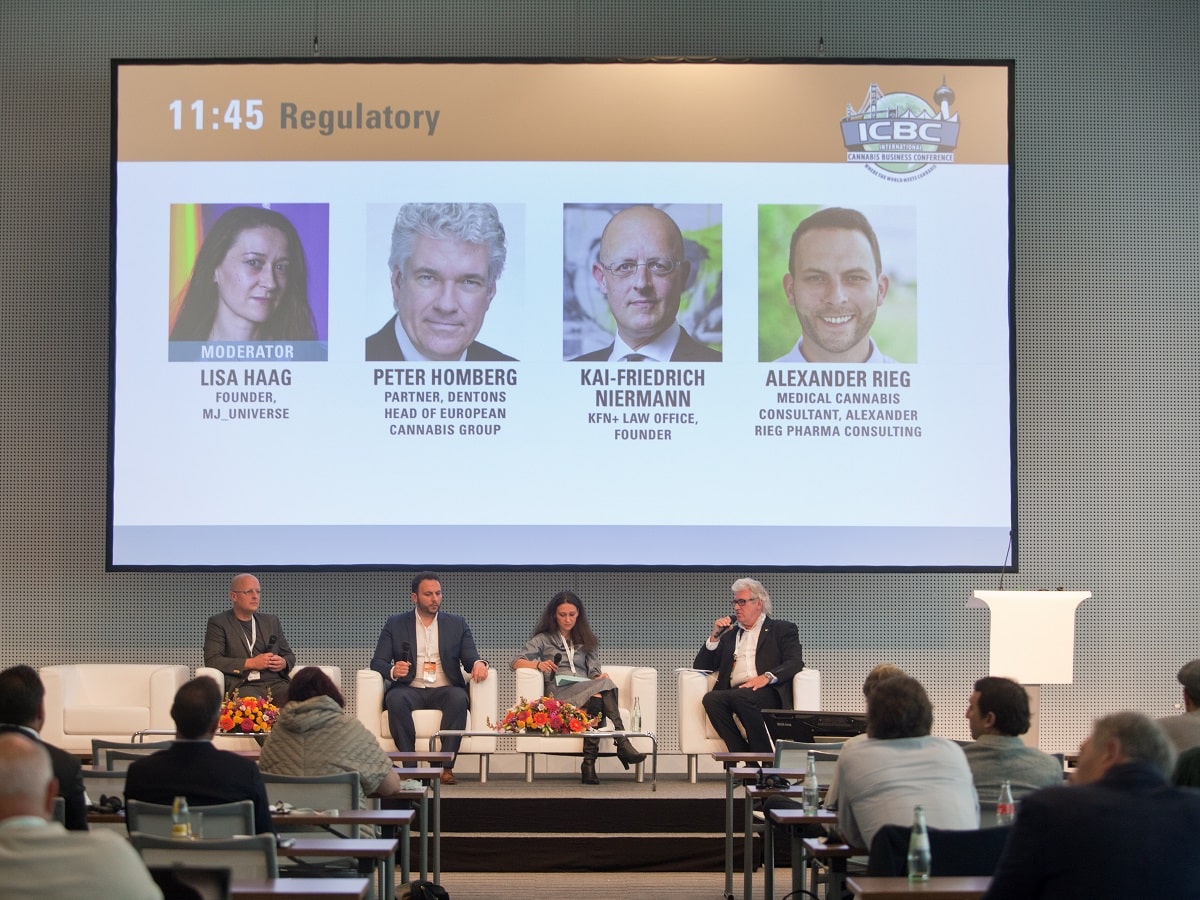
The recent International Cannabis Business Conference in Berlin, which included our Global Investment Forum, brought together entrepreneurs, investors, and policymakers from all over the planet. Below is a recap video of our 2021 conference in Berlin:

One of the many highlights from our conference in Berlin was a truly historic bipartisan political panel featuring current German lawmakers discussing cannabis policy The panel can be viewed below (the panel was held in the German language):

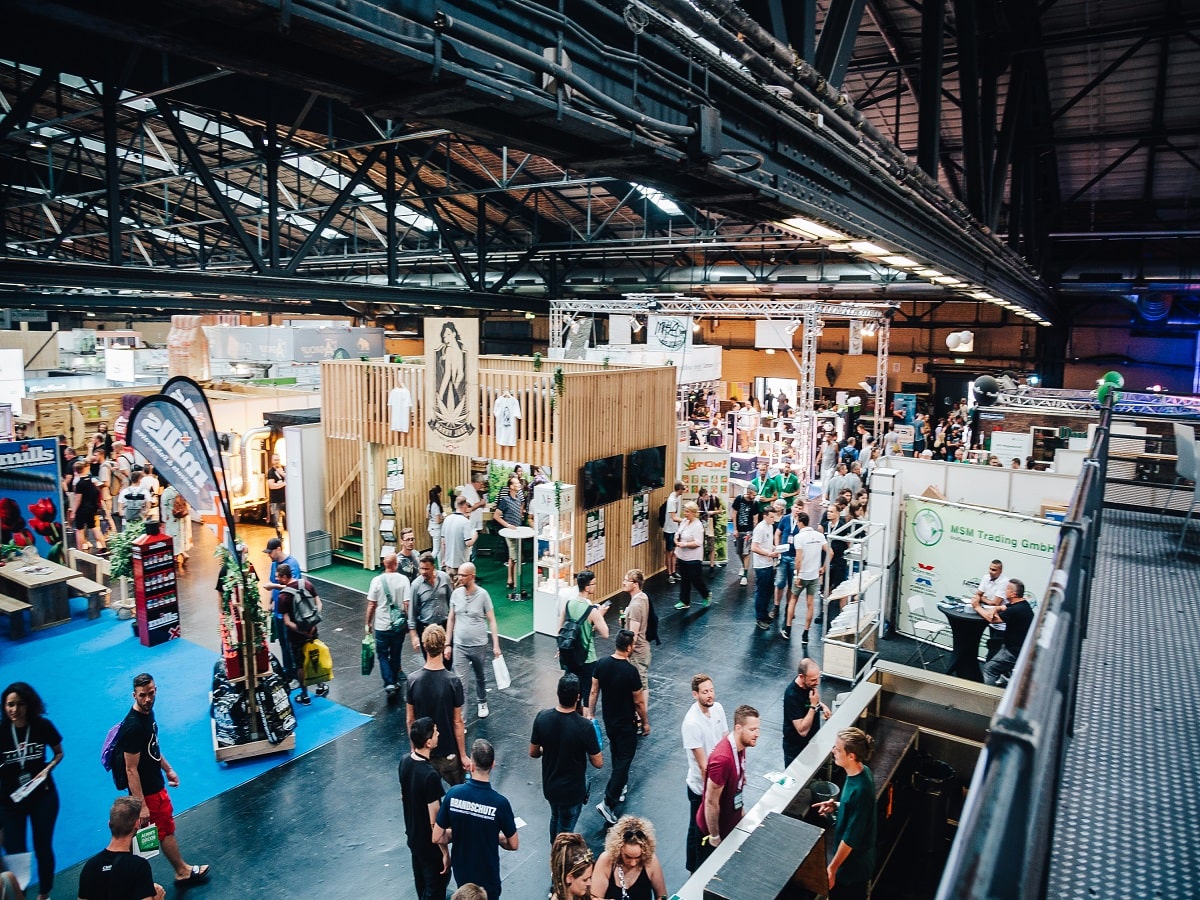
Another event that we are particularly excited about is the Mary Jane Berlin hemp fair coming up on October 22-24, 2021. Mary Jane Berlin is a C2C event and festival and includes an extensive cultural and entertainment program that is offered in conjunction with exhibitors, food stands, live concerts, and congresses on therapeutic properties.

Mary Jane Berlin Hemp Fair 2019

Below is a video recap of Mary Jane Berlin’s last event:

We are very excited about the strong bond that our two events have created and the strategic partnership that we have formed. Mary Jane Berlin is Europe’s fastest-growing C2C cannabis fair and pairs perfectly with our flagship B2B conference in Berlin to provide a comprehensive cannabis experience.

If you want to learn more about cannabis and network with like-minded cannabis enthusiasts, make sure to check out the upcoming Mary Jane Berlin hemp fair and festival. The event is expected to have over 35,000 cannabis-related products on display and it’s almost guaranteed that there will be something that very few cannabis enthusiasts have ever seen before. You can find out more about Mary Jane Berlin, including how to purchase tickets, at their website: https://maryjane-berlin.com/

In addition to the Mary Jane event, also make sure to mark July 19-20, 2022 on your calendars because the International Cannabis Business Conference will be coming back to Berlin and bringing with it our signature blend of industry, policy, and entertainment. Attend both the Mary Jane Berlin C2C fair and our B2B conference in Berlin to take your cannabis pursuits to the next level!

From Taboo To Typical: Global Cannabis Comes Of Age

by Shane MacGuill and Spiros Malandrakis

As global cannabis industry leaders gathered at the International Cannabis Business Conference in Berlin in late August our overarching reflection was of an industry that is – if not maturing – entering the end of its beginning as a legitimate mainstream commercial force. Ultimately, the nature and potency of that force will be determined as much by the industry’s collective ability to address consumer needs as by the intricacies of compliance and complexities of operations.

At a high level, there is no question that this is an industry on the rise, projected by Euromonitor to reach a global legal value of around USD100 billion across its adult-use, medical and CBD pillars within the next half-decade. US adult-use undoubtedly drives this growth albeit there is a haze of uncertainty there which is only partially lifting. However, regardless of the evolution of reform at a federal level, it is all but inevitable that in the near future tens of millions of more Americans will gain legal access to the full spectrum of modern cannabis products.

And globally, the steady rolling wave of liberalisation continues, propelled by the increased acceptance and tacit activism of the general public. In our recent cannabis survey, more than half of all respondents expressed support for the positive economic argument in favour of full cannabis legalisation, believing that commercialisation would be economically beneficial. Even more strikingly, two-thirds of the sample (consisting of a balance of all kinds of relationships with cannabis, and none) expect adult-use of cannabis to be legalised in their country within the next decade.
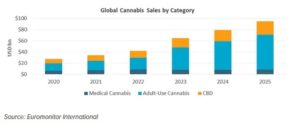
Global Cannabis Sales By Category

Expectation. Benefit. Belief. This is clearly no longer the language of taboo, of hope against the odds. However, for the industry to truly graduate into mainstream fmcg status it will need to be responsive to the drivers of its emerging consumer base.

It will need to be adventurous with the formats and brand purposes it is elevating to the market. And ensuring that cannabinoid products deliver on their intrinsic promise of offerings that are tailored to our individual goals and are improving our lives – sometimes in small, sometimes in large – ways on a daily basis.

The industry needs to embed sustainability and social justice at its core, and into its brand propositions. Not just because this is the right thing to do but because in doing so it will differentiate itself with a consumer population increasingly concerned with the wider impact of its consumption.

Its pricing strategies will also need to be refined: Unpretentious affordability and a competitive price point will be essential. On the other hand, bling retains a certain degree of penetration to this day but such historic approaches towards aspirational consumption are increasingly transitioning towards a focus on authenticity, craftmanship and artisanal credentials instead.

Nevertheless, it is not merely about the efficacy or competitive intoxicating attributes new formats will bring to the table. Creating new rituals or shedding fresh light on established ones will cement ever-elusive brand equity. While beverages and edibles have monopolised headlines under the Cannabis 2.0 umbrella of launches, the answer can sometimes be simpler. For example, dogwalkers are cannabis pre-rolls “inspired by the simple pleasure of leisurely strolls with one’s dog”.

Celebrity endorsements, tie-ins and collaborations have also been an instrumental part of key branding initiatives across fmcg industries. However celebrity sparkle is not a panacea – shared values, direct involvement and a long-term strategic symbiosis will separate sustainable business propositions from short-lived gimmicks

On the retailing front, utilitarian and stoner-chic stereotypes of the Dutch coffeeshop paradigm belong to the 1990s and do not reflect the evolution and outreach of the industry in 2021. As the industry matures, clear and differentiated propositions that aspire to facilitate retailing experiences focusing on specific demographics will be the winners over more “me too” Apple store copycats.

Beyond retailing, there can be no overstating the importance of on-trade venues and occasions in providing momentum to normalisation, establishing new consumption rituals and occasions and, ultimately, cementing the fledgling cannabis industry as a key competitor for the alcoholic drinks industry.

Tailoring brand propositions to attract specific focus demographics will be key. From identifying the cannacurious cohort to expand penetration and reach to focusing on seasoned consumers to allow for connoisseurship and premiumisation to add value, diligent segmentation will be another sign of the industry’s transition into mature fmcg territory. Euromonitor International’s surveys are also shedding light into key perceptions, concerns and patterns. For example, 79% of cannabis consumers in US legal states consider strength to be an important product attribute followed by price (70%) and strain (66%)- a fact that highlights the still simplistic and embryonic nature of buying behaviours, a situation that is in many ways akin to alcohol consumers choosing brands purely based on abv content . But on the CBD front education also remains essential with 43% of global respondents saying that they do not see a clear need to use CBD.

Beyond the haze of hype and dramatic share price fluctuations, the cannabis industry is shifting into the realms of fmcg through the adoption of innovative formats, design sophistication and evolving language and semiotics. As it sheds its mantle of illicit associations, branding through lifestyle cues and positioning, retailing strategy and demographic breakdowns will shape its future and its transition from novelty to an industry that has come of age.

For more insights see our cannabis research at: https://www.euromonitor.com/cannabis

In conjunction with this article, make sure to also check out this link to download the related presentation slides: https://bit.ly/2VRrvTu

This article first appeared on Euromonitor.com and is syndicated with special permission

Zurich Officials Release Cannabis Legalization Pilot Program Details

Switzerland is at the forefront of cannabis policy in many ways, not the least of which is the widespread availability of low-THC cannabis products.

Starting in 2017 cannabis consumers have been able to legally purchase cannabis products that contain less than 1% THC. In 2019 a Swiss Federal Administrative Court ruled that the taxation of such products was legal, further paving the way for a booming industry.

The low-THC products may not be as strong as cannabis available in some other countries, however, they are still extremely popular with consumers and even some patients, and stronger products are on their way to some markets in Switzerland.

Back in May amendments to Switzerland’s Narcotics Act took effect. The amendments provided for legal adult-use cannabis pilot programs in Switzerland. Zurich is one of the cities that is taking part in the pilot research programs and its pilot will begin next year.

The pilot program in Zurich will run for three and a half years as part of a greater research program to help lawmakers craft federal policies and industry regulations. Basel, Bern, Lucerne, and Geneva are also launching their own related pilot programs.

For Zurich specifically, the City of Zurich is partnering with the Psychiatric University Clinic Zurich and the Zurich Pharmacy Network, with study participants acquiring their cannabis from pharmacies and ‘social clubs.’

As part of the study, cannabis producers will be required to obtain a production permit from the Switzerland Federal Office of Public Health. Below is more information via a press release from the City of Zurich (translated to English):

Regulated Cannabis Sales: The Zurich Study

Once the legal basis is in place, the City of Zurich is launching the “Züri Can – Cannabis with Responsibility” pilot project together with the Zurich University Psychiatric Clinic. The effects of regulated cannabis use are being researched in a three-and-a-half year study. The cannabis study is intended to provide the basis for appropriate cannabis legislation at the federal level.

For years, the City of Zurich and the Psychiatric University Clinic in Zurich have been committed to an objective and low-risk approach to cannabis use. In mid-May 2021, amendments to the Narcotics Act came into force, which enable pilot tests for regulated cannabis sales. On this legal basis, the Psychiatric University Clinic Zurich, in cooperation with the City of Zurich, wants to research models of the regulated procurement of cannabis and its effects on the health and consumption behavior of the consumer. The aim of the Zurich study is to provide relevant knowledge on the best possible use of cannabis. The study is intended to promote public health, maintain public safety and support the protection of minors.

Responsibility for production, prevention and consumption

The Zurich cannabis study “Züri Can – Cannabis with Responsibility” is intended to show what effects the sale of standardized and tested cannabis products at approved outlets with health and prevention concepts has on cannabis users. The study creates framework conditions that promote the responsible use of cannabis at all levels – production, prevention and consumption.

Reference points with a focus on health promotion

The study participants will be able to obtain their study cannabis from pharmacies and social clubs. Variously designed purchase options allow valuable conclusions to be drawn about the different consumer groups. The points of reference should be given a great deal of leeway so that the most realistic forms of regulated access to cannabis can be researched. The Psychiatric University Clinic Zurich is investigating which sales outlets can be used to achieve the long-term goal of promoting public and individual health and safety. At all purchase points, value is placed on personal and health-promoting advice and on responding to individual needs. The aim is always to keep the health risks for consumers as low as possible.

Tested products for responsible consumers

The producers of the study cannabis must have a production permit from the Federal Office of Public Health. Only cannabis that meets high quality standards is produced. The aim is organic quality and local production. Various cannabis products are offered in the study, each with a different THC / CBD content. This makes it possible to switch to lower-risk products during the study period. The participants can consume cannabis more health-consciously and responsibly, because the ingredients of the products are of impeccable quality and are shown transparently. In order to record the health and social situation and its developments, the participants are questioned at regular intervals.

Looking for pharmacies and social clubs

The study management is now looking for interested pharmacies and interested parties who would like to found and operate a social club. They can contact the head of studies by the end of the year and apply for participation as a reference point (stadt-zuerich.ch/cannabisprojekt). Cannabis is expected to be available to study participants from autumn 2022.

(Joint media release by the City of Zurich, the Psychiatric University Clinic Zurich and the Zurich Pharmacy Network)

South Africa Gets Its First Cannabis Pain Patient

Kwanda Mtetwa has become South Africa’s first legal cannabis patient – receiving the prescription to treat his chronic pain – he won’t be the last.

The first South African patient has now been prescribed medical cannabis for chronic pain. The 32-year-old activist had to obtain a special license and a doctor’s prescription. Nevertheless, once this onerous process was completed, Mtetwa became the first patient in a country that is moving even faster into the medical discussion on the way to recreational reform in just a few years hence.

Much like other countries, including Germany and Canada, it is still very hard to find doctors willing to prescribe the drug as well as work with the patient through the complicated applications and screening process.

The Blooming South African Cannabis Market

South Africa (and its surrounded “neighbour” Lesotho) are moving forward on cannabis reform with gusto. There is a large market outside the country (see Europe if not Israel and Australia). Beyond that there is of course a new domestic, formal, and regulated patient market now in process, and of course, inter African trade.

In the meantime, decriminalization of the cannabis plant for personal use is now in progress through the South African Parliament, with healthy debate on how to keep the drug out of the hands of minors also well underway. The bill would also allow caregivers to grow cannabis for medical or compassionate purposes and give it away for free – and the right to grow up to eight plants.

Cannabis has long been used as a medical and wellness plant in the region. Dagga, as cannabis is called locally, was already in widespread use by the settlement of Europeans in the mid-1600s. Use of the plant was associated with traditional African medicine. The Dutch East India company even attempted to establish a monopoly on its trade, although the widespread cultivation of the plant by indigenous peoples even then kept prices low and stymied the plan.

During this century, Interpol rated South Africa as the fourth-largest cannabis producer in the world. Most of the black-market cannabis in the UK still hails from South Africa.

The current trend in South Africa towards a modern cannabis market got underway in 2017 with a High Court ruling in Cape Town saying that the prevention of personal cultivation was a violation of constitutional rights.

For more information about emerging cannabis markets, be sure to check in with the International Cannabis Business Conference on a regular basis.

What Role Will Cannabis Social Clubs Play In European Recreational Reform?

The continued popularity of this kind of gathering point has spread far from Spain and is now increasingly looked to as a model for recreational trials in places like Switzerland and South Africa

There is one thing that Spain, if not the early caregiving days in places like the US and Canada has given the cannabis reform discussion that is enduring as it is international. Namely the idea of a “social club” as a meeting point for cannabis consumers as well as a non-profit point of distribution.

Indeed, the Spanish concept, which has gathered in steam since the beginning of the last decade, has spread to places like South Africa where the concept is increasingly important for all the same reasons. 

Even more interestingly, as the battle for full and final recreational reform begins to be spoken of with a bit more seriousness in Europe, the Swiss have just announced that they intend to use this model too, starting next year.

Indeed, beyond the also enduring “coffee shop” pioneered by the Dutch, the social club construct may indeed be the turning point for real reform across at least Europe.

Here are a few reasons why:

  1. There is an established procedure for operations that has been set out by organizations like ENCOD.
  2. The infrastructure is easy to monitor if not monetize to at least self-sufficiency. Most of such clubs are indeed “non-profit” and serve both patients and recreational users alike with no differentiation. As frustrating as this might be for those with a pharma background, the reality is that at this juncture, there are just too many conditions that cannabis can treat which doctors are still leery of approving (everywhere). Further, the borderline recreational/medical discussion is almost always in the room. During the Pandemic, for example, even legal stores in places like Germany have noted a massive uptick in sales of just CBD (for anxiety if nothing else).
  3. The operating infrastructure is a good way to begin to bridge the gaps between highly regulated pharmacy and head or cannabis shop. Such clubs are usually non-profit, but also help create a seed to sale infrastructure that can be monitored, regulated, and even certified at standards that can reach a national level (see EU-BIO).

As the cannabis conversation rolls on in Europe, if not the rest of the world, expect to see such models tweaked, adapted, and integrated into local models, and far from just Spain.

Be sure to stay tuned to updates and news from the International Cannabis Business Conference.

Leading German Politician Erwin Rüddel On Cannabis: “Attitude Is More Open”

Until now, the CDU seemed to be quite isolated with its position on a possible new regulation. While the SPD, the Greens, the FDP and the Left all call for legalization, or at least model projects, in their election campaign programs, the CDU does not mention a possible new regulation of cannabis in a single syllable. Also to an inquiry of krautinvest.de the press office of the CDU answers only with short reference to the current government program.

A few weeks before the election, the CDU member of parliament Erwin Rüddel, who is also the chairman of the health committee of the German Bundestag, sits on a panel with Dirk Heidenblut (SPD), Werner Graf (Greens), Dr. Wieland Schinnenburg (FDP) and Niema Movassat (Left) at the International Cannabis Business Conference – in a rather lost position, one would think.

Far from it. In the interview with krautinvest.de Rüddel makes possible coalition partners hope for compromises, suggests at least model projects as solution. Especially when the CDU would have to negotiate with two other parties, the CDU politician does not seem to believe in maintaining the status quo. And: Even the great challenges of our time – such as Corona, Afghanistan or Corona – he does not let pass as an excuse to put off a possible cannabis re-regulation: “We are a parliament based on the division of labor and accordingly there are also the necessary capacities.”

It will be interesting to see whether possible coalition partners agree to model projects (or push for fundamental legalization) and what these would look like in detail. Should it come to that, a first small market for recreational cannabis is likely to develop in Germany under state control. After all, flowers have to be cultivated or imported, stored and distributed.

krautinvest.de: Five parties are currently being considered for a new government. In all conceivable coalitions, the CDU is the only party that is against any form of legalization. Is legalization completely out of the question if the CDU is in government?

Erwin Rüddel: The CDU/CSU is somewhat isolated in its stance on this issue. That’s why I’d be surprised if the issue didn’t come up in the coalition negotiations after the upcoming federal elections, especially if the CDU/CSU were to negotiate with two other parties. In my view, model projects would be a conceivable compromise.

krautinvest.de: You personally have already hinted at such model projects recently. Can you briefly specify the conditions?

Erwin Rüddel: In any case, such a project would have to be implemented in a well-selected region with a defined group of people entitled to access it, and the dispensing would have to be linked to addiction prevention and counseling. This is done in a similar way in Uruguay, for example. It is important that the THC content of the cannabis distributed is controlled. The biggest problem I see is the involvement of 15- to 18-year-olds. Of course, they should not be able to legally purchase cannabis for consumption, but this group is exactly the one where prevention work is most important and should therefore be taken into account in the evaluation.

krautinvest.de: Could you imagine further new regulations beyond the model projects?

Erwin Rüddel: For me, such a model project would be an open-ended introduction to the topic: Either we get confirmation of the reservations about cannabis or we learn that things should be approached somewhat differently than is the case today. After an appropriate evaluation, further steps can then follow.

krautinvest.de: Hand on heart: How strongly do opinions differ on this topic within the CDU?

Erwin Rüddel: There are certainly very different opinions in our group. In general, however, I have the feeling that the attitude to this issue is more open than it was a few years ago.

krautinvest.de: In addition, the challenges are currently great: climate change, Corona, Afghanistan – does a new regulation of cannabis fall completely under the table, because the concerns are much greater elsewhere and the parties prioritize other areas?

Erwin Rüddel: The fact that we are facing very great challenges does not mean that we cannot tackle other issues. We are a parliament based on the division of labor, and the necessary capacities exist accordingly.

This interview has been first published on krautinvest.de and syndicated with special permission.

Cannabis Reform Moves Forward In UK’s Islands

Support for cannabis reform if not actual cultivation is moving ahead on the many islands ringing the mainland

From Guernsey, where cultivation is finally proceeding officially, to the Isle of Man’s upcoming election where candidates are talking openly if not enthusiastically for the need for cannabis reform, the entire discussion is proceeding in the UK, even if slowly, and even if, for the moment, mostly off its mainland.

There are of course, several reasons for this, starting with the dire need for economic development if not effectively treating residents with medicines that can be made easily and economically, locally.

On Guernsey, seven applications for cultivation have been filed by companies intending to cultivate and or process high THC cannabis for medical use.

On the Isle Man, only one of the five candidates in the running for the House of Keys election has categorized reform as a “slippery slope.” The other four are all in favour of at least decriminalization.

Regardless, both the Channel Islands and the Isle of Man are moving the conversation forward and, in a way, likely to rebound on the larger debate in the UK.

The Status of Cannabis Reform in the UK

Despite being the largest exporter of cannabis products in the world for the last twenty years (albeit with one company holding an exclusive monopoly on the same), reformers have struggled to move the entire cannabis legalization discussion forward in a manner similar to Germany. 

Currently there are several new cultivation projects afoot in the UK proper, but these are focussed on low THC. These days, much of the medical cannabis legally consumed in the UK comes from abroad (including Canada, Holland, and Germany). 

Beyond this, medical authorities have refused to consider including chronic pain as one of the medical reasons for obtaining a cannabis prescription via the NHS (in other words at a discounted cost which most patients can easily afford).

Beyond the actual supply chain discussion however, there is one area in which the UK promises to be a major boon to the conversation across the continent – namely the more liberal financial markets in the UK – which are lining up to be one of the best sources of public equity across Europe.

In the meantime, however, green shoots and leaves are certainly appearing now on the islands dotting the British coastline. And this may, in turn, make all the difference in finally moving the conversation forward faster on the mainland.

The International Cannabis Business Conference has returned to Europe. Follow us for news and other developments.