Cannabis DUI Laws Must Be Based On Science, Not Political Fearmongering

If there is one area of public policy that cannabis opponents and responsible cannabis advocates can agree on, at least at a macro level, it is that people should not operate a motor vehicle on a public roadway when impaired by cannabis use. Public roadways should remain safe at all times, and that extends to all forms of substance impairment, not just cannabis.

Unfortunately, cannabis opponents and advocates diverge when it comes to the details of what driving under the influence (DUI) of cannabis enforcement should entail. Cannabis opponents typically fall into one of two cannabis DUI enforcement camps.

The first is a zero-tolerance approach in which any amount of tetrahydrocannabinol (THC) in a person’s system results in a penalty, including THC that entered the person’s system weeks or months ago and has long since metabolized.

A second approach that is called for, both by opponents and policymakers who do not have a solid understanding of cannabis, is to have a per se limit. Per se limits involve a set threshold similar to what is in place for alcohol. Using the United States as an example, the per se threshold for alcohol is a .08 blood alcohol level. If someone is found to be above that threshold, they are automatically charged with a DUI.

Both of the previously mentioned approaches to cannabis DUI enforcement are flawed for multiple reasons due to what cannabis impairment involves and how human biology works as it pertains to cannabis consumption. Implementing either model is bad for consumers, taxpayers, and ultimately bad for governments, including members of law enforcement and courts who have to oversee the flawed approaches to cannabis DUI enforcement.

The obvious goal when it comes to effective cannabis DUI enforcement is to deter impaired drivers from operating a motor vehicle on public roadways and to penalize truly impaired people. Lawmakers must recognize that there is no one-size-fits-all answer to ‘how long is someone impaired after using cannabis’ and implement laws and rules that calculate for that fact.

In 2021, a team of researchers affiliated with the Lambert Initiative for Cannabinoid Therapeutics at the University of Sydney (among others) conducted a comprehensive analysis involving 80 scientific studies to identify the ‘window of impairment’ for cannabis. The researchers’ findings were published in the academic journal Neuroscience & Biobehavioral Reviews.

“The increasing legal availability of cannabis has important implications for road safety. This systematic review characterised the acute effects of Δ9-THC on driving performance and driving-related cognitive skills, with a particular focus on the duration of Δ9-THC-induced impairment. Eighty publications and 1534 outcomes were reviewed.” the investigators stated about their research.

“Several measures of driving performance and driving-related cognitive skills (e.g. lateral control, tracking, divided attention) demonstrated impairment in meta-analyses of “peak” Δ9-THC effects (p’s<0.05). Multiple meta-regression analyses further found that regular cannabis users experianced less impairment than ‘other’ (mostly occasional) cannabis users (p = 0.003) and that the magnitude of oral (n = 243 effect estimates [EE]) and inhaled (n = 481 EEs) Δ9-THC-induced impairment depended on various factors (dose, post-treatment time interval, the performance domain (skill) assessed) in other cannabis users (p’s<0.05).” the researchers also stated.

“The latter model predicted that most driving-related cognitive skills would ‘recover’ (Hedges’ g=–0.25) within ∼5-hs (and almost all within ∼7-hs) of inhaling 20 mg of Δ9-THC; oral Δ9-THC-induced impairment may take longer to subside. These results suggest individuals should wait at least 5 -hs following inhaled cannabis use before performing safety-sensitive tasks.” the researchers concluded.

The study’s results demonstrate that just because someone has THC in their system, it doesn’t automatically equate to the person being impaired at the time of the testing. It is individual and situation-specific and depends on many factors.

Furthermore, the study also demonstrates that more frequent cannabis consumers are less impaired than infrequent consumers when the same amount of cannabis is consumed due to varying tolerance levels.

That latter part is particularly problematic for per se DUI laws because per se laws disproportionately penalize frequent consumers who are less likely to be actually impaired, yet almost always test above the per se THC threshold. Meanwhile, infrequent cannabis users who are more easily impaired and may pose a true danger to public roadways often test below the per se limit because they do not have the built-up metabolized THC in their systems compared to frequent users.

In laypeople’s terms, per se limits often penalize people who are not impaired, while simultaneously often failing to catch the people who are actually impaired. In addition to that being illogical and dangerous, per se laws can have negative impacts on a nation’s criminal justice system by wasting the time of law enforcement and courts with challenged cases often being disaffirmed once they are adjudicated. Those cases are a waste of law enforcement’s time, the courts’ time, and a waste to taxpayers.

A per se limit makes sense for alcohol because of how the body metabolizes alcohol. Whereas consumed alcohol is typically detected in a person’s bodily fluids for 1-3 days, cannabis can stay in a person’s system for as long as 100 days, long after impairment has worn off. Per the previously cited study from the University of Sydney, cannabis impairment lasts for 3-10 hours, depending on the consumer.

Should people who consume alcohol on the first day of the year be charged with a DUI several weeks or even months later? Of course not. Assuming that they refrained from consuming alcohol again after that first day of the year, the impairment had long since subsided. However, that is basically what is happening when the same principle is applied to cannabis due to how the human body metabolizes THC and how long THC stays in a person’s system.

Per se THC limit policies and zero-tolerance THC limit policies are not based on sound science. Policymakers who push for them are either basing their opinions on political fearmongering or a lack of knowledge about how cannabis consumption and human biology actually work (or both).

The rise of the consumption of cannabidiol (CBD) products has created another problem for policymakers, law enforcement, courts, and taxpayers. CBD use is not associated with impairment for the purpose of DUI enforcement. However, quality cannabidiol products typically contain trace amounts of THC, and if someone consumes enough CBD products containing those trace amounts of THC, the THC can build up in a person’s system over time.

If tested, the person in that situation will violate a zero-tolerance DUI law, and possibly a per se DUI law depending on the THC threshold involved, even though the person was presumably never impaired at any time. DUI public policy and enforcement are far more nuanced than many people may think, and that is why it needs to be based on science, and not based on political fearmongering and/or ignorance.

The best approach to cannabis DUI enforcement is a comprehensive approach involving field sobriety tests and situation-specific circumstances. Law enforcement should be allowed the flexibility to consider all of the factors, including whether the driver truly appears to be intoxicated or not, there is the presence of obvious recent cannabis use, etc.

Conversely, the accused must always have the right to proper due process and be able to appeal their charge(s) if they feel that they are being falsely accused. The facts and science should lead the way, ensuring that the right determination is made regarding whether the driver was truly impaired at the time of the incident.

Just because someone has metabolized THC in their system does not automatically mean that they were impaired at the time of testing, just as someone testing below an arbitrary THC per se threshold does not automatically mean that they were not impaired at the time.

Those approaches should be coupled with robust government and industry-led awareness campaigns that educate patients and consumers about the facts of driving under the influence of cannabis. Part of those education efforts should harness advanced technology to help patients and consumers determine ahead of time if they are impaired, such as the development of apps that incorporate questionnaires about the type and amount of use involved, individual criteria, such as how often the person consumes cannabis, and various activities to help the app gauge the person’s reaction time and other useful information.

As with most things cannabis-related, we are all in this together. Responsible cannabis advocates should want to keep themselves and others safe, governments should want to make efficient use of limited public resources, and members of the industry should want patients and consumers to consume cannabis responsibly.

Advocates Rally In Mexico City To Demand Cannabis Reform

Cannabis reform advocates held a rally in Mexico City, Mexico over the weekend, demanding that the nation’s government modernize Mexico’s cannabis policies and regulations to expressly permit personal recreational cannabis activity.

“Thousands of people flooded the streets of Mexico City this weekend demanding free access to marijuana and cannabis.” reported 7 News Miami in its original coverage. “Protesters who took part in Saturday’s demonstration also demanded having the ability to grow it for personal use and for legal harassment of using it to end.”

The effort to modernize Mexico’s cannabis policies has taken many turns in recent years. Back in June 2021, Mexico’s Supreme Court ruled in an 8-3 decision that the prohibition of private recreational use of cannabis by adults was unconstitutional.

“Today is a historic day for liberties,” Supreme Court president Arturo Zaldívar said at the time. The Court’s decision did not extend to recreational cannabis commerce, and consuming cannabis in public remained prohibited in Mexico.

Part of the Court’s decision tasked lawmakers in Mexico with introducing, approving, and implementing an adult-use cannabis legalization model that included expressed limits for private adult-use activity and regulated sales. However, political leaders in Mexico have continued to fail to codify those public policy changes.

Canada: Alcohol A “Greater Threat To Road Safety” Than Cannabis

When it comes to cannabis policy modernization efforts, two of the most popular talking points within the cannabis opponent community are that ‘cannabis reform will harm children’ and that ‘cannabis reform will result in less safe public roadways.’

Historically, in every jurisdiction where cannabis policy reform is being proposed, those two talking points are almost always offered up by cannabis opponents. What cannabis opponents fail to recognize is that responsible cannabis advocates also want to ensure that children and public roadways are safe, which is why we advocate for sensible regulation over prohibition.

Alcohol is an intoxicating substance that is popular all over the world, and just as alcohol can be permitted and regulated, the same should also be true for cannabis. A recent analysis in Canada found that alcohol poses a greater threat to road safety. Below is more information about the analysis via a news release from NORML:

Vancouver, Canada: Alcohol is among the most frequently detected controlled substances identified in drivers following a motor vehicle accident and it “remains the greatest threat to road safety,” according to data published in the Journal of the American Medical Association (JAMA) Network Open.

Canadian researchers reviewed bloodwork data for over 8,300 drivers involved in a motor vehicle accident. Over half of the study’s participants tested positive for the presence of a controlled substance. Drivers were most likely to test positive for either depressants, cannabis, or alcohol – with cannabis being more common among younger drivers (ages 19 to 24).

However, most drivers who tested positive for the presence of THC in blood did so at nominal levels – indicating that their exposure may have been several hours or even days beforehand. (THC may remain present in the blood of more habitual consumers for several days following past exposure.) Only about three percent of participants tested positive for THC at elevated levels (THC ≥ 5 ng/mL).

“These statistics suggest that although more drivers test positive for THC, alcohol remains the greater threat to road safety,” the study’s authors concluded.

A prior Canadian study reported that drivers treated for traffic-related injuries are over three times as likely to test positive for elevated levels of alcohol (BAC ≥ 0.08 percent) than elevated levels of THC (THC ≥ 5 ng/mL).

Driving simulator studies report that cannabis administration is typically associated with compensatory driving behavior, such as decreased mean speed and increased mean following distance, whereas alcohol administration is associated with more aggressive driving behavior. Nevertheless, cannabis exposure can influence certain psychomotor skills necessary for safe driving, such as reaction time and drivers’ ability to maintain lane positioning.

study conducted by the US National Highway Traffic Safety Administration reported that drivers who test positive for any amount of THC possess, on average, a far lower risk of being involved in a traffic collision than do drivers who test positive for alcohol at or near legal limits.

By contrast, drivers who test positive for the presence of both THC and alcohol in their system tend to possess significantly higher odds of being involved in a motor vehicle accident than do those who test positive for either substance alone.

Full text of the study, “Prevalence of impairing substance use in injured drivers,” appears in JAMA Network Open. Additional information on cannabis, psychomotor performance, and accident risk is available from the NORML Fact Sheet, ‘Marijuana and Psychomotor Performance.

UK Epilepsy Patients Improve Following Medical Cannabis Therapy

A growing list of peer-reviewed studies and personal medical cannabis patient testimonials demonstrates that cannabis is medicine, and it can be effectively used to treat a wide range of health conditions.

Suffering patients of one serious health condition in particular, epilepsy, seem to greatly benefit from the incorporation of medical cannabis therapies in treatment regimens. Epilepsy patients from around the globe have reportedly experienced dramatic improvements following medical cannabis use.

A team of researchers in the United Kingdom recently conducted a study involving patients with treatment-resistant epilepsy and medical cannabis, and the results of their research found that the patients experienced significant improvements. Below is more information about the study via a news release from NORML:

London, United Kingdom: Patients with refractory epilepsy report sustained improvements in their symptoms following the use of medical cannabis preparations, according to observational data published in the journal Brain and Behavior.

British investigators assessed the use of cannabis-based medicinal products (CBMPs) in a cohort of 134 patients with treatment-resistant epilepsy. (British health care providers may prescribe cannabis-based medicinal products to patients unresponsive to conventional medications.) Patients’ outcomes were assessed at one, three, and six months.

Medical cannabis treatment was associated with improvements in patient‐reported epilepsy‐specific outcomes, alongside improvements in anxiety, sleep quality, and health-related quality of life. Over 96 percent of study subjects reported no adverse events from cannabis treatment.

“Treatment with CBMPs was associated with an improvement in both epilepsy‐specific and general HRQoL [health-related quality of life] outcomes at one, three, and six months,” the study’s authors concluded. “This study shows the promising potential of CBMPs as an adjunctive treatment option in the management of TRE [treatment-resistant epilepsy.]”

In 2018, regulators at the US Food and Drug Administration granted market approval to Epidiolex, a prescription medicine containing a standardized formulation of plant-derived cannabidiol (CBD) for the treatment of two rare forms of epilepsy: Lennox-Gastaut syndrome and Dravet syndrome.

Other observational studies assessing the use of cannabis products among those enrolled in the UK Medical Cannabis Registry have reported them to be effective for patients diagnosed with cancer-related painanxietyfibromyalgiainflammatory bowel diseasehypermobility disordersdepressionmigrainemultiple sclerosisosteoarthritis, and inflammatory arthritis, among other conditions.

Full text of the study, “UK Medical Cannabis Registry: A clinical outcomes analysis for epilepsy,” appears in Brain and Behavior. Additional information on cannabis and epilepsy is available from NORML’s publication, Clinical Applications for Cannabis & Cannabinoids.

Portugal’s Cannabis Exports Have Nearly Tripled

The legal medical cannabis industry has experienced tremendous growth in recent years, particularly in Europe. One country that is witnessing substantial growth of its emerging medical cannabis industry is Portugal, where cannabis exports are booming.

“According to data provided to ECO by the National Authority for Medicines and Health Products (Infarmed), sales abroad totalled 32,558 kilos, covering cultivation, manufacturing and wholesale trade activities.” reported The Portugal News in its local coverage (translated to English).

“Germany, Spain, Poland, the United Kingdom and Australia were the top five destinations for medical cannabis exports last year. With this year-on-year growth of 172%, which made the volume exceed 65 tons in 2019, the country consolidated its status as the largest European exporter and second in the world, a ranking in which it appears behind only Canada.” the outlet also reported.

One factor that people should have on their radars is the rise of domestic medical cannabis production in major markets, particularly in Germany. As part of the nation’s 2024 CanG law, caps on domestic medical cannabis production were removed in Germany.

It will take time for domestic production to significantly ramp up in Germany, which is Europe’s largest legal medical cannabis market, but once it does, it could impact imports from other countries such as Portugal.

Cannabis is now legal in some form, whether it be for medical use, adult use, or in the form of industrial hemp, in over 115 countries. According to a recent study conducted by researchers from Ukraine and France, and published by the U.S. National Institute of Health, 57 countries have adopted medical cannabis legalization measures.

More Than 1 Out Of Every 7 German Pharmacies Offers Medical Cannabis

Germany has served as the largest legal medical cannabis market in Europe for several years, with cannabis pharmacies being the foundation of Germany’s emerging industry. Legal medical cannabis sales first launched in German pharmacies in 2017.

Since the launch of initial sales, safe access to medical cannabis via Germany’s pharmacies has increased dramatically, as demonstrated by statistics that were included in the German Cannabis Business Association’s (BvCW) most recent newsletter.

“Patients can order cannabis online with a private prescription and have it delivered to their home. Nationwide, around 2,500 of the 17,000 pharmacies now offer medical cannabis,” BvCW stated (translated from German to English). “The industry’s revenue is now estimated at around half a billion euros.”

Having recently traveled to Berlin, Germany, for the International Cannabis Business Conference Week, I witnessed the level of excitement and interest that has engulfed Germany’s emerging medical cannabis industry. Industry members worldwide are clamoring to try to get into the growing German market, and to a lesser extent, other European markets.

Leading international cannabis economist Beau Whitney, founder of Whitney Economics, provided a keynote presentation at the International Cannabis Business Conference in which he highlighted cannabis product import data that helps quantify the level of international interest in Germany’s market:

beau whitney international cannabis business conference 2025 (1)

As large as Germany’s medical cannabis industry is becoming, it is still in the early stages by many measures. Consider the fact that many medical cannabis product sales found in other legal markets, most notably edibles, are not currently permitted in Germany. Only cannabis flower and extracts are being sold in the legal German market.

Cannabis edibles are particularly popular with patients and consumers who would otherwise not consume cannabis. Many consumers and patients prefer edibles and other consumables because they are smokeless cannabis delivery methods.

Typically, when you read about ‘increases in cannabis consumption’ following cannabis policy reform enactment, the increase is due to older individuals who have either never consumed cannabis or are coming back to it after a long hiatus, and their cannabis products of choice are often edibles, drinks, and/or topicals.

To get an idea of what Germany’s industry is currently missing out on when it comes to product variety and availability, consider sales data from the United States. According to a recent article by Honeysuckle Magazine, only 41% of products sold in the U.S. on the cannabis holiday April 20th were for cannabis flower.

Vape products were responsible for 27% of national sales on 4/20, edibles made up 14% of sales, pre-rolls were 10% of sales, and extracts were 6% of sales. The remaining sales were presumably for topical products.

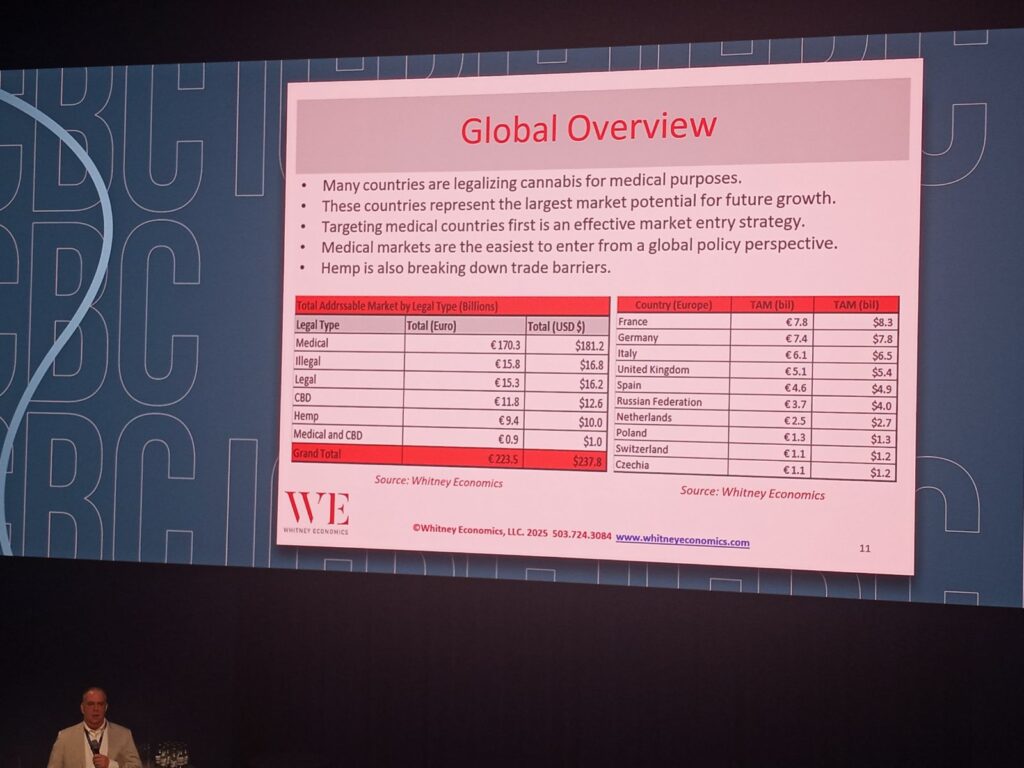
Below is another data chart that Mr. Whitney shared during his presentation in Berlin, which contains the total addressable market for Germany and other European markets. As you can see, the previously cited half a billion euro estimation for Germany’s current industry, referenced earlier in this article, is a mere fraction of the true potential of Germany’s cannabis industry:

beau whitney international cannabis business conference 2025 global market overview

One of the professed goals of German cannabis policy modernization efforts is to sufficiently combat the nation’s unregulated cannabis market to boost public health outcomes. The only way that goal will be achieved is by lawmakers in Europe’s largest market instituting a robust commerce system that allows consumers and patients to legally access the cannabis products that they want to purchase.

Until that happens, the unregulated market in Germany will continue to thrive, the nation will continue to miss out on the economic boost that a sufficient legal market yields, and public health outcomes will pay the price, with consumers and patients making their purchases of untested products from unregulated sources.

One thing is for sure – consumers and patients will not stop consuming cannabis just because such activity is prohibited. History is very clear on that. Lawmakers and regulators in Germany and throughout Europe would be wise to recognize that reality and to pursue sensible, balanced public policies.

Total Number Of German Cultivation Associations Rises To 211

Starting on July 1st, 2024, adults in Germany can apply to launch a member-based cannabis cultivation association. Cultivation associations are a key component of Germany’s adult-use model, and according to a recent newsletter by the German Cannabis Business Association (BvCW), the total number of approved associations has risen to 211.

“So far, out of 624 applications nationwide, 211 have been approved and 25 have been rejected.” stated BvCW in its most recent newsletter (translated from German to English). “A detailed overview can be found on the BCAv website.”

Policymakers and industry members in Germany originally pushed for a national adult-use cannabis legalization model that was broader compared to what is currently in place. However, after discussions and consultations with the European Union, it was determined that nationwide cannabis sales, like what is implemented in Uruguay and Canada, are prohibited under current EU agreements.

What is permitted in EU member nations is the adult-use model that Germany has adopted, which involves permitting personal consumer rights such as the cultivation, possession, and consumption of personal amounts of cannabis, as well as licensing member-based cultivation associations. Both components fall under the ‘boosting public health outcomes’ provisions of the current EU agreements.

Malta also permits cultivation associations as part of its modern adult-use cannabis policy model, and the number of associations there provides some insight into how many cultivation associations may eventually launch in Germany.

Currently, according to the Malta Authority for the Responsible Use of Cannabis’ website, there are 19 ‘cannabis harm reduction associations’ that have obtained an operating permit. It is worth noting that not all of those are dispensing cannabis to members right now, with some still being in the early stages of operation.

Malta has an estimated population of roughly 569,900, which works out to roughly one association for every 29,995 citizens. Germany currently has an estimated population of roughly 84,075,075. If we apply the same association-to-population ratio from Malta to Germany’s population, it would work out to about 2,803 total associations.

There is additional context that must be considered, and Malta and Germany are not an apples-to-apples comparison, so to speak. However, the basic calculation and comparison demonstrate how much potential for growth there is for Germany’s emerging cultivation association sector, at least at a macro level.

Another contextual factor to consider is that Malta’s association numbers are presumably going to rise as time goes on, and are not fixed at 19, so the 2,803 estimate for Germany will likely prove to be a low-end figure.

International Interest In Europe’s Cannabis Market Is Surging

As cannabis entrepreneurs, investors, policymakers, regulators, and industry service providers descended upon Germany in recent days for the International Cannabis Business Conference week, one thing is very evident: worldwide interest in Europe’s emerging legal cannabis market is surging.

I am based in the United States (Oregon), and having spent the last week in Germany surrounded by representatives from nearly every legal cannabis market on earth, and witnessing things on the ground firsthand, I can safely say that Europe’s status as being the most exciting place for cannabis policy and industry is officially here.

People from every corner of the globe are scrambling to gain a meaningful footprint in Germany and other legal markets in Europe, and rightfully so. Europe’s Green Rush era is in full swing.

In a lot of ways, what is happening in Europe right now reminds me of what occurred in the United States from 2012-2016 when the first of our states approved modernized adult-use cannabis laws. As many of us from the U.S. who attended The Talman House and International Cannabis Business Conference events this week in Berlin discussed, it felt like going back in time, and that we were re-watching a movie that we had already seen.

Yet, in other ways, the emergence of the modernized European cannabis industry is completely unique with its own nuances, opportunities, and challenges. There are certainly many components of the legal German cannabis industry’s rise, and to a lesser extent, other European markets, that are similar to what happened in the United States and Canada years ago. But some things are entirely new.

Knowing what the similarities are between North America’s experience and Europe’s, and equally important, what is not similar, is paramount for everyone who wants to succeed. Right now, Europe has the chance to incorporate the best of what has happened in the U.S. and Canadian markets and to learn from North America’s mistakes and failings.

Members of Europe’s legal cannabis community, along with policymakers and regulators, have a golden opportunity to create something better than the world has ever witnessed before. It is up to all of us, from entrepreneurs to investors to government officials, to capitalize on this historic moment and not squander it.

The biggest positive lesson that has come out of the United States and Canada that Europe must learn from is that when given the legal option to do so, consumers and patients will make their purchases from regulated cannabis channels instead of making those purchases from unregulated sources, provided that policies and regulations are sensible.

What constitutes ‘sensible’ is subjective and leaves a lot of room for interpretation. However, we now objectively know that in legal North American markets, robust access to reasonably regulated legal cannabis commerce will decimate the unregulated industry. Consumers and patients clearly prefer to make their purchases from commerce channels that have set hours of operation, on-time delivery and/or storefronts, and tested products. Unregulated sources do not offer any of those things.

Conversely, in North American markets where overburdensome regulations and illogical policies were implemented, the unregulated market continues to thrive. The data is clear that consumers and patients are willing to pay a little extra for regulated products. But there comes a point when regulations and taxes drive up costs to such an extent that it deters legal purchases, at which point people continue to buy their cannabis products from unregulated sources.

In my ongoing discussions with top European legal cannabis expert Peter Homberg of gunnercooke, he often points out that there are three goals of German cannabis policy modernization efforts. The three goals, which Mr. Homberg touched on in his keynote address on day 1 of the International Cannabis Business Conference in Berlin, also extend to other EU markets (paraphrased below):

  1. To protect children.
  2. To boost public health outcomes.
  3. To hinder the unregulated market.

The first two items on the above list flow from the third, and success can only be achieved by recognizing the reality that consumers and patients are going to purchase and consume cannabis products, and they must be afforded the legal options to do so.

European lawmakers and regulators who wish to stick their heads in the sand and act as if prohibition or overburdensome regulations will somehow magically reduce European cannabis consumption do so at their own peril, and at the peril of public health and other outcomes. That is particularly true in Germany, where the launch of regional adult-use cannabis commerce pilot trials has experienced several delays, and where conservative members of the newly elected governing coalition have expressed a desire to scrap pilot trials and other legalization provisions entirely.

Such members of the German governing coalition are, presumably as a political strategy, refusing to recognize a key point – that regional adult-use cannabis commerce pilot trials are not a new thing and are already successfully operating in the Netherlands and Switzerland. Just as the sky has not fallen over those EU nations, the same will prove to be true if the incoming German Minister of Health Nina Warken, and the recently announced Federal Ministry of Food and Agriculture (BMEL) Alois Rainer, allow already-submitted pilot trial applications to proceed.

For an insightful and thorough examination of both Nina Warken and Alois Rainer, both of whom will be instrumental in overseeing Germany’s emerging cannabis industry in the near future, check out a recent article by krautinvest.

A major difference between the North American markets and what is being built in Germany and Europe is the European Union (EU), as well as the EU’s politically independent executive arm, the European Commission (EC). All member nations are bound by EU agreements and EC policies and processes, and while state-level markets in the U.S. operate under the federal umbrella, it is not the same dynamic compared to the EU/EC.

EU agreements prohibit adult-use commerce models found at the state level in the United States and what is in place in Canada at a national level. Medical cannabis commerce is permitted in the European market, but adult-use commerce is limited to models that are based in research and designed to help boost public health outcomes, such as pilot trials and cultivation associations.

Those limitations need to be addressed via continued lobbying of continental decision-makers, and while many of them may be committed to ignoring demands to modernize EU agreements, the demands and pressure must be consistently applied nonetheless.

A significant lesson learned from ongoing policy and regulatory implementation in the United States is that a ‘patchwork’ approach is inefficient and chaotic, and ultimately doesn’t work for anyone. In the U.S., every legal state operates in a siloed fashion, with each jurisdiction having its own laws and regulations, and yet each state is also governed by conflicting federal law.

The same dysfunctional dynamic is on display in the EU to some degree, where individual nations have their own set of industry rules, which are then overlapped by an additional layer of EU-level rules that are either vague, conflicting, or in some cases, outright harmful. It is vital that the EU modernize and harmonize agreements and other policies in such a way that it recognizes reality and provides better certainty for patients, consumers, industry members, and ultimately, governments.

Europe’s cannabis industry and advocacy communities must continue to educate the rest of European society about the benefits of sensible policy modernization and the harms of senseless cannabis prohibition laws and regulations.

All the eyes of the global cannabis community are fixated on what is happening in Germany and other emerging European markets right now, including and especially the eyes of policymakers and regulators. Members of Europe’s emerging industry need to be mindful and strive to be good stewards of the opportunity that is being afforded to them. Germany’s industry and other legal markets in Europe are under a microscope right now, and that will remain the case for the foreseeable future.

I was asked many times while I was in Berlin for the International Cannabis Business Conference week what I consider to be the biggest lesson that entrepreneurs and investors can learn from the U.S., and my answer was always the same: don’t let your emotions get the best of you. Always perform your due diligence and make your decisions based on a sound process that you would apply to any other large, emerging industry.

Cannabis is exciting, and Europe’s industry potential is enormous. But if you don’t anticipate how fierce the competition will be, and recognize that industry success will not involve a straight path, you can lose a lot of money really fast.

I will end this article with a word of caution, as someone who had a front-row seat to how things unfolded in the United States years ago. We are all in this era of European cannabis together, and a single wrong move by one person or entity will no doubt be applied by cannabis opponents to the rest of Europe’s industry.

This special and historic moment in time can never be repeated, and we need to learn from the mistakes made in North America and ensure that things are done right in Europe to help put in place a foundation and framework that will set the stage for years to come. Proceed accordingly.

Austria’s CBD Flower Ban Faces Legal Challenges

Months after it was reportedly determined that dried hemp flowers in Austria with a THC content of up to 0.3% are subject to the country’s tobacco tax and monopoly, the nation’s government is facing ongoing legal challenges from cannabis industry members.

“The Austrian cannabis industry is breathing a sigh of relief after the publication of a constitutional opinion by leading jurist Dr. Heinz Mayer. According to Mayer, the sale of CBD weed with less than 0.3% THC is not subject to the tobacco monopoly, despite earlier reports from the Ministry of Finance. This would allow CBD shops to legally resume the sale of smokable cannabis products.” reported Cannabis Industrie in its original coverage (translated to English).

“Mayer argues that the ruling of the highest administrative court only confirms that CBD weed falls under tobacco excise duty, not under the monopoly itself. According to him, an extension of the tobacco monopoly to cannabis would be in conflict with the Austrian constitution and European law.” the outlet also reported.

According to a previous analysis by the Tax Foundation, Austria places a €3.32 excise duty per 20-pack of tobacco cigarettes. An additional ‘value added tax’ or VAT is also placed on tobacco products, raising the total tax per pack of tobacco cigarettes to €4.23. The Tax Foundation estimates that tax as a share of the final selling price per pack of tobacco cigarettes is 77%.

Regulators across Europe, and many other parts of the world, are struggling to rectify the inconsistencies in laws and regulations on consumable hemp products. For many years, hemp products were largely limited to textiles. However, many savvy entrepreneurs are bringing more consumable hemp products to emerging markets, often referred to as ‘cannabis light,’ and policymakers are scrambling to try to catch up.

According to the Austrian government, sales of cannabis light products must exclusively go through official tobacco shops as long as the sales ban remains in force. Vending machine sales are also prohibited according to the Austrian government.