Draft Bill Would Allow Adult-Use Cannabis Activity In Grenada

A majority of governments around the world have modernized their cannabis laws and regulations in recent years as they pertain to medical cannabis activity, to varying degrees. Some governments have comprehensively overhauled their medical cannabis public policies to permit robust commerce involving a wide array of products, while others have made more limited changes to permit hemp-derived product sales to patients experiencing a narrow set of qualifying conditions.

Adult-use cannabis policy modernization is rarer around the globe right now compared to medical cannabis reform, but momentum for recreational cannabis legalization is increasing with every passing year. Grenada, an island nation located in the Caribbean, is a country where lawmakers are pursuing adult-use cannabis reform.

“Agriculture Minister Lennox Andrews has confirmed that the proposed amendment to the Drug Act, which will decriminalise cannabis for recreational and religious use, will prohibit people under the age of 21 from being in possession and using cannabis.” reported <a href=”https://nowgrenada.com/2025/08/draft-bill-marijuana-use-and-possession-only-for-21-years-and-over/” target=”_blank” rel=”noopener”><em>Now Grenada</em></a> in its recent local coverage.

“This is a fundamental difference to the bill that was laid in the House in 2021 by the previous New National Party (NNP) Administration. That bill was laid for first reading and did not receive Parliamentary approval because of the June 2022 General Elections. It allowed anyone over 18 to have 28 grams or 0.987671 ounces of marijuana and allowed each homeowner over the age of 18 to grow no more than 5 trees.”

Cannabis is currently legal for adult use at a national level in Uruguay, Canada, Malta, Luxembourg, Germany, and South Africa. Lawmakers in the Czech Republic approved a national recreational cannabis legalization measure earlier this year, with the law set to take effect on January 1st, 2026.

Uruguay became the first country to legalize cannabis for adult use at a national level back in 2013, and set the legal age to 18 years old. Canada set the federal age limit to 18 when it adopted national legalization in late 2018, although most individual jurisdictions in Canada have raised their local age limit to between 19-21 years old.

Malta, Luxembourg, Germany, and South Africa have all set their legal age limits to 18 years old, and Czechia will have a legal age limit of 21 years old once its law takes effect.

Advocates Push For Private Cannabis Clubs In South Africa

South Africa is on a short but growing list of countries that have adopted national adult-use cannabis legalization measures. South Africa is joined by Uruguay, Canada, Malta, Luxembourg, and Germany, which all adopted recreational cannabis legalization measures before South Africa. The Czech Republic also recently adopted a national legalization measure.

The modern adult-use legalization law in South Africa actually started in late 2018 when the nation’s Constitutional Court deemed cannabis prohibition against private consumers to be unconstitutional. The landmark court decision was finally codified in 2024 by the nation’s lawmakers.

Policymakers and regulators are still working to properly set up South Africa’s recreational cannabis industry, and if advocates have their way, the nation’s legalization model will expressly include private cannabis clubs.

“A new initiative to unify private cannabis clubs to lobby for legal recognition has just been launched. The South African Cannabis Clubs Alliance (SACCA) says the time is critical for the private club movement to speak with one voice ahead of the anticipated release of draft regulations that will empower the Cannabis for Private Purposes Act.” reported Cannabiz Africa in its local reporting.

SACCA’s launch does come at a time of mounting pressure on authorities to draft regulations to combat the growing cannabis retail ‘Grey Zone’, the omniglot of thousands of unlicensed businesses dealing in cannabis across the country. To date, conflicting court decisions have cast clubs into a legal ‘no man’s land’ where the best they can strive for in terms of compliance, is to be ‘technically’ not illegal.” the outlet also reported.

As part of its advocacy, the South African Cannabis Clubs Alliance has launched a website, stating on it that the organization seeks to “ensure that self-regulated Cannabis Clubs are formally recognised in future cannabis legislation, with compliance requirements embedded into law to promote safety, transparency, and legitimacy.”

“SACCA is committed to an inclusive, transparent drafting process, inviting participation from a broad spectrum of stakeholders — including cultivators, legal experts, health professionals, traditional healers, activists, and community members.” the organization also states on its website.

The South African Cannabis Clubs Alliance has created ‘foundational documents’ that it is encouraging members of South Africa’s emerging industry to weigh in on, and the drafting phase for the documents will remain open until February 2026.

“In March 2026, the finalized SACCA documents will be formally submitted to all relevant government departments as part of the push for recognition and regulation of Private Cannabis Clubs in South Africa.” states SACCA on its website.

Uruguay Updates Legal Cannabis Prices

Uruguay became the first country in history to adopt a national adult-use cannabis legalization measure in 2013. Multiple nations have since adopted national recreational cannabis legalization measures, but Uruguay will always hold the title of being the first to do so.

Sales of legal adult-use cannabis flower launched in Uruguay’s pharmacies in 2017, and part of Uruguay’s model is having pre-set prices for all recreational cannabis products sold in pharmacies. Periodically, regulators in Uruguay update those prices, which happened recently in the South American country.

When pharmacy sales began in 2017, Uruguay’s market initially offered two flower strains for consumers to choose from. The first is a strain named ‘Alfa, ‘ and the second strain is named ‘Beta,’ each with tetrahydrocannabinol (THC) levels equal to or less than 9%, and cannabidiol (CBD) levels equal to or less than 3%.

Then, in 2022, Uruguay permitted a third option, ‘Gamma,’ which has a THC level of equal to or less than 15%, and CBD levels of equal to or less than 1%. A fourth strain named ‘Épsilon’ was introduced to Uruguay’s legal market in October 2024. Épsilon has a THC level of equal to or less than 20%, and CBD levels of equal to or less than 1%.

“The Institute for the Regulation and Control of Cannabis (IRCCA) announced the new prices for adult-use cannabis dispensed in pharmacies.” reported Montevideo in its local reporting (translated from Spanish to English). “Along these lines, the agency ordered a $10 increase as part of the semiannual update corresponding to August of the new product prices.”

The updated pricing for each strain is below, in Uruguayan pesos:

Since Uruguay adopted its legalization model, Canada, Malta, Luxembourg, Germany, South Africa, and the Czech Republic have also adopted national legalization measures. However, out of the countries that have legalized cannabis for adult use, only Uruguay currently has a set-price model for legal products.

The theory behind Uruguay’s approach to cannabis pricing is that by offering cannabis through the nation’s pharmacies and keeping prices reasonable, it combats the unregulated market. Legal cannabis purchases in Uruguay are limited to residents only. Over 75,000 consumers have registered to make legal purchases through the nation’s pharmacies.

Nearly 50% Of German Patients Live Over 10 Kilometers From A Cannabis Pharmacy

As is the case with any country that has adopted a modernized medical cannabis program, Germany’s patient base is spread out across the country, with some regions of Germany having a larger concentration of patients than others. Meanwhile, medical cannabis safe access points are also spread across Germany in a non-uniform manner.

For able-bodied patients who live near a German pharmacy that dispenses medical cannabis, acquiring their medicine is presumably not too big a burden. However, for patients who live far away from a cannabis pharmacy and/or are not able-bodied, telemedicine and delivery services are vital.

Unfortunately, Germany’s Health Minister Nina Warken is currently pushing to abolish both medical cannabis telemedicine and delivery services in the European country. Minister Warken recently released a draft amendment that, as introduced, would:

  • Mandate in-person doctor consultations
  • Ban mail-order medical cannabis dispensing
  • Impose stricter rules for medical cannabis prescriptions

For the first time, data has been compiled and published that quantifies which regions and medical cannabis patients would be hit the hardest if the harmful amendment and its provisions were to be adopted.

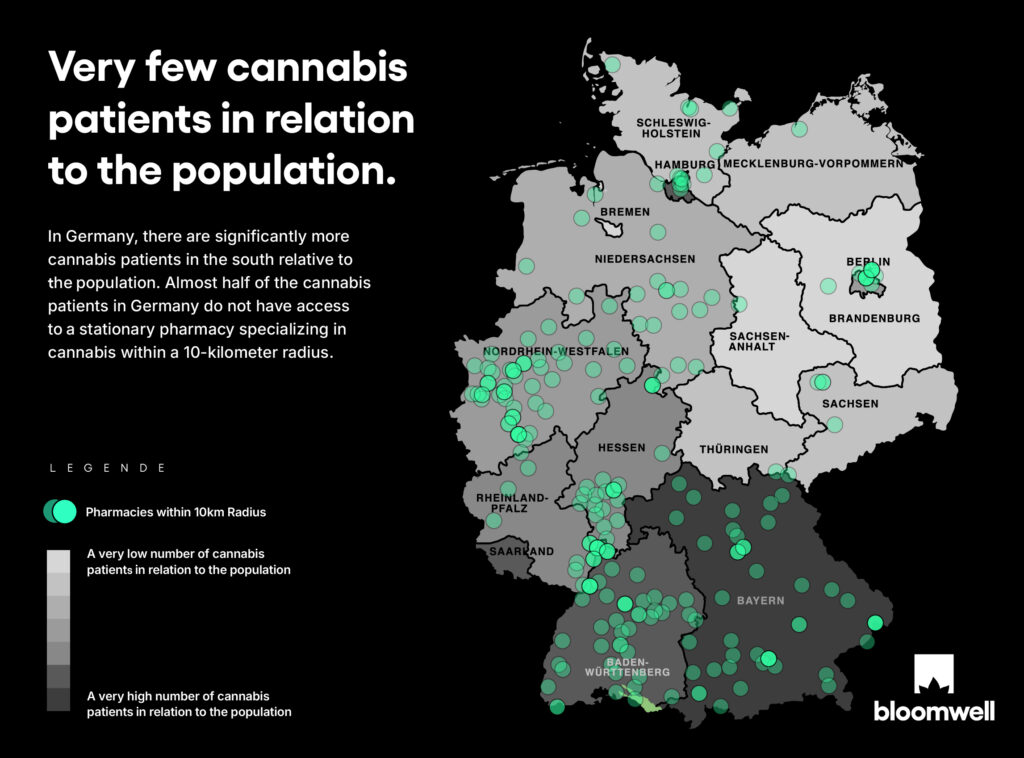
Bloomwell Group released a map outlining the number of medical cannabis patients in Germany in relation to the country’s population, along with which regions have the most, and least, patients. The results suggest that online delivery of medical cannabis is heavily relied upon by German patients who do not have local access to brick-and-mortar pharmacies that can supply cannabis treatment.” stated Bloomwell in a press release obtained by the International Cannabis Business Conference.

bloomwell German Germany medical cannabis patient location map

According to the company’s data analysis, “there are significantly more medical cannabis patients in relation to the population in the South of the country than in the North,” and “almost half of the cannabis patients in Germany do not have access to a brick-and-mortar pharmacy specializing in cannabis treatment within a 10-kilometer radius.”

German medical cannabis telemedicine services help the nation’s most vulnerable patients, including rural patients who live far away from doctors, disabled patients who often cannot travel to complete in-person consultations, and low income patients who may be able-bodied and yet cannot afford to travel to a physical doctors office or pay extra for a doctor to travel to them for in-person consultations. It is paramount for these types of German medical cannabis patients that telemedicine and delivery services be maintained and not banned.

“If half of cannabis patients cannot legally obtain their medication from a pharmacy within a 10-kilometer radius, what alternative remains for these medical patients besides turning to the illicit market? We are only at the very beginning of the legislative process, and given the severe potential consequences of the current draft for limiting the pharmaceutical care access of hundreds of thousands of chronically ill patients, I predict that this amendment will not be passed in its current form. Fortunately, the SPD parliamentary group has already emphasized that without solid evaluation results, they will not jeopardize patient safety through such drastic measures.” states Niklas Kouparanis, Co-Founder and CEO of Bloomwell Group.

Leading international cannabis economist Beau Whitney, founder of Whitney Economics, estimates that Germany is home to between 700k and 900k medical cannabis patients.

Saarland Cannabis Social Club Receives Cultivation Approval

One of the main components of Germany’s adult-use cannabis legalization model is permitting consumers to join a member-based cultivation association. German cultivation associations are also sometimes referred to as ‘cannabis social clubs.’

Per our prior reporting, as of last month, 293 cultivation association applications had been approved by regulators in Germany, and hundreds more applications are pending. At least one application had been approved in every German state except Saarland. The southwestern German state was a notable holdout, but it has reportedly finally approved its first application.

“In Saarland, the first Cannabis Social Club (CSC) has received a permit from the state government to cultivate cannabis communally.” reported Saarbrücker Zeitung in its local reporting (translated from German to English). “The responsible Ministry of the Environment announced this in response to an inquiry by the Süddeutsche Zeitung (SZ).”

“Saarland is thus the last federal state to issue a cultivation permit. The Saarland SPD state government had spoken out against the legalization of cannabis in the Bundesrat (Federal Council).” the outlet also reported.

Starting on July 1st, 2024, adults in Germany can apply to their local authority to launch a cultivation association. Once approved, adult cannabis consumers in Germany can become members of the association and source products legally. German adults can only be members of one association at any given time, and additional association regulations apply.

Whereas current European Union agreements prohibit national adult-use cannabis sales, such as what is occurring in Canada and Uruguay, EU agreements do permit member nations to allow cultivation associations since they fall under the umbrella of boosting public health outcomes. Malta also includes cultivation associations in its national recreational legalization model.

A major premise of the European recreational cannabis policy modernization effort is that when adults consume regulated cannabis or cannabis that they cultivate themselves, it is better for public health outcomes compared to when adults consume cannabis from unregulated sources.

That premise is the basis for the European Union allowing Malta, Luxembourg, Germany, and the Czech Republic to adopt national adult-use cannabis legalization measures. Recreational cannabis legalization measures are also currently being considered in Slovenia and Switzerland.

Germany Imported Over 43 Tonnes Of Cannabis In Q2 2025

Germany’s Federal Institute for Drugs and Medical Devices (BfArM) recently published medical cannabis import data for the second quarter of 2025, and once again, Germany’s emerging legal medical cannabis industry set a new record for import totals.

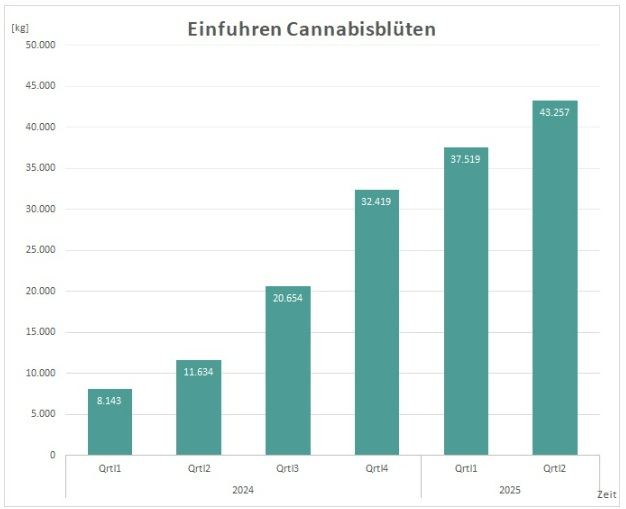
In the second quarter of 2025, Germany imported 43.257 tonnes of medical cannabis products according to BfArM’s data. That is an increase over the previous record set in Q1 2025 of 37.519 tonnes, and a significant increase compared to Q2 2024 when Germany imported 11.634 tonnes of medical cannabis products. Below is a graph of import totals from BfArM:

germany medical cannabis imports 2024 and 2025

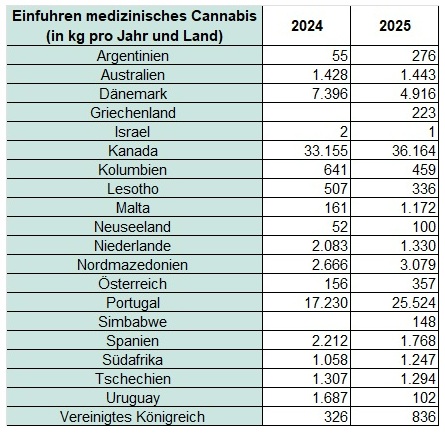
Canada continues to serve as the top source of medical cannabis imports to Germany, with BfArM reporting that Germany has imported 36.164 tonnes of medical cannabis products in the first half of 2025. By comparison, 25.524 tonnes have been imported to Germany from Portugal in the first half of 2025.

Below is a breakdown of countries of origin for medical cannabis imports to Germany in 2024 and the first half of 2025, via BfArM:

germany medical cannabis imports by country 2024 and 2025

Legal sales of medical cannabis products through pharmacies began in Germany in 2017. Back then, the Netherlands served as the top source for medical cannabis imports to Germany. The same was true for 2018. However, in 2019, imports to Germany from Canada topped the Netherlands and every other country of origin, and that has remained the case ever since.

Germany was already home to Europe’s largest legal medical cannabis market before the nation’s CanG law took effect in April 2024, and as the data demonstrates, Germany’s medical cannabis industry has surged since then. Germany is on pace to eclipse 160 tonnes of medical cannabis imports in 2025 if current trends persist, but given the fact that import totals still appear to be climbing, it will be interesting to see what the actual final total for 2025 ends up being.

Comparing U.S. And European Cannabis Legalization

Starting in 2012 with Colorado and Washington State, jurisdictions in the U.S. began to modernize their cannabis policies to permit adult-use cannabis activity. In some cases, the reform efforts involved legalizing sales of recreational cannabis products. Today, two dozen states in the U.S. have adopted adult-use legalization, as well as Washington D.C.

In recent years, adult-use cannabis policy modernization has spread to the European continent. The first European nation to adopt a national recreational cannabis law was Malta in 2021, followed by Luxembourg in 2023 and Germany in 2024.

Earlier this year, lawmakers in the Czech Republic also adopted a national adult-use cannabis legalization measure, with the new law set to take effect on January 1st, 2026. A national adult-use cannabis legalization measure was recently introduced in Slovenia, and policymakers in Switzerland are also considering a national recreational legalization measure.

At the state level in the U.S., and the national level in Europe, no two legal jurisdictions have the same model. Every jurisdiction permits differing cultivation, possession, and commerce policies and regulations to some degree.

In the U.S., most legal cannabis states permit home cultivation, but not all of them. Washington State is a noteworthy example. Despite being one of the first legal states in the U.S., along with Colorado, Washington still prohibits adult-use home cannabis cultivation. Illinois also does not permit adult-use cultivation.

Additionally, most legal recreational jurisdictions in the U.S. permit adult-use cannabis product sales, but there are exceptions. Virginia allows legal adult-use cannabis possession, but not sales. Washington D.C. also permits personal adult-use activity, but not adult-use product sales.

Vermont was the first state in the U.S. to legalize via legislative action, and initially did not permit adult-use cannabis sales, but later modernized its adult-use model to permit sales. All the while, cannabis has remained a Schedule I substance at the federal level in the United States, and all adult-use activity is prohibited at the federal level, but ‘tolerated’ at the state and district levels.

A somewhat similar public policy scenario exists in Europe, where European Union agreements largely prohibit modernized adult-use cannabis policies and regulations, but do allow limited national-level legalization to proceed in some ways.

Current European Union agreements prohibit national adult-use product sales, like what is occurring in Canada and Uruguay, but do allow reform measures to be adopted by its member nations if they fall within research and ‘boosting public health outcome’ parameters.

Home cultivation is so far a standard component of adult-use legalization models in Europe. Malta, Luxembourg, and Germany all permit home cultivation by adults, and once Czechia’s legalization law takes effect, it will also allow home cultivation.

Limited adult-use commerce of non-cannabis light products occurs legally via two channels in Europe right now. The first is via cultivation associations, in which consumers become members of an association and source their cannabis products. Malta and Germany permit cultivation associations, but Luxembourg does not, and when Czechia’s law takes effect, it will also continue to prohibit cultivation associations.

The other EU-approved legal channel for recreational cannabis commerce is regional adult-use cannabis pilot trials. Pilot trials are already operating in the Netherlands and Switzerland, even though both nations have yet to adopt national legalization measures, and pilots are expected to launch someday in Germany too. The legalization models in Malta, Luxembourg, and Czechia do not include pilot trials.

One of the biggest differences between the United States and Europe’s adult-use policy modernization efforts is the way that they are described. Europe’s recent policy modernization models are often described as ‘decriminalization’ even though they would constitute ‘legalization’ in the United States.

The difference between how the two are described is often in the eye of the beholder. Many cannabis policy reformists in the United States do not consider policies to be true legalization unless they involve permitted home cultivation. Conversely, many advocates in Europe do not consider policies to be true legalization unless national adult-use sales are permitted.

My home state, Oregon, became the first state in the U.S. to adopt a cannabis decriminalization measure in 1973, removing the criminal charge associated with possessing a personal amount of cannabis and replacing the penalty with a fine.

Later, in 2014, voters in Oregon approved a measure that removed the fine and allowed adults to possess a personal amount of cannabis with no penalty at all. In my personal opinion, that is the difference between decriminalization and legalization, but I also respect the opinions of other longtime cannabis activists who feel differently.

I am hopeful that in the not-too-distant future, lawmakers on both sides of the Atlantic Ocean will adopt sensible, harmonized cannabis policies and regulations so that consumers and patients are protected, and the industry can reach its full potential.

DHV Issues Statement Against Harmful German Draft Amendment

Last month, Germany’s Ministry of Health released a draft amendment that, if approved, would negatively impact the nation’s medical cannabis program, and with it, Germany’s suffering patients and emerging industry. As proposed, the draft amendment would:

  • Mandate in-person doctor consultations
  • Ban on mail-order medical cannabis dispensing
  • Impose stricter rules for medical cannabis prescriptions

Pushback to the draft amendment by medical cannabis patients, advocates, and industry members was swift. The German Hemp Association (DHV) recently issued its own statement calling for the proposed amendment to be defeated.

“Telemedical prescriptions of cannabis medications and online delivery were already possible before the MedCanG “in the days of the Narcotics Act.” The planned changes would essentially catapult us back to pre-digital times when it comes to cannabis medicine, while the federal government otherwise wants to catch up with its significant lag in digitalization. This not only feels anachronistic for citizens and patients in Germany, but is likely to cause head-scratching abroad as well. No online delivery of (cannabis) medications? Picking everything up in person? In Canada and the USA, this will be hard to believe. This is reminiscent of the strength of the pharmacist lobby, just as it is in Germany.” stated DHV in a recent news release (translated from German to English).

DHV is calling out the apparent selective focus by the Ministry of Health on cannabis flower but not cannabis extracts. Germany has experienced exponential growth in medical cannabis flower imports over the last year. However, the increase in exports has not been directly tied to any increase in public health issues.

“It is unclear why the planned regulations should only apply to cannabis flowers and not to extracts with significantly higher THC concentrations. The justification merely states that the import of flowers has increased significantly. However, it is likely that the import of extracts is also likely to have increased significantly from the first to the second half of 2024. However, the Federal Ministry of Health does not provide any figures on this. The Federal Institute for Drugs and Medical Devices (BfArM) also does not provide any information on the development of extracts. Furthermore, it is unclear whether and to what extent extracts are produced and distributed within Germany after the import of cannabis flowers. ” DHV points out.

“Without data on the import of extracts and the processing of flowers into extracts within Germany, an objective assessment is impossible, and a one-sided restriction on flowers is incomprehensible. For years, we have seen a one-sided negative portrayal of flowers compared to other cannabis medications because they resemble the traditional recreational drug cannabis, even though the flowers certainly have their justification for medical use through simple inhalation.” DHV also stated in its news release.

DHV’s full statement can be read at this link here, and people are encouraged to read it in its entirety. Readers can also check out our previous coverage of statements from other advocates and organizations, as well as information on where to sign petitions against the draft amendment, at this link here.

Japanese Study Refutes Cannabis ‘Gateway Drug’ Theory

When it comes to cannabis opponent talking points, the ‘cannabis is a gateway drug’ talking point may be the most popular one of all time. Cannabis opponents have frequently claimed that cannabis use will lead to the use of more harmful substances, going back to the reefer madness era.

The cannabis gateway drug theory went unquestioned for a long time. However, it has become the focus of a growing amount of peer-reviewed research in recent decades, including in Japan, where a team of investigators examined relevant data to test the theory.

A team of researchers affiliated with several health and academic institutions in Japan conducted an analysis of nationwide survey results that asked about substance use. The researchers’ findings were published in the journal Neuropsychopharmacology Reports.

“In Japan, cannabis is frequently labeled a “gateway drug,” yet strong causal evidence for progression to other substances is limited. This study investigates whether cannabis acts as a gateway drug among Japanese users.” the researchers stated about the focus of their effort.

An anonymous online survey was conducted in Japan in January 2021 involving 3900 individuals who reported their lifetime cannabis use. The survey of Japanese residents “gathered data on demographics, cannabis and other substance use history, order of substance initiation, psychiatric background, and criminal records.”

“A Sankey diagram visualized substance use progression, and odds ratios were calculated to assess the likelihood of using other substances following cannabis use.” the researchers stated about their methodology.

“Tobacco and alcohol were the most common initial substances, while cannabis was typically the third. Odds for subsequent use of alcohol, tobacco, methamphetamine, and other illicit drugs after cannabis use were 1.25, 0.77, 0.08, and 0.78, respectively, suggesting low probabilities of progression. Nearly half of those who reported cannabis as their third drug did not use other substances afterward.” the researchers determined.

“These findings challenge the gateway hypothesis in the Japanese context. Shared vulnerabilities and strict drug policies may shape these patterns. Further research is warranted to explore the impact of legal changes on drug use behavior.” the researchers concluded.

The recent study results in Japan build on research in other jurisdictions around the globe that have also arrived at similar conclusions. The misuse of household products and pharmaceutical medications is also often found to precede cannabis use, and whether someone decides to use more harmful substances after using cannabis is due to many factors and not due to the subject simply having tried cannabis.