Legal CBD Sectors Are Set For Significant Growth

The cannabis plant contains several cannabinoids, with one of the most popular ones for consumers and patients being cannabidiol (CBD). CBD is being incorporated into more recreational and medical products now than ever before, and that is leading to some eye-popping projections for the overall CBD industry and various CBD industry sectors.

According to a recent market report by Coherent Market Insights, the global CBD industry “is estimated to be valued at USD 8.12 Bn in 2024 and is expected to reach USD 23.41 Bn by 2031, exhibiting a CAGR of 16.3% from 2024 to 2031,” although, time may likely prove that projection to be too conservative as individual sector projections below will demonstrate.

A particularly popular consumption method for cannabidiol is gummies. Many consumers and patients prefer ingesting gummies versus consuming cannabidiol in forms that involve smoking or vaporization. CBD gummies are discrete and convenient, making them a great option for many people.

According to a market analysis by Straits Research, “the global CBD gummies market size was valued at USD 1.88 billion in 2024 and is projected to reach from USD 2.44 billion in 2025 to USD 19.93 billion by 2033, growing with a CAGR of 30.02% during the forecast period (2025–2033).”

“North America is the most significant global CBD gummies market shareholder and is expected to grow significantly over the forecast period. The increased prevalence of CBD-infused gummy bears within the United States can be ascribed to the escalating consumer interest in CBD merchandise and the burgeoning acceptance of alternative medicinal practices.” Straits Research also stated in its market analysis.

CBD nutraceuticals are also poised for tremendous growth in the coming years. According to market analysts at Research and Markets, “the global CBD nutraceuticals market size is expected to reach USD 23.17 billion by 2030, registering a CAGR of 14.2% from 2024 to 2030.”

Research and Markets also determined the following in its analysis:

  • CBD tinctures segment dominated the global market and accounted for a revenue share of 41.9% in 2023
  • The edibles and fortified foods segment accounted for the largest revenue share in 2023
  • North America CBD nutraceuticals market dominated the global industry with a revenue share of 54.5% in 2023

Many countries around the world are modernizing their cannabis policies and regulations to allow legal CBD commerce. Every country that does so adds further momentum to the global CBD industry.

Published Scientific Papers About Cannabis Tops 35,000 In Past Decade

Since the beginning of when cannabis prohibition policies were first implemented around the globe, there has never been a better time for cannabis research. Cannabis research efforts have greatly benefitted from policy modernization efforts worldwide in recent years. The increase in cannabis research findings is reflected in a recent analysis published by NORML.

“For the fourth consecutive year, researchers worldwide published over 4,000 scientific papers specific to cannabis, its active constituents, and their effects, according to the results of a keyword search of the National Library of Medicine/PubMed.gov website.” NORML stated in a recent article posted on its website.

“Over the past decade, there has been a dramatic increase in scientific inquiries about the cannabis plant — with researchers publishing more than 35,000 scientific papers about cannabis since the beginning of 2014. Much of this uptick is a result of researchers’ newfound focus on marijuana’s therapeutic activities as well investigations into the real-world effects of legalization laws.” NORML also stated.

For many decades, cannabis was prohibited around the world, and that greatly hindered cannabis research efforts. However, cannabis is now legal for medical use in nearly five dozen nations and legal for adult use in Uruguay, Canada, Malta, Luxembourg, Germany, and South Africa. Those policy modernization efforts are boosting worldwide knowledge of the cannabis plant.

A number of other jurisdictions are expected to modernize their cannabis policies in 2025, which will further add to the momentum of global cannabis research efforts. That is in addition to countries that are already conducting a considerable amount of cannabis research.

Lawmakers Criticized In Australia For Failing To Legalize Cannabis

A lawmaker in Australia is criticizing his peers for failing to approve an adult-use cannabis legalization measure this year. Legalise Cannabis WA MP Dr. Brian Walker recently lashed out at Australia’s federal government for failing to take advantage of the robust economic benefits that recreational cannabis legalization creates.

“Dr Walker hit out at what he called the “pig-headed intransigence of the federal government” after it helped vote down Greens Senator David Shoebridge’s Legalising Cannabis Bill 2023 in November.” Cannabiz stated in its local coverage.

“Late last month, we watched the Labor and Liberal parties vote down a proposal to legalise cannabis in the federal senate,” Dr. Walker said according to Cannabiz.

Currently, cannabis is legal for adult use in Uruguay, Canada, Malta, Luxembourg, Germany, and South Africa. Additionally, two dozen states in the U.S. have adopted recreational cannabis legalization measures, and regional adult-use cannabis commerce pilot trials are operating in the Netherlands and Switzerland.

Medical cannabis sales in Australia have quadrupled during the last two years, with Australians expected to spend an estimated $1 billion on medical cannabis this year. Medical cannabis was first legalized in Australia in 2016.

“The Pennington Institute’s Cannabis in Australia report has revealed spending has skyrocketed from $230 million two years ago to a predicted $1 billion by the end of this year.” 9News stated in its local coverage.

“The spending correlates with usage, which jumped from just 3.9 per cent of survey respondents in 2019 to almost 30 per cent admitting they use prescription marijuana.” the outlet also reported.

France’s Medical Cannabis Trial Receives Another Extension

Health authorities in France recently announced that the nation’s medical cannabis trial experiment will be extended until July 31st, 2025. The announcement is welcomed news to the reported 1,800 suffering patients estimated to be currently participating in the trial.

“The experiement was due to end on 31 December 2024, but at a meeting on Thursday between patient associations and the health authorities, the Ministry of Health gave the green light for it to run for a further six months, FranceInfo reported.” stated RFI in its local coverage.

“The extension will be granted only “with a view to weaning patients off the drug or finding alternatives”, the resigning Health Minister, Geneviève Darrieussecq, wrote in the letter enabling the decision.” the outlet also reported.

In March 2021, France launched its limited medical cannabis experiment involving between 2,000 and 3,000 suffering patients at the time to gain insight into crafting national medical cannabis policies and regulations.

The French medical cannabis experiment received initial approval from the federal Senate back in 2019, however, the launch of the trial was delayed until the spring of 2021 due to various reasons.

Initially slated for two years, France’s medical cannabis experiment was eventually granted a one-year extension and was set to end in 2024 before receiving the latest extension pushing the estimated end of the trial to the summer of 2025.

According to a recent newsletter sent out by international cannabis economist Beau Whitney of Whitney Economics, France is home to the largest total addressable cannabis market in the European Union with a value of $11.3 billion (midpoint).

Cannabis Oil Mitigates Osteoarthritis Knee Pain In Clinical Trial

Unfortunately, knee injuries are common worldwide, especially within the sports community and among older individuals. Researchers estimate that knee injuries account for as much as 41% of all sports-related injuries for athletes.

Many knee injuries result in the affected patient developing osteoarthritis in the injured knee. An estimated 365 million people worldwide suffer from knee osteoarthritis, which can be very painful for the individual suffering from the condition.

A team of researchers in Thailand recently conducted a clinical trial involving the use of cannabis-infused oil among patients suffering from osteoarthritis knee pain. Below is more information about the clinical trial and its results via a news release from NORML:

Sukhothai, Thailand: The sublingual administration of oil extracts containing plant-derived cannabinoids significantly reduces knee pain in subjects suffering from treatment-resistant osteoarthritis, according to clinical data published in the Journal of Southeast Asian Orthopaedics.

A team of Thai investigators conducted a randomized, double-blind, placebo-controlled clinical trial involving 32 patients diagnosed with severe osteoarthritic knee pain. All the participants in the study were awaiting total knee arthroplasty. Participants consumed either oral extracts containing THC (4.59 mg/drop) and CBD (24.25 mg/drop) or a placebo (coconut oil) for 30 days in addition to traditional prescription medications.

Patients’ pain scores “demonstrated a statistically significant improvement” following cannabis treatment, researchers reported.

The study’s authors concluded: “Cannabis oil significantly reduced pain intensity and improved the QOL [quality of life] in patients with knee OA, as reflected by improvements in the NRS [Numeric Rating Scale]and KOOS [Knee Injury and Osteoarthritis Outcome] scores. … Future research with optimized dosages, larger sample sizes, and longer follow-up periods is needed to evaluate its true clinical relevance.”

Full text of the study, “Effectiveness of cannabis oil as an adjuvant therapy in patients with severe knee osteoarthritis: A randomized, double-blind study,” appears in the Journal of Southeast Asian OrthopaedicsAdditional information on cannabis and arthritis is available from NORML’s publication, Clinical Applications for Cannabis & Cannabinoids.

Support For Cannabis Legalization In Germany Rises To 59%

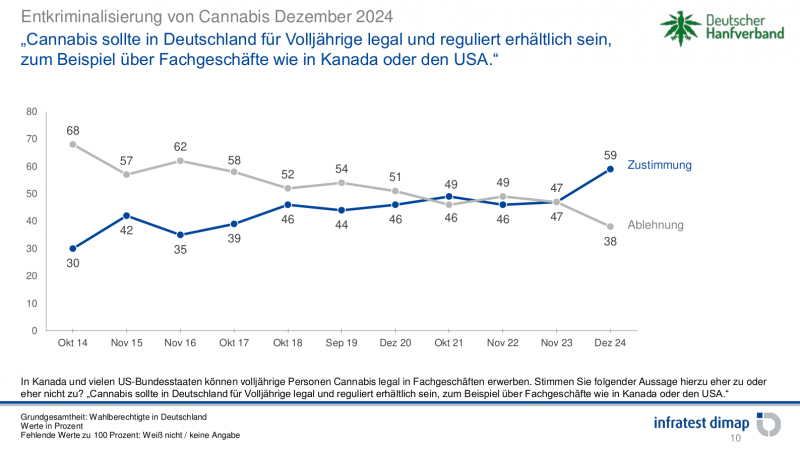
Support for comprehensive adult-use cannabis legalization in Germany has increased to 59% according to the results of a new poll commissioned by the German Hemp Association (DHV). Lawmakers in Germany adopted partial cannabis legalization earlier this year.

“For the first time, according to infratest dimap, an absolute majority of Germans are in favor of legalizing cannabis, i.e. regulated distribution to adults, as originally agreed in the coalition agreement of the traffic light government. A similarly large majority opposes the CDU/CSU’s plans to make possession of small amounts of cannabis and the cultivation of some plants a criminal offense again.” DHV stated in a press release announcing the results of the recent poll (translated from German to English).

“After three years of stagnation in support for legalization at just under 50%, there has now been a spectacular and surprising increase to 59%! This is surprising because since the traffic light government took office, opponents of cannabis legalization, such as the German Medical Association and police unions, have regularly spread negative information about the discussed and implemented Cannabis Act (CanG) with high media reach.” DHV also stated.

Starting on April 1st, 2024, adults in Germany can cultivate a personal amount of cannabis plants in their private residences and possess a personal amount of cannabis for recreational purposes. Additionally, starting on July 1st, 2024, people can apply to start a cultivation association in Germany.

“The CanG, which was drafted under the leadership of Karl Lauterbach and came into force on April 1, 2024, does not involve the legalization of cannabis because it does not provide for legal sales. This is why we commissioned additional questions from infratest dimap this year. And here, too, there is overwhelming agreement in Germany. Only 37% are in favor of making possession of small quantities a criminal offense again (or 41% for home cultivation).” DHV stated about why they commissioned the poll.

“The surveys conducted by infratest dimap for the DHV are the best data basis on the opinion of Germans regarding the legalization of cannabis, because the survey is formulated neutrally in consultation with the institute and, apart from a few small updates, has been carried out almost identically every year since 2014. This not only allows a snapshot, but also a long-term trend to be identified.” DHV stated.

german cannabis legalization poll 2024 dhv

“Looking at the party supporters of those surveyed, it is also clear that the Union is alone in its demand to reverse the reform. The majority of supporters of all potential coalition partners are against a renewed ban on possession and home cultivation. The SPD, which does not comment on cannabis in its current draft program, can also be bolder and stand by its law.” DHV stated.

Transdermal Cannabis Mitigates Diabetic Neuropathy In Clinical Trial

Diabetic neuropathy is a form of nerve damage that can happen in patients who suffer from diabetes. International researchers estimate that roughly 536.6 million people worldwide have been diagnosed with diabetes.

Health investigators around the world are researching how medical cannabis products and diabetes interact at an ever-increasing rate, and many studies are finding that medical cannabis can help treat diabetes to some degree.

A team of researchers in Thailand recently conducted a clinical trial focusing on transdermal cannabis products and patients who suffer from diabetic neuropathy. Below is more information about the results of the study and its findings via a news release from NORML:

Khon Kaen, Thailand: The transdermal application of oil extracts containing plant-derived cannabinoids significantly reduces diabetic neuropathy, according to clinical data published in the journal Medical Cannabis and Cannabinoids.

A team of Thai investigators conducted a Phase III, randomized, double-blind, placebo-controlled clinical trial involving 100 patients diagnosed with diabetic neuropathy of the lower extremities. Participants received either transdermal formulations containing THC (3.20 mg/drop), CBD (0.32 mg/drop), and CBN (0.65 mg/drop) or a placebo (coconut oil) for 12 weeks. Subjects’ pain levels were assessed at baseline and at four, eight, and 12 weeks.

“Mean total NPSI-T (Neuropathic Pain Symptom Inventory) scores decreased markedly from 25.60 to 5.57 in the treatment cohort, contrasting with minimal reduction from 25.24 to 22.85 in the placebo group,” researchers reported. “GEE (Generalized Estimating Equation) analysis revealed significant pain amelioration at weeks 4, 8, and 12. The cannabis formulation exhibited an excellent safety profile, with only 10 percent of participants reporting mild adverse events, comparable to placebo group outcomes.”

The study’s authors concluded: “This novel transdermal medical cannabis formulation (consisting of THC, CBD, and CBN) demonstrated significant therapeutic efficacy in ameliorating painful DPN [diabetic peripheral neuropathy] symptoms while maintaining a favorable safety profile. These findings provide robust clinical evidence supporting its potential as an innovative therapeutic option for managing painful diabetic peripheral neuropathy.”

Prior studies have similarly shown that a wide range of cannabis formulations, including vaporized cannabis floweroral CBD extracts, and aerosolized THC can mitigate neuropathic pain.

Full text of the study, “Efficacy and safety of transdermal medical cannabis (THC: CBD: CBN formula) to treat painful diabetic peripheral neuropathy of the lower extremities,” appears in Medical Cannabis and Cannabinoids.

Alex Rogers Visits Cannabis Pharmacy In Munich

Germany first started legally dispensing medical cannabis products through a pharmacy model back in 2017. Since that time, Germany’s medical cannabis industry has become the largest on the European continent.

Helios Cannabis is one of the leading medical cannabis companies operating in Germany and runs a medical cannabis pharmacy in Munich. Helios is comprised of an enthusiastic, committed team that deals with the topic of cannabis as a medicine and its use in the treatment of suffering patients.

Thanks to their many years of experience and continuous training, Helios provides patients with comprehensive advice and improves their quality of life.

The Munich public prosecutor’s office conducted a search of the Helios pharmacy on Königsplatz on October 24th, 2024, accusing the location of ‘producing hash illegally.’ As legal counsel for Helios pointed out, the company is well within legal parameters to produce necessary medical cannabis products for its patients.

“Pharmacies are allowed to legally manufacture cannabis products for medical and scientific purposes. No special permission is required for this. Ensuring that the population is supplied with medicines – including cannabis – is the legal responsibility of pharmacies.” stated Konstantin Grubwinkler, legal counsel for Helios.

The recent unfounded search of the Helios location in Munich serves as an unfortunate reminder that cannabis opponents will continue to do what they can to try to thwart the progress of entities doing things the right way such as Helios.

Alex Rogers, founder and CEO of the International Cannabis Business Conference, recently visited Helios’ Munich pharmacy location to see their world-class operations firsthand. Below is a video that captures the highlights of the visit, and includes a brief discussion about the recent incident mentioned above.

27 German Jurisdictions Express Interest In Cannabis Model Projects

Germany’s Federal Ministry of Food and Agriculture (BMEL) was recently tasked with the responsibility of overseeing adult-use model project applications. The announcement cleared the way for entities in Germany to start submitting applications for scientific model projects on the legal distribution of recreational cannabis.

The German Cannabis Industry Association (BvCW) called on interested universities and companies to submit applications “as soon as possible” in its newsletter this week. BvCW is pointing interested entities to BMEL’s website to learn more about how to apply.

According to BvCW, the following German municipalities have expressed interest in launching cannabis model projects:

  • Freiburg
  • Munich
  • State of Berlin
  • Pankow
  • Charlottenburg-Wilmersdorf
  • Lichtenberg
  • Friedrichshain-Kreuzberg
  • Neukölln
  • Center (Berlin)
  • Treptow-Köpenick
  • Bremen
  • Hamburg
  • Marburg
  • Wiesbaden
  • Offenbach
  • Darmstadt
  • Groß-Gerau
  • Frankfurt
  • Hanover
  • Cologne
  • Dortmund
  • Bonn
  • Muenster
  • Bielefeld
  • Düsseldorf
  • Mainz
  • Leipzig

“We are very pleased that this important step has been taken. Various research projects are enabling a new range of knowledge on what the best possible future regulation of the recreational cannabis market could look like. This is an essential contribution to significantly reducing the black market in the medium to long term,” said Dirk Heitepriem, President of the Cannabis Industry Association (BvCW), about BMEL’s authority over the application process (translated from German to English).

“No black market dealer asks for ID. However, as part of these model projects, there will be strict age checks – as in the cannabis cultivation associations. Safe sources will guarantee quality and thus exclude the greatest health risks – additives and cutting agents,” added Michael Greif, Managing Director of the BvCW.

BvCW has also published a checklist for model project applications to help potential applicants.