Australian Medical Cannabis Sales Quadrupled In The Last Two Years

Medical cannabis sales in Australia have quadrupled during the last two years, with Australians expected to spend an estimated $1 billion on medical cannabis this year. Medical cannabis was first legalized in Australia in 2016.

“The Pennington Institute’s Cannabis in Australia report has revealed spending has skyrocketed from $230 million two years ago to a predicted $1 billion by the end of this year.” 9News stated in its local coverage.

“The spending correlates with usage, which jumped from just 3.9 per cent of survey respondents in 2019 to almost 30 per cent admitting they use prescription marijuana.” the outlet also reported.

Australia’s Senate voted on an adult-use cannabis legalization measure this week. According to the Australian Greens Party, which introduced the measure, the measure was “blocked by the Labor and Coalition parties in a 13 to 24 vote against progress.”

“We took a big step today from treating cannabis as part of the failing ‘war on drugs’ and instead putting forward a model that is safer, reduces harms and delivers for the millions of Australians who just want us to legalize it!” Greens Senator and Justice Spokesperson David Shoebridge said in a media release.

“The support for this bill across the community is enormous and it’s why we know cannabis legalisation in this country is inevitable.” Shoebridge also stated. “The Labor and Coalition parties joined together to try and hold Australia back in the 1950’s by blocking this desperately needed reform.”

Currently, cannabis is legal for adult use at a national level in Uruguay, Canada, Malta, Luxembourg, Germany, and South Africa. Cannabis is also legal for recreational use in two dozen states in the U.S., and regional adult-use cannabis commerce pilot trials are operating in the Netherlands and Switzerland.

“Government data shows 8.8 million of adult Australians have consumed cannabis. The Labor and Liberal parties are happy to call all of these people criminals. That’s a bloody disgrace.” Senator Shoebbridge said. “My office keeps hearing from people using cannabis to deal with anxiety or pain, or just to relax. We think that adults should have the right to do just that.”

“If choosing cannabis instead of products from pharmaceutical corporations is working for you, as it does for many Australians, then you should have that choice.” Shoebridge also said. “If you’d rather have a brownie than a beer, or a gummy than a cigarette, of course you should be allowed to do that.”

Uruguay’s Legal Cannabis Exports Continue To Increase

Uruguay will forever hold the title of being the first country to adopt a national adult-use cannabis legalization measure. Lawmakers in Uruguay adopted recreational cannabis legalization in 2013, with legal domestic sales beginning in the nation’s pharmacies in 2017.

The South American nation is rapidly becoming a top source of legal medical cannabis products for other countries. Uruguay’s legal cannabis companies exported over $3 million worth of medical cannabis products in the last year to such nations as Germany, Portugal, Australia, New Zealand, and the United States. Uruguay’s export data is part of a new report published by the Uruguay XXI Institute.

“In 2023, Uruguayan companies exported about 25 tons of cannabis, of which 83% corresponded to medicinal flowers, with sales of USD 1.5 million.” El Planteo reported about the previous year’s statistics for contextual purposes.

The report by the Uruguay XXI Institute also determined the following:

  • Uruguay’s domestic adult-use consumer base is an estimated 250,000 people
  • The Ministry of Livestock, Agriculture, and Fisheries has issued cultivation licenses to 36 companies
  • Annual consumption of recreational cannabis in Uruguay is between 44 and 50 tons

Legal sales at pharmacies began in Uruguay in the summer of 2017, and consumers could initially choose from two different strains. The two strains are named ‘Alpha’ and ‘Beta’, each with tetrahydrocannabinol (THC) levels equal to or less than 9%, and cannabidiol (CBD) levels equal to or less than 3%.

Then, in 2022, Uruguay permitted a third option, ‘Gamma,’ which has a THC level equal to or less than 15%, and CBD levels equal to or less than 1%. Regulators in Uruguay recently approved a fourth option that contains a higher level of THC than the other three options.

“The new variant has a tetrahydrocannabinol (THC) content of equal to or less than 20% and a cannabidiol (CBD) content of equal to or less than 1%.” stated Latin America Reports in its local coverage.

“Currently, 71,843 Uruguayan citizens are legally registered to purchase cannabis in pharmacies, 11,708 have received permission to grow it at home, and 13,687 are members of cannabis clubs.” the outlet also reported.

CBD Mitigates Symptoms In Alzheimer’s Patients In Colombian Study

Alzheimer’s disease is a serious health condition that results in a brain disorder that slowly destroys a patient’s memory and thinking skills. Eventually, the condition impedes the patient’s ability to carry out simple daily tasks.

Global researchers estimate that every 3 seconds someone develops dementia somewhere on Earth, and that there were over 55 million people worldwide living with dementia as of 2020. The number of sufferers will roughly double every 20 years, reaching a projected 78 million in 2030 and 139 million in 2050.

A team of investigators in Colombia recently conducted a study in which they examined the use of CBD oil by Alzheimer’s patients experiencing neuropsychiatric symptoms. The study was published in Medical Cannabis and Cannabinoids.

“Neuropsychiatric symptoms (NPS) may be disruptive and problematic for patients with Alzheimer’s disease (AD) and for their caregivers. Cannabidiol (CBD) may be a safer alternative. The objective was to evaluate whether CBD-rich oil was effective, and safe in adults with NPS secondary to AD.” the researchers stated about their study.

“An open-label, prospective cohort, single-center study in patients with AD onset after the age of 65 with untreated NPS. A CBD-rich oil was administrated 0.1 mL sublingually every 8–12 h, up-titrated weekly. The primary outcome was to establish a reduction in the NPI-Q severity score of >30% at 12 weeks compared with the baseline. A p value of <0.05 was statistically significant.” the researchers stated about the study’s methodology.

“Between July 2020 and July 2023, 59 (93.5%) patients completed ≥3 months of follow-up. The patients were under treatment for a mean of 23.2 months, the median dose of CBD was 111 mg/day. The median NPI-Q severity and caregiver’s distress scores at baseline were 24 and 29, respectively. At 3 months, the median NPI-Q severity score shifted to 12 (p < 0.001) and 14 (p < 0.001), respectively. The proportion of patients who achieved a reduction in the NPI-Q severity score of >30% was 94.9%, while a reduction of >50% was achieved by 54.2%. The improvement was maintained for up to 24 months,” they stated regarding the study’s findings.

“This study shows that CBD-rich oil is an effective and safe therapy for treating NPS in AD patients, while also reducing the caregivers’ distress.” the researchers concluded.

According to a recent market analysis by Insightace Analytic, “the global CBD oil market is poised for significant growth, projected to reach $3.12 billion by 2030, with a robust compound annual growth rate (CAGR) of 32.65% from 2022 to 2030.”

Denmark Announces Plan To Make Medical Cannabis Pilot Program Permanent

The government in Denmark recently announced its plans to make its medical cannabis pilot program permanent. The pilot program, first introduced in 2018, was originally designed to help federal lawmakers and regulators gather data and other research to be better suited to craft national laws and rules. The program has issued over 20,000 prescriptions since its launch.

“The scheme was introduced in 2018 to give selected patient groups, e.g. patients with multiple sclerosis or cancer, a legal opportunity to be prescribed medical cannabis as part of their treatment.” stated the Ministry of the Interior and Health (translated from Danish to English).

“We can see that many patients who are prescribed medical cannabis by their doctor seem to benefit from the treatment. This applies, for example, to cancer patients who may suffer from severe nausea after treatment with chemotherapy, or people with multiple sclerosis who may have severe pain,” Minister of the Interior and Health Sophie Løhde stated.

“If it’s up to the government, patients must continue to have a legal option to use medical cannabis, which is why we plan to make the scheme permanent. But now we have to see how the parties to the agreement stand.” the minister also stated.

Denmark’s medical cannabis pilot trial is slated to end in 2025. The proposal to make the medical cannabis pilot program permanent still needs final approval.

“On behalf of the government, Sophie Løhde has invited the agreement parties – SF, Liberal Alliance, Enhedslisten, Dansk Folkeparti and Alternativet – to negotiations on the trial scheme on medical cannabis.” the Ministry of the Interior and Health stated about the next steps.

According to a recent study conducted by researchers from Ukraine and France, and published by the U.S. National Institute of Health, 57 countries have adopted medical cannabis legalization measures.

A recent market analysis by Introspective Market Research projects that the legal global medical cannabis industry will be worth an estimated $91.065 billion by 2032. Introspective Market Research estimates that the emerging worldwide medical cannabis industry was worth over $13 billion in 2023.

Legal Medical Cannabis Imports Surged In Q3 In Germany

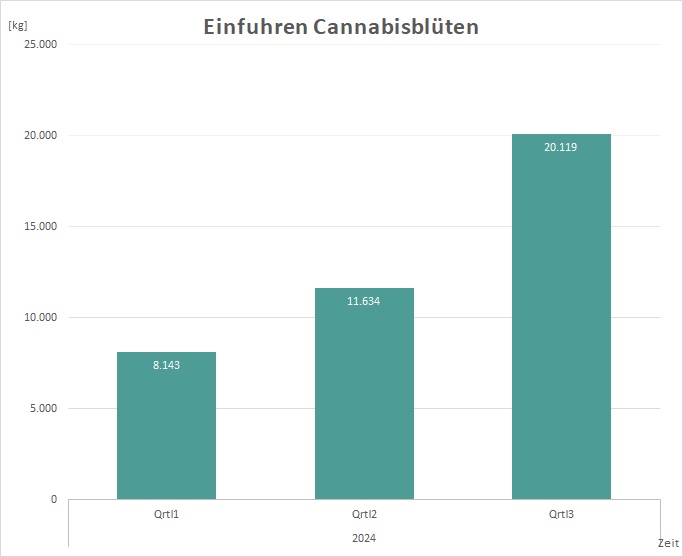
During the first three full months following Germany’s enactment of the CanG adult-use legalization law (Q3), legal medical cannabis imports increased by over 70% compared to the previous period. The first provisions of Germany’s CanG law, which removed cannabis from the nation’s Narcotics List, took effect on April 1st, 2024.

Germany’s Federal Institute for Drugs and Medical Devices (BfArM) recently published medical cannabis import data for Q3 2024, with the BfArM graph below showing “the total amount of cannabis imported quarterly from abroad to Germany for medical and medical-scientific purposes in the form of dried flowers (in kg )”:

BfArM dried flower cannabis imports germany Q3

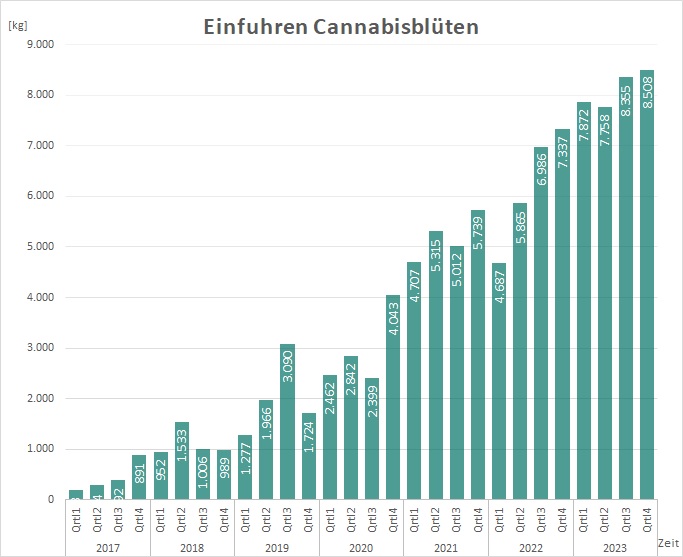
“The following figure shows the total amount of cannabis imported into Germany from abroad for medical and scientific purposes in the form of dried flowers and extracts on a quarterly basis. The dried cannabis flowers are included as a weight quantity (in kg ), the extracts as a weight quantity of dried cannabis flowers (in kg ) that were required to produce the respective extracts.” states BfArM (translated from German to English):

BfArM dried flower and extracts cannabis imports germany Q3

Germany adopted a national adult-use cannabis legalization measure earlier this year. The first provisions of the law permitting personal cultivation, possession, and use went into effect on April 1st, 2024. Additionally, as another part of ‘Pillar 1’ of German legalization, cultivation associations became legal on July 1st, 2024.

‘Pillar 2’ of the nation’s legalization model involves launching regional adult-use cannabis commerce pilot trials. Such trials already operate in the Netherlands and Switzerland and are allowed under European Union law.

The German Cannabis Business Association (BvCW) recently called for no further delays in launching pilot trials in Germany to combat Germany’s unregulated market and for the nation’s new government to not regress on cannabis policies and regulations.

“Legal access options such as home cultivation, cultivation associations, but also commercial models with licensed specialist shops are the best solution to push back the black market. Therefore, a new federal government should ensure that these legal accesses to cannabis are created and maintained,” says Michael Greif, Managing Director of the BvCW. “There is no protection for young people on the black market, dealers do not ask for ID. But there are dangerous additives there. The best way to ensure youth and consumer protection is through a legal and regulated market.”

The German cannabis market is home to 4-8 million consumers with a total potential market value of between €7.8 billion and €15.6 billion according to data provided by leading economist firm Whitney Economics.

To completely supply German demand, and thus eliminate the unregulated market, Germany’s cannabis industry would need to produce over 948,000 kg of flower annually according to Whitney Economics.

U.K. Cannabidiol Market Projected To Reach Over $5 Billion In Value By 2032

According to a market analysis by Vantage Market Research, the value of the United Kingdom’s emerging cannabidiol (CBD) industry is projected to reach over $5 billion by 2032. The analysis valued the U.K.’s CBD industry at $1.355 billion in 2023.

A separate analysis published in September 2024 by CLEAR found that legalizing all forms of cannabis for adult use in the United Kingdom and taxing and regulating sales could generate as much as £9.5 billion per year. However, non-CBD cannabis products are only legal in the U.K. in limited medical circumstances.

“One of the top trends in the U.K. cannabidiol market is the increasing popularity of CBD-infused wellness products, such as skincare and beauty items, driven by consumer demand for holistic health solutions.” researchers at Vantage Market Research previously stated.

Below are other findings from Vantage:

• The U.K. CBD market is rapidly expanding, driven by consumer demand for natural health solutions
• CBD-infused wellness products and beverages are gaining significant popularity
• Transparency and quality assurance are becoming crucial for consumer trust
• There is an increasing integration of CBD into traditional pharmaceuticals
• The therapeutic potential of CBD continues to drive market interest and research investments

Cannabis remains the most commonly used controlled substance in the United Kingdom, with 7.4% of adults between 16 and 59 years old in the UK reporting having used cannabis within the past year according to a 2022 report by the Office for National Statistics.

The National Centre for Social Research recently conducted a poll of United Kingdom citizens in which members of UK society were asked about their opinions regarding cannabis policy modernization efforts in the UK. The poll found a strong majority of support for legalizing cannabis sales in nearly every age group.

According to a separate analysis by The Dales Report, Germany and the United Kingdom are projected to control an estimated 77% of Europe’s emerging legal medical cannabis market by 2028.

“This growth is driven by both expanding legal frameworks and an increasing acknowledgment of the therapeutic benefits of cannabis. As both nations continue to refine their policies and commercial strategies, the focus remains on balancing patient needs with scientific and public health priorities.” The Dales Report stated about both national markets.

Advocates Call For Cannabis Industry Expansion In Germany

The German Cannabis Business Association (BvCW) is calling for the German government to embrace the nation’s emerging legal industry rather than treating people like criminals for consuming cannabis responsibly. The urging by BvCW comes amidst calls by some conservative lawmakers to roll back Germany’s recent cannabis policy changes.

“If the Union factions want to dry up the black market and fight organized crime, the cannabis industry is on their side. However, if this is to be done by criminalizing patients and consumers, this is the wrong way. It is not the users who are criminal, but the actors of the black market,” said Dirk Heitepriem, President of the BvCW, in a recent newsletter.

Germany adopted a national adult-use cannabis legalization measure earlier this year, with the first provisions of the law permitting personal cultivation, possession, and use going into effect on April 1st, 2024. Additionally, as another part of ‘Pillar 1’ of German legalization, cultivation associations became legal on July 1st, 2024.

‘Pillar 2’ of the nation’s legalization model involves launching regional adult-use cannabis commerce pilot trials. Such trials already operate in the Netherlands and Switzerland and are allowed under European Union law. BvCW is calling for no further delays in launching pilot trials in Germany to combat Germany’s unregulated market.

“Legal access options such as home cultivation, cultivation associations, but also commercial models with licensed specialist shops are the best solution to push back the black market. Therefore, a new federal government should ensure that these legal accesses to cannabis are created and maintained,” says Michael Greif, Managing Director of the BvCW. “There is no protection for young people on the black market, dealers do not ask for ID. But there are dangerous additives there. The best way to ensure youth and consumer protection is through a legal and regulated market.”

Lawmakers in Germany adopted the CanG law to boost public health outcomes by permitting adult consumers to obtain, or cultivate their own, cannabis products legally.  EU law does not permit national recreational cannabis commerce, however, it does permit regional pilot trials since they are research-based.

The German cannabis market is home to 4-8 million consumers with a total potential market value of between €7.8 billion and €15.6 billion according to data provided by leading economist firm Whitney Economics.

To completely supply German demand, and thus eliminate the unregulated market, Germany’s cannabis industry would need to produce over 948,000 kg of flower according to Whitney Economics. That would be impossible if Germany’s cannabis laws regressed.

“Reversing the CanG would also set Germany back considerably in international competition and in research opportunities related to cannabis,” explains Dr. Stefan Meyer, Vice President of the BvCW. “The cannabis industry in Germany has created hundreds of jobs in recent years, provided thousands of patients with access to urgently needed therapies and proven that high-quality and safe products can also be produced in Germany.”

“Regulate instead of prohibit – this should also be the motto for a new federal government. The cannabis industry is ready to work together to dry up the black market. This requires commercial opportunities to grow and sell cannabis in Germany, legal access to home-grown cannabis for consumption, safety and reliability for patients, and liberalization of industrial hemp,” said Dirk Heitepriem.

BvCW suggests that as a first step, “the Federal Ministry of Food and Agriculture could now issue the Consumer Cannabis Science Responsibility Ordinance (KCanWV).”

In the middle of the ongoing debate in Germany, the nation is hosting a multi-national conference where various leaders will share their experiences with modernizing cannabis policies and regulations, as first reported by Marijuana Moment.

“Representatives from Luxembourg, Malta, the Netherlands, the Czech Republic and Switzerland were invited by German Commissioner for Addiction and Drug Issues Burkhard Blienert to the meeting in Berlin on Monday and Tuesday to “exchange experiences in regulating cannabis for non-medical purposes.” the outlet reported.

Australian Lawmakers To Vote On Cannabis Legalization This Month

Australia’s parliament is set to vote on an adult-use cannabis legalization bill later this month. The Australian Greens are championing the recreational legalization measure, which will receive a vote on November 27th, 2024.

“The bill, introduced by Shoebridge in the upper house in August 2023, would allow adult recreational use and pave the way for legal home grow of up to six plants and a commercial cannabis market across the country.” stated Cannabiz in its local reporting.

If approved, the bill would create “the Cannabis Australia National Agency as a statutory agency to register cannabis strains and regulate activities relating to cannabis including: growing and possessing cannabis plants; manufacturing and selling cannabis products; operating cannabis cafes; and importing and exporting cannabis products.”

At the local level, a recent parliamentary report issued in New South Wales calls for cannabis reform in the Australian state. The 148-page report, which was tabled by the premier and finance committee, called cannabis reform the “only rational course of action.”

In the Australian Capital Territory, where the country’s capital is located, cannabis is already decriminalized and has been since January 2020. Driving while under the influence of cannabis is still prohibited in the territory, as is cannabis commerce and public cannabis consumption.

Cannabis remains prohibited at the federal level in Australia, although medical cannabis is legal in some instances.

Australia’s Parliamentary Budget Office (PBO) estimates that a legalized domestic adult-use cannabis market would generate $28 billion in tax revenue in the first decade. However, researchers at The Conversation “think the PBO’s estimate is too high, and based on the current patterns of cannabis use, $13 billion is a more credible estimate.”

The Conversation estimates “that a new legalised market could attract 3.4 million cannabis users in its first year” and that “Australia consumes 441 tonnes of cannabis per year.”

The researchers at The Conversation note that the “Parliamentary Budget Office supposes a price of $16.95 per gram, of which $3.55 would be tax – 10% GST and 15% excise” and that the “Australian Criminal Intelligence Commission (ACIC) estimates that one gram typically costs $22.50.”

However, The Conversation indicates that “we base our estimated tax revenues on a retail price of $12 per gram, of which $2.51 would be tax” and using those figures is how they arrived at the $13 billion figure.

“The Australia legal cannabis market size was valued at USD 66.0 million in 2022 and is expected to expand at a compound annual growth rate (CAGR) of 29.6% from 2023 to 2030.” Grand View Research stated about Australia’s emerging cannabis industry.

“In July 2020, 41.0% of citizens supported legalization, according to the Australian Institute of Health and Welfare.” Grand View Research also stated.

Czech Cabinet Moves To Allow Cannabis Possession And Cultivation

The Czech Republic’s cabinet recently approved a plan that would permit adults in the European nation to cultivate multiple plants in their private residences and possess a personal amount of cannabis.

The plan, which would legalize the cultivation of up to three cannabis plants and set a maximum possession limit of 50 grams of cannabis, was originally introduced by the Czech Republic’s Ministry of Justice back in September 2024. The plan does not go far enough according to members of the Czech Pirate Party.

“Instead of legalization and money in the budget, today the government presents pasquil. You can grow cannabis, but you can’t harvest it. To be able to grow three cannabis plants and at the same time have a limit of 50 grams that you can have at home is absurd. It’s like you could raise three hens, but they could lay a maximum of one egg, otherwise you’ll be fined or go to jail,” said former Deputy Prime Minister and former head of the Pirates Ivan Bartoš according to local reporting by Echo24.

Personal cannabis possession without intent to distribute was first decriminalized in the Czech Republic in 2010 and medical cannabis was legalized in 2013. Adult-use cannabis reform in the Czech Republic is part of an increasing trend in Europe where multiple countries have now adopted legalization measures to boost public health strategies.

What is being proposed in Czechia is similar to what was implemented in Germany earlier this year from cultivation plant limit and possession limit standpoints, however, the proposed legal age of 21 years old would differ from what Germany adopted and is similar to what is in place in two dozens states in the U.S.

Currently, cannabis is legal for adult use at a national level in Uruguay, Canada, Malta, Luxembourg, Germany, and South Africa. Additionally, regional adult-use cannabis commerce pilot trials are operating in the Netherlands and Switzerland.

The Czech government “believes it will manage to push through the changes by the end of its term in October 2025” per local reporting by TVP World.

According to the European Monitoring Centre for Drugs and Drug Addiction (EMCDDA), nearly 30% of Czech adults have consumed cannabis at least once in their lifetimes and 11.1% report having consumed cannabis within the last year. The average rate for once-a-year consumption across Europe is 8% according to EMCDDA data.