Pharmacies In Uruguay To Sell Recreational Cannabis With Higher THC Levels

Uruguay became the first country on earth to adopt a national adult-use cannabis legalization measure back in 2013, with legal recreational cannabis sales launching in 2017, including sales through the nation’s pharmacies.

Legal sales at pharmacies began in Uruguay in the summer of 2017, and consumers could initially choose from two different strains. The two strains are named ‘Alpha’ and ‘Beta’, each with tetrahydrocannabinol (THC) levels equal to or less than 9%, and cannabidiol (CBD) levels equal to or less than 3%.

Then, in 2022, Uruguay permitted a third option, ‘Gamma,’ which has a THC level of equal to or less than 15%, and CBD levels of equal to or less than 1%. Regulators in Uruguay recently approved a fourth option that contains a higher level of THC than the other three options.

“The new variant has a tetrahydrocannabinol (THC) content of equal to or less than 20% and a cannabidiol (CBD) content of equal to or less than 1%.” stated Latin America Reports in its local coverage.

“Currently, 71,843 Uruguayan citizens are legally registered to purchase cannabis in pharmacies, 11,708 have received permission to grow it at home, and 13,687 are members of cannabis clubs.” the outlet also reported.

Right now, cannabis is legal for adult use at a national level in Uruguay, Canada, Malta, Luxembourg, Germany, and South Africa, although nationwide sales are currently only permitted in Uruguay and Canada. Regional adult-use cannabis commerce pilot trials are also currently permitted in the Netherlands and Switzerland.

Recreational cannabis is also legal in two dozen states in the U.S., as well as in Washington D.C. Almost all of those jurisdictions permit legal adult-use cannabis sales, but cannabis remains prohibited at the federal level in the United States.

European Commission Launches Investigation Into Italy’s Ban On ‘Cannabis Light’

In recent years, cannabis and hemp-derived products that are high in cannabidiol (CBD) and low in tetrahydrocannabinol (THC), often referred to as ‘cannabis light,’ have increased in availability and popularity across Europe, including in Italy.

Lawmakers in Italy recently approved measures that seek to prohibit such products from being bought and sold within Italy’s borders. The European Commission has launched an investigation to determine if the measures, and others that are being considered, violate European Union (EU) law.

“The Italian government, led by Prime Minister Giorgia Meloni, is proposing a two-part strategy to eliminate legal hemp flowers in the EU, which contain cannabinoids such as CBD.” stated Newsweed in its local coverage.

“The current controversy stems from an amendment to the 2023 Security Law that would impose a complete ban on the sale of hemp flowers. This amendment was passed by the Italian Chamber of Deputies in September 2024 and must now be considered by the Italian Senate.” the outlet also stated.

Cannabis advocates and members of Italy’s emerging cannabis industry argue that what is being pursued in Italy violates EU law. The Court of Justice of the European Union previously ruled in 2021 that hemp extracts and flowers should not be classified as narcotics.

Canapa Sativa Italia, an Italian hemp industry trade organization, filed a formal complaint with the European Commission claiming that Italy’s actions violate the EU’s Common Agricultural Policy and impede fair competition within the European Union market.

As we previously reported, a decree was issued in 2020 to classify CBD as a narcotic in Italy, but shortly after it was issued, the decree was temporarily suspended. That temporary suspension was then lifted via yet another decree in 2023, just to also be temporarily suspended.

Prior to the decrees and other measures recently pursued by Italy’s government, much of Italy’s public cannabis policies were shaped by legal decisions. In late 2019, Italy’s Supreme Court ruled that laws against ‘small-scale domestic cultivation of cannabis’ were unconstitutional, providing some level of legal protection for consumers and patients.

In 2021, cannabis activists in Italy successfully collected hundreds of thousands of signatures to place a cannabis referendum measure on the ballot for voters to decide. However, in 2022 the nation’s Supreme Court deemed the measure’s language to be unconstitutional.

Study Finds Cannabis Provides Sustained Benefits For Fibromyalgia Patients

Fibromyalgia is a serious health condition involving widespread musculoskeletal pain accompanied by fatigue, sleep, memory, and mood issues. Ongoing research has determined that fibromyalgia amplifies painful sensations by affecting the way the suffering patient’s brain and spinal cord process painful and nonpainful signals.

According to a peer-reviewed study from January 2023, fibromyalgia “affects up to 5.0% of the world population” and “has a high female predominance, between 80 and 96%.” According to a separate study recently conducted in the United Kingdom, cannabis may provide sustained benefits for suffering fibromyalgia patients.

A team of British researchers affiliated with various academic and private entities assessed the use of cannabis-based medicinal products (CBMP) consisting of cannabis flower or oil extracts in 148 patients enrolled in the UK Medical Cannabis Registry. The researchers assessed changes in patient-reported outcomes at one, three, six, and twelve-month timelines.

The findings from the study were published in the Journal of Pain & Palliative Care Pharmacotherapy.

“Improvements in the generalized anxiety disorder-7 questionnaire, single-item sleep quality scale, fibromyalgia symptom severity score and EQ-5D-5L Index values [a descriptive scale assessing mobility, self-care, usual activities, pain/discomfort and anxiety/depression] were observed at each follow up period compared to baseline,” the researchers reported.

“Positive associations between initiation of CBMP therapy and decreased fibromyalgia severity were observed at all time points.…These findings are complemented by the wider literature.” the study’s authors concluded.

“Other observational studies assessing the use of cannabis products in patients enrolled in the UK Cannabis Registry have reported them to be effective for those suffering from chronic painanxietypost-traumatic stressdepressionmigrainemultiple sclerosisosteoarthritisinflammatory arthritis, and inflammatory bowel disease.” NORML stated in a recent news release, adding additional context and resources about the topic.

How Many Countries In Africa Have Legalized Commercial Cannabis Cultivation?

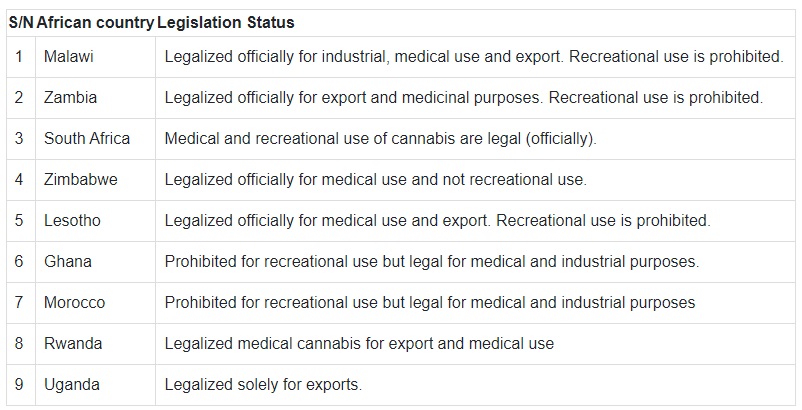
As cannabis policy modernization has spread across the globe, one continent that has experienced a significant amount of reform in recent years is Africa. Currently, the only nation in Africa that has adopted a national adult-use legalization measure is South Africa. However, several other African nations have adopted laws that permit commercial medical cannabis and hemp cultivation.

According to a recent study conducted by researchers from Ukraine and France, and published by the U.S. National Institute of Health, 57 countries have adopted medical cannabis legalization measures.

According to a recent report titled “Medical Use of Cannabis in Africa: The Pharmacists’ Perspective” which was published by the National Library of Medicine, nine African countries have adopted laws to regulate commercial cannabis and hemp cultivation, as well as the processing, storage, sales, and/or exports of harvests. Per recent reporting by Business Insider:

africa commercial cannabis cultivation regulation

In addition to the dozens of countries around the world that have adopted medical cannabis legalization measures, Uruguay, Canada, Malta, Luxembourg, and Germany have implemented adult-use legalization measures, as well as South Africa, as previously mentioned in this article.

The legal global cannabis industry is set for significant expansion in the coming years, with a recent report by Skyquest Technology Consulting projecting that the regulated worldwide cannabis market will surpass $148.4 billion in value by 2031.

“Cannabis market was valued at USD 36.4 Billion in 2022 and is poised to grow from USD 42.6 Billion in 2023 to USD 148.4 Billion by 2031, growing at a CAGR of 16.9% during the forecast period (2024-2031).” the market analysts stated.

“Legalization and regulation are among the primary factors contributing to the development of the cannabis market. The market is expanding beyond the capacity of understanding and awareness as an increasing number of countries have legalized cannabis for medical and recreational purposes.” the analysts also stated.

Study Demonstrates Why Banks Are One Of The Biggest Winners Of Legalization

The banking industry and the cannabis industry have a complicated relationship due to prohibition laws. Cannabis businesses have more options for financial services than they have in the past, however, many members of the global cannabis industry still rely on cash-only models and/or struggle to find loans to scale their businesses.

Cannabis businesses are not the only ones harmed by the lack of banking access for the emerging legal cannabis industry. A recent analysis by Whitney Economics (WE), CTrust, and Green Check demonstrates how much profit potential banks are missing out on by not working properly with cannabis businesses.

“A first-of-its-kind report released today projects that the U.S. cannabis industry will need between $65.6B and $130.7B in sustainable growth capital to support new cannabis businesses and help refinance existing ones over the next decade, generating approximately $1.0 billion to $2.4 billion in potential interest revenue for financial institutions willing to lend to cannabis businesses.” stated the authors of the report.

While the financial analysis report is focused on the United States, many of the same findings can be adapted and applied to every other jurisdiction on earth that still hinders or outright prohibits accredited banks from working with the cannabis industry.

“The report also shows that U.S. cannabis retail sales are forecasted to grow from $28.8 billion in 2023 to $87.0 billion by 2035. To support that growth, the U.S. cannabis industry could add 25,000 to 30,000 licenses to roughly 40,000 current licensees—a near doubling of potential lending and interest revenue opportunities for banks.” the authors also stated about their report.

“The funding needed to realize this growth cannot be supported solely by friends and families,” said Beau Whitney, WE founder and chief economist. “By demonstrating regional opportunities and broader market potential, the report aims to empower financial institution lending departments to help educate their boards on risks, rewards and opportunities—all in the hopes of accelerating the industry’s growth by encouraging more financial institutions to participate”

“Banks have long been cautious about entering the cannabis industry due to regulatory and financial risks, though when they do, they have to rely on non-cannabis specific underwriting and due diligence,” said Dotan Y. Melech, CEO and co-founder of CTrust. “This report should pave the way for conversations with financial institutions to develop more informed lending partnerships with the cannabis industry.”

Legal cannabis companies should be afforded the same access to the world’s financial systems that other large legal industries are afforded. As more countries get on the right side of history and modernize their cannabis policies, momentum will continue to build and hopefully comprehensive global reform will be achieved soon.

German Survey Finds 80% Would Rather Open A Specialty Cannabis Store

Earlier this year, on April 1, 2024, Germany adopted the historic CanG law that legalized cannabis possession, cultivation, and use by adults. Germany may have not been the first country in Europe to do so, but legalization in Germany is undeniably the most significant cannabis policy modernization victory in Europe’s history.

Due to European Union agreements, legalization in Germany differs in many aspects compared to legalization in the Western Hemisphere. Whereas adult-use cannabis products can be sold nationwide in Uruguay and Canada at retail outlets, legalization in Europe focuses more on boosting public health outcomes and research.

Starting on July 1, 2024, people could start applying to launch German adult-use cannabis cultivation associations. The associations are member-based and are one of the main ways that cannabis can be legally obtained by adults in Germany.

The German Cannabis Business Association (BvCW) recently conducted a poll of its members asking if people in Germany would rather open a cannabis cultivation association or a specialty cannabis store.

“In our non-representative survey, which we shared in our newsletter, we asked from 07.10.2024 – 15.10.2024: “If you had the choice, would you rather set up a cultivation association or open a specialty store or licensed point of sale for cannabis as part of a model project?” BvCW stated in a recent newsletter.

“The respondents voted as follows: 50% definitely wanted a specialist shop/licensed point of sale, 30% rather wanted a specialist shop/licensed point of sale, 10% rather wanted a growers’ association, 5% definitely wanted a growers’ association and 5% partly/partly.” BvCW stated about the results of the survey.

“Thus, over 80% said they rather or definitely wanted to open a specialist shop/licensed point of sale.” BvCW also stated.

In addition to home cultivation and cannabis cultivation associations, Germany’s legalization model will eventually also incorporate regional adult-use cannabis commerce pilot trials, similar to what is already in place in the Netherlands and Switzerland but on a much larger scale.

Unfortunately, until European Union agreements are modernized, nationwide sales at retail outlets like what is in place in Uruguay and Canada will have to wait. With that being said, Germany will continue to lead the charge to achieve such policy modernization at the continental level, and a more robust commerce system will no doubt be permitted in Germany in the future.

The Global Cannabis Community Loses A Legend

The International Cannabis Business Conference team posts this article with a heavy heart. The global cannabis community lost a giant this month with the passing of Jürgen Neumeyer. Mr. Neumeyer has been a part of the International Cannabis Business Conference family for many years, and he will be dearly missed by everyone who was blessed to know him.

Below is a message sent out by the German Cannabis Business Association (BvCW) commemorating the life and accomplishments of Jürgen Neumeyer. He was truly a legend:

Our co-founder and managing director Jürgen Neumeyer died unexpectedly on Wednesday, October 9, 2024, during a family visit to his hometown. At the age of 56, he left behind a comprehensive life’s work. He was able to realize his greatest political goal in life, the decriminalization of cannabis, during his lifetime.

For decades, Jürgen had dedicated a large part of his life to the vision that cannabis users in Germany would no longer be criminalized. In various roles in politics and business, he did not lose sight of this goal and was able to celebrate an important milestone on April 1, 2024. The cannabis law would look different today without Jürgen’s tireless work. But not all of his goals have been achieved yet – be it improvements in the area of ​​industrial hemp or the creation of a legal market for recreational cannabis.

His drug policy career began in the 1990s with the Federal Association of Jusos, followed by a career as an employee for various members of the German Bundestag, publicist and networker. As the founding managing director of the “ Netzwerk Berlin” he was committed to the legalization of cannabis, among other things, and published several books on the subject. In addition to his editorial work for the magazine “ Berliner Republik”, he was also active in its management. He was also a co-founder of the think tank “ Das Progressive Zentrum eV”, as well as the non-partisan association “ Walkkreis eV”, which was firmly anchored in the Berlin government district with a political pub of the same name. His passion for cannabis policy led him to head political communications for the German Hemp Association (DHV) for several years. Jürgen recognized early on that an independent interest group was needed. He was the driving force behind the founding of an association for the German cannabis industry and was managing director of the industry association Cannabiswirtschaft e.V. from 2019 until his death. V. (BvCW) and CS Cannabis Service GmbH.

Our association, which represents all sectors of the industry (industrial hemp, medicinal cannabis & stimulants as well as technology, trade & services), grew to over 100 members within 5 years under his management, published over 40 specialist publications, many statements and press releases, and organized parliamentary meetings and specialist events. As a trade association representing all specialist areas of the cannabis industry, we became the largest of its kind in Europe. With all our commitment, we made significant contributions to the creation of the Cannabis Act, the abolition of the Narcotics Act status and the urgently awaited abolition of the intoxication clause with the Industrial Hemp Liberalization Act.

Jürgen Neumeyer had set himself and the association many other tasks, such as setting up the cannabis industry directory and the cannabis specialist publishing house, which are still in their infancy, a cannabis roadshow and the long-term goal of a “House of the Cannabis Industry” in Berlin. The focus was always on the current political goals, such as the model projects for cannabis (“Pillar 2”), but also many other construction projects such as hemp as a building material and the promotion of renewable raw materials.

With his death, we have not only lost a talented manager, friend and networker, but also an empathetic and authentic fellow human being who knew how to lighten up any professional and private conversation with his cheerful nature. He was also notorious for his extensive knowledge of winemaking and beer brewing, as well as his passion as a DJ. He was greatly respected and valued by everyone for his unique style.

Global Cannabis Testing Market Projected To Reach $5.87 Billion By 2031

The emerging global cannabis industry is comprised of various sectors, with some having more profit potential than others. One sector of the worldwide cannabis industry that shows the most promise is the cannabis product testing sector.

Every legal cannabis market on the planet has different policies and regulations to some degree, but one constant seems to be that cannabis products must be tested before hitting retail shelves, and rightfully so. Cannabis testing ensures that products are safe for human consumption.

Additionally, cannabis testing captures cannabinoid levels which is a requirement in most legal cannabis markets. It lets regulators know if cannabis products fit within certain THC/CBD parameters and helps inform consumers and patients of the cannabinoid content of the products that they are purchasing.

In addition to cannabinoid levels, testing can also determine terpene profiles, which is an emerging area of cannabis testing and research.

According to a recent market analysis by Coherent Market Insights, the global cannabis testing services market is estimated to be valued at $2.38 billion in 2024 and is projected to reach $5.87 billion in value by 2031.

“The Cannabis Testing Services market has been growing significantly in recent years, driven by a number of key factors, such as increasing demand for its products, expanding customer base, and technological advancements.” the market analysts stated.

A separate market analysis recently published by SkyQuest Technology Consulting projects an even larger rate of growth for the global cannabis testing market, projecting that the sector will reach a value of $21.9 Billion by 2031, with a CAGR of 13.5% during the forecast period (2024-2031).

“The use of cannabis in the treatment of several neurological and psychiatric conditions has also increased dramatically along with the increasing prevalence and production of marijuana. This growing trend is expected to drive significant growth in the cannabis testing market during the forecast period.” Skyquest stated about its analysis.

“Asia-Pacific within the cannabis testing market will witness an outstanding CAGR of 25.9%, indicating a vast upward trend.” the analysts also stated.

Study Finds That Cannabis Edibles Reduce Chronic Lower Back Pain

Anyone who has experienced lower back pain knows that it is far from a fun thing to have to endure. Lower back pain can be caused by a number of different factors, from living a sedentary lifestyle to being injured while engaging in a sports activity.

Whatever the cause, a lower back injury can linger for a long time, and in some cases, lower back pain can persist for many years. Common treatments for lower back pain include pharmaceutical painkillers, and for some patients, treatments can also involve surgery.

According to a recent study examining cannabis and chronic lower back pain patients, the use of cannabis edibles can help reduce chronic lower back pain. Below is more information about the study via a news release from NORML:

Boulder, CO: The consumption of cannabis-infused edible products, particularly those that are higher in THC content, provides acute relief for patients with chronic lower back pain, according to data published in the journal Frontiers in Pharmacology.

Researchers with the University of Colorado at Boulder assessed the ad libitum use of three distinct edible products (THC-dominant products, CBD-dominant products, or products containing similar amounts of THC and CBD) in 249 subjects with low back pain. Participants consumed the products for two weeks. Researchers evaluated changes in patients’ pain intensity and subjective mood, which were assessed at the conclusion of the study.

“Pain intensity following edible cannabis use decreased over time across all three broadly defined product groups,” investigators reported. Decreases in pain intensity were most pronounced in patients who consumed THC-dominant edibles. CBD-dominant products were “primarily associated with short-term tension relief” rather than significant reductions in acute pain.

The study’s authors concluded: “These findings support the short-term analgesic effects of THC and anxiolytic effects of CBD … [and] indicate that edible cannabis may be a safe and suitable alternative pain therapy for those looking to substitute more traditional pain medications.”

Longitudinal data published in 2022 determined that patients suffering from chronic back pain reduce their use of prescription opioids and report improvements in their condition following medical cannabis treatment.

Full text of the study, “Edible cannabis for chronic low back pain: Associations with pain, mood, and intoxication,” appears in the journal Frontiers in PharmacologyAdditional information on cannabis and chronic pain is available from NORML’s publication, Clinical Applications for Cannabis & Cannabinoids.