The German Cannabis Industry Continues To Evolve

Germany was already home to Europe’s largest legal medical cannabis market before the first provisions of the nation’s adult-use legalization measure took effect on April 1st, 2024. When the first provisions of Germany’s CanG law were enacted at the start of April, the nation also became the largest country on earth to implement national adult-use reform.

The nation’s cannabis policy and industry landscape will forever be measured as occurring before or after 2024 due to how pivotal the year 2024 is proving to be. Nearly every facet of Germany’s industry and cannabis community is evolving this year, with the most notable items listed and discussed below.

Personal Consumption

People in Germany who are 18 years old or older can now consume cannabis in private settings without the fear of prosecution and can possess up to 25 grams of cannabis when away from their residences. Cannabis consumption is not new in Germany, with 4.3% of German adults reporting that they use cannabis on a monthly basis and 8.8% reporting that they have used cannabis at least once in the last year.

However, the way that people consume cannabis in Germany is undergoing a technological revolution, with many device and gadget makers eyeing the German cannabis consumer market with their latest creations. According to a recent analysis by market researchers, the global handheld cannabis vaporizer market is projected to reach $15.9 billion in value by 2031, and Germany will play a big role in the growth of the sector.

Home Cultivation

On April 1st Germany became home to the largest potential home cultivation market in Europe, with Germany’s roughly 70 million adults becoming eligible to cultivate up to three plants in their private residences. Personal cannabis cultivation is already proving to be very popular with adult consumers in Germany, as reflected by a recent YouGov poll which found that 7% of poll participants indicated they had already purchased cannabis clones or seeds since legalization took effect. Another 11% of poll participants stated that they intend to purchase clones or seeds in the future.

In addition to clones and seeds, Germany’s newly afforded home cultivation freedoms are increasing sales of many other sector products, including growing mediums, nutrients, lighting, environmental control systems, odor control, harvesting tools, and drying equipment. Home cultivation educational programs and materials are also experiencing increased demand in Germany.

Social Clubs

Starting next month, Germany will begin permitting social cannabis clubs in many parts of the country. Social clubs are a key provision of ‘Pillar 1’ of Germany’s CanG law and will play a vital role in legally sourcing adult-use cannabis in Germany. Earlier this month the Bundestag approved new policies that afford states more authority to set limits on social cannabis clubs, so the prevalence and scope of clubs will likely vary throughout the country.

It is going to be very interesting to see how creative social cannabis club operators get once clubs are launched. The basic premise of social clubs is for adults to become members and to source legal cannabis through the social clubs that will cultivate cannabis for members. However, cannabis clubs can employ paid workers to carry out various tasks that are not necessarily directly related to the cultivation or distribution of cannabis, and clubs will likely offer ancillary products and services that could prove to be very engaging (and lucrative). Only time will tell what social club operators come up with, and conversely, what local and national regulators will allow.

Pilot Trials

‘Pillar 2’ of Germany’s cannabis legalization model revolves around the launch of regional adult-use cannabis commerce pilot trials. Pilot trials permit a certain number of entities to cultivate cannabis that is then sold to registered customers at licensed outlets. Such pilot trials are already underway in parts of the Netherlands and Switzerland with no reported issues.

Pilot trials in Germany are expected to be more widespread than what is in place in Switzerland and the Netherlands, both in the number of jurisdictions where they operate and the number of participants they will serve. German pilot trials are expected to begin by the end of the year, and when combined with social clubs and home cultivation, will serve as the foundation for legal adult-use cannabis access in Germany.

Medical Cannabis

Often lost in the hype and chaotic nature of the rise of adult-use cannabis in Europe is the fact that Germany’s medical cannabis industry is currently undergoing dramatic changes. Part of Germany’s new CanG law involved the removal of cannabis from the nation’s Narcotics List and the removal of quota limits for domestic medical cannabis production. Doctors in Germany can prescribe cannabis more easily, the medical cannabis supply chain has fewer hurdles and hoops, and domestic production is set to surge.

As a result, the German medical cannabis industry is projected to experience tremendous growth in the coming years. A February 2024 market analysis by Zuanic & Associates determined that if 1% of Germany’s population became cash-paying medical cannabis patients, the German medical market could reach €1.7Bn in value by the end of 2025. Germany’s medical cannabis industry is a major winner of German adult-use legalization.

Study Finds No Link Between Cannabis Use And Sedentary Behavior

The false ‘lazy stoner’ stereotype is as old as cannabis prohibition itself. For decades cannabis consumers were portrayed in mainstream media, film, and on television as lazy burnouts who lacked drive and motivation.

Of course, that stereotype could not be farther from the truth. Many professional athletes consume cannabis and they are some of the fittest humans to ever exist. Titans of the business world consume cannabis, and many other types of successful members of society also consume cannabis. The use of cannabis does not automatically equate to a reduction in motivation.

A team of researchers in Canada recently conducted a study examining cannabis use and the prevalence of sedentary behavior. The study found no link between the two. Below is more information about the study and its results via a news release from NORML:

Toronto, Canada: Young and middle-aged adults who consume cannabis are no less likely than non-users to engage in daily physical activity, according to data published in the journal Cannabis and Cannabinoid Research.

Canadian researchers assessed physical activity in a cohort of 4,666 US adults ages 18 to 59 years old. Subjects wore a portable accelerometer that tracked participant’s daily activity levels. Researchers collected data for a minimum of four days.

Investigators reported that cannabis consumers were slightly more likely than non-users to engage in light physical activity. Researchers reported no differences between the two groups with respect to median daily sedentary time, time spent engaging in vigorous physical exercise, or sleeping.

“Recent cannabis use in young to midlife adults was not associated with accelerometer-measured sedentary or MVPA [moderate-to-vigorous physical activity] time, but it was associated with a marginal increase in LPA [light physical activity] time,” the study’s authors concluded. “Our findings provide evidence against existing concerns that cannabis use independently promotes sedentary behavior and decreases physical activity.

“This study provides useful insight into the association between cannabis use and physical activity, which may help inform clinicians and prescribers with patient counseling, patients and their lifestyle choices, as well as policy makers around public health resource allocations.”

The findings are consistent with those of several prior studies “challenging the stereotype that marijuana … users are less active than their non-using counterparts.” Among those age 60 and older, marijuana use has been associated with increased exercise frequency.

Full text of the study, “Recent cannabis use and accelerometer-measured physical activity and sedentary behavior among young-to-midlife adults: An analysis of the National Health and Nutrition Examination Survey from 2011 to 2014,” appears in Cannabis and Cannabinoid Research.

U.K. MS Patients Report Quality Of Life Improvements Following Cannabis Therapy

Multiple sclerosis (MS) is a serious health condition that impacts the lives of many suffering patients around the globe. It is estimated that as many as 2.8 million people suffer from MS worldwide and that a person is diagnosed somewhere on the planet with the health condition every 5 minutes.

MS is a progressive disease involving damage to the sheaths of nerve cells in the brain and spinal cord. Symptoms can include but are not limited to, numbness, impaired speech, impaired muscular coordination, blurred vision, and severe fatigue.

Studies and personal experiences around the world have found that cannabis may be a helpful form of treatment for MS patients. A growing list of patients have reported that cannabis helps them effectively and safely treat their condition.

According to a recent study in the United Kingdom, MS patients reported improvements in their quality of life after completing cannabis therapies. Below is more information about it via a news release from NORML:

London, United Kingdom: Multiple sclerosis (MS) patients report improvements in their health-related quality of life following the use of medical cannabis preparations, according to observational data published in the journal Multiple Sclerosis and Related Disorders.

British researchers assessed the use of cannabis-based medicinal products (CBMPs) consisting of either flower or oil extracts in 141 MS patients enrolled in the UK Medical Cannabis Registry. (Since 2018, British specialists have been permitted to prescribe cannabis-based medicinal products to patients unresponsive to conventional medications.) Researchers assessed changes in patient-reported outcomes measures at one month, three months, and six months.

Patients reported sustained improvements in their physical and mental health following cannabis therapy. They reported few serious adverse health effects during treatment.

“This case series demonstrates a potential association between [the] initiation of CBMPs and improved patient reported outcomes in sleep, anxiety and general HRQoL [health-related quality of life] measures, over six months,” the study’s authors concluded. “Additional measures for HRQoL, including various physical and mental health subdomains, also exhibit improvements up to six months when compared to baseline.”

A prescription cannabis spray (nabiximols aka Sativex) consisting of specific ratios of THC and CBD is currently available in several countries, including Canada, France, Germany, Spain, and the United Kingdom. The drug is not approved in the United States for treatment of any condition.
Full text of the study, “Clinical outcome analysis of patients with multiple sclerosis – Analysis from the UK Medical Cannabis Registry,” appears in Multiple Sclerosis and Related DisordersAdditional information on cannabis and multiple sclerosis is available from NORML’s publication, Clinical Applications for Cannabis & Cannabinoids.

Italy’s Hemp Industry Seeks European Commission Intervention

Much of Italy’s public cannabis policies are shaped by legal decisions. In late 2019, Italy’s Supreme Court ruled that laws against ‘small-scale domestic cultivation of cannabis’ were unconstitutional, providing some level of legal protection for consumers and patients.

In 2021, cannabis activists in Italy successfully collected hundreds of thousands of signatures to place a cannabis referendum measure on the ballot for voters to decide. However, in 2022 the nation’s Supreme Court deemed the measure’s language to be unconstitutional.

A decree was issued in 2020 to classify CBD as a narcotic in Italy, but shortly after it was issued, the decree was temporarily suspended. That temporary suspension was then lifted via yet another decree in 2023, just to also be temporarily suspended.

Efforts to shut down Italy’s emerging hemp-derived industry have picked up recently, resulting in Italian trade groups seeking an intervention by the European Commission.

“The Italian hemp supply chain receives important news from the European Commission. Our complaint against amendment 13.6 to the Security Bill (Security Bill) has been officially examined.” the Canapa Sativa Italia trade organization stated in a news release (translated from Italian to English).

“This amendment, which introduces restrictions on the cultivation and trade of hemp inflorescences and derived products, has been contested because it could violate European Union law on free competition and movement of goods. The complaint, registered under number CPLT(2024)01387, represents a positive signal for the sector, which has over 15 thousand workers and a turnover of 500 million euros.” the organization also stated.

If the European Commission determines that there is a violation of Union law, it could send a “letter of formal notice” to Italy’s government. The notice would compel Italy’s government to submit various information by a set deadline.

From there, if the returned information is not deemed to be satisfactory, the European Commission may issue a “reasoned opinion” and possibly refer the matter to the Court of Justice of the European Union.

“This process, although it may take years, is essential to ensure that national regulations comply with EU law.” stated Canapa Sativa Italia.

An estimated 5% of adults in Italy report having consumed cannabis within the last month, 10.8% report having consumed it at least once in the last year, and 34.8% of adults in Italy have consumed cannabis at least once in their lifetime.

Thailand Issues Draft Regulation To Reclassify Cannabis As A Narcotic

Lawmakers in Thailand continue to move forward with their plan to reclassify cannabis as a narcotic, unveiling a draft regulation this week that would change the cannabis plant’s legal status. Thailand removed cannabis from its national narcotics list in June 2022.

Thailand’s historic cannabis policy shift in 2022 was supposed to pave the way for the nation’s emerging cannabis industry to become a regional and international powerhouse. Every household in the entire country could sign up initially to legally cultivate low-THC cannabis plants, which a reported 1.1 million citizens of Thailand have done.

At the time of Thailand’s historic change in 2022, the nation’s Public Health Minister indicated that there would be no plant limit for the government’s cannabis cultivation program. Thailand’s government also gave away over 1 million cannabis seeds directly to households that signed up for the program.

broad spectrum of government agencies in Thailand agreed to do their part to push Thailand’s emerging cannabis industry forward after the 2022 policy change. However, times have clearly changed, and Thailand is set to make a dramatic U-turn on cannabis policy. Per the Yahoo News:

The Ministry of Public Health will re-list cannabis buds as a “category five” narcotic from Jan. 1, according to the draft rules published on Tuesday. But the use of various other parts of the plant, including roots and leaves, will however remain legal.

The ministry will receive public feedback on the proposal until June 25. Health Minister Somsak Thepsutin said on Tuesday he will listen to suggestions from both cannabis advocates and opponents.

Researchers estimate that Thailand’s 2022 policy change resulted in roughly 12,000 cannabis dispensaries opening across the country. The dispensaries operate on three-year licenses from the Department of Thai Traditional and Alternative Medicines and employ an estimated 60,000 people.

The current draft regulation that was published earlier this week does not include any grace period for cannabis businesses in Thailand, and the industry will presumably be brought to a grinding halt. Medical cannabis will still be permitted in Thailand, although details about what that will ultimately look like remain elusive.

EMCDDA Releases The ‘European Drug Report 2024’

The European Monitoring Centre for Drugs and Drug Addiction has released its annual European Drug Report, in which it determines that cannabis “remains by far the most commonly consumed illicit drug in Europe.”

“National surveys of cannabis use would suggest that, overall, an estimated 8 % of European adults (22.8 million aged 15 to 64) have used cannabis in the last year.” the authors of the report stated.

Currently, Europe is home to multiple countries that have modernized their cannabis policies to permit adults to use cannabis. Malta became the first European nation to do so in 2021, followed by Luxembourg in 2023.

On April 1st, 2024, Germany became the largest country in Europe (and the entire planet) to implement a national recreational cannabis legalization measure. Adults in Germany can now cultivate up to three plants in their private residences and possess a personal amount of cannabis both in their homes and when away from their homes.

Slovenia became the latest European country to see its voters approve an adult-use cannabis legalization measure. Over the weekend, voters in Slovenia approved an adult-use legalization referendum measure in addition to also approving a domestic medical cannabis production measure. Both cannabis consultation referendum measures will now be considered by Slovenia’s lawmakers.

According to the recent report by the European Monitoring Centre for Drugs and Drug Addiction, “around 1.3 % of adults in the European Union (3.7 million people) are estimated to be daily or almost daily users of cannabis.”

The European Monitoring Centre for Drugs and Drug Addiction report also determined that “of the 51 cities with comparable data, 20 reported an annual increase in the cannabis metabolite THC-COOH in wastewater samples, while 15 reported a decrease.”

The report also determined the following:

  • In 2022, EU member nations reported 243,000 seizures of cannabis concentrate amounting to 468 tonnes (816 tonnes in 2021), and 234,000 seizures of floral cannabis amounting to 265 tonnes (256 tonnes in 2021). The overall quantity of cannabis concentrate seized in the European Union decreased by 43% in 2022.
  • Approximately 609,000 cannabis use or possession offenses were reported in the European Union in 2022 (566,000 in 2021), in addition to roughly 98,000 supply offenses (100,000 in 2021).
  • In 2022, the average THC content of cannabis concentrates in the European Union was 24.8% and cannabis flower was 10.1 %.

According to a recent market analysis, the legal European medical cannabis market is projected to be worth over $9.7 billion by 2028, with the United Kingdom and Germany projected to gain a 77% market share by the end of the forecast period.

Voters Approve Adult-Use Cannabis Legalization Measure In Slovenia

(*Editorial note – this article was updated from its original version to reflect updated voting results*)

Support for adult-use cannabis policy modernization continues to gain momentum in Europe, with the latest example occurring on Election Day in Slovenia this weekend with voters in the Central European country approving a personal cannabis cultivation and use referendum measure.

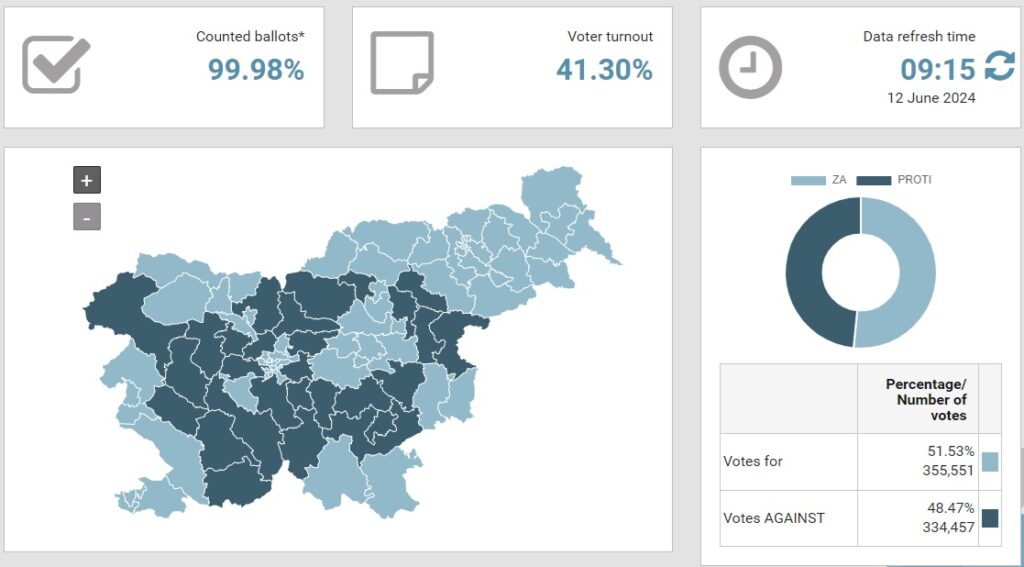
Voters in Slovenia were asked, “Should the Republic of Slovenia allow the cultivation and possession of cannabis for limited personal use on its territory?” With a voter turnout of over 41%, and nearly 700,000 votes cast, the referendum measure was approved.

adult cannabis use slovenia election 2024 results

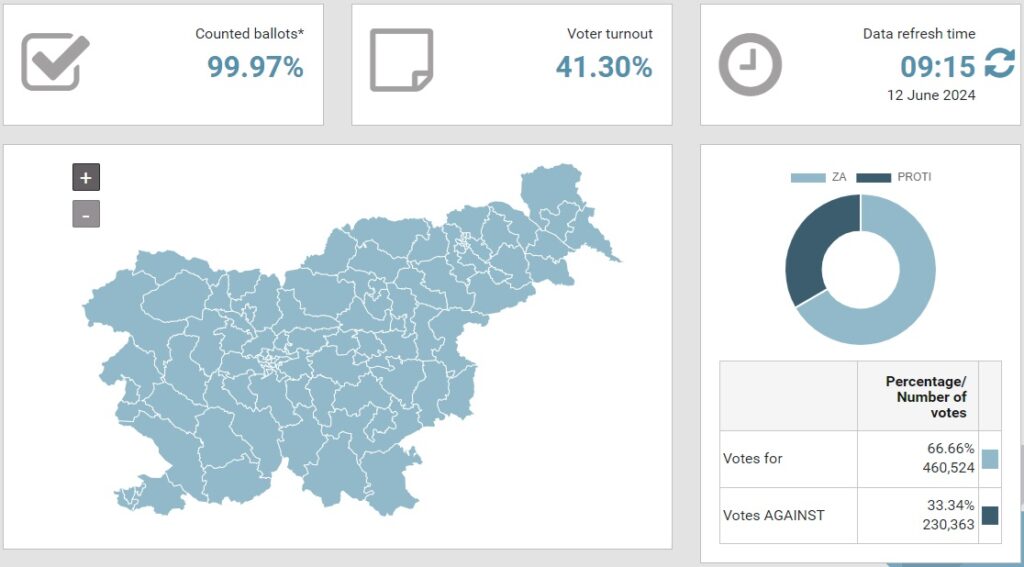
The adult-use referendum measure was one of two measures considered by Slovenia’s voters. A separate measure asked the question, “Should the Republic of Slovenia allow the cultivation and processing of cannabis for medical purposes on its territory?” The medical cannabis measure was overwhelmingly approved by Slovenian voters.

medical cannabis production slovenia 2024 election results

Both measures were consultation measures and are not legally binding. However, the voting results of both referendums send a clear and significant message to lawmakers in Slovenia that it is time to modernize the nation’s cannabis policies.

The historic votes in Slovenia come on the heels of other successful recent cannabis policy modernization efforts in other nations. Last month, South Africa’s President signed a measure that legalized private cannabis cultivation, possession, and use by adults.

On April 1st, 2024 the first provisions of Germany’s adult-use cannabis legalization measure went into effect. Adults in Germany can now cultivate up to three plants in their private residences. Social cannabis clubs are expected to launch in July in Germany, and regional adult-use cannabis commerce pilot trials are expected to begin by the end of the year.

Cannabis is also currently legal for adult use in Uruguay, Canada, Malta, Luxembourg, and in two dozen states in the U.S. Additionally, adult-use cannabis commerce pilot trials are underway in several jurisdictions in the Netherlands and Switzerland.

Slovenia Voters Overwhelmingly Approve Medical Cannabis Referendum Measure

(*Editorial note – this article was updated from its original version to reflect updated voting results*)

Voters in Slovenia appear to have overwhelmingly voted in favor of a medical cannabis referendum measure today. Today’s cannabis vote in Slovenia occurred alongside the wider 2024 European election.

With 92.84% of the votes counted, 65.41% answered ‘for’ when asked the question (translated from Slovenian to English), “Should the Republic of Slovenia allow the cultivation and processing of cannabis for medical purposes on its territory?”

The medical cannabis referendum question was one of two cannabis questions placed before Slovenia’s voters. The second one asked the question, “Should the Republic of Slovenia allow the cultivation and possession of cannabis for limited personal use on its territory?”

The personal adult cultivation and use question was passing by a slim margin with 92.74% of the vote counted, with 50.93% of voters answering ‘for’ and 49.07% answering ‘against’ the adult-use measure. With such a razor-thin margin, the vote is still too close to call. Local cannabis advocates are celebrating the results of today’s vote in Slovenia.

“People are clearly not satisfied with this drug policy. However, problems are not solved by the same people who created the problems. If only half of the voters are in favor of greater use of cannabis, it will be a big eavesdrop on the counter-propaganda financed by the Ministry of Health and doctors,” stated Božidar Radišič according to domestic reporting by Delo (translated from Slovenian to English).

Both cannabis referendum measures are consultation referendums and are not binding. What happens after all of the votes are counted and recorded is up to lawmakers in Slovenia.

Limited medical cannabis activity is currently permitted in Slovenia, although the nation’s program is more restrictive compared to other European nations, with countries such as Germany having incorporated a wider list of qualifying conditions, regulated domestic production, and regulated commerce.

Slovenia already serves as an international research and development hub for several large industries, and the favorable medical cannabis production and processing vote combined with an already existing infrastructure makes Slovenia well-positioned to do the same for the emerging international cannabis industry.

“Thanks to researchers and laboratories, Slovenia could become an intellectual superpower in the field of cannabis according to Alex Rogers,” Delo also stated in its original coverage.

Today’s vote in Slovenia comes on the heels of other successful recent cannabis policy modernization efforts in other nations. Last month, South Africa’s President signed a measure that legalized private cannabis cultivation, possession, and use by adults.

On April 1st, 2024 the first provisions of Germany’s adult-use cannabis legalization measure went into effect. Adults in Germany can now cultivate up to three plants in their private residences. Social cannabis clubs are expected to launch in July in Germany, and regional adult-use cannabis commerce pilot trials are expected to begin by the end of the year.

Cannabis is also currently legal for adult use in Uruguay, Canada, Malta, Luxembourg, and in two dozen states in the U.S. Additionally, adult-use cannabis commerce pilot trials are underway in several jurisdictions in the Netherlands and Switzerland.

***

Update: The medical cannabis production measure was officially approved after receiving 66.66% ‘for’ votes and the adult-use measure was also officially approved after receiving 51.53% ‘for’ votes. Voting turnout was roughly 41.3% for both measures.

Germany’s New Per Se Cannabis Driving Law Is The Wrong Approach

One of the most serious topics in cannabis policy modernization discussions is how to mitigate the dangers of people driving under the influence of cannabis. If there is one thing that cannabis opponents and responsible cannabis advocates agree on, it is that no one should operate a motor vehicle on a public roadway when they are intoxicated.

Yet, whereas opponents and supporters can agree on that basic premise, the two sides diverge when it comes to how cannabis DUI enforcement should be handled. In every jurisdiction that has modernized its cannabis policies to permit adult use, cannabis opponents have pushed for enforcement practices that are not backed by science.

Germany is the latest jurisdiction to experience this scenario. Lawmakers in Germany adopted a per se cannabis DUI law this week, and drivers in Germany will now be subjected to a 3.5 ng/mL THC limit.

“The amendment to the Road Traffic Act is intended to introduce a THC (tetrahydrocannabinol) limit in road traffic and a ban on alcohol for cannabis users.” The Bundestag stated on its website.

“According to the new regulation, the limit will be 3.5 nanograms per milliliter in the future. If the limit is exceeded for the first time, there is a risk of a fine of 500 euros and a one-month driving ban.” the Bundestag also stated about the recently adopted measure.

Per se THC DUI limits are a knee-jerk public policy reaction by cannabis opponents. Opponents spend a considerable amount of time falsely hyping up imaginary ‘terror on the roadways’ doomsday scenarios leading up to legalization, including in Germany, and per se THC limits are their ‘solution’ to the imaginary problem that they themselves established using false pretenses.

Unfortunately, per se THC limits often resonate with many members of society due to per se alcohol limits being common, including in Europe. Per se blood alcohol limits in Europe range from zero tolerance in places like Hungary and the Czech Republic to .08 in the United Kingdom. The United States also has a national .08 limit, although state-level limits can vary in some circumstances.

While per se limits for blood alcohol levels are based on sound science, the same is not true for cannabis due to a multitude of factors, not the least of which is how the human body metabolizes THC. The human body does not metabolize alcohol and THC in the same manner.

According to a 2021 analysis conducted in Australia, cannabis impairment can last “between three and 10 hours” when consumption involves “moderate to high doses of the intoxicating component of cannabis, tetrahydrocannabinol (THC).” The analysis involved data from over 80 different studies spanning a period of over 20 years.

THC impairment may only last 3 to 10 hours, but metabolized THC can stay in a person’s system for as long as 100 days, well beyond the window of impairment. Depending on how much THC the user consumed and their metabolism rate, the consumer could easily have more than 3.5 ng/mL of THC in their system for weeks or months into the future.  Those consumers will not be impaired at all, and yet still run afoul of Germany’s new cannabis law.

The 3.5 ng/mL threshold in Germany is completely arbitrary, as there is no sound science demonstrating that such a limit automatically equates to impairment. In fact, a study conducted in Canada in 2019 found “no evidence of increased crash risk in drivers with Δ-9-tetrahydrocannabinol < 5 ng/ml and a statistically non-significant increased risk of crash responsibility (odds ratio = 1.74) in drivers with Δ-9-tetrahydrocannabinol ≥ 5 ng/ml.”

Another study conducted in Canada (2024) involving simulated driving data found that the presence of THC in blood is not predictive of detriments in psychomotor performance. The findings are in line with a separate government-funded study in the U.S. that also found that “there was no correlation between THC (and related metabolites/cannabinoids) in blood, OF [oral fluid], or breath and driving performance.”

“The complete lack of a relationship between the concentration of the centrally active component of cannabis in blood, OF, and breath is strong evidence against the use of per se laws for cannabis.” the researchers stated about the government-funded study. Researchers at Yale University also arrived at the same conclusions in a study in 2021.

Germany’s 3.5 ng/mL threshold will likely put a massive burden on the nation’s court system, with countless drivers being falsely accused of operating a motor vehicle while intoxicated. Offenders will have an affirmative defense and will be able to point out that just because they had THC in their system did not automatically mean that they were impaired at the time in question.

Cases involving those set of circumstances will presumably be disaffirmed, but only after a considerable amount of time and money was wasted for both the accused and the courts.

The cannabis plant is complex and how it interacts with human biology is dynamic. There is no one-size-fits-all approach to cannabis impairment as it pertains to operating motor vehicles on public roadways. Germany would be far wiser to implement a comprehensive approach to determining impairment, including the incorporation of various field sobriety tests.

They are less intrusive and are more effective at spotting actual impairment. Field sobriety tests, combined with public awareness campaigns educating consumers about the dangers of driving while impaired and the benefits of pursuing public transit options, are a much better strategy than per se limits.

Until Germany implements more sensible cannabis DUI laws, consumers in Germany are encouraged to take public transit as much as possible.