Taking European CBD Products From Concept To Reality

The rise in the availability of cannabis products in many parts of the world is amazing from a consumer standpoint, and for suffering patients specifically, the boost in safe access is a tremendous blessing. More cannabis products are now legally available than ever before since the dawn of prohibition, and that is particularly true for CBD products.

Demand for CBD products is increasing around the globe. In fact, just the CBD skincare market alone is estimated to be worth hundreds of millions of dollars currently according to Verified Market Research. By 2028, that figure is expected to jump to over $3.7 billion.

Skincare products are not the only type of CBD product that consumers demand. Far from it, in fact. The beverages sector of the CBD industry is currently worth an estimated $4.52 billion and is expected to grow 25.6% CAGR according to Straits Research.

The CBD industry possesses tremendous profit potential, however, product development is much more difficult than many people think. Just because someone has a great idea for a type of CBD product does not mean that they possess the knowledge and resources to fully develop it.

Even if someone has such resources at their disposal, it may not make sense for them to manufacture products themselves, and instead, they should focus their time and energy on getting products to market and building brand recognition among consumers and patients. That is where white-label companies come in.

White-label companies help take CBD products from concept to reality, with Essentia Pura serving as one of the top white-label CBD companies on earth. I recently reached out to Nejc Rusjan, CEO & Co-Founder of Essentia Pura, to discuss white labeling, as well as his views on the larger cannabis conversation (my questions are in bold):

JG: What concerns should people have regarding CBD products (such as contamination)?

NR: CBD products are not yet regulated, neither by the FDA in the states nor by EFSA in the EU, so it is on us manufacturers to self-regulate to high standards and participate in novel foods applications.

Unfortunately, not all manufacturers do this so there is no guarantee that the consumer is getting a product that contains the amount of CBD listed on the label or that the THC level is not within the legal limits. Additionally, some CBD products may contain contaminants such as heavy metals, and pesticides, which can occur during hemp cultivation or solvents that were used during the extraction process other than CO2 extraction.

Consumers should purchase CBD products from reputable sources and look for third-party lab testing results to ensure the product is safe, compliant, and contains the claimed amount of CBD.

JG: Why is it more advantageous for a cannabis company to use your white-label or custom formulation services instead of doing everything themselves?

NR: Using our white-label and custom formulation services firstly gives a company access to market-proven, proprietary formulated CBD products, with a market-leading cannabinoid ratio and secondly, it allows them to focus on their core competencies while still offering to their customers what we believe are the highest-quality CBD products.

By partnering with a white-label provider like Essentia Pura, the cannabis company can avoid the costs of establishing an extraction facility and avoid the risks associated with developing and manufacturing new products in-house. We handle everything from product development and manufacturing to packaging and labelling, allowing our customers to focus on marketing and distribution. We like to call ourselves a one-stop solution provider for white-label CBD business needs.

JG: What do you envision Europe’s cannabis industry looking like in five years?

NR: In the next five years, the European cannabis industry is expected to grow as more countries legalise cannabis for medical and recreational use. The industry will likely become more sophisticated, with more professional growers and manufacturers entering the market. The legally compliant full-spectrum hemp extracts will not be considered novel food.

Additionally, we may see more cross-border collaborations and partnerships as companies look to expand their reach across Europe. However, regulatory issues and cultural attitudes towards cannabis may continue to be a challenge in some countries, and it remains to be seen how these issues will be resolved in the coming years.

Cannabis Production Identified As A Top Investment Opportunity In Rwanda

Rwanda’s economy ranks 171st on earth according to World Data, making it one of the poorest countries on the planet. Rwanda’s economy is still largely agrarian, with many citizens living in rural, undeveloped areas.

Years of conflict, particularly in the 1990s, ravaged the African nation and negatively impacted the already-dim economic prospects within its borders. Needless to say, any and all reasonable boosts to Rwanda’s economy are surely welcomed.

The emerging international cannabis industry is creating jobs, generating revenue for governments, and providing boosts to local economies at an ever-increasing rate around the globe as more and more countries reform their cannabis policies. If certain leaders in Rwanda have their way, their country will join the list of international cannabis industry leaders. Per The New Times:

Rwanda is looking to attract at least Rwf19 billion (about $17.5 million) investment in the production of cannabis, also known as a high-value therapeutic crop, The New Times has learnt.

The development was recently ranked among the country’s top 100 investment opportunities, during the Invest Rwanda Forum held last week.

According to the Rwanda Development Board (RDB), global cannabis production is projected to grow from the current $28.3 billion raked in 2021, to $197.7 billion in 2028 at a compound annual growth rate of 32 per cent.

Whether or not the projection offered up by the RDB proves to be accurate is anyone’s guess. And exactly to what extent the cannabis industry may help Rwanda’s economy specifically is unclear at this time, particularly since it involves many factors.

However, if Rwanda’s government and business community can develop its domestic cannabis industry, and especially if that industry can make meaningful inroads in the export market, amazing things could happen.

The Global Cannabis Industry’s Increasing Momentum Was On Full Display In Barcelona

The emerging legal international cannabis industry is stronger now than at any other time since the dawn of prohibition so many decades ago, and that was on full display last week in Barcelona where leading cannabis investors, entrepreneurs, activists, policymakers, and industry service providers from all over the planet gathered at the International Cannabis Business Conference on March 9th.

March in Barcelona has largely developed into the start of ‘cannabis event season’ for the international cannabis community in recent years, with the International Cannabis Business Conference partnering once again with Spannabis (held March 10th-12th) to put on the world’s largest cannabis super-event in 2023.

The two events combine for what is likely the closest thing in this world to an international cannabis community reunion, and it’s always heartwarming and inspiring to see old friends connecting (in addition to new friendships being created).

International Cannabis Business Conference Barcelona 2023

The International Cannabis Business Conference is Spain’s largest cannabis B2B event and this year’s installment came at a very crucial time for cannabis policy in Spain, as well as for cannabis policy at the continental level. Lawmakers and regulators in Spain are working harder than ever to pass meaningful legislation that will help Spain’s emerging cannabis industry reach its full potential. The same can also be said about many other parts of Europe right now.

With that in mind, it was tremendously beneficial to bring not only leaders from throughout Spain to one venue to network and discuss cannabis policy, but also leaders from other nations that are either working towards the same end goal as Spain or are farther along in the process and were able to impart their wisdom. Those leaders were able to network with each other and additionally were able to network with industry members, which is important for a multitude of reasons.

Cannabis policy reform is still a relatively new phenomenon at the international level and the global cannabis ecosystem is still largely a patchwork of laws, rules, and regulations, and that patchwork extends to efforts to reform and improve current public policies. The saying, ‘teamwork makes the dream work’ is as applicable to global cannabis efforts as anything you will ever find, so seeing leaders from all sectors of society (law, government, industry, activism) networking with each other was very encouraging and uplifting.

The International Cannabis Business Conference’s next event will be in Berlin in June. Buy your tickets today before prices go up!

International Cannabis Business Conference Barcelona 2023

As is always the case, the curriculum at the International Cannabis Business Conference in Barcelona was packed with world-class speakers who are all global leaders in their particular fields. We will be publishing videos of the panel discussions on the event’s YouTube channel, so make sure to check them out in the near future.

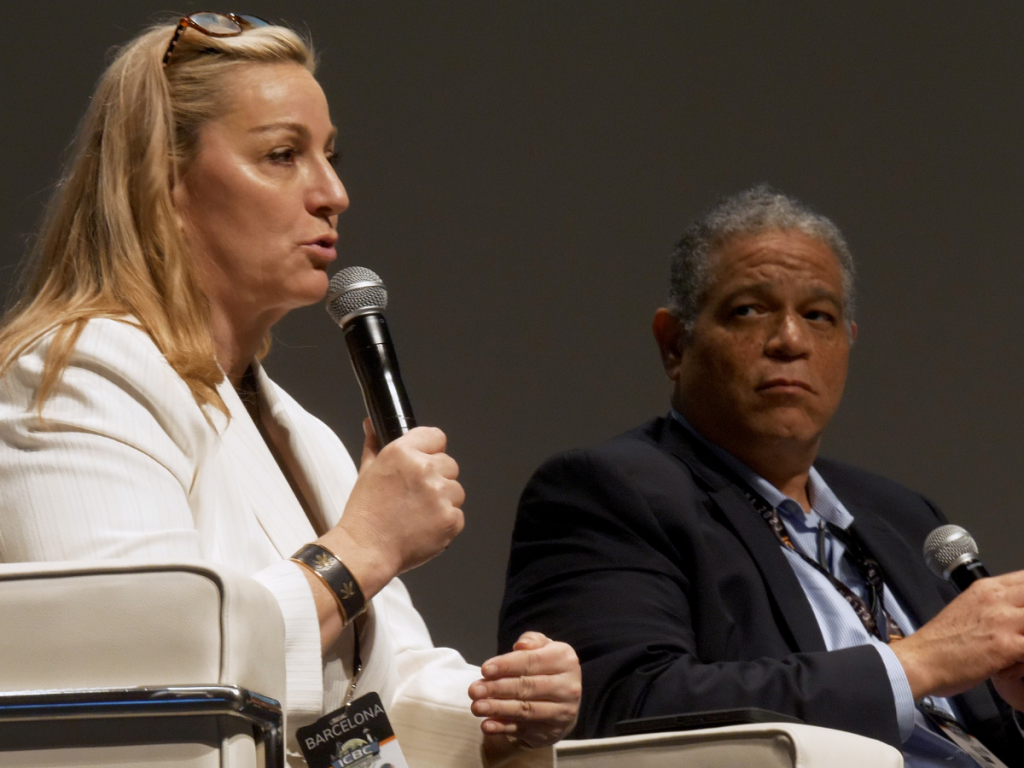
Below is a small sampling of photos from some of the many insightful panel discussions that took place at the 2023 International Cannabis Business Conference Barcelona B2B event:

International Cannabis Business Conference Barcelona 2023

No International Cannabis Business Conference event would be complete without an epic after-party, and this year’s event in Barcelona was no exception.

Below is a sampling of pictures demonstrating the ‘work hard, play hard’ mentality that makes the International Cannabis Business Conference’s events so special:

Why Is The Czech Republic Punishing A Cannabis Educator?

The cannabis reform movement, as with any meaningful social movement, would not be possible without people spreading education. Cannabis educators are vital because without them there would be a vast knowledge void, and that knowledge void would be filled entirely by cannabis opponents as history has clearly demonstrated.

For several decades positive cannabis knowledge and information were suppressed by governments worldwide. Those that tried to spread the truth and facts were sometimes targeted. Unfortunately, that censorship continues to this day, including in countries that you may not have expected.

Robert Veverka is a journalist and director of the Czech-based cannabis magazine LegalizaceBack in October 2021, I published an article about Robert being targeted by the Czech government over his journalism, with the government accusing him of “inciting and promoting toxicomania.”

Legalizace is a bimonthly periodical focused on cannabis, as well as drug policy relating to human rights and environmental issues. Here in the United States where I live and conduct similar efforts, what Veverka did is well within the parameters of legal speech/expression. Legalizace clearly provides content that possesses significant scientific, political, and literary value.

“The prosecution, which is calculated, stigmatizing, borderline untruthful, and based on fallacious conjectures and limited interpretation by the police that the cultivation and processing of cannabis is automatically illegal or that any mention of cannabis automatically equates ‘inciting toxicomania’, comprises a dangerous precedent comparable to totalitarian repression and censorship.” Robert Veverka stated back in late 2021 regarding the initial indictment.

“I consider it my duty to fight not only for the right of Legalizace magazine to exist, but also for the rights of all print and electronic media who have ever dared mention the word ‘cannabis’ – or plan to do so in the future,” Robert Veverka went on to say at the time.

Unfortunately, the Czech Republic proceeded with the indictment and in November 2021 Veverka and his media outlet were found guilty of the allegations, and Veverka was given a one-year prison sentence contingent on a probationary period of two and a half years as well as a fine of 50,000 CZK by the district court in Bruntál following two court hearings.

“The judge mentioned that he is not competent to assess the benefits of the current legislation, the benefits of cannabis products in healthcare, or the negative effects of cannabis use, but that he must base his verdict on the existing legislation which is binding for all. He stated that according to his judgement, Legalizace magazine evidently and factually constituted the criminal offence of inciting and promoting toxicomania.” Veverka stated at the time of the November 2021 verdict in a press release.

“He did not take into account the legislative provisions allowing for cannabis to be handled legally in certain cases or the comprehensive and educational nature of the information published in the magazine. On the contrary, the judge expressed his doubts as to whether the individuals who granted interviews to the magazine were made aware of its content and overall message. Personally, I consider the verdict to be very biased and severely restrictive of the freedom of expression, the right to express political opinion, and the right to information,” Veverka also stated.

News broke this month that Veverka was sentenced by a Czech court for similar allegations, although it’s still unclear to me from afar if that is part of an appeal attempt to the previously cited charges, or if this is a separate, additional matter. Either way, one thing that I do know is that what Veverka is being subjected to is horrific and unfair, and the global cannabis community needs to rally around him.

Veverka must reportedly pay an administrative offense of €4.000 (as a defendant and a natural person) and €6.000 on behalf of his media outlet as part of the recent verdict. For anyone that is able to support Robert Veverka and contribute to his defense, bank details are below. If you are not able to contribute financially, please help spread the word on your social channels about his plight:

IBAN: CZ4320100000002900469065
BIC/SWIFT: FIOBCZPPXXX
Fio banka, as, V Celnici 1028/10, 117 21 Praha 1

Cannabis Use Is Effective In Chronic Pain And Anxiety Patients According To UK Study

Chronic pain and anxiety are two of the most common health conditions diagnosed around the world. In fact, it is estimated that as many as 20% of people on the planet suffer from chronic pain to some degree.

Anxiety also affects a large number of people globally, with it being estimated that over 264 million people around the world are now diagnosed with some form of anxiety disorder. It’s quite possible that the number is actually higher due to the lack of healthcare access in many parts of the planet.

For both conditions, the prescribing of pharmaceutical medications is standard, which is unfortunate. Many pharmaceutical drugs are not only ineffective – they can be harmful and addictive. This is not to say that is the case every time, however, it’s definitely a cause for concern.

The cannabis plant is significantly safer compared to many pharmaceutical drugs, and for many patients, cannabis can be more effective. Below is information regarding a recent study in the United Kingdom that found that cannabis is effective in treating chronic pain and anxiety, via a news release from NORML:

London, United Kingdom: The use of cannabis products is associated with symptomatic improvements in pain patients with and without comorbid anxiety, according to observational trial data published in the journal Expert Review of Neurotherapeutics.

British investigators assessed the safety and efficacy of cannabis-derived products in 1,254 chronic pain patients. Of these, 711 subjects were also diagnosed with anxiety. Study subjects were participants in the UK Medical Cannabis Registry, and each of them possessed a doctor’s authorization to access cannabis. Study participants consumed cannabis by either vaporizing marijuana flower or by ingesting plant-derived extracts containing both THC and CBD. Researchers assessed subjects’ symptoms compared to baseline at one, three, and six-months.

Cannabis treatment was associated with “significant improvements in all primary outcomes … at all timepoints,” authors reported. Those with comorbid anxiety reported greater improvements in health-related quality of life as compared to those subjects diagnosed with chronic pain only. Both cohorts achieved significant reductions in their opioid consumption over the course of the study – a finding that is consistent with dozens of other observational trials.

Authors concluded: “A potential association between initiation of CBMPs [cannabis-based medicinal products] and improvements in pain and HRQoL [health-related quality of life], as well as reductions in opioid consumption and an acceptable AE [adverse events] profile in both cohorts was found, complimenting previous UKMCR studies. Moreover, CP [chronic pain] patients with co-morbid anxiety may achieve better HRQoL outcomes and potentially pain outcomes due to CBMPs’ peripheral and central effects.”

Several placebo-controlled trials document the ability of either inhaled or vaporized herbal cannabis to significantly mitigate pain in various patient populations, including those suffering from HIVdiabetesspinal cord injury, or severe treatment-resistant neuropathy (nerve pain). Several observational trials similarly show reduced anxiety in patients taking medical cannabis. Data published earlier this year in the journal JAMA Network Open reported that nearly one in four pain patients residing in states where medical cannabis access is legal self-identify as marijuana consumers.

In recent months, British researchers have published findings from several observational studies involving patients enrolled in the UK Medical Cannabis Registry, including those diagnosed with post-traumatic stressdepressionrefractory epilepsyheadaches, and inflammatory bowel disease.

Full text of the study, “Comparing the effects of medical cannabis for chronic pain patients with and without comorbid anxiety: A cohort study,” appears in Expert Review of NeurotherapeuticsAdditional information on cannabis and pain management is available from NORML’s publication, Clinical Applications for Cannabis and Cannabinoids.

The World Has Lost A Giant Of Cannabis Science – Tribute To Raphael Mechoulam

Some events are so monumental that people measure their lives by them. People remember where they were when humans landed on the moon. They remember where they were during the OJ Simpson high-speed chase, or when the Twin Towers fell.

I do not remember where I was when I first learned about international cannabis scientist Dr. Raphael Mechoulam, however, I will forever remember where I was when I found out about his passing today.

The world has truly lost a science giant, and for us in the cannabis community, we have lost one of the greatest minds that we have ever had in our community.

In the early hours of today (Pacific Standard Time), one of Mechoulam’s colleagues at the Israel Institute of Technology, associate professor David (Dedi) Meiri, posted the following message on LinkedIn:

Dedi Meiri tribute to Raphael Mechoulam

Dr. Raphael Mechoulam is widely recognized as one of the greatest scientists in the field of cannabis research that the world has ever known. Mechoulam began his cannabis research in the 1960s, and is often referred to as ‘the Godfather of cannabis research,’ and for good reason.

Mechoulam and his team were the first to ever isolate and synthesize tetrahydrocannabinol in human history. The same goes for cannabidiol, cannabigerol, cannabichromene, and various cannabinoid carboxylic acids.

Virtually all current cannabis research is essentially built on the efforts of Dr. Raphael Mechoulam, whether people realize it or not. He is truly a legend and will be dearly missed. Below is Dr. Raphael Mechoulam providing the keynote address at the 2019 International Cannabis Business Conference in Berlin. Enjoy:

b

Spain To Quadruple Legal Medical Cannabis Production This Year

Late last month lawmakers in Spain considered a cannabis reform measure, and while the measure did not pass, Spain’s emerging legal cannabis industry will undergo a fairly substantial expansion this year regardless. The Spanish Medicines Agency recently notified the International Narcotics Control Board that it plans to (roughly) quadruple the amount of legal medical cannabis grown within its borders.

As verified by Público, Spain’s Ministry of Health “has forecast a production of 23.43 tons of medical cannabis in Spain this year.” As required by international agreements, Spain has to notify the International Narcotics Board of the United Nations every year regarding how much domestic medical cannabis it projects it will produce. This year’s notification from Spain is obviously a considerable increase compared to last year.

Why It’s Not Enough

For some historical context, consider that in 2019 and 2020 Spain reported to the International Narcotics Board that it would cultivate 500 kilos each year. That figure increased in 2021 to a reported 600 kilos. The following year in 2020 the figure grew exponentially to a reported 6,000 kilos. This year’s reported forecast of 23.43 tons compared to just two years ago highlights how fast Spain’s medical cannabis industry is expanding. And yet, it’s not enough. Not even close.

The boost in cannabis production in Spain will benefit exports and research, however, it’s not going to help Spain’s regulated domestic medical cannabis industry being that Spain doesn’t really have one, at least not compared to many other nations. As pointed out by Público, only two medical cannabis pharmaceutical products are authorized in Spain right now (Sativex and Epidiolex).

As such, most patients rely on the unregulated market to source their medical cannabis products, including from unregulated clubs that operate in a ‘grey area’ of the law. Spain doesn’t just need a boost in domestic medical cannabis production – it also needs to reform its laws to embrace and develop the domestic medical cannabis industry in a way that helps as many patients as possible.

A Boost For Reform Efforts

Increasing domestic medical cannabis production in Spain is generally a good thing. If it helps suffering patients abroad via direct access to medical cannabis, that is still beneficial, and if it contributes to groundbreaking research that helps suffering patients around the world, that is also beneficial. With that being said, clearly, there is still a lot more that can and should be done.

Fortunately, Spain is about to receive a boost for reform efforts via the world’s largest cannabis super-event that starts later this week. On March 9th policymakers, industry leaders, and cannabis advocates from all over the globe will descend on Barcelona, first for the International Cannabis Business Conference (March 9th), and then for Spannabis (March 10th-12th). A limited number of tickets are still available for both events.

The two events have once again teamed up to create an opportunity for thought leaders from around the world to discuss cannabis policy inside and outside of Spain. Whenever the world’s smartest cannabis brains get together amazing things happen, and this month in Barcelona will be no exception.

Recent Cannabis Study Provides Hope For Tinnitus Patients

Tinnitus involves people hearing a ringing or other noise in their ears. Sometimes it is constant, and sometimes it comes and goes. However, as any tinnitus sufferer will be quick to point out, it’s annoying every time.

For people that do not suffer from tinnitus, it may sound like a mild annoyance. Yet, tinnitus can actually prove to be debilitating in extreme cases. Imagine trying to fall asleep at night and get a good night’s rest when you have a constant sound in your ear that you cannot stop. Now, imagine what life is like without proper sleep. It doesn’t take a medical professional to see the problem.

Thankfully, recent research out of Canada suggests that the cannabis plant may be able to help people that suffer from tinnitus. Below is more information about it via a news release from NORML:

Ottawa, Canada: Patients suffering from tinnitus (ringing in the ears) frequently report using cannabis products for symptom relief, according to survey data published in the Journal of Otolaryngology – Head & Neck Surgery.

A team of Canadian scientists surveyed 45 patients with the affliction. Over one in five identified as current cannabis consumers and 80 percent of them reported it to be beneficial in treating symptoms of the disorder, including dizziness, anxiety, pain, and sleep disturbances.

Over 90 percent of those surveyed said that they “would consider cannabis as a treatment for their tinnitus.”

Authors concluded: “This is the first study to assess perspectives and usage patterns of cannabis in patients experiencing tinnitus. The results of this study demonstrate an active interest amongst patients with tinnitus to consider cannabis as a potential adjunctive treatment for symptom management. Moreover, cannabis use is both common and can be beneficial in this patient population. … This data may lay the groundwork for future research and clinical trials on cannabis use for tinnitus alleviation.”

Full text of the study, “Cannabis use among tinnitus patients: Consumption patterns and attitudes,” appears in the Journal of Otolaryngology – Head & Neck Surgery.

Yukon Has The Highest Per Person Cannabis Sales Ratio In Canada

Statistics Canada released new sales data pertaining to the nation’s emerging legal cannabis industry for the period of April 1, 2021 to March 31, 2022. During that time period, Canada’s legal adult-use cannabis industry generated roughly $1.6 billion for federal and provincial governments.

To put the $1.6 billion figure into perspective, Canada’s alcohol industry generated roughly $13.6 billion during the same time period. The figures for both alcohol and cannabis include taxes at all jurisdictional levels, as well as fees related to licenses and permits.

Overall, sales for adult-use cannabis products across Canada (provincial cannabis authorities and other retail outlets) totaled roughly $4 billion between April 1, 2021 to March 31, 2022, which is “equivalent to $131 per person of legal age to consume cannabis” according to Statistics Canada.

Yukon, which is the smallest and westernmost of Canada’s three territories, had the largest per-person cannabis sales ratio at $291. Yukon was followed by Alberta ($210), Saskatchewan ($185), Nova Scotia ($125), and Manitoba ($107). Quebec had the lowest ratio at $89 per person of legal age. Data from certain jurisdictions is apparently ‘suppressed to meet the confidentiality requirements of the Statistics Act.’

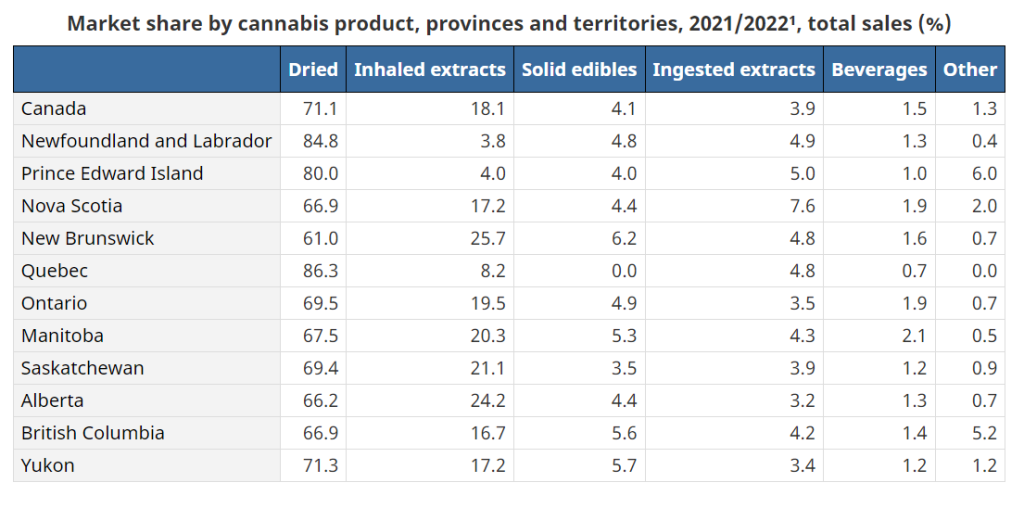
Dried cannabis flower was by far the most popular form of cannabis sold during the specified time frame, accounting for 71.1% of all adult-use cannabis sales in Canada during the calendar year. Inhaled extracts made up 18.1% of overall sales and edibles gained 4.1% of the market share according to the available data. Below is a breakdown of market share by cannabis product, provinces, and territories according to Statistics Canada:

Canada cannabis sales breakdown 2021 2022

The data released by Statistics Canada comes around the same time findings were published from a very insightful survey analysis dealing with reported cannabis consumer spending habits.

According to the study, which was conducted by investigators affiliated with the University of Waterloo School of Public Health, “In 2021, the percentage of consumers sourcing all their products legally in the past 12 months ranged from 49 percent of solid concentrate consumers in 2021 to 82 percent of cannabis drink consumers.”

The growing success of adult-use cannabis legalization in Canada will not only benefit consumers within the nation’s boundaries but also consumers in other jurisdictions where lawmakers are pursuing legalization and keeping a close eye on Canada to see how things continue to develop.