Morocco Exports First Legal Medical Cannabis To Australia

Cannabis being exported from Morocco to markets in other countries is not a new thing. After all, Morocco has served as a top source for unregulated cannabis for decades. However, policymakers and regulators in Morocco have worked in recent years to transition the nation’s cannabis industry into a regulated system.

In March 2021, the government of Morocco approved a proclamation allowing the legal production of medical cannabis. The proclamation was followed by additional policies and the creation of a national agency to oversee Morocco’s emerging legal cannabis industry.

A significant focus of the cannabis policy modernization effort in Morocco was to promote international exports of medical cannabis products to other countries, aiming to boost the domestic Moroccan economy. This effort reached a major milestone this month, with Morocco’s legal cannabis industry completing its first export to Australia.

“Morocco has officially entered the international medical cannabis market with its first export to Australia.” reported APA News in its local coverage. “This initial shipment marks a significant milestone for the country, which is rapidly formalizing its cannabis industry.”

“A 50-kilogram batch of the local Baldiya cannabis variety was shipped to Australia this week, following a successful quality control sample sent in June.” the outlet also reported.

A recent study conducted in Morocco found that the Baldiya cannabis strain exhibits a higher level of chemical stability compared to other strains commonly cultivated in Morocco. The study was performed by researchers affiliated with various academic institutions in Morocco, and the findings of the study were published in the journal Food Chemistry Advances.

“In this study, a comprehensive analysis of Cannabis sativa L. cultivars was conducted, focusing on the phytocannabinoid profiles of resin from one local cultivar ‘Beldiya’ and four exotic cultivars over three consecutive crop years.” stated the researchers about the focus of their investigation.

“The cannabinoid composition of the resin from the studied cultivars was analyzed using liquid chromatography-mass spectrometry coupled with a triple-stage quadrupole mass spectrometer (LC-MS/TSQ Endura) to evaluate the chemical variability in phytocannabinoid compounds among the cultivars and across the harvest years.” the researchers wrote about their methodology.

“The results showed significant chemical polymorphism among the studied cultivars, with the clustering of phytocannabinoids, indicating three distinct chemical groups based on the concentrations of the major cannabinoids.” the researchers concluded. “In addition, only the local Northern Moroccan cultivar Beldiya demonstrated chemical stability across the three harvest years, whereas the exotic cultivars exhibited heterogeneity from one year to another.”

A market analysis from last year found that Morocco’s emerging legal cannabis industry could reach between $420 million and $630 million in value annually.

The Science Of Cannabis Extraction

It is unclear when humans first started extracting cannabinoids from the cannabis plant to make concentrated forms of cannabis. The topic is somewhat difficult to pin down due to various reasons, not the least of which is answering the question, ‘what constitutes extracting cannabis?’

Cannabis extracts can come in many forms, including cannabis oils and hashish, both of which humans have created for centuries. Regardless of when humans first started extracting cannabinoids from the cannabis plant, these days, cannabis extracts are one of the most in-demand forms of cannabis around the world.

The cannabis extraction sector of the emerging global cannabis industry is currently undergoing significant changes from nearly every angle, including regulations, technology, and shifting consumer and patient demands.

As the international cannabis import/export market continues to develop, products using cannabis extracts as inputs will increase in popularity, including solventless extract products and new products involving lesser-known cannabinoids.

The science behind cannabis extraction was the focus of a panel discussion at the recent International Cannabis Business Conference in Berlin, Germany. The panel was moderated by Michael Knodt, a freelance journalist and author of Cannabis-Extraktion. Mr. Knodt was joined on the panel by:

  • Nick Brousianos, CEO of Cannabreeze
  • Yogesh Jhamtani, CEO and Co-Founder of Buffalo Extraction Systems
  • Serge Korovitsyn, Founder of LabCradle
  • Steve Fuhr, Director of Sales and Business Development at SciPhy Systems

You can view the panel discussion in its entirety at this link here.

German SPD Will Not Support Draft Cannabis Amendment “Under Any Circumstances”

Last month, Germany’s Health Ministry released a draft medical cannabis amendment that seeks to roll back Germany’s medical cannabis regulations significantly. The proposed changes contained within the draft amendment include:

  • Mandatory in-person doctor consultations
  • A ban on mail-order medical cannabis dispensing
  • Stricter rules for medical cannabis prescriptions

Fortunately, not everyone in Germany’s governing coalition is in favor of the proposed changes. Leadership of the Social Democratic Party (SPD) was recently asked what the SPD’s position on the draft amendment is, and what the SPD will do to oppose the announced amendment.

“The Federal Ministry of Health wants to restrict telemedicine and prescribe only after personal contact and no longer allow mail delivery.” a concerned member of the public asked on the platform Abgeordnetenwatch (translated from German to English), as originally reported by krautinvest. “What is the SPD’s position on this? And what, if anything, does it intend to do to oppose the change?”

“The Ministry of Health, under the new Union Minister Warken, has now presented a draft bill intended to address the increase in imports of medical cannabis. According to the Federal Ministry of Health, this is primarily due to the increased use of private prescriptions for self-payers via online platforms, without any doctor-patient contact. Therefore, misuse of medical cannabis is assumed. The ministry has stated that, for patient protection, it intends to ensure consultation before consumption and therefore restrict online sales.” Ms. Carmen Wegge, SPD member of the German Bundestag, stated in her response to the inquiry (translated from German to English).

As alluded to by Ms. Wegge in her response to the inquiry, Germany’s Federal Institute for Drugs and Medical Devices (BfArM) recently published medical cannabis import data for the second quarter of 2025, and once again, Germany’s emerging legal medical cannabis industry set a new record for import totals.

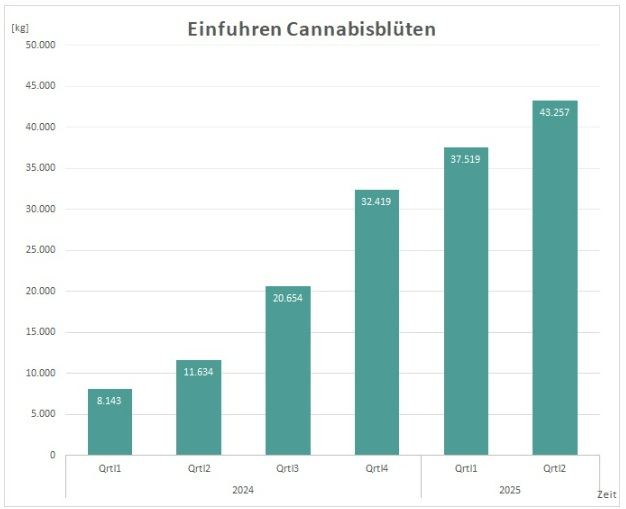
In the second quarter of 2025, Germany imported 43.257 tonnes of medical cannabis products according to BfArM’s data. That is an increase over the previous record set in Q1 2025 of 37.519 tonnes, and a significant increase compared to Q2 2024 when Germany imported 11.634 tonnes of medical cannabis products. Below is a graph of historical import totals from BfArM:

germany medical cannabis imports 2024 and 2025

“For us as the SPD, however, in addition to protecting and adequately advising patients, it is crucial to ensure reliable, local, and accessible care. Digital care is particularly important for people with chronic and/or serious illnesses, as well as in areas with inadequate primary care. Therefore, we will not support the current version of the bill under any circumstances.” Ms. Wegge also stated.

In the upcoming discussions, we will therefore develop a solution that will ensure that medicinal cannabis remains readily accessible to all patients who need it, while simultaneously ensuring patient protection. The initial draft bill from the Federal Ministry of Health will now be discussed with experts in the ministry and subsequently debated in the cabinet before a decision is made there and a potential draft bill from the ministry is submitted to the Bundestag. In the Bundestag, it will be discussed in the relevant specialist committees, and Struck’s Law applies, which stipulates that no bill leaves committee deliberations in the same condition as it was submitted. Many negotiation steps will therefore still take place before a possible decision is made in the Bundestag, and we as the SPD will advocate for a good solution for patients.” Ms. Wegge added.

“Even though we must primarily defend the drug policy achievements of the last legislative period, we will not lose sight of the goal. I remain convinced that full legalization of cannabis, in compliance with European law, and its sale in licensed specialist stores is the best way forward, and that medical care must be made as simple as possible. I can assure you that I will fight for political majorities that make this possible, and I will not shy away from discussions with the Union.” Ms. Carmen Wegge concluded.

(The featured image of this article of Bundestag member Carmen Wegge is a photo by Anna Voelske.)

High Tide To Become Major Player In German Medical Cannabis Market

High Tide, Inc. is a leading community-grown, retail-forward international cannabis company. Its wholly owned subsidiary, Canna Cabana, is the second-largest cannabis retail brand globally. In a major move for the company, High Tide has acquired a majority stake in Germany-based Remexian Pharma GmbH.

Founded in 2018 and headquartered just outside of Berlin, Germany, Remexian is an established medical cannabis pharmaceutical company specializing in the importation and wholesale of medical cannabis. As part of its business model, Remexian has a fully certified EU GDP warehouse.

Remexian is currently licensed to import medical cannabis products into Germany from 19 countries, including Canada, which represents approximately 33% of their total imports into Germany. Given its over $1.9 billion in Canadian cannabis sales since adult-use legalization, High Tide is well-positioned to further increase the Canadian share of medical cannabis imports into Germany.

“Remexian is an ideal match for us—not only in its commitment to discount pricing, but also in its operational approach, which mirrors our lowest price guarantee in Canada. We took our time evaluating potential partners and couldn’t be more excited to join forces with the best-in-class team that built Remexian into a national leader. Together, our complementary strengths and deep procurement expertise will create a stronger foundation for growth and further enhance the fundamentals of this business,” said Raj Grover, Founder and Chief Executive Officer of High Tide.

“With this highly accretive acquisition adding approximately C$100 million in topline revenue and significant EBITDA annually, we will meaningfully strengthen our financials, positioning us well to establish a strong foothold in Germany, which will serve as a springboard into other European markets in due course. Our goal in Germany remains clear: to provide the highest quality medical cannabis at the most affordable prices, led by our Canadian house of brands and supplemented by medical cannabis imports from all across the globe,” added Mr. Grover.

“We are truly energized by the strong synergy we’ve found with High Tide, whose impressive scale amplifies our impact in Germany,” said Markus Wenner, Co-Founder of Remexian. “Both of our companies have taken a deliberate, strategic approach to becoming leaders in our respective markets. By combining one of Germany’s largest cannabis distribution networks with High Tide’s unmatched access to Canadian supply, we are setting the stage for unprecedented growth. We at Remexian are looking forward to building this exciting future together with Raj and the talented High Tide team.”

Germany’s Federal Institute for Drugs and Medical Devices (BfArM) recently published medical cannabis import data for the second quarter of 2025, and once again, Germany’s emerging legal medical cannabis industry set a new record for import totals.

In the second quarter of 2025, Germany imported 43.257 tonnes of medical cannabis products according to BfArM’s data. That is an increase over the previous record set in Q1 2025 of 37.519 tonnes, and a significant increase compared to Q2 2024 when Germany imported 11.634 tonnes of medical cannabis products. Below is a graph of historical import totals from BfArM:

germany medical cannabis imports 2024 and 2025

Remexian has an annualized revenue and Adjusted EBITDA of €70 million and €15 million, respectively, for the six months ending March 2025. Remexian is currently one of the largest distributors of medical cannabis flower in Germany in terms of total grams sold, distributing the equivalent of 7 tonnes in Q2 2025, representing 16% of the 43 tonnes imported into Germany during the quarter.

How Is Advanced Technology Transforming The Cannabis Industry?

Few other large international industries are being transformed by advanced technology at the same rate and scope as the emerging legal cannabis industry. Cannabis businesses worldwide are embracing advanced technology to optimize output and efficiency, which, in turn, is propelling the global industry forward.

Advanced technology can take on many forms, and for the emerging cannabis industry specifically, it often manifests itself as automated technology that helps cannabis producers and product manufacturers create the end products that consumers and patients purchase in legal markets. Programmed automation is drastically changing the way that cannabis is cultivated, how cannabis products are created, and how those products are stored and transported.

Another area where advanced technology is being integrated by cannabis companies is in the area of communications. Recent digital innovations have revolutionized how cannabis companies communicate with their customers and develop their brands.

How advanced technology is being harnessed by the emerging international cannabis industry was the focus of a panel discussion at the recent International Cannabis Business Conference in Berlin. The panel discussion was moderated by Canadian medical cannabis pioneer Alex Revich. Mr. Revich was joined on the panel by:

  • David Sandelman, Serial Inventor, Entrepreneur, and the Creator of Cannatrol Systems
  • Eral Osmanoglou, Co-Founder and Head of R&D at Becanex GmbH
  • Charlie Wang, Co-Founder and CEO of Cannvital NV LLC
  • Peter Machalek, Chief Revenue Officer of Greentank

You can view the panel discussion via this link here.

Autumn 2025 Could Be Pivotal For German Cannabis

As the summer months of 2025 are coming to an end and the autumn season approaches, the eyes of the international cannabis community will continue to be fixed on Germany, where policymakers, regulators, and researchers are expected to make some major announcements that could prove to be pivotal for the future of Germany’s industry.

The first interim report from the ongoing EKOCAN evaluation of Germany’s Consumer Cannabis Act (KCanG) is scheduled for release on October 1, 2025. The evaluation will consider, among other things:

  • Consumption rates and behaviors of various age groups
  • Cannabis use prevention among youth
  • Impact on public health outcomes, including mental health
  • Public roadway safety
  • Impacts on criminal activity
  • Impacts on Germany’s court system

“To this end, a wide variety of data will be compiled (e.g., from ongoing studies on the topic or from public administration), our own surveys will be conducted (e.g., with public organizations directly involved in the topic, as well as consumers and cultivation associations), and the data will finally be evaluated with regard to the aforementioned overarching objectives.” states the Federal Ministry of Health (BMG) on its website (translated from German to English).

“The evaluation will make an important contribution to answering the question of how the law is being implemented in everyday life and whether the intended effects of the law are being achieved. Furthermore, the evaluation should provide reliable evidence for potentially necessary legislative adjustments.” BMG also states.

Some initial findings from the EKOCAN project and its project manager, Dr. Jakob Manthey, have already surfaced via original reporting by krautinvest. One of the major takeaways from the initial findings is that reported cannabis consumption rates were already on the rise in Germany leading up to the enactment of the CanG law, and Dr. Manthy determined that the rise was due to older individuals reporting cannabis use.

Regarding younger consumers, which is a demographic often focused on by cannabis opponents in their talking points, Dr. Manthy “sees no anomalies since the Cannabis Act came into force,” according to krautinvest’s reporting, and that Dr. Manthy doesn’t assume “that any changes can be attributed to the Cannabis Act.”

Other high-level takeaways from the initial evaluation findings are that there aren’t enough cannabis cultivation associations in Germany, that there are no “short-term changes” regarding public roadway safety, legalization has not increased reported mental illnesses, and that the CanG law has significantly lowered cannabis-related criminal offenses in Germany. It will be interesting to see if those initial findings are included in the upcoming interim report in October.

Another major item that members of the cannabis community inside and outside of Germany need to have on their radars relates to decisions on pending applications for regional adult-use cannabis commerce pilot projects. The pending applications and looming decisions were touched on in the German Cannabis Business Association’s (BvCW) recent newsletter.

“To date, 58 applications for research projects have been submitted under Section 2 (4) of the KCanG, 32 of which are so-called model projects. The first decisions on applications by the Federal Office for Agriculture and Food are expected in the third quarter of 2025.” BvCW wrote in its newsletter this week (translated from German to English).

Regional adult-use cannabis commerce pilot trials are part of the second phase of Germany’s legalization model, and were initially expected to launch by the end of 2024. However, German pilot launches have experienced a series of delays.

Hopefully the delays have run their course, and approvals will be announced soon. Adult-use pilot trials are already operating in the Netherlands and Switzerland, with no major issues being reported.

Advocates Push For Private Cannabis Clubs In South Africa

South Africa is on a short but growing list of countries that have adopted national adult-use cannabis legalization measures. South Africa is joined by Uruguay, Canada, Malta, Luxembourg, and Germany, which all adopted recreational cannabis legalization measures before South Africa. The Czech Republic also recently adopted a national legalization measure.

The modern adult-use legalization law in South Africa actually started in late 2018 when the nation’s Constitutional Court deemed cannabis prohibition against private consumers to be unconstitutional. The landmark court decision was finally codified in 2024 by the nation’s lawmakers.

Policymakers and regulators are still working to properly set up South Africa’s recreational cannabis industry, and if advocates have their way, the nation’s legalization model will expressly include private cannabis clubs.

“A new initiative to unify private cannabis clubs to lobby for legal recognition has just been launched. The South African Cannabis Clubs Alliance (SACCA) says the time is critical for the private club movement to speak with one voice ahead of the anticipated release of draft regulations that will empower the Cannabis for Private Purposes Act.” reported Cannabiz Africa in its local reporting.

SACCA’s launch does come at a time of mounting pressure on authorities to draft regulations to combat the growing cannabis retail ‘Grey Zone’, the omniglot of thousands of unlicensed businesses dealing in cannabis across the country. To date, conflicting court decisions have cast clubs into a legal ‘no man’s land’ where the best they can strive for in terms of compliance, is to be ‘technically’ not illegal.” the outlet also reported.

As part of its advocacy, the South African Cannabis Clubs Alliance has launched a website, stating on it that the organization seeks to “ensure that self-regulated Cannabis Clubs are formally recognised in future cannabis legislation, with compliance requirements embedded into law to promote safety, transparency, and legitimacy.”

“SACCA is committed to an inclusive, transparent drafting process, inviting participation from a broad spectrum of stakeholders — including cultivators, legal experts, health professionals, traditional healers, activists, and community members.” the organization also states on its website.

The South African Cannabis Clubs Alliance has created ‘foundational documents’ that it is encouraging members of South Africa’s emerging industry to weigh in on, and the drafting phase for the documents will remain open until February 2026.

“In March 2026, the finalized SACCA documents will be formally submitted to all relevant government departments as part of the push for recognition and regulation of Private Cannabis Clubs in South Africa.” states SACCA on its website.

Uruguay Updates Legal Cannabis Prices

Uruguay became the first country in history to adopt a national adult-use cannabis legalization measure in 2013. Multiple nations have since adopted national recreational cannabis legalization measures, but Uruguay will always hold the title of being the first to do so.

Sales of legal adult-use cannabis flower launched in Uruguay’s pharmacies in 2017, and part of Uruguay’s model is having pre-set prices for all recreational cannabis products sold in pharmacies. Periodically, regulators in Uruguay update those prices, which happened recently in the South American country.

When pharmacy sales began in 2017, Uruguay’s market initially offered two flower strains for consumers to choose from. The first is a strain named ‘Alfa, ‘ and the second strain is named ‘Beta,’ each with tetrahydrocannabinol (THC) levels equal to or less than 9%, and cannabidiol (CBD) levels equal to or less than 3%.

Then, in 2022, Uruguay permitted a third option, ‘Gamma,’ which has a THC level of equal to or less than 15%, and CBD levels of equal to or less than 1%. A fourth strain named ‘Épsilon’ was introduced to Uruguay’s legal market in October 2024. Épsilon has a THC level of equal to or less than 20%, and CBD levels of equal to or less than 1%.

“The Institute for the Regulation and Control of Cannabis (IRCCA) announced the new prices for adult-use cannabis dispensed in pharmacies.” reported Montevideo in its local reporting (translated from Spanish to English). “Along these lines, the agency ordered a $10 increase as part of the semiannual update corresponding to August of the new product prices.”

The updated pricing for each strain is below, in Uruguayan pesos:

Since Uruguay adopted its legalization model, Canada, Malta, Luxembourg, Germany, South Africa, and the Czech Republic have also adopted national legalization measures. However, out of the countries that have legalized cannabis for adult use, only Uruguay currently has a set-price model for legal products.

The theory behind Uruguay’s approach to cannabis pricing is that by offering cannabis through the nation’s pharmacies and keeping prices reasonable, it combats the unregulated market. Legal cannabis purchases in Uruguay are limited to residents only. Over 75,000 consumers have registered to make legal purchases through the nation’s pharmacies.

Nearly 50% Of German Patients Live Over 10 Kilometers From A Cannabis Pharmacy

As is the case with any country that has adopted a modernized medical cannabis program, Germany’s patient base is spread out across the country, with some regions of Germany having a larger concentration of patients than others. Meanwhile, medical cannabis safe access points are also spread across Germany in a non-uniform manner.

For able-bodied patients who live near a German pharmacy that dispenses medical cannabis, acquiring their medicine is presumably not too big a burden. However, for patients who live far away from a cannabis pharmacy and/or are not able-bodied, telemedicine and delivery services are vital.

Unfortunately, Germany’s Health Minister Nina Warken is currently pushing to abolish both medical cannabis telemedicine and delivery services in the European country. Minister Warken recently released a draft amendment that, as introduced, would:

  • Mandate in-person doctor consultations
  • Ban mail-order medical cannabis dispensing
  • Impose stricter rules for medical cannabis prescriptions

For the first time, data has been compiled and published that quantifies which regions and medical cannabis patients would be hit the hardest if the harmful amendment and its provisions were to be adopted.

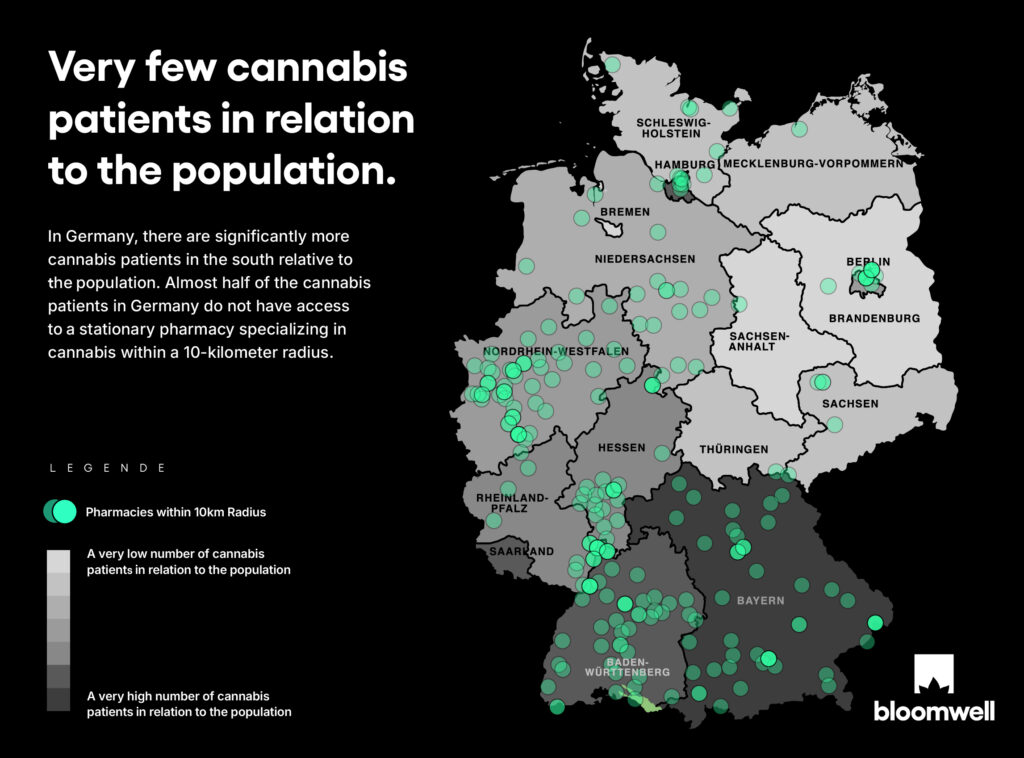
Bloomwell Group released a map outlining the number of medical cannabis patients in Germany in relation to the country’s population, along with which regions have the most, and least, patients. The results suggest that online delivery of medical cannabis is heavily relied upon by German patients who do not have local access to brick-and-mortar pharmacies that can supply cannabis treatment.” stated Bloomwell in a press release obtained by the International Cannabis Business Conference.

bloomwell German Germany medical cannabis patient location map

According to the company’s data analysis, “there are significantly more medical cannabis patients in relation to the population in the South of the country than in the North,” and “almost half of the cannabis patients in Germany do not have access to a brick-and-mortar pharmacy specializing in cannabis treatment within a 10-kilometer radius.”

German medical cannabis telemedicine services help the nation’s most vulnerable patients, including rural patients who live far away from doctors, disabled patients who often cannot travel to complete in-person consultations, and low income patients who may be able-bodied and yet cannot afford to travel to a physical doctors office or pay extra for a doctor to travel to them for in-person consultations. It is paramount for these types of German medical cannabis patients that telemedicine and delivery services be maintained and not banned.

“If half of cannabis patients cannot legally obtain their medication from a pharmacy within a 10-kilometer radius, what alternative remains for these medical patients besides turning to the illicit market? We are only at the very beginning of the legislative process, and given the severe potential consequences of the current draft for limiting the pharmaceutical care access of hundreds of thousands of chronically ill patients, I predict that this amendment will not be passed in its current form. Fortunately, the SPD parliamentary group has already emphasized that without solid evaluation results, they will not jeopardize patient safety through such drastic measures.” states Niklas Kouparanis, Co-Founder and CEO of Bloomwell Group.

Leading international cannabis economist Beau Whitney, founder of Whitney Economics, estimates that Germany is home to between 700k and 900k medical cannabis patients.