UK Government Announces Reforms To Hemp License Regulations

Government officials in the United Kingdom announced this week that regulators are changing hemp licensing regulations in the country. Starting in 2025, hemp license holders in the UK will no longer have to identify a specific area on a farm property where they intend to cultivate hemp. Rather, the farmers can produce hemp anywhere on the licensed farm.

Furthermore, starting in 2026, the maximum period for a hemp production license will be increased from the current 3 years to 6 years. Hemp producers in the UK will also be able to defer the start date of cultivation by up to one year.

“These reforms will bring an important boost to this industry and cut down the unnecessary burdens that have been placed on businesses.” Dame Diana Johnson, Minister for Crime and Policing, said. “This government will always listen and engage with industry experts, and we want to make it easier for licence holders to capitalise on the economic potential of legally growing hemp.”

“These improvements to the licensing regime for industrial hemp are a positive step for farmers.” Daniel Zeichner, Minister for Food Security and Rural Affairs, said. “Recognising that industrial hemp is a field-grown agricultural crop, these reforms will simplify the license application process and provide greater flexibility within the crop rotation, enabling farmers to fully realise the economic and environmental benefits of the crop.”

In other recent hemp industry news in the United Kingdom, a government-appointed advisory panel, the Advisory Council on the Misuse of Drugs (ACMD), recommended that the UK increase the amount of tetrahydrocannabinol (THC) allowed in hemp from 0.2% to 0.3%.

“The ACMD is supportive of the proposed change to increase the maximum THC content of industrial hemp grown outdoors for seed production or in order to use the non-controlled parts of the plant to produce fibre for use in the construction and textile industries from 0.2% to 0.3%, as the potential benefits outweigh an increased risk of harms.” the panel stated.

“The ACMD recommends the Home Office to conduct an assessment of the impact of the legislative change after 2 years. The ACMD foresees no issues with applying the lower fee of £580 to a raised level of THC not exceeding 0.3%, to align with other international examples.” the panel also stated.

According to the United Kingdom government, the number of hemp licenses in the UK increased from six licenses in 2013 to 136 in 2023. A first-time hemp license in the United Kingdom costs £580. Hemp producers who apply for subsequent licenses pay £326, or less than £109 per year.

Cannabis Industry In Central And South America Is Worth An Estimated $8 Billion

Central and South America have long served as top sources for agricultural crops, and in recent years, the two regions have also emerged as top sources for legal medical cannabis products. According to leading international cannabis economist Beau Whitney, the region’s growing cannabis market is worth a considerable amount of money.

“Central and South America together are an $8 billion total market; however, its low-cost manufacturing and drive towards EU GMP and GAP certifications is making the region an attractive source of supply for the EU.” Whitney stated in a recent newsletter.

Whitney’s analysis was originally provided as part of his presentation at the inaugural Andean Hemp and Cannabis Trade Summit in October where he presented on the Central and South American hemp and cannabis markets.

In addition to the overall market value analysis, Whitney Economics also provided the following market information as part of his presentation:

  • Five countries in Central and South America make up 89% of the regional demand
  • Brazil is home to the largest domestic market ($2.5 billion)
  • Total Central and South American market demand requires 6.3 million pounds of cultivated output
  • Peru is an estimated $0.8 – $2.2 billion domestic market
  • Peru’s hemp industry has strong opportunities in fibers, grains, and isolated cannabinoids

South America will forever be home to the first country on earth to adopt a national adult-use cannabis legalization measure. Lawmakers in Uruguay approved a national recreational cannabis legalization measure in 2013, with legal sales launching in 2017. Legal adult-use sales are limited to residents of Uruguay.

Due to low labor costs and an ideal climate for outdoor cannabis cultivation, cannabis can be produced in Central and South America at a fraction of what it costs to produce in larger emerging cannabis markets, particularly in Europe. As such, legal cannabis from Central and South America will presumably be dominant in the global export market going forward.

Global Cannabis Packaging Market Projected To Reach $22.10 Billion By 2034

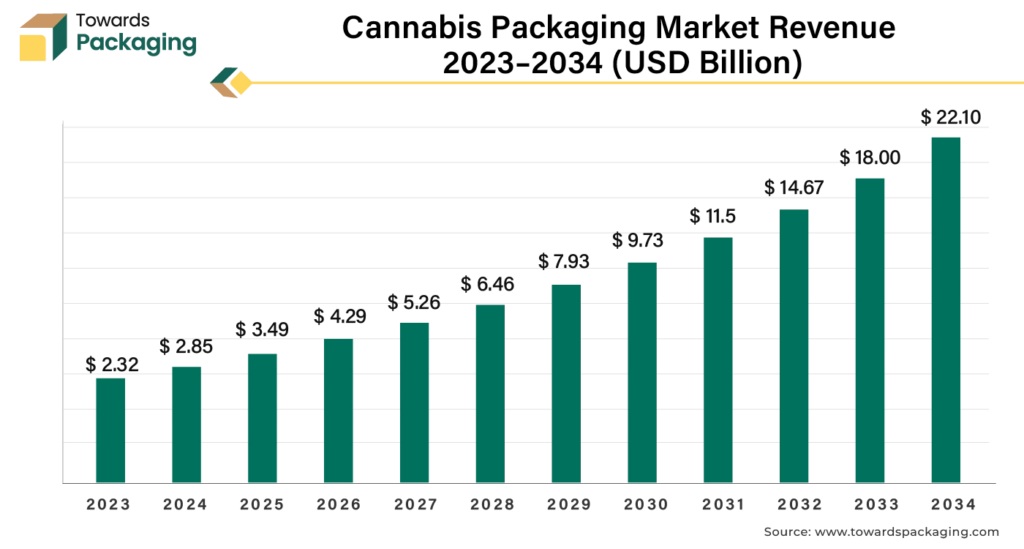
The worldwide cannabis packing market is projected to reach $22.10 billion in value by 2034 according to a recent study conducted by Precedent Statistics. The market analysis values the cannabis packaging market at $3.49 billion in 2025.

“The market was estimated at USD 2.85 billion in 2024 and is projected to expand at a double-digit CAGR of 22.74% between 2024 and 2034.” the analysts stated.

cannabis packaging market projection 2024 to 2034

“The cannabis packaging market revolves around strong and tamper-evident packaging which provides child-resistance protection. Along with this, providing accurate information with labels and providing temperature and humidity resistance are the leading objectives of the market.” Precedent Statistics stated. The market researchers also determined the following:

  • North America holds the largest share and dominates the market due to its well-established regulations and advancement in cannabis packaging
  • Europe is a significant and mature market that drives the cannabis packaging industry by focusing on improving and adopting child-resistant features
  • Asia-Pacific is the fastest-growing market due to its versatile use and demand for the cannabis packaging market

The cannabis packaging sector of the emerging legal cannabis market is one of the most promising sectors due to every legal market requiring that cannabis products be in compliant packaging that includes such labeling information as cannabinoid content, harvest date, and/or production source.

Turkey Sets Hemp Quota For Medical Products

In 2016, hemp cultivation became legal in 19 provinces in Turkey for industrial purposes. Aspiring hemp producers must obtain the country’s Ministry of Food, Agriculture, and Livestock permission before beginning operations. Hemp product permits are valid for a maximum of three years in Turkey.

Regulators in Turkey recently announced that annual hemp cultivation in the country will be limited to 5,000 square meters and 120,000 plants ‘for the production of pharmaceutical active ingredients.’ Many medical cannabis products around the globe incorporate cannabidiol derived from hemp plants.

“Exempt from these restrictions are universities, research institutes within the Ministry of Agriculture and Forestry, and organizations with research permits, which may conduct scientific and R&D projects without being subject to the quota. The Ministry of Agriculture and Forestry will oversee the allocation of the quota.” stated Daily Sabah in its local reporting.

The modern push to boost Turkey’s emerging hemp industry came in 2019 when Turkey’s president, Recep Tayyip Erdoğan, announced that the country would take steps to increase production. Turkey was experiencing an economic crisis, and increased hemp production for the purpose of medical cannabis product exports was established to try to address the problem.

Turkey has a long history of cannabis and hashish production going back many centuries, and it wasn’t until the 1970s that the country outlawed production due to pressure from the United States.

According to a recent market analysis by Spherical Insights LLP, the global industrial hemp market is projected to be worth an estimated $24.30 billion by 2033.

“The Global Industrial Hemp Market Size is to Grow from USD 5.38 Billion in 2023 to USD 24.30 Billion by 2033, at a Compound Annual Growth Rate (CAGR) of 16.27% during the projected period.” the researchers stated in a press release.

Global Cannabidiol Market Projected To Reach $23.41 Billion By 2031

According to a new report by Coherent Market Insights, the global cannabidiol (CBD) market is projected to reach $23.41 billion by 2031. The analysis predicts the worldwide CBD market will experience a compound annual growth rate (CAGR) of 16.3% from 2024 to 2031.

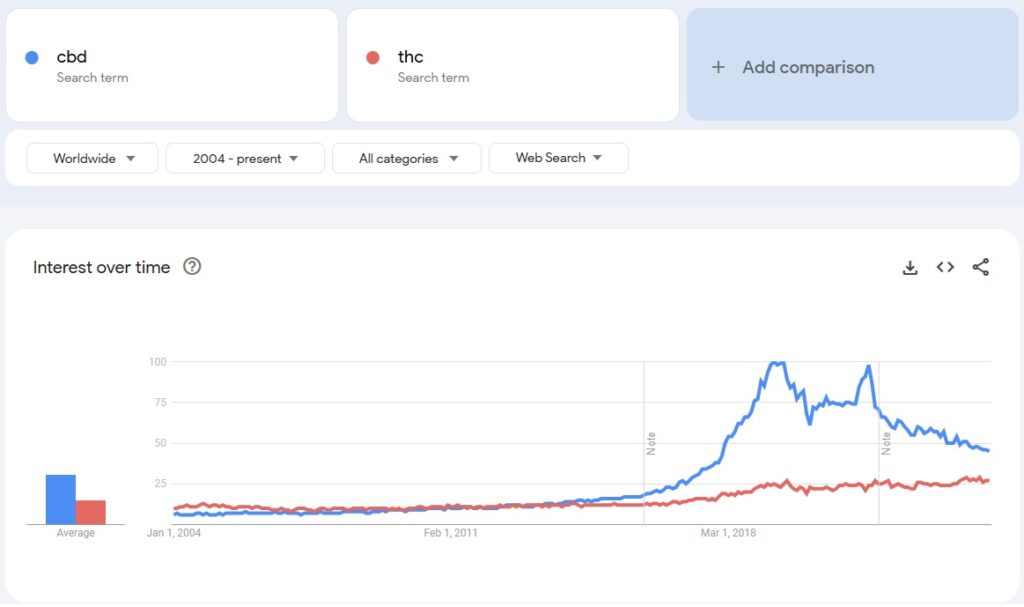
Interest in CBD has increased exponentially in recent years around the world, which is evidenced by how often CBD is searched on Google compared to tetrahydrocannabinol (THC). THC has historically served as the most popular cannabinoid among consumers and patients. Below is a chart demonstrating search trends for both cannabinoids in recent decades:

cbd and thc google search trends

A rise in CBD research and product availability parallels increased interest in CBD among patients and consumers. Additionally, the variety of CBD products patients and consumers can choose from has increased in recent years. CBD is now being infused into everything from edibles to topicals.

Legal CBD products are not just limited to humans. CBD products for pets are also big business these days. The global CBD pet market was worth an estimated $693.4 million in 2023 according to a recent market analysis by Global Market Insights. The CBD pet product market is projected to grow at an estimated 18.2% CAGR from 2024 to 2032.

The global market for hemp-based products is projected to reach $16.2 billion by 2033, growing at a CAGR of 24.5% between 2023 and 2033, according to a separate market analysis by Fact.MR. The researchers estimated that the market was worth $1.8 billion in 2023.

“Europe and North America collectively account for around 70% of the global market share at present and are expected to maintain a similar outlook over the coming years as well.” Fact.MR stated about its market report.

“Rapid legalization of marijuana and CBD products in these regions is expected to be a prominent factor that will help these regions sustain a dominant market share across the forecast period.” the researchers also stated.

Technavio recently published an estimate for the overall global industrial hemp industry. Technavio is a global technology research and advisory company that “focuses on emerging market trends and provides actionable insights to help businesses identify market opportunities and develop effective strategies to optimize their market positions.”

“The global industrial hemp market size is estimated to grow by USD 6.87 bn from 2023 to 2027, according to Technavio. The market is estimated to grow at a CAGR of over 17.1% during the forecast period.” Technavio stated in a press release.

Investing In Europe’s Emerging Legal Cannabis Industry

The European continent is the most exciting region for the cannabis industry and policy right now, with several nations working to modernize their cannabis laws and regulations. The most noteworthy example is Germany, where lawmakers enacted the first provisions of a national adult-use legalization measure on April 1, 2024.

Adults in Germany can now cultivate up to three plants in their private residences in addition to being able to possess and consume cannabis for recreational purposes legally. Furthermore, adult consumers in Germany can join a growing list of adult-use cultivation associations.

Before Germany’s legalization, Malta and Luxembourg also adopted national recreational cannabis legalization measures. Regional adult-use cannabis commerce pilot trials are also operating in both the Netherlands and Switzerland. Policy modernization efforts are also gaining traction in other European nations such as in Slovenia and the Czech Republic.

A rise in opportunities for entrepreneurs and investors is paralleling the rise of policy modernization efforts in Europe. Things are moving quickly and it can be difficult to navigate the evolving landscape. Fortunately, there is an opportunity coming up next week in Munich that streamlines the process of identifying and networking with startups and investors.

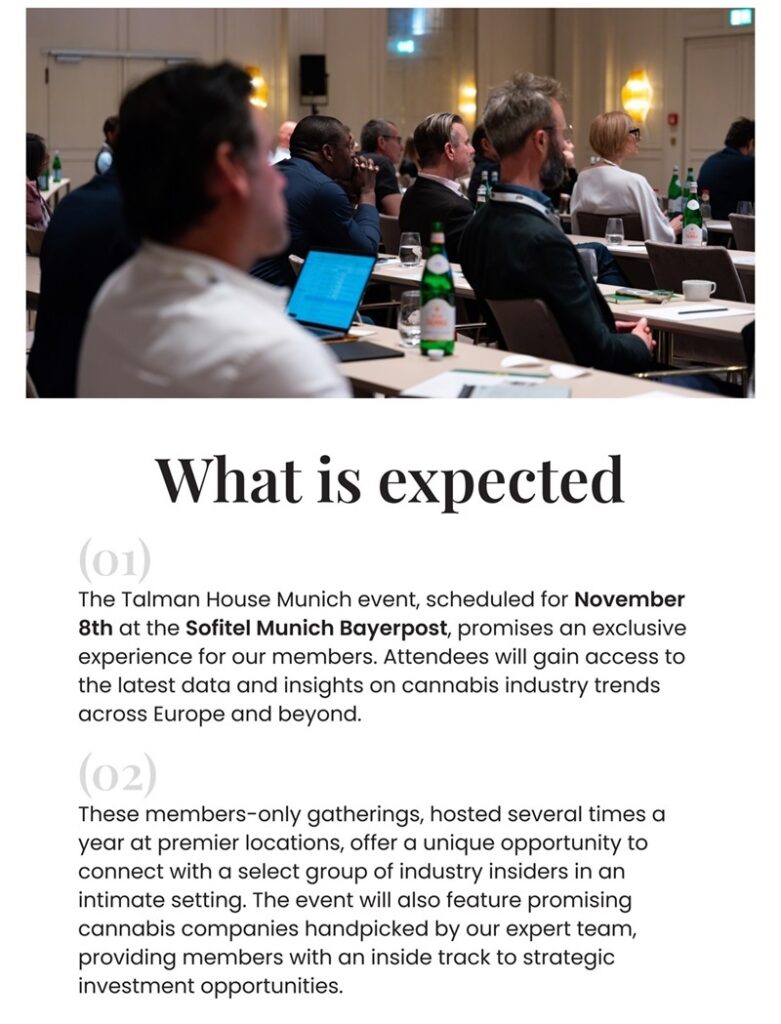
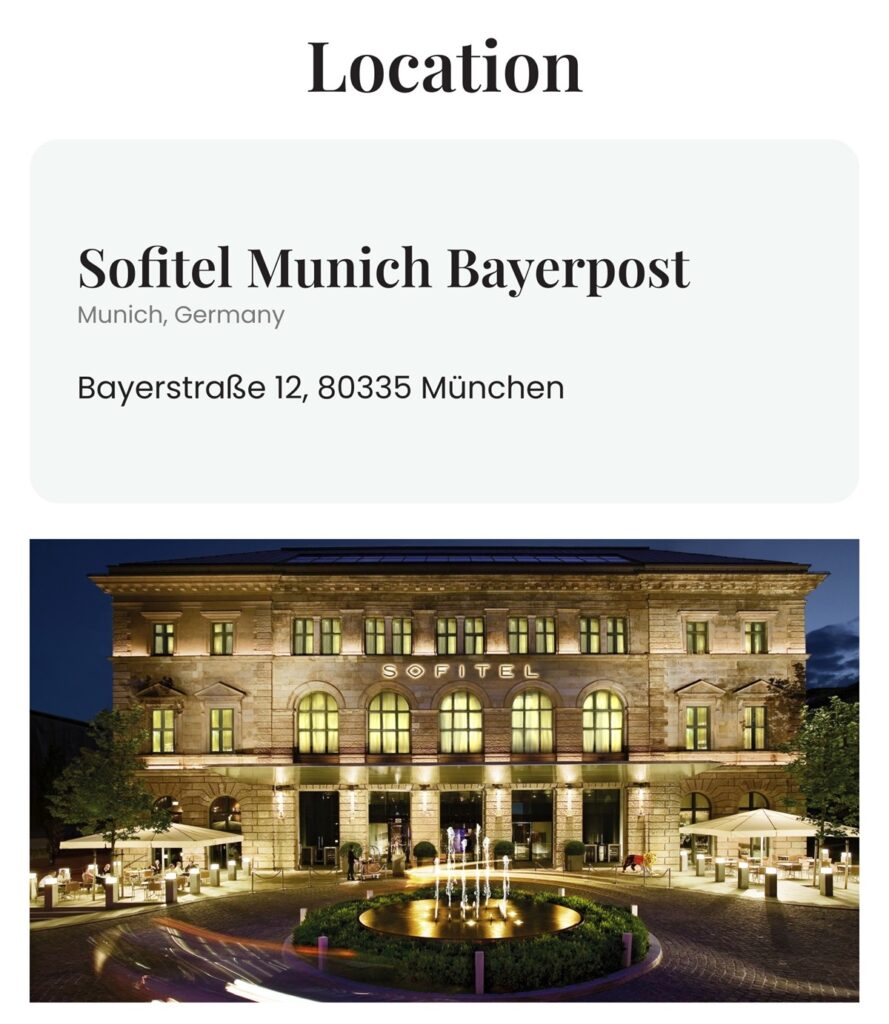
The Talman Group is hosting an investor event in Munich, Germany on November 8, 2024, for Talman House members. Below is a graphic that explains what attendees can expect at the event. To learn more about how you can become a member of the Talman House, click this link here.

Talman House Munich November 2024 1

Talman House Munich November 2024 2

Talman House Munich November 2024 3

European Commission Launches Investigation Into Italy’s Ban On ‘Cannabis Light’

In recent years, cannabis and hemp-derived products that are high in cannabidiol (CBD) and low in tetrahydrocannabinol (THC), often referred to as ‘cannabis light,’ have increased in availability and popularity across Europe, including in Italy.

Lawmakers in Italy recently approved measures that seek to prohibit such products from being bought and sold within Italy’s borders. The European Commission has launched an investigation to determine if the measures, and others that are being considered, violate European Union (EU) law.

“The Italian government, led by Prime Minister Giorgia Meloni, is proposing a two-part strategy to eliminate legal hemp flowers in the EU, which contain cannabinoids such as CBD.” stated Newsweed in its local coverage.

“The current controversy stems from an amendment to the 2023 Security Law that would impose a complete ban on the sale of hemp flowers. This amendment was passed by the Italian Chamber of Deputies in September 2024 and must now be considered by the Italian Senate.” the outlet also stated.

Cannabis advocates and members of Italy’s emerging cannabis industry argue that what is being pursued in Italy violates EU law. The Court of Justice of the European Union previously ruled in 2021 that hemp extracts and flowers should not be classified as narcotics.

Canapa Sativa Italia, an Italian hemp industry trade organization, filed a formal complaint with the European Commission claiming that Italy’s actions violate the EU’s Common Agricultural Policy and impede fair competition within the European Union market.

As we previously reported, a decree was issued in 2020 to classify CBD as a narcotic in Italy, but shortly after it was issued, the decree was temporarily suspended. That temporary suspension was then lifted via yet another decree in 2023, just to also be temporarily suspended.

Prior to the decrees and other measures recently pursued by Italy’s government, much of Italy’s public cannabis policies were shaped by legal decisions. In late 2019, Italy’s Supreme Court ruled that laws against ‘small-scale domestic cultivation of cannabis’ were unconstitutional, providing some level of legal protection for consumers and patients.

In 2021, cannabis activists in Italy successfully collected hundreds of thousands of signatures to place a cannabis referendum measure on the ballot for voters to decide. However, in 2022 the nation’s Supreme Court deemed the measure’s language to be unconstitutional.

How Many Countries In Africa Have Legalized Commercial Cannabis Cultivation?

As cannabis policy modernization has spread across the globe, one continent that has experienced a significant amount of reform in recent years is Africa. Currently, the only nation in Africa that has adopted a national adult-use legalization measure is South Africa. However, several other African nations have adopted laws that permit commercial medical cannabis and hemp cultivation.

According to a recent study conducted by researchers from Ukraine and France, and published by the U.S. National Institute of Health, 57 countries have adopted medical cannabis legalization measures.

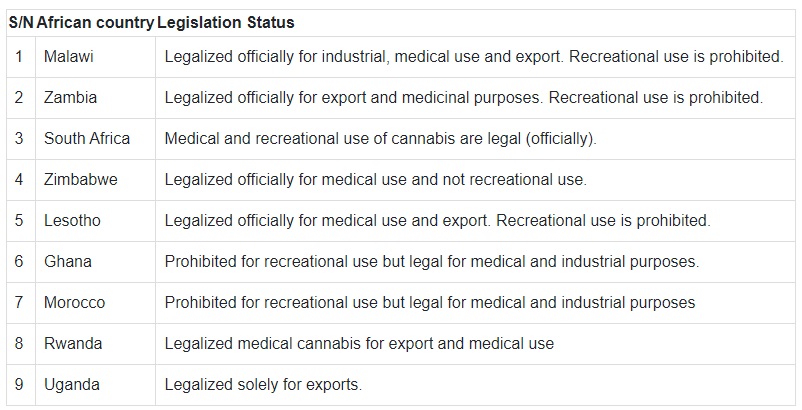
According to a recent report titled “Medical Use of Cannabis in Africa: The Pharmacists’ Perspective” which was published by the National Library of Medicine, nine African countries have adopted laws to regulate commercial cannabis and hemp cultivation, as well as the processing, storage, sales, and/or exports of harvests. Per recent reporting by Business Insider:

africa commercial cannabis cultivation regulation

In addition to the dozens of countries around the world that have adopted medical cannabis legalization measures, Uruguay, Canada, Malta, Luxembourg, and Germany have implemented adult-use legalization measures, as well as South Africa, as previously mentioned in this article.

The legal global cannabis industry is set for significant expansion in the coming years, with a recent report by Skyquest Technology Consulting projecting that the regulated worldwide cannabis market will surpass $148.4 billion in value by 2031.

“Cannabis market was valued at USD 36.4 Billion in 2022 and is poised to grow from USD 42.6 Billion in 2023 to USD 148.4 Billion by 2031, growing at a CAGR of 16.9% during the forecast period (2024-2031).” the market analysts stated.

“Legalization and regulation are among the primary factors contributing to the development of the cannabis market. The market is expanding beyond the capacity of understanding and awareness as an increasing number of countries have legalized cannabis for medical and recreational purposes.” the analysts also stated.

Study Demonstrates Why Banks Are One Of The Biggest Winners Of Legalization

The banking industry and the cannabis industry have a complicated relationship due to prohibition laws. Cannabis businesses have more options for financial services than they have in the past, however, many members of the global cannabis industry still rely on cash-only models and/or struggle to find loans to scale their businesses.

Cannabis businesses are not the only ones harmed by the lack of banking access for the emerging legal cannabis industry. A recent analysis by Whitney Economics (WE), CTrust, and Green Check demonstrates how much profit potential banks are missing out on by not working properly with cannabis businesses.

“A first-of-its-kind report released today projects that the U.S. cannabis industry will need between $65.6B and $130.7B in sustainable growth capital to support new cannabis businesses and help refinance existing ones over the next decade, generating approximately $1.0 billion to $2.4 billion in potential interest revenue for financial institutions willing to lend to cannabis businesses.” stated the authors of the report.

While the financial analysis report is focused on the United States, many of the same findings can be adapted and applied to every other jurisdiction on earth that still hinders or outright prohibits accredited banks from working with the cannabis industry.

“The report also shows that U.S. cannabis retail sales are forecasted to grow from $28.8 billion in 2023 to $87.0 billion by 2035. To support that growth, the U.S. cannabis industry could add 25,000 to 30,000 licenses to roughly 40,000 current licensees—a near doubling of potential lending and interest revenue opportunities for banks.” the authors also stated about their report.

“The funding needed to realize this growth cannot be supported solely by friends and families,” said Beau Whitney, WE founder and chief economist. “By demonstrating regional opportunities and broader market potential, the report aims to empower financial institution lending departments to help educate their boards on risks, rewards and opportunities—all in the hopes of accelerating the industry’s growth by encouraging more financial institutions to participate”

“Banks have long been cautious about entering the cannabis industry due to regulatory and financial risks, though when they do, they have to rely on non-cannabis specific underwriting and due diligence,” said Dotan Y. Melech, CEO and co-founder of CTrust. “This report should pave the way for conversations with financial institutions to develop more informed lending partnerships with the cannabis industry.”

Legal cannabis companies should be afforded the same access to the world’s financial systems that other large legal industries are afforded. As more countries get on the right side of history and modernize their cannabis policies, momentum will continue to build and hopefully comprehensive global reform will be achieved soon.