Saarland Cannabis Social Club Receives Cultivation Approval

One of the main components of Germany’s adult-use cannabis legalization model is permitting consumers to join a member-based cultivation association. German cultivation associations are also sometimes referred to as ‘cannabis social clubs.’

Per our prior reporting, as of last month, 293 cultivation association applications had been approved by regulators in Germany, and hundreds more applications are pending. At least one application had been approved in every German state except Saarland. The southwestern German state was a notable holdout, but it has reportedly finally approved its first application.

“In Saarland, the first Cannabis Social Club (CSC) has received a permit from the state government to cultivate cannabis communally.” reported Saarbrücker Zeitung in its local reporting (translated from German to English). “The responsible Ministry of the Environment announced this in response to an inquiry by the Süddeutsche Zeitung (SZ).”

“Saarland is thus the last federal state to issue a cultivation permit. The Saarland SPD state government had spoken out against the legalization of cannabis in the Bundesrat (Federal Council).” the outlet also reported.

Starting on July 1st, 2024, adults in Germany can apply to their local authority to launch a cultivation association. Once approved, adult cannabis consumers in Germany can become members of the association and source products legally. German adults can only be members of one association at any given time, and additional association regulations apply.

Whereas current European Union agreements prohibit national adult-use cannabis sales, such as what is occurring in Canada and Uruguay, EU agreements do permit member nations to allow cultivation associations since they fall under the umbrella of boosting public health outcomes. Malta also includes cultivation associations in its national recreational legalization model.

A major premise of the European recreational cannabis policy modernization effort is that when adults consume regulated cannabis or cannabis that they cultivate themselves, it is better for public health outcomes compared to when adults consume cannabis from unregulated sources.

That premise is the basis for the European Union allowing Malta, Luxembourg, Germany, and the Czech Republic to adopt national adult-use cannabis legalization measures. Recreational cannabis legalization measures are also currently being considered in Slovenia and Switzerland.

Germany Imported Over 43 Tonnes Of Cannabis In Q2 2025

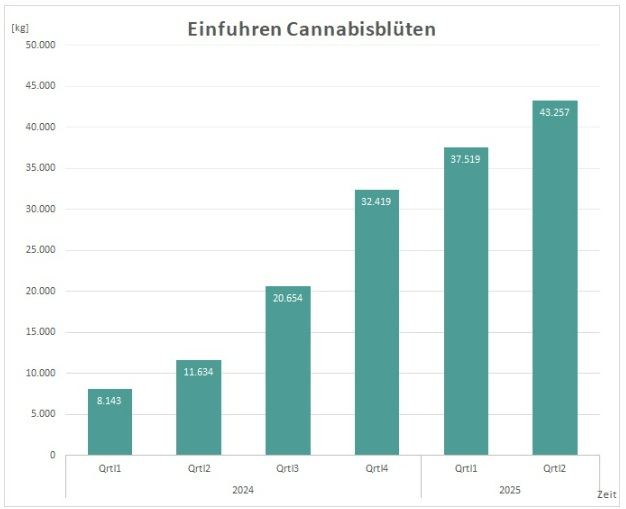
Germany’s Federal Institute for Drugs and Medical Devices (BfArM) recently published medical cannabis import data for the second quarter of 2025, and once again, Germany’s emerging legal medical cannabis industry set a new record for import totals.

In the second quarter of 2025, Germany imported 43.257 tonnes of medical cannabis products according to BfArM’s data. That is an increase over the previous record set in Q1 2025 of 37.519 tonnes, and a significant increase compared to Q2 2024 when Germany imported 11.634 tonnes of medical cannabis products. Below is a graph of import totals from BfArM:

germany medical cannabis imports 2024 and 2025

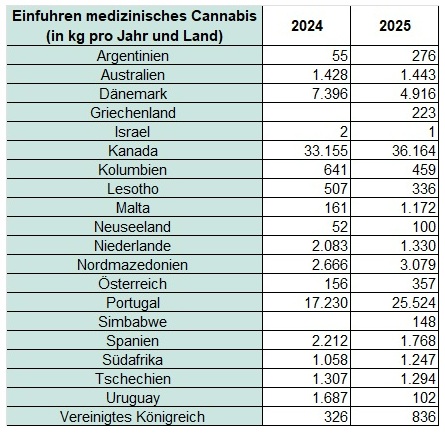
Canada continues to serve as the top source of medical cannabis imports to Germany, with BfArM reporting that Germany has imported 36.164 tonnes of medical cannabis products in the first half of 2025. By comparison, 25.524 tonnes have been imported to Germany from Portugal in the first half of 2025.

Below is a breakdown of countries of origin for medical cannabis imports to Germany in 2024 and the first half of 2025, via BfArM:

germany medical cannabis imports by country 2024 and 2025

Legal sales of medical cannabis products through pharmacies began in Germany in 2017. Back then, the Netherlands served as the top source for medical cannabis imports to Germany. The same was true for 2018. However, in 2019, imports to Germany from Canada topped the Netherlands and every other country of origin, and that has remained the case ever since.

Germany was already home to Europe’s largest legal medical cannabis market before the nation’s CanG law took effect in April 2024, and as the data demonstrates, Germany’s medical cannabis industry has surged since then. Germany is on pace to eclipse 160 tonnes of medical cannabis imports in 2025 if current trends persist, but given the fact that import totals still appear to be climbing, it will be interesting to see what the actual final total for 2025 ends up being.

DHV Issues Statement Against Harmful German Draft Amendment

Last month, Germany’s Ministry of Health released a draft amendment that, if approved, would negatively impact the nation’s medical cannabis program, and with it, Germany’s suffering patients and emerging industry. As proposed, the draft amendment would:

  • Mandate in-person doctor consultations
  • Ban on mail-order medical cannabis dispensing
  • Impose stricter rules for medical cannabis prescriptions

Pushback to the draft amendment by medical cannabis patients, advocates, and industry members was swift. The German Hemp Association (DHV) recently issued its own statement calling for the proposed amendment to be defeated.

“Telemedical prescriptions of cannabis medications and online delivery were already possible before the MedCanG “in the days of the Narcotics Act.” The planned changes would essentially catapult us back to pre-digital times when it comes to cannabis medicine, while the federal government otherwise wants to catch up with its significant lag in digitalization. This not only feels anachronistic for citizens and patients in Germany, but is likely to cause head-scratching abroad as well. No online delivery of (cannabis) medications? Picking everything up in person? In Canada and the USA, this will be hard to believe. This is reminiscent of the strength of the pharmacist lobby, just as it is in Germany.” stated DHV in a recent news release (translated from German to English).

DHV is calling out the apparent selective focus by the Ministry of Health on cannabis flower but not cannabis extracts. Germany has experienced exponential growth in medical cannabis flower imports over the last year. However, the increase in exports has not been directly tied to any increase in public health issues.

“It is unclear why the planned regulations should only apply to cannabis flowers and not to extracts with significantly higher THC concentrations. The justification merely states that the import of flowers has increased significantly. However, it is likely that the import of extracts is also likely to have increased significantly from the first to the second half of 2024. However, the Federal Ministry of Health does not provide any figures on this. The Federal Institute for Drugs and Medical Devices (BfArM) also does not provide any information on the development of extracts. Furthermore, it is unclear whether and to what extent extracts are produced and distributed within Germany after the import of cannabis flowers. ” DHV points out.

“Without data on the import of extracts and the processing of flowers into extracts within Germany, an objective assessment is impossible, and a one-sided restriction on flowers is incomprehensible. For years, we have seen a one-sided negative portrayal of flowers compared to other cannabis medications because they resemble the traditional recreational drug cannabis, even though the flowers certainly have their justification for medical use through simple inhalation.” DHV also stated in its news release.

DHV’s full statement can be read at this link here, and people are encouraged to read it in its entirety. Readers can also check out our previous coverage of statements from other advocates and organizations, as well as information on where to sign petitions against the draft amendment, at this link here.

How Cannabis Consumer Preferences Are Shaping The Industry

In many legal cannabis markets around the world, consumers and patients have more consumption options than ever before. It wasn’t that long ago that consumers and patients were lucky to get any form or quality of cannabis that they could find.

These days, consumers and patients have a wide range of options to choose from in many legal markets, including edibles, topicals, beverages, tinctures, transdermal patches, concentrates, pre-rolls, and many other products. That is in addition to several strains and potency options for unprocessed cannabis flower.

The average cannabis consumer is becoming more sophisticated, and that, in turn, is revolutionizing the emerging legal cannabis industry as companies continue to bring new products and services to the marketplace. Cannabis consumer preferences are evolving rapidly around the world, from product types to ethical considerations.

Consumption delivery methods are expanding, and many consumers and patients are seeking products containing lesser-known cannabinoids beyond THC and CBD. How consumer preferences are shaping the cannabis industry was the focus of an insightful panel at the most recent International Cannabis Business Conference in Berlin.

Panelists discussed the latest trends and how businesses can adapt to meet these demands, including how to incorporate AI technology for data collection and analysis. The panel was moderated by Tim Powers, the Founder of Kind Selections and the Co-Founder of Cannabis Tolling Solutions. Mr. Powers was joined on the panel by:

  • Chris Sinacori, CEO of 3Win Corp
  • Emily Fisher, CEO and Founder of Leafwell
  • Tanner Stewart, CEO of Stewart Farms
  • Lorenz Minks, Strategic Consultant at Research Gardens

You can watch the panel discussion via this link here.

Colombia To Allow Pharmacies To Dispense Medical Cannabis Flower

Cannabis products come in many forms these days, including edibles, topicals, tinctures, concentrates, beverages, and vape cartridges. More types of consumables seem to be hitting the market every year, which is good news for consumers and patients.

With that being said, cannabis flower is still one of the most popular forms of cannabis among consumers and patients for various reasons. Consuming cannabis flower provides the fastest effects for consumers and relief for patients, and it can also be used by people to make their own edibles and other products if they choose to.

All medical cannabis programs around the world must include legal sales of cannabis flower as part of their safe access models, including through pharmacies. Germany and Uruguay are two countries that already permit cannabis flower sales through pharmacies. Thankfully, that is reportedly expected to also happen soon in Colombia.

“Colombia is set to legalize the sale of psychoactivecannabis with a medical prescription, under a draft decree from the Justice Ministry that would, for the first time, permit pharmacies to dispense psychoactive marijuana flower to patients with a doctor’s authorization.” reported Colombia One in its local coverage.

“Under the proposed decree, Colombians could legally purchase cannabis in its flower form and consume it by smoking or vaporizing, once they present a medical prescription for conditions such as chronic pain, sleep disorders, or illnesses affecting the central nervous system, including Parkinson’s disease and multiple sclerosis.” the outlet also reported.

Lawmakers in Colombia first approved medical cannabis legalization in the South American nation in 2016. Legal exports of medical cannabis products were approved in 2021, and since that time, Colombia’s export sector has increasingly gained global market share.

You will be hard-pressed to find a place anywhere else on earth where quality cannabis can be cultivated on a large scale as easily and cost-effectively as it can be grown in Colombia. Licensed large-scale producers can cultivate quality cannabis in Colombia for as little as ten cents (USD) per gram. That is nearly impossible for other markets to duplicate, with only a few exceptions.

The world has enjoyed consuming Colombian cannabis flower for decades, albeit not always regulated Colombian cannabis. Fortunately, the nation’s own medical cannabis patients will soon be able to access it through the nation’s pharmacies, and without the fear of prosecution.

South Africa Is Studying Cannabis Business Development Opportunities

South Africa officially approved a national adult-use cannabis legalization measure in 2024, placing the African nation on an exciting and ambitious path towards taking its rightful place as a continental and international cannabis industry leader.

In 2018, South Africa’s Constitutional Court rendered a landmark legal decision that struck down the nation’s cannabis prohibition law as it pertained to private individual cannabis activity. Part of the decision tasked South Africa’s lawmakers with drafting new laws within two years to reflect the order. It obviously took longer for the Court’s decision to be codified.

A parliamentary question was recently posed in South Africa, which inquired about what steps the Minister of Small Business Development is taking to “support and promote small- and medium-sized enterprises in the hemp and cannabis sectors.”

The question, directed to Minister Stella Ndabeni-Abrahams, asked about:

  • Timelines
  • Budget allocations
  • What regulations and laws has her department identified that “impede the development of a hemp and cannabis sector”
  • Steps taken to assist SMEs in navigating “red tape”
  • Steps taken to “ensure that the sector is an enabling space” for rural, black, and women-owned businesses

Below are excerpts from the Minister’s reply, which can be read in its entirety at this link here:

“The Department has conducted research on the value chain relating to hemp and cannabis to assist the Department in understanding the areas in the primary, secondary and tertiary economic functions which MSMEs may find opportunities for creation of small businesses to generate income, create jobs and play a meaningful role in the sector and related economic functional support activities. The study was conducted internally and as such, there were no costs associated with conducting the study.” Minister Stella Ndabeni-Abrahams wrote.

“Currently, the Department is assessing cannabis projects in three provinces (KwaZulu-Natal, Northern Cape and Eastern Cape) as a start for provision of support on infrastructure requirements. The process of site visits is underway and projects in KwaZulu-Natal have already been visited for verification, Northern Cape is to follow in this first quarter of the 2025/26 financial year, and Eastern Cape will follow thereafter.” she also wrote.

“The Department has taken a deliberate stance to approach issues of economic participation and inclusion through mainstreaming using the national targets as a benchmark in the implementation of its support interventions and programmes. This is mainly reflected in the performance reports that measures the extend to which rural, township, black, women, youth and the disabled are part of the MSMEs supported from the financial and non-financial support provided on an ongoing basis. The normal structure of reporting addresses these elements under all programmes. In instances where any of the elements is reflected in the reports, reasons for deviation on lack of data in reports submitted are required to justify the omission.” the Minster concluded in her reply to the inquiry.

A recent market projection for South Africa’s emerging legal cannabis industry estimated that the nation’s draft National Cannabis Master Plan, once fully implemented, would create over 100,000 jobs and add approximately R30 billion to South Africa’s economy.

Ghana Engages With Morocco To Discuss Cannabis Policy Implementation

Ghana’s current cannabis industry regulatory body, the Management of the Narcotics Control Commission (NACOC), recently engaged Moroccan Ambassador Mrs. Imane Quaadill to discuss Ghana’s ongoing cannabis policy implementation.

The reported goal of the cannabis regulation-based discussion between the two African countries was to help Ghana regulators gain insight into best practices and strategies from Morocco’s experiences as a continental cannabis industry leader. The representatives also discussed ways that the two countries could boost partnerships.

“NACOC is committed to exploring opportunities that would build and enhance the capacities of our staff and share ideas.” stated Brigadier General Maxwell Obuba Mantey, Director-General of the NACOC, per the Ghana News Agency.

“Mrs. Quaadil said her office would also collaborate with the Moroccan anti-drug authorities to host some selected NACOC staff in September 2025 to study the procedures and successes in the implementation of cannabis regulations.” the news agency also wrote.

Ghana’s parliament approved the ‘Narcotics Control Commission Bill, 2023’ roughly two years ago. The measure tasked Ghana’s Ministry of Interior with issuing cannabis cultivation licenses.

In 2020, Ghana’s parliament passed a measure authorizing the production of low-THC cannabis for medical and research purposes. However, the nation’s Supreme Court later deemed the measure to be unconstitutional, and as a result, kept prohibition in place. The measure that was approved in 2023 in Ghana seemed to directly address the reported legal insufficiencies.

Ghana’s economy currently ranks 10th among African nations. However, it ranks 74th globally. The average salary in Ghana is roughly 60,340 GHS, which converts to about 5,292 USD. Needless to say, a robust, thriving medical cannabis industry would greatly benefit the citizens of Ghana via a boost in economic development and job creation.

The economic benefit to Ghana comes in addition to the therapeutic benefits that will be afforded to suffering patients under the approved law. As is the case in every country, Ghana is home to countless suffering patients who could benefit from cannabis therapies.

German Cannabis Advocates Push Back On Harmful Amendment

Germany’s medical cannabis community is resiliant, as demonstrated by swift and largely united pushback from medical cannabis advocates against a recently published draft amendment to the country’s Medical Cannabis Act (MedCanG).

The changes are being proposed by Germany’s Ministry of Health despite the effectiveness and safety of telemedicine services. As drafted, the amendment would negatively impact safe access in Germany, and the nation’s most vulnerable medical cannabis patients would suffer as a result. The proposed changes contained within the draft amendment include:

  • Mandatory in-person doctor consultations
  • A ban on mail-order medical cannabis dispensing
  • Stricter rules for medical cannabis prescriptions

“Health Minister Warken sees mail-order sales and anonymous online prescriptions as a gateway for misuse, which is promoted by commercial platforms. However, the draft does not appear to have been agreed upon with the coalition partner, the SPD , yet . The industry is calling for differentiated solutions instead of blanket bans. Reputable providers are advocating for stricter standards in telemedicine, but against a complete ban on digital care. A mail-order ban would once again push patients onto the black market and overburden pharmacies and practices.” stated the German Cannabis Business Association (BvCW) in a recent newsletter (translated from German to English).

“Security of supply, for example through rare varieties or short-term availability, has so far been better ensured through digital processes. In light of the planned evaluation of the Cannabis Act in the fall, platforms and patient representatives are calling for a fact-based dialogue with politicians – otherwise, there is a risk of setbacks in patient care and the re-criminalization of many chronically ill people.” BvCW also wrote.

“Healthcare should never depend on your zip code or bank balance,” said David Barnan, Chief Marketing Officer at DoktorABC, in a press release. “We are watching with great concern as Germany moves toward a two-tier healthcare system. In major cities, those with money receive treatment, while patients in rural areas are left behind. The proposed restrictions on telemedicine prescribing of cannabis and mail-order sales of medicines would push tens of thousands of legitimate medical cannabis patients back to ineffective therapies—or, worse, into the unregulated market.”

“For many patients, a doctor’s visit can cost up to €100 out of pocket—and that doesn’t even include travel expenses, lost time from work, or the cost of caregivers,” Barnan also stated. “And most local pharmacies simply can’t stock the full range of cannabis flowers that doctors prescribe. Patients will be forced to travel from pharmacy to pharmacy just to find their medication. Smaller local stocks also keep prices high. Faced with rising costs and repeated supply shortages, many patients will forgo treatment—or turn to the black market, where there is no medical oversight.”

“Telemedicine is not a loophole—it’s a lifeline that lowers costs, expands access, and keeps patients in regulated care,” Barnan said.

“We call on legislators to protect digital consultation channels and ensure the shipping and delivery of legally prescribed medical cannabis from pharmacies. Where additional security measures are necessary, they should be specifically enhanced—but patients must not be cut off from effective, physician-assisted access.” states a petition started by DoktorABC on Change.org. As of the posting of this article, the petition has been signed by 17,289 people.

“Mail-order sales by German pharmacies should remain possible – especially with regard to chronically ill people who are limited in their mobility.” stated health politician Simone Borchardt (CDU), according to local reporting by Handelsblatt (translated from German to English). “If shipping from abroad is stopped while maintaining domestic shipping, we will strengthen the pharmacy landscape in Germany and improve care, especially in rural areas. A complete ban, however, goes too far.”

“For hundreds of thousands of people, medical cannabis is the only effective treatment. Nevertheless, due to concerns about abuse, centralized care channels such as telemedicine and mail-order delivery are being restricted – contrary to current healthcare practices and without consulting those affected.” states a separate petition launched by Grünhorn Group (translated from German to English). “A telemedicine ban would hurt the wrong people: the patients. The black market would profit.”

“Telemedicine access is to be severely limited, and the shipping of medical cannabis flowers by pharmacies is to be prohibited. This would likely result in at least halving the current market volume. This raises questions about the BMG’s motives.” pointed out krautinvest in a recent article.

“The high demand for online offerings is not the problem, but a symptom of a sick healthcare system that is failing to adequately fulfill its mandate. New hurdles do not lead to better standard care—instead, they lead to fewer options and longer journeys for those affected. A ban on flower shipping threatens conditions that are more restrictive than when cannabis was still a narcotic.” stated Stefan Konikowski, Board Member of Berliner Cannabis Hilfe eV (Berlin Cannabis Help Association).

“In the interest of patients, we demand that the market for medical cannabis, as well as related (tele)medical, pharmaceutical, and other care-related services, be sensibly regulated and controlled through existing laws. Particular consideration must be given to patient welfare, security of supply, and low-threshold access.” Stefan Konikowski also stated (translated from German to English).

Total Approved German Cultivation Associations Nears 300

The total number of approved adult-use cannabis cultivation associations in Germany continues to increase, with officials having approved nearly 300 applications so far. That total is up from a previously reported 234 approved applications as of mid-June 2025.

“One year after cannabis clubs were permitted, authorities have licensed 293 such associations, according to an investigation by the dpa news agency into the respective state authorities. The clubs are authorized to cultivate cannabis and distribute it to their members.” stated Zeit in its local reporting (translated from German to English).
“According to the German Press Agency (dpa), North Rhine-Westphalia leads the list with 83 approved cultivation associations, well ahead of Lower Saxony with 55.” the outlet also reported. “It is followed by Rhineland-Palatinate with 27 and Baden-Württemberg with 23 approved associations. Saarland is at the bottom of the list – no associations have been approved there yet. There are two approved associations in Bremen, three in Mecklenburg-Western Pomerania, six in Thuringia, and seven in Berlin.”

Starting on July 1st, 2024, adults in Germany can apply to launch a recreational cannabis cultivation association, sometimes referred to as ‘social clubs.’ The associations are member-based, and adults can join the associations and legally source their cannabis from them. It is worth noting that not all approved cultivation associations are operational, with many still in various stages of startup.

Cultivation associations are a key component of Germany’s legalization model. Whereas current European Union agreements still prohibit regulated national adult-use cannabis sales, such as what is occurring in Canada and Uruguay, EU agreements do permit cultivation associations. Malta’s legalization model also involves permitting cannabis cultivation associations.

One of the many ongoing German adult-use cannabis legalization evaluation projects being conducted is the Evaluation of the Consumer Cannabis Act (EKOCAN), led by project manager Dr. Jakob Manthey. Dr. Manthey recently announced some of EKOCAN’s preliminary findings, which included the determination that there aren’t enough cannabis cultivation associations in Germany.

The continued uptick in approved German adult-use cannabis cultivation association applications comes against continued calls by cannabis opponents in Germany to limit the use of medical cannabis telemedicine services.

A draft amendment to Germany’s Medical Cannabis Act (MedCanG) was recently released by Germany’s Ministry of Health and German Health Minister Nina Warken. The proposed changes contained within the draft amendment include:

  • Mandatory in-person doctor consultations
  • A ban on mail-order medical cannabis dispensing
  • Stricter rules for medical cannabis prescriptions

German medical cannabis telemedicine services help the nation’s most vulnerable patients, including rural patients who live far away from doctors, disabled patients who often cannot travel to complete in-person consultations, and low income patients who may be able-bodied and yet cannot afford to travel to a physical doctors office or pay extra for a doctor to travel to them for in-person consultations.

All of those limitations would also apply to the ongoing logistics of acquiring medical cannabis products for the suffering patients who can overcome the arbitrary additional hurdles and gain initial approval from a doctor.

There is still time for medical cannabis advocates to prevent the drastic changes from gaining final approval, which was touched on by leading German cannabis policy expert attorney Peter Homberg of gunnercooke in a recent interview with krautinvest (I encourage everyone to read the interview on krautinvest.de in its entirety).

“I can’t imagine this draft bill being passed in its current form. In my view, it represents the Federal Ministry of Health’s maximum demands, which go far beyond the actual goal.” Peter Homberg said (translated from German to English) in the interview in response to krautinvest’s question, “In your opinion, how realistic is it that these changes will be implemented?”

Mr. Homberg would go on to explain that some changes to Germany’s medical cannabis rules and regulations will likely occur, but not everything that is being proposed in the recently released draft amendment.

“I can imagine that the SPD, as part of the coalition, will work quite hard to prevent this law from being implemented in this form. After all, its contents are counterproductive to what the government implemented during the last legislative period: comprehensive patient care with high-quality cannabis products from pharmacies.” Mr. Homberg also stated in the interview.