The German Cannabis Industry Continues To Evolve

Germany was already home to Europe’s largest legal medical cannabis market before the first provisions of the nation’s adult-use legalization measure took effect on April 1st, 2024. When the first provisions of Germany’s CanG law were enacted at the start of April, the nation also became the largest country on earth to implement national adult-use reform.

The nation’s cannabis policy and industry landscape will forever be measured as occurring before or after 2024 due to how pivotal the year 2024 is proving to be. Nearly every facet of Germany’s industry and cannabis community is evolving this year, with the most notable items listed and discussed below.

Personal Consumption

People in Germany who are 18 years old or older can now consume cannabis in private settings without the fear of prosecution and can possess up to 25 grams of cannabis when away from their residences. Cannabis consumption is not new in Germany, with 4.3% of German adults reporting that they use cannabis on a monthly basis and 8.8% reporting that they have used cannabis at least once in the last year.

However, the way that people consume cannabis in Germany is undergoing a technological revolution, with many device and gadget makers eyeing the German cannabis consumer market with their latest creations. According to a recent analysis by market researchers, the global handheld cannabis vaporizer market is projected to reach $15.9 billion in value by 2031, and Germany will play a big role in the growth of the sector.

Home Cultivation

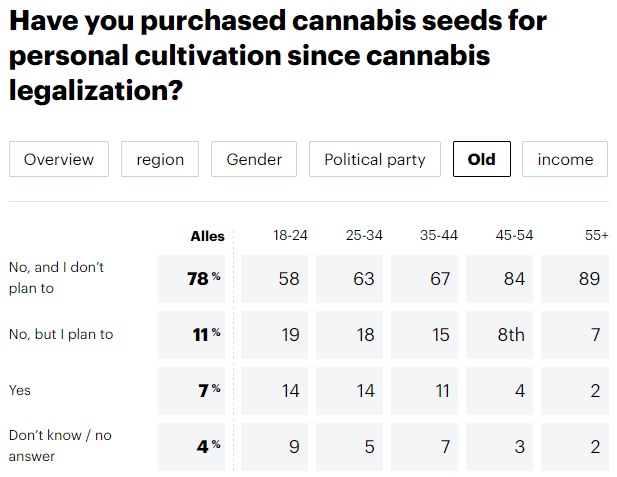
On April 1st Germany became home to the largest potential home cultivation market in Europe, with Germany’s roughly 70 million adults becoming eligible to cultivate up to three plants in their private residences. Personal cannabis cultivation is already proving to be very popular with adult consumers in Germany, as reflected by a recent YouGov poll which found that 7% of poll participants indicated they had already purchased cannabis clones or seeds since legalization took effect. Another 11% of poll participants stated that they intend to purchase clones or seeds in the future.

In addition to clones and seeds, Germany’s newly afforded home cultivation freedoms are increasing sales of many other sector products, including growing mediums, nutrients, lighting, environmental control systems, odor control, harvesting tools, and drying equipment. Home cultivation educational programs and materials are also experiencing increased demand in Germany.

Social Clubs

Starting next month, Germany will begin permitting social cannabis clubs in many parts of the country. Social clubs are a key provision of ‘Pillar 1’ of Germany’s CanG law and will play a vital role in legally sourcing adult-use cannabis in Germany. Earlier this month the Bundestag approved new policies that afford states more authority to set limits on social cannabis clubs, so the prevalence and scope of clubs will likely vary throughout the country.

It is going to be very interesting to see how creative social cannabis club operators get once clubs are launched. The basic premise of social clubs is for adults to become members and to source legal cannabis through the social clubs that will cultivate cannabis for members. However, cannabis clubs can employ paid workers to carry out various tasks that are not necessarily directly related to the cultivation or distribution of cannabis, and clubs will likely offer ancillary products and services that could prove to be very engaging (and lucrative). Only time will tell what social club operators come up with, and conversely, what local and national regulators will allow.

Pilot Trials

‘Pillar 2’ of Germany’s cannabis legalization model revolves around the launch of regional adult-use cannabis commerce pilot trials. Pilot trials permit a certain number of entities to cultivate cannabis that is then sold to registered customers at licensed outlets. Such pilot trials are already underway in parts of the Netherlands and Switzerland with no reported issues.

Pilot trials in Germany are expected to be more widespread than what is in place in Switzerland and the Netherlands, both in the number of jurisdictions where they operate and the number of participants they will serve. German pilot trials are expected to begin by the end of the year, and when combined with social clubs and home cultivation, will serve as the foundation for legal adult-use cannabis access in Germany.

Medical Cannabis

Often lost in the hype and chaotic nature of the rise of adult-use cannabis in Europe is the fact that Germany’s medical cannabis industry is currently undergoing dramatic changes. Part of Germany’s new CanG law involved the removal of cannabis from the nation’s Narcotics List and the removal of quota limits for domestic medical cannabis production. Doctors in Germany can prescribe cannabis more easily, the medical cannabis supply chain has fewer hurdles and hoops, and domestic production is set to surge.

As a result, the German medical cannabis industry is projected to experience tremendous growth in the coming years. A February 2024 market analysis by Zuanic & Associates determined that if 1% of Germany’s population became cash-paying medical cannabis patients, the German medical market could reach €1.7Bn in value by the end of 2025. Germany’s medical cannabis industry is a major winner of German adult-use legalization.

Italy’s Hemp Industry Seeks European Commission Intervention

Much of Italy’s public cannabis policies are shaped by legal decisions. In late 2019, Italy’s Supreme Court ruled that laws against ‘small-scale domestic cultivation of cannabis’ were unconstitutional, providing some level of legal protection for consumers and patients.

In 2021, cannabis activists in Italy successfully collected hundreds of thousands of signatures to place a cannabis referendum measure on the ballot for voters to decide. However, in 2022 the nation’s Supreme Court deemed the measure’s language to be unconstitutional.

A decree was issued in 2020 to classify CBD as a narcotic in Italy, but shortly after it was issued, the decree was temporarily suspended. That temporary suspension was then lifted via yet another decree in 2023, just to also be temporarily suspended.

Efforts to shut down Italy’s emerging hemp-derived industry have picked up recently, resulting in Italian trade groups seeking an intervention by the European Commission.

“The Italian hemp supply chain receives important news from the European Commission. Our complaint against amendment 13.6 to the Security Bill (Security Bill) has been officially examined.” the Canapa Sativa Italia trade organization stated in a news release (translated from Italian to English).

“This amendment, which introduces restrictions on the cultivation and trade of hemp inflorescences and derived products, has been contested because it could violate European Union law on free competition and movement of goods. The complaint, registered under number CPLT(2024)01387, represents a positive signal for the sector, which has over 15 thousand workers and a turnover of 500 million euros.” the organization also stated.

If the European Commission determines that there is a violation of Union law, it could send a “letter of formal notice” to Italy’s government. The notice would compel Italy’s government to submit various information by a set deadline.

From there, if the returned information is not deemed to be satisfactory, the European Commission may issue a “reasoned opinion” and possibly refer the matter to the Court of Justice of the European Union.

“This process, although it may take years, is essential to ensure that national regulations comply with EU law.” stated Canapa Sativa Italia.

An estimated 5% of adults in Italy report having consumed cannabis within the last month, 10.8% report having consumed it at least once in the last year, and 34.8% of adults in Italy have consumed cannabis at least once in their lifetime.

Cannabis Clones And Seeds Are Already Becoming A Huge Industry In Germany

Germany made history on April 1st, 2024 when it became the largest nation to implement provisions of a national adult-use legalization measure. Starting in April, adults in Germany can legally cultivate, possess, and consume cannabis. Social cannabis clubs are set to launch in July, and regional adult-use cannabis commerce pilot trials are expected to launch by the end of the year.

Personal cannabis cultivation is already proving to be very popular with adult consumers in Germany, as reflected by a recent YouGov poll which found that 7% of poll participants indicated that they had already purchased cannabis clones or seeds since legalization took effect.

Commercial sales of cannabis clones and seeds were legalized in Germany as part of the nation’s new cannabis law (CanG). In addition to the 7% of poll participants indicating that they had already purchased cannabis clones or seeds, another 11% of poll participants responded that they plan to purchase cannabis clones or seeds in the future.

When the results are filtered by age, 14% of poll participants aged 18-34 indicated that they had already purchased cannabis clones or seeds. Only 2% of German adults over 55 who participated in the YouGov poll indicated that they had already purchased cannabis clones or seeds.

german cannabis clones seeds purchases

The YouGov poll, which surveyed 3,375 German adults, was conducted on May 13th, 2024. When social cannabis clubs launch in Germany in July, they are expected to be a primary source of cannabis clones and seeds for aspiring German cannabis cultivators, and that will increase access to cannabis genetics.

YouGov’s poll results provide insight into how big the cannabis clones and seeds sector may currently be in Germany, and with it the larger personal cultivation sector. Germany is home to an estimated 70 million adults and if the results of the YouGov poll are indicative of the larger adult German population, that works out to a massive personal cultivation market base.

Cannabis cultivation, even on a small personal scale, requires more than just clones or seeds. Growers need grow mediums for their clones or seeds, nutrients to feed their plants, indoor lighting, environmental control equipment, and/or harvesting and drying equipment too. Many aspiring cultivators also need instructional materials such as books or other educational literature. All of those subsectors create opportunities for entrepreneurs and innovators.

Personal cannabis cultivation is already big business in Germany, and the sector will presumably only get bigger as time goes along. Domestic commercial medical cannabis production is also set to experience tremendous growth in Germany, with historical medical cannabis domestic production quotas being removed as part of the new CanG law.

The rise of personal recreational cultivation and increased domestic commercial medical cannabis production is going to transform Germany’s cannabis industry going forward. In 2023 Germany imported a record 34.6 tons of medical cannabis products from other countries, and clearly, that is going to change.

Major Shift: German Hemp ‘Intoxication Clause’ Expected To End Soon

Cannabis products that contain high percentages of THC generate a lot of headlines in Germany these days, and rightfully so. Germany recently legalized the cultivation, possession, and consumption of high-THC flower by adults, and the nation’s medical cannabis industry continues to thrive as well.

However, Germany’s domestic hemp industry is making strides too, with consumer demand for hemp-derived products trending upward. Some consumers in Germany prefer CBD products with little to no amounts of THC, as well as products derived from hemp containing ‘alternative cannabinoids’ such as delta-8 THC.

Leadership in Germany recently announced that enforcement authority for the “authorization and monitoring of the use of cannabis for scientific purposes” will be vested in the Federal Agency for Food and Agriculture. Cem Özdemir, the current Federal Minister of Food and Agriculture, has indicated that a major hurdle facing Germany’s emerging hemp industry could be going away soon.

“Cem Özdemir, Federal Minister of Food and Agriculture, announced the abolition of the so-called “intoxication clause” at yesterday’s Parliamentary Evening of the Cannabis Industry. This special German rule means that even very low levels of THC in industrial hemp can lead to criminal liability, raids and plant closures.” stated the Cannabis Industry Association (BvCW) in its initial coverage (translated from German to English).

“In conjunction with other bureaucratic hurdles, this has hindered the use and processing of industrial hemp in Germany. This unnecessary competitive disadvantage is now finally being abolished. The cannabis industry association has campaigned intensively for this in recent years.” the Cannabis Industry Association (BvCW) also stated.

“Imagine if dealers and producers of non-alcoholic beer were subjected to raids and punished because they could distill a schnapps from the remaining alcohol. In practice, such a complex extraction does not take place with industrial hemp,” said BvCW managing director Jürgen Neumeyer. “This senseless noise clause has increasingly led to economic damage and bankruptcies in recent years. The abolition is urgently needed and we are therefore very pleased! This is an important step towards re-establishing the German industrial hemp industry. We look forward to a draft from the BMEL and will continue to support the parliamentary process constructively.”

Soon, Germany will launch social cannabis clubs and adult-use cannabis commerce pilot trials. Adult consumers will be able to become members of a social club and/or join a local pilot trial and legally source cannabis products that contain THC.

As previously mentioned, adults in Germany can already cultivate high-THC cannabis in their homes as of April 1st, 2024. Punishing people for cultivating or consuming hemp-derived products is more ridiculous than ever.

Cannabis advocates have long pushed for this type of reform, including in the lead-up to the passage of the new CanG bill. Unfortunately, opponents were able to maintain the status quo under the premise that consumers could make intoxicating products out of hemp.

“If access to THC-containing flowers is to be made possible through clubs and home cultivation anyway, why should anyone go to the trouble of extracting low doses of THC from CBD flowers for several hours in their own home workshop?” Krautinvest.de pointed out in its initial reporting.

“Speaking at the International Cannabis Business Conference Berlin last year, industry veteran and President of EIHA Daniel Kruse said: “I would simply cancel this clause. All stakeholders will advocate for its abolition.” Business of Cannabis stated in its initial reporting.

“The debate about the ‘misuse of hemp’ needs to be brought to an end. Hemp has huge potential if the clause is abolished. Industrial hemp would lead to more sales than medical and recreational put together in Germany.” Daniel Kruse also stated at the International Cannabis Business Conference in Berlin according to Business of Cannabis.

In addition to causing headaches in Germany, the lack of comprehensive hemp and CBD industry reform has also caused similar issues throughout Europe. The European CBD and hemp-derived consumables industries are here to stay, and governments at all levels would be wise to work toward harmonizing related laws, rules, and regulations.

Attend Cannabis Europa 2024 In London In June

The emerging legal cannabis industry in Europe continues to experience exponential growth as more nations modernize their cannabis policies and regulations. Germany recently enacted the first provisions of its adult-use legalization measure and more European countries are expected to do the same in the coming years.

In addition to adult-use reform, the legal medical cannabis industry is also continuing to expand across the European continent. The rise of adult-use legalization will obviously impact Europe’s medical cannabis industry to some extent, however, much is still unclear regarding how both sectors of the industry will operate alongside each other in the future.

The remaining years of this decade in Europe will be pivotal for the emerging legal cannabis industry. Now is the time for entrepreneurs and investors to work to gain a meaningful footprint in Europe’s cannabis space.

Industry policies, rules, regulations, and other framework components that are being created and implemented during this crucial period will largely determine what the future of Europe’s cannabis industry looks like for decades to follow.

That is why it is so important for cannabis entrepreneurs, policymakers, and other leaders to network and learn from each other as much as they can right now. A great opportunity to do exactly that is coming to London on June 25-26, 2024, when Cannabis Europa’s flagship event comes back to London.

“We are ultimately trying to change society by bringing about acceptance and accessibility to cannabis in Europe,” stated Stephen Murphy, Co-Founder and CEO of Prohibition Partners at last year’s Cannabis Europa event. It’s a mission that remains true for this year’s event as well.

The venue for the event, the Barbican Centre, is a return to Cannabis Europa’s roots, with the location previously serving as the venue for the first-ever Cannabis Europa conference back in 2018 and the 2023 installment of the conference. The event’s two-day agenda will cover a range of topics. Below is a sampling of the event’s speakers:

  • Boris Jordan – Executive Chairman, Curaleaf
  • Pat Cash – Former Wimbledon Champion
  • Adonis Georgiadis – Minister of Health, Hellenic Republic (Greece)
  • Paul Depla – Mayor of Breda
  • Nikos Beis – CEO & Vice President of the Board, Tikun Olam Europe
  • Katrina Ffrench – Founder & Director, Unjust C.I.C.
  • Dr. Dylan Said – Senior Head, Malta Medicines Authority

Join 1,500+ influential leaders from thriving cannabis companies, investors actively deploying capital into the market, plus key politicians — the crucial combination needed to drive the European cannabis industry and your business forward.

The event will once again be holding a boutique industry expo, showcasing more than 50 leading businesses as the cream of the European cannabis crop, acting as a jumping off point for growing your business in Europe and beyond.

You can find more information about Cannabis Europa, including how to register for the event, at: www.cannabis-europa.com.

Recapping The Historic 2024 International Cannabis Business Conference In Berlin

Thousands of leading international cannabis investors, entrepreneurs, inventors, policymakers, regulators, and industry service providers descended upon Berlin, Germany for the annual International Cannabis Business Conference on April 16th-17th, 2024. This year’s two-day International Cannabis Business Conference in Berlin took place at the iconic Estrel Berlin Hotel and was the first major cannabis event to occur after Germany’s new adult-use legalization law took effect.

Germany’s recent adoption of its CanG law loomed large over the event, and rightfully so. Germany became the largest country to ever adopt a national adult-use cannabis legalization measure on April 1st, 2024, and the significance of the policy change cannot be overstated. Germany has ushered in a new era for cannabis policy on the European continent, and the International Cannabis Business Conference continues to be at the heart of it all.

Georg Wurth, leader of the German Hemp Association (DHV), kicked off the two-day conference by providing background information about Germany’s history with cannabis policy, how the cannabis movement arrived at where it is currently, and what people can expect in Germany going forward. Wurth also explained what components are involved in Germany’s legalization model, and what advocates can do to help ensure that Germany has the best cannabis policies possible.

Yoko Miyashita, CEO of Leafly, also provided a keynote address at the event. Miyashita shared observations from Leafly’s 13-year history of tracking and operating in jurisdictions that have modernized their cannabis policies to permit adult use. Yoko Miyashita also discussed what lessons other nations can learn from North America’s legalization journey.

Internationally renowned cannabis expert Peter Homberg, a partner at leading business law firm Dentons, provided an update regarding current cannabis policy modernization efforts underway in European Union member nations. Homberg examined major economic developments in Europe’s emerging legal cannabis industry and provided prognostic outlooks on significant legal trends arising from the continent’s cannabis movement.

Rounding out the rest of the Day 1 curriculum for the event was a series of panel discussions on important topics within the emerging global cannabis industry. Videos of each panel discussion from the Berlin event, as well as videos for past International Cannabis Business Conference events, can be viewed on the International Cannabis Business Conference’s YouTube channel.

In addition to the event’s curriculum, the International Cannabis Business Conference in Berlin featured an exhibition floor where cannabis companies displayed their products and services. The event’s expo floor facilitated a significant amount of industry networking. Against the historical backdrop of legalization in Germany, the excitement level on the expo floor was considerable throughout the two-day event.

No International Cannabis Business Conference event in Berlin would be complete without an after-party, and this year’s conference in Berlin was no exception. The after-party for the International Cannabis Business Conference in Berlin was headlined by Reggae pioneer Rocker-T. It made for the perfect evening for conference participants after a day full of learning and networking.

Day 2 of the conference kicked off with a keynote address by Barinder S. Bhullar, Senior Vice President of Brains Bioceutical Corp. Bhullar discussed advancing the cannabinoid scientific landscape and the challenges and rewards involved. Bhullar provided strategies and necessary considerations to help minimize risk for sound investment decision-making.

A series of expert panel discussions followed throughout Day 2, with topics ranging from regulations and pharmaceuticals to technological advancements, cultivation, and emerging markets. Videos of each panel discussion from day 2 of the Berlin event can be viewed on the International Cannabis Business Conference’s YouTube channel.

The next International Cannabis Business Conference event will be held in Bled, Slovenia on September 13th, 2024 and anyone interested in emerging cannabis science and technology is encouraged to attend. The next International Cannabis Business Conference event in Berlin will be held on April 29th-30th, 2025. Tickets go on sale starting May 22nd, 2024.

Canada Received $1.9 Billion From Legal Cannabis Sales In 2022/2023

Canada became the first G-7 nation on the planet to pass a national adult-use legalization measure in 2018, and only the second country to ever do so. The only country to have passed a national adult-use legalization measure before Canada was Uruguay, which legalized cannabis for adult use in 2013.

However, unlike Uruguay, which limits legal adult-use sales to residents, anyone of legal age (18 years old) can make recreational cannabis purchases from retailers in Canada. Canada remains the largest adult-use policy and industry experiment on Earth.

Statistics Canada recently released new cannabis industry and consumer data, including how much money the legal industry generated for Canadian governments during the 2022/2023 fiscal period. Per excerpts from Statistics Canada:

Sales of recreational cannabis by provincial cannabis authorities and other retail outlets increased 15.8% to $4.7 billion in the 2022/2023 fiscal year. Most of the increase was due to higher sales of inhaled extracts (+59.0%), which accounted for one-quarter of total cannabis sales.

Federal and provincial governments received $1.9 billion from the control and sale of recreational cannabis in 2022/2023, up by almost one-quarter (+24.2%) from a year earlier.

With more than 3,000 legal cannabis stores in Canada, over two in three cannabis consumers bought from the legal market. Among those who used cannabis in the 12 months before the survey, just over 7 out of 10 (71.7%) bought exclusively from legal sources.

Cannabis legalization is succeeding in Canada by every reasonable measure, as demonstrated by the new consumer and industry data from Statistics Canada. In addition to the revenue generated by Canada’s legal industry for public coffers, governments have also saved a considerable amount of public resources by no longer arresting consumers for cannabis activity.

Canada is a glowing example of what is possible when lawmakers take a sensible approach toward cannabis. The nation’s cannabis law is not perfect, however, it is undeniably better than cannabis prohibition and countries would be wise to follow in Canada’s footsteps.

Germany Imported A Record Amount Of Cannabis In 2023

Germany continues to serve as the largest legal medical cannabis market in Europe, and not just for domestically produced medical cannabis products. Germany reportedly imported a record amount of medical cannabis products from other countries in 2023.

In 2023, Germany imported 31,398 kilograms of medical cannabis products according to data from Germany’s Federal Institute for Drugs and Medical Devices (BfArM), a 26.2% increase compared to last year’s medical cannabis imports.

In 2022 Germany imported 24,876 kilograms, compared to 20,771 kilograms in 2021, 11,746 kilograms in 2020, and 8,057 kilograms in 2019. Canada was the top source of imported medical cannabis in Germany followed by Portugal and the Netherlands. Roughly 50% of imported cannabis to Germany in 2023 originated in Canada compared to 40% the previous year.

Starting in 2017, Germany legalized the use of 14 different varieties of cannabis flower for patients with severe debilitating diseases and no other treatment options. The legal medical cannabis products have been distributed through German pharmacies ever since.

However, it wasn’t until 2019 that Germany allowed medical cannabis to be produced domestically, with the European nation’s medical cannabis industry initially relying solely on medical cannabis imports. Domestic production has ramped up since 2019, yet, medical cannabis imports have remained strong.

With the new German adult-use cannabis legalization law (CanG) taking effect on April 1, 2024, Germany’s medical cannabis industry is set to undergo a fairly substantial evolution going forward.

Three companies were chosen in 2019 to produce medical cannabis in Germany. The companies were capped at 10,400 kilograms of product production over the course of a four-year span. With the new CanG law taking effect, that quota system is going away. More companies can now apply to cultivate medical cannabis within Germany’s borders.

Furthermore, a major component of the new CanG law involves cannabis being removed from Germany’s Narcotics List, which will have a significant impact on patient access to medical cannabis. Germany’s medical cannabis program will no longer require a narcotic prescription form. The policy change will likely result in a dramatic increase in Germany’s legal medical cannabis base.

Japan’s Cannabis Market Expanded Sixfold Between 2019-2023

Japan’s emerging cannabis industry expanded sixfold during four years spanning from 2019 to 2023 according to a new report by Euromonitor International. Japan’s emerging legal cannabis industry currently largely revolves around the buying and selling of CBD products.

In December 2023, Japan’s government lifted a long-time ban on cannabis-derived medications. The approved measure legalized imported, regulated cannabis-derived medical products in Japan.

One such cannabis-derived medication, Epidiolex, has been found to help people who suffer from severe epilepsy. A study conducted in 2019 found that “6.9 per 1000 individuals have epilepsy in the general Japanese population, and that the prevalence of epilepsy increases with age, probably because of elderly onset cerebrovascular diseases.”

The new report by Euromonitor International regarding Japan’s emerging cannabis industry was insightful. Per excerpts from The Japan Times:

Japan’s cannabis market expanded sixfold over four years to ¥24 billion ($154 million) in 2023, a trend that is expected to accelerate with the amendment in December of cannabis laws, market research firm Euromonitor International said in a recent report.

The growing sales of products using CBD (cannabidiol), a compound found in marijuana, are attributed to the rising demand for products that offer relaxation, sleep and stress relief, the firm said, estimating the current number of CBD users in Japan at 588,000.

“The year 2023 marked a pivotal moment for cannabis in Japan, signaling a potential turning point for the country’s CBD market. Recent legal reforms have opened doors for further CBD establishment and development, with the sector gaining attention as a high-growth industry. The increasing utilization of CBD across various sectors, including health, beauty, beverages, and edibles, is expected to reshape societal perceptions of CBD and cannabis.” Euromonitor stated about its new report.

Back in December, the same month that Japan’s government lifted its ban on cannabis-derived medications, the nation’s Health Ministry banned products containing one or more specific synthetic cannabinoids. Six synthetic cannabinoids total were listed in the new ban.

A March 2023 analysis by Comprehensive Research Report found that the global CBD market is projected to reach $59.43 billion by 2030. The researchers estimated that the global CBD market was worth $18.43 billion in 2022.