First Legal Medical Cannabis Clinic Opens In Ireland

Medical cannabis may be commonly found in various parts of the world now, however, in Ireland, medical cannabis policy modernization efforts have taken considerably longer to become a reality.

Back in June 2019, Ireland’s Minister for Health signed a measure that permitted the operation of the Medical Cannabis Access Programme on a pilot basis for five years. Similar to the medical cannabis program that is in operation in France, the policy change was initially only temporary and limited in scope.

In Ireland, there are only three recognized health conditions that qualify a suffering patient to be able to enroll in the Medical Cannabis Access Programme. Those conditions are:

  • Spasticity associated with multiple sclerosis
  • Intractable nausea and vomiting associated with chemotherapy
  • Severe, refractory (treatment-resistant) epilepsy

The nation’s medical cannabis program took a moderate step forward in 2021 when Ireland’s Health Minister announced that medical consultants could sign up themselves and their patients to the Medical Cannabis Access Programme through the nation’s Health Service Executive.

It was that latest change that led to the launch of Ireland’s first legal medical cannabis clinic. Per Irish Mirror:

Medicann CEO Gary Whipp, whose background is primarily in tech, has been studying cannabis for five years and is a qualified cannabis consultant. He told the Irish Mirror that Medicann first launched in “sunny” Jersey in 2019 and has since set up clinics in Guernsey and the Isle of Man.

Now, Medicann has opened its first Irish clinic recently and has been “inundated” since it began accepting patients who wish to know if they are eligible for treatment with medicinal cannabis.

While it is presumed that many suffering patients who contact the clinic ultimately do not qualify right now due to the limited number of qualifying conditions, Medicann’s CEO feels that there may be a path for increased patient access via a ministerial license.

“Each individual gets a ministerial licence, it lasts for 12 months, and that allows us to prescribe for that particular condition.” Gary Whipp stated according to Irish Mirror. “That’s the only real difference between the other jurisdictions and Ireland, is that the initiating of it needs to have a ministerial licence if it’s not one of the MCAP conditions.”

ExpoMedeWeed Is Coming To Colombia On November 24th-26th

Colombia is one of the most exciting places for all things cannabis right now. As the nation continues to work toward modernizing its cannabis policies the South American nation is rapidly becoming an international cannabis industry leader.

An amazing event is coming up in Colombia at the end of the month and we are encouraging people to attend. Below is more information about the event:

ExpoMedeWeed is an annual event that has established itself as the epicenter for the integration of businesses, knowledge, and culture around the Cannabis industry. As tradition dictates, this sixth edition is accompanied by the International Medical Cannabis Seminar, a top-level academic space that brings together prominent researchers, academics, and professionals with the aim of exploring issues in depth, updating concepts, and creating crucial initiatives to drive the generation and dissemination of knowledge for the Cannabis industry.

This fair, organized by MERCOAGRÍCOLA S.A.S., will take place on November 24, 25, and 26, 2023, at the Plaza Mayor Convention and Exhibition Center in the city of Medellín – Colombia. It offers attendees and exhibitors the opportunity to interact in the trade show, the academic seminar, and the business matchmaking event for the industry, activities that will take place during this important event.

Our main topic for this year is the Dissemination of pedagogical approaches for teaching medicinal cannabis industry knowledge at both national and international levels. an approach based on the following thematic axes:

1. Medical cannabis supply chain
Lessons learned of projects that link activities related to the medical cannabis supply chain such as: small and medium growers, agro-industrial processes, manufacturing, import and/or export.

2. Contribution to the health area
Projects aimed at developing activities of production, distribution and consumption of goods and services whose main or exclusive objectives are to promote the health of individuals or population groups.

3. Legislation and research
Approach to the correct reading and interpretation of the regulations established for the production, use and research of medical cannabis in Colombia.

We look forward to having you at the ExpoMedeWeed 2023.

Purchase tickets at: www.expomedeweed.com

Contact us:

info@expomedeweed.com
www.expomedeweed.com

5 Uses For Cannabis Plants That You May Not Know About

The cannabis plant is very popular for recreational purposes among consumers. It is also very popular among suffering patients for medical use. However, there are several other ways that the cannabis plant can be used to benefit society. Below are some notable examples.

Soil Remediation

It is no secret that various industries, including the steel industry, produce toxic chemicals. Every steel plant on earth produces toxic byproducts during the steel-making process, including a steel plant in Italy that was, at one time, the largest one in Europe. The soil in the area (Taranto, Italy) is contaminated after decades of production at the plant. Farmers in the Taranto region have taken an intriguing approach to cleaning up the soil – planting hemp.

The hemp plant, and other varieties of cannabis, have a significant ‘uptake’ capability, particularly as it pertains to heavy metals. Whereas other methods are cost and labor-intensive, planting hemp on a large scale is relatively cheap and easy compared to other strategies. Innovators are still trying to come up with ways to use the harvested hemp in a safe manner, however, the benefit to the contaminated soil from planting hemp is undeniable, as a growing number of jurisdictions are finding out as they deploy the sustainability strategy.

Batteries

According to academic researchers, batteries made from hemp last up to eight times longer compared to lithium-ion batteries. Scientists are using hemp bast fiber, which is often thrown away historically, to make batteries that can be used for almost anything that currently relies on lithium-ion batteries.

Economists estimate that the lithium-ion battery market was worth roughly $70 billion in 2022, which provides context to just how much an emerging hemp battery sector could be worth someday. Most lithium-ion batteries end up in landfills, so transitioning consumers and businesses to hemp-based batteries would be exponentially more sustainable. It’s a concept that would benefit all members of society.

Construction Material

One of the best uses for the cannabis plant is making hempcrete. Hempcrete is a bio-composite building material made from the inner woody core of the hemp plant. That woody core material is mixed with a lime-based binder to create the final hempcrete product. The ‘shiv’ of the hemp plant is high in silica content, allowing it to bind well with lime. It’s a very unique property of hemp that is not found in other all-natural fibers.

Hempcrete is primarily used as an insulating material, and for good reason. It weighs only roughly one-eighth of what concrete weighs, it is fire resistant, and it is also carbon negative, meaning that it pulls more carbon out of the atmosphere than it needs in order to be created in the first place. Hempcrete is being used in more areas of the world now than in past years, particularly in Europe.

Livestock Feed

Cannabis is being used more and more as a livestock feed around the globe, but perhaps not in a manner that most people realize. Obviously, no farmer is giving their animals cannabis flower that is high in THC. Not only would that be cruel to the livestock, but it would also be very cost-prohibitive.

What farmers are feeding their livestock is the benign, undesirable parts of the cannabis plant that are left over from other processes. Many companies around the world are extracting cannabinoids from harvests, leaving behind branches, stems, and other plant parts. Those plant parts can then be used directly to feed livestock or as an added feed ingredient.

Biofuel

Similar to livestock feed, cannabis plant material that is deemed not suitable for recreational or medical purposes, such as branches and stems, can still be used as a source of biofuel. Researchers estimate that the “energy yield of solid fuel from industrial hemp is very high, approximately 100 GJ/ha/y [115], which is superior to Lucerne and clover grass ley.”

“The low requirements for growing hemp allow it to be competitive with higher yield crops, and hemp’s versatility opens many opportunities for co-production.” the researchers stated.

This article first appeared at TheTalmanGroup.com and is syndicated with special permission

Annual International Cannabis Business Conference In Berlin To Be Biggest Ever

The International Cannabis Business Conference is once again bringing its signature blend of industry, policy, and entertainment to Berlin’s iconic Estrel Hotel. The two-day B2B conference, which is the largest of its type in Europe, will be held on April 16th and 17th, 2024.

Over 5,000 global cannabis entrepreneurs, investors, policymakers, regulators, and industry service providers from over 80 different countries are expected to attend the annual conference in 2024. In addition to the two-day curriculum portion of the event, which is sponsored by The Talman Group, there will be an infamous event after-party. The International Cannabis Business Conference after-party is sponsored by Advanced Nutrients and is sure to be an amazing time.

Germany is currently leading the effort to modernize Europe’s outdated cannabis policies. It is no secret that lawmakers in Germany are working through the legalization process right now, as well as taking the lead in cannabis policy discussions with the European Union.

Germany is the metaphorical crack in the prohibition dam, and when it bursts, it will open the policy modernization floodgates. That all makes Berlin the perfect backdrop, and the place to be, in mid-April 2024 at the International Cannabis Business Conference.

If you have a cannabis industry product or service that you want to get in front of a truly international cannabis audience, and at a better time than ever before, consider exhibiting and/or sponsoring the 2024 International Cannabis Business Conference in Berlin.

Early bird ticket pricing is in effect through December 6th. Get your tickets today before the event sells out. Click here to see a video with more information about the upcoming conference.

How Long Will Canadian Cannabis Exports Increase?

Canada was not the first nation to pass a national adult-use cannabis legalization measure. That title will always be held by Uruguay which beat Canada to the legalization punch by roughly 5 years. However, Canada was the first G-7 nation to pass such a measure and has reigned as the international champion of legal cannabis commerce ever since.

In addition to cannabis being legal for adult use throughout Canada, and consumers having robust options for acquiring legal cannabis, Canada also exports a considerable amount of medical cannabis to other countries.

International cannabis exports are arguably the most complicated business transactions on earth, and the sector is still largely in its infancy. Still, Canadian cannabis companies are exporting cannabis products at an increasing rate, and new data from Health Canada is providing some insight.

According to initial reporting by Stratcann, Health Canada has received 1,211 applications from entities wishing to export cannabis since the beginning of the fiscal year (April 1, 2023), and of the applications received, 1,147 were approved.

“The number of applications and permits issued has been increasing on an annual basis, with 1,805 permits issued in 2022-2023, 1,421 in the previous year, 1,267 in 2020-21, 1,213 in 2019-20, and 272 in 2018-19.” Stratcann stated in its coverage.

The new data begs the question, how long will current trends persist? As with many things in the business world, getting to a market first is paramount, and Canada is already an established exporter to key markets such as Australia and Germany.

Canadian cannabis companies and companies in other nations that legally export cannabis internationally will continue to benefit from the imbalance created by prohibition. Many countries have yet to modernize their cannabis policies, and several more have only reformed their laws to permit medical cannabis imports.

Conversely, only a handful of countries have legal cannabis export operations up and running to meet the current demand. As full prohibition nations slowly reform their laws, allowing imports, at least initially, makes implementation easier. That all contributes to a bright future for Canadian cannabis exporters, at least in the near future.

Yet, there is a storm brewing, with Germany being a great example of what is to come. Germany currently imports a significant amount of medical cannabis products from Canada. However, domestic production in Germany will eventually supplant much of the supply that is currently coming from Canada. When adult-use cannabis is legalized in Germany, that will likely further speed up the trend.

Germany is not alone in its pursuit to pass a national adult-use legalization measure. Many other countries are pursuing the same goal to some degree, and eventually, all of those nations will likely permit domestic production in some manner. Of course, some nations will take longer than others, but in the long run cannabis modernization will win out in most parts of the globe.

Eventually, cannabis will become like every other major international crop, with some countries producing the raw harvests at a much cheaper price compared to other nations. For example, Colombia is primed to become the top producer of raw cannabis on earth due to its climate and expert cultivation community.

In the meantime, Canadian companies will continue to benefit from the patchwork of international cannabis laws and regulations.

Malta Issues First Noncommercial Cannabis Club Licenses

Malta became the third nation on earth, and the first in Europe, to pass a national adult-use legalization measure back in late 2021. Since that time, Luxembourg has also passed a national measure. However, unlike Luxembourg, Malta’s legalization model includes the permitting of noncommercial cannabis clubs. The EU nation recently issued its first licenses for such clubs.

According to domestic reporting, Executive Chairperson Authority for The Responsible Use of Cannabis (ARUC) Leonid McKay announced during a recent press conference that “operational licenses” were issued to two different entities.

The recipients of the noncommercial cannabis licenses are KDD Society and Ta’ Zelli. The entities cannot start distributing cannabis until they receive tested products. All testing will reportedly be handled by Malta’s Authority for The Responsible Use of Cannabis.

It’s not entirely clear when products will officially go on sale, however, it’s speculated that the first legal sales via noncommercial clubs will begin early next spring. Four more entities have received “in-principle licenses” and are continuing to work through the licensing process.

Per our prior reporting, regulations for noncommercial clubs in Malta include (but are not limited to):

  • A maximum of 500 club members
  • Cannot be located within 250 meters of a school or ‘youth center’
  • No advertising
  • Cannot use the word ‘cannabis’ in the club’s name, or anything that would ‘incite use’
  • At least two club founders with no prior convictions of money laundering
  • Clubs must have a legal representative
  • Club administrators have to be residents for at least 5 years
  • All cannabis has to be cultivated by the club itself (out of public view)
  • Registration fee of €1,000
  • License fee starting at €8,750
  • Initial licenses valid for 1 year, with 3 year renewals
  • Labeling requirements
  • Ongoing government auditing
  • Product testing
  • THC percentage caps for consumers 18-20 years old
  • Consumers can only have a membership at 1 club at a time
  • Revenue dispersal requirements

Attend Business Of Cannabis: New York On November 3rd

A great event is coming up a week from today in New York City, and we are encouraging everyone in the region to attend. Below is more information about it:

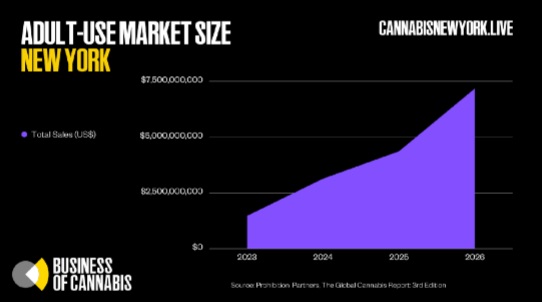
New adult-use regulations in New York are set to bring a fresh wave of capital into the cannabis market. Investors and operators will attend Business of Cannabis: New York to identify opportunities at a critical time for the forecasted $7.2bn industry.

With federal regulations looking likely to relax and markets beginning to gain traction again, the cannabis industry seems to be entering a unique phase of growth across North America. In New York, the adult-use cannabis market roll out has faced unique and arduous hurdles since legalization, with a court injunction still preventing many CAURD dispensaries from progressing with their plans.

Despite that, according to Prohibition Partners’ Global Cannabis Report, the New York cannabis market is still set to achieve impressive year-on-year growth and be worth a staggering US$7.2 billion by 2026.

new york adult use cannabis market

With full adult-use retail finally opening up in the state, is now the moment for the market to fulfill its promise as the new global ‘Capital of Cannabis’ and, if so, how can equity and its
much vaunted CAURD scheme remain at the forefront of its policies?

“How can CAURD operators stand out with ROs now entering the market? Independents need to move faster to compete with ROs entering the adult-use markets soon.” – Dai Truong, Managing Director, Arlington Capital Advisors (speaker)

“In spite of the hurdles constantly thrown in front of us, we will continue to pursue our dream of opening our dispensaries and are doing everything we can to make it a reality for us and the other CAURD licensees.” – Vladimir Bautista, CEO & Co-Founder, The Happy Munkey (speaker)

Business of Cannabis: New York is an exclusive leaders summit that connects 400+ visionary entrepreneurs, savvy investors, plus new and seasoned operators in the cannabis space. Attendees will gain a competitive edge through a comprehensive day-long programme that shines a spotlight on the latest market trends, regulatory updates, and investment opportunities, whilst tying together the three key pillars which enable the industry to thrive: retail, policy & investment.

Key highlights of the conference include:

Leading Industry Experts: Renowned CEOs, industry titans, and key policy makers will share their invaluable insights and knowledge, providing attendees with the inside scoop on industry trends and strategies in real time.

Investor Connections: With a high percentage of attendees coming from the realms of finance and investment, take the chance to discuss business ideas and connect with potential investors looking to deploy capital.

Networking Opportunities: Attendees will have ample opportunities to network with peers, form strategic partnerships, and build relationships that can drive their cannabis ventures to new heights.

Regulatory Updates: Stay ahead of the curve with exclusive updates on the ever-evolving cannabis regulations, ensuring compliance and mitigating risks for your business.

Market Intelligence: Gain access to proprietary market data and intelligence that will help you make informed decisions, identify untapped opportunities and provide actionable insights.

Participating companies and speakers so far include X (formerly Twitter), Acreage Holdings, Weedmaps, The New York Office of Cannabis Management, Union Square Travel Agency, Bloomberg, Politico, The National Cannabis Industry Association, Conbud, Arcview and CannDelta.

“New Yorkers have always had an insatiable appetite for cannabis. We are blessed, privileged and very excited to help build out and support New York’s cannabis ecosystem.” – David Hess, Co-Founder & President, Tress Capital (speaker)

This conference presents a unique opportunity for investors to discover high-potential ventures, operators to expand their networks and knowledge, and all attendees to immerse themselves in the exciting world of cannabis.

Don’t miss your chance to be part of this transformative event. Register now to secure your spot at the Business of Cannabis: New York Conference on November 3, 2023.

About Business of Cannabis: The Business of Cannabis is a leading platform dedicated to providing industry professionals with the latest insights, news, and networking opportunities in the cannabis sector. Our conferences and events are renowned for bringing together the best minds and companies in the industry to drive growth and innovation.

For sponsorship, speaking, or exhibition opportunities, please contact Matt Freemantle at matt@prohibitionpartners.com.

For media inquiries, please contact Michael Hoban at michael@prohibitionpartners.com.

5 Reasons To Exhibit At The International Cannabis Business Conference

The emerging legal cannabis industry is going global as nations around the globe work to modernize their cannabis policies and industry regulations. Long gone are the days when cannabis was taboo, and the cottage industry model was in place.

Competition within the legal cannabis space increases with every passing year, and as the industry continues its march to every corner of the planet it’s more important than ever before to stand out. That is harder to do at the global level for various reasons, not the least of which is that it’s very difficult to get in front of the right people at the right time.

Timing is everything in the business world, and cannabis-based businesses are no exception. One of the best returns on an investment in the emerging industry is to exhibit at an International Cannabis Business Conference event. Below are five reasons why.

Global Audience

The International Cannabis Business Conference event series is the only one of its kind to have a truly international following. Attendees come from all over the planet to attend our events, with past conferences being attended by representatives from 80 different countries.

The International Cannabis Business Conference team works with leading international policymakers, investors, entrepreneurs, inventors, and industry service providers from every major cannabis market on earth and brings them together.  Exhibiting at an International Cannabis Business Conference event is the most efficient way to get your product or service in front of true international cannabis leaders.

Network With Other Exhibitors

Some of the best connections that are made at International Cannabis Business Conference events are among fellow exhibitors. Your company may provide a product or service that can be enhanced by forming a partnership with another company that provides a beneficial ancillary service that is also exhibiting at one of our events.

Networking is a vital function of any industry, and the International Cannabis Business Conference provides a world-class opportunity to do exactly that.

Unparalleled Venues

No other cannabis conference series on earth holds its events at such amazing internationally acclaimed venues. The International Cannabis Business Conference has held events in the United States, Canada, Switzerland, Croatia, Slovenia, Barcelona, and Germany, and each event was held in an iconic setting unlike anything else that can be in the emerging cannabis industry.

Timely Information

In addition to networking, exhibitors are also attendees of International Cannabis Business Conference events and benefit from the thoughtfully curated event curriculum. Keynote speakers and panelists at our events are on the cutting edge of their respective fields, and there is no better way to learn than from the people who are actually doing the work and getting the results.

Work Hard, Play Hard

No International Cannabis Business Conference would be complete without one of our infamous after-parties. In addition to the parties being held in world-class venues, they are headlined by top international entertainers such as Morgan Heritage, Magnifico, Jim Belushi, and many others. The after-party setting is a great way to cap off days of travel, hard work, and learning while unwinding and having a great time. We hope to see you at an upcoming event!

Top 5 Economic Effects Of Slovenian Cannabis Policy Modernization

Modernizing a nation’s outdated cannabis policies yields numerous benefits, and not just to people directly involved in the cannabis industry. All members of society benefit from the economic impact of policy modernization. Below are five examples of how Slovenia would benefit from modernizing its cannabis policies to permit regulated cannabis commerce incorporating data from already established legal markets.

Job Creation

One of the most significant economic benefits of permitting cannabis commerce is job creation. The emerging legal industry is made up of several sectors, each with its own workforce needs, requiring nearly every job type imaginable to some degree. Additionally, other than outdoor cultivation operations that rely solely on the sun, industry facilities can feasibly be located anywhere in Slovenia for the purposes of research and product development, bringing jobs to areas that may need them more than others.

The emerging legal industry has already created over 428,000 jobs in the United States where regulated commerce is permitted in certain states. Adult-use reform was first implemented in Canada in 2018, and an analysis by Deloitte determined that Canada’s legal industry had created over 150,000 jobs as of the publishing of its February 2022 report.

Boosting Local Economies

The overall economic boost from Canada’s legalized industry is substantial. Deloitte estimates that the legal cannabis industry in Canada contributed over $43.5 billion to the nation’s GDP between the period of October 2018 and February 2022. Cannabis companies directly invested over $4.4 billion into Canada’s economy, with the remaining boost to GDP coming from “indirect” economic contributions, and “induced” contributions.

Public Revenue

According to the United States Census Bureau, between July 2021 and the end of 2022, the governments of legal U.S. states received more than $5.7 billion in public revenue from the emerging industry via taxes and fees. In fiscal 2021-22 in Canada, national and local governments collected more than $1.12 billion.

The public revenue generated by a regulated industry benefits all members of Slovenia’s society, providing policymakers and government officials additional revenue that they can use for such things as schools, social services, and public infrastructure.

Boosting Existing Industries

Slovenia is already established as an international science and tech hub, and the demand for cannabis-based research and product development is already substantial and increasing with every passing year. Slovenia already possesses the knowledge, facilities, and human capital to gain a significant footprint in the cannabis science and technology sectors. However, the window of opportunity to gain a meaningful market share of the sectors will not be open forever, and delays in policy modernization will impact the potential for existing industries.

Savings From Ending Prohibition Enforcement

While it is unknown exactly how much Slovenia spends enforcing cannabis prohibition, it’s likely that it’s a substantial sum. When Slovenia modernizes its policies to permit legal commerce and refrain from enforcing prohibition against consumers and patients, it will instantly save whatever is currently being spent on cannabis enforcement. In Germany, where lawmakers are working to modernize the nation’s cannabis policies, cannabis prohibition costs the nation 1.3 billion euros a year according to an analysis by the Institute for Competition Economics (DICE) at the Heinrich Heine University in Duesseldorf.

This article first appeared at TheTalmanGroup.com and is syndicated with special permission