
Yukon Has The Highest Per Person Cannabis Sales Ratio In Canada

Statistics Canada released new sales data pertaining to the nation’s emerging legal cannabis industry for the period of April 1, 2021 to March 31, 2022. During that time period, Canada’s legal adult-use cannabis industry generated roughly $1.6 billion for federal and provincial governments.

To put the $1.6 billion figure into perspective, Canada’s alcohol industry generated roughly $13.6 billion during the same time period. The figures for both alcohol and cannabis include taxes at all jurisdictional levels, as well as fees related to licenses and permits.

Overall, sales for adult-use cannabis products across Canada (provincial cannabis authorities and other retail outlets) totaled roughly $4 billion between April 1, 2021 to March 31, 2022, which is “equivalent to $131 per person of legal age to consume cannabis” according to Statistics Canada.

Yukon, which is the smallest and westernmost of Canada’s three territories, had the largest per-person cannabis sales ratio at $291. Yukon was followed by Alberta ($210), Saskatchewan ($185), Nova Scotia ($125), and Manitoba ($107). Quebec had the lowest ratio at $89 per person of legal age. Data from certain jurisdictions is apparently ‘suppressed to meet the confidentiality requirements of the Statistics Act.’

Dried cannabis flower was by far the most popular form of cannabis sold during the specified time frame, accounting for 71.1% of all adult-use cannabis sales in Canada during the calendar year. Inhaled extracts made up 18.1% of overall sales and edibles gained 4.1% of the market share according to the available data. Below is a breakdown of market share by cannabis product, provinces, and territories according to Statistics Canada:
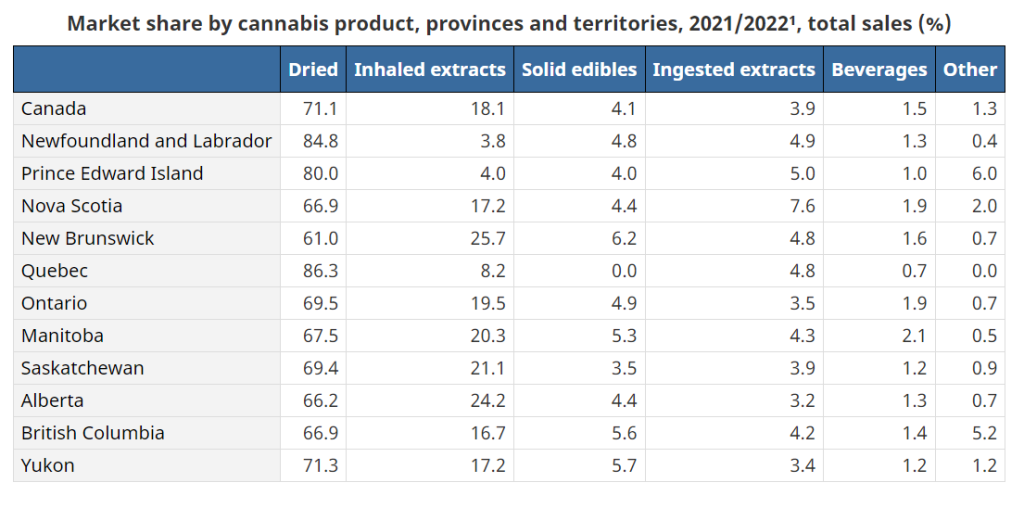
Canada cannabis sales breakdown 2021 2022

The data released by Statistics Canada comes around the same time findings were published from a very insightful survey analysis dealing with reported cannabis consumer spending habits.

According to the study, which was conducted by investigators affiliated with the University of Waterloo School of Public Health, “In 2021, the percentage of consumers sourcing all their products legally in the past 12 months ranged from 49 percent of solid concentrate consumers in 2021 to 82 percent of cannabis drink consumers.”

The growing success of adult-use cannabis legalization in Canada will not only benefit consumers within the nation’s boundaries but also consumers in other jurisdictions where lawmakers are pursuing legalization and keeping a close eye on Canada to see how things continue to develop.

Uruguay’s Medical Cannabis Industry To Expand Via Authorization Of ‘Master Formulas’

Uruguay was the first country to ever pass and implement a national adult-use legalization measure. Lawmakers initially passed a legalization measure back in 2013, and regulated adult-use sales via pharmacies began in 2017.

Since that time Uruguay’s emerging legal adult-use industry has garnered significant international attention and generated considerable headlines, and rightfully so. After all, what Uruguay did and continues to do on the adult-use front is truly historic.

However, Uruguay’s cannabis industry and policy are not limited to just adult-use cannabis. Uruguay’s medical cannabis program, which receives far less attention, is set to undergo a fairly substantial expansion thanks to a recent authorization by the government. Per Montevideo (translated to English):

The government established through a decree the expansion of access routes to products made from medical cannabis, by regulating a procedure to be able to carry out treatments through master formulations prescribed by treating doctors and made in authorized pharmacies.

The decree enabled access to “master preparations based on cannabis extracts or standardized cannabinoids, from companies authorized by the Department of Medicines for the production of plant raw material with pharmacological activity.” “These master preparations may exclusively contain active principles derived from cannabis,” added the second article of the regulations.

This new authorization will hopefully help some of the most suffering patients in the South American nation, who historically have had to rely on less-sophisticated forms of medical cannabis. This is not to say that raw flower and rudimentary preparations are not sufficient, as those options can clearly help many people. Yet, for some suffering patients, they are not the best option.

Depending on a suffering patient’s condition(s), certain consumption methods are not as viable as others. Additionally, particular conditions and individual cases respond better to certain formulations for various reasons, so patients in Uruguay having more options to consider is a great thing from that perspective.

Cannabis Consumers In Canada Continue To Transition To The Regulated Market

Canada was the second nation to pass a national adult-use legalization measure back in 2018, with only Uruguay preceding Canada in doing so (2013). Yet, unlike Uruguay, Canada allows legal sales to anyone of legal age whereas Uruguay limits it to residents only.

As such, Canada provides the best example for international observers to monitor and see what is working with the nation’s regulated industry and what is not working. With other nations considering legalization, any insight Canada can provide is valuable.

One of the biggest measures of success for legalization is whether or not consumers transition away from the unregulated market into the regulated market. According to a recent study in Canada, that is exactly what is occurring, and at an increasing rate. Below is more information about it via a news release from NORML:

Waterloo, Canada: Canadian cannabis consumers are steadily transitioning from the unregulated market to the legal market, according to data published in the Harm Reduction Journal.

Investigators affiliated with the University of Waterloo, School of Public Health surveyed over 15,000 cannabis consumers regarding where they obtained their products. Researchers evaluated data for the years 2019 to 2021. (Canada instituted licensed retail sales of cannabis products in October 2018.)

Authors reported that the percentage of respondents legally sourcing their cannabis products increased year over year. Respondents were most likely to purchase cannabis-infused drinks, oils, and capsules from the legal marketplace. About 55 percent of respondents said they obtained cannabis flower exclusively from legally licensed retailers.

In 2019, fewer than half of consumers acknowledged obtaining their cannabis products from legal sources. According to separate consumer survey data published last year, that percentage rose to nearly 70 percent in 2020.

“Legal sourcing of cannabis was greater in 2021 than 2020 for all ten cannabis products [surveyed]. In 2021, the percentage of consumers sourcing all their products legally in the past 12 months ranged from 49 percent of solid concentrate consumers in 2021 to 82 percent of cannabis drink consumers,” investigators reported. “Transitioning consumers of all cannabis products into the regulated market is important for public health and safety. Future studies should continue to examine cannabis product sourcing in Canada over time, as well as ways to displace the illegal market for all cannabis products without also promoting the use of high-potency cannabis products.”

Full text of the study, “Legal sourcing of ten cannabis products in the Canadian cannabis market, 2019-2021: A repeat cross-sectional study,” appears in the Harm Reduction Journal.

March 2023 Is Set To Be A Historic Month For European Cannabis

The next 32 days on the European continent could prove to be one of the most historic stretches of time for cannabis public policy and the continent’s emerging legal cannabis industry. Starting tomorrow, Malta’s government will begin accepting applications for non-profit cannabis clubs.

It’s a major milestone not just for Malta, which is the only country in Europe to pass a national adult-use legalization measure, but it’s also a major milestone for the greater European industry being that Malta is the first nation in Europe to set up this kind of national adult-use licensing system. It will be very interesting to see how many applications Malta receives next month.

Malta is not the only nation set to experience a historic March 2023. As every global cannabis observer already knows, lawmakers in Germany have worked very hard to make good on their coalition agreement component relating to legalizing cannabis for adult use and implementing a regulated adult-use industry.

Germany’s Health Minister Karl Lauterbach made a formal presentation of a legalization plan back in October 2022 and has since lobbied the European Union for its permission to proceed with an official introduction of a legalization measure.

What some observers seem to have overlooked, or perhaps forgotten about, is that roughly a month ago Minister Lauterbach reportedly confirmed a timetable for a formal introduction of a legalization measure and indicated at the time that he had ‘no reason to doubt’ that a legalization measure would be introduced ‘in the first quarter of this year.’

With February drawing to a close that puts the German adult-use legalization bullseye squarely on the month of March. Whether or not Minister Lauterbach’s reported timeline proves to be accurate or not is something that time will have to determine, although, there have been no meaningful setbacks reported from what I can tell as of the posting of this article.

Additionally, cannabis enthusiasts, entrepreneurs, investors, policymakers, and industry service providers are set to flock to Barcelona, Spain in March as part of the world’s largest super-event collaboration. The International Cannabis Business Conference has once again partnered with Spannabis, Europe’s top cannabis expo, to form another super-event that is a must-attend for anyone that is serious about succeeding in the emerging cannabis industry.

The International Cannabis Business Conference will host Spain’s largest cannabis B2B event on March 9th at the L’Auditori de Cornellà, with the after-party being held at the Hotel Arts (Ritz-Carleton) Barcelona. Spannabis will follow on March 10-12th at Fira de Cornellà. The super-event is the first large cannabis conference collaboration of the year. Whenever thousands of cannabis supporters get together and network good things happen, and that will surely be the case in Barcelona next month.

Cannabis policy and industry in Europe are both at pivotal points, and being that a legal industry cannot come into existence without reform occurring first, the two are directly tied to each other. If Germany does witness the formal introduction of an adult-use legalization measure next month, it will likely set off a wave of similar political activity in other parts of Europe and that will be good news for the continent’s emerging industry.

The same goes for Malta’s cannabis club application rollout. If Malta can successfully gather, review, and approve non-profit cannabis club applications, it will have set up a bureaucratic blueprint for other nations to copy. It’s nuanced but very significant.

We will all have to wait and see what happens for cannabis in Europe in March while doing our best to temper our excitement and expectations.

Malta Home Affairs Ministry Is Reportedly ‘In Talks With A Main Bank’

A unique cannabis public policy and industry experiment is ramping up in Malta where non-profit adult-use cannabis clubs are expected in the near future. Starting next week, Malta’s government will begin accepting applications for non-profit adult-use cannabis clubs. The European nation became just the third country on earth to pass a national adult-use legalization measure in late 2021, with only Uruguay (2013) and Canada (2018) proceeding Malta. Non-profit cannabis clubs will serve as the backbone of Malta’s adult-use industry, and this week the nation’s Home Affairs Ministry reportedly entered into discussions with an unnamed ‘main bank’ that will be needed to help Malta’s emerging industry reach its full potential.

Access to the global banking system has proven to be difficult for certain entities in the public and private sector regarding cannabis commerce, although there are certainly examples of entities being able to successfully navigate the financial regulatory labyrinth in some instances. Still, getting consistent banking solutions pinned down is something that is a top priority for any emerging cannabis market, and Malta is no exception, so reports that there is progress on that front is encouraging.

A Somewhat Unique Model

Cannabis clubs are not a new phenomenon, so from afar, what is going on in Malta may not seem significant. After all, Uruguay and Canada both already permit cannabis clubs to operate in some fashion in certain jurisdictions. For that matter, Barcelona is home to hundreds of private cannabis clubs, albeit operating in a semi-grey area of the law. Yet, Malta is unique compared to those markets in that its entire cannabis commerce model will be based on licensed non-profit cannabis clubs. Home cultivation will be permitted, but the only way to legally purchase cannabis in Malta once clubs are implemented is via non-profit clubs.

It may seem nuanced, but as anyone that has paid attention to the ongoing cannabis banking saga will recognize this is a bit of a new wrinkle. Uruguay has experienced banking issues despite permitting non-profit cannabis clubs, but it also permits sales in pharmacies. That last component was the root of banking issues in Uruguay back in 2017. Major banks in Canada are the subject of a recent lawsuit due to alleged discrimination against cannabis companies. It will be interesting to see if Malta ever experiences the same hurdles given the fact that its legalization model is much more limited compared to Uruguay and Canada.

Helping Create The Blueprint

For many years I blogged about cannabis reform efforts in the United States, and many things have proven to be similar as I have transitioned to blogging about international reform efforts. Similar to different states in the U.S., within the international community there are clearly categories of nations when it comes to cannabis policy. Some are pro-cannabis, some are anti-cannabis, and some are seemingly indifferent. The pro-cannabis nations are doing what they can to get around international hurdles, and anti-cannabis nations are doing everything they can to cling to treaty provisions in an attempt to maintain the prohibition status quo wherever they can.

Due to international treaties, cannabis legalization cannot proceed unhindered in any nation. Even Uruguay and Canada had to consider international agreements and partnerships prior to legalizing, and even when they did proceed, they did so in defiance by some measures. In the Eastern Hemisphere things are proceeding differently. Leaders in nations like Malta and Germany are seeming to be getting more and more creative as they try to figure out a blueprint of sorts for what legalization may look like without violating agreements that extend beyond their borders. With that in mind, the banking discussions in Malta may not seem like a big deal, but if it can add to the previously mentioned metaphorical legalization blueprint in a meaningful way, it will indeed prove to be a very big deal.

Report Estimates Global Legal Cannabis Sales To Reach $59.6 Billion By 2027c

These are truly exciting times for the emerging international cannabis industry. After decades of prohibition policies dominating the globe, more and more countries are getting on the right side of history and legalizing medical and/or adult-use cannabis to some degree.

In addition to preventing people’s lives from being needlessly ruined, cannabis reform is helping suffering patients and ushering in a new era for an industry that has long operated in the shadows.

Legal sales will continue to increase for the foreseeable future, as reflected by a new report from cannabis data company BDSA. Below is more information about the report via a news release:

LOUISVILLE, Colo., Feb. 22, 2023 (GLOBE NEWSWIRE) — BDSA, the leading provider of market intelligence for the cannabis industry, today released its updated five-year global legal cannabis market forecast. Global legal cannabis spending grew 4.8% to $32 billion in 2022 and forecasts a compound annual growth rate (CAGR) of 13.2% from 2022 to 2027, resulting in a market size of $59.6 billion by 2027. Despite economic uncertainty and rising inflation, BDSA expects legal U.S. cannabis sales to grow 14% by the end of 2023.

“Legal cannabis spending slowed significantly in 2022 due to rapid price declines across all markets,” said Roy Bingham, Co-Founder and CEO of BDSA. “Despite this, our updated forecast predicts strong growth in the U.S. driven by developing markets, particularly the adult-use markets of Missouri, New Jersey and New York. Additionally, four of the top five U.S. markets—Florida, Illinois, Massachusetts and Michigan—will increase by a combined 9.5% in 2023, adding nearly $770 million in new spending.”

While legal cannabis sales saw rapid growth during the height of the pandemic, 2022 marked the first overall spending contractions in many mature markets throughout the U.S., with the mature adult-use markets of California, Colorado, Nevada and Oregon suffering a combined spending decline of 16.5%. While BDSA expects to see a return to growth for most mature markets in 2024, mature markets in the U.S. are expected to grow slower during the forecast period. However, several newer markets accomplished a strong expansion in 2022, and growth in new and emerging markets is expected to ramp up in the coming years. New Jersey and Montana, which launched adult-use sales in 2022, saw approximately 140% growth last year, while Missouri grew by 84% in its second full year of medical-only sales.

By 2027, adult-use sales are forecasted to contribute 78% of the total global legal cannabis spend, up from 64% in 2022. U.S. legal cannabis spending is expected to grow at a CAGR of 11.3%, from $26.1 billion in 2022 to $44.5 billion in 2027, driven primarily by the New York, Florida, New Jersey and California markets. BDSA forecasts the launch of several new adult-use markets by 2027, including Maryland and Oklahoma in 2024 and Florida and Ohio in 2025. New adult-use markets in Hawaii and Minnesota are also possible. Although BDSA does not expect any comprehensive U.S. federal regulations on cannabis in this timeframe, there is a possibility of partial reform, such as cannabis banking, within the next few years.

Globally, cannabis markets beyond the U.S. and Canada are forecast to grow at a CAGR of 40% to $9.5 billion in 2027, up from $1.8 billion in 2022. BDSA forecasts the Canadian market will see 12% overall growth this year, becoming a $5.7 billion market by 2027 at a CAGR of 6.3%. New adult-use markets and Germany and Mexico are the primary drivers of global growth, and current limited medical cannabis programs are expected to expand, primarily within the European Union and Latin America.

BDSA will cover the new market forecast report in a webinar on March 7 at 11 a.m. MT. The free webinar will explore cannabis industry growth throughout 2022, what the industry will look like by 2027, and what factors are driving growth in the U.S. and beyond. To register, visit here.

About BDSA
Headquartered in Louisville, Colorado, BDSA helps businesses improve revenues, reduce innovation risk and prioritize market expansion with accurate and actionable cannabis market intelligence, consumer research and advisory services. The company provides a holistic understanding of the cannabis market by generating insights from point-of-sale data, wholesale data, consumer research and market forecasts. To learn more, please visit bdsa.com.

Zimbabwe Tobacco Farmers Get More Incentive To Switch To Hemp

Historically, Zimbabwe has served as the top producer of tobacco on the African continent, although in recent years many tobacco farmers in Zimbabwe have transitioned to cultivating hemp due to lowering global demand for tobacco. Zimbabwe’s government more than tripled the amount of allowable THC in hemp this month, and that should further motivate farmers to switch their fields from tobacco to hemp.

Prior to this month, the legal THC threshold for hemp in Zimbabwe was .3%, which is the legal standard in most countries around the world. However, a handful of countries have already raised the threshold from .3% to 1%, and Zimbabwe has followed suit. Zimbabwe joins Australia, Ecuador, Malawi, Switzerland, and Uruguay in setting its hemp THC threshold at 1%.

Why Does It Matter?

Going from a .3% THC threshold to a 1% THC threshold may not seem like a major leap, and yet, it is very significant. Whenever a hemp crop is tested and it has a higher percentage of THC than is allowed by law, the entire crop has to be destroyed. For obvious reasons, that is a very undesirable outcome for any farmer. In Zimbabwe, where the median income is just $932, a failed crop is particularly detrimental.

By allowing farmers in Zimbabwe to cultivate hemp with a higher THC threshold, it accommodates a greater level of THC percentage variance. Farmers that were worried about their current genetics producing slightly too much THC no longer have to worry as much. They now have more cultivars to choose from when deciding what to cultivate, and the medical cannabis products that they produce will be more effective since there will be more THC involved. The cannabinoid ‘entourage effect’ will be enhanced in patients that consume said products thanks to there being more THC in them.

Limited medical cannabis was first legalized in Zimbabwe in 2018, making it only the second country on the African continent to pass such reform. Since that time several other African nations have followed in Zimbabwe’s footsteps and legalized limited medical cannabis production. Will Zimbabwe become the continental leader for hemp, just as it has served historically for tobacco? Only time will tell, but the higher THC threshold will certainly increase the odds of that happening.

Jobs, Economic Boost, And An Improved Environment

Arguably the biggest motivating factor behind Zimbabwe’s recent THC threshold change is economic stimulation. Zimbabwe is one of the poorest nations on earth, and any and all jobs that the hemp industry can create are greatly needed. Demand for hemp products, particularly CBD-based products, is strong worldwide. If Zimbabwe can produce raw hemp to be made into products, and/or produces its own finished products, it will hopefully create many career opportunities in the process.

A booming hemp industry in Zimbabwe wouldn’t just help individuals that work directly in the industry. It would also help create ancillary hemp companies, from security to storage to just about anything else that the mind can imagine. The domestic hemp industry bringing in money from afar via exports would help boost local economies, with hemp industry workers spending their wages in the areas in which they live. Everyone would benefit from an economic butterfly effect from such activity, in addition to the public benefitting directly from increased industry tax and fee revenue.

Cultivating tobacco results in degraded soil and threatened biodiversity. Tobacco farming on a large scale often involves pesticides and fertilizers that are bad for the environment. Conversely, the hemp plant requires very little inputs and actually improves the soil in which it is cultivated via a process known as soil remediation. Furthermore, roughly 4.5 trillion cigarette butts end up in our oceans, rivers, soil, and other places every year, and presumably (hopefully) that will not be the case with hemp products. With all of that in mind, any hectare in Zimbabwe that transitions from tobacco to hemp is a great thing.

Lawmakers In Spain To Debate Cannabis Regulation On Tuesday

When it comes to cannabis reform efforts there are various speeds at which jurisdictions move, ranging from a rapid pace like we saw in Thailand in the last couple of years all the way to places like China where cannabis prohibition is clung to at all costs and they are seemingly somehow finding new ways to ramp up prohibition efforts.

Somewhere in between on the spectrum is Spain. As with many other things, Spain moves at its own pace when it comes to cannabis reform. Medical cannabis is legal in Spain, however, current licenses are geared towards research and exports.

Adult-use cannabis is quasi-legal in private settings in Spain, which has created a loophole of sorts that private cannabis clubs take advantage of. What Spain truly needs is domestic cannabis regulations to take away the uncertainty and help Spain’s emerging cannabis industry reach its full potential.

Fortunately, lawmakers in Spain are considering such reform, with a debate scheduled for tomorrow. The measure being considered would reportedly go beyond medical cannabis regulations. Per Infosalus (translated to English):

The Plenary of the Congress of Deputies will debate this Tuesday the Proposal for a Law of Esquerra Republicana (ERC) to regulate cannabis in an “integral” way, that is, both its therapeutic and recreational use.

One of the objectives of the Law, which ERC presented at a press conference in September 2021, is to “decriminalize” cannabis and consider it a medicine that can be accessed with a prescription.

In this way, the consumption of marijuana would be legalized in places where tobacco smoking is allowed, this would include the ability to consume cannabis outdoors and on private property.

The measure would permit for the cultivation of up to six plants within an adult residence, with a reported limit of ‘producing up to 480 grams per year.’ For context, one harvested plant cultivated using advanced techniques can yield more than 480 grams of dried cannabis flower.

Additionally, the measure would mandate that certain funds be earmarked for ‘resources to combat addiction’ and to ‘increase the awareness of the negative effects of cannabis.’ Hopefully people in Spain are already aware of the harms of prohibition, and continue to demand a more sensible approach to cannabis policy in Spain.

Cultivating Cannabis For An Emerging International Cannabis Market

The act and art of cultivating the cannabis plant is far from a new thing. Researchers have found evidence of humans cultivating the cannabis plant in a domestic fashion going back roughly 12,000 years. Yet, the methods, techniques, and particularly the technology that humans have incorporated over time has evolved considerably.

For many years humans cultivated cannabis the same way that many crops were cultivated – by planting seeds into tilled soil and cultivating it under the sun using nothing more than rain or river/creek water. Over time fertilizer concoctions were eventually incorporated. Selective breeding techniques were eventually used by various cultivators, with particular genetics being grown for specific uses.

At some point cannabis cultivation operations moved indoors, both to control the environment that the plants were grown in to maximize yield as well as out of necessity to avoid detection by law enforcement. Advances in artificial lighting and feeding systems occurred as a result, with many of those advances still being used by producers today.

The cultivation sector of the emerging international cannabis industry is currently taking cannabis production to a level that was previously unfathomable. Advances in cultivation research and technology are allowing producers to cultivate cannabis that is of a higher quality and quantity than ever before.

One of the biggest benefits to cannabis reform efforts is the opening up of cannabis production research and innovation. No longer are cultivators restricting their crafts to closets and basements. They can completely operate out in the open and only be restricted by their creativity and ingenuity, and every cannabis consumer and patient on the planet is benefitting from it.

A group of leading cannabis production experts will be participating in a panel at the upcoming International Cannabis Business Conference in Barcelona on March 9th. It’s an amazing opportunity to learn directly from people that are at the forefront of the global cannabis production evolution. Panelists will include:

  • Marcus Richardson, Hashish Aficionado and Creator of Bubble Bags (Moderator)
  • Timo Bongartz, General Manager of Fluence Emea
  • Sabrina Carvalho, Cannabis Plant Specialist at Philips Horticulture LED Solutions
  • Neal Lund, Global Technical Advisor at RIOCOCO
  • Jeremy Youness, International Commercial Sales and Cannabis Cultivation Specialist at Fohse

The International Cannabis Business Conference is the leading cannabis business to business (B2B) event series on the planet, with previous conferences occurring in several countries on multiple continents. The event series is owned and operated by cannabis advocates that believe in celebrating cannabis culture, in addition to providing world-class cannabis industry education and networking opportunities.

The International Cannabis Business Conference has once again partnered with Spannabis, Europe’s top cannabis expo, to form another super-event that is a must-attend for anyone that is serious about succeeding in the emerging cannabis industry. Spannabis originally teamed up with the International Cannabis Business Conference in 2019, and the collaboration was a tremendous success. The 2023 super-event will be bigger and better than ever, with the collaboration event being the largest of its kind.

Not all networking opportunities are created equal, and that is particularly true in the cannabis space. International Cannabis Business Conference events are attended by cannabis leaders from dozens of different countries, with the Barcelona B2B trade show serving as the first major international cannabis event of its type for 2023. The conference itself will be held at the L’Auditori de Cornellà, with the after-party being held at the Hotel Arts (Ritz-Carleton) Barcelona. You can view the event’s schedule at this link here.

The International Cannabis Business Conference also has additional upcoming events in Berlin in June 2023. Secure your tickets now before the events are sold out!