European Cannabis Pilot Projects

Certain European markets are home to a unique public policy and commerce concept known as pilot trials. These research-based projects permit regional adult-use cannabis commerce at a local level to help lawmakers and regulators gather data and information to be better informed when crafting national laws and industry policies.

Current European Union agreements prohibit national commerce models like what is found in the Western Hemisphere, however, EU agreements do permit recreational commerce projects for public health research purposes. Pilot trials are currently operating in the Netherlands and Switzerland, and soon, trials are expected to launch in Germany.

In the video at this link, you can watch a recent presentation from the International Cannabis Business Conference in Berlin about European cannabis pilots. The panel was moderated by leading cannabis policy expert and attorney Kai-Friedrich Niermann, Founder of KFN+ Law Office. The panel also included:

  • Daniel S. Hübner, Senior Science Manager at the Cannabis Research Lab Humboldt-Universität zu Berlin
  • Finn A. Hänsel, Managing Director and a Founder of Sanity Group
  • Deepak Anand, Principal at ASDA Consultancy Services

Until EU agreements are modernized, cannabis pilot trials will continue to serve as an important legal commerce concept for EU member nations to consider.

Examining Germany’s Evolving Legal Cannabis Industry

Germany continues to be the continental leader for Europe’s emerging legal cannabis industry. Legal sales of medical cannabis products started in Germany in 2017, and the country’s medical sector has since become an international juggernaut and a top market for medical cannabis exports.

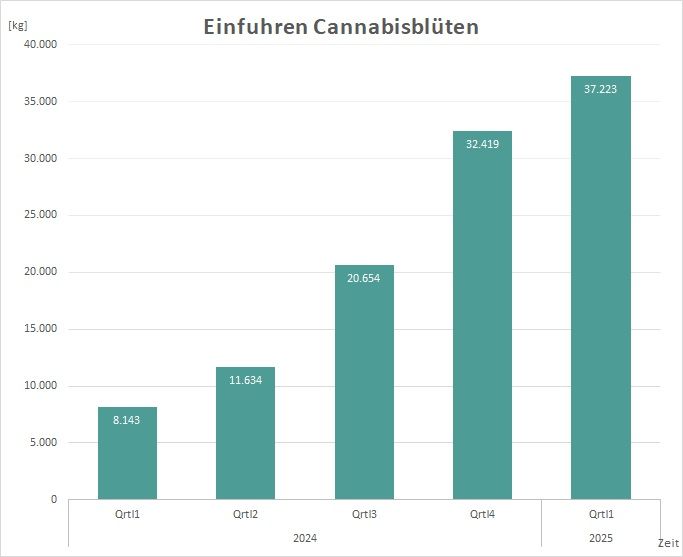
In the first quarter of 2025, Germany imported over 37.223 metric tonnes of medical cannabis products. To put that figure into perspective, the total imports for Q1 2025 increased by roughly 14.8% compared to the Q4 2024 total (32.419 metric tonnes), which was itself a record at the time.

Q1 2025’s import total is an increase of over 457% compared to the same period one year ago. Germany imported 8.143 metric tonnes of medical cannabis products in Q1 2024. The updated import numbers bring the total amount of legally imported medical cannabis products to Germany during the last 12 months to 101.9 metric tonnes.

Around 2,500 of Germany’s 17,000 pharmacies now offer medical cannabis. According to the most recent data from the German Federal Association of Cannabis Cultivation Associations (BCAv), a total of 215 cultivation association applications have been approved out of 626 submissions nationwide.

Business is booming in Germany, although the political and regulatory landscape overseeing Germany’s emerging industry continues to evolve. A panel of leading experts from multiple sectors of Germany’s industry recently participated in a discussion about strategies and approaches for adapting to recent changes in Germany, and what industry members should anticipate in the coming years.

The panel was moderated by Dirk Heitepriem, President and Chairman of the German Cannabis Industry Association (BvCW). Mr. Heitepriem was joined by:

  • Lisa Haag, Founder of MJ_Universe
  • Timo Bongartz, CEO of CANNAVIGIA
  • Marijn Roersch van der Hoogte, Co-Founder of Hemp-Impact.com and Co-Founder and VP of BvCW
  • Henry Wieker, Board Member of BvCW and Coordinator of BCAv
  • Sita Schubert, EUMCA’s General Secretary

The discussion, which was held at the International Cannabis Business Conference in Berlin last month, provided valuable insights to help industry members navigate the future of cannabis in Germany. Click here to watch the panel presentation.

German Medical Cannabis Imports Increased Over 457% In One Year

Germany’s legal medical cannabis industry continues to expand at a staggering rate, as demonstrated by new medical cannabis import numbers. In the first quarter of 2025, Germany imported over 37.223 metric tonnes of medical cannabis products.

To put that figure into perspective, the total imports for Q1 2025 increased by roughly 14.8% compared to the Q4 2024 total (32.419 metric tonnes), which was itself a record at the time. Q1 2025’s import total is an increase of over 457% compared to the same period one year ago. Germany imported 8.143 metric tonnes of medical cannabis products in Q1 2024.

Alfredo Pascual, CFA, Executive Director at Seed Innovations Ltd (LON: SEED), posted the updated statistics on his LinkedIn page earlier today:

germany medical cannabis imports q1 2025

The updated import numbers bring the total amount of legally imported medical cannabis products to Germany during the last 12 months to 101.9 metric tonnes. Demand for medical cannabis continues to increase in Germany, with no slowdown currently in sight.

“A conservative projection, assuming Q1 2025 levels persist through Q2-Q4, would result in ~150 tonnes imported for the full year. However, given the consistent strong quarterly growth observed recently, the actual CY 2025 import volume could be significantly higher.” wrote Alfredo Pascual in his social media post.

“The primary downside risk is the ongoing political discussion in Germany regarding potential restrictions on online medical cannabis prescriptions, which could influence patient access and market development.” Pascual also wrote.

Canada remained the top source for imported medical cannabis products to Germany at 16.1 tonnes during Q1 2025. Portugal was the second leading source for medical cannabis imports during that timeframe at 12.1 tonnes, and Denmark was third at 2.6 tonnes.

Cannabis And Hemp Tourism Is A Growth Engine

The concept of people traveling to faraway destinations to enjoy consuming food and wine is not a new thing. Television shows are dedicated to the activity, and massive subsectors of the tourism industry are built around the concept. The same is proving to be true for cannabis and hemp tourism at an increasing rate.

A multi-year survey conducted by MMGY Travel Intelligence discovered that the cannabis travel audience in the United States alone includes roughly 72 million Americans, or 37% of the active leisure travel audience in the United States.

“Half of these interested travelers would consider visiting a cannabis shop, and a quarter of them are not regular cannabis users but are open to such experiences while traveling.” reported Travel Age West about the survey results.

In 2023, inbound tourism spending in Europe was an estimated 645 billion euros. At the intersection of these industries – cannabis, hemp, and travel – are opportunities for growth and creative differentiation.

Medical tourism, leisure travel, events, and business travel, including group meetings and conferences, are all part of it. Cannabis travel expert Brian Applegarth of Applegarth Strategies recently moderated a panel dedicated to cannabis and hemp tourism at the International Cannabis Business Conference in Berlin. Mr. Applegarth was joined by:

  • Mara Gordon – Co-Founder, Aunt Zelda’s, Octopi Wellness, Zelira Therapeutics
  • Jim Zielinski – General Manager, The Bulldog Hotel
  • Cristina Sánchez – Full Professor of Biochemistry and Molecular Biology at Complutense University
  • Ivan Ross Vrána – Managing Partner, Diplomat Consulting
  • Teddy Cabugos – President, Director, Sunstone Winery

Click here to watch a video of the ninety-minute presentation and panel discussion unpacking the tourism opportunities for cannabis and hemp businesses and brands in the European market.

The German Medical Cannabis Industry Is The Main European Market Driver

Germany first legalized medical cannabis in 2017, and its distribution model involves permitting legal sales at registered pharmacies. Germany’s medical cannabis industry has become the largest legal market in Europe, boosting the nation’s pharmacy sector in the process. Since the launch of initial sales, safe access to medical cannabis via Germany’s pharmacies has increased dramatically, as demonstrated by statistics that were included in a recent newsletter by the German Cannabis Business Association (BvCW).

“Patients can order cannabis online with a private prescription and have it delivered to their home. Nationwide, around 2,500 of the 17,000 pharmacies now offer medical cannabis,” BvCW stated (translated from German to English). “The industry’s revenue is now estimated at around half a billion euros.”

A major contributing factor to Germany’s recent medical cannabis industry growth was the enactment of the CanG law in April 2024, which removed cannabis from the nation’s Narcotics List. The rise of telemedicine has also contributed to the medical cannabis industry’s growth in Germany. A recent newsletter by leading international cannabis economist Beau Whitney, founder of Whitney Economics, provides some reliable market data regarding the current estimated number of medical cannabis patients in Germany.

“There has been a consistent number of between 200k – 300k medical patients.” Beau Whitney writes. “As a result of this new innovation, there is now an additional 500k – 600k self-paying consumers participating in the legal market.”

“When combined with 100k cultivation association members, there is approximately 800k legal consumers in the German market right now. For perspective, 800k consumers represents between 10% and 20% of the total market, while the supply and capacity at the end of 2024 represented nearly 15% of all of the supply that the market needs.” Whitney stated.

At the recent International Cannabis Business Conference in Berlin, a team of experts from Germany’s emerging medical cannabis industry examined how the nation’s medical market is the main overall market driver in Europe. The panel was moderated by Canadian medical cannabis pioneer Alex Revich and included:

  • Torsten Greif, CEO, Four 20 Pharma
  • Benedikt Sons, Co-Founder and CEO, Cansativa Group
  • Matthias Fischer, Founder and Managing Director, Canymed, CCO, Grünhorn
  • Dr. rer. nat. Adrian Fischer, Physician and Natural Scientist, Co-Founder and Managing Director, DEMECAN

Click here to watch a video of the panel discussion.

Hemp Fiber May Be A Viable Cotton-Compatible Textile Input

The hemp fiber industry holds tremendous economic potential. According to a recent market projection by MarkNtel Advisors, “the global hemp fiber market stood at USD 11 billion in 2024 and is projected to reach USD 36 billion by 2030, growing at a CAGR of 22%.”

“The surge in hemp fiber adoption reflects broader shifts in consumer behavior, policy frameworks, and material science innovation. Hemp’s fast growth rate, minimal pesticide requirements, and carbon sequestration properties are positioning it as a bio-based solution for climate-conscious industries.” MarkNtel Advisors stated.

One logistical issue that is holding the hemp fiber sector back, to some degree, is limited infrastructure. In the wider textile industry, hemp is largely seen as a niche material input requiring specialized machinery to create end products. However, a recent study is providing new insight into hemp’s potential as a cotton-compatible textile input.

A team of researchers affiliated with Universitat Politècnica de Catalunya-BarcelonaTech (Spain) and Dresden University of Technology (Germany) recently conducted a study examining non-textile hemp by using mechanical-chemical cottonization. The results of the study were published in the academic journal Cellulose.

“The raw material used was an agricultural residue that is mainly employed for paper manufacturing. These fibers were subjected to an alkaline chemical treatment followed by an oxidizing treatment (H2O2) to reduce non-cellulosic components.” the researchers stated about their methodology. “Subsequently, a mechanical process was carried out to increase fiber elementarization and obtain suitable slivers for spinning.”

“The potential of open-end rotor spinning was evaluated for both the 100% treated hemp and blends of 25% hemp/75% cotton. The selection criteria included a low reduction of the degree of cellulose polymerization, a low mass loss during the process, an appropriate tensile strength of the resulting yarns, an absence of breakage during spinning, and a low twist.” the researchers also wrote.

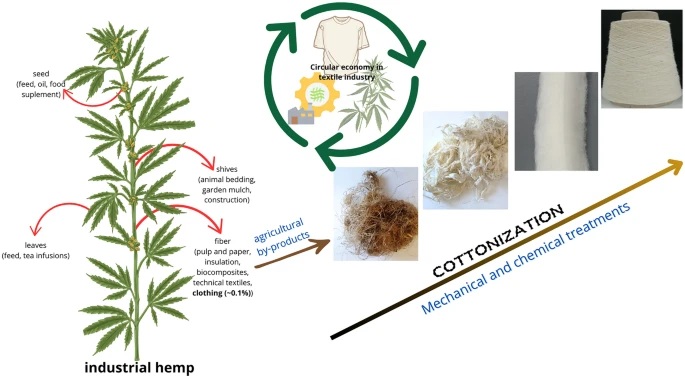
Below is a graphical abstract provided in the researchers’ article listed on Springer Nature:

industrial hemp cottonization mechanical and chemical treatments

“The hemp treated with a high level of H2O2 stabilizer, according to the established experimental design for the oxidizing process, exhibited superior performance when blended with cotton and spun with a count of 40 tex and a twist coefficient (αm) of 170. These outcomes are of industrial interest for the production of fine yarns because they can be easily implemented using existing machinery devoted to processing cotton.” the researchers determined.

“Furthermore, it contributes to the circular economy within the textile industry by adding value to a waste material that can serve as an alternative source of more environmentally friendly cellulosic fibers.” the researchers concluded.

The results of this recent study come at a time when Europe’s industrial hemp industry potential is being researched at an increasing rate. For example, a team of researchers affiliated with the University of Göttingen recently examined industrial hemp from the perspective of its prospects as a sustainable crop for modern agriculture in Germany.

“Industrial hemp offers promising prospects for agriculture. Its ecological advantages, such as improved soil structure and CO2 sequestration, as well as the economic potential offered by dual-use land and low or no need for pesticides, make it a sustainable addition to crop rotation.” the researchers concluded. “With the right strategy, industrial hemp can make a valuable contribution to sustainable agriculture, especially when economies of scale, stable sales contracts, and effective integration into crop rotation systems are considered.”

The University of Göttingen’s findings built on other recent hemp-focused sustainability research, including a study led by researchers affiliated with the University of Banja Luka, the University of Belgrade, and the University of Niš, which found that raw hemp can be used as an effective and eco-friendly alternative for removing toxic dye chemicals from wastewater.

During a recent presentation at the International Cannabis Business Conference in Berlin, leading international cannabis industry economist Beau Whitney, founder of Whitney Economics, provided data demonstrating that the value of the global industrial hemp industry could be as much as $456.2 billion.

Excitement Level In Berlin Demonstrates Surging Interest In The Global Industry

On April 29th-30th, 2025, the International Cannabis Business Conference held its flagship event at the Estrel Berlin, Germany’s largest hotel and conference center. The event was nothing short of electric, and it was the conference’s biggest and best event to date.

Interest in the emerging global cannabis industry, particularly in Germany and Europe, is experiencing exponential growth right now, and that was evident throughout the two-day conference in Berlin. Roughly 5,000 people attended the conference, with over 80 countries and every major legal market represented. Click here to see an after-movie video of the conference.

One readily apparent fact at the conference was that Europe has now become the top focus of industry members across the world, particularly for industry members wanting to gain a meaningful footprint in Germany’s market. As leading European policy and legal expert Peter Homberg of gunnercooke pointed out in his keynote presentation, imports of medical cannabis products to Germany nearly quadrupled in the last quarter of 2024 compared to the first quarter.

The expansion of Germany’s legal industry in recent years was accelerated in April 2024 with the adoption of the nation’s CanG law, which legalized personal cannabis cultivation, possession, and consumption by adults. The CanG law also permits adult-use cannabis associations to operate, with 211 associations having already received approval.

Arguably, the most significant component of Germany’s CanG law was the removal of cannabis from the nation’s Narcotics List. The declassification of cannabis dramatically improved Germany’s medical cannabis industry. Germany’s medical cannabis patient base is increasing in size with every passing day, as proven by the fact that more than 1 out of every 7 of the nation’s pharmacies now sell medical cannabis products.

A common theme throughout the Berlin conference was the parallels and interplay of the Western Hemisphere’s legal markets and Europe’s emerging markets. What Europe is currently experiencing is reminiscent in various ways of what happened in North America starting in 2012 with the initial adoption of state-level legalization in the U.S. The ‘green rush’ in the U.S. and Canada provides lessons that entrepreneurs, investors, policymakers, and industry service providers in the Eastern Hemisphere can learn from.

Kicking off the conference was a keynote presentation by Charlie Bachtell, CEO and Founder of Cresco Labs. Charlie Bachtell has served as Cresco Labs’ [CSE:CL] Chief Executive Officer since February 2015 after co-founding the company in 2013. Cresco Labs operates in several U.S. markets, and the insight that Mr. Bachtell provided in his presentation was invaluable for attendees.

Following Bachtell’s presentation was a keynote address by gunnercooke’s Peter Homberg. Mr. Homberg examined the current state of Germany’s industry and political landscape, including the fresh announcement of the appointments of incoming German Minister of Health Nina Warken and Federal Ministry of Food and Agriculture Alois Rainer. Both incoming ministers will play a major role in shaping what happens next for Germany’s emerging industry, and with it, the wider European cannabis economy. Mr. Homberg’s thorough presentation on day 1 of the conference in Berlin could not have been more timely.

Another timely presentation was a panel discussion focusing on European pilot projects. Pilot projects are currently operating in the Netherlands and Switzerland and are also part of Germany’s legalization model. The panel was moderated by German policy expert Kai-Friedrich Niermann, Founder of KFN+ Law Office. Joining Mr. Niermann was:

  • Paul-Lukas Good, President, Swiss Cannabis Research Association
  • Daniel S. Hübner, Senior Science Manager, Cannabis Research Lab Humboldt-Universität zu Berlin
  • Finn A. Hänsel, Managing Director, Sanity Group
  • Deepak Anand, Principal, ASDA Consultancy Services

Current European Union agreements prohibit national commerce models like those found in the Western Hemisphere. However, EU agreements do permit regional adult-use cannabis commerce pilot trials for public health research purposes, and the panel of leading experts analyzed current and future European pilot trials.

The next panel, moderated by Jamie Pearson, President of New Holland Group, focused on investing in the evolving global cannabis industry. Ms. Pearson was joined on the panel by:

  • Raj Grover, CEO, High Tide Inc.
  • Will Muecke, Co-Founder, Artemis Growth Partners
  • George Bellow, Co-Founder, SOMAÍ Pharmaceuticals
  • David Hyde, CEO, Hyde Advisory & Investments Inc.
  • Margaret Brodie, CEO, Rubicon Organics

Effectively investing in the emerging global cannabis industry is more complex than ever, and the panel’s insights were invaluable. Additional day 1 panels and presentations included such topics as:

  • Medical cannabis in Germany
  • Germany’s evolving cannabis industry
  • Advanced cultivation technologies
  • The latest trends and innovations in cannabis logistics
  • German cannabis industry data
  • Establishing international brands
  • Unlocking new markets
  • Cannabis research
  • The evolving industrial hemp industry

The first day of the conference’s curriculum was followed by an intimate VIP after-party headlined by none other than cannabis industry and culture icon DJ Muggs of Cypress Hill and Soul Assassins. International Cannabis Business Conference events are known for combining industry, policy, and entertainment, and the 2025 event in Berlin was no exception. DJ Muggs put on a show for the VIP crowd that will be talked about for years to come.

Day 2 of the Berlin conference started with a keynote presentation by Dr. jur. Can Ansay, CEO of DR. ANSAY LTD. Dr. Ansay is a notable figure in Germany’s medical cannabis sector and the founder of the popular telemedicine platform DrAnsay.com. He examined safe access to medical cannabis in Germany and discussed changes and trends in Europe’s largest medical cannabis market.

Following the day 2 keynote address, the following topics were discussed at length by panels of leading experts:

  • Forming strategic partnerships
  • Industry compliance strategies
  • Cannabis and hemp tourism
  • Genetics
  • Opportunities in emerging markets
  • Compliant cannabinoid importation in Japan’s evolving market
  • Evolving consumer preferences
  • Digital innovation, programmed automation, and virtual trends
  • Cannabis extraction
  • GMP compliance
  • Cannabis packaging

The International Cannabis Business Conference has served as the top gathering place for the emerging global cannabis industry for over a decade, with events being held in several countries on multiple continents. The Berlin installment is the largest cannabis B2B event in the Eastern Hemisphere, and will continue to provide the best opportunity for members of the worldwide cannabis industry to learn, network, and explore potentially lucrative collaborations.

To find out more about upcoming International Cannabis Business Conference events, go to: Internationalcbc.com

Calls For Cannabis Excise Tax Reform Intensify In Canada

Taxing cannabis commerce can be a delicate thing. On one hand, a major argument in favor of cannabis policy modernization is that it will generate public revenue for governments that allow legal cannabis sales. But on the other hand, taxing cannabis commerce too much can hinder the industry’s ability to reach its full potential and displace the unregulated market.

Canada legalized adult-use cannabis sales in 2018, and according to a new report, the current excise tax model in Canada “is unsustainable and must be restructured to reflect the economic realities of the industry.”

Deloitte, a multinational professional services entity, recently published a report titled ‘The Impact of the Cannabis Excise Tax,’ in which the authors call for overhauling Canada’s current approach to applying cannabis excise taxes. The recommendations from Deloitte in their report are being echoed by the Cannabis Council of Canada.

“Canada likes to position itself as a global leader in legal cannabis – but since legalization in 2018, the federal government has failed this industry and the tens of thousands of hardworking Canadians it supports,” said Paul McCarthy, President of the Cannabis Council of Canada. “With a new government in office, it’s time for a fresh approach. The cannabis industry deserves the same attention and support as any sector of our economy.”

“Canada’s cannabis industry is a major driver of economic growth – since legalization it has contributed over $43 billion to the national GDP, with approximately $7.4 billion contributed in 2024 alone. To keep that momentum going, key policy changes are needed to ensure the industry can grow, compete and innovate.” the Council stated in a press release.

“The current excise taxation framework is completely misaligned with today’s market realities. When it was introduced in 2018, cannabis sold for approximately $10 per gram. Today, producers are receiving as little as $3 per gram – yet the excise tax remains the greater of 10% of the product’s value or $1 per gram.” the Council also stated.

The Cannabis Council of Canada is urging the nation’s government to eliminate the $1 per gram floor and replace it with a 10% ad valorem rate, which the Council points out was proposed by the Standing Committee on Finance in 2024.

Why U.S. MSOs Are Looking To Invest In Germany And Europe

For many years, the emerging legal cannabis industry in the United States has operated in siloed markets, with each jurisdiction having its own laws and regulations. While that is still largely the case from a public policy standpoint, in recent years, larger cannabis companies in the U.S. have expanded to multiple state-level markets.

Multistate operators (MSOs), as they are known, are gaining a larger market share of the cannabis industry in the U.S., with Cresco Labs being one of the most prominent and successful MSOs. Led by CEO Charlie Bachtell, Cresco Labs is a publicly traded, vertically integrated MSO that produces the U.S. industry’s #1 portfolio of cannabis brands. The company also operates licensed dispensaries under the Sunnyside brand.

Mr. Bachtell was named one of Chicago’s most visionary and accomplished business leaders in the Chicago Titan 100 Awards and received the Captains of the Industry Award from the American Trade Association for Cannabis Hemp. Through his leadership of Cresco Labs, the company has been recognized as a Best-Led American Company by Inc. Magazine. Currently, Mr. Bachtell is the Chairman of the National Cannabis Roundtable and is also an adjunct professor at Northwestern University’s Pritzker School of Law, teaching a course on legal and regulatory issues in the cannabis industry.

Charlie Bachtell provided the keynote address at the recent International Cannabis Business Conference in Berlin, focusing on the topic of why U.S. MSOs are looking to invest in Germany and Europe. The cannabis industry is going global, and multistate operators in the U.S. are increasingly identifying expansion opportunities in Europe. Click on this link to see a video of Mr. Batchtell’s insightful presentation via the International Cannabis Business Conference’s YouTube channel.