Ukraine Launches Nation’s Largest Industrial Hemp Processing Plant

Hemp harvests have to be processed before they are incorporated into finished products and shipped to the markets where they will eventually be sold, with some limited exceptions. A nation’s hemp industry will never reach its full potential without proper processing facilities.

With that in mind, Ukraine’s emerging industrial hemp industry passed a major milestone with the recent launch of the nation’s largest hemp processing plant. The Ma’Ryzhany Hemp Company’s new facility is located in the Ma’Ryzhany industrial park in the Zhytomyr region and is estimated to be capable of processing up to 14,000 tons of hemp annually.

“Developing our own processing is one of the key tasks of the government’s policy “Made in Ukraine” and part of the national economic idea. We must change the structure of the economy from raw materials to high-tech and increase the production of goods with high added value.” Ukraine’s Minister of Economy Yulia Svyrydenko stated, according to a government press release (translated from Ukrainian to English).

“Restoring the primary processing of hemp trust is one of the key elements for the further revival of industrial hemp, which once made Ukraine a powerful player in the global textile market. The presence of its own domestic raw materials is difficult to overestimate – it is the basis of price competitiveness. In addition, industrial hemp is not just a raw material for textiles, but an ecological and renewable resource for dozens of other industries. And the reconstruction of the textile chain is only the beginning of the great industrial potential that “Ma’Ryzhany Hemp Company” is laying today,” stated Ma’Ryzhany Hemp Company Director Andriy Mykytiv.

The goal of the industrial park where the new hemp processing facility is located is “to attract businesses working with industrial hemp processing products and create over 700 new jobs. The work of the park will also stimulate farmers to grow industrial hemp in the Zhytomyr region and contribute to the development of a sustainable industrial hemp ecosystem in Ukraine.”

Ukraine’s new industrial hemp processing plant is designed to produce long fiber for textiles and technical fabrics, short fiber for paper, nonwovens, and insulation, and raw material for bioplastics, building materials, and animal bedding.

The launch of the facility comes at a time when Europe’s industrial hemp industry potential is being researched at an increasing rate. For example, a team of researchers affiliated with the University of Göttingen recently examined industrial hemp from the perspective of its prospects as a sustainable crop for modern agriculture in Germany.

“Industrial hemp offers promising prospects for agriculture. Its ecological advantages, such as improved soil structure and CO2 sequestration, as well as the economic potential offered by dual-use land and low or no need for pesticides, make it a sustainable addition to crop rotation.” the researchers concluded. “With the right strategy, industrial hemp can make a valuable contribution to sustainable agriculture, especially when economies of scale, stable sales contracts, and effective integration into crop rotation systems are considered.”

The University of Göttingen’s findings built on other recent hemp-focused sustainability research, including a study led by researchers affiliated with the University of Banja Luka, the University of Belgrade, and the University of Niš, which found that raw hemp can be used as an effective and eco-friendly alternative for removing toxic dye chemicals from wastewater.

During a recent presentation at the International Cannabis Business Conference in Berlin, leading international cannabis industry economist Beau Whitney, founder of Whitney Economics, provided data demonstrating that the value of the global industrial hemp industry could be as much as $456.2 billion.

Legalization In Lebanon ‘Could Generate $1-3 Billion Annually’

A 2019 report by the United Nations Office on Drugs and Crime (UNODC) estimated that Lebanon was the third largest source for ‘cannabis resin’ worldwide, only behind Morocco and Afghanistan. UNODC estimated that roughly 6% of all the cannabis resin on earth originates in Lebanon.

Two historical measures largely govern cannabis activity in Lebanon. The first came in 1998, when Lebanon passed law 673/1998, which criminalized the use of illicit drugs and scheduled cannabis as a “very dangerous substance with no medical use.”

The second occurred in 2020, when Lebanon became the first country in the region to somewhat liberalize its cannabis policies by permitting limited cannabis farming. As time has gone on, the measure approved in 2020 has proven to be largely symbolic, with the nation’s cabinet refraining from implementing decrees to establish a regulatory authority.

“In April 2020, after decades of discussions and controversy, the Lebanese parliament voted a law legalizing the cultivation, production, and sale of cannabis for medicinal purposes. Although the law leaves several unanswered questions and awaits implementation, the symbolic nature of this step in recognizing a positive role of cannabis in the local economy is significant on a regional level.” wrote a team of researchers affiliated with various health and academic institutions based in Lebanon.

“The social experiment taking place in Lebanon is fraught with risks, given the unstable political situation and chronic economic challenges. The reactions to the law have been mixed with several scientific bodies such as the Lebanese Psychiatric Society criticizing the absence of proper consultation of stakeholders.” the researchers also wrote.

With Lebanon’s economy struggling, discussions have turned toward exploring new ways to generate revenue and boost the nation’s economy. Talk of implementing the previously approved medical cannabis production measure has emerged as a result.

“If cannabis cultivation were legalized and properly regulated, Lebanon could generate between $1 billion and $3 billion annually in state revenue, according to Agriculture Minister Nizar Hani.” reported LBC International.

“That would amount to roughly one-quarter to one-half of the state’s projected revenue for 2024. In that case, cannabis could become a major source of income, more effective than other alternatives that often result in higher taxes and fees for citizens without tangible returns.” the outlet also reported.

A report presented by leading international cannabis economist Beau Whitney, founder of Whitney Economics, at the recent International Cannabis Business Conference in Berlin estimates that the potential global medical and adult-use cannabis market is roughly $237.8 billion. Separately, Whitney projects that the potential value of the global industrial hemp industry could be as much as $456.2 billion.

How Many Medical Cannabis Patients Does Brazil’s Industry Serve?

As it currently stands, dozens of countries around the world have adopted medical cannabis legalization measures, with legalization models ranging from cannabidiol-only laws for patients suffering from a very limited list of approved conditions to national models that permit robust medical cannabis commerce for a wide range of conditions.

Brazil has an operating medical cannabis program, and it’s fairly large. In its recent coverage of Brazil’s emerging legal medical cannabis industry, Sechat provided insight into the size of the nation’s industry and patient base.

“The medical cannabis market in Brazil is undergoing a transformation. In 2024, the sector generated R$853 million and served 672,000 patients in more than 80% of Brazilian municipalities.” Sechat reported (translated from Portuguese to English).

“Of these, 315,000 use products imported via Anvisa’s RDC 660, 208,000 use medicines registered under RDC 327, and 147,000 are served through associations.” the outlet also stated.

In 2023, Brazil’s Superior Court of Justice rendered a landmark ruling that recognized the legal right to cultivate low-THC (up to 0.3%) cannabis in the South American nation. The Court’s decision was the result of an industry-based lawsuit.

At the time of the decision, the Superior Court of Justice determined that ANVISA (Brazil’s Health Regulatory Agency) and the Ministry of Agriculture must establish and publish rules and provisions to regulate low-THC (hemp) commercial production. The Court set a May 19th deadline, however, that deadline will reportedly not be met.

“In a sudden and unexplained move, Brazil’s health agency this week suspended the process to regulate the cultivation of industrial hemp, ignoring a deadline set by the country’s highest court.” reported Hemp Today earlier this week.

In the meantime, Brazil’s medical cannabis patients and industry members will continue to wait for the nation’s government to provide clarity and a greater level of certainty via established regulations.

To put the size of Brazil’s legal medical cannabis patient base into perspective, Germany is currently estimated to have between 700,000 and 900,000 legal medical cannabis patients. Brazil’s estimated total population is roughly 221 million people, whereas Germany’s estimated total population is roughly 83 million people.

Changes Coming To Ontario Cannabis Stores

Changes are coming to Ontario’s emerging retail cannabis industry. The Ford government is reportedly loosening cannabis store restrictions that have historically forced brick-and-mortar retailers to cover their shop windows.

“As part of its 2025 budget, the province announced it is planning to amend those rules to allow cannabis stores to operate with transparent windows, like any other high street shop.” reported Global News in its local coverage. “The move is one the industry has lobbied for and welcomed after it was announced in the budget.”

“To increase the comfort, security and safety of both customers and employees of licensed cannabis retail stores, changes are being made to allow stores to improve their outside visibility,” stated the government, according to Global News‘ reporting. “These changes are intended to support legitimate local businesses by enhancing transparency and fostering a more welcoming environment for consumers, while still protecting youth from exposure to cannabis.”

Requiring non-transparent windows negatively impacts cannabis retailers in various ways. Foot traffic in the area doesn’t result in potential customers coming in to make purchases like it typically does for stores in other industries that have transparent windows. After all, ‘window appeal’ is predicated on customers being able to see through windows.

As touched on in Global News‘ coverage, not being able to see through windows creates safety issues for cannabis retail staff and the store’s customers. Obviously, people with nefarious intent can still cause public safety issues even if windows are transparent. However, it helps mitigate potential issues to some degree to have better visibility and see if trouble is heading in the direction of the store.

Ontario will not be the first Canadian jurisdiction to make the regulatory retail change. Both Alberta and British Columbia have already permitted cannabis retailers to remove coverings from store windows. In addition to changes to store window regulations, Ontario is expected to place a special logo on domestic cannabis products to make consumers aware that the products were ‘made in Ontario.’

The World Continues To Learn From Canada’s Modernized Cannabis Industry

When Canada became the second country to adopt a national adult-use cannabis legalization measure in 2018, it was a historic moment for both Canada and the larger international cannabis industry. Uruguay may have legalized recreational cannabis before Canada; however, Canadian legalization has proven to be more significant in many ways.

Whereas Uruguay limits legal adult-use cannabis sales to residents through limited commerce channels, Canada’s recreational commerce model permits sales to anyone of legal age via a multitude of purchasing options. Canada remains the top jurisdiction for cannabis industry and policy research, years after modernized adult-use policies were implemented.

Canada’s emerging legal cannabis industry goes well beyond the nation’s borders, with Canada serving as a major source for cannabis exports to other legal markets around the globe. As the international cannabis industry continues to transition from a patchwork of largely siloed markets to a more harmonized global industry, Canada’s legal market is more important than ever.

Every large national and international industry is built on partnerships and relationships, and lucrative collaborations require effective networking. Additionally, entrepreneurs, investors, policymakers, regulators, and industry service providers have to remain in a constant state of learning and evolving. After all, the cannabis industry and policy landscape are constantly shifting, and people and entities must always stay ahead of the curve if they want to succeed.

With that in mind, two timely events are coming up at the end of this month that everyone serious about the cannabis industry should consider attending. The first is the CannaVision Global Executive Summit taking place on May 26th, 2025, at the Pearson Conference Center in Ontario.

CannaVision is an exclusive event designed for leaders and decision-makers in the cannabis space to engage in high-level discussions, to network, and to collaborate with other executives, entrepreneurs, investors, and experts in the industry. Attendees will have the opportunity to participate in strategic talks, panel discussions, and case studies addressing the latest trends, regulations, market developments, and investment opportunities in the global cannabis market.

Following the CannaVision Global Executive Summit will be the iconic Grow Up Industry Gala Awards, which is also taking place on May 26th, 2025. The Awards Gala, which is now in its 6th year, is one of the most anticipated events on the annual international cannabis industry calendar, where industry pioneers, innovators, and trailblazers gather to celebrate the year’s achievements and the people who made them possible.

The two-day Grow Up Conference and Expo, Canada’s largest and premier cannabis event, will be held on May 27th and 28th, 2025. The event is in its 11th year, and this year’s installment will be bigger and better than ever. With so much going on in Canada’s industry and the wider international cannabis industry, the two-day Grow Up Conference and Expo is a must-attend for anyone wanting to gain a meaningful spot in the most exciting industry on the planet.

A wide range of important topics will be discussed via the event’s numerous presentations, all of which will be led by some of the true experts in the cannabis space. You can see a list of the event’s speakers and schedule at this link here.

The Grow Up Conference is a privately owned Canadian company since 2017, focusing on cultivation, brands, and retail. Event attendees will be surrounded by industry professionals to network with and explore potential collaborations. A limited number of tickets, exhibitor spots, and sponsorship opportunities are still available. Lock in your spot now before it is too late. You can find out more at: growupconference.com.

grow up toronto 2025

South African Province To Prioritize Cannabis Industry Job Creation

South Africa’s government released updated employment data yesterday, with the official unemployment rate increasing by 1.0 percentage point from 31.9% in the fourth quarter of 2024 to 32.9% in the first quarter of 2025.

In response to the high unemployment rate, a province in South Africa is launching an initiative seeking to create new jobs in the nation’s emerging legal cannabis industry. South Africa legalized cannabis last year for adult use in private settings. Medical cannabis use was already legal in South Africa before the legalization of recreational cannabis.

“With grim employment statistics released yesterday, a new cannabis initiative in KwaZulu-Natal aims to unlock job opportunities, especially in rural parts of the province.” reported IOL in its local coverage. “The Department of Economic Development, Tourism and Environmental Affairs (Edtea) has recently detailed its plans for the sector, including a partnership aimed at piloting a Shared Cannabis Processing Facility.”

According to Edtea’s website, “The KwaZulu-Natal Department of Economic Development and Environmental Affairs is mandated to oversee the socio-economic transformation in the province.”

“This project is critical, with at least one municipality, the Okhahlamba (Bergville) Municipality, hinging its hopes on it to address unemployment and boost the municipality’s budget. The central focus of the project is processing cannabis into various products.” IOL also reported.

South Africa is on a short list of countries that have adopted national adult-use cannabis legalization measures, along with Uruguay, Canada, Malta, Luxembourg, and Germany. Back in March of this year, the Department of Health in South Africa announced a complete ban on cannabis and hemp-derived ‘foodstuffs.’

The announcement was met with considerable outcry from the public and members of South Africa’s emerging legal cannabis industry, resulting in the ban being rescinded. Earlier this month, South Africa’s Health Minister Aaron Motsoaledi announced that the government department he oversees will publish draft regulations for the sale of cannabis-infused foods soon.

“The initial ban faced significant criticism from experts and industry leaders, particularly for prohibiting cannabis derivatives like hemp, which were not illegal.” reported Business Insider Africa in its local coverage. “Following intervention from President Cyril Ramaphosa, the controversial regulations which have been condemned for lacking public consultation, were ultimately rescinded.”

At the recent International Cannabis Business Conference in Berlin, Germany, leading international cannabis economist Beau Whitney, founder of Whitney Economics, presented data in which he estimated the potential global medical and adult-use cannabis market to be worth roughly $237.8 billion. Only time will tell how much of that market potential South Africa will be able to tap into.

How Many Legal Medical Cannabis Patients Does Germany Have?

A common question related to Germany’s emerging legal cannabis industry that I see asked online, and hear in person, relates to how many medical cannabis patients the nation’s market serves. The answer to the question ‘how many German medical cannabis patients are there?’ is not as straightforward as some may think due to how the nation’s medical cannabis industry operates.

Medical cannabis is dispensed by German pharmacies, and patients have the option to self-pay or to be reimbursed by insurance companies. Reimbursements are easier to track because of the paper trail that such transactions create. Self-pay transactions are trickier. However, a recent newsletter by leading international cannabis economist Beau Whitney, founder of Whitney Economics, provides some reliable data.

In Beau Whitney’s newsletter, Whitney Wire, he describes how Germany has traditionally had a strong legal medical cannabis market. Even before the adoption of the nation’s CanG law in April 2024, which removed cannabis from Germany’s Narcotics List, Germany was already home to the largest legal medical cannabis market in Europe.

But after the CanG law’s adoption, safe access greatly improved for German medical cannabis patients, and thanks in large part to the rise of medical cannabis telemedicine, Germany’s legal patient base has increased exponentially.

“There has been a consistent number of between 200k – 300k medical patients.” Beau Whitney writes. “As a result of this new innovation, there is now an additional 500k – 600k self-paying consumers participating in the legal market.”

“When combined with 100k cultivation association members, there is approximately 800k legal consumers in the German market right now. For perspective, 800k consumers represents between 10% and 20% of the total market, while the supply and capacity at the end of 2024 represented nearly 15% of all of the supply that the market needs.” Whitney stated.

According to the most recent data published on BCAv’s website, 215 cultivation association applications have been approved so far, out of 626 submitted applications. It is worth noting that not all of the approved cultivation associations are fully operational right now. Presumably, some are in the early stages of launching after receiving approval.

In addition to medical cannabis patients making legal purchases through German pharmacies and/or joining member-based cultivation associations, many adult cannabis consumers in Germany are cultivating their own cannabis in their private residences. Starting on April 1st, 2024, adults in Germany can cultivate up to three plants in their private residences.

The results of a new scientific study, led by Dr. Mira Lehberger and Prof. Dr. Kai Sparke from the Department of Horticultural Economics at Geisenheim University, provide insight into how popular home cultivation is in Germany post-legalization.

The scientific study involved a survey, conducted in December 2024, of 1,500 adults. Study participants were selected from “an existing panel to ensure representation of all age groups and regions of origin (both federal states and urban/rural)” according to initial reporting by Deutscher Hanfverband (DHV), and subjects were divided ‘roughly equally’ between men and women.

Below are key findings from the study:

  • 47% of survey respondents expressed support for legal home cultivation
  • 46.3% indicated agreement with the statement “The legalization of private cannabis cultivation reduces illegal activities in Germany.”
  • 44% of participants see legal home cultivation as ‘an opportunity for better quality control’
  • 41.1% see legal home cultivation as ‘an opportunity for greater sustainability’
  • One in ten participants indicated that they had already legally cultivated cannabis post-legalization
  • 11% of participants who had not cultivated cannabis ‘could imagine’ doing so in the future
  • A majority of participants who stated they had cultivated legal cannabis were male (58.5%)

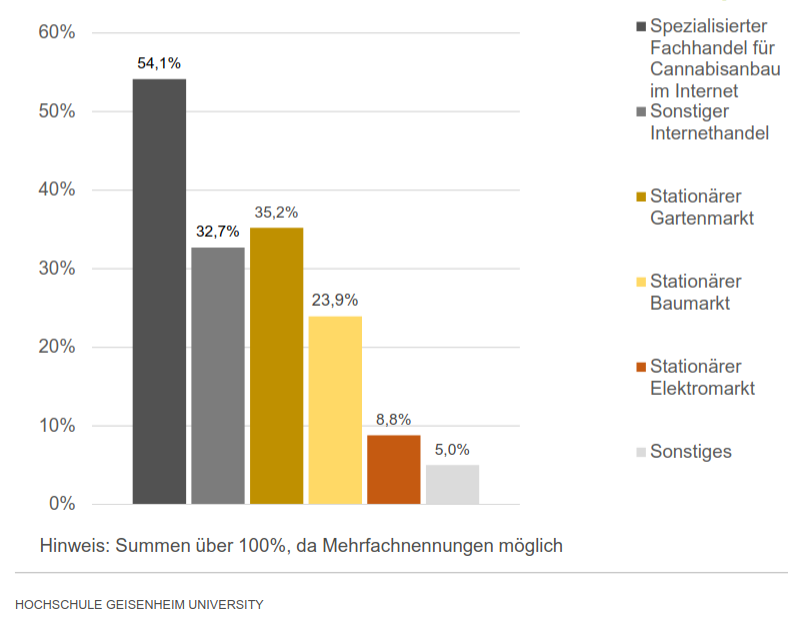
“Growing supplies and seeds were purchased both online and in-store, but specialized online retailers were used most frequently.” stated DHV in its local reporting.

German growing supplies and seeds purchase data

According to DHV’s coverage of the study’s findings, “The median cultivation costs were €30 per plant and €1 per gram of cannabis, which are significantly lower than the prices of cannabis on the black market or medical cannabis in pharmacies.”

A previous YouGov poll in Germany found that 7% of poll participants had already purchased cannabis seeds or cuttings/clones at the time of the polling (May 2024). In addition to the 7% of poll participants indicating that they had already purchased cannabis genetics for their home gardens, another 11% of poll participants responded that they planned to purchase cannabis genetics in the future.

To further economist Beau Whitney’s point mentioned earlier in this article, most of Germany’s cannabis consumer base still relies on the unregulated market. According to data published by Statistisches Bundesamt, Germany’s total population was 84,669,326 at the end of 2023 (the most recent data available). Of that, an estimated 83.1% of the population was of legal cannabis age (18+), or roughly 70.36 million people.

Now, take into consideration data from Germany’s Epidemiological Addiction Survey, which found that roughly 8.8% of Germany’s population reported consuming cannabis at least once within the last year. Applying that percentage to the number of adults in Germany, the total potential legal cannabis consumer base in Germany is nearly 6.2 million people, and that is likely a low-end estimate because presumably some amount of consumers refrained from admitting to the government that they are cannabis consumers out of fear of persecution.

The math is clear – Germany’s legal cannabis market is just scraping the surface from the perspective of gaining potential market share. Until EU agreements are modernized to allow Germany to implement a robust legal commerce model like in Canada, and equally important, domestic German lawmakers adopt such a model when allowed to, the unregulated market will continue to thrive in Germany.

One of the professed goals of German legalization is to sufficiently combat the unregulated market to boost public health outcomes. As demonstrated by a recent data analysis from Canada’s market, consumers and patients will transition to a regulated market when given consistent options to do so, assuming the market provides the types of products that they want.

However, as long as legal purchasing options and product types remain limited in Germany, the European nation will continue to fail at achieving its stated cannabis public policy goals.

Analysis Finds Legal Canadian Cannabis Has Largely Displaced Unregulated Market

A major goal of every jurisdiction that has modernized its cannabis policies to permit adult-use cannabis activity is to help combat the unregulated market, including in Canada, where lawmakers adopted a national recreational cannabis legalization measure in 2018.

Since 2018, Canada has served as the largest legal national adult-use cannabis market and remains the only country on earth where anyone of legal age can make purchases of recreational cannabis products, regardless of their residential status. Uruguay, which adopted national legalization in 2013, still restricts legal adult-use cannabis sales to residents only.

A team of investigators affiliated with academic and research institutions based in Canada, the United States, and the United Kingdom recently analyzed data from Canada’s legal cannabis market and determined that Canadian legalization has resulted in the legal industry largely displacing the nation’s unregulated market.

The researchers’ findings were published in the academic publication International Journal of Drug Policy.

“The current analysis used ‘demand-side’ methods to estimate the size of the Canadian cannabis market using data from two sources.” the researchers stated about their study’s methodology. “First, data from the Canadian Community Health Survey were used to estimate the number of Canadians who use cannabis.”

“Second, data on cannabis expenditures from legal versus illegal sources were analyzed from 5656 past 12-month consumers aged 16–100 who completed national surveys conducted in 2022 as part of the International Cannabis Policy Study.” the researchers also stated.

In a regulated cannabis commerce system, cannabis producers, product manufacturers, and retailers must adhere to certain standards, including stringent testing, which ensures that consumables are fit for human use. The same is not true of the unregulated cannabis market, which creates potential public health outcome issues when patients and consumers make their purchases through unregulated sources.

Additionally, unregulated cannabis sales do not generate revenue for public coffers, and profits from such sales often support organized criminal enterprises, which further adds to the potential for public issues that can affect all members of society. With that in mind, the more market share that a legal, regulated cannabis commerce system can gain, the more it benefits all members of the jurisdiction’s society.

“In the 12-month period ending in September 2022, total cannabis expenditures in Canada were estimated at $6.72 billion dollars, including $5.23 billion from legal sources and $1.49 billion from illegal sources for an estimated legal market capture of 78 %.” the researchers stated about the legal Canadian market’s share of the nation’s cannabis purchases.

“In 2022, dried flower accounted for 55 % of total legal expenditures and an additional 2 % was spent on plants and seeds. Concentrates accounted for 12 % of legal expenditures, followed by oral liquids (11 %), vaping liquids (10 %), and edibles (8 %, excluding drinks).” the researchers also stated.

“The findings provide evidence of substantial transition in expenditures from the illegal to the legal market in the five years since legalization of non-medical cannabis in Canada.” the researchers concluded.

Findings from this data analysis provide valuable insight for lawmakers and regulators in other jurisdictions who desire to effectively combat the unregulated market in their areas, including in European jurisdictions where national adult-use commerce models like Canada’s remain prohibited due to current European Union agreements.

Australia’s Legal Cannabis Growers Urge Support Of Nation’s Producers

Australia’s legal cannabis farmers are banding together and warning the nation’s government of looming “catastrophic failures” and a “bleak reality” for the emerging Australian medicinal cannabis industry. The Australian Cannabis Cultivators Guild, which represents a reported 80% of the nation’s legal medical cannabis producers, is urging Australian lawmakers to reform the nation’s regulations.

The newly formed organization is demanding that the Australian government prioritize domestic producers, stating that Australia’s legal medical cannabis cultivators are at a disadvantage and unable to compete with cheaper imported medical cannabis products due to a rigorous and expensive licensing process.

“Without change, we expect to see catastrophic failures across local cultivators, resulting in bankruptcies which will impact Australian supply in the long term,” the guild wrote, according to local coverage by ABC.

According to a Guild member named Cade Turland, the director at Hale Farm in Tasmania, as reported by ABC, “Australian farmers pay about $50,000 annually to maintain their medicinal cannabis licences, including costs like random and routine inspections, which were between $4,800 and $12,800.”

The Therapeutic Goods Administration, which oversees Australia’s medical cannabis industry, has no fees for a licence or permit to import medicinal cannabis, according to ABC‘s local reporting. Over 61% of medical cannabis products in Australia were imported in 2023.

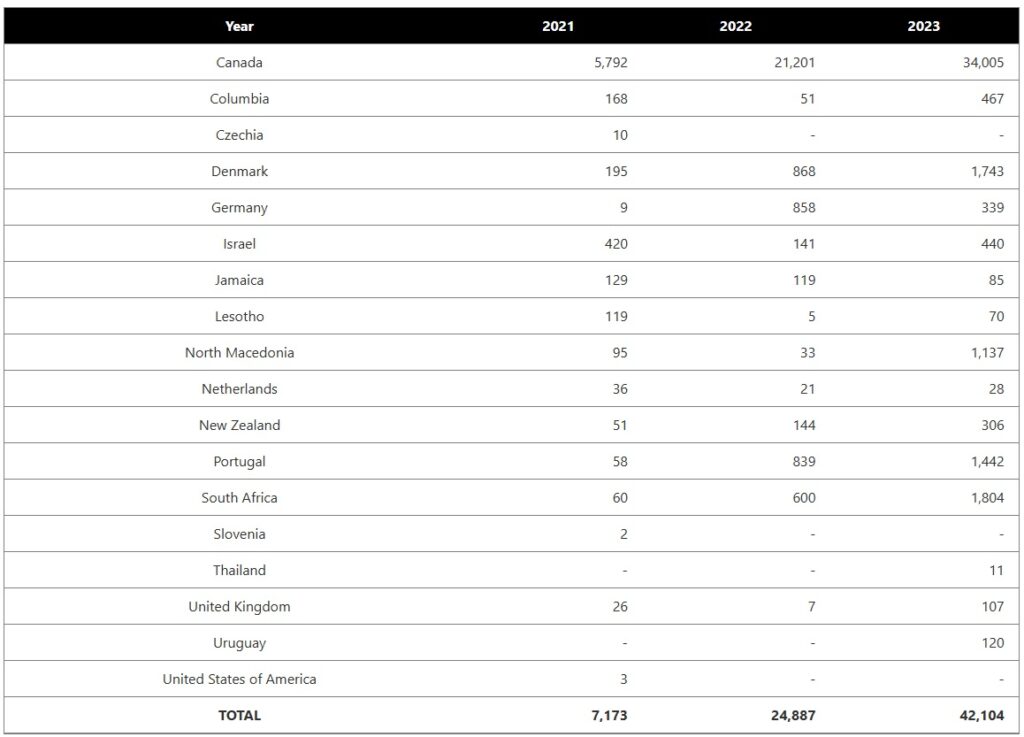
Data from Australia’s government listed Canada as the top source for medical cannabis product imports between 2021 and 2023, with Australia importing 34,005 kilograms of medical cannabis from Canada in 2023. The next closest nation was South Africa at 1,804 kilograms.

Below is a table containing historical Australian government medical cannabis import data broken down by year and originating country:

Australia Cannabis Import Data

By comparison, Australia’s legal medical cannabis producers only exported 1,426 kilograms in 2021, 1,510 kilograms in 2022, and 2,066 kilograms in 2023. In 2023, the most recent year for which government data is available, Australia’s domestic medical cannabis growers produced a total of 26,593 kilograms.

A recent rise in imports from Thailand is further exacerbating the market imbalance, according to Cade Turland of Hale Farm.

“The reality is, the Canadian market is buffered from the global markets because you don’t allow imports,” stated Turland, according to initial reporting by StratCann. “We are the dumping ground of the entire world. We have products here from countries where our wages are ten times higher. We can’t compete with Thailand because their general labour costs are much lower.”

“We’ve definitely come a long way quality-wise, but in the beginning, the reality is we would not have been able to serve Australian patients without Canadian imports. However, it doesn’t take away from the fact that we’re not dealing with a level playing field because of that import ruling on the Canadian side. Australia hasn’t had that luxury.” Turland continued. “But the issues we’re seeing now with countries like Thailand flooding the market, that’s the real concern for us. We’re fine with Canada because it’s been there all along, and you guys ask a fair price for a fair product, but this increased pressure from Thailand’s market is doubling down on how difficult it is to survive here in Australia.”