Industrial Hemp’s Market Potential Is Nearly Double Consumable Cannabis’ Potential

One of the most insightful moments for me at the recent International Cannabis Business Conference in Berlin occurred during leading international cannabis economist Beau Whitney’s presentation. Mr. Whitney, founder of Whitney Economics, provided a keynote address at the event in which he examined a multitude of important industry data points.

As part of his presentation, Beau Whitney compared the market potential of industrial hemp to the market potential for the medical and adult-use cannabis consumables sectors. Industrial hemp has historically been, and continues to be, an important source of material for several large industries.

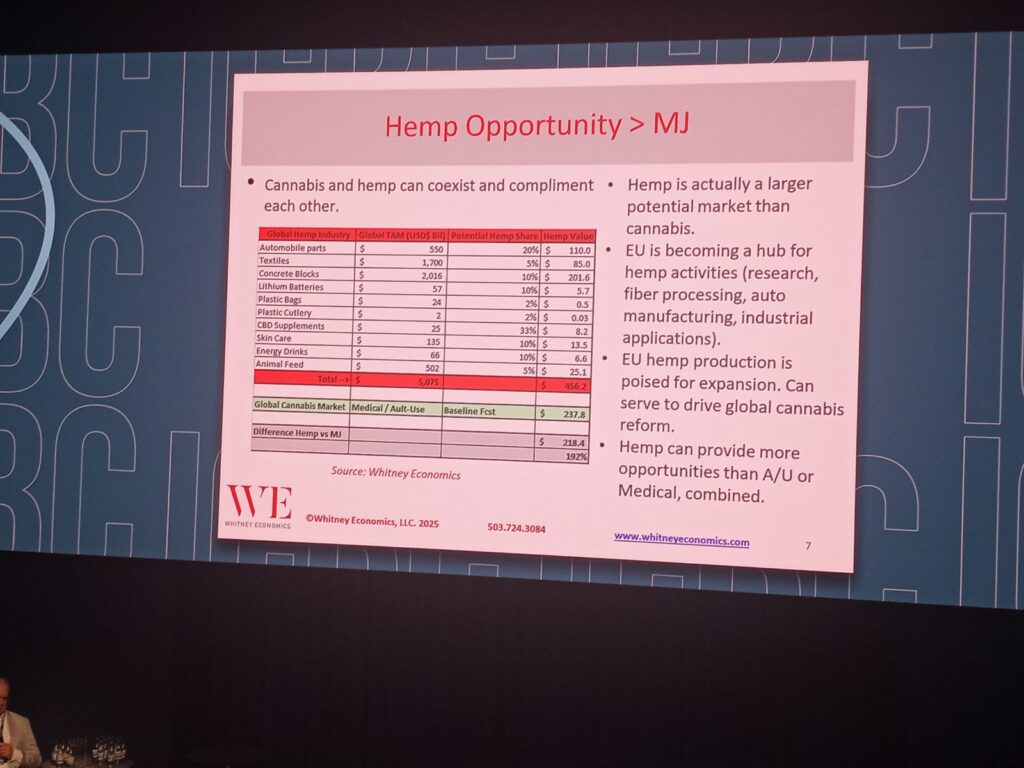
Whitney listed several major industries that currently rely on industrial hemp as a source material, or that may in the future, including the automotive industry, textiles, building materials, batteries, shopping bags, cutlery equipment, health supplements, skin care, energy drinks, and animal feed.

Industrial hemp can also be used for many other purposes, including such things as bioremediation efforts. However, relying on just the previously mentioned large industries and combining hemp’s potential industry share of each of them, Mr. Whitney projected that the value of the global industrial hemp industry could be $456.2 billion.

Whitney compared that market potential to his estimated potential global market value for medical and adult-use cannabis consumables, as seen in the image below:

beau whitney economics hemp opportunities international cannabis business conference berlin 2025

As you can see, Beau Whitney’s estimate for the potential global medical and adult-use cannabis market is roughly $237.8 billion, and the market potential for industrial hemp is about 192% greater in comparison.

Whitney’s presentation slide references the increasing opportunities for industrial hemp in Europe, and many other regions of the world are also experiencing an increase in industrial hemp industry opportunities.

“A new era has begun for Kazakhstan’s agricultural and industrial policy, as the government officially approved the cultivation of industrial hemp and launched a pilot initiative that aims to encourage wider adoption among farmers and manufacturers.” Hemp Today recently reported on the Central Asia nation.

“A source of great anxiety for the cannabis sector, the regulation of hemp cultivation will be published by May 19, confirmed a member of the Ministry of Agriculture and Livestock,” reported Sechat in recent days regarding Brazil’s efforts to boost its domestic industrial hemp industry in South America (translated from Portuguese to English).

On the African continent, Botswana continues to take steps to build its industrial hemp industry, with the nation’s Director of Institute of Energy and Technology Development, Charity Kennedy, recently touting the ‘job creation and environmental healing’ potential of a thriving domestic industrial hemp industry, and that industrial hemp can benefit the nation’s ‘engineering, agriculture, construction, manufacturing, mining rehabilitation, pharmaceuticals, and climate-smart innovations’ industries.

South Africa To Release New Cannabis Food Regulations After Backlash

South Africa is on a short list of countries that have adopted national adult-use cannabis legalization measures, along with Uruguay, Canada, Malta, Luxembourg, and Germany. Courts in other nations have rendered decisions providing consumers and patients some level of protection, however, the previously mentioned list contains the only countries to pass national recreational legalization measures that go beyond low-THC.

Back in March of this year, the Department of Health in South Africa announced a complete ban on cannabis and hemp-derived ‘foodstuffs.’ The announcement was met with considerable outcry from the public and members of South Africa’s emerging legal cannabis industry, resulting in the ban being rescinded.

This week, South Africa’s Health Minister Aaron Motsoaledi reportedly announced that the government department he oversees will publish draft regulations for the sale of cannabis-infused foods soon.

“The initial ban faced significant criticism from experts and industry leaders, particularly for prohibiting cannabis derivatives like hemp, which were not illegal.” reported Business Insider Africa in its local coverage. “Following intervention from President Cyril Ramaphosa, the controversial regulations which have been condemned for lacking public consultation, were ultimately rescinded.”

It is unclear at this time what the new regulations will specifically contain. South Africa’s President signed a limited adult-use cannabis legalization measure into law back in May 2024.

“President Cyril Ramaphosa has signed into law the Cannabis for Private Purposes Act (“CfPPA”). The CfPPA regulates the cultivation, possession, and use of cannabis by adults in a private setting.” The President’s office stated in a press release at the time.

“The consequent regulatory reform enabled by the CfPPA will, amongst others, entirely remove cannabis from the Drugs and Drug Trafficking Act. This will further enable amendment of the Schedules to the Medicines and Related Substances Act and provide for targeted regulatory reform of the Plant Breeders Rights Act and the Plant Improvement Act, as well as other pieces of legislation that require amendment to allow for the industrialisation of the cannabis sector.” the press release also stated.

Back in 2018, South Africa’s Constitutional Court issued a landmark ruling that deemed cannabis prohibition as it pertained to adult individuals to be unconstitutional. The 2018 decision stemmed from a lower court decision in the Western Cape in March 2017, which determined that a ban on cannabis use by adults at home was unconstitutional.

The 2018 decision in South Africa left many unknowns, including how much cannabis a person could cultivate and possess in a private setting. The Court largely punted many policy decisions to lawmakers, with the lawmaking and regulatory processes experiencing several delays before South Africa’s President signed the legalization measure into law roughly one year ago.

Robust Legal Sales Is Vital For Achieving Europe’s Cannabis Goals

The current level of excitement and interest in Europe’s emerging legal cannabis market is remarkable in many ways, as is the interesting public policy model that has developed in Europe in recent years. Whereas current European Union agreements prohibit nationwide adult-use cannabis sales like what is found in Uruguay and Canada, the EU does permit research-based cannabis policies that focus on boosting public health outcomes.

The first European nation to adopt a national adult-use legalization measure was Malta in 2021. Malta’s legalization model is built on allowing adults to cultivate, possess, and consume a personal amount of cannabis in addition to permitting regulated cultivation associations to operate. Malta was followed by Luxembourg in 2023, with Luxembourg adopting a more restrictive model that only permits personal cultivation and possession.

Germany ushered in the next evolution in European cannabis legalization by adopting the historic CanG law in 2024. Germany’s two-pillared approach incorporates personal cultivation and possession freedoms, cultivation associations, and the launch of regional adult-use cannabis commerce pilot trials. The Netherlands and Switzerland also have pilot trials; however, adult-use activity outside of the parameters of the trials remains prohibited in those nations.

In the lead up to Germany adopting the CanG law, German policymakers pushed hard to get the European Union’s permission to let Germany adopt a more comprehensive sales model like what is in place in Canada. In many ways, Germany was not only lobbying on its own behalf, but also on behalf of other European nations that wish to follow in Germany’s policy modernization footsteps.

Unfortunately, the European Union refrained from granting permission for national recreational sales in Germany, thereby limiting the chances of success for Germany and other EU member nations in reaching their cannabis policy goals.

In my ongoing discussions with top European legal cannabis expert Peter Homberg of gunnercooke, he often points out that there are three goals of German cannabis policy modernization efforts. The three goals, which Mr. Homberg touched on in his keynote address on day 1 of the recent International Cannabis Business Conference in Berlin, also extend to other EU markets (paraphrased below):

  1. To protect children.
  2. To boost public health outcomes.
  3. To hinder the unregulated market.

As I have previously stated, the first two items on the above list flow from the third, and success can only be achieved by recognizing the reality that consumers and patients are going to purchase and consume cannabis products, and they must be afforded the legal options to do so. Home cultivation will help alleviate consumer and patient reliance on unregulated sources to a degree, and the same is true for cultivation associations.

However, both of those components of current European legalization models can only go so far. Some amount of consumers and patients will still turn to the unregulated market, either because they do not have the means to cultivate their cannabis at home, or they do not have a sufficient cultivation association option in their area. Even if they do have the ability to cultivate cannabis at home and join a cultivation association, there will no doubt be times when they need to bridge a supply gap.

If they can’t make a legal purchase from a delivery service or brick and mortar, their only option is to turn to the unregulated market. Historical data is clear – most consumers and patients in that situation will not go without, despite what cannabis opponents and certain policymakers would lead people to believe. Until consumers and patients have legal options to purchase the type of cannabis that they prefer, via channels that they prefer, they will continue to turn to the unregulated market, and European cannabis policy modernization goals will never be fully achieved.

Consumers and patients across Europe need to keep the pressure on their policymakers to modernize national laws and EU agreements. They need to educate everyone they can about the harms of cannabis prohibition and the benefits of modernized cannabis policies. Everyone needs to know that cannabis prohibition is a failed public policy, and it harms all members of society, whether they consume cannabis or not. When limited public resources are wasted enforcing failed cannabis prohibition, everyone loses, including taxpayers and members of the criminal justice system.

Individual nations in Europe need to band together and modernize European Union agreements. Additionally, in Germany specifically, domestic policymakers need to allow regional adult-use cannabis commerce pilot trials to proceed. As I previously mentioned, pilot trials are already operating in the Netherlands and Switzerland, and no major issues have been reported. The same will be true in Germany when pilot trials are launched. There is no valid excuse for the continued pilot trial foot-dragging in Germany.

The European Union and European Commission need to recognize that humans are going to consume cannabis, whether it is legal to do so or not. It is clearly better for public health outcomes, taxpayers, local economies, and the criminal justice system when consumers and patients make their cannabis purchases from regulated sources instead of from criminal operations.

European cannabis prohibition has been in place for decades, and it has done nothing to lower consumption rates. All it has done is enrich the unregulated market, much of which is controlled by organized criminal enterprises that do not care about children and public health outcomes. It is beyond time for a more sensible, reality-based public policy approach.

Portugal’s Cannabis Exports Have Nearly Tripled

The legal medical cannabis industry has experienced tremendous growth in recent years, particularly in Europe. One country that is witnessing substantial growth of its emerging medical cannabis industry is Portugal, where cannabis exports are booming.

“According to data provided to ECO by the National Authority for Medicines and Health Products (Infarmed), sales abroad totalled 32,558 kilos, covering cultivation, manufacturing and wholesale trade activities.” reported The Portugal News in its local coverage (translated to English).

“Germany, Spain, Poland, the United Kingdom and Australia were the top five destinations for medical cannabis exports last year. With this year-on-year growth of 172%, which made the volume exceed 65 tons in 2019, the country consolidated its status as the largest European exporter and second in the world, a ranking in which it appears behind only Canada.” the outlet also reported.

One factor that people should have on their radars is the rise of domestic medical cannabis production in major markets, particularly in Germany. As part of the nation’s 2024 CanG law, caps on domestic medical cannabis production were removed in Germany.

It will take time for domestic production to significantly ramp up in Germany, which is Europe’s largest legal medical cannabis market, but once it does, it could impact imports from other countries such as Portugal.

Cannabis is now legal in some form, whether it be for medical use, adult use, or in the form of industrial hemp, in over 115 countries. According to a recent study conducted by researchers from Ukraine and France, and published by the U.S. National Institute of Health, 57 countries have adopted medical cannabis legalization measures.

More Than 1 Out Of Every 7 German Pharmacies Offers Medical Cannabis

Germany has served as the largest legal medical cannabis market in Europe for several years, with cannabis pharmacies being the foundation of Germany’s emerging industry. Legal medical cannabis sales first launched in German pharmacies in 2017.

Since the launch of initial sales, safe access to medical cannabis via Germany’s pharmacies has increased dramatically, as demonstrated by statistics that were included in the German Cannabis Business Association’s (BvCW) most recent newsletter.

“Patients can order cannabis online with a private prescription and have it delivered to their home. Nationwide, around 2,500 of the 17,000 pharmacies now offer medical cannabis,” BvCW stated (translated from German to English). “The industry’s revenue is now estimated at around half a billion euros.”

Having recently traveled to Berlin, Germany, for the International Cannabis Business Conference Week, I witnessed the level of excitement and interest that has engulfed Germany’s emerging medical cannabis industry. Industry members worldwide are clamoring to try to get into the growing German market, and to a lesser extent, other European markets.

Leading international cannabis economist Beau Whitney, founder of Whitney Economics, provided a keynote presentation at the International Cannabis Business Conference in which he highlighted cannabis product import data that helps quantify the level of international interest in Germany’s market:

beau whitney international cannabis business conference 2025 (1)

As large as Germany’s medical cannabis industry is becoming, it is still in the early stages by many measures. Consider the fact that many medical cannabis product sales found in other legal markets, most notably edibles, are not currently permitted in Germany. Only cannabis flower and extracts are being sold in the legal German market.

Cannabis edibles are particularly popular with patients and consumers who would otherwise not consume cannabis. Many consumers and patients prefer edibles and other consumables because they are smokeless cannabis delivery methods.

Typically, when you read about ‘increases in cannabis consumption’ following cannabis policy reform enactment, the increase is due to older individuals who have either never consumed cannabis or are coming back to it after a long hiatus, and their cannabis products of choice are often edibles, drinks, and/or topicals.

To get an idea of what Germany’s industry is currently missing out on when it comes to product variety and availability, consider sales data from the United States. According to a recent article by Honeysuckle Magazine, only 41% of products sold in the U.S. on the cannabis holiday April 20th were for cannabis flower.

Vape products were responsible for 27% of national sales on 4/20, edibles made up 14% of sales, pre-rolls were 10% of sales, and extracts were 6% of sales. The remaining sales were presumably for topical products.

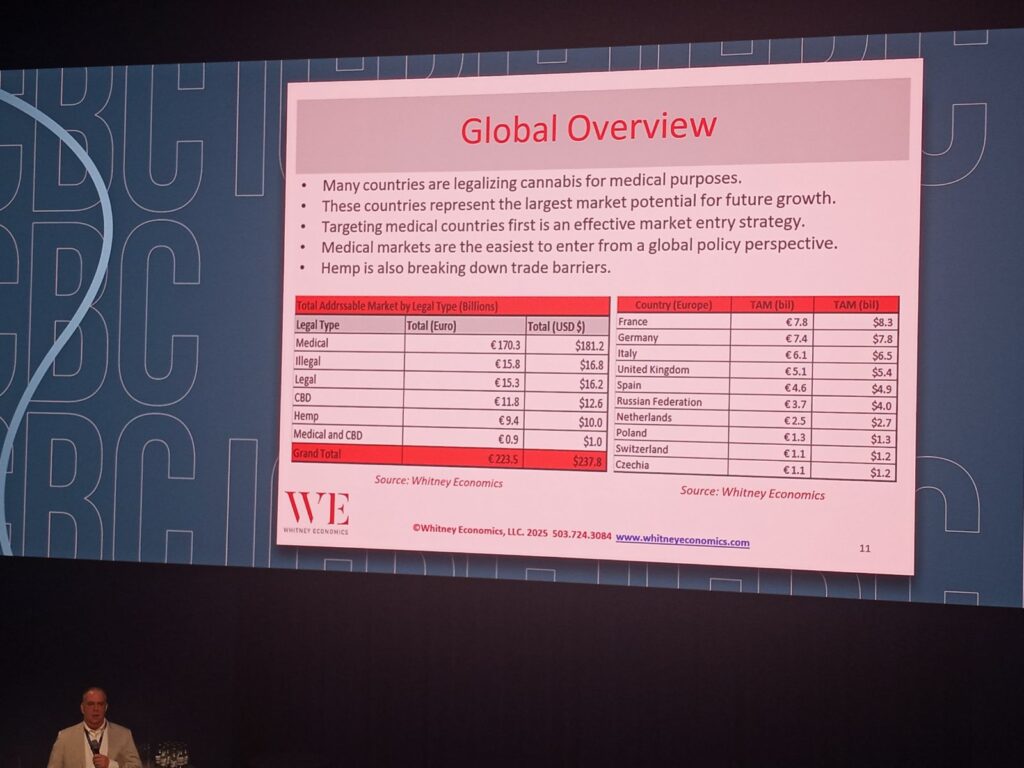
Below is another data chart that Mr. Whitney shared during his presentation in Berlin, which contains the total addressable market for Germany and other European markets. As you can see, the previously cited half a billion euro estimation for Germany’s current industry, referenced earlier in this article, is a mere fraction of the true potential of Germany’s cannabis industry:

beau whitney international cannabis business conference 2025 global market overview

One of the professed goals of German cannabis policy modernization efforts is to sufficiently combat the nation’s unregulated cannabis market to boost public health outcomes. The only way that goal will be achieved is by lawmakers in Europe’s largest market instituting a robust commerce system that allows consumers and patients to legally access the cannabis products that they want to purchase.

Until that happens, the unregulated market in Germany will continue to thrive, the nation will continue to miss out on the economic boost that a sufficient legal market yields, and public health outcomes will pay the price, with consumers and patients making their purchases of untested products from unregulated sources.

One thing is for sure – consumers and patients will not stop consuming cannabis just because such activity is prohibited. History is very clear on that. Lawmakers and regulators in Germany and throughout Europe would be wise to recognize that reality and to pursue sensible, balanced public policies.

Total Number Of German Cultivation Associations Rises To 211

Starting on July 1st, 2024, adults in Germany can apply to launch a member-based cannabis cultivation association. Cultivation associations are a key component of Germany’s adult-use model, and according to a recent newsletter by the German Cannabis Business Association (BvCW), the total number of approved associations has risen to 211.

“So far, out of 624 applications nationwide, 211 have been approved and 25 have been rejected.” stated BvCW in its most recent newsletter (translated from German to English). “A detailed overview can be found on the BCAv website.”

Policymakers and industry members in Germany originally pushed for a national adult-use cannabis legalization model that was broader compared to what is currently in place. However, after discussions and consultations with the European Union, it was determined that nationwide cannabis sales, like what is implemented in Uruguay and Canada, are prohibited under current EU agreements.

What is permitted in EU member nations is the adult-use model that Germany has adopted, which involves permitting personal consumer rights such as the cultivation, possession, and consumption of personal amounts of cannabis, as well as licensing member-based cultivation associations. Both components fall under the ‘boosting public health outcomes’ provisions of the current EU agreements.

Malta also permits cultivation associations as part of its modern adult-use cannabis policy model, and the number of associations there provides some insight into how many cultivation associations may eventually launch in Germany.

Currently, according to the Malta Authority for the Responsible Use of Cannabis’ website, there are 19 ‘cannabis harm reduction associations’ that have obtained an operating permit. It is worth noting that not all of those are dispensing cannabis to members right now, with some still being in the early stages of operation.

Malta has an estimated population of roughly 569,900, which works out to roughly one association for every 29,995 citizens. Germany currently has an estimated population of roughly 84,075,075. If we apply the same association-to-population ratio from Malta to Germany’s population, it would work out to about 2,803 total associations.

There is additional context that must be considered, and Malta and Germany are not an apples-to-apples comparison, so to speak. However, the basic calculation and comparison demonstrate how much potential for growth there is for Germany’s emerging cultivation association sector, at least at a macro level.

Another contextual factor to consider is that Malta’s association numbers are presumably going to rise as time goes on, and are not fixed at 19, so the 2,803 estimate for Germany will likely prove to be a low-end figure.

International Interest In Europe’s Cannabis Market Is Surging

As cannabis entrepreneurs, investors, policymakers, regulators, and industry service providers descended upon Germany in recent days for the International Cannabis Business Conference week, one thing is very evident: worldwide interest in Europe’s emerging legal cannabis market is surging.

I am based in the United States (Oregon), and having spent the last week in Germany surrounded by representatives from nearly every legal cannabis market on earth, and witnessing things on the ground firsthand, I can safely say that Europe’s status as being the most exciting place for cannabis policy and industry is officially here.

People from every corner of the globe are scrambling to gain a meaningful footprint in Germany and other legal markets in Europe, and rightfully so. Europe’s Green Rush era is in full swing.

In a lot of ways, what is happening in Europe right now reminds me of what occurred in the United States from 2012-2016 when the first of our states approved modernized adult-use cannabis laws. As many of us from the U.S. who attended The Talman House and International Cannabis Business Conference events this week in Berlin discussed, it felt like going back in time, and that we were re-watching a movie that we had already seen.

Yet, in other ways, the emergence of the modernized European cannabis industry is completely unique with its own nuances, opportunities, and challenges. There are certainly many components of the legal German cannabis industry’s rise, and to a lesser extent, other European markets, that are similar to what happened in the United States and Canada years ago. But some things are entirely new.

Knowing what the similarities are between North America’s experience and Europe’s, and equally important, what is not similar, is paramount for everyone who wants to succeed. Right now, Europe has the chance to incorporate the best of what has happened in the U.S. and Canadian markets and to learn from North America’s mistakes and failings.

Members of Europe’s legal cannabis community, along with policymakers and regulators, have a golden opportunity to create something better than the world has ever witnessed before. It is up to all of us, from entrepreneurs to investors to government officials, to capitalize on this historic moment and not squander it.

The biggest positive lesson that has come out of the United States and Canada that Europe must learn from is that when given the legal option to do so, consumers and patients will make their purchases from regulated cannabis channels instead of making those purchases from unregulated sources, provided that policies and regulations are sensible.

What constitutes ‘sensible’ is subjective and leaves a lot of room for interpretation. However, we now objectively know that in legal North American markets, robust access to reasonably regulated legal cannabis commerce will decimate the unregulated industry. Consumers and patients clearly prefer to make their purchases from commerce channels that have set hours of operation, on-time delivery and/or storefronts, and tested products. Unregulated sources do not offer any of those things.

Conversely, in North American markets where overburdensome regulations and illogical policies were implemented, the unregulated market continues to thrive. The data is clear that consumers and patients are willing to pay a little extra for regulated products. But there comes a point when regulations and taxes drive up costs to such an extent that it deters legal purchases, at which point people continue to buy their cannabis products from unregulated sources.

In my ongoing discussions with top European legal cannabis expert Peter Homberg of gunnercooke, he often points out that there are three goals of German cannabis policy modernization efforts. The three goals, which Mr. Homberg touched on in his keynote address on day 1 of the International Cannabis Business Conference in Berlin, also extend to other EU markets (paraphrased below):

  1. To protect children.
  2. To boost public health outcomes.
  3. To hinder the unregulated market.

The first two items on the above list flow from the third, and success can only be achieved by recognizing the reality that consumers and patients are going to purchase and consume cannabis products, and they must be afforded the legal options to do so.

European lawmakers and regulators who wish to stick their heads in the sand and act as if prohibition or overburdensome regulations will somehow magically reduce European cannabis consumption do so at their own peril, and at the peril of public health and other outcomes. That is particularly true in Germany, where the launch of regional adult-use cannabis commerce pilot trials has experienced several delays, and where conservative members of the newly elected governing coalition have expressed a desire to scrap pilot trials and other legalization provisions entirely.

Such members of the German governing coalition are, presumably as a political strategy, refusing to recognize a key point – that regional adult-use cannabis commerce pilot trials are not a new thing and are already successfully operating in the Netherlands and Switzerland. Just as the sky has not fallen over those EU nations, the same will prove to be true if the incoming German Minister of Health Nina Warken, and the recently announced Federal Ministry of Food and Agriculture (BMEL) Alois Rainer, allow already-submitted pilot trial applications to proceed.

For an insightful and thorough examination of both Nina Warken and Alois Rainer, both of whom will be instrumental in overseeing Germany’s emerging cannabis industry in the near future, check out a recent article by krautinvest.

A major difference between the North American markets and what is being built in Germany and Europe is the European Union (EU), as well as the EU’s politically independent executive arm, the European Commission (EC). All member nations are bound by EU agreements and EC policies and processes, and while state-level markets in the U.S. operate under the federal umbrella, it is not the same dynamic compared to the EU/EC.

EU agreements prohibit adult-use commerce models found at the state level in the United States and what is in place in Canada at a national level. Medical cannabis commerce is permitted in the European market, but adult-use commerce is limited to models that are based in research and designed to help boost public health outcomes, such as pilot trials and cultivation associations.

Those limitations need to be addressed via continued lobbying of continental decision-makers, and while many of them may be committed to ignoring demands to modernize EU agreements, the demands and pressure must be consistently applied nonetheless.

A significant lesson learned from ongoing policy and regulatory implementation in the United States is that a ‘patchwork’ approach is inefficient and chaotic, and ultimately doesn’t work for anyone. In the U.S., every legal state operates in a siloed fashion, with each jurisdiction having its own laws and regulations, and yet each state is also governed by conflicting federal law.

The same dysfunctional dynamic is on display in the EU to some degree, where individual nations have their own set of industry rules, which are then overlapped by an additional layer of EU-level rules that are either vague, conflicting, or in some cases, outright harmful. It is vital that the EU modernize and harmonize agreements and other policies in such a way that it recognizes reality and provides better certainty for patients, consumers, industry members, and ultimately, governments.

Europe’s cannabis industry and advocacy communities must continue to educate the rest of European society about the benefits of sensible policy modernization and the harms of senseless cannabis prohibition laws and regulations.

All the eyes of the global cannabis community are fixated on what is happening in Germany and other emerging European markets right now, including and especially the eyes of policymakers and regulators. Members of Europe’s emerging industry need to be mindful and strive to be good stewards of the opportunity that is being afforded to them. Germany’s industry and other legal markets in Europe are under a microscope right now, and that will remain the case for the foreseeable future.

I was asked many times while I was in Berlin for the International Cannabis Business Conference week what I consider to be the biggest lesson that entrepreneurs and investors can learn from the U.S., and my answer was always the same: don’t let your emotions get the best of you. Always perform your due diligence and make your decisions based on a sound process that you would apply to any other large, emerging industry.

Cannabis is exciting, and Europe’s industry potential is enormous. But if you don’t anticipate how fierce the competition will be, and recognize that industry success will not involve a straight path, you can lose a lot of money really fast.

I will end this article with a word of caution, as someone who had a front-row seat to how things unfolded in the United States years ago. We are all in this era of European cannabis together, and a single wrong move by one person or entity will no doubt be applied by cannabis opponents to the rest of Europe’s industry.

This special and historic moment in time can never be repeated, and we need to learn from the mistakes made in North America and ensure that things are done right in Europe to help put in place a foundation and framework that will set the stage for years to come. Proceed accordingly.

Austria’s CBD Flower Ban Faces Legal Challenges

Months after it was reportedly determined that dried hemp flowers in Austria with a THC content of up to 0.3% are subject to the country’s tobacco tax and monopoly, the nation’s government is facing ongoing legal challenges from cannabis industry members.

“The Austrian cannabis industry is breathing a sigh of relief after the publication of a constitutional opinion by leading jurist Dr. Heinz Mayer. According to Mayer, the sale of CBD weed with less than 0.3% THC is not subject to the tobacco monopoly, despite earlier reports from the Ministry of Finance. This would allow CBD shops to legally resume the sale of smokable cannabis products.” reported Cannabis Industrie in its original coverage (translated to English).

“Mayer argues that the ruling of the highest administrative court only confirms that CBD weed falls under tobacco excise duty, not under the monopoly itself. According to him, an extension of the tobacco monopoly to cannabis would be in conflict with the Austrian constitution and European law.” the outlet also reported.

According to a previous analysis by the Tax Foundation, Austria places a €3.32 excise duty per 20-pack of tobacco cigarettes. An additional ‘value added tax’ or VAT is also placed on tobacco products, raising the total tax per pack of tobacco cigarettes to €4.23. The Tax Foundation estimates that tax as a share of the final selling price per pack of tobacco cigarettes is 77%.

Regulators across Europe, and many other parts of the world, are struggling to rectify the inconsistencies in laws and regulations on consumable hemp products. For many years, hemp products were largely limited to textiles. However, many savvy entrepreneurs are bringing more consumable hemp products to emerging markets, often referred to as ‘cannabis light,’ and policymakers are scrambling to try to catch up.

According to the Austrian government, sales of cannabis light products must exclusively go through official tobacco shops as long as the sales ban remains in force. Vending machine sales are also prohibited according to the Austrian government.

The Biggest Winners Of German Legalization So Far

More than a year after the first provisions of Germany’s adult-use legalization law took effect, domestic and international cannabis policy and industry observers continue to evaluate the impact of the policy modernization change.

Starting on April 1st, 2024, adults in Germany can cultivate, possess, and consume a personal amount of cannabis. Additionally, cannabis was removed from Germany’s Narcotics List as part of the nation’s CanG law. The changes in German public policy have had a positive effect on society, industry, and government.

“One year of the cannabis law is already a complete success for me, because it’s a year without criminalization and unnecessary persecution. Access to support services has been made easier, and there’s more education going on, which is precisely one of the health policy goals. The fact that cannabis clubs are now also emerging shows that there’s a movement here as well. This will noticeably reduce the black market, similar to home cultivation.” stated Dirk Heidenblut (former member of the Bundestag), according to Merkur (translated from German to English).

Earlier this month, the new governing coalition in Germany announced that, at least for the time being, there will be no changes to the CanG law. Evaluations of German cannabis policy and regulations will be ongoing, but the coalition’s announcement was welcomed news for cannabis advocates and industry members.

The coalition announcement comes after polling found little support for a CanG reversal. A recent YouGov poll has found that a minority (38%) of the nation’s citizens support reversing German adult-use cannabis legalization.

Additionally, according to the results of a Forsa survey commissioned by the KKH Kaufmännische Krankenkasse, 55% of surveyed Germans do not want to repeal the nation’s CanG adult-use legalization law. Only 36% of the Forsa survey respondents indicated that they want to repeal legalization, with the rest being undecided.

Arguably, the biggest winner of German adult-use legalization so far is the nation’s medical cannabis industry and the patients it serves. According to a recent report by the Bloomwell Group, prescriptions for medical cannabis in Germany increased by roughly 1,000% between March 2024 and December 2024. The report also found that prices for medical cannabis products are decreasing in Europe’s largest medical cannabis market.

During the first three full months following Germany’s enactment of the CanG adult-use legalization law (Q3 2024), legal medical cannabis imports increased by over 70% compared to the previous period.

Another major winner is Germany’s home cultivation sector. According to a recent survey by the German Cannabis Business Association (BvCW), consumers reported that ‘seeds and accessories (e.g. grow box sets) for home cultivation and cannabis flowers, followed by humidity regulators for storing cannabis,’ were the most frequently sold out items in their area.

Adult consumers, German courts and law enforcement, and ultimately German taxpayers, have all greatly benefited from the CanG law. Consumers no longer face prosecution for personal cannabis activity, the nation’s court system is no longer jammed up with needless cannabis consumer cases, German law enforcement is freed up to focus on fighting real crime, and taxpayers no longer have to foot the bill for enforcing harmful, ineffective cannabis consumer prohibition policies.

The Institute for Competition Economics at the Heinrich Heine University in Düsseldorf previously conducted an analysis that found that adult-use legalization could yield as much as 1.3 billion euros per year in savings for Germany’s police and judicial system.

Germany’s legalization model is not perfect, and advocates must continue to push for improvements. With that being said, the CanG law is clearly better than cannabis prohibition, and it is superior to other policies in place in other European nations.