Armenia’s Parliament Speaker Says Cannabis Should Be Legalized

Alen Roberti Simonyan has been President of the National Assembly of Armenia since August 2021. During his recent participation in the Deep TALKS program, Mr. Simonyan expressed support for modernizing Armenia’s cannabis laws.

“Today the world is unable to fight marijuana, and that is why it is on the path of legalization to take it under control,” Alen Roberti Simonyan stated, according to original reporting by News.am.

“He explained that he does not initiate the legalization process, as he “knows that he will not be able to convince people.”” the outlet also reported. Currently, cannabis is prohibited in Armenia. Individuals caught with cannabis face stiff penalties.

According to the European Union Drugs Agency’s database listing for drug laws and penalties in Armenia, “Using drugs without a doctor’s prescription may be punished by an administrative fine of 100-200 times the minimum wage.” Certain cannabis offenses in Armenia can also result in potential prison sentences.

Cannabis is currently legal for adult use at a national level in Uruguay, Canada, Malta, Luxembourg, Germany, and South Africa. Recreational cannabis is also legal for adults in two dozen states in the U.S., and regional adult-use cannabis commerce pilot trials are operating in the Netherlands and Switzerland. Court decisions in multiple other countries afford some level of legal protection to adult cannabis consumers.

Dozens of countries around the world have adopted varying forms of medical cannabis legalization, ranging from cannabidiol-only medical cannabis models to fully legalized medical cannabis programs. Most countries around the globe permit industrial hemp.

South Africa To Release New Cannabis Food Regulations After Backlash

South Africa is on a short list of countries that have adopted national adult-use cannabis legalization measures, along with Uruguay, Canada, Malta, Luxembourg, and Germany. Courts in other nations have rendered decisions providing consumers and patients some level of protection, however, the previously mentioned list contains the only countries to pass national recreational legalization measures that go beyond low-THC.

Back in March of this year, the Department of Health in South Africa announced a complete ban on cannabis and hemp-derived ‘foodstuffs.’ The announcement was met with considerable outcry from the public and members of South Africa’s emerging legal cannabis industry, resulting in the ban being rescinded.

This week, South Africa’s Health Minister Aaron Motsoaledi reportedly announced that the government department he oversees will publish draft regulations for the sale of cannabis-infused foods soon.

“The initial ban faced significant criticism from experts and industry leaders, particularly for prohibiting cannabis derivatives like hemp, which were not illegal.” reported Business Insider Africa in its local coverage. “Following intervention from President Cyril Ramaphosa, the controversial regulations which have been condemned for lacking public consultation, were ultimately rescinded.”

It is unclear at this time what the new regulations will specifically contain. South Africa’s President signed a limited adult-use cannabis legalization measure into law back in May 2024.

“President Cyril Ramaphosa has signed into law the Cannabis for Private Purposes Act (“CfPPA”). The CfPPA regulates the cultivation, possession, and use of cannabis by adults in a private setting.” The President’s office stated in a press release at the time.

“The consequent regulatory reform enabled by the CfPPA will, amongst others, entirely remove cannabis from the Drugs and Drug Trafficking Act. This will further enable amendment of the Schedules to the Medicines and Related Substances Act and provide for targeted regulatory reform of the Plant Breeders Rights Act and the Plant Improvement Act, as well as other pieces of legislation that require amendment to allow for the industrialisation of the cannabis sector.” the press release also stated.

Back in 2018, South Africa’s Constitutional Court issued a landmark ruling that deemed cannabis prohibition as it pertained to adult individuals to be unconstitutional. The 2018 decision stemmed from a lower court decision in the Western Cape in March 2017, which determined that a ban on cannabis use by adults at home was unconstitutional.

The 2018 decision in South Africa left many unknowns, including how much cannabis a person could cultivate and possess in a private setting. The Court largely punted many policy decisions to lawmakers, with the lawmaking and regulatory processes experiencing several delays before South Africa’s President signed the legalization measure into law roughly one year ago.

Swiss Study Finds Legal Cannabis Access Reduces ‘Problematic Consumption’

Roughly two years ago, Switzerland launched what was then a unique approach to science-based cannabis commerce research. The European nation launched the first of what has eventually become a series of regional adult-use cannabis commerce pilot trials, which involve permitting local production and sales of recreational cannabis products. Pilot trials now also operate in the Netherlands and are part of Germany’s legalization model, although pilot trials have yet to launch in Germany due to various reasons.

Whereas current European Union agreements prohibit national adult-use cannabis sales like those found in Canada, the agreements do permit member nations to conduct research that is focused on improving public health outcomes, which is the goal of pilot research trials. Pilot trials are aimed at gathering data and insight at a local level to help lawmakers and regulators be better suited when crafting national policies.

An interdisciplinary research team affiliated with the Addiction Department of the Department of Health of the Canton of Basel-Stadt, the University of Basel, the University Psychiatric Clinics Basel (UPK), and Psychiatric Services Aargau recently published findings from a study that relied on data from the Weed Care pilot trial project in Switzerland.

The study’s findings, which are the first academic reporting of its kind, were published on the University of Basel’s website in addition to being published in the academic journal Addiction.

“We measured the effects of public health-oriented cannabis access compared with the illegal market on cannabis use and related mental health outcomes in adult cannabis users.” the researchers stated about their study. “This was a two-arm, parallel group, open-label, randomized controlled trial. Follow-up outcome measurement took place after 6 months.”

“The primary outcome was self-reported severity of cannabis misuse after 6 months, as measured by the Cannabis Use Disorders Identification Test – Revised (range 0–32). Secondary outcomes involved depressive, anxiety, and psychotic symptoms, cannabis consumption amount, alcohol, and drug use.” the researchers wrote regarding their investigation’s measurements.

“Public health-oriented recreational cannabis access may decrease cannabis use and cannabis-related harms, especially among those using other drugs.” the researchers concluded.

A common talking point among cannabis opponents is that legal access to adult-use cannabis products will increase problematic cannabis use in society. This study’s findings contradict that claim. Another common talking point among opponents is the claim that legal cannabis use will lead to a decline in mental health among consumers. This Switzerland study also provided findings that addressed that claim.

“Furthermore, the study was able to dispel fears that legalization could exacerbate the psychopathological symptoms associated with cannabis consumption in addition to consumption itself: after the first six months, there was no difference between the two study groups in terms of depression, anxiety or other symptoms.” stated the University of Basel on its website.

“The interim assessment after two years of study shows a significant improvement in the mental state of the approximately 300 or so participants who are still taking part.” the University also wrote.

“There has never been a controlled, randomized study like this before,” emphasizes Dr. Lavinia Baltes-Flückiger, deputy head of the study at the Psychiatric Services Aargau and lead author of the study, according to the University of Basel’s reporting.

Earlier this year, Marijuana Moment reported that a government-commissioned report found that  Switzerland’s adult-use cannabis legalization pilot program is “running smoothly,” with “no indication of any disturbances to public order.”

“About two years after the pilot program launched in seven municipalities across the country, the Federal Office of Public Health (FOPH) study—carried out by the University of Lausanne and the University of Applied Sciences Northwestern Switzerland—generally determined that the initiative has been a success.” the outlet also reported.

Previously published government data from the United States found that in jurisdictions where adult-use cannabis legalization was adopted, consumption rates among minors had reduced post-legalization compared to pre-legalization. The results of a Canadian study that was published last month found that while reported overall cannabis use in Canadian society increased post-legalization, “misuse decreased.”

Robust Legal Sales Is Vital For Achieving Europe’s Cannabis Goals

The current level of excitement and interest in Europe’s emerging legal cannabis market is remarkable in many ways, as is the interesting public policy model that has developed in Europe in recent years. Whereas current European Union agreements prohibit nationwide adult-use cannabis sales like what is found in Uruguay and Canada, the EU does permit research-based cannabis policies that focus on boosting public health outcomes.

The first European nation to adopt a national adult-use legalization measure was Malta in 2021. Malta’s legalization model is built on allowing adults to cultivate, possess, and consume a personal amount of cannabis in addition to permitting regulated cultivation associations to operate. Malta was followed by Luxembourg in 2023, with Luxembourg adopting a more restrictive model that only permits personal cultivation and possession.

Germany ushered in the next evolution in European cannabis legalization by adopting the historic CanG law in 2024. Germany’s two-pillared approach incorporates personal cultivation and possession freedoms, cultivation associations, and the launch of regional adult-use cannabis commerce pilot trials. The Netherlands and Switzerland also have pilot trials; however, adult-use activity outside of the parameters of the trials remains prohibited in those nations.

In the lead up to Germany adopting the CanG law, German policymakers pushed hard to get the European Union’s permission to let Germany adopt a more comprehensive sales model like what is in place in Canada. In many ways, Germany was not only lobbying on its own behalf, but also on behalf of other European nations that wish to follow in Germany’s policy modernization footsteps.

Unfortunately, the European Union refrained from granting permission for national recreational sales in Germany, thereby limiting the chances of success for Germany and other EU member nations in reaching their cannabis policy goals.

In my ongoing discussions with top European legal cannabis expert Peter Homberg of gunnercooke, he often points out that there are three goals of German cannabis policy modernization efforts. The three goals, which Mr. Homberg touched on in his keynote address on day 1 of the recent International Cannabis Business Conference in Berlin, also extend to other EU markets (paraphrased below):

  1. To protect children.
  2. To boost public health outcomes.
  3. To hinder the unregulated market.

As I have previously stated, the first two items on the above list flow from the third, and success can only be achieved by recognizing the reality that consumers and patients are going to purchase and consume cannabis products, and they must be afforded the legal options to do so. Home cultivation will help alleviate consumer and patient reliance on unregulated sources to a degree, and the same is true for cultivation associations.

However, both of those components of current European legalization models can only go so far. Some amount of consumers and patients will still turn to the unregulated market, either because they do not have the means to cultivate their cannabis at home, or they do not have a sufficient cultivation association option in their area. Even if they do have the ability to cultivate cannabis at home and join a cultivation association, there will no doubt be times when they need to bridge a supply gap.

If they can’t make a legal purchase from a delivery service or brick and mortar, their only option is to turn to the unregulated market. Historical data is clear – most consumers and patients in that situation will not go without, despite what cannabis opponents and certain policymakers would lead people to believe. Until consumers and patients have legal options to purchase the type of cannabis that they prefer, via channels that they prefer, they will continue to turn to the unregulated market, and European cannabis policy modernization goals will never be fully achieved.

Consumers and patients across Europe need to keep the pressure on their policymakers to modernize national laws and EU agreements. They need to educate everyone they can about the harms of cannabis prohibition and the benefits of modernized cannabis policies. Everyone needs to know that cannabis prohibition is a failed public policy, and it harms all members of society, whether they consume cannabis or not. When limited public resources are wasted enforcing failed cannabis prohibition, everyone loses, including taxpayers and members of the criminal justice system.

Individual nations in Europe need to band together and modernize European Union agreements. Additionally, in Germany specifically, domestic policymakers need to allow regional adult-use cannabis commerce pilot trials to proceed. As I previously mentioned, pilot trials are already operating in the Netherlands and Switzerland, and no major issues have been reported. The same will be true in Germany when pilot trials are launched. There is no valid excuse for the continued pilot trial foot-dragging in Germany.

The European Union and European Commission need to recognize that humans are going to consume cannabis, whether it is legal to do so or not. It is clearly better for public health outcomes, taxpayers, local economies, and the criminal justice system when consumers and patients make their cannabis purchases from regulated sources instead of from criminal operations.

European cannabis prohibition has been in place for decades, and it has done nothing to lower consumption rates. All it has done is enrich the unregulated market, much of which is controlled by organized criminal enterprises that do not care about children and public health outcomes. It is beyond time for a more sensible, reality-based public policy approach.

How Common Is Legal Home Cannabis Cultivation In Germany?

Starting on April 1st, 2024, adults in Germany can cultivate up to three plants in their private residences. Before the public policy change and enactment of the nation’s CanG law, cultivating cannabis in Germany was a criminal offense. Home cultivation is one of the major components of Germany’s legalization model.

Until recently, it was largely unclear how many adults in Germany were taking advantage of their new, sensible home cultivation freedom. The results of a new scientific study, led by Dr. Mira Lehberger and Prof. Dr. Kai Sparke from the Department of Horticultural Economics at Geisenheim University, provide insight into how popular home cultivation is in Germany post-legalization.

The scientific study involved a survey, conducted in December 2024, of 1,500 adults. Study participants were selected from “an existing panel to ensure representation of all age groups and regions of origin (both federal states and urban/rural)” according to initial reporting by Deutscher Hanfverband (DHV), and subjects were divided ‘roughly equally’ between men and women.

Below are key findings from the study:

  • 47% of survey respondents expressed support for legal home cultivation
  • 46.3% indicated agreement with the statement “The legalization of private cannabis cultivation reduces illegal activities in Germany.”
  • 44% of participants see legal home cultivation as ‘an opportunity for better quality control’
  • 41.1% see legal home cultivation as ‘an opportunity for greater sustainability’
  • One in ten participants indicated that they had already legally cultivated cannabis post-legalization
  • 11% of participants who had not cultivated cannabis ‘could imagine’ doing so in the future
  • A majority of participants who stated they had cultivated legal cannabis were male (58.5%)

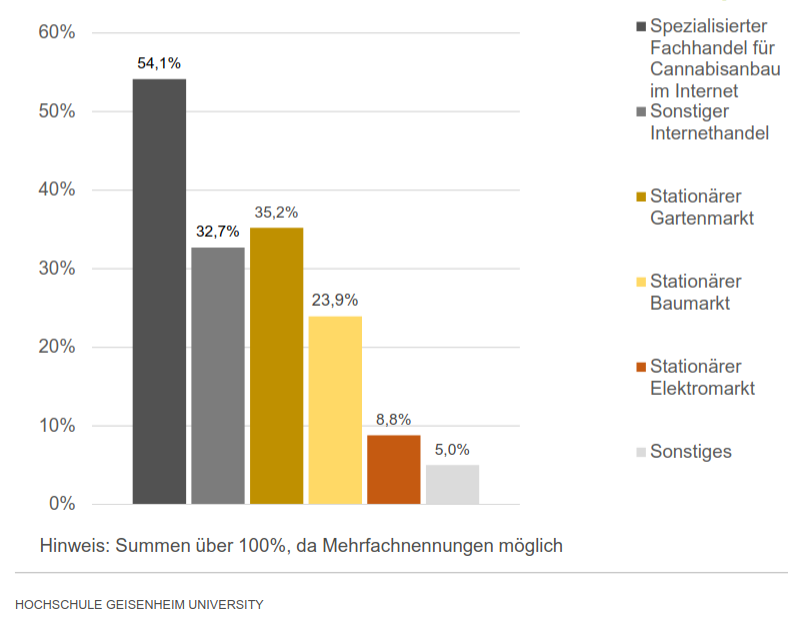
“Growing supplies and seeds were purchased both online and in-store, but specialized online retailers were used most frequently.” stated DHV in its local reporting.

German growing supplies and seeds purchase data

According DHV’s coverage of the study’s findings, “The median cultivation costs were €30 per plant and €1 per gram of cannabis, which are significantly lower than the prices of cannabis on the black market or medical cannabis in pharmacies.”

A previous YouGov poll in Germany found that 7% of poll participants had already purchased cannabis seeds or cuttings/clones at the time of the polling (May 2024). In addition to the 7% of poll participants indicating that they had already purchased cannabis genetics for their home gardens, another 11% of poll participants responded that they planned to purchase cannabis genetics in the future.

Home cultivation provides consumers with numerous benefits, not the least of which is controlling what goes into cultivating the cannabis that they consume. By producing their own cannabis, consumers know exactly what the harvested cannabis contains. Furthermore, home cultivation provides cost savings for experienced home cultivators, as the results of the recent scientific study demonstrate.

Cannabis opponents in Germany are continuing to push for a reversal of the nation’s cannabis legalization law, particularly when it comes to home cultivation. Demands by opponents fail to recognize, either purposefully or out of ignorance, that cannabis is going to be produced in Germany regardless of whether it is legal or not. Allowing personal home cultivation is a more sensible approach to public policy and frees up the nation’s criminal justice system to focus on fighting real crime.

Home cannabis cultivation by adults for recreational purposes is also legal in Uruguay, Canada, Malta, Luxembourg, South Africa, and in many local jurisdictions in the United States. Major court decisions in other nations also provide some level of protection for adults cultivating personal amounts of cannabis.

Cannabis DUI Laws Must Be Based On Science, Not Political Fearmongering

If there is one area of public policy that cannabis opponents and responsible cannabis advocates can agree on, at least at a macro level, it is that people should not operate a motor vehicle on a public roadway when impaired by cannabis use. Public roadways should remain safe at all times, and that extends to all forms of substance impairment, not just cannabis.

Unfortunately, cannabis opponents and advocates diverge when it comes to the details of what driving under the influence (DUI) of cannabis enforcement should entail. Cannabis opponents typically fall into one of two cannabis DUI enforcement camps.

The first is a zero-tolerance approach in which any amount of tetrahydrocannabinol (THC) in a person’s system results in a penalty, including THC that entered the person’s system weeks or months ago and has long since metabolized.

A second approach that is called for, both by opponents and policymakers who do not have a solid understanding of cannabis, is to have a per se limit. Per se limits involve a set threshold similar to what is in place for alcohol. Using the United States as an example, the per se threshold for alcohol is a .08 blood alcohol level. If someone is found to be above that threshold, they are automatically charged with a DUI.

Both of the previously mentioned approaches to cannabis DUI enforcement are flawed for multiple reasons due to what cannabis impairment involves and how human biology works as it pertains to cannabis consumption. Implementing either model is bad for consumers, taxpayers, and ultimately bad for governments, including members of law enforcement and courts who have to oversee the flawed approaches to cannabis DUI enforcement.

The obvious goal when it comes to effective cannabis DUI enforcement is to deter impaired drivers from operating a motor vehicle on public roadways and to penalize truly impaired people. Lawmakers must recognize that there is no one-size-fits-all answer to ‘how long is someone impaired after using cannabis’ and implement laws and rules that calculate for that fact.

In 2021, a team of researchers affiliated with the Lambert Initiative for Cannabinoid Therapeutics at the University of Sydney (among others) conducted a comprehensive analysis involving 80 scientific studies to identify the ‘window of impairment’ for cannabis. The researchers’ findings were published in the academic journal Neuroscience & Biobehavioral Reviews.

“The increasing legal availability of cannabis has important implications for road safety. This systematic review characterised the acute effects of Δ9-THC on driving performance and driving-related cognitive skills, with a particular focus on the duration of Δ9-THC-induced impairment. Eighty publications and 1534 outcomes were reviewed.” the investigators stated about their research.

“Several measures of driving performance and driving-related cognitive skills (e.g. lateral control, tracking, divided attention) demonstrated impairment in meta-analyses of “peak” Δ9-THC effects (p’s<0.05). Multiple meta-regression analyses further found that regular cannabis users experianced less impairment than ‘other’ (mostly occasional) cannabis users (p = 0.003) and that the magnitude of oral (n = 243 effect estimates [EE]) and inhaled (n = 481 EEs) Δ9-THC-induced impairment depended on various factors (dose, post-treatment time interval, the performance domain (skill) assessed) in other cannabis users (p’s<0.05).” the researchers also stated.

“The latter model predicted that most driving-related cognitive skills would ‘recover’ (Hedges’ g=–0.25) within ∼5-hs (and almost all within ∼7-hs) of inhaling 20 mg of Δ9-THC; oral Δ9-THC-induced impairment may take longer to subside. These results suggest individuals should wait at least 5 -hs following inhaled cannabis use before performing safety-sensitive tasks.” the researchers concluded.

The study’s results demonstrate that just because someone has THC in their system, it doesn’t automatically equate to the person being impaired at the time of the testing. It is individual and situation-specific and depends on many factors.

Furthermore, the study also demonstrates that more frequent cannabis consumers are less impaired than infrequent consumers when the same amount of cannabis is consumed due to varying tolerance levels.

That latter part is particularly problematic for per se DUI laws because per se laws disproportionately penalize frequent consumers who are less likely to be actually impaired, yet almost always test above the per se THC threshold. Meanwhile, infrequent cannabis users who are more easily impaired and may pose a true danger to public roadways often test below the per se limit because they do not have the built-up metabolized THC in their systems compared to frequent users.

In laypeople’s terms, per se limits often penalize people who are not impaired, while simultaneously often failing to catch the people who are actually impaired. In addition to that being illogical and dangerous, per se laws can have negative impacts on a nation’s criminal justice system by wasting the time of law enforcement and courts with challenged cases often being disaffirmed once they are adjudicated. Those cases are a waste of law enforcement’s time, the courts’ time, and a waste to taxpayers.

A per se limit makes sense for alcohol because of how the body metabolizes alcohol. Whereas consumed alcohol is typically detected in a person’s bodily fluids for 1-3 days, cannabis can stay in a person’s system for as long as 100 days, long after impairment has worn off. Per the previously cited study from the University of Sydney, cannabis impairment lasts for 3-10 hours, depending on the consumer.

Should people who consume alcohol on the first day of the year be charged with a DUI several weeks or even months later? Of course not. Assuming that they refrained from consuming alcohol again after that first day of the year, the impairment had long since subsided. However, that is basically what is happening when the same principle is applied to cannabis due to how the human body metabolizes THC and how long THC stays in a person’s system.

Per se THC limit policies and zero-tolerance THC limit policies are not based on sound science. Policymakers who push for them are either basing their opinions on political fearmongering or a lack of knowledge about how cannabis consumption and human biology actually work (or both).

The rise of the consumption of cannabidiol (CBD) products has created another problem for policymakers, law enforcement, courts, and taxpayers. CBD use is not associated with impairment for the purpose of DUI enforcement. However, quality cannabidiol products typically contain trace amounts of THC, and if someone consumes enough CBD products containing those trace amounts of THC, the THC can build up in a person’s system over time.

If tested, the person in that situation will violate a zero-tolerance DUI law, and possibly a per se DUI law depending on the THC threshold involved, even though the person was presumably never impaired at any time. DUI public policy and enforcement are far more nuanced than many people may think, and that is why it needs to be based on science, and not based on political fearmongering and/or ignorance.

The best approach to cannabis DUI enforcement is a comprehensive approach involving field sobriety tests and situation-specific circumstances. Law enforcement should be allowed the flexibility to consider all of the factors, including whether the driver truly appears to be intoxicated or not, there is the presence of obvious recent cannabis use, etc.

Conversely, the accused must always have the right to proper due process and be able to appeal their charge(s) if they feel that they are being falsely accused. The facts and science should lead the way, ensuring that the right determination is made regarding whether the driver was truly impaired at the time of the incident.

Just because someone has metabolized THC in their system does not automatically mean that they were impaired at the time of testing, just as someone testing below an arbitrary THC per se threshold does not automatically mean that they were not impaired at the time.

Those approaches should be coupled with robust government and industry-led awareness campaigns that educate patients and consumers about the facts of driving under the influence of cannabis. Part of those education efforts should harness advanced technology to help patients and consumers determine ahead of time if they are impaired, such as the development of apps that incorporate questionnaires about the type and amount of use involved, individual criteria, such as how often the person consumes cannabis, and various activities to help the app gauge the person’s reaction time and other useful information.

As with most things cannabis-related, we are all in this together. Responsible cannabis advocates should want to keep themselves and others safe, governments should want to make efficient use of limited public resources, and members of the industry should want patients and consumers to consume cannabis responsibly.

Advocates Rally In Mexico City To Demand Cannabis Reform

Cannabis reform advocates held a rally in Mexico City, Mexico over the weekend, demanding that the nation’s government modernize Mexico’s cannabis policies and regulations to expressly permit personal recreational cannabis activity.

“Thousands of people flooded the streets of Mexico City this weekend demanding free access to marijuana and cannabis.” reported 7 News Miami in its original coverage. “Protesters who took part in Saturday’s demonstration also demanded having the ability to grow it for personal use and for legal harassment of using it to end.”

The effort to modernize Mexico’s cannabis policies has taken many turns in recent years. Back in June 2021, Mexico’s Supreme Court ruled in an 8-3 decision that the prohibition of private recreational use of cannabis by adults was unconstitutional.

“Today is a historic day for liberties,” Supreme Court president Arturo Zaldívar said at the time. The Court’s decision did not extend to recreational cannabis commerce, and consuming cannabis in public remained prohibited in Mexico.

Part of the Court’s decision tasked lawmakers in Mexico with introducing, approving, and implementing an adult-use cannabis legalization model that included expressed limits for private adult-use activity and regulated sales. However, political leaders in Mexico have continued to fail to codify those public policy changes.

Total Number Of German Cultivation Associations Rises To 211

Starting on July 1st, 2024, adults in Germany can apply to launch a member-based cannabis cultivation association. Cultivation associations are a key component of Germany’s adult-use model, and according to a recent newsletter by the German Cannabis Business Association (BvCW), the total number of approved associations has risen to 211.

“So far, out of 624 applications nationwide, 211 have been approved and 25 have been rejected.” stated BvCW in its most recent newsletter (translated from German to English). “A detailed overview can be found on the BCAv website.”

Policymakers and industry members in Germany originally pushed for a national adult-use cannabis legalization model that was broader compared to what is currently in place. However, after discussions and consultations with the European Union, it was determined that nationwide cannabis sales, like what is implemented in Uruguay and Canada, are prohibited under current EU agreements.

What is permitted in EU member nations is the adult-use model that Germany has adopted, which involves permitting personal consumer rights such as the cultivation, possession, and consumption of personal amounts of cannabis, as well as licensing member-based cultivation associations. Both components fall under the ‘boosting public health outcomes’ provisions of the current EU agreements.

Malta also permits cultivation associations as part of its modern adult-use cannabis policy model, and the number of associations there provides some insight into how many cultivation associations may eventually launch in Germany.

Currently, according to the Malta Authority for the Responsible Use of Cannabis’ website, there are 19 ‘cannabis harm reduction associations’ that have obtained an operating permit. It is worth noting that not all of those are dispensing cannabis to members right now, with some still being in the early stages of operation.

Malta has an estimated population of roughly 569,900, which works out to roughly one association for every 29,995 citizens. Germany currently has an estimated population of roughly 84,075,075. If we apply the same association-to-population ratio from Malta to Germany’s population, it would work out to about 2,803 total associations.

There is additional context that must be considered, and Malta and Germany are not an apples-to-apples comparison, so to speak. However, the basic calculation and comparison demonstrate how much potential for growth there is for Germany’s emerging cultivation association sector, at least at a macro level.

Another contextual factor to consider is that Malta’s association numbers are presumably going to rise as time goes on, and are not fixed at 19, so the 2,803 estimate for Germany will likely prove to be a low-end figure.

International Interest In Europe’s Cannabis Market Is Surging

As cannabis entrepreneurs, investors, policymakers, regulators, and industry service providers descended upon Germany in recent days for the International Cannabis Business Conference week, one thing is very evident: worldwide interest in Europe’s emerging legal cannabis market is surging.

I am based in the United States (Oregon), and having spent the last week in Germany surrounded by representatives from nearly every legal cannabis market on earth, and witnessing things on the ground firsthand, I can safely say that Europe’s status as being the most exciting place for cannabis policy and industry is officially here.

People from every corner of the globe are scrambling to gain a meaningful footprint in Germany and other legal markets in Europe, and rightfully so. Europe’s Green Rush era is in full swing.

In a lot of ways, what is happening in Europe right now reminds me of what occurred in the United States from 2012-2016 when the first of our states approved modernized adult-use cannabis laws. As many of us from the U.S. who attended The Talman House and International Cannabis Business Conference events this week in Berlin discussed, it felt like going back in time, and that we were re-watching a movie that we had already seen.

Yet, in other ways, the emergence of the modernized European cannabis industry is completely unique with its own nuances, opportunities, and challenges. There are certainly many components of the legal German cannabis industry’s rise, and to a lesser extent, other European markets, that are similar to what happened in the United States and Canada years ago. But some things are entirely new.

Knowing what the similarities are between North America’s experience and Europe’s, and equally important, what is not similar, is paramount for everyone who wants to succeed. Right now, Europe has the chance to incorporate the best of what has happened in the U.S. and Canadian markets and to learn from North America’s mistakes and failings.

Members of Europe’s legal cannabis community, along with policymakers and regulators, have a golden opportunity to create something better than the world has ever witnessed before. It is up to all of us, from entrepreneurs to investors to government officials, to capitalize on this historic moment and not squander it.

The biggest positive lesson that has come out of the United States and Canada that Europe must learn from is that when given the legal option to do so, consumers and patients will make their purchases from regulated cannabis channels instead of making those purchases from unregulated sources, provided that policies and regulations are sensible.

What constitutes ‘sensible’ is subjective and leaves a lot of room for interpretation. However, we now objectively know that in legal North American markets, robust access to reasonably regulated legal cannabis commerce will decimate the unregulated industry. Consumers and patients clearly prefer to make their purchases from commerce channels that have set hours of operation, on-time delivery and/or storefronts, and tested products. Unregulated sources do not offer any of those things.

Conversely, in North American markets where overburdensome regulations and illogical policies were implemented, the unregulated market continues to thrive. The data is clear that consumers and patients are willing to pay a little extra for regulated products. But there comes a point when regulations and taxes drive up costs to such an extent that it deters legal purchases, at which point people continue to buy their cannabis products from unregulated sources.

In my ongoing discussions with top European legal cannabis expert Peter Homberg of gunnercooke, he often points out that there are three goals of German cannabis policy modernization efforts. The three goals, which Mr. Homberg touched on in his keynote address on day 1 of the International Cannabis Business Conference in Berlin, also extend to other EU markets (paraphrased below):

  1. To protect children.
  2. To boost public health outcomes.
  3. To hinder the unregulated market.

The first two items on the above list flow from the third, and success can only be achieved by recognizing the reality that consumers and patients are going to purchase and consume cannabis products, and they must be afforded the legal options to do so.

European lawmakers and regulators who wish to stick their heads in the sand and act as if prohibition or overburdensome regulations will somehow magically reduce European cannabis consumption do so at their own peril, and at the peril of public health and other outcomes. That is particularly true in Germany, where the launch of regional adult-use cannabis commerce pilot trials has experienced several delays, and where conservative members of the newly elected governing coalition have expressed a desire to scrap pilot trials and other legalization provisions entirely.

Such members of the German governing coalition are, presumably as a political strategy, refusing to recognize a key point – that regional adult-use cannabis commerce pilot trials are not a new thing and are already successfully operating in the Netherlands and Switzerland. Just as the sky has not fallen over those EU nations, the same will prove to be true if the incoming German Minister of Health Nina Warken, and the recently announced Federal Ministry of Food and Agriculture (BMEL) Alois Rainer, allow already-submitted pilot trial applications to proceed.

For an insightful and thorough examination of both Nina Warken and Alois Rainer, both of whom will be instrumental in overseeing Germany’s emerging cannabis industry in the near future, check out a recent article by krautinvest.

A major difference between the North American markets and what is being built in Germany and Europe is the European Union (EU), as well as the EU’s politically independent executive arm, the European Commission (EC). All member nations are bound by EU agreements and EC policies and processes, and while state-level markets in the U.S. operate under the federal umbrella, it is not the same dynamic compared to the EU/EC.

EU agreements prohibit adult-use commerce models found at the state level in the United States and what is in place in Canada at a national level. Medical cannabis commerce is permitted in the European market, but adult-use commerce is limited to models that are based in research and designed to help boost public health outcomes, such as pilot trials and cultivation associations.

Those limitations need to be addressed via continued lobbying of continental decision-makers, and while many of them may be committed to ignoring demands to modernize EU agreements, the demands and pressure must be consistently applied nonetheless.

A significant lesson learned from ongoing policy and regulatory implementation in the United States is that a ‘patchwork’ approach is inefficient and chaotic, and ultimately doesn’t work for anyone. In the U.S., every legal state operates in a siloed fashion, with each jurisdiction having its own laws and regulations, and yet each state is also governed by conflicting federal law.

The same dysfunctional dynamic is on display in the EU to some degree, where individual nations have their own set of industry rules, which are then overlapped by an additional layer of EU-level rules that are either vague, conflicting, or in some cases, outright harmful. It is vital that the EU modernize and harmonize agreements and other policies in such a way that it recognizes reality and provides better certainty for patients, consumers, industry members, and ultimately, governments.

Europe’s cannabis industry and advocacy communities must continue to educate the rest of European society about the benefits of sensible policy modernization and the harms of senseless cannabis prohibition laws and regulations.

All the eyes of the global cannabis community are fixated on what is happening in Germany and other emerging European markets right now, including and especially the eyes of policymakers and regulators. Members of Europe’s emerging industry need to be mindful and strive to be good stewards of the opportunity that is being afforded to them. Germany’s industry and other legal markets in Europe are under a microscope right now, and that will remain the case for the foreseeable future.

I was asked many times while I was in Berlin for the International Cannabis Business Conference week what I consider to be the biggest lesson that entrepreneurs and investors can learn from the U.S., and my answer was always the same: don’t let your emotions get the best of you. Always perform your due diligence and make your decisions based on a sound process that you would apply to any other large, emerging industry.

Cannabis is exciting, and Europe’s industry potential is enormous. But if you don’t anticipate how fierce the competition will be, and recognize that industry success will not involve a straight path, you can lose a lot of money really fast.

I will end this article with a word of caution, as someone who had a front-row seat to how things unfolded in the United States years ago. We are all in this era of European cannabis together, and a single wrong move by one person or entity will no doubt be applied by cannabis opponents to the rest of Europe’s industry.

This special and historic moment in time can never be repeated, and we need to learn from the mistakes made in North America and ensure that things are done right in Europe to help put in place a foundation and framework that will set the stage for years to come. Proceed accordingly.