Brazil’s Supreme Court Decriminalizes Personal Cannabis Possession

Brazil’s top court issued a landmark ruling this week, determining that the nation’s cannabis prohibition policies toward individual consumers possessing a personal amount of cannabis are unconstitutional.

Deliberations began on the personal cannabis possession case in 2015. A majority of the justices on Brazil’s Supreme Court ruled in favor of decriminalization. In their decision, the justices made it clear that it only applies to individual consumers and not distributors. What constitutes a ‘personal amount’ of cannabis in Brazil is yet to be specifically defined.

This week’s ruling builds on previous decisions in Brazil, such as a ruling in October 2023 that determined cannabis odor alone does not justify searching an individual’s home. A decision in March 2023 granted a registered NGO permission to cultivate medical cannabis domestically in Brazil after the government refused to grant permission.

In June 2022, Brazil’s top Court ruled in favor of three patients who sought to cultivate their own cannabis.

The ruling in Brazil this week is somewhat similar to court decisions rendered in a handful of other nations. In October 2018, Mexico’s Supreme Court deemed the nation’s prohibition policies against personal use to be unconstitutional.

In 2018 South Africa’s Supreme Court issued a similar ruling as Mexio’s, and in 2019 Italy’s Supreme Court ruled against personal cannabis cultivation prohibition.

Brazil now enters a growing global debate about what constitutes ‘legalization’ or ‘decriminalization’ and which nations fall into which category. Brazil’s ruling this week provides for some protections for individuals, however, it’s clearly not the same as having codified adult-use laws.

Currently, Uruguay, Canada, Malta, Luxembourg, Germany, and South Africa have officially adopted laws that expressly protect adult consumers who possess and use cannabis. Law enforcement is expressly prohibited from going after adult consumers who are within the parameters of those nations’ cannabis laws.

Brazil is in a similar category as Mexico where case law is such that cannabis prohibition pertaining to individual consumers is unconstitutional, but also, lawmakers have not passed a new measure to officially replace old policies with new ones. The saga in Mexico has gone on for over 5 years and still no changes. Only time will tell if the same proves to be true in Brazil.

44% Of German Adult Cannabis Consumers Plan To Join A Social Club

In a recent nationwide survey conducted in Germany by Pronova BKK, 44% of self-reported ‘regular’ cannabis consumers indicated that they plan to join one of the country’s social cannabis clubs once they launch this summer. Another 27% of ‘occasional’ cannabis consumers also indicated that they plan to join a club.

The Pronova BKK survey involved 1,000 people in Germany aged 18 and over and was conducted in May 2024. The survey also determined the following (translated from German to English) about Germany’s cannabis consumer base:

  • Over a quarter of Germans consume cannabis at least occasionally, and one in ten consumes it weekly
  • More than half of Generation Z consumes cannabis at least occasionally
  • For a third of cannabis consumers, legalization does not influence consumption behavior
  • Among younger respondents under 45 years of age, one in ten has increased consumption since legalization
  • Eight percent of non-users are considering growing their own cannabis at home

Among self-reported ‘regular’ cannabis consumers participating in the survey, 51% selected “Yes, I can imagine having my own cannabis to grow at home” when asked about home cultivation. Another 40% of ‘occasional’ cannabis consumers also selected that option in the survey.

The results of the Pronova BKK survey were published shortly after the European Monitoring Centre for Drugs and Drug Addiction (EMCDDA) released its annual European Drug Report. The EMCDDA report lists that 34.7% of German adults have consumed cannabis at least once in their lifetime.

YouGov poll that was also conducted in May 2024 found that 7% of surveyed German adults (consumers and non-consumers) have already purchased cannabis seeds or clones. Another 11% indicated in the YouGov survey that they planned to purchase seeds or clones in the future. The YouGov poll involved 3,375 German adults.

The first provisions of Germany’s CanG law took effect on April 1st, 2024. Adults in Germany can now cultivate up to three plants in their private residences and possess up to 25 grams of cannabis when away from their homes.

Additionally, cannabis was removed from the nation’s Narcotics List which is having an immediate impact on Germany’s medical cannabis industry. Germany was already the largest legal medical cannabis market in Europe, and now domestic production quotas are removed, doctors can prescribe cannabis more easily, and the medical cannabis supply chain has fewer hurdles.

In 2023, Germany imported 31,398 kilograms of medical cannabis products according to data from Germany’s Federal Institute for Drugs and Medical Devices (BfArM), a 26.2% increase compared to the previous year’s medical cannabis imports.

With domestic production quotas removed and many patients now cultivating their own medical cannabis, total imports will presumably lower by a considerable amount in Germany in 2024.

Mexico Regulators Authorize The Cultivation Of Low-THC Hemp

Mexico’s Federal Commission for the Protection against Sanitary Risks (COFEPRIS) has reportedly authorized the cultivation of low-THC hemp plants (less than 1% THC content). The announcement came in the form of a letter from the regulatory entity to Semillas Endemicas Mexicanna SA de CV, as originally reported by El Planteo.

“The official document acquired by El Planteo, dated November 17, 2023 but delivered to the company just a few days ago, details the conditions under which Semillas Endemicas Mexicanna SA de CV can operate. The permit includes the import of seeds, the processing of hemp for the extraction of cannabidiol (CBD), and the marketing of cannabidiol oil as long as the THC content in the plants does not exceed 1%.” El Planteo stated in its coverage.

“The requested health authorization must guarantee that the plant produces concentrations equal to or less than 1% of THC and under the monitoring, control and safety conditions that the competent authority deems appropriate to protect health and public order.” the regulator’s letter reportedly stated.

Mexico has a long history with the cannabis plant, with many of the nation’s unregulated cannabis farms historically supplying markets in the United States. In recent years, as cannabis policy modernization has spread across the United States, less cannabis has been smuggled into the U.S. from Mexico.

In December 2021, Mexico’s Supreme Court deemed barriers to low-THC cannabis production to be unconstitutional. The 2021 decision followed a previous Supreme Court decision in 2019 that deemed prohibition policies pertaining to the personal use of cannabis to be unconstitutional.

Despite the landmark decisions in Mexico, there was still the regulatory hurdle of COFEPRIS granting its authorization for low-THC hemp production. The issuance of authorization to Semillas Endemicas Mexicanna SA de CV by COFEPRIS marks a major milestone for Mexico’s emerging legal industry.

COFEPRIS emphasized that the issuance of this one authorization does not open the floodgates to unfettered low-THC hemp production in Mexico.

According to an April 2022 market analysis, New Frontier Data determined that “Mexico’s total 2021 imports of hemp fiber were worth $120,000, or 25 metric tons (MT). Among those, imports from the United States accounted for 63% of the total of the tariff group, with France second at 29%.”

“In 2020, Mexico’s CBD market was valued at $9.2 million.” New Frontier Data stated. “Expectations over the next seven years are for the market to reach $675 million.”

Cannabis Pilot Trial Program Expands In The Netherlands

Regional cannabis commerce pilot trials are popping up in Europe, including in the Netherlands where the official launch of more pilot trials occurred in several municipalities this week. Trials first launched in Breda and Tilburg back in December.

The municipalities of Groningen, Zaanstad, Almere, Arnhem, Nijmegen, Voorne aan Zee, Heerlen, and Maastricht were previously announced for pilot trial locations, and as of today, consumers registered as pilot participants can make legal purchases at 80 coffee shops in those jurisdictions.

The coffee shops are supplied by three domestic producers, with two more producers expected to enter the fold by September according to domestic reporting by Dutch News. Cannabis pilot trials were first proposed in the Netherlands in 2017 as part of a governing coalition agreement, but a series of delays prevented the program from launching until late 2023.

“The aim of the experiment is to ascertain whether or not it is possible to regulate a quality-controlled supply of cannabis to coffee shops and to study the effects of a regulated supply chain on crime, safety, public nuisance and public health. In order to allow the experiment to take place, special legislation must be adopted.” the Netherlands’ government stated when pilot programs were first proposed.

A proposal to expand the cannabis trials to the Amsterdam-Oost district was denied in March 2024 by members of the Netherlands Parliament. Amsterdam has long served as a top international cannabis destination.

According to a recent poll, a strong majority of residents in the Netherlands (60%) want to install regulations around the country’s cannabis industry. Regional cannabis commerce pilot trials are also operating in Switzerland, and pilot trials are expected to launch in Germany by the end of the year.

Adult-use legalization in Germany is already having a butterfly effect in the Netherlands. A survey of adults in Germany recently found that 7% reported having already purchased cannabis seeds, with another 11% indicating that they plan to in the future.

Seed banks in the Netherlands have reported significant upticks in seed orders since Germany legalized and home cultivation became permitted.

The German Cannabis Industry Continues To Evolve

Germany was already home to Europe’s largest legal medical cannabis market before the first provisions of the nation’s adult-use legalization measure took effect on April 1st, 2024. When the first provisions of Germany’s CanG law were enacted at the start of April, the nation also became the largest country on earth to implement national adult-use reform.

The nation’s cannabis policy and industry landscape will forever be measured as occurring before or after 2024 due to how pivotal the year 2024 is proving to be. Nearly every facet of Germany’s industry and cannabis community is evolving this year, with the most notable items listed and discussed below.

Personal Consumption

People in Germany who are 18 years old or older can now consume cannabis in private settings without the fear of prosecution and can possess up to 25 grams of cannabis when away from their residences. Cannabis consumption is not new in Germany, with 4.3% of German adults reporting that they use cannabis on a monthly basis and 8.8% reporting that they have used cannabis at least once in the last year.

However, the way that people consume cannabis in Germany is undergoing a technological revolution, with many device and gadget makers eyeing the German cannabis consumer market with their latest creations. According to a recent analysis by market researchers, the global handheld cannabis vaporizer market is projected to reach $15.9 billion in value by 2031, and Germany will play a big role in the growth of the sector.

Home Cultivation

On April 1st Germany became home to the largest potential home cultivation market in Europe, with Germany’s roughly 70 million adults becoming eligible to cultivate up to three plants in their private residences. Personal cannabis cultivation is already proving to be very popular with adult consumers in Germany, as reflected by a recent YouGov poll which found that 7% of poll participants indicated they had already purchased cannabis clones or seeds since legalization took effect. Another 11% of poll participants stated that they intend to purchase clones or seeds in the future.

In addition to clones and seeds, Germany’s newly afforded home cultivation freedoms are increasing sales of many other sector products, including growing mediums, nutrients, lighting, environmental control systems, odor control, harvesting tools, and drying equipment. Home cultivation educational programs and materials are also experiencing increased demand in Germany.

Social Clubs

Starting next month, Germany will begin permitting social cannabis clubs in many parts of the country. Social clubs are a key provision of ‘Pillar 1’ of Germany’s CanG law and will play a vital role in legally sourcing adult-use cannabis in Germany. Earlier this month the Bundestag approved new policies that afford states more authority to set limits on social cannabis clubs, so the prevalence and scope of clubs will likely vary throughout the country.

It is going to be very interesting to see how creative social cannabis club operators get once clubs are launched. The basic premise of social clubs is for adults to become members and to source legal cannabis through the social clubs that will cultivate cannabis for members. However, cannabis clubs can employ paid workers to carry out various tasks that are not necessarily directly related to the cultivation or distribution of cannabis, and clubs will likely offer ancillary products and services that could prove to be very engaging (and lucrative). Only time will tell what social club operators come up with, and conversely, what local and national regulators will allow.

Pilot Trials

‘Pillar 2’ of Germany’s cannabis legalization model revolves around the launch of regional adult-use cannabis commerce pilot trials. Pilot trials permit a certain number of entities to cultivate cannabis that is then sold to registered customers at licensed outlets. Such pilot trials are already underway in parts of the Netherlands and Switzerland with no reported issues.

Pilot trials in Germany are expected to be more widespread than what is in place in Switzerland and the Netherlands, both in the number of jurisdictions where they operate and the number of participants they will serve. German pilot trials are expected to begin by the end of the year, and when combined with social clubs and home cultivation, will serve as the foundation for legal adult-use cannabis access in Germany.

Medical Cannabis

Often lost in the hype and chaotic nature of the rise of adult-use cannabis in Europe is the fact that Germany’s medical cannabis industry is currently undergoing dramatic changes. Part of Germany’s new CanG law involved the removal of cannabis from the nation’s Narcotics List and the removal of quota limits for domestic medical cannabis production. Doctors in Germany can prescribe cannabis more easily, the medical cannabis supply chain has fewer hurdles and hoops, and domestic production is set to surge.

As a result, the German medical cannabis industry is projected to experience tremendous growth in the coming years. A February 2024 market analysis by Zuanic & Associates determined that if 1% of Germany’s population became cash-paying medical cannabis patients, the German medical market could reach €1.7Bn in value by the end of 2025. Germany’s medical cannabis industry is a major winner of German adult-use legalization.

Italy’s Hemp Industry Seeks European Commission Intervention

Much of Italy’s public cannabis policies are shaped by legal decisions. In late 2019, Italy’s Supreme Court ruled that laws against ‘small-scale domestic cultivation of cannabis’ were unconstitutional, providing some level of legal protection for consumers and patients.

In 2021, cannabis activists in Italy successfully collected hundreds of thousands of signatures to place a cannabis referendum measure on the ballot for voters to decide. However, in 2022 the nation’s Supreme Court deemed the measure’s language to be unconstitutional.

A decree was issued in 2020 to classify CBD as a narcotic in Italy, but shortly after it was issued, the decree was temporarily suspended. That temporary suspension was then lifted via yet another decree in 2023, just to also be temporarily suspended.

Efforts to shut down Italy’s emerging hemp-derived industry have picked up recently, resulting in Italian trade groups seeking an intervention by the European Commission.

“The Italian hemp supply chain receives important news from the European Commission. Our complaint against amendment 13.6 to the Security Bill (Security Bill) has been officially examined.” the Canapa Sativa Italia trade organization stated in a news release (translated from Italian to English).

“This amendment, which introduces restrictions on the cultivation and trade of hemp inflorescences and derived products, has been contested because it could violate European Union law on free competition and movement of goods. The complaint, registered under number CPLT(2024)01387, represents a positive signal for the sector, which has over 15 thousand workers and a turnover of 500 million euros.” the organization also stated.

If the European Commission determines that there is a violation of Union law, it could send a “letter of formal notice” to Italy’s government. The notice would compel Italy’s government to submit various information by a set deadline.

From there, if the returned information is not deemed to be satisfactory, the European Commission may issue a “reasoned opinion” and possibly refer the matter to the Court of Justice of the European Union.

“This process, although it may take years, is essential to ensure that national regulations comply with EU law.” stated Canapa Sativa Italia.

An estimated 5% of adults in Italy report having consumed cannabis within the last month, 10.8% report having consumed it at least once in the last year, and 34.8% of adults in Italy have consumed cannabis at least once in their lifetime.

Thailand Issues Draft Regulation To Reclassify Cannabis As A Narcotic

Lawmakers in Thailand continue to move forward with their plan to reclassify cannabis as a narcotic, unveiling a draft regulation this week that would change the cannabis plant’s legal status. Thailand removed cannabis from its national narcotics list in June 2022.

Thailand’s historic cannabis policy shift in 2022 was supposed to pave the way for the nation’s emerging cannabis industry to become a regional and international powerhouse. Every household in the entire country could sign up initially to legally cultivate low-THC cannabis plants, which a reported 1.1 million citizens of Thailand have done.

At the time of Thailand’s historic change in 2022, the nation’s Public Health Minister indicated that there would be no plant limit for the government’s cannabis cultivation program. Thailand’s government also gave away over 1 million cannabis seeds directly to households that signed up for the program.

broad spectrum of government agencies in Thailand agreed to do their part to push Thailand’s emerging cannabis industry forward after the 2022 policy change. However, times have clearly changed, and Thailand is set to make a dramatic U-turn on cannabis policy. Per the Yahoo News:

The Ministry of Public Health will re-list cannabis buds as a “category five” narcotic from Jan. 1, according to the draft rules published on Tuesday. But the use of various other parts of the plant, including roots and leaves, will however remain legal.

The ministry will receive public feedback on the proposal until June 25. Health Minister Somsak Thepsutin said on Tuesday he will listen to suggestions from both cannabis advocates and opponents.

Researchers estimate that Thailand’s 2022 policy change resulted in roughly 12,000 cannabis dispensaries opening across the country. The dispensaries operate on three-year licenses from the Department of Thai Traditional and Alternative Medicines and employ an estimated 60,000 people.

The current draft regulation that was published earlier this week does not include any grace period for cannabis businesses in Thailand, and the industry will presumably be brought to a grinding halt. Medical cannabis will still be permitted in Thailand, although details about what that will ultimately look like remain elusive.

EMCDDA Releases The ‘European Drug Report 2024’

The European Monitoring Centre for Drugs and Drug Addiction has released its annual European Drug Report, in which it determines that cannabis “remains by far the most commonly consumed illicit drug in Europe.”

“National surveys of cannabis use would suggest that, overall, an estimated 8 % of European adults (22.8 million aged 15 to 64) have used cannabis in the last year.” the authors of the report stated.

Currently, Europe is home to multiple countries that have modernized their cannabis policies to permit adults to use cannabis. Malta became the first European nation to do so in 2021, followed by Luxembourg in 2023.

On April 1st, 2024, Germany became the largest country in Europe (and the entire planet) to implement a national recreational cannabis legalization measure. Adults in Germany can now cultivate up to three plants in their private residences and possess a personal amount of cannabis both in their homes and when away from their homes.

Slovenia became the latest European country to see its voters approve an adult-use cannabis legalization measure. Over the weekend, voters in Slovenia approved an adult-use legalization referendum measure in addition to also approving a domestic medical cannabis production measure. Both cannabis consultation referendum measures will now be considered by Slovenia’s lawmakers.

According to the recent report by the European Monitoring Centre for Drugs and Drug Addiction, “around 1.3 % of adults in the European Union (3.7 million people) are estimated to be daily or almost daily users of cannabis.”

The European Monitoring Centre for Drugs and Drug Addiction report also determined that “of the 51 cities with comparable data, 20 reported an annual increase in the cannabis metabolite THC-COOH in wastewater samples, while 15 reported a decrease.”

The report also determined the following:

  • In 2022, EU member nations reported 243,000 seizures of cannabis concentrate amounting to 468 tonnes (816 tonnes in 2021), and 234,000 seizures of floral cannabis amounting to 265 tonnes (256 tonnes in 2021). The overall quantity of cannabis concentrate seized in the European Union decreased by 43% in 2022.
  • Approximately 609,000 cannabis use or possession offenses were reported in the European Union in 2022 (566,000 in 2021), in addition to roughly 98,000 supply offenses (100,000 in 2021).
  • In 2022, the average THC content of cannabis concentrates in the European Union was 24.8% and cannabis flower was 10.1 %.

According to a recent market analysis, the legal European medical cannabis market is projected to be worth over $9.7 billion by 2028, with the United Kingdom and Germany projected to gain a 77% market share by the end of the forecast period.

Voters Approve Adult-Use Cannabis Legalization Measure In Slovenia

(*Editorial note – this article was updated from its original version to reflect updated voting results*)

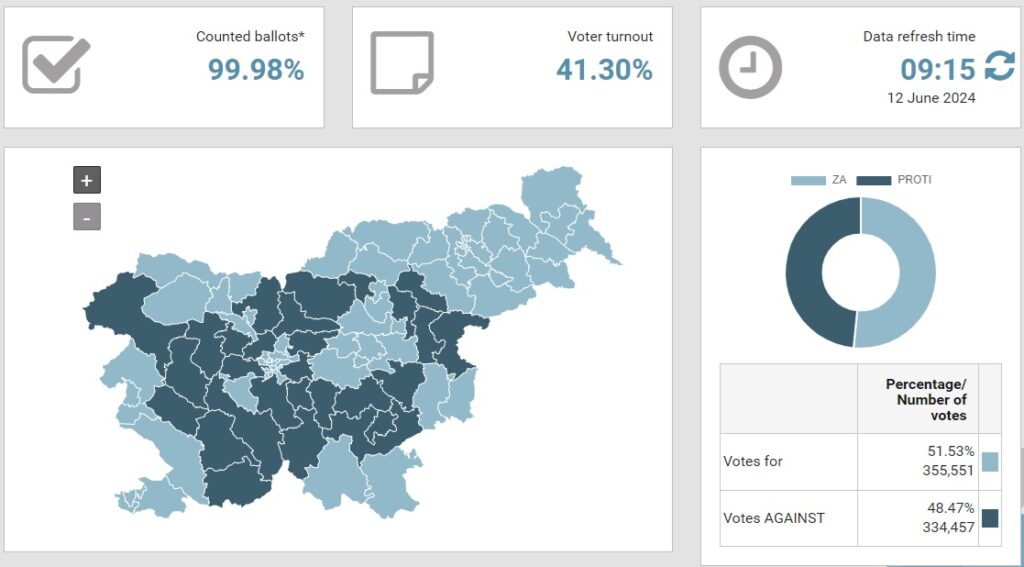
Support for adult-use cannabis policy modernization continues to gain momentum in Europe, with the latest example occurring on Election Day in Slovenia this weekend with voters in the Central European country approving a personal cannabis cultivation and use referendum measure.

Voters in Slovenia were asked, “Should the Republic of Slovenia allow the cultivation and possession of cannabis for limited personal use on its territory?” With a voter turnout of over 41%, and nearly 700,000 votes cast, the referendum measure was approved.

adult cannabis use slovenia election 2024 results

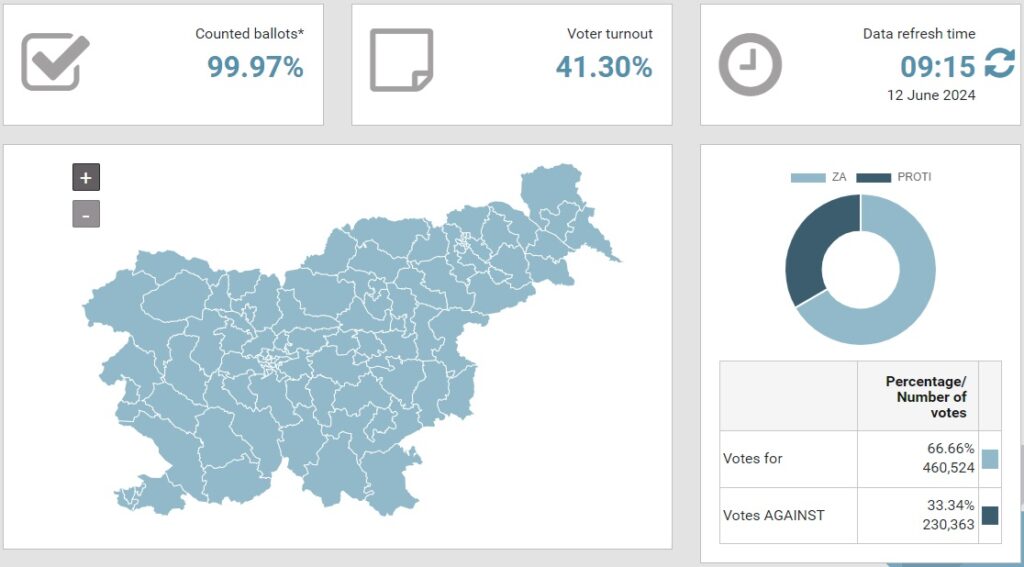
The adult-use referendum measure was one of two measures considered by Slovenia’s voters. A separate measure asked the question, “Should the Republic of Slovenia allow the cultivation and processing of cannabis for medical purposes on its territory?” The medical cannabis measure was overwhelmingly approved by Slovenian voters.

medical cannabis production slovenia 2024 election results

Both measures were consultation measures and are not legally binding. However, the voting results of both referendums send a clear and significant message to lawmakers in Slovenia that it is time to modernize the nation’s cannabis policies.

The historic votes in Slovenia come on the heels of other successful recent cannabis policy modernization efforts in other nations. Last month, South Africa’s President signed a measure that legalized private cannabis cultivation, possession, and use by adults.

On April 1st, 2024 the first provisions of Germany’s adult-use cannabis legalization measure went into effect. Adults in Germany can now cultivate up to three plants in their private residences. Social cannabis clubs are expected to launch in July in Germany, and regional adult-use cannabis commerce pilot trials are expected to begin by the end of the year.

Cannabis is also currently legal for adult use in Uruguay, Canada, Malta, Luxembourg, and in two dozen states in the U.S. Additionally, adult-use cannabis commerce pilot trials are underway in several jurisdictions in the Netherlands and Switzerland.