
Philippines Department Of Health Supports Limited Medical Cannabis

While many parts of the world have reformed their laws to permit the use of cannabis for medical purposes, the Philippines has been much slower to do so. Unfortunately, cannabis is prohibited in all of its forms in the Philippines, and the nation’s cannabis penalties are some of the harshest on planet Earth.

The binding law is the Comprehensive Dangerous Drugs Act of 2002, which specifies hefty fines and long prison sentences for cannabis offenses. The level of penalty depends on the amount involved and whether there was perceived intent to distribute by law enforcement.

Even simply having metabolized THC in a person’s system is illegal in the Philippines, with offenders being required to undergo at least six months at a government rehabilitation center.

Fortunately, the nation’s government is slowly opening up to the idea of at least permitting cannabidiol (CBD) products. Per The Manila Times:

Among the pending measures was House Bill 4208 filed by Camarines Sur 2nd District Rep. Luis Raymund Villafuerte that seeks to create a state agency to oversee the production and marketing for the export of CBD, which does not have psychoactive properties that produce a “high” effect like those experienced by marijuana users.

During the hearing of the Commission on Appointments on Health Secretary Teodoro Herbosa’s ad-interim appointment last September, Villafuerte, who acts as the majority floor leader of the Commission, asked him whether he supported the legal use of cannabis oil for medicinal purposes.

“We are in favor of the legalization of medical use of marijuana and its products, your honor,” Herbosa replied, adding that the DoH will pursue medicinal cannabis legalization as a policy.

To be clear, the type of reform that is being pursued in the Philippines is incredibly restrictive and will only help a limited number of suffering patients. Hopefully this type of reform succeeds and paves the way for more comprehensive reform.

How Long Will Canadian Cannabis Exports Increase?

Canada was not the first nation to pass a national adult-use cannabis legalization measure. That title will always be held by Uruguay which beat Canada to the legalization punch by roughly 5 years. However, Canada was the first G-7 nation to pass such a measure and has reigned as the international champion of legal cannabis commerce ever since.

In addition to cannabis being legal for adult use throughout Canada, and consumers having robust options for acquiring legal cannabis, Canada also exports a considerable amount of medical cannabis to other countries.

International cannabis exports are arguably the most complicated business transactions on earth, and the sector is still largely in its infancy. Still, Canadian cannabis companies are exporting cannabis products at an increasing rate, and new data from Health Canada is providing some insight.

According to initial reporting by Stratcann, Health Canada has received 1,211 applications from entities wishing to export cannabis since the beginning of the fiscal year (April 1, 2023), and of the applications received, 1,147 were approved.

“The number of applications and permits issued has been increasing on an annual basis, with 1,805 permits issued in 2022-2023, 1,421 in the previous year, 1,267 in 2020-21, 1,213 in 2019-20, and 272 in 2018-19.” Stratcann stated in its coverage.

The new data begs the question, how long will current trends persist? As with many things in the business world, getting to a market first is paramount, and Canada is already an established exporter to key markets such as Australia and Germany.

Canadian cannabis companies and companies in other nations that legally export cannabis internationally will continue to benefit from the imbalance created by prohibition. Many countries have yet to modernize their cannabis policies, and several more have only reformed their laws to permit medical cannabis imports.

Conversely, only a handful of countries have legal cannabis export operations up and running to meet the current demand. As full prohibition nations slowly reform their laws, allowing imports, at least initially, makes implementation easier. That all contributes to a bright future for Canadian cannabis exporters, at least in the near future.

Yet, there is a storm brewing, with Germany being a great example of what is to come. Germany currently imports a significant amount of medical cannabis products from Canada. However, domestic production in Germany will eventually supplant much of the supply that is currently coming from Canada. When adult-use cannabis is legalized in Germany, that will likely further speed up the trend.

Germany is not alone in its pursuit to pass a national adult-use legalization measure. Many other countries are pursuing the same goal to some degree, and eventually, all of those nations will likely permit domestic production in some manner. Of course, some nations will take longer than others, but in the long run cannabis modernization will win out in most parts of the globe.

Eventually, cannabis will become like every other major international crop, with some countries producing the raw harvests at a much cheaper price compared to other nations. For example, Colombia is primed to become the top producer of raw cannabis on earth due to its climate and expert cultivation community.

In the meantime, Canadian companies will continue to benefit from the patchwork of international cannabis laws and regulations.

United Kingdom Accepts New Recommendations For CBD Products

The United Kingdom, like most countries, has struggled to regulate products containing cannabidiol (CBD). CBD products have increased in popularity and availability across Europe, and there is a considerable amount of confusion regarding what is permitted, what is not, and what is in a ‘grey area.’

Due to CBD’s lack of euphoria-inducing properties, people who typically buy and consume CBD products are doing so for wellness purposes, and not recreational purposes. As such, they really need the products that they are consuming to be properly regulated to ensure consistency, efficacy, and safety.

The government of the United Kingdom recently accepted recommendations to specify permissible cannabinoid levels in CBD products. Per excerpts from Cannabis Health News:

The UK Home Office this week accepted recommendations from the Advisory Council for the Misuse of Drugs (ACMD) regarding the legal levels of controlled cannabinoids, including THC, in consumer CBD products.

In a response to the ACMD report, published on 24 October, Minister for Crime and Policing, Chris Philp MP, said the government intends to accept the advised limit of 50 micrograms of THC and other controlled cannabinoids per unit of consumption.

Clear and sensible regulations are desperately needed in the global CBD sector. Many jurisdictions either have no regulations or vague regulations, while many others have regulations that are overburdensome and/or conflicting with other public policies and rules.

All of that makes it very difficult to be an entrepreneur or investor, as neither wants to operate in an uncertain and seemingly-shifting landscape. That, in addition to the issues that it causes for consumers and patients. Unfortunately, the situation in the United Kingdom and beyond will likely get more murky before better clarity and consistency are achieved.

Morocco’s King Appoints General Director Of National Cannabis Agency

Back in mid-2021, Morocco passed a key measure that has helped pave the way for the nation’s emerging legal cannabis industry. Morocco has long served as a top source for unregulated cannabis, particularly for the European continent.

Now, thanks to the nation modernizing its cannabis policies, legal cannabis is cultivated in multiple Moroccan provinces. Roughly one year ago, Morocco issued ten permits for legal medical cannabis cultivation. Farmer cooperatives in the northern mountain areas of Al Houceima, Taounat, and Chefchaouen received the permits.

The agency that oversees the nation’s emerging legal industry is the National Agency for Regulating Cannabis Related Activities, which met for the first time in June 2022. The agency recently received a new general director. Per Morocco World News:

Morocco’s King Mohammed VI appointed Mohamed El Guerrouj as general director of the National Agency for Regulating Cannabis Related Activities (ANRAC).

The appointment was announced during the Council of Ministers meeting held in Rabat on Thursday.

Prior to the new appointment, El Guerrouj has been serving as an interim director for ANRAC since September 2022.

It will be some time before Morocco’s legal industry expands to a point that it can compete in any meaningful way with the nation’s unregulated market. Just as the unregulated market still exists in other legal jurisdictions, the same will always be true in Morocco to some extent.

With that being said, any economic stimulus that the emerging industry can provide is presumably very much welcomed in Morocco where per capita income is low and jobs are often hard to come by.

Malta Issues First Noncommercial Cannabis Club Licenses

Malta became the third nation on earth, and the first in Europe, to pass a national adult-use legalization measure back in late 2021. Since that time, Luxembourg has also passed a national measure. However, unlike Luxembourg, Malta’s legalization model includes the permitting of noncommercial cannabis clubs. The EU nation recently issued its first licenses for such clubs.

According to domestic reporting, Executive Chairperson Authority for The Responsible Use of Cannabis (ARUC) Leonid McKay announced during a recent press conference that “operational licenses” were issued to two different entities.

The recipients of the noncommercial cannabis licenses are KDD Society and Ta’ Zelli. The entities cannot start distributing cannabis until they receive tested products. All testing will reportedly be handled by Malta’s Authority for The Responsible Use of Cannabis.

It’s not entirely clear when products will officially go on sale, however, it’s speculated that the first legal sales via noncommercial clubs will begin early next spring. Four more entities have received “in-principle licenses” and are continuing to work through the licensing process.

Per our prior reporting, regulations for noncommercial clubs in Malta include (but are not limited to):

  • A maximum of 500 club members
  • Cannot be located within 250 meters of a school or ‘youth center’
  • No advertising
  • Cannot use the word ‘cannabis’ in the club’s name, or anything that would ‘incite use’
  • At least two club founders with no prior convictions of money laundering
  • Clubs must have a legal representative
  • Club administrators have to be residents for at least 5 years
  • All cannabis has to be cultivated by the club itself (out of public view)
  • Registration fee of €1,000
  • License fee starting at €8,750
  • Initial licenses valid for 1 year, with 3 year renewals
  • Labeling requirements
  • Ongoing government auditing
  • Product testing
  • THC percentage caps for consumers 18-20 years old
  • Consumers can only have a membership at 1 club at a time
  • Revenue dispersal requirements

Attend Business Of Cannabis: New York On November 3rd

A great event is coming up a week from today in New York City, and we are encouraging everyone in the region to attend. Below is more information about it:

New adult-use regulations in New York are set to bring a fresh wave of capital into the cannabis market. Investors and operators will attend Business of Cannabis: New York to identify opportunities at a critical time for the forecasted $7.2bn industry.

With federal regulations looking likely to relax and markets beginning to gain traction again, the cannabis industry seems to be entering a unique phase of growth across North America. In New York, the adult-use cannabis market roll out has faced unique and arduous hurdles since legalization, with a court injunction still preventing many CAURD dispensaries from progressing with their plans.

Despite that, according to Prohibition Partners’ Global Cannabis Report, the New York cannabis market is still set to achieve impressive year-on-year growth and be worth a staggering US$7.2 billion by 2026.
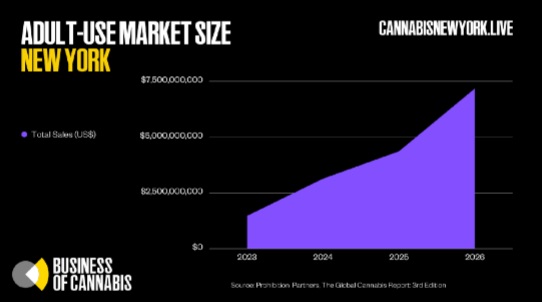
new york adult use cannabis market

With full adult-use retail finally opening up in the state, is now the moment for the market to fulfill its promise as the new global ‘Capital of Cannabis’ and, if so, how can equity and its
much vaunted CAURD scheme remain at the forefront of its policies?

“How can CAURD operators stand out with ROs now entering the market? Independents need to move faster to compete with ROs entering the adult-use markets soon.” – Dai Truong, Managing Director, Arlington Capital Advisors (speaker)

“In spite of the hurdles constantly thrown in front of us, we will continue to pursue our dream of opening our dispensaries and are doing everything we can to make it a reality for us and the other CAURD licensees.” – Vladimir Bautista, CEO & Co-Founder, The Happy Munkey (speaker)

Business of Cannabis: New York is an exclusive leaders summit that connects 400+ visionary entrepreneurs, savvy investors, plus new and seasoned operators in the cannabis space. Attendees will gain a competitive edge through a comprehensive day-long programme that shines a spotlight on the latest market trends, regulatory updates, and investment opportunities, whilst tying together the three key pillars which enable the industry to thrive: retail, policy & investment.

Key highlights of the conference include:

Leading Industry Experts: Renowned CEOs, industry titans, and key policy makers will share their invaluable insights and knowledge, providing attendees with the inside scoop on industry trends and strategies in real time.

Investor Connections: With a high percentage of attendees coming from the realms of finance and investment, take the chance to discuss business ideas and connect with potential investors looking to deploy capital.

Networking Opportunities: Attendees will have ample opportunities to network with peers, form strategic partnerships, and build relationships that can drive their cannabis ventures to new heights.

Regulatory Updates: Stay ahead of the curve with exclusive updates on the ever-evolving cannabis regulations, ensuring compliance and mitigating risks for your business.

Market Intelligence: Gain access to proprietary market data and intelligence that will help you make informed decisions, identify untapped opportunities and provide actionable insights.

Participating companies and speakers so far include X (formerly Twitter), Acreage Holdings, Weedmaps, The New York Office of Cannabis Management, Union Square Travel Agency, Bloomberg, Politico, The National Cannabis Industry Association, Conbud, Arcview and CannDelta.

“New Yorkers have always had an insatiable appetite for cannabis. We are blessed, privileged and very excited to help build out and support New York’s cannabis ecosystem.” – David Hess, Co-Founder & President, Tress Capital (speaker)

This conference presents a unique opportunity for investors to discover high-potential ventures, operators to expand their networks and knowledge, and all attendees to immerse themselves in the exciting world of cannabis.

Don’t miss your chance to be part of this transformative event. Register now to secure your spot at the Business of Cannabis: New York Conference on November 3, 2023.

About Business of Cannabis: The Business of Cannabis is a leading platform dedicated to providing industry professionals with the latest insights, news, and networking opportunities in the cannabis sector. Our conferences and events are renowned for bringing together the best minds and companies in the industry to drive growth and innovation.

For sponsorship, speaking, or exhibition opportunities, please contact Matt Freemantle at matt@prohibitionpartners.com.

For media inquiries, please contact Michael Hoban at michael@prohibitionpartners.com.

Is This The Best Way To Change Minds About Cannabis?

If you are a cannabis patient or consumer, then chances are you have had to deal with people who pass judgment on you because of cannabis. The stigma surrounding the cannabis plant and those who use it is unfortunate and unfair.

More often than not people generally oppose cannabis use and cannabis policy modernization efforts due to a lack of knowledge, and in some cases, outright ignorance. However, there is one powerful tool that cannabis advocates have that can change people from opponents to supporters – the truth.

The hard facts and science regarding the cannabis plant and cannabis use are heavily in favor of cannabis advocates, and often it’s just a matter of opponents being effectively educated about what researchers have determined via clinical trials, studies, and other academic investigations.

That principle is at the heart of the findings of a new study that was recently conducted by researchers in Mexico. A team of researchers affiliated with Autonomous University of Sinaloa, Culiacán, Mexico conducted a study “spanning the period from November 2022 to March 2023.”

“The objective of the present study is to ascertain the prevalence and perception of cannabis consumption in the Mexican state of Sinaloa, while also examining the impact of disseminating scientific facts about cannabis on attitudes and public perception.” the researchers stated.

“A total of 3162 adults residing in the primary cities of Sinaloa, namely Culiacán (n = 1133), Mazatlán (n = 1050), and Los Mochis (n = 979), were interviewed. The surveyors employed a random/convenience sampling technique.” the study listed regarding its methodology.

The survey participants included 1668 women and 1494 men, aged 18 to 76 years. Regarding educational backgrounds, “5.3% had no formal education, 32% completed elementary school, 40% held a high school diploma, 21% had a bachelor’s degree, and 1% had a postgraduate degree.”

Participants were provided factual information about cannabis if they opposed it, referred to as an “intervention” for the purposes of the study.

“Our analysis delved into examining attitudes towards cannabis both before and after the intervention, with a particular focus on the influence of education and age. By stratifying the data based on these factors, we aimed to explore how different educational backgrounds and age groups may respond to the intervention and whether any significant changes in attitudes were observed.” researchers stated.

“The results of our analysis demonstrated substantial differences in attitudes towards cannabis before and after the intervention, considering taking the participants’ educational levels and age categories. These differences were statistically significant, indicating that the intervention had a noticeable impact on shaping attitudes towards cannabis among different population segments.” researchers concluded.

Bundestag Holds First Debate On German Legalization Measure

A long-awaited initial legalization measure debate was finally held in Germany’s Bundestag earlier this week after a reading scheduled for earlier in the week was delayed. The initial reading was scheduled for Monday, however, it was rescheduled for Wednesday due to the ongoing conflict in the Middle East.

The process behind the measure currently being considered by members of the Bundestag essentially started after the dust settled on the 2021 German election. A new governing coalition was elected during that year, commonly referred to as the Traffic Light Coalition, and members of the coalition made it abundantly clear that they wished to pass a national legalization measure.

For over a year, Germany’s Health Minister Karl Lauterbach then worked behind the scenes to craft a measure for lawmakers to consider, incorporating feedback he reportedly received from the European Union. The European Union has consistently taken the position that national sales, such as what many lawmakers in Germany want, are prohibited in Europe.

Eventually, in October 2022, Minister Lauterbach finally provided public insight into some of the general provisions he planned to include in his measure. Below is Health Minister Lauterbach’s presentation in full (broadcast in German):

After the public presentation, Minister Lauterbach then further lobbied the European Union, and eventually formally introduced his legalization measure in Germany. It was approved by the Federal Cabinet and recently avoided being derailed by opponents in the Bundesrat.

It is widely expected that the measure will evolve from its current form, however, it’s unclear exactly how much evolution could occur.

Cannabis opponents in the Bundestag have tried to further the efforts of opponents in the Bundesrat by filing motions to prevent the legalization measure from proceeding, but as Minister Lauterbach pointed out on social media, opponents are short on viable alternatives:

If the measure does proceed in its current form, it would legalize personal cultivation, possession, and use by adults of legal age. The measure would also permit noncommercial cannabis clubs to launch in Germany, similar to what is being launched in Malta, but it’s expected to be on a much larger scale compared to what is reportedly planned in Malta.

The measure now heads to the committee stage for further debate. The Bundestag’s Health Committee is scheduled to review the measure on November 6th. A final reading of the measure is currently scheduled for November 16th.

First German Legalization Measure Reading In The Bundestag Scheduled For Wednesday

A long-awaited reading of Germany’s national adult-use cannabis legalization measure was originally scheduled for today, however, it was reportedly delayed due to the ongoing conflict in the Middle East. The measure is now scheduled to be read on Wednesday, October 18th at 6 p.m. CET.

The legalization measure being considered by the Bundestag was originally introduced by Germany’s Health Minister Karl Lauterbach earlier this year after extensive discussions with the European Union. Initially, it was hoped that the EU would permit regulated sales to adults nationwide.

Unfortunately, the EU’s position is that such a model runs contrary to continental agreements.

What was ultimately introduced was a multi-phased plan, with the first phase involving the legalization of personal cultivation, possession, and consumption. The measure would also create noncommercial clubs that would provide cannabis to members.

Purchasing limits would be involved, as would ‘buffer zones,’ limits on the number of clubs per jurisdiction, and a limit of 500 members per club. Those provisions are now being considered by national lawmakers.

Back in August, Germany’s federal cabinet approved the measure:

Earlier this month cannabis opponents in Germany’s other legislative body, the Federal Council (or Bundesrat), failed to block the measure from proceeding to the Bundestag for consideration.

Several members of the Bundestag have expressed a desire to change some of the provisions of Minister Lauterbach’s measure, and it will be very interesting to see how the measure evolves now that it is being considered by the chamber.