Prime Minister Trudeau: Time To “Catch Up” With The Cannabis Industry

Canada remains the only country on earth where anyone of legal age can make a legal adult-use cannabis purchase regardless of residency status. The only country to legalize cannabis for adult use prior to Canada doing so in 2018 was Uruguay back in 2013.

Unlike in Canada, Uruguay limits adult-use sales to residents only. Malta is the only other country on the planet right now that has also passed an adult-use legalization measure, however, the only way to legally purchase cannabis in Malta will be via licensed non-profit cannabis clubs, and no licenses seem to have been issued thus far. Malta started accepting applications for clubs late last month.

Until legal sales to non-residents become a reality elsewhere, Canada will continue to be in a league of its own. Canada’s legalization model and related policies are obviously not perfect, although, they are still exponentially better than prohibition.

The industry has succeeded by many measures despite it operating on a playing field that is far from level compared to other legal industries of its size in Canada. Prime Minister Justin Trudeau made comments recently that suggest a leveling of the playing field may be on the horizon. Per excerpts from initial reporting by StratCann:

Prime Minister Justin Trudeau acknowledged the need for the government to “catch up” with the cannabis industry’s concerns around issues like high taxation in a recent public event.

In his response, Trudeau first brought up the government’s historical public-health focussed messaging around legaization, but noted that now that the legal system is established, the government has a need to take a look at ensuring those businesses who “stepped up” in this new industry can survive.

“Now that we’ve got the public health and safety stuff out of the way, or on the way, I think you’re absolutely right that we should absolutely take a much closer look at ‘okay, what do we do then to make sure that this is a beneficial industry?’

As we previously reported, the legal cannabis industry in Canada had created roughly 151,000 jobs as of February 2022. Additionally, the emerging legal cannabis industry is responsible for generating over $15 billion since legal adult-use sales launched in late 2018.

Deloitte estimates that the legal cannabis industry in Canada has contributed over $43.5 billion to the nation’s GDP since the start of legalization. Cannabis companies have directly invested roughly $4.4 billion into Canada’s economy, with the remaining boost to GDP coming from “indirect” economic contributions, and “induced” contributions according to Deloitte.

As impressive as those statistics are, they come from an era in which Canada’s cannabis industry faced needless hurdles, many of which are still in place today. Hopefully Prime Minster Trudeau puts actions behind his recent words and does everything in his power to help his nation’s emerging cannabis industry reach its full potential.

Society Deserves A Sensible Approach To Cannabis Clubs And Driving

An area of concern for many members of society when it comes to cannabis reform, and understandably so, relates to cannabis and driving. After all, no reasonable person wants to have impaired people operating motor vehicles on public roadways. However, reasonable people also want to let science lead the way when it comes to determining impairment and crafting public policies that help mitigate impaired drivers on public roadways, and unfortunately, hard science is often not part of the public policy process.

Often replacing hard science and a rational approach for mitigating cannabis impairment on public roadways is outright political scare tactics, which is truly unfortunate. ‘There will be terror and bloodshed on the roadways’ is a common theme of cannabis opponents when any type of cannabis reform is being considered. The latest focus of such anti-cannabis PR efforts is cannabis clubs.

New Report Targets Cannabis Clubs

Days ago the Traffic Injury Research Foundation released a report titled, “Recreational Cannabis Consumption Spaces in Canada.” The report was published with support from the Canada Safety Council and DRIVE SOBER®. While some of the points made in the report’s press release are valid, many of them involved typical reefer madness talking points and communication strategies.

The report relied heavily on convoluting the nuanced differences between confirmed cannabis impairment at the time of an incident versus someone merely having cannabis in their system but no proven impairment, or someone having several substances in their system, or someone having so little cannabis in their system that impairment was likely nonexistent. For example, the report states, “more than 7% of drivers had ≥ 2 ng/mL, and 3.5% had ≥ 5 ng/mL.” To put those ng/mL limits into perspective, the Olympics’ cannabis testing threshold is 150 ng/mL.

“The report underscores that any proposal to move forward with the implementation of cannabis consumption spaces in the absence of effective and well-developed prevention strategies to protect the public from recognized harm is premature.” the report stated, which if you ask me, is merely a delay tactic to try to stop the spread of cannabis clubs. If so, there’s a really big flaw with that tactic – it ignores the fact that cannabis clubs are far from a new thing.

Cannabis Clubs In Canada

Regulated cannabis clubs may be a relatively new thing from a public policy standpoint, however, in the real world they have existed for decades, including in Canada. Underground cannabis clubs have existed for years, particularly in British Columbia, and the last time that I checked, the sky was still intact over B.C. Despite unregulated cannabis clubs being somewhat common in parts of B.C., it’s worth noting that the province does not lead Canada in drug-related DUIs.

According to government data from Canada, “Newfoundland and Labrador had the highest rate of drug-impaired driving (52 incidents per 100,000 population), followed by Prince Edward Island,” with New Brunswick (36) coming in next. By contrast, British Columbia had 32 incidents per 100,000 population. If increasing the number of cannabis clubs in a jurisdiction automatically made the roadways unsafe, then it would be reflected in the data. Yet, that is obviously not the case.

A Rational Approach

One thing that the report noted that was absolutely correct is that there is a need for ongoing public education regarding cannabis use and operating a motor vehicle while impaired. No responsible cannabis consumer advocates for impaired driving, and the same is true of responsible members of Canada’s emerging cannabis industry. Clearly, there is a common goal between responsible cannabis advocates and opponents alike in that we all want public roadways to be safe.

The friction between the two groups begins when prevention strategies and detection are discussed. Cannabis advocates want to rely on facts to educate the public, and not fear-mongering. Cannabis advocates want science to determine impairment and not arbitrary nanogram thresholds that do not take into account a person’s tolerance level, individual biology, and other situational factors.

Unfortunately, the topic of cannabis and driving is such a hot-button issue with cannabis opponents that it makes it very difficult to have a rational conversation about what an effective prevention strategy looks like. People have consumed cannabis in social settings for many years, albeit in a non-regulated fashion, and a vast majority of people take precautionary measures such as walking, taking public transportation, or arranging private transportation.

Cannabis clubs are merely the latest boogeyman punching bag for cannabis opponents. Concerns about impaired driving are valid, however, they should not be used to derail further implementation of cannabis clubs in Canada, or anywhere else for that matter.

A 60+ Year Old International Cannabis Policy Agreement Serves No Useful Purpose In 2023

Last week the United Nations’ International Narcotics Control Board issued a press release in which the international body expressed, “concern over the trend to legalize non-medical use of cannabis, which contravenes the 1961 Single Convention on Narcotic Drugs.”

In its 2022 Annual Report, the International Narcotics Control Board outlined the following, as also mentioned in last week’s press release:

  • notes that the 1961 Single Convention on Narcotic Drugs classified cannabis as highly addictive and liable to abuse, and that any non-medical or non-scientific use of cannabis contravenes the Convention;
  • expresses concern that this trend among a small number of governments is leading to higher consumption, negative health effects and psychotic disorders;
  • finds the impact of legalizing cannabis on society difficult to measure because legislative models vary from country to country and data is still limited;
  • voices concern that many countries continue to have difficulties procuring enough controlled substances for medical treatment, including during emergency situations;
  • highlights that countries are confiscating a high number of non-scheduled chemicals and designer precursors used in illicit drug manufacture and is concerned about the global spread of these substances.

Coupled with the points listed above, the press release also provided various arguments and talking points to seemingly portray cannabis legalization in as negative a light as possible. The press release also seemed to ignore quite a bit of real-world context, so I figured I would provide some below.

1961 Single Convention on Narcotic Drugs

One of the most popular talking points among cannabis opponents as legalization continues its march across the globe is that legalization violates the 1961 Single Convention on Narcotic Drugs. For many years opponents would point to the international agreement as ‘justification’ for preventing legalization efforts worldwide. After all, opponents benefit from the status quo, so it is not surprising that they will point to this particular agreement and leverage it to try to slow down the legalization process anywhere and everywhere.

Unfortunately for opponents, the legalization genie is already out of the bottle. Uruguay became the first country to pass a national adult-use legalization measure back in 2013. Canada followed suit in 2018. In late 2021, Malta also passed a national legalization measure. Germany is expected to see a governing coalition-backed legalization measure introduced in the near future, and that will likely result in a flood of other countries doing the same.

With all of that in mind, operatively speaking, the 1961 agreement is becoming more and more symbolic in nature with every passing year. If/when Germany passes an adult-use legalization measure and launches regulated sales, the relevance of the 1961 agreement will erode even further. That begs the question – why is it still around in 2023? The existence of the 1961 Single Convention on Narcotic Drugs or not, the reality of the situation is that more countries are going to legalize cannabis for adult use, and no amount of United Nations PR is going to stop it.

Higher Consumption Rates

Another popular anti-cannabis talking point is that ‘consumption rates are increasing in places where cannabis is legal.’ This talking point is a scare tactic that doesn’t provide nearly enough context, presumably by design. For starters, assuming that consumption rates are truly increasing in all legal jurisdictions, cannabis consumption rates are also going up in places where cannabis is not legal, such as Japan, which opponents seem to always fail to point out.

Furthermore, data from the European Monitoring Centre for Drugs and Drug Addiction (EMCDDA), which is one of the European Union’s decentralized agencies, demonstrates that the countries in Europe with the highest cannabis consumption rates are not those that have passed legalization measures. For young adults (age 15-34), which are often the focus of expressed ‘concerns’ from cannabis opponents, Czechia has the highest reported consumption rate (22.9%) for reported past-year use, followed by France (21.8%), Italy (20.9%), and Croatia (20.3%).

Malta is the only European country to have passed an adult-use cannabis legalization measure so far, and while it’s still very early in the legalization implementation process, the EMCDDA estimates that “around 4.3% of those aged 18-65 years reported having used cannabis during their lifetime” in Malta. That’s ‘at least once in a lifetime’ versus the ‘used in the last year’ measurement that was referenced in the preceding paragraph.

Being that the number is very low to begin with, increased access to cannabis may indeed result in more people consuming it in Malta in the coming years. Keep that statistic in mind when inevitably cannabis opponents start acting like the sky is about to fall over Malta. Even if the consumption rate doubled, it would still be less than 10%, which in the grand scheme of things is far from being on the high side of the consumption rate spectrum (no pun intended). All the while it is also worth noting that just because people may be consuming more cannabis, that in itself is not a bad thing.

Concerns Regarding Inputs

One line that particularly stood out to me in the press release at the heart of this article was, “…countries are confiscating a high number of non-scheduled chemicals and designer precursors used in illicit drug manufacture and is concerned about the global spread of these substances.” Isn’t this an argument for legalization?

In an unregulated market, there are essentially no rules outside of ‘do not get caught.’ Producers, transporters, and sellers in an unregulated market can add whatever they want to the cannabis during various phases of its life cycle and it often goes completely undetected. This is not to say that all unregulated cannabis is tainted, however, without proper testing there’s no way to know what is ‘clean’ and what is not.

Compare that to a regulated market in which certain substances are prohibited from being added to the cannabis life cycle, such as pesticides, herbicides, harmful nutrients, and “non-scheduled chemicals and designer precursors.” Lab testing and site reviews are mandatory in a regulated system to detect and prevent the use of such substances. If tainted cannabis is truly a concern of the UN then the UN should be promoting cannabis reform efforts around the globe instead of trying to hinder them with anti-cannabis propaganda.

Calls For Cannabis Reform Are Picking Up Steam In Australia

Back in February, Australia‘s Parliamentary Budget Office (PBO) released a report that presented two options for legalizing adult-use cannabis in Australia. The first option involves the creation of a new entity, the Cannabis National Agency. The agency would be the sole wholesaler between producers and licensed retailers, and it would set wholesale prices and issue all licenses.

Under the first option, the legal age for adult-use cannabis would be 18. Additionally, adult households would be able to cultivate up to six plants, and legal sales via licensed retailers would be permitted for non-residents in addition to residents.

All licensed sales would be “subject to the Goods and Services Tax (GST) as well as a 25% excise duty on sales including the GST”. The second option that was part of the PBO report contains all of the previously mentioned provisions, with the exception of a lower excise rate (15%).

Several lawmakers in Australia are touting the recommendations of the report, including Greens Senator David Shoebridge. Per The Guardian:

Australia’s cannabis industry could be earning the black market $25bn a year and, rather than policing it, we could be gaining revenue from it by legalising it, Greens senator David Shoebridge has said.

“Law enforcement is spending billions of public dollars failing to police cannabis, and the opportunity here is to turn that all on its head by legalising it,” he said.

Shoebridge indicated that he intends to introduce a legalization bill that will be somewhat modeled on Canada’s adult-use cannabis policies. Canada became the second country to legalize cannabis for adult use in 2018, with Uruguay being the first in 2013.

Unlike Uruguay, which limits legal sales to residents only, Canada permits legal sales through various licensed channels to anyone of legal age, regardless of what country they are a resident of. As such, Canada is a top international cannabis tourism destination. With any luck, Australia will join them.

Germany’s Health Minister Indicates That The EU Will Allow Legalization To Proceed

The push to legalize adult-use cannabis in Germany received a significant boost today, with reports surfacing that the nation’s health minister has received “very good feedback” from the European Commission regarding his plan to legalize cannabis for adult use in Germany and to launch regulated adult-use sales. Minister Karl Lauterbach reportedly stated that “in the next few weeks” his bill will be formally presented.

“We will soon present a proposal that works, that is, that conforms to European law,” Lauterbach stated according to NTV. Minister Lauterbach’s comments come after months of discussions with the European Union. Back in October 2022, Minister Lauterbach presented a legalization plan in Germany that included the following provisions:

  • Legal age of 18 years old
  • 20-30 gram possession limit
  • Regulated outlets
  • Prohibition on advertising
  • No cap on THC percentages
  • Cultivate up to 3 plants per adult household
  • Remove cannabis from Germany’s Narcotics Law

As part of his formal presentation to German lawmakers back in October, Health Minister Karl Lauterbach stated that prior to formally introducing his measure he would first seek approval from the European Union to proceed. Minister Lauterbach has indicated throughout the lobbying process that the goal and focus of his efforts are to improve public health in Germany via regulating adult-use cannabis.

That approach, Minister Lauterbach has consistently argued, is in line with EU treaties. His recent comments seem to indicate that the EU agrees, at least in principle. This is not the first time that Minister Lauterbach has hinted that his conversations with the EU are favorable, although his level of optimism certainly seems to be increasing.

Back in January, we reported on comments that Minister Lautberbach made regarding his lobbying efforts, indicating at the time that he was ‘certain’ that the European Union would grant its approval and that a formal introduction of the legalization measure would occur ‘in the first quarter of this year.’ Minister Lauterbach added, according to the reporting at that time, that he had ‘no reason to doubt this schedule.’

For those that are keeping track at home, the first quarter of this year is set to draw to a close in roughly two weeks. With that in mind, it appears that Minister Lauterbach is essentially right on schedule, albeit perhaps one week behind what he projected back in January. If Minister Lauterbach is indeed on schedule, I think it is safe to assume that the EU has afforded some type of indication that it will approve German legalization to proceed. The ramifications of that cannot be overstated, as it would likely open the floodgates to similar reform in other European nations as we have pointed out in prior reporting.

The real question at this point, in my opinion, is what has changed from what Minister Lauterbach presented back in October compared to what he is planning on presenting in “the next few weeks?” If we read between the lines a bit and take Minister Lauterbach’s reported comments at face value, he has received some type of feedback from the EU. Until the public knows exactly what that feedback involves, there’s always the possibility that Minister Lauterbach’s plan may have regressed to some degree in certain aspects.

Regardless of the EU’s feedback, Minister Lauterbach still has to convince lawmakers in Germany that his plan is sufficient. The EU can provide all of the feedback that it wants to, however, that will be balanced against domestic political demands from Germany’s current governing coalition.

As history has clearly demonstrated, many lawmakers in Germany will not entertain regressed legalization components. They also will not tolerate any footdragging. As the pressure continues to build on both sides of the equation and Minister Lauterbach is stuck in the middle like a political pinball, the eyes of the international cannabis community will continue to be focused squarely on Germany.

Will we see another leak prior to Minister Lauterbach’s formal presentation, and components of the legalization plan ‘magically’ evolve to be more favorable after enormous public outcry, such as what occurred back in October 2022? Only time will tell.

Cannabis Legalization Public Hearing Set For March 15th In Germany

An adult-use cannabis legalization measure is scheduled for a public hearing in Germany on March 15th at 14:45 (CET). According to the Budestag’s website (translated to English), “The hearing will be broadcast with a time delay on Thursday, March 16, 2023, from 11 a.m. on parliamentary television and on the Internet at www.bundestag.de.”

The public hearing will be held by the Bundestag Health Committee, and the focus of the hearing will be, ‘a bill by the left-wing faction on the decriminalization of cannabis,’ as well as ‘a motion by the CDU/CSU, in which the parliamentary group advocates better patient care with medicinal cannabis.’

It is worth noting that the bill sponsored by the left-wing faction is separate from a legalization measure that is expected to be introduced this month by German Health Minister Karl Lauterbach. According to documentation published by the Bundestag (translated to English), the left-wing faction’s measure (20/2579) states the following:

In their coalition agreement, SPD, BÜNDNIS 90/DIE GRÜNEN and FDP on the introduction of a controlled sale of cannabis to adults agreed for pleasure purposes. According to statements made by Health Minister Karl Lauterbach on May 4, 2022, the corresponding reform is to be implemented in the second to be worked out in the first half of 2022. However, due to substantive differences between the coalition parties with regard to the precise design of the structures for the legal production and sale of cannabis, it is to be feared that the legislative process will take longer. It lasts until he graduates criminalization of consumers. Of the more than 200,000 cannabis offenses per year, over 80 percent are consumption-related offenses. The legal and social consequences of criminalization for those affected are considerable. The annual financial expenditure for prosecution and enforcement resources is also in the range of one billion euros.

Essentially, what the measure is pushing for is an end to cannabis prohibition as it pertains to individuals, which is admirable. However, the measure is likely to be rejected by members of the governing coalition, with those members likely pointing to the looming measure from Germany’s Health Minister and stating that they want to wait.

Wednesday’s public hearing may not be as significant as some may think upon first consideration, however, it’s going to keep the pressure on lawmakers when it comes to the overall push for adult-use cannabis legalization in Germany.

The nation’s government will be forced by the public hearing to once again clearly state its position and goals regarding adult-use cannabis, and that, in turn, will let the citizens of Germany know that the issue is still important and that they can hopefully expect meaningful progress in the near future.

Cannabis Production Identified As A Top Investment Opportunity In Rwanda

Rwanda’s economy ranks 171st on earth according to World Data, making it one of the poorest countries on the planet. Rwanda’s economy is still largely agrarian, with many citizens living in rural, undeveloped areas.

Years of conflict, particularly in the 1990s, ravaged the African nation and negatively impacted the already-dim economic prospects within its borders. Needless to say, any and all reasonable boosts to Rwanda’s economy are surely welcomed.

The emerging international cannabis industry is creating jobs, generating revenue for governments, and providing boosts to local economies at an ever-increasing rate around the globe as more and more countries reform their cannabis policies. If certain leaders in Rwanda have their way, their country will join the list of international cannabis industry leaders. Per The New Times:

Rwanda is looking to attract at least Rwf19 billion (about $17.5 million) investment in the production of cannabis, also known as a high-value therapeutic crop, The New Times has learnt.

The development was recently ranked among the country’s top 100 investment opportunities, during the Invest Rwanda Forum held last week.

According to the Rwanda Development Board (RDB), global cannabis production is projected to grow from the current $28.3 billion raked in 2021, to $197.7 billion in 2028 at a compound annual growth rate of 32 per cent.

Whether or not the projection offered up by the RDB proves to be accurate is anyone’s guess. And exactly to what extent the cannabis industry may help Rwanda’s economy specifically is unclear at this time, particularly since it involves many factors.

However, if Rwanda’s government and business community can develop its domestic cannabis industry, and especially if that industry can make meaningful inroads in the export market, amazing things could happen.

The Global Cannabis Industry’s Increasing Momentum Was On Full Display In Barcelona

The emerging legal international cannabis industry is stronger now than at any other time since the dawn of prohibition so many decades ago, and that was on full display last week in Barcelona where leading cannabis investors, entrepreneurs, activists, policymakers, and industry service providers from all over the planet gathered at the International Cannabis Business Conference on March 9th.

March in Barcelona has largely developed into the start of ‘cannabis event season’ for the international cannabis community in recent years, with the International Cannabis Business Conference partnering once again with Spannabis (held March 10th-12th) to put on the world’s largest cannabis super-event in 2023.

The two events combine for what is likely the closest thing in this world to an international cannabis community reunion, and it’s always heartwarming and inspiring to see old friends connecting (in addition to new friendships being created).

International Cannabis Business Conference Barcelona 2023

The International Cannabis Business Conference is Spain’s largest cannabis B2B event and this year’s installment came at a very crucial time for cannabis policy in Spain, as well as for cannabis policy at the continental level. Lawmakers and regulators in Spain are working harder than ever to pass meaningful legislation that will help Spain’s emerging cannabis industry reach its full potential. The same can also be said about many other parts of Europe right now.

With that in mind, it was tremendously beneficial to bring not only leaders from throughout Spain to one venue to network and discuss cannabis policy, but also leaders from other nations that are either working towards the same end goal as Spain or are farther along in the process and were able to impart their wisdom. Those leaders were able to network with each other and additionally were able to network with industry members, which is important for a multitude of reasons.

Cannabis policy reform is still a relatively new phenomenon at the international level and the global cannabis ecosystem is still largely a patchwork of laws, rules, and regulations, and that patchwork extends to efforts to reform and improve current public policies. The saying, ‘teamwork makes the dream work’ is as applicable to global cannabis efforts as anything you will ever find, so seeing leaders from all sectors of society (law, government, industry, activism) networking with each other was very encouraging and uplifting.

The International Cannabis Business Conference’s next event will be in Berlin in June. Buy your tickets today before prices go up!

International Cannabis Business Conference Barcelona 2023

As is always the case, the curriculum at the International Cannabis Business Conference in Barcelona was packed with world-class speakers who are all global leaders in their particular fields. We will be publishing videos of the panel discussions on the event’s YouTube channel, so make sure to check them out in the near future.

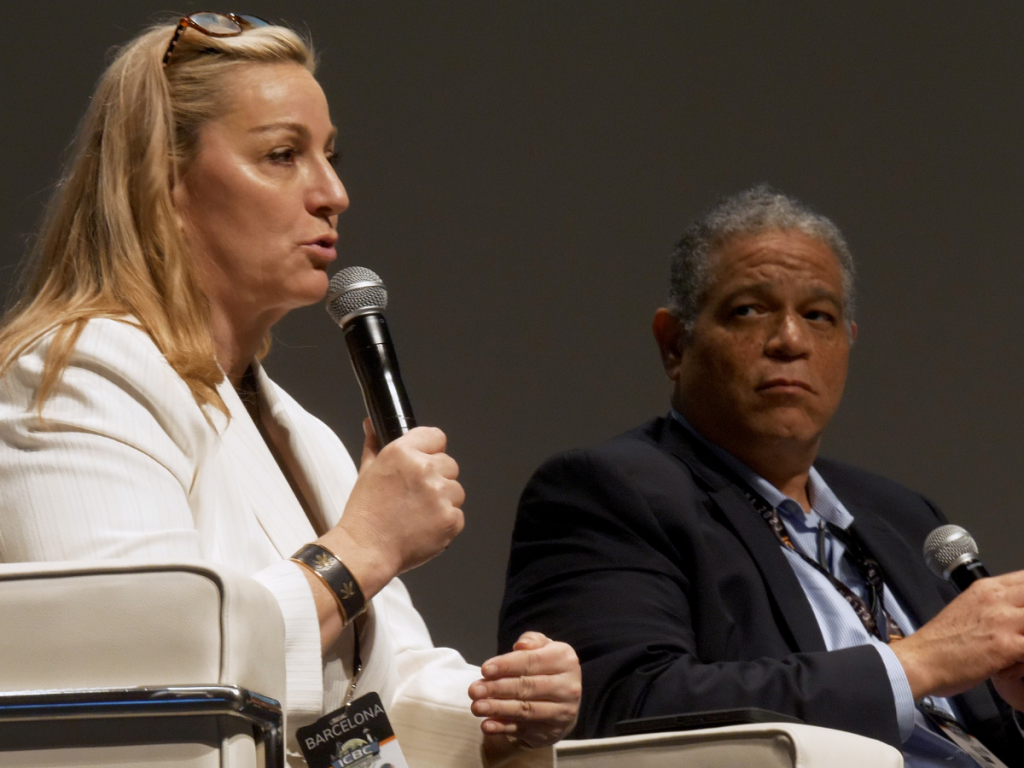
Below is a small sampling of photos from some of the many insightful panel discussions that took place at the 2023 International Cannabis Business Conference Barcelona B2B event:

International Cannabis Business Conference Barcelona 2023

No International Cannabis Business Conference event would be complete without an epic after-party, and this year’s event in Barcelona was no exception.

Below is a sampling of pictures demonstrating the ‘work hard, play hard’ mentality that makes the International Cannabis Business Conference’s events so special:

Why Is The Czech Republic Punishing A Cannabis Educator?

The cannabis reform movement, as with any meaningful social movement, would not be possible without people spreading education. Cannabis educators are vital because without them there would be a vast knowledge void, and that knowledge void would be filled entirely by cannabis opponents as history has clearly demonstrated.

For several decades positive cannabis knowledge and information were suppressed by governments worldwide. Those that tried to spread the truth and facts were sometimes targeted. Unfortunately, that censorship continues to this day, including in countries that you may not have expected.

Robert Veverka is a journalist and director of the Czech-based cannabis magazine LegalizaceBack in October 2021, I published an article about Robert being targeted by the Czech government over his journalism, with the government accusing him of “inciting and promoting toxicomania.”

Legalizace is a bimonthly periodical focused on cannabis, as well as drug policy relating to human rights and environmental issues. Here in the United States where I live and conduct similar efforts, what Veverka did is well within the parameters of legal speech/expression. Legalizace clearly provides content that possesses significant scientific, political, and literary value.

“The prosecution, which is calculated, stigmatizing, borderline untruthful, and based on fallacious conjectures and limited interpretation by the police that the cultivation and processing of cannabis is automatically illegal or that any mention of cannabis automatically equates ‘inciting toxicomania’, comprises a dangerous precedent comparable to totalitarian repression and censorship.” Robert Veverka stated back in late 2021 regarding the initial indictment.

“I consider it my duty to fight not only for the right of Legalizace magazine to exist, but also for the rights of all print and electronic media who have ever dared mention the word ‘cannabis’ – or plan to do so in the future,” Robert Veverka went on to say at the time.

Unfortunately, the Czech Republic proceeded with the indictment and in November 2021 Veverka and his media outlet were found guilty of the allegations, and Veverka was given a one-year prison sentence contingent on a probationary period of two and a half years as well as a fine of 50,000 CZK by the district court in Bruntál following two court hearings.

“The judge mentioned that he is not competent to assess the benefits of the current legislation, the benefits of cannabis products in healthcare, or the negative effects of cannabis use, but that he must base his verdict on the existing legislation which is binding for all. He stated that according to his judgement, Legalizace magazine evidently and factually constituted the criminal offence of inciting and promoting toxicomania.” Veverka stated at the time of the November 2021 verdict in a press release.

“He did not take into account the legislative provisions allowing for cannabis to be handled legally in certain cases or the comprehensive and educational nature of the information published in the magazine. On the contrary, the judge expressed his doubts as to whether the individuals who granted interviews to the magazine were made aware of its content and overall message. Personally, I consider the verdict to be very biased and severely restrictive of the freedom of expression, the right to express political opinion, and the right to information,” Veverka also stated.

News broke this month that Veverka was sentenced by a Czech court for similar allegations, although it’s still unclear to me from afar if that is part of an appeal attempt to the previously cited charges, or if this is a separate, additional matter. Either way, one thing that I do know is that what Veverka is being subjected to is horrific and unfair, and the global cannabis community needs to rally around him.

Veverka must reportedly pay an administrative offense of €4.000 (as a defendant and a natural person) and €6.000 on behalf of his media outlet as part of the recent verdict. For anyone that is able to support Robert Veverka and contribute to his defense, bank details are below. If you are not able to contribute financially, please help spread the word on your social channels about his plight:

IBAN: CZ4320100000002900469065
BIC/SWIFT: FIOBCZPPXXX
Fio banka, as, V Celnici 1028/10, 117 21 Praha 1