Albania Government Approves Medical Cannabis Cultivation

As medical cannabis policy and regulatory reform continues to sweep across the European continent, the latest country to witness modernization approval by lawmakers is Albania, where the nation’s government reportedly approved licenses for a significant amount of medical cannabis and industrial hemp cultivation.

“The Albanian government has approved the cultivation of cannabis for medical and industrial purposes, issuing licenses covering 29,000 hectares of land stretching from the north to the south of the country — a move hailed by officials as a boost to the economy but sharply criticized by the opposition and experts as a potential gateway to state capture by organized crime.” reported Tirana Times in its local coverage.

“While the official legal cap for cultivation remains 200 hectares, the government’s preliminary license allocations suggest a far greater scope — one that opposition figures claim could result in the planting of over 1.4 billion cannabis plants.” the outlet also reported.

According to the European Monitoring Centre for Drugs and Drug Addiction (EMCDDA), Albania is “the largest outdoor producer of cannabis in the region and there has recently been an increase in indoor cannabis cultivation.”

“In Albania, following a peak in 2017 when over 78 tonnes of herbal cannabis were seized, a steep downward trend was noted, with only 4.3 tonnes seized in 2020 and, according to preliminary data, approximately 3.6 tonnes in 2021.” EMCDDA also reported.

The emerging legal cannabis and hemp industries allow Albania’s farmers to cultivate their crops legally and to have their harvests provided to domestic and international medical patients rather than the unregulated market. However, that opportunity is only as good as the laws and regulations that are implemented in the Balkan country.

At the recent International Cannabis Business Conference in Berlin, leading international cannabis industry economist Beau Whitney, founder of Whitney Economics, estimated that the potential global medical and adult-use cannabis market is roughly $237.8 billion. Mr. Whitney estimated that the value of the global industrial hemp industry could be $456.2 billion.

An Estimated 8.4% Of European Adults Consume Cannabis

The European Union Drugs Agency (EUDA) recently published an updated analysis of cannabis use within the European continent. Based in Lisbon, Portugal, EUDA describes itself as “the leading authority on illicit drugs in Europe.”

“Cannabis is the most widely consumed illicit drug in Europe, with national surveys showing that an estimated 8.4 % of European adults (24 million aged 15 to 64) have used cannabis in the last year.” EUDA wrote in its ‘European Drug Report 2025‘. “The cannabis market accounts for the largest share of the overall illicit drug retail market in the European Union, with an estimated value of at least EUR 12.1 billion.”

“Around 1.5 % of adults in the European Union (4.3 million people) are estimated to be daily or almost daily cannabis consumers, and these people are most likely to experience problems associated with use of this drug.” the report also stated.

Cannabis is currently legal for adult use in Malta, Luxembourg, Germany, and, likely soon, the Czech Republic. Many more countries in Europe permit medical cannabis use, and several of those countries have legal medical cannabis industries.

“Seizures of cannabis products overall continued to be at historically high levels in 2023, confirming the high availability of this drug. However, the total quantity of cannabis resin seized in the European Union dropped significantly in 2022, largely due to a decrease in seizures reported by Spain, before slightly increasing again in 2023.” EUDA states in its report.

EUDA also determined the following:

  • Spain accounts for 68% of all resin seized, 30% of all herbal cannabis seized, and 73% of the total number of cannabis plants seized in the EU.
  • The average ‘resin sample’ of seized cannabis contains 23% THC
  • The European Commission has received 194 applications for CBD product authorization as a novel food since 2018
  • The most commonly encountered semi-synthetic cannabinoid is hexahydrocannabinol (HHC)
  • Males are “typically twice as likely to report use as females”
  • Only 45% of people entering treatment for cannabis use do so voluntarily
  • 615,000 cannabis use or possession offences were reported in the European Union in 2023

Additional context is worth considering regarding EUDA’s reported consumption rates. A vast majority of European nations still prohibit recreational cannabis use, and it is logical to conclude that many consumers are reluctant to admit using cannabis to government surveyors.

As such, the actual annual cannabis consumption rate for European adults could be greater than EUDA’s estimated 8.4%.

Ukraine Approves Country’s First Medical Cannabis Product Import Permit

Ukraine’s emerging legal medical cannabis industry continues to make strides, with a recent example being the nation’s first-ever approval of a medical cannabis product import permit. The permit’s approval was announced by the State Service of Ukraine on Medicine and Drugs Control.

“On June 2, 2025, the State Medical Service issued the first permit for the right to import medical cannabis substances into the territory of Ukraine.” the government stated in a news release (translated from Ukrainian to English). “The permit was issued for a substance that is registered in Ukraine and included in the State Register of Medicinal Products of Ukraine.”

The import permit announcement comes after Ukraine launched the country’s largest industrial hemp processing plant last month. The Ma’Ryzhany Hemp Company’s new facility is located in the Ma’Ryzhany industrial park in the Zhytomyr region and is estimated to be capable of processing up to 14,000 tons of hemp annually.

“Developing our own processing is one of the key tasks of the government’s policy “Made in Ukraine” and part of the national economic idea. We must change the structure of the economy from raw materials to high-tech and increase the production of goods with high added value.” Ukraine’s Minister of Economy Yulia Svyrydenko stated, according to a government press release (translated from Ukrainian to English).

“Restoring the primary processing of hemp trust is one of the key elements for the further revival of industrial hemp, which once made Ukraine a powerful player in the global textile market. The presence of its own domestic raw materials is difficult to overestimate – it is the basis of price competitiveness. In addition, industrial hemp is not just a raw material for textiles, but an ecological and renewable resource for dozens of other industries. And the reconstruction of the textile chain is only the beginning of the great industrial potential that “Ma’Ryzhany Hemp Company” is laying today,” stated Ma’Ryzhany Hemp Company Director Andriy Mykytiv.

The goal of the industrial park where the new hemp processing facility is located is “to attract businesses working with industrial hemp processing products and create over 700 new jobs. The work of the park will also stimulate farmers to grow industrial hemp in the Zhytomyr region and contribute to the development of a sustainable industrial hemp ecosystem in Ukraine.”

Ukraine’s new industrial hemp processing plant is designed to produce long fiber for textiles and technical fabrics, short fiber for paper, nonwovens, and insulation, and raw material for bioplastics, building materials, and animal bedding.

According to local reporting by UNN, “the eHemp electronic system has been operating in Ukraine since March 10. 38 entities have been registered, 16 of which have sown 1,251 hectares of hemp.”

During a recent presentation at the International Cannabis Business Conference in Berlin, leading international cannabis industry economist Beau Whitney, founder of Whitney Economics, provided data demonstrating that the value of the global industrial hemp industry could be as much as $456.2 billion.

German Survey: 70% In Favor Of Prescribing Cannabis Via Online Questionnaire

Germany’s medical cannabis industry is booming, thanks in large part to the rise of telemedicine. Telemedicine involves a potential medical cannabis patient using an online platform to seek approval for medical cannabis rather than going to a physical doctor’s office. It is a more convenient option for many patients, particularly those in rural areas and/or individuals with mobility issues.

Recent medical cannabis product import data demonstrates how fast Germany’s medical cannabis industry is growing. In the first quarter of 2025, Germany imported over 37.223 metric tonnes of medical cannabis products, a 457% increase compared to the same period from the prior year.

Medical cannabis telemedicine has become a popular target for lawmakers in Germany who are opposed to modernized medical cannabis policies, with many of those lawmakers expressing a desire to abolish the concept.

The German Cannabis Business Association (BvCW) recently conducted a survey asking, “What is your opinion on the possibility of obtaining prescription drugs by completing an online questionnaire?” The survey was conducted from May 26, 2025, to June 2, 2025.

“The majority of respondents support the option of obtaining prescription drugs via an online questionnaire. The survey responses were as follows: 49% support this procedure for both cannabis and other prescription drugs. 21% support it exclusively for cannabis.” BvCW stated in its recent newsletter (translated from German to English).

“Overall, 70% are in favor of prescribing cannabis via online questionnaire. 9% expressed a partly positive, partly critical attitude. 16% reject the approach in principle – regardless of the drug. 2.5% either rejected it only for cannabis or were undecided. No one expressed support exclusively for other drugs.” BvCW also wrote.

The survey was conducted following a major court decision in Germany, in which the North Rhine Chamber of Pharmacists successfully pursued a lawsuit in the Cologne Regional Court against a pharmacist who worked with a telemedicine platform.

“The AKNR considers the entire business model in this form to be illegal and has issued a warning to a pharmacist whom it believes to be the operator of the platform, a claim he denies. Among other things, the chamber sees this as impermissible advertising for remote treatment: According to Section 9 of the German Medicines Advertising Act (HWG), advertising for such treatment is only permitted in exceptional cases if, according to generally accepted professional standards, personal contact with the patient being treated is not necessary.” reported Pharmazeutische Zeitung in its local coverage (translated from German to English).

“However, the questionnaire is not a communication medium, and remote treatment is ruled out for the prescription of medical cannabis anyway, as it does not meet recognized professional standards.” the outlet also reported.

Germany’s Federal Health Minister Nina Warken (CDU) previously indicated that she intends to restrict online medical cannabis prescriptions, but as BvCW pointed out in their newsletter, “whether providers based abroad can be effectively stopped remains open.”

Lawmakers Approve Ban On ‘Cannabis Light’ In Italy

The legal saga for low-THC cannabis products in Italy has taken another turn, with lawmakers in the European nation officially adopting a measure earlier today that bans certain hemp-derived products, often referred to as ‘cannabis light.’

A ‘security decree’ measure received final passage by Italy’s Senate today by a vote of 109-69. In addition to the ban on cannabis light, the measure also involved several other provisions championed by Prime Minister Giorgia Meloni’s right-wing coalition government, including the introduction of 14 new crimes.

“It bans the trade of “cannabis light”, or hemp, which unlike marijuana has no mind-altering qualities, infuriating local entrepreneurs who say the move will cost thousands of jobs and imperil millions of euros of investments.” reported Reuters in its original coverage.

“Meloni’s coalition won elections decisively in September 2022 and is still riding high in polls after promising to get tough on law and order.” the outlet also reported.

All processing, distribution, trade, and transport of ‘cultivated hemp inflorescences’ is now prohibited under Italian law, although industry and policy advocates are pointing out that the new law is in direct conflict with European Union policies.

The newly approved measure comes after a recent court decision in which a cannabis light entrepreneur in Italy was acquitted by a Parma court of charges stemming from the seizure of 650 kilograms of hemp flowers and 19 liters of oil. The acquittal was rendered after a six-year court battle.

According to a recent economic report, Italy’s cannabis light industry employs over 20,000 people and provides a significant boost to Italy’s economy.

“The light cannabis sector has a direct economic impact of almost one billion euros, with another additional billion of indirect impact, and the creation of 22 thousand full-time jobs.” reported Dolce Vita in its original coverage.

U.S. Cannabis Industry Capital Is Tighter, But Still Flowing

The emerging legal cannabis industry in the United States continues to mature and evolve, and that is particularly evident when it comes to businesses raising capital. Investors are being more strategic than ever when it comes to funding cannabis companies in the U.S., and that, in turn, is resulting in industry operators having to update their approaches and strategies.

Fortunately, cannabis industry capital is still flowing in the U.S., albeit in a more competitive environment. It is more important than ever for cannabis startups and established companies to perform adequate due diligence, craft pitches that resonate with investors, and network effectively.

Attending worthwhile conferences is a must these days, and the upcoming Benzinga Cannabis Capital Conference is a great opportunity for members of the United States cannabis space. The event is taking place on June 8th-10th, 2025, in Chicago, Illinois, at the Marriott Magnificent Mile. Top industry leaders, entrepreneurs, and investors will gather to learn about the new fundraising landscape, build meaningful industry relationships, and ultimately get deals done.

The United States cannabis industry is continuing to increase in size and potential. Leading international cannabis economist Beau Whitney, founder of Whitney Economics, estimates that legal cannabis sales in the U.S. topped $30 billion in 2024. That figure does not include sales involving hemp-derived cannabinoids. Whitney projects that legal sales will top $34 billion in 2025, a roughly 13.1% increase compared to 2024.

“Even in today’s environment, capital is getting deployed. It’s just happening differently,” says Javier Hasse, strategic advisor at Benzinga. “Founders are pivoting, investors are more strategic, and new deal structures are emerging. This year’s conference will bring those conversations to the forefront and help the entire ecosystem adjust and thrive.”

The Benzinga Cannabis Capital Conference will feature:

  • 2,000+ attendees
  • 120+ speakers across business, investment, branding, and policy
  • 3,000+ meetings booked in advance
  • 40+ curated networking tables
  • A buzzing 7th-floor exhibit hall where deals and conversations happen nonstop
  • Hundreds of investors in the room, from early-stage VCs to institutional firms

The event is packed with expert speakers and presenters, including (but not limited to):

  • Kim Rivers (Trulieve)
  • George Archos & Aaron Miles (Summer)
  • Charlie Bachtell (Cresco Labs)
  • Beena Goldenberg (Organigram Global)
  • Vic Mensa (93 Boyz)
  • Matt Hawkins (Entourage Effect Capital)
  • Christelle Gedeon (Canopy Growth)
  • Kristi Palmer (Kiva Confections)
  • Tim Seymour (CNBC / Seymour Asset Management)
  • Cameron Forni (Adaptaphoria)
  • Paul Weaver (Boston Beer Co. – TeaPot)
  • Dan Ahrens (AdvisorShares)
  • Brady Cobb (Sunburn Cannabis)
  • Dr. Chanda Macias (Women Grow)
  • Ricardo Baca (Grasslands)
  • Rachelle Gordon (GreenState)
  • Rachel Wright, CPA (Verdant Strategies / 420 CPA)
  • Leah Heise, Irina Dashevsky, Gary Santo, Samantha Gleit, Cy Scott, and many more

To enhance the conference experience and help effectively map out their plans, a new conference app was launched. It includes the following features, which are built for business:

  • Access and message the full attendee list
  • Book meetings directly
  • Build custom schedules
  • Receive real-time updates
  • Enter raffles for prizes (winners announced at the closing party)

Through partnerships with organizations like Women Grow and BIPOCann, Benzinga provides earned opportunities for women and minority-owned cannabis businesses to access stage time, exhibit space, and investor connections.

“Benzinga has opened the doors of access for our community, and we are ready to drive innovation and growth.” stated Dr. Chanda Macias, CEO of Women Grow.

The conference will also involve a closing night afterparty titled ‘The Final Spark’ on June 10th from 9 pm to after midnight. The afterparty, to be held at the Tunnel Treehouse Rooftop and hosted by Dickinson Write, gives attendees one last chance to close deals with a skyline view of Chicago.

To find out more about the conference and to book your tickets before the event sells out, go to: www.benzinga.com/cannabis-conference

UK Poll Finds Majority Support For Decriminalizing Cannabis

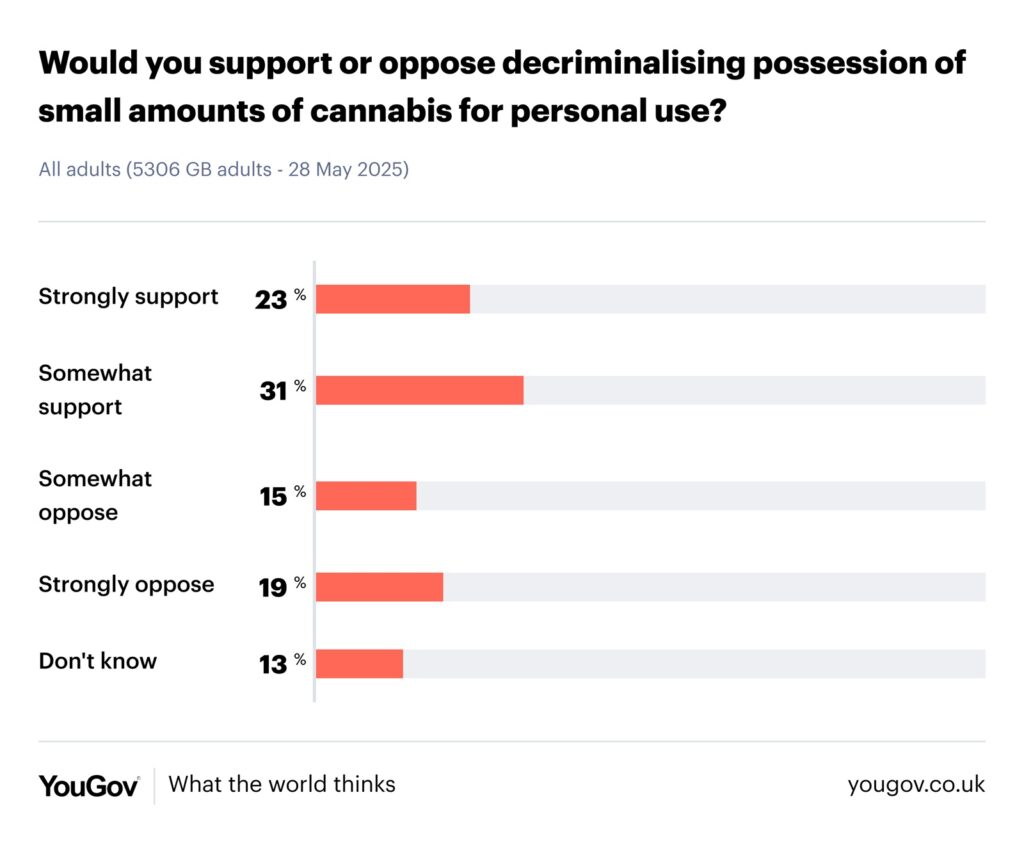
A YouGov UK poll was conducted on May 28th, 2025, the same day that news broke about the London Drugs Commission recommending that cannabis be decriminalized. London Mayor Sir Sadiq Khan, who established the Commission in 2022, quickly endorsed the cannabis decriminalization recommendation.

The YouGov UK poll asked adults in the United Kingdom, “Would you support or oppose decriminalising possession of small amounts of cannabis for personal use?” Below are the results of the poll:YouGov UK Cannabis Decriminalization Poll Results May 28 2025

As you can see from the YouGov UK poll data above, a combined 54% of poll respondents expressed support for the public policy change. Only 34% of poll respondents directly opposed cannabis decriminalization in the United Kingdom, with 13% being undecided.

When the results are filtered by region, support for cannabis decriminalization is even stronger in London, with a combined 56% of survey respondents expressing support for decriminalization, and only 30% of respondents directly opposing it. As is often the case with cannabis policy modernization polls, younger respondents were more likely to support decriminalization compared to older respondents.

“Inclusion of cannabis as a Class B drug in the Misuse of Drugs Act is disproportionate to the harms it can pose relative to other drugs controlled by the Act. The sentencing options currently available, especially for personal possession, cannot be justified when balanced against the longer-term impacts of experience of the justice system, including stop and search, or of serving a criminal sentence can have on a person.” The London Drugs Commission stated about its report earlier this week.

“Sir Sadiq Khan said current rules “cannot be justified”, adding that the commission’s findings had provided “a compelling, evidence-based case” for decriminalisation.” reported BBC in its local coverage.

A previous YouGov UK poll found that the level of support for cannabis legalization among adults in the United Kingdom is greater than the level of support for adult-use legalization among lawmakers.

“The results show that 50% of MPs are opposed to cannabis legalisation when asked in a support/oppose format, compared to 39% who would be in support.” YouGov UK stated about their January 2025 poll results. “The large majority of MPs do, however, believe that doctors should be allowed to prescribe cannabis for medical use (83%). Only 7% are opposed.”

“On the binary question of legalising cannabis, the British public are split, with 45% in favour and 42% opposed, making the public slightly more pro-legalisation than MPs.” YouGov UK also stated.

Adult-use cannabis legalization in the United Kingdom could generate as much as £1.5 billion in revenue and savings, according to a previous report by the advocacy group Transform Drug Policy Foundation.

The report, which was posted on the organization’s social media account back in March, determined that over £1.2 billion would be generated from taxes and fees annually, and an additional £284 million would be saved annually by the nation’s criminal justice system no longer enforcing cannabis prohibition policies.

“There would be costs incurred for Govt by regulatory infrastructure – inspection, monitoring, compliance, trading standards etc – but largely covered by licensing/other fees.” the organization stated on social media.

Transform Drug Policy Foundation also determined that “up to 15,500 full-time jobs could be created in cultivation, manufacturing, retail & related services, (depending on the model implemented).”

The report also found that “a regulated market could displace 80% of the illegal trade in five years (based on trends in Canada).” The organization’s proposed legalization model involves permitting home cultivation, cultivation associations, and a government retail monopoly.

A separate analysis published last year by UK-based advocacy group CLEAR determined that legalizing cannabis for adult use in the United Kingdom and taxing and regulating sales could generate as much as £9.5 billion per year based on their proposed model.

European Cannabis Pilot Projects

Certain European markets are home to a unique public policy and commerce concept known as pilot trials. These research-based projects permit regional adult-use cannabis commerce at a local level to help lawmakers and regulators gather data and information to be better informed when crafting national laws and industry policies.

Current European Union agreements prohibit national commerce models like what is found in the Western Hemisphere, however, EU agreements do permit recreational commerce projects for public health research purposes. Pilot trials are currently operating in the Netherlands and Switzerland, and soon, trials are expected to launch in Germany.

In the video at this link, you can watch a recent presentation from the International Cannabis Business Conference in Berlin about European cannabis pilots. The panel was moderated by leading cannabis policy expert and attorney Kai-Friedrich Niermann, Founder of KFN+ Law Office. The panel also included:

  • Daniel S. Hübner, Senior Science Manager at the Cannabis Research Lab Humboldt-Universität zu Berlin
  • Finn A. Hänsel, Managing Director and a Founder of Sanity Group
  • Deepak Anand, Principal at ASDA Consultancy Services

Until EU agreements are modernized, cannabis pilot trials will continue to serve as an important legal commerce concept for EU member nations to consider.

Czechia Takes Historic Step Toward Cannabis Policy Modernization

Lawmakers in the Czech Republic have reportedly approved a historic measure today that will legalize home cultivation for adult use. Part of the measure also legalizes the possession of a personal amount of dried cannabis, and reduces penalties for possessing larger amounts. The historic measure’s approval was announced by longtime Czech cannabis activist Lukas Hurt on LinkedIn:

The approved legalization model in Czechia involves a possession limit that is considerably greater than in other legalized European countries. Malta became the first country to legalize cannabis for adult use in 2021. Adult households in Malta can cultivate up to 4 plants in private, and adults can possess up to 50 grams of cannabis.

In Luxembourg, where lawmakers adopted a national cannabis reform measure in 2023, adult households can cultivate up to 4 plants in private, but possess just three grams of cannabis. Germany, which legalized cannabis for adult use in 2024, allows adults to cultivate up to three plants in private residences and possess up to 50 grams of cannabis.