Spain Needs To Take Its Rightful Place As A Global Cannabis Leader

Spain, particularly Barcelona, has been home to a vibrant cannabis community for many years. Cannabis is very easy to acquire throughout most of Spain where roughly 1 out of every 10 adults consumes cannabis annually, and it’s no secret that Spain has long served as the top destination for world-class Moroccan hashish.

When it comes to cannabis clubs, Spain has some of the best on the entire planet. Home to roughly 47 million people, Spain is also home to hundreds of cannabis clubs with a majority of them operating in the Barcelona area. The clubs are private and require a membership, however, they are extremely popular and most people have been able to join if they are willing to jump through the necessary hoops.

Barcelona is one of the most beautiful cities on earth, and we are very excited to once again be teaming up with Spannabis to put on the world’s largest cannabis superconference this March. Barcelona is a hotbed for cannabis clubs due to a 2016 regulation approved by the Barcelona City Council which permitted cannabis clubs to operate in the city.

Unfortunately, that regulation was overturned in 2021 by Catalonia’s Superior Court, leaving Barcelona’s entire social cannabis club scene in a state of limbo. Technically, such clubs are considered to be illegal under Spanish law, however, with so many cannabis clubs already in operation shutting them all down is likely to prove to be an impossible task. Even if some get shut down, more will presumably open up.

Lawmakers Need To Accept Reality

Cannabis prohibition does not work, and there is zero evidence that it stops humans from consuming the cannabis plant. Instead, people just do it in the shadows, all the while living in fear. This also applies to cannabis clubs. The clubs in Spain serve a vital function for suffering patients by providing them safe access, and they provide a safer alternative for consumers compared to many other substances that are legal in Spain, including and especially alcohol. Prohibiting them will not make them go away. Rather, it will just make them less safe.

Spain is world-famous for its cannabis, its cannabis community, and specifically, its cannabis clubs. Rather than sticking their heads in the sand and acting as if the clubs will go away, lawmakers in Spain need to embrace cannabis clubs and let Spain take its rightful place as a global cannabis industry tourism leader.

Such a move would create jobs, generate public revenue via fees and taxes, and eliminate any costs to taxpayers that are tied to enforcing cannabis club prohibitions. Cannabis clubs are going to exist in Spain no matter what. Spain might as well regulate them and reap the benefits from doing so.

Spain Needs Adult-Use Legalization

Full adult-use cannabis legalization has obviously failed to pass in Spain as of this article’s posting. For many years it was easy for lawmakers in Spain to drag their feet, to refuse to take action, and to point their fingers elsewhere. That approach is going to be harder to stick with as cannabis legalization spreads across the European continent.

At the end of 2021, Malta became the first country in Europe to pass an adult-use legalization measure. Malta’s legalization model will include legalizing cannabis clubs, which will serve as the primary source for people to acquire cannabis beyond cultivating it themselves. Luxembourg, Italy, and Germany are all on the cusp of legalization. Certain jurisdictions in Switzerland and the Netherlands are participating in a legalization pilot program. All of that reform puts pressure on lawmakers in Spain to step up.

Spain is at a vital crossroads right now. Lawmakers in Spain can continue to cling to failed cannabis prohibition policies and only allow a very limited medical cannabis industry to operate, or they can embrace the emerging cannabis industry and benefit in ways that many other countries cannot due to how well-known Spain is for cannabis. Only time will tell which one it ends up being.

British Food Standards Agency To Publish CBD Guidelines

The regulatory agency is about to release a guide of legal CBD products in the UK market

Sometime in the next few weeks, the British Food Standards Agency (FSA) will publish details about the CBD companies and products allowed to remain on sale in the UK market.

The move comes as 210 applications for CBD products are still in consideration. Late last year, the FSA claimed that the reason this document is almost 9 months late is because of the ‘quality of applications” was lower than expected.

It is now expected that the FSA will potentially issue several documents. One is a public list of validated products, the second is a list of applications for products likely to be approved.

While it is a frustrating process for all involved, it does create, at last, a formal regulatory and approvals infrastructure for CBD products specifically. 

This puts the UK ahead of several other countries at least on a regulatory front. This includes Germany, where CBD is still technically regulated under the German Narcotics Act (although CBD products are on sale in the country). It also includes Italy and France, which just issued national guidelines for the cannabinoid on December 31.

What Next?

The decision by the FSA could be the regulatory peg that the developing industry in-country hangs its hat on. This will, for the first time, allow a conversation to proceed that well may become the first regulatory schemata for the entire British industry. This in turn may help other cannabinoids, like THC, become more accepted.

So far, tragically, on the THC front, the British government has put the brakes on including medical cannabis as a covered prescription under national healthcare. As a result, the only medical cannabis available in the country is imported and further, not accessible to anyone who cannot afford both the medication and the prescription costs.

The Future of The British Cannabis Industry

It is unlikely that moving events on the continent are going to pass the UK by. Germany has just announced its intention to move forward with full boat recreational cannabis. Luxembourg, Malta, and presumably Luxembourg will all move forward in this year. Beyond this, the French have finally begun to accept CBD as a legitimate cannabinoid.

It is unlikely the Brexited British will sit this one out entirely. 

How fast further reform will come, however, is still very much in the air. The silver lining of this cloud, however, is that cannabis reform has moved another step forward in the UK.

Stay abreast of European cannabis industry developments by attending the International Cannabis Business Conference in Barcelona, Berlin, and Zurich this year.

Switzerland’s Federal Court Decriminalizes Minor Possession Of Cannabis

The Federal Court of Justice has just ruled in favour of decriminalizing possession of up to 10 grams of cannabis

In a move that is well-timed – namely right before the new Swiss recreational cannabis trial begins, the Swiss Federal Court of Justice has decriminalized minor possession of cannabis. The ruling is in support of a District Court of Zurich decision in 2016 when a student refused to pay the fine for possessing 8 grams.

News moves quickly in the cannabis world these days. In Zurich, the City Council has already taken an official stance on decriminalization based on the court’s ruling.

Why Is This Important?

There are several reasons why this development is important. 

The first is that supposedly, technically, and legally, this puts a damper on fines for minor possession, hopefully for the last time. The police were supposed to stop issuing fines four years ago. Despite this, the Zurich police at least have said they will still “report small quantities” even though individuals can now no longer be fined.

However, beyond this, the implications are major both domestically and right across the border, starting with the idea that a European country (even if not in the EU) will take steps to amend its national Narcotics Act. This in turn will provide a guide for (at least) Germany which will have to do the same thing as soon as it passes some kind of recreational reform. 

Where Switzerland Goes…

While every country will implement cannabis laws in different strategies and time periods, one thing is for sure. Switzerland may be outside of the EU, but its evolving marketplace may well prove to be more of a template for other countries now moving towards cannabis legalization than either Holland (within the EU) or North American examples (the U.S. and Canada). 

This is important for several reasons, starting with the fact that right over the border in Germany, there is already a fierce debate about the form that the German retail cannabis market may take. Switzerland’s approach, namely backing distribution into pharmacies and social clubs, may well in fact be a model that Germany also adopts, at least initially.

Beyond this, however, it is conceivable that at least German legislators may well take another page out of the Swiss legalization book – namely starting a recreational “experiment” rather than full boat market all at once.

No matter what happens in the coming months, however, Switzerland at least, is clearing the books of outdated laws, and becoming a model in this regard for countries in the EU to follow.

Be sure to stay abreast of breaking developments in the European cannabis industry and attend the International Cannabis Business Conference when it returns to Barcelona, Berlin and Zurich in 2022!

The World From Here: Cannabis Reform Europe Roundup 2021

The discussion has moved forward increasingly faster this year, in large part after September because of the new German government’s decision to enact federal recreational reform as of 2022

In every revolution, there is a tipping point in time – and on the topic of recreational cannabis reform and Europe, this is indeed that moment.

Significant reform is now in the offing in several European countries, beyond Switzerland, starting of course, with Germany. The pace-setting country is in this space in part because of its population and rich economy. It is also clear because of recent political developments that include the decision in 2017 to move forward on federal medical reform as well as the newly announced decision by the newly formed Traffic Light Coalition to enact recreational reform as early as next year.

Beyond Germany, of course, there have been, particularly in the last quarter of the year, significant announcements, and progress reports all over Europe. Malta just announced that they are in fact the first mover on a recreational market in the EU, with Luxembourg likely to be a hair’s whisker behind with a market that at least at first, looks remarkably similar.

Portugal is also not out for the count – with a government snap election pushing back the inevitability of reform here as well – now almost certain to be reintroduced next year if only to keep pace with the Germans. Italy is also likely to move forward with at least a reform that allows home grow if not like Luxembourg and Malta, the public sale of seeds.

In the Czech Republic, the increased blending of medical and recreational markets (namely the use of GACP rather than GMP cannabis in the medical market) is also a model that is likely to have some kind of impact on blended markets going forward. See Switzerland as the prime European example of the same, even if not in the EU.

Do not forget that Greece is still also moving forward on the development of its medical market, as is neighbour to the north, North Macedonia.

Spain is also likely to finally move forward on some kind of regulation of its coffee shop trade, particularly as Holland also moves, however slowly and painfully, to a national model of regulatory reform and procedure.

Denmark is also likely to announce the details of its own recreational trial too, especially as the medical market continues to take shape.

In short, 2021 has been much like the U.S. in 2012 where two American states – Colorado and Washington State, voted to create recreational markets. The difference, of course, is that all this reform in Europe is of the federal kind. 

Regional Reform & The Outliers

There are still a few larger fights on the horizon, both on the sovereign and then of course regional level. Outliers even in the medical discussion include not just France but Poland as well as other countries particularly in the eastern part of the region.

On a regional level, expect recreational reform to move far more slowly. There is still wide disagreement on the implementation of this kind of guidance even in the low THC, hemp market. 

Regardless, the cannabis genie is out of the bottle here, as of this year. And no matter when actual sales now begin to happen, it will never be stuffed back.

Be sure to keep abreast of developments in Europe by attending one of the International Cannabis Business Conference events in Europe in 2022!

Removing Cannabis From The German Narcotics Act – Is It A Pipe Dream?

Thailand has just done it, why can’t Germany?

With all the celebratory hoopla that came with the news that Germany would, finally, after experimenting with the medical question during the last four years of the Angela Merkel headed, CDU led government, now move with the new Traffic Light Coalition into the future that includes recreational reform, have now come the inevitable questions.

Namely, for all the excitement, those on the regulatory and legal side of the coin have already been raising red flags about how quickly all of this could move – even if the government does enact formal adult-use legislation next summer or fall.

Namely, cannabis is still listed in the German Narcotics Act. And this still trips up even the CBD industry here. See, if nothing else, the embarrassing police raid on a national grocery store in Munich that may (or even may not) have been selling THC-free, CBD cookies and other “cannabis” products (as advertised by the store themselves) just this year.

However, as Thailand has just proved, this legal doom and gloom may be a bit displaced. See what just happened here. Namely, the government just removed cannabis from their national narcotics act completely.

Is This Realistic in Germany?

There will, no doubt, be a great deal of discussion about how to proceed with a recreational market while preserving the status of cannabis (even the flower) as a medical substance. 

Here is the difference between how things are proceeding in Germany vs. Thailand. The first is that in Thailand, the government has allowed a waiver of GMP standards for medical cannabis if it is grown domestically. Local farmers are allowed to deliver plants directly to hospitals.

This seems highly unlikely aus Deutschland, home of the modern pharmaceutical industry (along with the U.S.), birthed in the 1930s. 

However, one should not entirely count this kind of development out. Indeed, just over DACH border, in Switzerland, authorities are (sort of) doing the same thing as the Thai government with the advent of their own recreational trial. Namely, they are also waiving both EU GMP and Novel Food regulation on early-stage, trial products for adult use market products. 

These, however, in turn, will first be distributed via pharmacies, which themselves are under strict national and international regulatory rules, even if Switzerland is outside of the EU.

Beyond this, the Czech Republic also seems to be going a similar route. So, the idea the Thai government is now implementing is not unknown here.

That said, given the amount of money the government itself stands to make from recreational licensing, it is unlikely. And many questions remain about how the Germans will in fact proceed. It is also unlikely that the plant will be removed from the Narcotics Act completely, but rather provisions made for its use in both medical and non-medical situations, the latter of which could easily resemble the alcohol industry. Then again, this being the cannabis industry, it is impossible to predict what the path will actually be, even after the establishment of the market itself at least on the federal regulatory level.

Be sure to book your tickets early to the International Cannabis Business Conference when it returns to Berlin in the summer of 2022!

Fiji Plans To Move Forward On Hemp Reform

The island nation is going to move forward on basic cannabis reform as early as next year.

The 300 island archipelago nation of Fiji is moving forward on cannabis reform. The nation’s president opened the new legislative year in November with a pledge to move at least the hemp industry forward as a way of diversifying the country’s agricultural sector. This vertical accounts for about 10% of the country’s GDP. 

Current plans include identifying a foreign partner to help move the country successfully along with a first pilot project.

Industrial hemp, at least at the moment, however, is about as far as the conversation will go for now. Authorities are only interested in authorizing the growth of plants with under 1% THC.

Bringing Economic and Political Stability?

The Fiji Islands are located in the South Pacific, to the east of Australia and due north of New Zealand. With a complicated colonial past and a history of coups over the last twenty of its recent thirty-year history, authorities are clearly trying to establish a cash crop that is not too controversial. It is undeniable, however, that changing cannabis policies in both Australia and New Zealand (if not elsewhere) have influenced this new policy direction, although it is interesting that so far at least, hemp reform is as far as the island is interested in proceeding.

Fiji is one of the most developed Pacific Island economies, with a large subsistence sector. Tourism is the other big industry here, with white sand beaches and tropical weather year-round drawing global tourists. And while nobody is talking cannatourism yet, give it time. Thailand is moving rapidly to remove restrictions on its cannabis industry. Other countries in this part of the world, including the Philippines, which delayed cannabis reform indefinitely this year, are moving more slowly and cautiously.

Regardless, progress here does indicate that even in Asia, the subject of cannabis reform is shifting, even if slowly. Tourists come primarily from Australia, New Zealand, the United States, China, and the UK. As the global economy rebounds from Covid, it is unlikely that this vertical will be overlooked, anywhere, as a source of economic development one way or the other.

For more updates on the global cannabis industry, be sure to stay tuned to the International Cannabis Business Conference blog!

Organizing For National Cannabis Reform: A New Spanish Advocacy Group Gets Going

The Cannabis Industry Guild (or GIC) has just been formed to create an advocacy group for the nascent industry across the country

In yet more of a sign of how large the ripple effect of the German announcement to move forward on recreational cannabis has been in Europe, a group of Spanish entrepreneurs has just come together to form a new business group. According to Canamo.net, which broke the story, the members of the new Guild are coming together to create a new partnership with the government. Namely, one in which seed sales are legalized and that the grow shop sector be recognized as legitimate and regulated.

The Spanish industry has suffered several setbacks beyond Covid, most of which stem from the intransigence, so far, on a national, federal level, to consider even the widespread medical use of cannabis. Indeed, the regulatory authorities in Spain have only issued four EU GMP cultivation licenses, all of which are focused on export. In the meantime, the Club industry has evolved and taken its knocks. One of the cofounders of the same, Albert Tio, is currently doing jail time for his part in organizing the same after losing his appeal at the European level earlier this year.

Beyond this, of course, the Spanish industry is suffering all the problems still recognizable to the American state industry – namely police intervention and even problems with getting a bank account.

Organizing for National and Regional Cannabis Reform

It is very clear that the Spanish industry is not going to let the other conversations about reform lie unanswered, even if they come from outside the country. The GIC is working closely with the Guild of Grow Shops in Catalonia, a group in operation for over 15 years in the heart of the Spanish industry (in Barcelona). Beyond this, the group has formed an alliance with the European Observatory of Cannabis Consumption and Cultivation to move the conversation forward at a national and EU-wide level.

There are many reasons to believe that this forward motion might in fact this time be successful, and not just because of the new German Coalition government decision on the same. The model proposed by the GIC is very much what has been proposed now for Luxembourg. This is surely also not a coincidence.

Regardless, more reform is clearly on the way in Spain, driven undeniably by the forward motion in countries all around it.

Be sure to book your tickets to the International Cannabis Business Conference when it returns to Barcelona in March!

Malta Becomes First Country In EU To Legalize Adult Use Cannabis

The country will edge out Luxembourg, Germany, and Portugal to create a fully functioning, federally legal cannabis market

Malta has just become the first EU country to formally legitimize an adult-use cannabis market. The Maltese Parliament voted to move forward on the same on December 14. All that is needed now is the signature of the President (a mere formality).

There will be a formal government agency established to oversee the industry. Regulated sales will be allowed to occur in shops. Home grow will be allowed.

How Will This Impact Recreational Reform Across Europe?

While cannabis reform and of both the medical and recreational kind, has been moving forward steadily in Europe, driven by Germany, over the last four years, 2021 and even more so 2022, is likely to be considered “Ground Zero” in terms of finally moving the recreational conversation over the finish line across the region.

Even Holland is formalizing its market on a national level. Beyond this, of course, Luxembourg will establish a limited recreational market, Portugal is likely to do so as is Italy. And of course, right in the middle of it all, even if not in the EU, Switzerland is moving ahead as of next year.

There are, beyond “domino” discussions, however, other interesting developments potentially afoot with this development. The first of course is financing for the industry, no matter where it is based in Europe. 

The second is what this development will do to the entire reform discussion in the UK. Like Canada, Malta is in the Commonwealth. It now becomes the second commonwealth country to formally legitimize the drug. Beyond this, of course, another commonwealth country, namely South Africa, is also about to move forward on significant cannabis reform.

Whatever happens, as a result, will begin to move reform forward not just within the EU, but potentially as a formal policy of the Commonwealth. This in turn, beyond regional pressure from the EU, may in turn finally convince policymakers at the UN to take the next step and enact truly global cannabis reform.

None of this will happen overnight, of course, and despite all the excitement, there is plenty of ground to cover from merely passing cannabis reform to implementing it on the ground.

Regardless, it is an important step, and further one that casts yet another encouraging light on the entire recreational cannabis conversation across Europe – if not a bit further afield than this.

The International Cannabis Business Conference returns to Europe in 2022 in Barcelona, Berlin, and Zurich.

Relative Majority Favors Legalizing Cannabis In Germany For The First Time

Cannabis reform has more momentum on the European continent right now than ever before since the start of prohibition, and Germany is at the heart of it.

Medical cannabis is already legal in Germany, and legal sales have been underway for a handful of years now. Every passing year sees a new record set for German medical cannabis sales.

A new type of reform, adult-use legalization, is on the horizon in Germany, with the new coalition government has expressed a desire to legalize cannabis for all adults in the near future.

When news of the legalization plan surfaced it instantly took over the international news cycle, beyond just cannabis news, and that didn’t come as any surprise to long-time cannabis policy observers.

Support For Legalization Is Strong

Many polls have been conducted over the course of several years in Germany to try to gauge public support for full cannabis legalization.

While some of those polls showed strong support for legalization, they almost entirely relied upon online methods for people to participate in the polls.

That methodology is very hard to rely upon and is largely why polling results out of Germany were all over the board, with many polls showing overwhelming support and other polls showing the exact opposite depending on which outlet/entity was conducting the online poll.

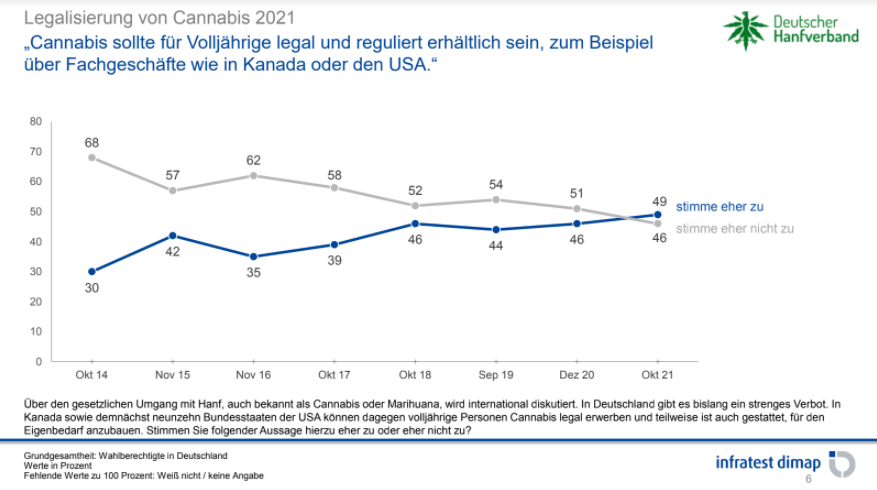
Deutscher Hanfverband recently conducted a poll in conjunction with an established, well-known institute that incorporated both telephone and online polling. 

The poll was part of a similar annual survey, which is an important distinction compared to other polls because it provides tremendous insight regarding shifting views in Germany regarding adult-use legalization.

As you can see from the chart below, provided by Deutscher Hanfverband, support for legalization is now at 49%, which is greater than support for keeping prohibition in place. This is a first for Germany:

Germany Cannabis Legalization Poll

“There is no majority in the population in favor of banning cannabis. For more than 200,000 criminal proceedings per year, not only is there a lack of scientific basis, but also democratic legitimation. It’s time for legalization.” stated Georg Wurth, spokesman for the German Hemp Association.

The Most Significant Legalization Domino So Far

As of this article’s posting, there are only two countries that have legalized cannabis for adult use – Uruguay in 2013 and Canada in 2018.

A laundry list of countries has indicated that they plan to make a major push for legalization in 2022, including Germany.

Malta appears to be on the verge of legalizing cannabis for adult use for cultivation and possession purposes, with the final passage and the president’s signature expected to happen this week. 

If that happens, Malta would become the first country to legalize cannabis for adult use in Europe, and the third country to do so on the planet.

With that being said, legalization in Germany would be a bigger deal from political momentum and emerging cannabis industry standpoints compared to Uruguay, Canada, and Malta combined.

Germany has a population of over 80 million people and is home to the fourth-largest economy on planet earth. By comparison, Canada, Uruguay, and Malta only have a combined population of roughly half that of Germany, and those nations do not wield nearly as much political power as Germany on the international level.

Whereas Malta, and reportedly also Luxembourg, plans on only legalizing cannabis cultivation and possession for adults, Germany is planning on implementing a robust, regulated adult-use industry nationwide.

Given Germany’s place in the political and industry arenas in Europe and throughout the rest of the world, legalization there will be more significant than can be expressed in words, and according to recent polling, it’s a move supported by more Germans than not for the first time in history.