Cannabidiol Found To Be An Effective Antifungal Treatment

A team of academic researchers based in Australia and the United Kingdom recently collaborated on a study examining cannabinoids and their ability to be used in antifungal treatment regimens. The researchers found cannabidiol (CBD) and cannabidivarin (CBDV) to be particularly effective.

“Fungal infections pose a major threat to human health with increasing incidence of antifungal resistance globally. Despite the need for novel antifungal drugs, few are currently in clinical development.” the researchers wrote. The study’s findings were published in the academic database PLOS.

The cannabis plant is made up of dozens of cannabinoids, with CBD being a particularly popular cannabinoid in recent years for researchers. CBDV is a lesser-known cannabinoid, and research focused on it is more limited compared to CBD and tetrahydrocannabinol (THC).

“Here we evaluate the antifungal activity of five phytocannabinoids against several clinically relevant fungal pathogens, with a focus on the priority pathogen Cryptococcus neoformans.” the team of researchers stated in their published review. “Our results demonstrate that Cannabidiol (CBD), and particularly Cannabidivarin (CBDV), have broad activity against C. neoformans and other fungal pathogens, including dermatophytes that cause common tinea.”

“We found that both CBD and CBDV acted in a fungicidal manner and prevented biofilm formation in C. neoformans. Phytocannabinoid treatment impeded factors important for virulence and antifungal resistance, including reduced capsule size and disruption of mature biofilms. Proteomics analysis revealed that the antifungal activity of CBD and CBDV was linked to destabilisation of the membrane, alterations in ergosterol biosynthesis, disruption of metabolic pathways, as well as selective involvement of mitochondrial-associated proteins.” they also wrote.

“We next tested the ability of CBD to topically clear a C. neoformans fungal infection in vivo using the Galleria mellonella burn wound model, and we observed greatly improved survival in the CBD treated larvae. This study illustrates the potential of phytocannabinoids as antifungal treatments and opens up new routes towards development of novel antifungal drugs.” the study’s authors concluded.

A recent market analysis by Emergen Research determined that “the Cannabidiol (CBD) Consumer Health Market is expected to grow from USD 20.52 billion in 2024 to an estimated USD 81.76 billion by 2033, at a compound annual growth rate (CAGR) of 16.60%.”

Discussing Advanced Cannabis Cultivation Technologies

Advanced cannabis cultivation has come a long way in recent years. Humans have cultivated the cannabis plant for centuries. However, much of it was outdoors under the sun without the use of technology.

In recent decades, cannabis cultivators have produced crops indoors or in greenhouses at an increasing rate, largely out of necessity due to global prohibition policies. The rise of the legal cannabis industry has been paralleled by an increased use of cultivation technology, as well as advances in that technology. It is truly exciting times for the legal cannabis cultivation sector.

Long gone are the days of simply yielding a cannabis harvest. Successful cultivation is more methodical than ever, with commercial cultivators having to produce harvests at scale in a cost-effective manner, all while being mindful of yielding crops that are compliant with market regulations and capable of being used in an ever-expanding list of end products for patients and consumers.

At the recent International Cannabis Business Conference in Berlin, a panel moderated by Quinn Shiskin, President of McIntyre Creek Cannabis Inc., discussed advanced cannabis cultivation technologies. Mr. Shiskin was joined by:

  • Franz Josef Sima, Horticulture Service Specialist in the EMEA Region for Fluence
  • Albert Eppinga, Entrepreneur and Philanthropist, Founder of BC Cann
  • Max Majot, Technical Manager and Cultivation Expert at Royal Queen Seeds
  • Rui Soares, Founder and CEO of Paralab
  • Mikhail Sagal, President of TSRgrow

Technological innovation is reshaping cannabis cultivation, from automated systems to AI-driven analytics. This panel explored how tech solutions can boost yields, improve quality, and reduce costs. Panelists also discussed modern ways of energy storage, innovations in cultivation lighting, and high-efficiency cannabis cultivation techniques. You can watch the panel at this link here.

Researchers Pinpoint Markers That “Significantly Influence Cannabinoid Production”

Anyone who has cultivated cannabis knows that certain strains produce better cannabis than others, and sometimes also in larger volumes. Even if all things were equal, from light exposure to environment to nutrients and grow mediums, some strains just perform better in the end.

For many years, home cultivators and commercial producers were unsure why certain strains yielded better harvests than others. However, new research out of Canada is shedding light on why some cannabis varieties yield more cannabinoid production than others.

Researchers affiliated with various academic and research institutions examined “cannabis accessions from the legal Canadian market” and focused on “identifying quantitative trait loci (QTL) and candidate genes associated with eleven cannabinoid traits using 282K common single-nucleotide polymorphisms.”

The study’s results were published in the academic journal The Plant Genome.

“This approach aims to transform our understanding of Cannabis genetics.” the researchers wrote. “We have pinpointed 33 significant markers that significantly influence cannabinoid production, promising to drive the development of Cannabis varieties with specific cannabinoid profiles.”

“Among the notable findings is a massive haplotype of ∼60 Mb on chromosome 7 in Type I (i.e., tetrahydrocannabinol [THC]-dominant) accessions, highlighting a major genetic influence on cannabinoid profiles.” the researchers determined. “These insights offer valuable guidance for Cannabis breeding programs, enabling the use of precise genetic markers to select and refine promising Cannabis varieties.”

Knowing which markers boost cannabinoid production will help cannabis breeders and cultivators selectively breed cannabis strains that contain those markers and develop crops that are rich in certain cannabinoids. Those crops can then be used to make products that patients and consumers need, and likely in a more efficient and cost-friendly manner.

“This approach promises to speed up the breeding process, reduce costs significantly compared to traditional methods, and ensure that the resulting Cannabis varieties are optimized for specific medical and recreational needs.” the researchers stated.

“This study marks a significant stride toward fully integrating Cannabis into modern agricultural practices and genetic research, paving the way for future innovations.” the researchers concluded.

Brazilian Study Finds Cannabis To Be An ‘Exit Drug’

Historically, cannabis policy modernization opponents have portrayed cannabis as a ‘gateway drug,’ claiming that the use of cannabis leads to the use of more harmful substances. The results of a recent study in Brazil suggest that cannabis may be effective at helping people reduce their use of more harmful substances.

“Researchers from the University of Brasília (UnB) have announced encouraging results in the use of cannabidiol (CBD) to treat people addicted to crack cocaine.” reported Sechat in their local coverage (translated from Portuguese to English).

“The study conducted at UnB revealed that the use of CBD was more effective in reducing crack consumption and side effects, compared to medications traditionally used in Alcohol and Drug Psychosocial Care Centers (CAPs AD). For those facing the challenge of treating such complex conditions, the novelty represents a relief, both for health professionals and for patients and their families.” the outlet also reported.

The results of the study in Brazil build on previously conducted international research involving other substances that arrived at similar conclusions.

For example, a study conducted in early 2024 by a team of international researchers involving 2,697 subjects found that “study participants reported that cannabis had a high degree of efficacy in alleviating their illness/symptoms, and many reported a reduction in their use of prescription opioids, alcohol, tobacco, and other substances.”

A study from earlier this year found that 60% of surveyed patients reported “reducing opioids since starting cannabis.” A separate study conducted in 2024 found that the use of medical cannabis was associated with a lowering of the use of morphine.

“This systematic review summarized published literature on county-level predictors of drug overdose mortality in the United States. … “[M]easures related to cannabis dispensaries, substance use treatment, social capital, and proportions of family households, were generally consistently associated with lower drug overdose mortality outcomes across multiple studies.” stated researchers who conducted a systematic review of county-level predictors of drug overdose mortality in the United States in 2022.

CBD Associated With Improved Memory In Preclinical Models

Worldwide, Alzheimer’s disease is the most common cause or type of dementia, with an estimated 60-70% of global dementia cases involving an Alzheimer’s diagnosis. That works out to roughly 34.2 million to 39.9 million cases. The condition is characterized by progressive memory loss and cognitive decline.

A team of researchers affiliated with several health and academic institutions in Spain recently conducted a study examining the use of cannabidiol (CBD) and its potential as a treatment for Alzheimer’s disease. The study’s findings were published in the academic journal Alzheimer’s Research and Therapy.

“This study employs in vitro and in vivo methodologies to validate CBD’s potential as a treatment for Alzheimer’s disease (AD) by addressing key hallmarks of the condition and promoting neuroprotective effects on spatial memory.” the researchers stated about their methodology.

“Our findings demonstrate CBD’s ability to decrease pTau and Aβ aggregation and to mitigate their axonal transport between cortical and hippocampal neurons.” the researchers wrote. “Moreover, CBD treatment was shown to reduce neuroinflammation, as CBD was able to skew microglia towards a neuroprotective M2 phenotype while attenuating proinflammatory cytokine release in the 5xFAD AD mouse model.”

“Notably, daily CBD injections (10 mg/Kg) for 28 days in 5xFAD mice resulted in significant improvements in both short- and long-term spatial memory. The study also reveals CBD’s capacity to partially revert neurite formation loss induced by Aβ, Tau, and pTau proteins, suggesting a potential role in promoting neuronal plasticity.” the researchers added. “Additionally, CBD treatment led to a reduction in reactive oxygen species (ROS) formation and increased neuronal viability in the presence of AD-associated protein aggregates.”

The full structure of cannabidiol was first identified in 1964 by Raphael Mechoulam and his colleagues in Israel. Since that time, cannabis prohibition policies have largely hindered CBD research, however, the cannabinoid has become the focus of investigations at an increasing rate in recent years.

“These multifaceted effects of CBD, ranging from molecular-level modulation to behavioral improvements, underscore its potential as a comprehensive therapeutic approach for AD.” the Spanish researchers concluded about their study. “The findings not only support CBD’s neuroprotective properties but also highlight its ability to target multiple pathological processes simultaneously, offering a promising avenue for future AD treatment strategies.”

According to a recent CBD industry analysis by Grand View Research, “the global cannabidiol market size is expected to reach USD 22.05 billion by 2030,” which is “a CAGR of 15.8% from 2025 to 2030.”

Analysis Finds ‘Few Changes In Cognitive Performance’ Post-Cannabis Use

One of the main talking points used by cannabis opponents is that ‘cannabis is bad for the brain’ and that its use will result in significant declines in cognitive performance. The talking point is often applied to public policies as they pertain to driving under the influence.

A team of researchers affiliated with the University of the Sunshine Coast and the University of Queensland, both in Australia, recently performed an analysis examining cognitive performance after patients have used medical cannabis products. The results of the analysis were posted in the academic journal Drug and Alcohol Review.

“This program of research investigated the acute effects of orally ingested (Study 1) and vaporised (Study 2) cannabis containing delta-9-tetrahydrocannabinol (THC) on cognitive functions relevant for driving in two samples of medicinal cannabis patients (Study 1 N = 41 oral users; Study 2 N = 37 flower users).” the researchers wrote.

“Participants completed counterbalanced baseline (no cannabis) and cannabis consumption (post-cannabis) appointments scheduled approximately 1 week apart. During each session, participants were administered a cognitive battery assessing information processing speed, sustained and divided attention, inhibitory control and mental flexibility. In the post-cannabis condition, the battery was completed 90 min after consuming one dose of cannabis oil (Study 1) or 15 min after vaporising one dose of cannabis flower (Study 2).” the researchers stated about their methodology.

Many jurisdictions where medical cannabis is legal, including Australia, are struggling with how to strike the right balance between keeping people from operating motor vehicles when they are too impaired and not persecuting medical cannabis patients who are not impaired and simply have metabolized THC in their systems.

“In both samples, acute cannabis oil and flower administration did not induce a change in information processing speed, divided and sustained attention, or inhibitory control performance (after excluding participants with a positive drug indication at the start of either session), highlighting the moderating role of tolerance.” the researchers found.

It is worth noting that the population size of this analysis was not large, and further research is needed. However, the results of this analysis in Australia are in line with findings from other studies that have examined medical cannabis use and cognitive performance.

A 2018 meta-analysis conducted in the United Kingdom also found that “the acute effects of single cannabinoid administration are less prominent in regular cannabis users compared to non-regular users” and that “repeated cannabinoid administration more consistently suggest less prominent effects upon repeated exposure.”

In laypeople’s terms, patients who use cannabis more regularly are less likely to be impaired after cannabis consumption compared to infrequent consumers. That is an important distinction because per se cannabis DUI laws are such that they penalize frequent consumers for having built up metabolized THC in their system, even though those consumers are less likely to be impaired at the time of testing.

Conversely, the metabolized THC thresholds of per se cannabis laws often result in infrequent cannabis consumers testing below the THC threshold, even though they are more likely to be impaired after cannabis use. As such, cannabis DUI laws need to be based on sound science, and not arbitrary metabolized THC thresholds that ultimately do not detect true intoxication levels.

Australian Study: Far-Red Light Use May Increase Cannabis Yields

Cannabis cultivation has become more sophisticated in recent years due to various factors. One major factor is advancements in cultivation technology, including climate control, lighting, and feeding technology, to name a few areas.

Another contributing factor is sheer necessity born out of modern cultivation and harvest policies and regulations. Many jurisdictions around the world require cannabis to be cultivated outside of public view, and in some cases, in locked indoor facilities.

Several jurisdictions, particularly European markets, have end-product standards that make outdoor cultivation difficult from a product compliance standpoint. Cannabis products to be sold in regulated European markets must be GMP compliant, and that is a hard threshold to meet when the raw cannabis inputs for products are cultivated completely outdoors.

A team of researchers affiliated with the New South Wales Department of Primary Industries and Regional Development and Southern Cross University in Australia recently examined the use of far-red light technology and cannabis cultivation to see how far-red light affects plant yields. The study’s findings were published in the academic journal Scientific Reports.

“Far-red (FR) light elicits two distinct processes in plants. First, a shade avoidance response which is triggered when the ratio of red to FR (R: FR) declines. Second, it interacts synergistically with higher frequency wavelengths of light (e.g. red or white) which improves the efficiency of photosynthesis.” the researchers wrote.

“We investigated whether we could harness these phenomena in medicinal Cannabis to improve yields so that the duration of the photoperiod could be reduced to 10 h (“10L”) whilst returning similar or improved yields compared to a 12 h photoperiod (“12L”).” the researchers also wrote.

Energy consumption is an increasing concern for the emerging global cannabis industry from a sustainability standpoint. It is also a financial concern for legal cannabis producers being as the cost of energy is rising around the world. With that in mind, reducing photoperiod time while maintaining, or even better increasing, overall yield is significant.

“The THC concentrations were elevated in both high THC varieties by the different FR treatments. In Hindu Kush the concentration of THC was elevated by the addition of 4 h of total FR (“10L_2_2D”), and in Northern Lights total cannabinoid yields were increased by nearly 70% over the 12 L control (0.43 versus 0.25 g Plant− 1) by the addition of 2 h of FR in darkness after 10 h of light (“10L_2D”).” the researchers determined.

“Our results show a strong yield and quality advantage in high THC lines treated with end-of-day FR treatments. Furthermore, a lighting schedule of 10L_2D instead of 12 L would result in a saving of 5.5% in power usage and resultant emissions.” the researchers concluded.

It is worth noting that this study was fairly limited in size and scope, and that further research needs to be performed before there is a final answer regarding the benefits of incorporating far-red light into cultivation strategies. However, the results of this study are still insightful and give producers things to consider.

Hemp Fiber May Be A Viable Cotton-Compatible Textile Input

The hemp fiber industry holds tremendous economic potential. According to a recent market projection by MarkNtel Advisors, “the global hemp fiber market stood at USD 11 billion in 2024 and is projected to reach USD 36 billion by 2030, growing at a CAGR of 22%.”

“The surge in hemp fiber adoption reflects broader shifts in consumer behavior, policy frameworks, and material science innovation. Hemp’s fast growth rate, minimal pesticide requirements, and carbon sequestration properties are positioning it as a bio-based solution for climate-conscious industries.” MarkNtel Advisors stated.

One logistical issue that is holding the hemp fiber sector back, to some degree, is limited infrastructure. In the wider textile industry, hemp is largely seen as a niche material input requiring specialized machinery to create end products. However, a recent study is providing new insight into hemp’s potential as a cotton-compatible textile input.

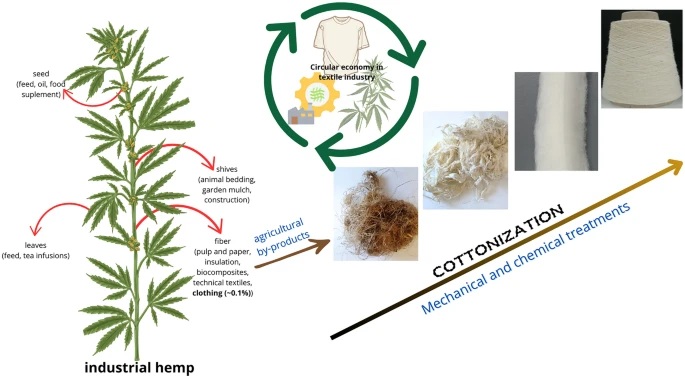
A team of researchers affiliated with Universitat Politècnica de Catalunya-BarcelonaTech (Spain) and Dresden University of Technology (Germany) recently conducted a study examining non-textile hemp by using mechanical-chemical cottonization. The results of the study were published in the academic journal Cellulose.

“The raw material used was an agricultural residue that is mainly employed for paper manufacturing. These fibers were subjected to an alkaline chemical treatment followed by an oxidizing treatment (H2O2) to reduce non-cellulosic components.” the researchers stated about their methodology. “Subsequently, a mechanical process was carried out to increase fiber elementarization and obtain suitable slivers for spinning.”

“The potential of open-end rotor spinning was evaluated for both the 100% treated hemp and blends of 25% hemp/75% cotton. The selection criteria included a low reduction of the degree of cellulose polymerization, a low mass loss during the process, an appropriate tensile strength of the resulting yarns, an absence of breakage during spinning, and a low twist.” the researchers also wrote.

Below is a graphical abstract provided in the researchers’ article listed on Springer Nature:

industrial hemp cottonization mechanical and chemical treatments

“The hemp treated with a high level of H2O2 stabilizer, according to the established experimental design for the oxidizing process, exhibited superior performance when blended with cotton and spun with a count of 40 tex and a twist coefficient (αm) of 170. These outcomes are of industrial interest for the production of fine yarns because they can be easily implemented using existing machinery devoted to processing cotton.” the researchers determined.

“Furthermore, it contributes to the circular economy within the textile industry by adding value to a waste material that can serve as an alternative source of more environmentally friendly cellulosic fibers.” the researchers concluded.

The results of this recent study come at a time when Europe’s industrial hemp industry potential is being researched at an increasing rate. For example, a team of researchers affiliated with the University of Göttingen recently examined industrial hemp from the perspective of its prospects as a sustainable crop for modern agriculture in Germany.

“Industrial hemp offers promising prospects for agriculture. Its ecological advantages, such as improved soil structure and CO2 sequestration, as well as the economic potential offered by dual-use land and low or no need for pesticides, make it a sustainable addition to crop rotation.” the researchers concluded. “With the right strategy, industrial hemp can make a valuable contribution to sustainable agriculture, especially when economies of scale, stable sales contracts, and effective integration into crop rotation systems are considered.”

The University of Göttingen’s findings built on other recent hemp-focused sustainability research, including a study led by researchers affiliated with the University of Banja Luka, the University of Belgrade, and the University of Niš, which found that raw hemp can be used as an effective and eco-friendly alternative for removing toxic dye chemicals from wastewater.

During a recent presentation at the International Cannabis Business Conference in Berlin, leading international cannabis industry economist Beau Whitney, founder of Whitney Economics, provided data demonstrating that the value of the global industrial hemp industry could be as much as $456.2 billion.

Excitement Level In Berlin Demonstrates Surging Interest In The Global Industry

On April 29th-30th, 2025, the International Cannabis Business Conference held its flagship event at the Estrel Berlin, Germany’s largest hotel and conference center. The event was nothing short of electric, and it was the conference’s biggest and best event to date.

Interest in the emerging global cannabis industry, particularly in Germany and Europe, is experiencing exponential growth right now, and that was evident throughout the two-day conference in Berlin. Roughly 5,000 people attended the conference, with over 80 countries and every major legal market represented. Click here to see an after-movie video of the conference.

One readily apparent fact at the conference was that Europe has now become the top focus of industry members across the world, particularly for industry members wanting to gain a meaningful footprint in Germany’s market. As leading European policy and legal expert Peter Homberg of gunnercooke pointed out in his keynote presentation, imports of medical cannabis products to Germany nearly quadrupled in the last quarter of 2024 compared to the first quarter.

The expansion of Germany’s legal industry in recent years was accelerated in April 2024 with the adoption of the nation’s CanG law, which legalized personal cannabis cultivation, possession, and consumption by adults. The CanG law also permits adult-use cannabis associations to operate, with 211 associations having already received approval.

Arguably, the most significant component of Germany’s CanG law was the removal of cannabis from the nation’s Narcotics List. The declassification of cannabis dramatically improved Germany’s medical cannabis industry. Germany’s medical cannabis patient base is increasing in size with every passing day, as proven by the fact that more than 1 out of every 7 of the nation’s pharmacies now sell medical cannabis products.

A common theme throughout the Berlin conference was the parallels and interplay of the Western Hemisphere’s legal markets and Europe’s emerging markets. What Europe is currently experiencing is reminiscent in various ways of what happened in North America starting in 2012 with the initial adoption of state-level legalization in the U.S. The ‘green rush’ in the U.S. and Canada provides lessons that entrepreneurs, investors, policymakers, and industry service providers in the Eastern Hemisphere can learn from.

Kicking off the conference was a keynote presentation by Charlie Bachtell, CEO and Founder of Cresco Labs. Charlie Bachtell has served as Cresco Labs’ [CSE:CL] Chief Executive Officer since February 2015 after co-founding the company in 2013. Cresco Labs operates in several U.S. markets, and the insight that Mr. Bachtell provided in his presentation was invaluable for attendees.

Following Bachtell’s presentation was a keynote address by gunnercooke’s Peter Homberg. Mr. Homberg examined the current state of Germany’s industry and political landscape, including the fresh announcement of the appointments of incoming German Minister of Health Nina Warken and Federal Ministry of Food and Agriculture Alois Rainer. Both incoming ministers will play a major role in shaping what happens next for Germany’s emerging industry, and with it, the wider European cannabis economy. Mr. Homberg’s thorough presentation on day 1 of the conference in Berlin could not have been more timely.

Another timely presentation was a panel discussion focusing on European pilot projects. Pilot projects are currently operating in the Netherlands and Switzerland and are also part of Germany’s legalization model. The panel was moderated by German policy expert Kai-Friedrich Niermann, Founder of KFN+ Law Office. Joining Mr. Niermann was:

  • Paul-Lukas Good, President, Swiss Cannabis Research Association
  • Daniel S. Hübner, Senior Science Manager, Cannabis Research Lab Humboldt-Universität zu Berlin
  • Finn A. Hänsel, Managing Director, Sanity Group
  • Deepak Anand, Principal, ASDA Consultancy Services

Current European Union agreements prohibit national commerce models like those found in the Western Hemisphere. However, EU agreements do permit regional adult-use cannabis commerce pilot trials for public health research purposes, and the panel of leading experts analyzed current and future European pilot trials.

The next panel, moderated by Jamie Pearson, President of New Holland Group, focused on investing in the evolving global cannabis industry. Ms. Pearson was joined on the panel by:

  • Raj Grover, CEO, High Tide Inc.
  • Will Muecke, Co-Founder, Artemis Growth Partners
  • George Bellow, Co-Founder, SOMAÍ Pharmaceuticals
  • David Hyde, CEO, Hyde Advisory & Investments Inc.
  • Margaret Brodie, CEO, Rubicon Organics

Effectively investing in the emerging global cannabis industry is more complex than ever, and the panel’s insights were invaluable. Additional day 1 panels and presentations included such topics as:

  • Medical cannabis in Germany
  • Germany’s evolving cannabis industry
  • Advanced cultivation technologies
  • The latest trends and innovations in cannabis logistics
  • German cannabis industry data
  • Establishing international brands
  • Unlocking new markets
  • Cannabis research
  • The evolving industrial hemp industry

The first day of the conference’s curriculum was followed by an intimate VIP after-party headlined by none other than cannabis industry and culture icon DJ Muggs of Cypress Hill and Soul Assassins. International Cannabis Business Conference events are known for combining industry, policy, and entertainment, and the 2025 event in Berlin was no exception. DJ Muggs put on a show for the VIP crowd that will be talked about for years to come.

Day 2 of the Berlin conference started with a keynote presentation by Dr. jur. Can Ansay, CEO of DR. ANSAY LTD. Dr. Ansay is a notable figure in Germany’s medical cannabis sector and the founder of the popular telemedicine platform DrAnsay.com. He examined safe access to medical cannabis in Germany and discussed changes and trends in Europe’s largest medical cannabis market.

Following the day 2 keynote address, the following topics were discussed at length by panels of leading experts:

  • Forming strategic partnerships
  • Industry compliance strategies
  • Cannabis and hemp tourism
  • Genetics
  • Opportunities in emerging markets
  • Compliant cannabinoid importation in Japan’s evolving market
  • Evolving consumer preferences
  • Digital innovation, programmed automation, and virtual trends
  • Cannabis extraction
  • GMP compliance
  • Cannabis packaging

The International Cannabis Business Conference has served as the top gathering place for the emerging global cannabis industry for over a decade, with events being held in several countries on multiple continents. The Berlin installment is the largest cannabis B2B event in the Eastern Hemisphere, and will continue to provide the best opportunity for members of the worldwide cannabis industry to learn, network, and explore potentially lucrative collaborations.

To find out more about upcoming International Cannabis Business Conference events, go to: Internationalcbc.com