
Tag: Australia

Australian Study: Far-Red Light Use May Increase Cannabis Yields

Cannabis cultivation has become more sophisticated in recent years due to various factors. One major factor is advancements in cultivation technology, including climate control, lighting, and feeding technology, to name a few areas.

Another contributing factor is sheer necessity born out of modern cultivation and harvest policies and regulations. Many jurisdictions around the world require cannabis to be cultivated outside of public view, and in some cases, in locked indoor facilities.

Several jurisdictions, particularly European markets, have end-product standards that make outdoor cultivation difficult from a product compliance standpoint. Cannabis products to be sold in regulated European markets must be GMP compliant, and that is a hard threshold to meet when the raw cannabis inputs for products are cultivated completely outdoors.

A team of researchers affiliated with the New South Wales Department of Primary Industries and Regional Development and Southern Cross University in Australia recently examined the use of far-red light technology and cannabis cultivation to see how far-red light affects plant yields. The study’s findings were published in the academic journal Scientific Reports.

“Far-red (FR) light elicits two distinct processes in plants. First, a shade avoidance response which is triggered when the ratio of red to FR (R: FR) declines. Second, it interacts synergistically with higher frequency wavelengths of light (e.g. red or white) which improves the efficiency of photosynthesis.” the researchers wrote.

“We investigated whether we could harness these phenomena in medicinal Cannabis to improve yields so that the duration of the photoperiod could be reduced to 10 h (“10L”) whilst returning similar or improved yields compared to a 12 h photoperiod (“12L”).” the researchers also wrote.

Energy consumption is an increasing concern for the emerging global cannabis industry from a sustainability standpoint. It is also a financial concern for legal cannabis producers being as the cost of energy is rising around the world. With that in mind, reducing photoperiod time while maintaining, or even better increasing, overall yield is significant.

“The THC concentrations were elevated in both high THC varieties by the different FR treatments. In Hindu Kush the concentration of THC was elevated by the addition of 4 h of total FR (“10L_2_2D”), and in Northern Lights total cannabinoid yields were increased by nearly 70% over the 12 L control (0.43 versus 0.25 g Plant− 1) by the addition of 2 h of FR in darkness after 10 h of light (“10L_2D”).” the researchers determined.

“Our results show a strong yield and quality advantage in high THC lines treated with end-of-day FR treatments. Furthermore, a lighting schedule of 10L_2D instead of 12 L would result in a saving of 5.5% in power usage and resultant emissions.” the researchers concluded.

It is worth noting that this study was fairly limited in size and scope, and that further research needs to be performed before there is a final answer regarding the benefits of incorporating far-red light into cultivation strategies. However, the results of this study are still insightful and give producers things to consider.

Australia’s Legal Cannabis Growers Urge Support Of Nation’s Producers

Australia’s legal cannabis farmers are banding together and warning the nation’s government of looming “catastrophic failures” and a “bleak reality” for the emerging Australian medicinal cannabis industry. The Australian Cannabis Cultivators Guild, which represents a reported 80% of the nation’s legal medical cannabis producers, is urging Australian lawmakers to reform the nation’s regulations.

The newly formed organization is demanding that the Australian government prioritize domestic producers, stating that Australia’s legal medical cannabis cultivators are at a disadvantage and unable to compete with cheaper imported medical cannabis products due to a rigorous and expensive licensing process.

“Without change, we expect to see catastrophic failures across local cultivators, resulting in bankruptcies which will impact Australian supply in the long term,” the guild wrote, according to local coverage by ABC.

According to a Guild member named Cade Turland, the director at Hale Farm in Tasmania, as reported by ABC, “Australian farmers pay about $50,000 annually to maintain their medicinal cannabis licences, including costs like random and routine inspections, which were between $4,800 and $12,800.”

The Therapeutic Goods Administration, which oversees Australia’s medical cannabis industry, has no fees for a licence or permit to import medicinal cannabis, according to ABC‘s local reporting. Over 61% of medical cannabis products in Australia were imported in 2023.

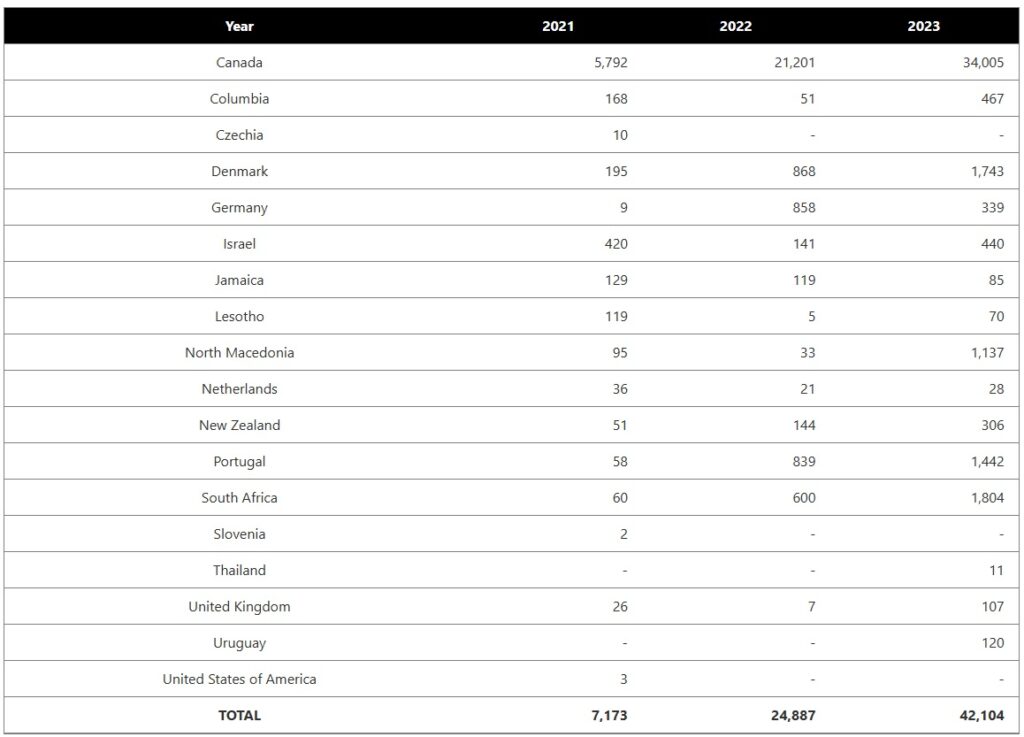
Data from Australia’s government listed Canada as the top source for medical cannabis product imports between 2021 and 2023, with Australia importing 34,005 kilograms of medical cannabis from Canada in 2023. The next closest nation was South Africa at 1,804 kilograms.

Below is a table containing historical Australian government medical cannabis import data broken down by year and originating country:

Australia Cannabis Import Data

By comparison, Australia’s legal medical cannabis producers only exported 1,426 kilograms in 2021, 1,510 kilograms in 2022, and 2,066 kilograms in 2023. In 2023, the most recent year for which government data is available, Australia’s domestic medical cannabis growers produced a total of 26,593 kilograms.

A recent rise in imports from Thailand is further exacerbating the market imbalance, according to Cade Turland of Hale Farm.

“The reality is, the Canadian market is buffered from the global markets because you don’t allow imports,” stated Turland, according to initial reporting by StratCann. “We are the dumping ground of the entire world. We have products here from countries where our wages are ten times higher. We can’t compete with Thailand because their general labour costs are much lower.”

“We’ve definitely come a long way quality-wise, but in the beginning, the reality is we would not have been able to serve Australian patients without Canadian imports. However, it doesn’t take away from the fact that we’re not dealing with a level playing field because of that import ruling on the Canadian side. Australia hasn’t had that luxury.” Turland continued. “But the issues we’re seeing now with countries like Thailand flooding the market, that’s the real concern for us. We’re fine with Canada because it’s been there all along, and you guys ask a fair price for a fair product, but this increased pressure from Thailand’s market is doubling down on how difficult it is to survive here in Australia.”

Australian Study Finds Medical Cannabis Use Improves Sleep

To some people, insomnia may not seem like a serious health condition, however, anyone who suffers from major insomnia will be the first to point out that it can have a negative and significant impact on a person’s life and their overall well-being.

The Mayo Clinic defines insomnia as “a common sleep disorder that can make it hard to fall asleep, hard to stay asleep, or cause you to wake up too early and not be able to get back to sleep.” Chronic insomnia occurs when the sleep condition lasts longer than a month.

In addition to making a person feel tired and drained throughout the day, insomnia can also be an indicator of a person experiencing one or more other potentially serious health conditions. A team of researchers affiliated with the University of Sydney recently conducted a study that found that after one year of medical cannabis use, subjects experienced improved sleep.

The results of the study were published in the academic database PLOS One earlier this month.

“We aimed to assess overall health-related quality of life (HRQL), pain, fatigue, sleep, anxiety, depression, and motor function in a large real-world sample of patients prescribed medicinal cannabis. We previously found all patient-reported outcomes improved in the first 3-months and hypothesised that improvements would be maintained to 12-months.” the researchers stated.

“The QUEST Initiative, a multicentre prospective study, recruited adult patients with any chronic health condition newly prescribed medicinal cannabis oil between November 2020 and December 2021. Participants identified by 114 clinicians across Australia completed validated questionnaires at baseline, then 2-weeks titration, and 1-,2-,3-,5-,7-,9- and 12-months follow-up.” the researchers stated about their study’s methodology.

“Statistically significant and clinically meaningful improvements in overall health-related quality of life, fatigue, and sleep disturbance were maintained over 12-months in patients prescribed medical cannabis for chronic health conditions. Anxiety, depression, insomnia, and pain also improved over time for those with corresponding health conditions.” the researchers concluded.

Medical Cannabis Associated With “Meaningful Improvements” In Patients’ Quality of Life

Nearly five dozen nations now permit some form of legal access to medical cannabis. Tens of thousands of peer-reviewed studies have focused on the medical benefits of cannabis, finding that it is an effective form of medicine. Legal medical cannabis is big business, too.

According to Persistence Market Research, “the global medical marijuana market is expected to grow from USD 33.1 Bn in 2025 to USD 83.1 Bn by 2032, registering a CAGR of 14.0% during the forecast period.”

A team of health researchers in Australia recently conducted a study examining medical cannabis’ impact on the health-related quality of life of patients who use it. Below is more information about the study via a news release from NORML:

Sydney, Australia: The use of physician-authorized medical cannabis products is associated with “statistically significant and clinically meaningful improvements” in patients’ health, according to observational study data published in the journal PLOS One.

Researchers assessed the efficacy of cannabis oil extracts containing standardized ratios of THC and CBD in more than 2,000 patients over one year. (Under Australian law, physicians may authorize cannabis products to patients unresponsive to conventional prescription treatments.)

Consistent with prior studies, patients reported sustained improvements following cannabis therapy.

“Statistically significant and clinically meaningful improvements were observed in HRQL [health-related quality of life], fatigue, pain, and sleep for people with chronic health conditions,” investigators concluded. “Similar improvements were found in pain outcomes for participants with chronic pain; sleep disturbance for participants with insomnia; depression scores for patients with depression; and anxiety scores in patients with anxiety. … The findings from this study contribute to the emerging evidence-base to inform decision making both in clinical practice and at policy level.”

Similarly designed studies involving patients enrolled in the United Kingdom’s medical marijuana access program have shown cannabis products to be safe and effective for those suffering from cancer-related painanxietyfibromyalgiainflammatory bowel diseasepost-traumatic stressdepressionmigrainemultiple sclerosisosteoarthritishypermobility disorders, and inflammatory arthritis, among other conditions.

Full text of the study, “Improvements in health-related quality of life are maintained long-term in patients prescribed medicinal cannabis in Australia: The QUEST Initiative 12-month follow up observational study,” appears in PLOS One. Additional information about the therapeutic use of cannabis is available from NORML’s publication, Clinical Application for Cannabis and Cannabinoids.

Australian Government Report Recommends Cannabis Reform

A government committee in Victoria, Australia is recommending that personal cannabis cultivation and possession be decriminalized in the jurisdiction. The recommendation is similar to the public policy approach that is already in place in the Australian Capital Territory (ACT).

The cross-party parliamentary group in Victoria is an eight-member council focused on legal and social issues. The committee concluded that the local government should “draw on the experience of the ACT” and adopt a “new approach” to cannabis policy.

“This Report from the Legal and Social Issues Committee examines a Bill introduced in the Legislative Council by the Legalise Cannabis Party, to regulate the personal use of cannabis in Victoria.” stated the report titled Inquiry into the Drugs, Poisons and Controlled Substances Amendment (Regulation of Personal Adult Use of Cannabis) Bill 2023.

“During this Inquiry, the Committee engaged with stakeholders through submissions and consultations. It visited Canberra on 11 February 2025 to better understand the impact of the ACT’s Drugs of Dependence (Personal Cannabis Use) Amendment Act 2019. The Committee also spoke with a range of stakeholders at a public hearing on 14 February 2025.” the report also stated.

The report determined the following after examining the impact of cannabis policy modernization in the ACT:

  • Stable cannabis use: Cannabis use rates have remained stable, with no significant increase since the reforms. ACT residents remain less likely to have used cannabis recently than the national average.
  • Decrease in cannabis offences: Charges for cannabis offences and police diversions have declined significantly, reflecting the intended shift towards treating
    cannabis use as a health issue rather than a criminal justice matter.
  • No increase in health issues: Cannabis‑related ambulance callouts and hospital admissions have shown no substantial changes since the Act’s implementation.

The 146-page report concluded by offering nine findings and seven recommendations for Victoria’s government to consider. The government now has six months to respond to the report.

Cannabis Legalization In Australia Would Generate $700 Million In Annual Revenue

A recent estimate from Australia’s Parliamentary Budget Office projects that the enactment of adult-use cannabis legalization in Australia could generate as much as $700 in annual revenue.

“The $700 million in annual revenue would come from a mix of sales tax, corporate taxes and a 15-percent special tax on cannabis.” reported Marijuana Moment in its original coverage. The government estimate is part of a renewed legalization effort recently announced by Australia’s Greens Party.

Currently, cannabis is legal for adult use in Uruguay, Canada, Malta, Luxembourg, Germany, and South Africa. Additionally, two dozen states in the U.S. have adopted recreational cannabis legalization measures, and regional adult-use cannabis commerce pilot trials are operating in the Netherlands and Switzerland.

Medical cannabis sales in Australia have quadrupled during the last two years, with Australians estimated to have spent an estimated $1 billion on medical cannabis in 2024. Medical cannabis was first legalized in Australia in 2016.

“The Pennington Institute’s Cannabis in Australia report has revealed spending has skyrocketed from $230 million two years ago to a predicted $1 billion by the end of this year.” 9News stated in its local coverage at the end of last year.

“The spending correlates with usage, which jumped from just 3.9 per cent of survey respondents in 2019 to almost 30 per cent admitting they use prescription marijuana.” the outlet also reported.

Study: Medical Cannabis Doesn’t Negatively Impact Driving Performance

No responsible cannabis advocate wants intoxicated drivers on public roadways. With that being said, just because someone has metabolized THC in their system does not automatically mean that they are intoxicated, and public policies need to reflect that scientific fact.

One jurisdiction that has struggled with this area of public policy is Victoria, a state in Australia. The Australian state was automatically banning the driving privileges of medical cannabis patients if they were found to have THC in their system while operating a motor vehicle on public roadways. Fortunately, that policy was changed starting on March 1st, 2025.

“Drivers who use medicinal cannabis in Victoria will no longer be subject to automatic licence bans under a new law coming into effect in the state. From the 1st of March, such motorists will have the opportunity to argue in court that they weren’t impaired while driving.” reported SBS News in its local coverage.

The policy change is backed by the findings of a recent study conducted in Australia which found that medical cannabis use does not negatively impact driving performance in experienced users. Below is more information about the study and its findings via a news release from NORML:

Queensland, Australia: Patients who consume botanical cannabis over extended periods do not exhibit significant changes in their simulated driving performance, according to data published in the Journal of Safety Research.

Australian researchers assessed patients’ simulated driving performance at baseline and 45 minutes after they vaporized prescribed doses of cannabis flowers. (Under Australian law, physicians may authorize cannabis products to patients unresponsive to conventional prescription treatments.)

“After vaporizing one dose of their prescribed cannabis flower, participants exhibited no significant changes in performance on any of the video-based tasks (hazard perception skill, gap acceptance, following distance or speed) compared to baseline,” investigators reported.

The study’s authors concluded, “The findings … suggest that a dose of vaporized cannabis (consumed in accordance with prescription) may not affect hazard perception ability or driving-related risk-taking behavior among medicinal cannabis patients.”

The study’s findings are consistent with those of several others determining that daily cannabis consumers, and patients especially, exhibit tolerance to many of cannabis’ psychomotor-influencing effects. According to the findings of a literature review published in the journal of the German Medical Association, “Patients who take cannabinoids at a constant dosage over an extensive period of time often develop tolerance to the impairment of psychomotor performance, so that they can drive vehicles safely.”

Full text of the study, “The acute effects of vaporized cannabis on drivers’ hazard perception and risk-taking behaviors in medicinal patients: A within-subjects experiment,” appears in the Journal of Safety Research. Additional information is available in the NORML Fact Sheet, ‘Marijuana and Psychomotor Performance.’

Lawmakers Criticized In Australia For Failing To Legalize Cannabis

A lawmaker in Australia is criticizing his peers for failing to approve an adult-use cannabis legalization measure this year. Legalise Cannabis WA MP Dr. Brian Walker recently lashed out at Australia’s federal government for failing to take advantage of the robust economic benefits that recreational cannabis legalization creates.

“Dr Walker hit out at what he called the “pig-headed intransigence of the federal government” after it helped vote down Greens Senator David Shoebridge’s Legalising Cannabis Bill 2023 in November.” Cannabiz stated in its local coverage.

“Late last month, we watched the Labor and Liberal parties vote down a proposal to legalise cannabis in the federal senate,” Dr. Walker said according to Cannabiz.

Currently, cannabis is legal for adult use in Uruguay, Canada, Malta, Luxembourg, Germany, and South Africa. Additionally, two dozen states in the U.S. have adopted recreational cannabis legalization measures, and regional adult-use cannabis commerce pilot trials are operating in the Netherlands and Switzerland.

Medical cannabis sales in Australia have quadrupled during the last two years, with Australians expected to spend an estimated $1 billion on medical cannabis this year. Medical cannabis was first legalized in Australia in 2016.

“The Pennington Institute’s Cannabis in Australia report has revealed spending has skyrocketed from $230 million two years ago to a predicted $1 billion by the end of this year.” 9News stated in its local coverage.

“The spending correlates with usage, which jumped from just 3.9 per cent of survey respondents in 2019 to almost 30 per cent admitting they use prescription marijuana.” the outlet also reported.

Australian Medical Cannabis Sales Quadrupled In The Last Two Years

Medical cannabis sales in Australia have quadrupled during the last two years, with Australians expected to spend an estimated $1 billion on medical cannabis this year. Medical cannabis was first legalized in Australia in 2016.

“The Pennington Institute’s Cannabis in Australia report has revealed spending has skyrocketed from $230 million two years ago to a predicted $1 billion by the end of this year.” 9News stated in its local coverage.

“The spending correlates with usage, which jumped from just 3.9 per cent of survey respondents in 2019 to almost 30 per cent admitting they use prescription marijuana.” the outlet also reported.

Australia’s Senate voted on an adult-use cannabis legalization measure this week. According to the Australian Greens Party, which introduced the measure, the measure was “blocked by the Labor and Coalition parties in a 13 to 24 vote against progress.”

“We took a big step today from treating cannabis as part of the failing ‘war on drugs’ and instead putting forward a model that is safer, reduces harms and delivers for the millions of Australians who just want us to legalize it!” Greens Senator and Justice Spokesperson David Shoebridge said in a media release.

“The support for this bill across the community is enormous and it’s why we know cannabis legalisation in this country is inevitable.” Shoebridge also stated. “The Labor and Coalition parties joined together to try and hold Australia back in the 1950’s by blocking this desperately needed reform.”

Currently, cannabis is legal for adult use at a national level in Uruguay, Canada, Malta, Luxembourg, Germany, and South Africa. Cannabis is also legal for recreational use in two dozen states in the U.S., and regional adult-use cannabis commerce pilot trials are operating in the Netherlands and Switzerland.

“Government data shows 8.8 million of adult Australians have consumed cannabis. The Labor and Liberal parties are happy to call all of these people criminals. That’s a bloody disgrace.” Senator Shoebbridge said. “My office keeps hearing from people using cannabis to deal with anxiety or pain, or just to relax. We think that adults should have the right to do just that.”

“If choosing cannabis instead of products from pharmaceutical corporations is working for you, as it does for many Australians, then you should have that choice.” Shoebridge also said. “If you’d rather have a brownie than a beer, or a gummy than a cigarette, of course you should be allowed to do that.”