
Tag: Canada

High Tide To Become Major Player In German Medical Cannabis Market

High Tide, Inc. is a leading community-grown, retail-forward international cannabis company. Its wholly owned subsidiary, Canna Cabana, is the second-largest cannabis retail brand globally. In a major move for the company, High Tide has acquired a majority stake in Germany-based Remexian Pharma GmbH.

Founded in 2018 and headquartered just outside of Berlin, Germany, Remexian is an established medical cannabis pharmaceutical company specializing in the importation and wholesale of medical cannabis. As part of its business model, Remexian has a fully certified EU GDP warehouse.

Remexian is currently licensed to import medical cannabis products into Germany from 19 countries, including Canada, which represents approximately 33% of their total imports into Germany. Given its over $1.9 billion in Canadian cannabis sales since adult-use legalization, High Tide is well-positioned to further increase the Canadian share of medical cannabis imports into Germany.

“Remexian is an ideal match for us—not only in its commitment to discount pricing, but also in its operational approach, which mirrors our lowest price guarantee in Canada. We took our time evaluating potential partners and couldn’t be more excited to join forces with the best-in-class team that built Remexian into a national leader. Together, our complementary strengths and deep procurement expertise will create a stronger foundation for growth and further enhance the fundamentals of this business,” said Raj Grover, Founder and Chief Executive Officer of High Tide.

“With this highly accretive acquisition adding approximately C$100 million in topline revenue and significant EBITDA annually, we will meaningfully strengthen our financials, positioning us well to establish a strong foothold in Germany, which will serve as a springboard into other European markets in due course. Our goal in Germany remains clear: to provide the highest quality medical cannabis at the most affordable prices, led by our Canadian house of brands and supplemented by medical cannabis imports from all across the globe,” added Mr. Grover.

“We are truly energized by the strong synergy we’ve found with High Tide, whose impressive scale amplifies our impact in Germany,” said Markus Wenner, Co-Founder of Remexian. “Both of our companies have taken a deliberate, strategic approach to becoming leaders in our respective markets. By combining one of Germany’s largest cannabis distribution networks with High Tide’s unmatched access to Canadian supply, we are setting the stage for unprecedented growth. We at Remexian are looking forward to building this exciting future together with Raj and the talented High Tide team.”

Germany’s Federal Institute for Drugs and Medical Devices (BfArM) recently published medical cannabis import data for the second quarter of 2025, and once again, Germany’s emerging legal medical cannabis industry set a new record for import totals.

In the second quarter of 2025, Germany imported 43.257 tonnes of medical cannabis products according to BfArM’s data. That is an increase over the previous record set in Q1 2025 of 37.519 tonnes, and a significant increase compared to Q2 2024 when Germany imported 11.634 tonnes of medical cannabis products. Below is a graph of historical import totals from BfArM:
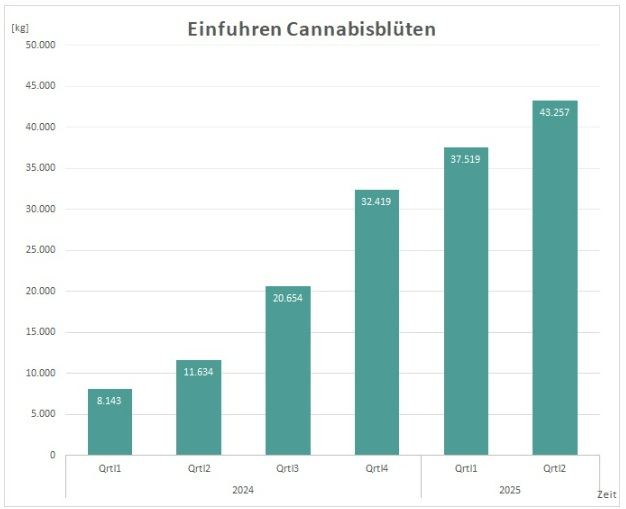
germany medical cannabis imports 2024 and 2025

Remexian has an annualized revenue and Adjusted EBITDA of €70 million and €15 million, respectively, for the six months ending March 2025. Remexian is currently one of the largest distributors of medical cannabis flower in Germany in terms of total grams sold, distributing the equivalent of 7 tonnes in Q2 2025, representing 16% of the 43 tonnes imported into Germany during the quarter.

Canadian Study Highlights The THC Variability Of Cannabis Flower

I have long theorized that part of the reason why it has taken so long for governments around the world to modernize their cannabis policies is that it is harder to regulate due to how variable cannabinoid levels are in harvests, at least compared to other crops.

Anyone who has cultivated cannabis knows how hard it is to cultivate the crop uniformly. Someone can cultivate the same strain in the same environment, and the quality and quantity of the flower from different plants can differ despite most things being equal. It gets even trickier when cultivating cannabis on a large scale, and only a short list of master growers can knock out large quality harvests reliably.

The variability of THC content in cannabis flower cultivated in greenhouses was at the heart of a recent study conducted in Canada by researchers affiliated with the Pure Sunfarms Corporation. Their findings were published in the academic journal Scientific Reports.

Cannabis sativa and C. indica dried cannabis total Delta-9 Tetrahydrocannabinol (THC) is of importance to consumers/patients and must be accurately reported for both recreational and medical dried flower. In this report, the variation in Total THC in THC-dominant commercially relevant cultivars was investigated.” the researchers wrote.

“The variation in Total THC values within different strata of the plant and between plants of the same batch were explored using a single analytical method. Within one stratum across nine batches (n = 27–57), Total THC varied by 3.1–6.7% of actual content, with only ~ 30–41% of individual replicates falling within their respective 99% confidence internal (CI) (representative of the batch mean).” the researchers wrote about their methodology.

“Between the top and bottom of plants across three batches, Total THC varied by 4.7–6.1% of actual THC content. Between plants of one cultivar, average Total THC varied by 2.8% which was statistically significant (p < 0.0001).” the researchers found.

The variability of THC in cannabis harvests isn’t just important to the cultivators, consumers, and patients, but also to government regulators who often have to enforce unrealistic THC industry standards. That is especially true in the hemp industry, where harvests cannot exceed a certain THC threshold, typically between .2 and 2 percent. If a hemp harvest exceeds the THC percentage threshold, the entire harvest has to be destroyed.

This is why it makes far more sense to set THC caps at the end-product stage of the process rather than at the harvest stage. If there is a cap on THC content for flower, such as what is in place for flower sold in Uruguay’s pharmacies, then any flower that exceeds the set limit can be used for making other products, such as edibles, topicals, and concentrates.

Data Suggests CBD Mitigates Age-Related Cognitive Decline

Cognitive decline, in which a person experiences a gradual decrease in their thinking abilities, is a natural and unfortunate part of the human aging process. It impacts people’s ability to make decisions by slowing down their mental processing speed and working memory as they get older.

Some people experience cognitive decline earlier in life than other people, and/or at a more rapid pace compared to others. Mitigating age-related cognitive decline is a growing area of scientific research around the globe, including in Canada where a team of researchers analyzed preclinical data focusing on cognitive decline and cannabidiol (CBD).

Canadian scientists affiliated with the University of Lethbridge and McGill University examined preclinical data involving the use of CBD and aging mice. Their findings were published in the journal Frontiers in Aging Neuroscience.

“Aging is associated with cognitive decline, and currently, there are no approved medications that can prevent these impairments. Recently, cannabinoids derived from Cannabis sativa have emerged as promising therapeutic compounds with neuroprotective, anti-inflammatory, and cognitive-enhancing properties.” the researchers wrote about their investigation. “This study investigates the effects of cannabidiol (CBD) on memory impairment and brain inflammation in aging mice.”

“Fourteen-month-old C57 mice were administered CBD orally for 7 months and subsequently evaluated between 19 and 21 months of age using behavioral tasks that are sensitive to dysfunction of the perirhinal cortex, hippocampus, amygdala, and various brain regions that are crucial for motor control and coordination.” the researchers stated about their methodology.

“The findings of this study indicate that CBD reduces inflammatory response in the brain and improves cognitive decline associated with aging.” the scientists concluded.

As with all scientific studies focusing on cannabinoids, the results of this study need to be kept in proper context. Further research, particularly research involving human subjects, needs to be conducted until a final determination can be made regarding CBD’s effectiveness at mitigating age-related cognitive decline. With that being said, the results of this study are encouraging.

Canada’s Legal Cannabis Industry Continues To Gain Market Share

Canada’s legal cannabis industry remains the best national legalization model on the planet, as evidenced by recent market data that demonstrates how the North American country’s industry continues to displace the unregulated market and provide an economic boost.

“The gross domestic product (GDP) at basic prices for the legal cannabis industry in Canada in April 2025 was $9.2 billion. The figures are up from $9.1 billion in March.” reported StratCann in its local coverage. “While licensed cannabis producers’ contribution to Canada’s GDP ($8.2 billion) increased 9.8% from April 2024, unlicensed cannabis production’s contribution ($1.7 billion) declined 4%, adding to the ongoing trend of market share shifting from the illicit sector since legalization in 2018.”

“Licensed cannabis stores contributed just under $1 billion to Canada’s GDP as of April 2025, a 6.4% year-over-year increase from April 2024. Unlicensed cannabis stores contributed another $839 million, representing a 4.1% decline.” the outlet also reported.

Canada became the second country to pass a national adult-use cannabis legalization measure in 2018. The only other country to adopt a national recreational cannabis legalization measure before Canada was Uruguay, which legalized cannabis in 2013.

However, Canada was the first G7 nation to adopt a national legalization measure, and unlike Uruguay, Canada permits legal recreational cannabis sales to anyone of legal age. Uruguay limits legal recreational cannabis sales to residents only.

Legal cannabis sales in Canada set a new record in April 2025, with the legal industry reaching roughly $470 million in total sales for the month. The previous record was set in August 2024 when Canada’s legal industry sold roughly $462.4 million in legal products. The August 2024 figure was recently adjusted from a previously reported $476 million total.

Ontario continues to be Canada’s largest legal cannabis market, with a reported 38% of all legal cannabis sales being made in the province.

Epilepsy Patients Report Seizure Freedom After Medical Cannabis Treatment

Medical cannabis has helped countless patients treat their health conditions, which, combined with an increasing amount of peer-reviewed cannabis research, demonstrates that cannabis is a truly effective medicine for many people.

One area of medical cannabis therapeutic application and research that is particularly clear on this point is epilepsy. Epilepsy is a serious neurological condition that results in patients experiencing recurrent seizures.

The frequency and severity of the seizures sufferers experience can vary from patient to patient. Medical cannabis has proven to be very effective at helping epilepsy patients reduce the frequency and severity of seizures.

A team of researchers based in Canada and affiliated with various health and academic institutions recently conducted a case series review involving epilepsy patients and medical cannabis therapies. The review’s findings were published in the academic journal Frontiers in Neuroscience.

“Seizure freedom (SF) is the primary goal of epilepsy treatment. More treatments that produce SF in drug-resistant epilepsy (DRE) are needed. Cannabis-based products for medicinal use (CBPMs) containing cannabidiol (CBD) and Δ9-tetrahydrocannabinol (THC), administered as oils, have been shown to induce SF in DRE. However, there remains a paucity of published real-world evidence in both pediatrics and adults on SF resulting from CBPM therapy.” the health investigators stated about the purpose of their research.

International public health experts estimate that as many as 50 million people worldwide suffer from epilepsy and its symptoms, and that “nearly 80% of people with epilepsy live in low- and middle-income countries.”

“This is a retrospective case series at an outpatient neurology clinic in Toronto, Canada, on patients with DRE who experienced significant SF during CBPM treatment. All patients were treated via the clinic’s stepwise treatment protocol with CBPM oils only. The study describes clinical features of patients and their CBPM-related SF.” the researchers stated about their methodology.

“We report 19 DRE cases that experienced SF; 15 pediatric, 4 adults. The median cumulative SF duration was 245 days, split between continuous SF periods lasting at least 90 days.” they wrote about their findings. “Five patients had continuous SF periods lasting ≥ 1 year. Most patients used CBD+THC regimens. Three patients weaned all concomitant ASMs. Adverse events (AEs) were reported by half of the patients.”

“The results of the study support prioritizing CBPMs in cases of DRE. It also supports research into identifying clinical and biological biomarkers for DRE cases that may achieve SF under CBPM treatment. Lastly, the study supports improving the accessibility of CBPMs, using SF as a primary outcome in future CBPM epilepsy trials, and assessing the role of THC in reducing seizures.” the researchers concluded.

Study: Cannabis Legalization Not Associated With Increased Adolescent Use

Modern cannabis prohibition policies were enacted starting in the early 1900s, and since that time, cannabis advocates around the world have worked very hard to reform laws that prohibit cannabis activity, including cannabis commerce.

Leading up to cannabis reform votes and implementation, cannabis opponents often make predictions that such reforms will result in increased cannabis use by adolescents. A team of international researchers based in Australia and the Czech Republic recently conducted a study focusing on the topic of cannabis reform and adolescent usage rates.

The study’s findings were published in the academic publication International Journal of Drug Policy.

“Several jurisdictions have pursued reforms that regulate cannabis production and/or sale for adult (non-medical) use. Looking at outcomes of such reforms across multiple jurisdictions may help to identify outcomes that are inherent to non-criminal cannabis supply, as well as provide insight into the outcomes of specific regulation models.” the researchers wrote about their study.

“We identified nine indicators of cannabis policy outcomes and aggregated them into three domains (social outcomes, outcomes in cannabis use, health-related outcomes). We assessed these outcomes across five jurisdictions with different models of regulating cannabis supply (Netherlands, Spain, U.S. states that legalized cannabis, Uruguay, and Canada).” the researchers wrote about their methodology.

“We used a three-level systematic literature review, prioritising studies with quasi-experimental design (i.e. comparative and longitudinal). We categorised the studies according to their design and the type of outcome (increase, decrease, or no outcome).” they also wrote.

Currently, recreational cannabis sales are limited to adult residents in Uruguay. Canada permits recreational cannabis sales to anyone of legal age. The Netherlands limits legal sales to participants of regional adult-use cannabis commerce pilot trials, fewer than half of the states in the U.S. permit adult-use sales, and sales in Spain operate in a ‘legal grey area.’

“Across long-standing as well as recent cannabis supply regimes, and across different models of cannabis supply, our review identified common outcomes: a decrease in cannabis-related arrests, an increase in adult (but not adolescent) cannabis use, and increase in healthcare utilization (not traffic-related).” the researchers found.

“Regulating cannabis supply may be associated with benefits in the social area and with potential harms regarding public health; there may though be trade-offs depending on the choice of a cannabis regulation model. Jurisdictions may attempt to mix and match the present models of cannabis regulation to achieve the best ratio of benefits and harms.” the study’s authors concluded.

Cannabis is also legal for adult use at a national level in Malta, Luxembourg, Germany, and South Africa. However, of those countries, only Malta and Germany currently provide legal channels for acquiring recreational cannabis beyond home cultivation. Both Malta and Germany are home to legal member-based cultivation associations. Adult-use cannabis legalization is also expected to be implemented soon in the Czech Republic.

Switzerland is another jurisdiction where regional adult-use cannabis commerce pilot trials are operating. The largest regional adult-use cannabis pilot trial in Switzerland is operating in Zurich, where a total of 4,400 people between the ages of 18 and 80 are participating.

“Over 90 percent of participants now obtain their cannabis products from legal sources, i.e. from one of the three specialist stores or one of the nine pharmacies taking part.” Blue News reported about Zurich’s pilot trial.

Another jurisdiction in Switzerland participating in regional adult-use cannabis commerce pilot trials is Basel. The results of a previous study, which was the first academic reporting of its kind, were published on the University of Basel’s website in addition to being published in the academic journal Addiction.

“Public health-oriented recreational cannabis access may decrease cannabis use and cannabis-related harms, especially among those using other drugs.” the researchers of that study concluded.

“Furthermore, the study was able to dispel fears that legalization could exacerbate the psychopathological symptoms associated with cannabis consumption in addition to consumption itself: after the first six months, there was no difference between the two study groups in terms of depression, anxiety or other symptoms.” stated the University of Basel on its website.

“The interim assessment after two years of study shows a significant improvement in the mental state of the approximately 300 or so participants who are still taking part.” the University also wrote.

Earlier this year, Marijuana Moment reported that a government-commissioned report found that  Switzerland’s adult-use cannabis legalization pilot program is “running smoothly,” with “no indication of any disturbances to public order.”

“About two years after the pilot program launched in seven municipalities across the country, the Federal Office of Public Health (FOPH) study—carried out by the University of Lausanne and the University of Applied Sciences Northwestern Switzerland—generally determined that the initiative has been a success.” the outlet also reported.

Previously published government data from the United States found that in jurisdictions where adult-use cannabis legalization was adopted, consumption rates among minors had reduced post-legalization compared to pre-legalization. The results of a Canadian study that was published earlier this year found that while reported overall cannabis use in Canadian society increased post-legalization, “misuse decreased.”

Discussing Advanced Cannabis Cultivation Technologies

Advanced cannabis cultivation has come a long way in recent years. Humans have cultivated the cannabis plant for centuries. However, much of it was outdoors under the sun without the use of technology.

In recent decades, cannabis cultivators have produced crops indoors or in greenhouses at an increasing rate, largely out of necessity due to global prohibition policies. The rise of the legal cannabis industry has been paralleled by an increased use of cultivation technology, as well as advances in that technology. It is truly exciting times for the legal cannabis cultivation sector.

Long gone are the days of simply yielding a cannabis harvest. Successful cultivation is more methodical than ever, with commercial cultivators having to produce harvests at scale in a cost-effective manner, all while being mindful of yielding crops that are compliant with market regulations and capable of being used in an ever-expanding list of end products for patients and consumers.

At the recent International Cannabis Business Conference in Berlin, a panel moderated by Quinn Shiskin, President of McIntyre Creek Cannabis Inc., discussed advanced cannabis cultivation technologies. Mr. Shiskin was joined by:

  • Franz Josef Sima, Horticulture Service Specialist in the EMEA Region for Fluence
  • Albert Eppinga, Entrepreneur and Philanthropist, Founder of BC Cann
  • Max Majot, Technical Manager and Cultivation Expert at Royal Queen Seeds
  • Rui Soares, Founder and CEO of Paralab
  • Mikhail Sagal, President of TSRgrow

Technological innovation is reshaping cannabis cultivation, from automated systems to AI-driven analytics. This panel explored how tech solutions can boost yields, improve quality, and reduce costs. Panelists also discussed modern ways of energy storage, innovations in cultivation lighting, and high-efficiency cannabis cultivation techniques. You can watch the panel at this link here.

Researchers Pinpoint Markers That “Significantly Influence Cannabinoid Production”

Anyone who has cultivated cannabis knows that certain strains produce better cannabis than others, and sometimes also in larger volumes. Even if all things were equal, from light exposure to environment to nutrients and grow mediums, some strains just perform better in the end.

For many years, home cultivators and commercial producers were unsure why certain strains yielded better harvests than others. However, new research out of Canada is shedding light on why some cannabis varieties yield more cannabinoid production than others.

Researchers affiliated with various academic and research institutions examined “cannabis accessions from the legal Canadian market” and focused on “identifying quantitative trait loci (QTL) and candidate genes associated with eleven cannabinoid traits using 282K common single-nucleotide polymorphisms.”

The study’s results were published in the academic journal The Plant Genome.

“This approach aims to transform our understanding of Cannabis genetics.” the researchers wrote. “We have pinpointed 33 significant markers that significantly influence cannabinoid production, promising to drive the development of Cannabis varieties with specific cannabinoid profiles.”

“Among the notable findings is a massive haplotype of ∼60 Mb on chromosome 7 in Type I (i.e., tetrahydrocannabinol [THC]-dominant) accessions, highlighting a major genetic influence on cannabinoid profiles.” the researchers determined. “These insights offer valuable guidance for Cannabis breeding programs, enabling the use of precise genetic markers to select and refine promising Cannabis varieties.”

Knowing which markers boost cannabinoid production will help cannabis breeders and cultivators selectively breed cannabis strains that contain those markers and develop crops that are rich in certain cannabinoids. Those crops can then be used to make products that patients and consumers need, and likely in a more efficient and cost-friendly manner.

“This approach promises to speed up the breeding process, reduce costs significantly compared to traditional methods, and ensure that the resulting Cannabis varieties are optimized for specific medical and recreational needs.” the researchers stated.

“This study marks a significant stride toward fully integrating Cannabis into modern agricultural practices and genetic research, paving the way for future innovations.” the researchers concluded.

Calls For Cannabis Excise Tax Reform Intensify In Canada

Taxing cannabis commerce can be a delicate thing. On one hand, a major argument in favor of cannabis policy modernization is that it will generate public revenue for governments that allow legal cannabis sales. But on the other hand, taxing cannabis commerce too much can hinder the industry’s ability to reach its full potential and displace the unregulated market.

Canada legalized adult-use cannabis sales in 2018, and according to a new report, the current excise tax model in Canada “is unsustainable and must be restructured to reflect the economic realities of the industry.”

Deloitte, a multinational professional services entity, recently published a report titled ‘The Impact of the Cannabis Excise Tax,’ in which the authors call for overhauling Canada’s current approach to applying cannabis excise taxes. The recommendations from Deloitte in their report are being echoed by the Cannabis Council of Canada.

“Canada likes to position itself as a global leader in legal cannabis – but since legalization in 2018, the federal government has failed this industry and the tens of thousands of hardworking Canadians it supports,” said Paul McCarthy, President of the Cannabis Council of Canada. “With a new government in office, it’s time for a fresh approach. The cannabis industry deserves the same attention and support as any sector of our economy.”

“Canada’s cannabis industry is a major driver of economic growth – since legalization it has contributed over $43 billion to the national GDP, with approximately $7.4 billion contributed in 2024 alone. To keep that momentum going, key policy changes are needed to ensure the industry can grow, compete and innovate.” the Council stated in a press release.

“The current excise taxation framework is completely misaligned with today’s market realities. When it was introduced in 2018, cannabis sold for approximately $10 per gram. Today, producers are receiving as little as $3 per gram – yet the excise tax remains the greater of 10% of the product’s value or $1 per gram.” the Council also stated.

The Cannabis Council of Canada is urging the nation’s government to eliminate the $1 per gram floor and replace it with a 10% ad valorem rate, which the Council points out was proposed by the Standing Committee on Finance in 2024.