Tag: Canada

Society Deserves A Sensible Approach To Cannabis Clubs And Driving

An area of concern for many members of society when it comes to cannabis reform, and understandably so, relates to cannabis and driving. After all, no reasonable person wants to have impaired people operating motor vehicles on public roadways. However, reasonable people also want to let science lead the way when it comes to determining impairment and crafting public policies that help mitigate impaired drivers on public roadways, and unfortunately, hard science is often not part of the public policy process.

Often replacing hard science and a rational approach for mitigating cannabis impairment on public roadways is outright political scare tactics, which is truly unfortunate. ‘There will be terror and bloodshed on the roadways’ is a common theme of cannabis opponents when any type of cannabis reform is being considered. The latest focus of such anti-cannabis PR efforts is cannabis clubs.

New Report Targets Cannabis Clubs

Days ago the Traffic Injury Research Foundation released a report titled, “Recreational Cannabis Consumption Spaces in Canada.” The report was published with support from the Canada Safety Council and DRIVE SOBER®. While some of the points made in the report’s press release are valid, many of them involved typical reefer madness talking points and communication strategies.

The report relied heavily on convoluting the nuanced differences between confirmed cannabis impairment at the time of an incident versus someone merely having cannabis in their system but no proven impairment, or someone having several substances in their system, or someone having so little cannabis in their system that impairment was likely nonexistent. For example, the report states, “more than 7% of drivers had ≥ 2 ng/mL, and 3.5% had ≥ 5 ng/mL.” To put those ng/mL limits into perspective, the Olympics’ cannabis testing threshold is 150 ng/mL.

“The report underscores that any proposal to move forward with the implementation of cannabis consumption spaces in the absence of effective and well-developed prevention strategies to protect the public from recognized harm is premature.” the report stated, which if you ask me, is merely a delay tactic to try to stop the spread of cannabis clubs. If so, there’s a really big flaw with that tactic – it ignores the fact that cannabis clubs are far from a new thing.

Cannabis Clubs In Canada

Regulated cannabis clubs may be a relatively new thing from a public policy standpoint, however, in the real world they have existed for decades, including in Canada. Underground cannabis clubs have existed for years, particularly in British Columbia, and the last time that I checked, the sky was still intact over B.C. Despite unregulated cannabis clubs being somewhat common in parts of B.C., it’s worth noting that the province does not lead Canada in drug-related DUIs.

According to government data from Canada, “Newfoundland and Labrador had the highest rate of drug-impaired driving (52 incidents per 100,000 population), followed by Prince Edward Island,” with New Brunswick (36) coming in next. By contrast, British Columbia had 32 incidents per 100,000 population. If increasing the number of cannabis clubs in a jurisdiction automatically made the roadways unsafe, then it would be reflected in the data. Yet, that is obviously not the case.

A Rational Approach

One thing that the report noted that was absolutely correct is that there is a need for ongoing public education regarding cannabis use and operating a motor vehicle while impaired. No responsible cannabis consumer advocates for impaired driving, and the same is true of responsible members of Canada’s emerging cannabis industry. Clearly, there is a common goal between responsible cannabis advocates and opponents alike in that we all want public roadways to be safe.

The friction between the two groups begins when prevention strategies and detection are discussed. Cannabis advocates want to rely on facts to educate the public, and not fear-mongering. Cannabis advocates want science to determine impairment and not arbitrary nanogram thresholds that do not take into account a person’s tolerance level, individual biology, and other situational factors.

Unfortunately, the topic of cannabis and driving is such a hot-button issue with cannabis opponents that it makes it very difficult to have a rational conversation about what an effective prevention strategy looks like. People have consumed cannabis in social settings for many years, albeit in a non-regulated fashion, and a vast majority of people take precautionary measures such as walking, taking public transportation, or arranging private transportation.

Cannabis clubs are merely the latest boogeyman punching bag for cannabis opponents. Concerns about impaired driving are valid, however, they should not be used to derail further implementation of cannabis clubs in Canada, or anywhere else for that matter.

Recent Cannabis Study Provides Hope For Tinnitus Patients

Tinnitus involves people hearing a ringing or other noise in their ears. Sometimes it is constant, and sometimes it comes and goes. However, as any tinnitus sufferer will be quick to point out, it’s annoying every time.

For people that do not suffer from tinnitus, it may sound like a mild annoyance. Yet, tinnitus can actually prove to be debilitating in extreme cases. Imagine trying to fall asleep at night and get a good night’s rest when you have a constant sound in your ear that you cannot stop. Now, imagine what life is like without proper sleep. It doesn’t take a medical professional to see the problem.

Thankfully, recent research out of Canada suggests that the cannabis plant may be able to help people that suffer from tinnitus. Below is more information about it via a news release from NORML:

Ottawa, Canada: Patients suffering from tinnitus (ringing in the ears) frequently report using cannabis products for symptom relief, according to survey data published in the Journal of Otolaryngology – Head & Neck Surgery.

A team of Canadian scientists surveyed 45 patients with the affliction. Over one in five identified as current cannabis consumers and 80 percent of them reported it to be beneficial in treating symptoms of the disorder, including dizziness, anxiety, pain, and sleep disturbances.

Over 90 percent of those surveyed said that they “would consider cannabis as a treatment for their tinnitus.”

Authors concluded: “This is the first study to assess perspectives and usage patterns of cannabis in patients experiencing tinnitus. The results of this study demonstrate an active interest amongst patients with tinnitus to consider cannabis as a potential adjunctive treatment for symptom management. Moreover, cannabis use is both common and can be beneficial in this patient population. … This data may lay the groundwork for future research and clinical trials on cannabis use for tinnitus alleviation.”

Full text of the study, “Cannabis use among tinnitus patients: Consumption patterns and attitudes,” appears in the Journal of Otolaryngology – Head & Neck Surgery.

Yukon Has The Highest Per Person Cannabis Sales Ratio In Canada

Statistics Canada released new sales data pertaining to the nation’s emerging legal cannabis industry for the period of April 1, 2021 to March 31, 2022. During that time period, Canada’s legal adult-use cannabis industry generated roughly $1.6 billion for federal and provincial governments.

To put the $1.6 billion figure into perspective, Canada’s alcohol industry generated roughly $13.6 billion during the same time period. The figures for both alcohol and cannabis include taxes at all jurisdictional levels, as well as fees related to licenses and permits.

Overall, sales for adult-use cannabis products across Canada (provincial cannabis authorities and other retail outlets) totaled roughly $4 billion between April 1, 2021 to March 31, 2022, which is “equivalent to $131 per person of legal age to consume cannabis” according to Statistics Canada.

Yukon, which is the smallest and westernmost of Canada’s three territories, had the largest per-person cannabis sales ratio at $291. Yukon was followed by Alberta ($210), Saskatchewan ($185), Nova Scotia ($125), and Manitoba ($107). Quebec had the lowest ratio at $89 per person of legal age. Data from certain jurisdictions is apparently ‘suppressed to meet the confidentiality requirements of the Statistics Act.’

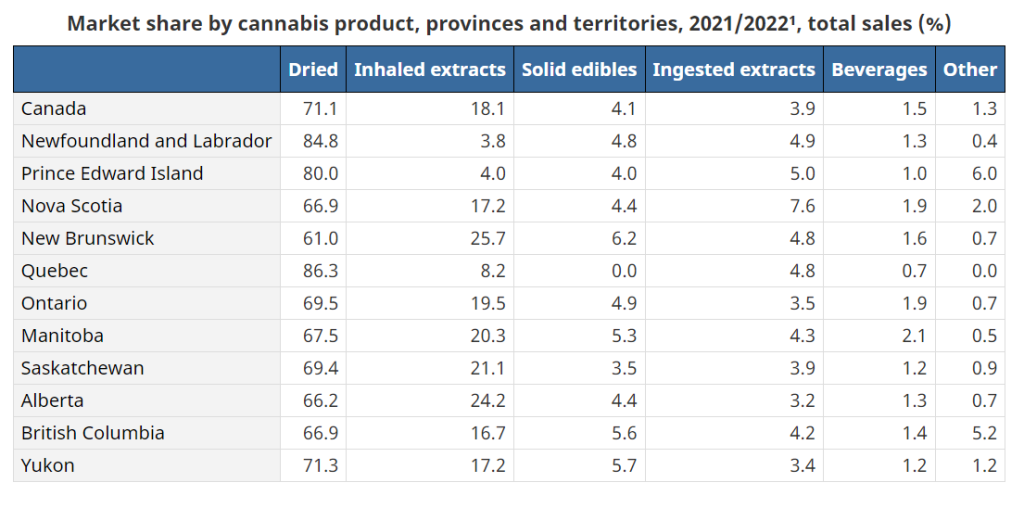
Dried cannabis flower was by far the most popular form of cannabis sold during the specified time frame, accounting for 71.1% of all adult-use cannabis sales in Canada during the calendar year. Inhaled extracts made up 18.1% of overall sales and edibles gained 4.1% of the market share according to the available data. Below is a breakdown of market share by cannabis product, provinces, and territories according to Statistics Canada:

Canada cannabis sales breakdown 2021 2022

The data released by Statistics Canada comes around the same time findings were published from a very insightful survey analysis dealing with reported cannabis consumer spending habits.

According to the study, which was conducted by investigators affiliated with the University of Waterloo School of Public Health, “In 2021, the percentage of consumers sourcing all their products legally in the past 12 months ranged from 49 percent of solid concentrate consumers in 2021 to 82 percent of cannabis drink consumers.”

The growing success of adult-use cannabis legalization in Canada will not only benefit consumers within the nation’s boundaries but also consumers in other jurisdictions where lawmakers are pursuing legalization and keeping a close eye on Canada to see how things continue to develop.

Cannabis Consumers In Canada Continue To Transition To The Regulated Market

Canada was the second nation to pass a national adult-use legalization measure back in 2018, with only Uruguay preceding Canada in doing so (2013). Yet, unlike Uruguay, Canada allows legal sales to anyone of legal age whereas Uruguay limits it to residents only.

As such, Canada provides the best example for international observers to monitor and see what is working with the nation’s regulated industry and what is not working. With other nations considering legalization, any insight Canada can provide is valuable.

One of the biggest measures of success for legalization is whether or not consumers transition away from the unregulated market into the regulated market. According to a recent study in Canada, that is exactly what is occurring, and at an increasing rate. Below is more information about it via a news release from NORML:

Waterloo, Canada: Canadian cannabis consumers are steadily transitioning from the unregulated market to the legal market, according to data published in the Harm Reduction Journal.

Investigators affiliated with the University of Waterloo, School of Public Health surveyed over 15,000 cannabis consumers regarding where they obtained their products. Researchers evaluated data for the years 2019 to 2021. (Canada instituted licensed retail sales of cannabis products in October 2018.)

Authors reported that the percentage of respondents legally sourcing their cannabis products increased year over year. Respondents were most likely to purchase cannabis-infused drinks, oils, and capsules from the legal marketplace. About 55 percent of respondents said they obtained cannabis flower exclusively from legally licensed retailers.

In 2019, fewer than half of consumers acknowledged obtaining their cannabis products from legal sources. According to separate consumer survey data published last year, that percentage rose to nearly 70 percent in 2020.

“Legal sourcing of cannabis was greater in 2021 than 2020 for all ten cannabis products [surveyed]. In 2021, the percentage of consumers sourcing all their products legally in the past 12 months ranged from 49 percent of solid concentrate consumers in 2021 to 82 percent of cannabis drink consumers,” investigators reported. “Transitioning consumers of all cannabis products into the regulated market is important for public health and safety. Future studies should continue to examine cannabis product sourcing in Canada over time, as well as ways to displace the illegal market for all cannabis products without also promoting the use of high-potency cannabis products.”

Full text of the study, “Legal sourcing of ten cannabis products in the Canadian cannabis market, 2019-2021: A repeat cross-sectional study,” appears in the Harm Reduction Journal.

Review Of Longitudinal Studies Concludes Legalization Associated With Less Use Of Opioids

One of the most promising areas of cannabis research hinges on the cannabis plant’s ability to treat pain. Researchers around the globe are conducting studies, reviewing data, and surveying patients to gain a better understanding of how cannabis can be effectively used for pain management.

Pharmaceutical painkillers are commonly prescribed to pain patients, and while they can be effective in some cases at treating pain, in many other cases the patient becomes significantly addicted to the medicine that they were prescribed.

Researchers in Canada recently examined data to gain more insight into the cannabis plant’s ability to replace the use of opioids. Below is more information about the study via a news release from NORML, the results of which add to a growing body of evidence that cannabis is a preferable alternative to pharmaceutical opioids:

Montreal, Canada: The adoption of state laws regulating the sale of cannabis to adults is strongly associated with reductions in the use of prescription opioids, according to a review of longitudinal studies published in the journal Frontiers in Psychiatry.

Canadian investigators reviewed data from 32 longitudinal studies evaluating public health outcomes in states that legalized adult-use cannabis sales compared to jurisdictions that did not.

Consistent with prior analyses, researchers identified “robust associations” between the enactment of adult-use legalization and decreases in the public’s use of prescription opioids.

“Most research articles included on this topic were evaluated as having high-quality evidence,” they acknowledged. “As such, the evidence is sufficient to establish a potentially beneficial association between recreational marijuana legislation and prescription opioid patterns.”

Though researchers acknowledged “moderate increases” in adults’ past-month use of cannabis following legalization, they identified “no increase in [use among] adolescents or young adults.” They also failed to identify any uptick in incidences of problematic marijuana use among young people – a finding consistent with prior data.

Authors reported inconsistent findings with respect to the potential impact of adult-use legalization on traffic safety or upon the public’s use of alcohol. They identified no increases in the public’s use of tobacco following marijuana legalization, and they failed to draw any conclusions regarding legalization’s impact on either crime rates or suicides due to a lack of sufficient data.

Full text of the study, “The clouded debate: A systematic review of comparative longitudinal studies examining the impact of recreational cannabis legalization on key public health outcomes,” appears in Frontiers in Psychiatry. Additional information is available from the NORML Fact Sheet, ‘Relationship Between Marijuana and Opioids.’

Case Series Demonstrates Cannabis’ Effectiveness At Treating Borderline Personality Disorder

Borderline personality disorder is a serious mental health condition that significantly impacts the way sufferers think and feel about themselves and the world around them. Examples of the negative impact that the condition can have include self-esteem issues, difficulty managing feelings and actions, and a pattern of being involved in unstable relationships.

Borderline personality disorder can involve a big fear of abandonment, and patients may have difficulty being alone, which can be particularly difficult given the fact that the condition often results in people not wanting to be around the patient due to their condition.

The condition usually starts during early adulthood, although a diagnosis could happen at any time during the person’s life. Fortunately, a growing body of evidence is demonstrating that the cannabis plant may be able to help treat the condition.

Below is more information about a recent study from the United Kingdom which presents a recent example of the promising area of research per a news release from NORML:

London, United Kingdom: The use of cannabis products containing THC and CBD are safe and effective in mitigating symptoms in patients diagnosed with emotionally unstable personality disorder (EUPD), according to a case series reported in the journal Brain Sciences. Emotionally unstable personality disorder (a/k/a borderline personality disorder) is a common mental health disorder associated with a range of chronic and debilitating symptoms, including impaired social functioning, unstable mood, and risky, impulsive, or self-injurious behavior.

An international team of researchers assessed the use of cannabis products in a cohort of seven EUPD patients. Subjects consumed products containing both THC and CBD in varying ratios for one month.

Six of the seven participants reported “an improvement in symptoms,” and “none of the participants reported any adverse side effects.”

The study’s authors concluded: “To our knowledge, this case series represents the first medical evidence of the use of CBMPs [cannabis-based medicinal products] for the clinical management of patients with a diagnosis of EUPD. …  [O]ur results suggest that, when deployed in a rigorously controlled clinical environment, CBMPs can provide substantial improvement in symptoms associated with EUPD thus warranting the need for further research on this therapeutic strategy.”

Full text of the study, “Cannabis based medicinal products in the management of emotionally unstable personality disorder: A narrative review and case series,” appears in Brain Sciences.

Legal Outlets Are The Most Common Source For Cannabis In Canada Since 2019

Canada still serves as the largest legal, national cannabis adult-use market, with sales originally launching in late 2018. The nation serves as the largest national cannabis public policy experiment, and industry and policy observers around the globe are keeping a close eye on any and all data coming out of Canada.

Every year Canada conducts a survey to gauge, among other things, the rate at which consumers purchase their cannabis from legal outlets versus the unregulated market. One of the most important stated goals of governments that pass legalization measures, including Canada, is to transition cannabis sales away from the unregulated market into the regulated system.

According to the most recent survey out of Canada, more and more people are making their purchases via regulated sources, a growing trend that has occurred for multiple years now. Per Toronto Sun:

The results of the 2022 Canadian Cannabis Survey were released last month. It found that a greater proportion of respondents reported a legal source as their usual source of cannabis compared to 2021, with legal storefronts being the most common source since 2019. A smaller proportion reported illegal storefronts and illegal online sources in 2022 compared to 2019.

The proportion of those who purchased cannabis in the past 12 months from a legal storefront did so 61% of the time, according to the survey, up from 53% in 2021. Only 2% said they purchased products from an illegal website, 1% from an illegal dispensary and 1% from a cannabis dealer.

The unregulated cannabis market will never be 100% eliminated in Canada or any other jurisdiction that is home to large populations. Just as there are still people selling unregulated alcohol and tobacco products in Canada, so too will the same occur with cannabis.

The name of the game is to mitigate unregulated sales as much as possible, and Canada is doing a great job of that so far. Transferring a decades old unregulated market into a regulated one is not an easy task, and takes time to fully materialize.

Canadian Medical Cannabis Patients Report Sustained Improvements In Their Health

Cannabis is medicine. That may seem like an obvious fact to cannabis supporters, however, cannabis opponents still try very hard to downplay the wellness benefits that the cannabis plant can provide. In many cases, cannabis opponents still cling to the false claim that cannabis provides zero medical benefits.

Unfortunately for cannabis opponents, and fortunately for suffering patients, the cannabis plant does possess tremendous wellness benefits and can be used to successfully treat a number of conditions.

A team of researchers in Canada recently published longitudinal data involving survey responses from registered medical cannabis patients in Canada. The participating patients reported sustained improvements in specific components of their overall health. Below is more information about it via a news release from NORML:

Montreal, Canada: Canadian patients authorized to use medical cannabis products report sustained improvements in their health-related quality of life, according to longitudinal data published in the journal Cannabis and Cannabinoid Research.

A team of investigators affiliated with McGill University in Montreal assessed the safety and efficacy of medical cannabis products in a cohort of 2,991 patients. Subjects in the study consumed cannabis flower, extracts, or other related products for one year.

Consistent with other studies, researchers reported: “All patient-reported outcomes showed a statistically significant improvement at 3 months, which was maintained or further improved (for pain interference, tiredness, and well-being) over the remainder of the 12-month follow-up. Results also revealed clinically significant improvements in pain interference and tiredness, anxiety, and well-being from baseline.” Few patients reported experiencing any serious adverse events as a result of their cannabis intake.

Authors concluded, “MC [medical cannabis] directed by physicians appears to be safe and effective within 3 months of initiation for a variety of medical indications.”

Data published late last week in the journal JAMA Network Open reported that nearly one in four pain patients residing in states where medical cannabis access is legal self-identify as marijuana consumers.

Full text of the study, “The Quebec Cannabis Registry: Investigating the safety and effectiveness of medical cannabis,” appears inCannabis and Cannabinoid Research.

Cannabis Compounds Effective At Mitigating Chronic Pain And Improving Sleep According To New Study

Neuropathic pain is a major health condition affecting a significant percentage of the global population. Neuropathic pain involves a patient’s nervous system being damaged or not working correctly due to various reasons.

Common causes of neuropathic pain include, but are not limited to, nerve pressure or nerve damage after surgery or trauma, infections, cancer, extreme alcohol use, and conditions such as multiple sclerosis and diabetes.

A common condition that accompanies chronic neuropathic pain is an inability to gain proper sleep. Neuropathic pain patients often report difficulty falling asleep and/or staying asleep, largely due to the pain that they are experiencing.

A team of researchers in Canada recently examined randomized controlled trial data involving neuropathic pain, sleep, and medical cannabis use and the results of their research was very insightful. Below is more information about it via a news release from NORML:

Toronto, Canada: Cannabis compounds are effective at mitigating chronic neuropathic pain and improving sleep, according to a review of randomized controlled trial data published in the journal Regional Anesthesia & Pain Medicine.

A team of Canadian researchers evaluated results from nine trials that compared synthetic and natural cannabinoids to placebo in patients suffering from neuropathic pain syndromes.

They reported: “Meta-analysis of data from six studies showed that cannabinoids were associated with a significant improvement in sleep quality. Meta-analysis of data from eight studies showed a significant reduction in daily pain scores in the cannabinoid group.”

Authors concluded: “Cannabinoids have a role in treating chronic neuropathic pain as evidenced by significant improvements in sleep quality, pain intensity, and PGIC [Patients’ Global Impression of Change scale]. More research is needed to comprehensively evaluate the impact of cannabinoids on sleep health and analgesic efficacy.”

Survey data consistently reports that patients who use cannabis products typically do so to mitigate chronic pain and improve sleep. Among patients in US states where medical cannabis access is permitted, over 60 percent are qualified to use it to treat pain.

Full text of the study, “Evaluating the impact of cannabinoids on sleep health and pain in patients with chronic neuropathic pain: A systematic review and meta-analysis of randomized controlled trials,” appears in Regional Anesthesia & Pain MedicineAdditional information on cannabis and chronic pain is available from NORML’s publication, Clinical Applications for Cannabis & Cannabinoids.