Tag: CBD

Cannabidiol Found To Be An Effective Antifungal Treatment

A team of academic researchers based in Australia and the United Kingdom recently collaborated on a study examining cannabinoids and their ability to be used in antifungal treatment regimens. The researchers found cannabidiol (CBD) and cannabidivarin (CBDV) to be particularly effective.

“Fungal infections pose a major threat to human health with increasing incidence of antifungal resistance globally. Despite the need for novel antifungal drugs, few are currently in clinical development.” the researchers wrote. The study’s findings were published in the academic database PLOS.

The cannabis plant is made up of dozens of cannabinoids, with CBD being a particularly popular cannabinoid in recent years for researchers. CBDV is a lesser-known cannabinoid, and research focused on it is more limited compared to CBD and tetrahydrocannabinol (THC).

“Here we evaluate the antifungal activity of five phytocannabinoids against several clinically relevant fungal pathogens, with a focus on the priority pathogen Cryptococcus neoformans.” the team of researchers stated in their published review. “Our results demonstrate that Cannabidiol (CBD), and particularly Cannabidivarin (CBDV), have broad activity against C. neoformans and other fungal pathogens, including dermatophytes that cause common tinea.”

“We found that both CBD and CBDV acted in a fungicidal manner and prevented biofilm formation in C. neoformans. Phytocannabinoid treatment impeded factors important for virulence and antifungal resistance, including reduced capsule size and disruption of mature biofilms. Proteomics analysis revealed that the antifungal activity of CBD and CBDV was linked to destabilisation of the membrane, alterations in ergosterol biosynthesis, disruption of metabolic pathways, as well as selective involvement of mitochondrial-associated proteins.” they also wrote.

“We next tested the ability of CBD to topically clear a C. neoformans fungal infection in vivo using the Galleria mellonella burn wound model, and we observed greatly improved survival in the CBD treated larvae. This study illustrates the potential of phytocannabinoids as antifungal treatments and opens up new routes towards development of novel antifungal drugs.” the study’s authors concluded.

A recent market analysis by Emergen Research determined that “the Cannabidiol (CBD) Consumer Health Market is expected to grow from USD 20.52 billion in 2024 to an estimated USD 81.76 billion by 2033, at a compound annual growth rate (CAGR) of 16.60%.”

European Commission Clarifies Hemp-Derived CBD Is Permitted In Cosmetics

The hemp-derived cannabidiol (CBD) market is increasing in size and value with every passing year, including the cosmetics sector. Just the skincare subsector of the CBD cosmetics market alone is worth billions of dollars according to market analysts.

“The global CBD Skincare Market is poised for rapid expansion, with forecasts revealing a compound annual growth rate (CAGR) of 15.76% from 2025 to 2030.” analysts at Research and Markets stated recently.

“This exponential growth indicates a market size increase from US$4.759 billion in 2025 to US$9.892 billion by the end of the decade, reflecting consumers’ rising inclination towards products infused with cannabidiol (CBD) and signaling a significant shift in skincare trends towards natural and effective ingredients.” the analysts also stated.

Europe is a market where hemp-derived CBD cosmetics are particularly popular, and the European Commission recently clarified that cosmetic products containing hemp-derived CBD are permitted.

“The European Commission has responded to a request for clarification from CannaReporter regarding the recent decision by Infarmed IP to withdraw from the market several cosmetic products containing cannabidiol (CBD) extracted from the hemp plant.” CannaReporter stated it its original coverage.

“In this regard, the EC reiterates that the classification of CBD as a narcotic (whether synthetic or extracted from hemp) is not in line with the understanding of the Court of Justice of the European Union (CJEU) or with European Regulation. It was also clarified that a scientific evaluation is underway to define safety criteria for CBD and THC in cosmetics.” the outlet also stated in its reporting.

A recent market analysis by Meticulous Market Research estimates that the overall global CBD-infused products market “is expected to reach $291.39 billion by 2032, at a CAGR of 30.6% from 2025 to 2032.”

Legal CBD Sectors Are Set For Significant Growth

The cannabis plant contains several cannabinoids, with one of the most popular ones for consumers and patients being cannabidiol (CBD). CBD is being incorporated into more recreational and medical products now than ever before, and that is leading to some eye-popping projections for the overall CBD industry and various CBD industry sectors.

According to a recent market report by Coherent Market Insights, the global CBD industry “is estimated to be valued at USD 8.12 Bn in 2024 and is expected to reach USD 23.41 Bn by 2031, exhibiting a CAGR of 16.3% from 2024 to 2031,” although, time may likely prove that projection to be too conservative as individual sector projections below will demonstrate.

A particularly popular consumption method for cannabidiol is gummies. Many consumers and patients prefer ingesting gummies versus consuming cannabidiol in forms that involve smoking or vaporization. CBD gummies are discrete and convenient, making them a great option for many people.

According to a market analysis by Straits Research, “the global CBD gummies market size was valued at USD 1.88 billion in 2024 and is projected to reach from USD 2.44 billion in 2025 to USD 19.93 billion by 2033, growing with a CAGR of 30.02% during the forecast period (2025–2033).”

“North America is the most significant global CBD gummies market shareholder and is expected to grow significantly over the forecast period. The increased prevalence of CBD-infused gummy bears within the United States can be ascribed to the escalating consumer interest in CBD merchandise and the burgeoning acceptance of alternative medicinal practices.” Straits Research also stated in its market analysis.

CBD nutraceuticals are also poised for tremendous growth in the coming years. According to market analysts at Research and Markets, “the global CBD nutraceuticals market size is expected to reach USD 23.17 billion by 2030, registering a CAGR of 14.2% from 2024 to 2030.”

Research and Markets also determined the following in its analysis:

  • CBD tinctures segment dominated the global market and accounted for a revenue share of 41.9% in 2023
  • The edibles and fortified foods segment accounted for the largest revenue share in 2023
  • North America CBD nutraceuticals market dominated the global industry with a revenue share of 54.5% in 2023

Many countries around the world are modernizing their cannabis policies and regulations to allow legal CBD commerce. Every country that does so adds further momentum to the global CBD industry.

U.K. Cannabidiol Market Projected To Reach Over $5 Billion In Value By 2032

According to a market analysis by Vantage Market Research, the value of the United Kingdom’s emerging cannabidiol (CBD) industry is projected to reach over $5 billion by 2032. The analysis valued the U.K.’s CBD industry at $1.355 billion in 2023.

A separate analysis published in September 2024 by CLEAR found that legalizing all forms of cannabis for adult use in the United Kingdom and taxing and regulating sales could generate as much as £9.5 billion per year. However, non-CBD cannabis products are only legal in the U.K. in limited medical circumstances.

“One of the top trends in the U.K. cannabidiol market is the increasing popularity of CBD-infused wellness products, such as skincare and beauty items, driven by consumer demand for holistic health solutions.” researchers at Vantage Market Research previously stated.

Below are other findings from Vantage:

• The U.K. CBD market is rapidly expanding, driven by consumer demand for natural health solutions
• CBD-infused wellness products and beverages are gaining significant popularity
• Transparency and quality assurance are becoming crucial for consumer trust
• There is an increasing integration of CBD into traditional pharmaceuticals
• The therapeutic potential of CBD continues to drive market interest and research investments

Cannabis remains the most commonly used controlled substance in the United Kingdom, with 7.4% of adults between 16 and 59 years old in the UK reporting having used cannabis within the past year according to a 2022 report by the Office for National Statistics.

The National Centre for Social Research recently conducted a poll of United Kingdom citizens in which members of UK society were asked about their opinions regarding cannabis policy modernization efforts in the UK. The poll found a strong majority of support for legalizing cannabis sales in nearly every age group.

According to a separate analysis by The Dales Report, Germany and the United Kingdom are projected to control an estimated 77% of Europe’s emerging legal medical cannabis market by 2028.

“This growth is driven by both expanding legal frameworks and an increasing acknowledgment of the therapeutic benefits of cannabis. As both nations continue to refine their policies and commercial strategies, the focus remains on balancing patient needs with scientific and public health priorities.” The Dales Report stated about both national markets.

Global Cannabidiol Market Projected To Reach $23.41 Billion By 2031

According to a new report by Coherent Market Insights, the global cannabidiol (CBD) market is projected to reach $23.41 billion by 2031. The analysis predicts the worldwide CBD market will experience a compound annual growth rate (CAGR) of 16.3% from 2024 to 2031.

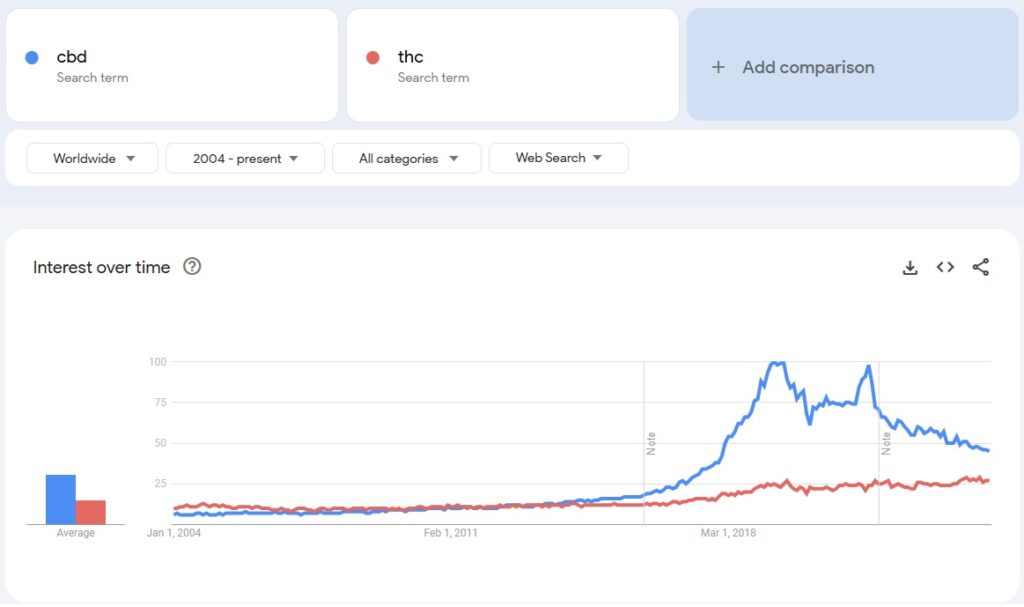
Interest in CBD has increased exponentially in recent years around the world, which is evidenced by how often CBD is searched on Google compared to tetrahydrocannabinol (THC). THC has historically served as the most popular cannabinoid among consumers and patients. Below is a chart demonstrating search trends for both cannabinoids in recent decades:

cbd and thc google search trends

A rise in CBD research and product availability parallels increased interest in CBD among patients and consumers. Additionally, the variety of CBD products patients and consumers can choose from has increased in recent years. CBD is now being infused into everything from edibles to topicals.

Legal CBD products are not just limited to humans. CBD products for pets are also big business these days. The global CBD pet market was worth an estimated $693.4 million in 2023 according to a recent market analysis by Global Market Insights. The CBD pet product market is projected to grow at an estimated 18.2% CAGR from 2024 to 2032.

The global market for hemp-based products is projected to reach $16.2 billion by 2033, growing at a CAGR of 24.5% between 2023 and 2033, according to a separate market analysis by Fact.MR. The researchers estimated that the market was worth $1.8 billion in 2023.

“Europe and North America collectively account for around 70% of the global market share at present and are expected to maintain a similar outlook over the coming years as well.” Fact.MR stated about its market report.

“Rapid legalization of marijuana and CBD products in these regions is expected to be a prominent factor that will help these regions sustain a dominant market share across the forecast period.” the researchers also stated.

Technavio recently published an estimate for the overall global industrial hemp industry. Technavio is a global technology research and advisory company that “focuses on emerging market trends and provides actionable insights to help businesses identify market opportunities and develop effective strategies to optimize their market positions.”

“The global industrial hemp market size is estimated to grow by USD 6.87 bn from 2023 to 2027, according to Technavio. The market is estimated to grow at a CAGR of over 17.1% during the forecast period.” Technavio stated in a press release.

CBD Skincare Market Expected To Experience Tremendous Growth

The overall cannabidiol (CBD) industry has experienced significant growth in recent years due to regulatory reforms and increased demand by consumers and patients. One sector that is witnessing the most growth is the CBD skincare market, which is projected to expand considerably in the coming years.

According to a recent market analysis by Allied Market Research, the global CBD skincare market is projected to reach $8.9 billion in value by 2033, a CAGR of 19.5%. The same market analysis estimates that the CBD skincare market was valued at $1.5 billion in 2023.

“Continuous innovation and new product launches by major skincare brands are attracting consumers and expanding the market. The influence of social media and celebrity endorsements is further enhancing market growth.” the researchers stated.

“Moreover, the increased availability of CBD skincare products through various retail channels, including online stores, specialty beauty shops, and health stores, is facilitating market expansion.” the researchers also stated.

A separate recent market analysis by SNS Insider also projects that the CBD skincare market will experience tremendous growth in the near future. According to SNS Insider, the CBD skincare market will be worth a projected $22.19 billion by 2032, a CAGR of 28.7%.

“Industry reports suggest that CBD skincare products are going to move upward, as growing awareness regarding the anti-inflammatory and antioxidant effects of CBD is entering as one of the largest most sought-after ingredients in modern skincare routines.” SNS Insider stated about the CBD skincare market. The market researchers also determined the following:

  • In 2023, the oils segment accounted for over 38.8 % of the total market share in the CBD skincare market
  • The segment of department stores had the highest share, above 29.0% in 2023
  • Hemp-based products topped the market with over 63.5% share in the year 2023
  • North America was established as a market leader in the CBD skincare product market in 2023

Additionally, according to a recent analysis by Research and Markets, the CBD nutraceuticals market will be worth an estimated $29.1 billion by 2030. The market analysis estimates that the CBD nutraceuticals market will be worth $9.7 billion in 2024.

CBD Nutraceuticals Market Projected To Be Worth $29.1 Billion By 2030

The emerging cannabidiol (CBD) nutraceuticals sector is expected to experience tremendous growth through the remainder of this decade, with a recent report by Research and Markets projecting that the CBD nutraceuticals market alone will be worth an estimated $29.1 billion by 2030. The market analysis estimates that the CBD nutraceuticals market is worth $9.7 billion in 2024.

“Worldwide, the market for CBD Nutraceuticals is poised to record an above-average growth over the analysis period, the crucial reasons for which are the increase in demand for plant-based foods, growing awareness concerning benefits of CBD nutraceuticals, innovative products in the pipeline and CBD nutraceuticals in capsule & softgel forms undergoing further advancements.” the researchers stated in their analysis.

“North America represents the primary global market for CBD Nutraceuticals, the reasons for which include introduction of the 2018 Farm Bill that legalized hemp cultivation and processing of hemp-derived products, demand from consumers after getting to know the benefits of CBD-based Nutraceuticals, major companies active in the region and a significant rise in geriatric population.” Research and Markets stated.

“Asia-Pacific, though, is anticipated to be the fastest growing global region for CBD Nutraceuticals, factors for which comprise entry of leading global players, an increase in lifestyle-associated diseases & other health disorders and greater knowledge pertaining to healthier eating routines.” the market researchers also stated.

“CBD Oils account for the largest share, as they have great versatility in being used in a range of applications, such as capsules, tinctures and cosmetics. However, the global demand for CBD Isolates is likely to maintain the fastest growth, since these are considered to offer high purity, making them ideal as CBD formulations in products that need exact concentrations of CBD.” the researchers stated about subsectors of the market.

“A high demand has been evident for CBD Tinctures, since they widely utilized in treating insomnia, cancer cell growth, seizures, anxiety, depression and chronic pain, as well as hyperglycemia, muscle spasms, psychosis and bone degeneration. However, the demand for CBD Capsules & Softgels is expected to exhibit the fastest growth over the analysis period, since they are more convenient to consume and are also travel-friendly.” the researchers concluded.

A previous market analysis conducted by Market Research Future estimated that the global CBD industry was worth $18.43 billion in 2023 and that the market would reach a projected $59.43 billion by 2030.

CBD Percentages In Infused Liquid Products Reportedly Lower Than Advertised

Products infused with cannabidiol (CBD) are very popular these days, and widely available. Unfortunately, they are not always regulated properly. This is not to say that every CBD product on the market is harmful, however, there are still many unknowns when it comes to CBD products in different jurisdictions.

Some jurisdictions have taken steps to try to regulate CBD products, with varying degrees of success. Yet other markets, and certainly the marketplace for CBD products sold over the internet, have virtually no oversight.

As such, it should not surprise anyone to learn that a recent study determined that CBD percentages for many infused liquid products are often lower than advertised, which itself is an argument for (not against) regulating CBD products. Below is more information about it via a news release from NORML:

Leicestershire, United Kingdom: CBD-infused liquid products available in the United Kingdom typically contain lower percentages of CBD than are advertised on the products’ labeling, according to data published in the Journal of Cannabis Research.

Researchers affiliated with Loughborough University in England performed laboratory testing on 29 CBD-infused liquid products, including oils, drinks, and tinctures. Consistent with numerous other analyses of CBD-infused products from the United Kingdom, the United States, and elsewhere, investigators reported that few products contained CBD in concentrations that were consistent with the products’ labels.

“Few products had measured CBD concentrations within 10 percent of advertised concentrations, with most falling below advertised concentrations,” authors concluded. “These findings may be indicative of poor manufacturing standards, or that CBD undergoes degradation in consumer products. This reinforces concerns over the quality of CBD-containing consumer products and may highlight the need for improved regulation of such products.”

Analyses of commercially available CBD products available in the United States have consistently determined that these products are of variable quality and potency, and that they often contain contaminants, adulterants, or elevated levels of heavy metals. Nevertheless, these products remain unregulated by the FDA, which has thus far refused to take action to oversee either the manufacturing or the purity of CBD products.

Survey data compiled by the National Consumers League reports that more than eight in ten US voters desire greater federal regulatory oversight over the labeling and marketing of commercially available CBD products.

Full text of the study, “A comparison of advertised versus actual cannabidiol content of oils, aqueous tinctures, e-liquids and drinks purchased in the UK,” appears in the Journal of Cannabis Research. 

Thailand Study Finds CBD Treatment Effective At Treating Canker Sores

Canker sores are not a fun topic to discuss, however, they are even less fun to endure. Canker sores, also referred to as aphthous ulcers, are small, shallow sores that develop inside the mouth or at the base of the gums.

According to the Mayo Clinic, “The precise cause of canker sores remains unclear, though researchers suspect that a combination of factors contributes to outbreaks, even in the same person.” Potential contributing factors include, but are not limited to: injury, foot sensitivities, stress, and lack of vitamins and minerals.

A recent study based in Thailand examined CBD as a potential treatment for canker sores, and the researchers’ findings are promising. Below is more information about it via a news release from NORML:

Bangkok, Thailand: The use of a topical agent containing trace levels of plant-derived CBD reduces ulcer size and promotes healing in subjects with recurrent aphthous ulcers (a/k/a canker sores), according to clinical trial data published in the journal BMC Complementary Medicine and Therapies. 

A team of Thai researchers compared the use of a topical patch containing 0.1 percent CBD with a placebo in 100 healthy subjects with recurrent aphthous ulcers (RAU). The CBD ointment was applied three times per day for seven days. Ulcer size was measured on days zero, two, five, and seven.

Authors reported that topical CBD “reduced ulcer size and accelerated ulcer healing without side effects.”

They concluded: “This clinical study demonstrated that topical 0.1 percent CBD reduced ulcer size and accelerated ulcer healing without any reported local (signs of allergic and anaphylactic reactions) or systemic (vital sign and blood test alteration) side effects.

Furthermore, in the RCT [randomly controlled trial], topical CBD exerted an anti-inflammatory effect by reducing the erythematous border size in the early stage and decreasing pain intensity in the late stage of RAU. Thus, CBD may be appropriate for RAU patients who choose not to take topical steroids, except for cases where CBD is contraindicated.”

The findings are consistent with those of other trials and case reports finding that the topical application of CBD promotes wound healing in patients with scleroderma,  refractory leg ulcers and with the rare skin blistering disease epidermolysis bullosa. The topical application of cannabinoids, and of CBD in particular, has demonstrated benefits in the treatment of a variety of skin-related conditions, including psoriasiserythemapruritis, and acne.

Full text of the study, “Efficacy and safety of topical 0.1% cannabidiol for managing recurrent aphthous ulcers: A randomized controlled trial,” appears in BMC Complementary Medicine and Therapies.