Tag: czech republic

Czech President Officially Signs Cannabis Legalization Measure

It’s official – Czech Republic President Petr Pavel signed the nation’s historic cannabis legalization measure into law earlier this week. The measure, which will permit adults over the age of 21 to cultivate, possess, and consume cannabis, will take effect on January 1st, 2026.

On May 30th, Czechia’s Chamber of Deputies of the Parliament of the Czech Republic approved the adult-use cannabis legalization measure. The European nation’s Senate then approved the measure a little over two weeks ago, sending it to the president’s desk for his signature.

Starting next year, Czech adults over the age of 21 can cultivate up to three plants in their private residences. Additionally, they can possess up to 100 grams of cannabis in private, and up to 25 grams in public spaces. Public consumption will remain prohibited.

“The reform distinguishes between cannabis possession and more serious drug offenses. Possession of four to five plants is considered a misdemeanor, while possession of more than 200 grams or cultivation of more than five plants remains punishable.” stated Cannabis Industrie in its original reporting (translated to English).

“A notable change is that possessing cannabis for another person, provided it’s within the permitted quantities, is no longer a criminal offense. The Czech government is pursuing a more realistic and less punitive drug policy.” the outlet also reported.

The Czech Republic is now set to implement a national adult-use cannabis legalization measure, joining Uruguay, Canada, Malta, Luxembourg, Germany, and South Africa in doing so. Regional adult-use cannabis commerce pilot trials are operating in the Netherlands and Switzerland, although recreational cannabis remains prohibited at the national level in those nations.

Unfortunately, current European Union agreements continue to prohibit national recreational cannabis sales, such as what is occurring in Uruguay and Canada, and will eventually occur in South Africa. Pilot trials and cultivation associations are permitted in EU member nations. However, there are currently no plans for pilot trials or associations in the Czech Republic.

Czech Cannabis Legalization To Take Effect On January 1, 2026

In late May 2025, the Chamber of Deputies of the Parliament of the Czech Republic voted to approve a national adult-use cannabis legalization measure. The basic provisions of the measure would permit adults 21 years old and older to cultivate up to three plants in their private residences and possess up to 100 grams of dried cannabis flower.

Longtime Czech cannabis activist Lukas Hurt announced today in a social media post that the measure was also approved by the country’s Senate, and the measure will take effect at the start of 2026:

The approved measure also lowers penalties for individuals caught with amounts over the permitted personal legal possession limit. The approved measure in the Czech Republic does not legalize recreational cannabis commerce.

Czechia is set to join Malta, Luxembourg, and Germany on the list of European nations that have approved a national adult-use cannabis legalization measure. Uruguay, Canada, and South Africa have also approved national recreational cannabis legalization measures.

It is also worth noting that two dozen states in the United States have adopted adult-use cannabis legalization measures, although non-hemp cannabis remains prohibited at the federal level in the U.S.

Additionally, regional adult-use cannabis commerce pilot trials are operating in the Netherlands and Switzerland, and court decisions have been rendered in a handful of other nations around the globe that provide adult consumers some level of legal protection, although those policies are not the same as the legal protection afforded by an approved national legalization measure.

Study: Cannabis Legalization Not Associated With Increased Adolescent Use

Modern cannabis prohibition policies were enacted starting in the early 1900s, and since that time, cannabis advocates around the world have worked very hard to reform laws that prohibit cannabis activity, including cannabis commerce.

Leading up to cannabis reform votes and implementation, cannabis opponents often make predictions that such reforms will result in increased cannabis use by adolescents. A team of international researchers based in Australia and the Czech Republic recently conducted a study focusing on the topic of cannabis reform and adolescent usage rates.

The study’s findings were published in the academic publication International Journal of Drug Policy.

“Several jurisdictions have pursued reforms that regulate cannabis production and/or sale for adult (non-medical) use. Looking at outcomes of such reforms across multiple jurisdictions may help to identify outcomes that are inherent to non-criminal cannabis supply, as well as provide insight into the outcomes of specific regulation models.” the researchers wrote about their study.

“We identified nine indicators of cannabis policy outcomes and aggregated them into three domains (social outcomes, outcomes in cannabis use, health-related outcomes). We assessed these outcomes across five jurisdictions with different models of regulating cannabis supply (Netherlands, Spain, U.S. states that legalized cannabis, Uruguay, and Canada).” the researchers wrote about their methodology.

“We used a three-level systematic literature review, prioritising studies with quasi-experimental design (i.e. comparative and longitudinal). We categorised the studies according to their design and the type of outcome (increase, decrease, or no outcome).” they also wrote.

Currently, recreational cannabis sales are limited to adult residents in Uruguay. Canada permits recreational cannabis sales to anyone of legal age. The Netherlands limits legal sales to participants of regional adult-use cannabis commerce pilot trials, fewer than half of the states in the U.S. permit adult-use sales, and sales in Spain operate in a ‘legal grey area.’

“Across long-standing as well as recent cannabis supply regimes, and across different models of cannabis supply, our review identified common outcomes: a decrease in cannabis-related arrests, an increase in adult (but not adolescent) cannabis use, and increase in healthcare utilization (not traffic-related).” the researchers found.

“Regulating cannabis supply may be associated with benefits in the social area and with potential harms regarding public health; there may though be trade-offs depending on the choice of a cannabis regulation model. Jurisdictions may attempt to mix and match the present models of cannabis regulation to achieve the best ratio of benefits and harms.” the study’s authors concluded.

Cannabis is also legal for adult use at a national level in Malta, Luxembourg, Germany, and South Africa. However, of those countries, only Malta and Germany currently provide legal channels for acquiring recreational cannabis beyond home cultivation. Both Malta and Germany are home to legal member-based cultivation associations. Adult-use cannabis legalization is also expected to be implemented soon in the Czech Republic.

Switzerland is another jurisdiction where regional adult-use cannabis commerce pilot trials are operating. The largest regional adult-use cannabis pilot trial in Switzerland is operating in Zurich, where a total of 4,400 people between the ages of 18 and 80 are participating.

“Over 90 percent of participants now obtain their cannabis products from legal sources, i.e. from one of the three specialist stores or one of the nine pharmacies taking part.” Blue News reported about Zurich’s pilot trial.

Another jurisdiction in Switzerland participating in regional adult-use cannabis commerce pilot trials is Basel. The results of a previous study, which was the first academic reporting of its kind, were published on the University of Basel’s website in addition to being published in the academic journal Addiction.

“Public health-oriented recreational cannabis access may decrease cannabis use and cannabis-related harms, especially among those using other drugs.” the researchers of that study concluded.

“Furthermore, the study was able to dispel fears that legalization could exacerbate the psychopathological symptoms associated with cannabis consumption in addition to consumption itself: after the first six months, there was no difference between the two study groups in terms of depression, anxiety or other symptoms.” stated the University of Basel on its website.

“The interim assessment after two years of study shows a significant improvement in the mental state of the approximately 300 or so participants who are still taking part.” the University also wrote.

Earlier this year, Marijuana Moment reported that a government-commissioned report found that  Switzerland’s adult-use cannabis legalization pilot program is “running smoothly,” with “no indication of any disturbances to public order.”

“About two years after the pilot program launched in seven municipalities across the country, the Federal Office of Public Health (FOPH) study—carried out by the University of Lausanne and the University of Applied Sciences Northwestern Switzerland—generally determined that the initiative has been a success.” the outlet also reported.

Previously published government data from the United States found that in jurisdictions where adult-use cannabis legalization was adopted, consumption rates among minors had reduced post-legalization compared to pre-legalization. The results of a Canadian study that was published earlier this year found that while reported overall cannabis use in Canadian society increased post-legalization, “misuse decreased.”

Czechia Takes Historic Step Toward Cannabis Policy Modernization

Lawmakers in the Czech Republic have reportedly approved a historic measure today that will legalize home cultivation for adult use. Part of the measure also legalizes the possession of a personal amount of dried cannabis, and reduces penalties for possessing larger amounts. The historic measure’s approval was announced by longtime Czech cannabis activist Lukas Hurt on LinkedIn:

The approved legalization model in Czechia involves a possession limit that is considerably greater than in other legalized European countries. Malta became the first country to legalize cannabis for adult use in 2021. Adult households in Malta can cultivate up to 4 plants in private, and adults can possess up to 50 grams of cannabis.

In Luxembourg, where lawmakers adopted a national cannabis reform measure in 2023, adult households can cultivate up to 4 plants in private, but possess just three grams of cannabis. Germany, which legalized cannabis for adult use in 2024, allows adults to cultivate up to three plants in private residences and possess up to 50 grams of cannabis.

Cannabis Advocates Demand Further Pardons In Czech Republic

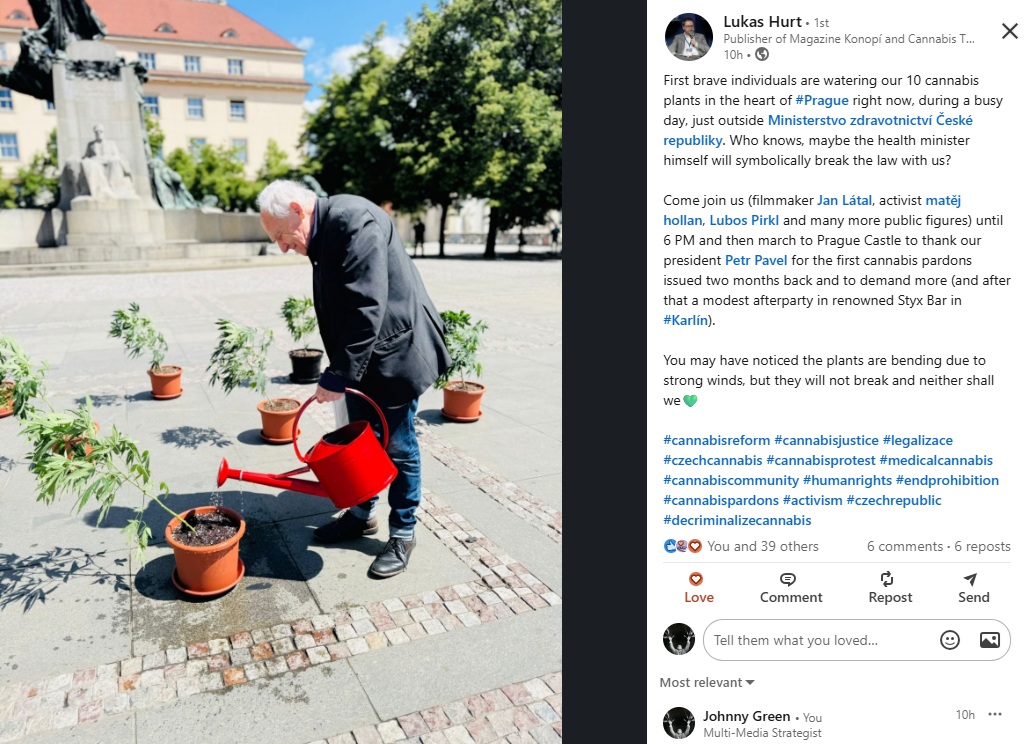
Cannabis advocates staged a peaceful protest today in Prague, Czechia, outside the nation’s Ministry of Health in Palacký Square. The protest, which involved publicly displaying ten cannabis plants as seen in the featured image of this article and the social media post below, was followed by a march.

Longtime Czech cannabis activist Lukas Hurt posted the image and description of the advocacy action on his LinkedIn page:

Lukas Hurt LinkedIn post May 15 2025

“If you can, please join us tomorrow afternoon in the heart of Prague, where my former high school classmate Jan Látal and my colleague from citizen initiative Rodiny proti prohibici (Family Against Prohibition), matěj hollan, and myself are organizing #Konopný #czeXperiment. Join us in a simple act of solidarity: water our 10 cannabis plants in the middle of busy Palacký Square to express support for cannabis prisoners.” Mr. Hurt wrote on his LinkedIn page the day before in a separate post.

“The symbolic watering of our beautiful plants right in the center of Czech capital begins at 5:00 p.m., followed by a peaceful walk to Prague Castle around 6:00 p.m. There, we will thank President Petr Pavel for the first pardons granted to three “cannabis granddads” and symbolically call on the Poslanecká sněmovna Parlamentu ČR to quickly adopt the criminal code reform, which is now going into the 3rd, final reading and which includes crucial changes in cannabis repression.” the Czech cannabis activist also wrote.

Cannabis advocates holding a banner in front of the St. Vitus Cathedral in Prague Czechia

(photo credit: Zuzana Kratochvilova)

In March 2025, Czech President Petr Pavel issued pardons to three men who were imprisoned for cultivating cannabis. All three men who received pardons from President Pavel were over the age of 70 and had initially received prison sentences ranging from 3-4 years before eventually receiving their pardons.

In recent years, a major push has been underway in the Czech Republic to modernize the nation’s cannabis policies to permit cannabis use and other activities by adults. Currently, cannabis is legal for adult use at a national level in Uruguay, Canada, Malta, Luxembourg, Germany, and South Africa.

Starting on April 1st, 2025, all GPs in the Czech Republic can prescribe medical cannabis for chronic pain. certain specialist doctors could do so (oncologists, neurologists, algeziologists). Doctors in the Czech Republic prescribed 318.7 kilograms of medicinal cannabis in 2024 to an average of roughly 3,300 patients per month.

Additionally, starting in July of this year, the Czech Republic wants to regulate sales of cannabis products containing up to one percent THC, but the gouvernement is still waiting for the EU’s opinion and the nation’s traditional hemp sector is in strong opposition to this change because there is a widespread fear of licences fees, ban on advertisement, and other strict limitations designed originally for psychoactive substances such as kratom or HHC, not low-THC hemp products.

A team of researchers affiliated with Charles University in the Czech Republic and the University of New South Wales in Australia recently collaborated on a study that examined the potential ‘social benefit’ effects of adult-use cannabis legalization in Czechia.

“Cannabis is the most commonly used illicit drug worldwide. In countries with repressive drug policies, the costs of its prohibition plausibly outweigh the benefits.” the researchers stated in their study, the findings of which were published in the Journal of Cost-Benefit Analysis.

“We conduct a cost–benefit analysis of cannabis legalization and regulation in the Czech Republic, taking into consideration alternative scenarios designed using parameters from the known effects of cannabis legalization in selected U.S. states, Canada, and Uruguay. Our analysis focuses on tax revenues, law enforcement costs, the cost of treatment and harm reduction, and the value of Quality Adjusted Life Years (QALYs).” the team of international researchers stated about their Czech-focused study’s methodology.

“Under all the projected scenarios, the identified benefits of legalizing cannabis for personal use exceed the potential costs. The estimated net social benefit of legalization is in the range of 34.4 to 107.6 million EUR per year (or between 3.2 and 10.1 EUR per capita), depending on the size of the cannabis market and the development of cannabis prices after legalization.” the researchers concluded.

Study: Net Social Benefit Of Czech Legalization Is 34.4-107.6 Million Euros Annually

A team of researchers affiliated with Charles University in the Czech Republic and the University of New South Wales in Australia recently collaborated on a study that examined the potential ‘social benefit’ effects of adult-use cannabis legalization in Czechia.

“Cannabis is the most commonly used illicit drug worldwide. In countries with repressive drug policies, the costs of its prohibition plausibly outweigh the benefits.” the researchers stated in their study, the findings of which were published in the academic publication Journal of Cost-Benefit Analysis.

In recent years, a major push has been underway in the Czech Republic to modernize the nation’s cannabis policies to permit cannabis use and other activities by adults. Currently, cannabis is legal for adult use at a national level in Uruguay, Canada, Malta, Luxembourg, Germany, and South Africa.

Top courts in a handful of other nations have rendered decisions providing adults some degree of legal protection for certain recreational cannabis activities.

“We conduct a cost–benefit analysis of cannabis legalization and regulation in the Czech Republic, taking into consideration alternative scenarios designed using parameters from the known effects of cannabis legalization in selected U.S. states, Canada, and Uruguay. Our analysis focuses on tax revenues, law enforcement costs, the cost of treatment and harm reduction, and the value of Quality Adjusted Life Years (QALYs).” the team of international researchers stated about their Czech-focused study’s methodology.

“Under all the projected scenarios, the identified benefits of legalizing cannabis for personal use exceed the potential costs. The estimated net social benefit of legalization is in the range of 34.4 to 107.6 million EUR per year (or between 3.2 and 10.1 EUR per capita), depending on the size of the cannabis market and the development of cannabis prices after legalization.” the researchers concluded.

Starting on April 1st, 2025, all licensed doctors in the Czech Republic can prescribe medical cannabis. Previously, only specialist doctors could do so. Doctors in the Czech Republic prescribed 318.7 kilograms of medicinal cannabis in 2024 to an average of roughly 3,300 patients per month.

Additionally, starting in July of this year, the Czech Republic will regulate sales of cannabis products containing up to one percent THC.

All Doctors In Czechia Can Now Prescribe Medicinal Cannabis

Starting today, all licensed doctors in the Czech Republic can now prescribe medical cannabis therapies to suffering patients. Previously, only specialist doctors could prescribe medical cannabis.

“All general practitioners (GPs) in Czechia are from today, April 1, authorized to prescribe medical cannabis to patients suffering from chronic pain, marking a significant shift in accessibility for the drug.” reported Expats CZ in its local coverage.

“Until now, only specialists—of whom there are approximately 250—could issue prescriptions for medical cannabis. Under the new regulation, GPs will be able to provide prescriptions, simplifying access for patients dealing with long-term health conditions.” the outlet also stated.

The medical cannabis public policy change will help improve safe access to cannabis therapies in the European nation. The change in who can prescribe legal medical cannabis in Czechia is now in line with many other countries around the world. Medical cannabis was first legalized in Czechia in 2013.

Starting in July of this year, the Czech Republic will regulate sales of cannabis containing up to one percent THC. The public policy change will also involve permitting regulated sales of kratom.

“The regulation focuses on substances deemed to pose low public health and social risks based on current scientific evidence. These include Kratom and kratom extracts, known for their stimulant and pain-relieving effects; cannabis with up to 1 percent THC, a low-potency form of cannabis with minimal psychoactive effects.” reported Expats CZ in its local coverage.

“Cannabis extracts and tinctures with up to 1 percent THC are also included.” Expats CZ also reportedLow-THC cannabis products will be permitted to be sold in licensed stores starting this summer in Czechia, although certain forms of commerce, such as automated vending machines, remain prohibited.

Czech Cannabis Legalization Effort Continues To Evolve

A push has been underway in the Czech Republic to legalize cannabis for adult use for several years now, with the cannabis policy modernization effort gaining steam in recent years after multiple European nations have adopted some form of recreational legalization. Cannabis is now legal for adults in Malta, Luxembourg, and Germany.

Cannabis advocates inside and outside of Czechia had hoped that legalization in the country would include regulated sales, however, it appears that will not occur in the near future, except for low-THC products. According to a recent interview by KrautInvest with leading cannabis advocate Lukáš Hurt, what is currently being considered in the Czech Republic is limited to home cultivation.

“At the moment, home growing decriminalization is the only proposal on the table, about eight months before the general election. And this is only thanks to the Minister of Justice, who included it as part of his broader criminal code reform. The original three-pillar plan – home growing, cannabis clubs, and a regulated market –, which we discussed last year and for which I lobbied, is essentially off the table.” Hurt stated in his recent interview with KrautInvest.

Another topic discussed in the interview was Czechia’s announcement earlier this year that low-THC products will be regulated later this year. Hurt pointed out that “the 1% THC limit was adopted about three years ago,” but that related products were not originally regulated for human consumption.

The Czech Republic’s cabinet previously approved a plan late last year that would permit adults in the European nation to cultivate multiple plants in their private residences and possess a personal amount of cannabis. That plan appears to still be on track, while the wider policy modernization reforms will have to wait. In the meantime, cannabis advocates will continue to push for sensible laws and regulations.

Medical cannabis is legal in the Czech Republic. Doctors in the Czech Republic prescribed 318.7 kilograms of medicinal cannabis in 2024 to an average of roughly 3,300 patients per month. Those figures are set to expand in April 2025 when Czech GPs will be permitted to prescribe cannabis for chronic pain.

Czech Doctors Prescribed 318.7 Kilograms Of Medicinal Cannabis In 2024

According to data from Czechia’s State Institute for Drug Control and as reported locally by BRNO Daily, doctors in the Czech Republic prescribed 318.7 kilograms of medicinal cannabis in 2024 to an average of roughly 3,300 patients per month. Those figures are set to expand in April 2025 when Czech GPs will be permitted to prescribe cannabis for chronic pain.

“GPs will now be able to prescribe medicinal cannabis for chronic pain, and patients can also be prescribed up to a three-month dose per prescription, according to changes to the relevant legislation which will come into force in April this year.” BRNO Daily stated in its reporting.

For context, in 2023 Czech doctors prescribed 258.8 kilograms of medical cannabis, 157.4 kilograms in 2022, and 109.4 kilograms in 2021. Additionally, the Czech Republic’s legal medical cannabis industry served an average of 2,570 patients in 2023, in 2022 it was 1,886, and in 2021 it was 1,389.

The Czech Republic’s medical cannabis expansion occurring later this year comes amidst a push for wider cannabis policy reform in the European nation. In November 2024, the Czech Republic’s cabinet approved a plan that would permit adults to cultivate multiple plants in their private residences and possess a personal amount of cannabis.

The plan, which would legalize the cultivation of up to three cannabis plants and set a maximum possession limit of 50 grams of cannabis, was originally introduced by the Czech Republic’s Ministry of Justice back in September 2024. The plan does not go far enough according to members of the Czech Pirate Party.

“Instead of legalization and money in the budget, today the government presents pasquil. You can grow cannabis, but you can’t harvest it. To be able to grow three cannabis plants and at the same time have a limit of 50 grams that you can have at home is absurd. It’s like you could raise three hens, but they could lay a maximum of one egg, otherwise you’ll be fined or go to jail,” said former Deputy Prime Minister and former head of the Pirates Ivan Bartoš according to previous reporting by Echo24.

Cannabis advocates in Czechia are urging lawmakers to modernize the nation’s cannabis policies in a more comprehensive fashion. More information about their proposal can be found at: www.racionalniregulace.cz.

Starting in July of this year, the Czech Republic will regulate sales of cannabis containing up to one percent THC. The public policy change will also involve permitting regulated sales of kratom.

“The regulation focuses on substances deemed to pose low public health and social risks based on current scientific evidence. These include Kratom and kratom extracts, known for their stimulant and pain-relieving effects; cannabis with up to 1 percent THC, a low-potency form of cannabis with minimal psychoactive effects.” reported Expats CZ in its local coverage.

“Cannabis extracts and tinctures with up to 1 percent THC are also included.” Expats CZ also reportedLow-THC cannabis products will be permitted to be sold in licensed stores starting this summer in Czechia, although certain forms of commerce such as automated vending machines will remain prohibited.