Tag: Germany

German SPD Will Not Support Draft Cannabis Amendment “Under Any Circumstances”

Last month, Germany’s Health Ministry released a draft medical cannabis amendment that seeks to roll back Germany’s medical cannabis regulations significantly. The proposed changes contained within the draft amendment include:

  • Mandatory in-person doctor consultations
  • A ban on mail-order medical cannabis dispensing
  • Stricter rules for medical cannabis prescriptions

Fortunately, not everyone in Germany’s governing coalition is in favor of the proposed changes. Leadership of the Social Democratic Party (SPD) was recently asked what the SPD’s position on the draft amendment is, and what the SPD will do to oppose the announced amendment.

“The Federal Ministry of Health wants to restrict telemedicine and prescribe only after personal contact and no longer allow mail delivery.” a concerned member of the public asked on the platform Abgeordnetenwatch (translated from German to English), as originally reported by krautinvest. “What is the SPD’s position on this? And what, if anything, does it intend to do to oppose the change?”

“The Ministry of Health, under the new Union Minister Warken, has now presented a draft bill intended to address the increase in imports of medical cannabis. According to the Federal Ministry of Health, this is primarily due to the increased use of private prescriptions for self-payers via online platforms, without any doctor-patient contact. Therefore, misuse of medical cannabis is assumed. The ministry has stated that, for patient protection, it intends to ensure consultation before consumption and therefore restrict online sales.” Ms. Carmen Wegge, SPD member of the German Bundestag, stated in her response to the inquiry (translated from German to English).

As alluded to by Ms. Wegge in her response to the inquiry, Germany’s Federal Institute for Drugs and Medical Devices (BfArM) recently published medical cannabis import data for the second quarter of 2025, and once again, Germany’s emerging legal medical cannabis industry set a new record for import totals.

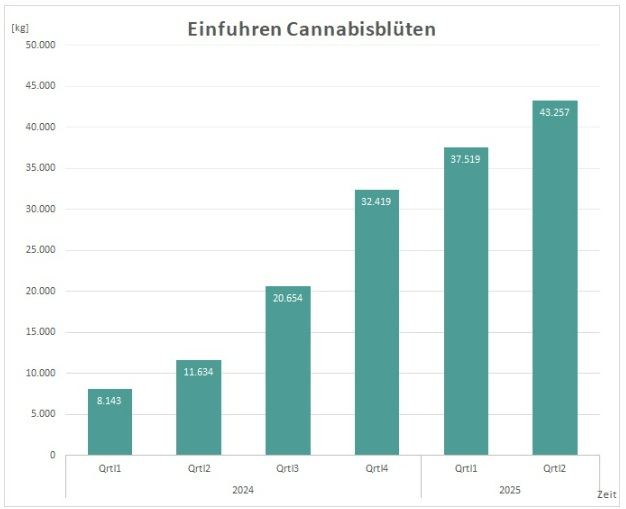
In the second quarter of 2025, Germany imported 43.257 tonnes of medical cannabis products according to BfArM’s data. That is an increase over the previous record set in Q1 2025 of 37.519 tonnes, and a significant increase compared to Q2 2024 when Germany imported 11.634 tonnes of medical cannabis products. Below is a graph of historical import totals from BfArM:
germany medical cannabis imports 2024 and 2025

“For us as the SPD, however, in addition to protecting and adequately advising patients, it is crucial to ensure reliable, local, and accessible care. Digital care is particularly important for people with chronic and/or serious illnesses, as well as in areas with inadequate primary care. Therefore, we will not support the current version of the bill under any circumstances.” Ms. Wegge also stated.

In the upcoming discussions, we will therefore develop a solution that will ensure that medicinal cannabis remains readily accessible to all patients who need it, while simultaneously ensuring patient protection. The initial draft bill from the Federal Ministry of Health will now be discussed with experts in the ministry and subsequently debated in the cabinet before a decision is made there and a potential draft bill from the ministry is submitted to the Bundestag. In the Bundestag, it will be discussed in the relevant specialist committees, and Struck’s Law applies, which stipulates that no bill leaves committee deliberations in the same condition as it was submitted. Many negotiation steps will therefore still take place before a possible decision is made in the Bundestag, and we as the SPD will advocate for a good solution for patients.” Ms. Wegge added.

“Even though we must primarily defend the drug policy achievements of the last legislative period, we will not lose sight of the goal. I remain convinced that full legalization of cannabis, in compliance with European law, and its sale in licensed specialist stores is the best way forward, and that medical care must be made as simple as possible. I can assure you that I will fight for political majorities that make this possible, and I will not shy away from discussions with the Union.” Ms. Carmen Wegge concluded.

(The featured image of this article of Bundestag member Carmen Wegge is a photo by Anna Voelske.)

High Tide To Become Major Player In German Medical Cannabis Market

High Tide, Inc. is a leading community-grown, retail-forward international cannabis company. Its wholly owned subsidiary, Canna Cabana, is the second-largest cannabis retail brand globally. In a major move for the company, High Tide has acquired a majority stake in Germany-based Remexian Pharma GmbH.

Founded in 2018 and headquartered just outside of Berlin, Germany, Remexian is an established medical cannabis pharmaceutical company specializing in the importation and wholesale of medical cannabis. As part of its business model, Remexian has a fully certified EU GDP warehouse.

Remexian is currently licensed to import medical cannabis products into Germany from 19 countries, including Canada, which represents approximately 33% of their total imports into Germany. Given its over $1.9 billion in Canadian cannabis sales since adult-use legalization, High Tide is well-positioned to further increase the Canadian share of medical cannabis imports into Germany.

“Remexian is an ideal match for us—not only in its commitment to discount pricing, but also in its operational approach, which mirrors our lowest price guarantee in Canada. We took our time evaluating potential partners and couldn’t be more excited to join forces with the best-in-class team that built Remexian into a national leader. Together, our complementary strengths and deep procurement expertise will create a stronger foundation for growth and further enhance the fundamentals of this business,” said Raj Grover, Founder and Chief Executive Officer of High Tide.

“With this highly accretive acquisition adding approximately C$100 million in topline revenue and significant EBITDA annually, we will meaningfully strengthen our financials, positioning us well to establish a strong foothold in Germany, which will serve as a springboard into other European markets in due course. Our goal in Germany remains clear: to provide the highest quality medical cannabis at the most affordable prices, led by our Canadian house of brands and supplemented by medical cannabis imports from all across the globe,” added Mr. Grover.

“We are truly energized by the strong synergy we’ve found with High Tide, whose impressive scale amplifies our impact in Germany,” said Markus Wenner, Co-Founder of Remexian. “Both of our companies have taken a deliberate, strategic approach to becoming leaders in our respective markets. By combining one of Germany’s largest cannabis distribution networks with High Tide’s unmatched access to Canadian supply, we are setting the stage for unprecedented growth. We at Remexian are looking forward to building this exciting future together with Raj and the talented High Tide team.”

Germany’s Federal Institute for Drugs and Medical Devices (BfArM) recently published medical cannabis import data for the second quarter of 2025, and once again, Germany’s emerging legal medical cannabis industry set a new record for import totals.

In the second quarter of 2025, Germany imported 43.257 tonnes of medical cannabis products according to BfArM’s data. That is an increase over the previous record set in Q1 2025 of 37.519 tonnes, and a significant increase compared to Q2 2024 when Germany imported 11.634 tonnes of medical cannabis products. Below is a graph of historical import totals from BfArM:

germany medical cannabis imports 2024 and 2025

Remexian has an annualized revenue and Adjusted EBITDA of €70 million and €15 million, respectively, for the six months ending March 2025. Remexian is currently one of the largest distributors of medical cannabis flower in Germany in terms of total grams sold, distributing the equivalent of 7 tonnes in Q2 2025, representing 16% of the 43 tonnes imported into Germany during the quarter.

Autumn 2025 Could Be Pivotal For German Cannabis

As the summer months of 2025 are coming to an end and the autumn season approaches, the eyes of the international cannabis community will continue to be fixed on Germany, where policymakers, regulators, and researchers are expected to make some major announcements that could prove to be pivotal for the future of Germany’s industry.

The first interim report from the ongoing EKOCAN evaluation of Germany’s Consumer Cannabis Act (KCanG) is scheduled for release on October 1, 2025. The evaluation will consider, among other things:

  • Consumption rates and behaviors of various age groups
  • Cannabis use prevention among youth
  • Impact on public health outcomes, including mental health
  • Public roadway safety
  • Impacts on criminal activity
  • Impacts on Germany’s court system

“To this end, a wide variety of data will be compiled (e.g., from ongoing studies on the topic or from public administration), our own surveys will be conducted (e.g., with public organizations directly involved in the topic, as well as consumers and cultivation associations), and the data will finally be evaluated with regard to the aforementioned overarching objectives.” states the Federal Ministry of Health (BMG) on its website (translated from German to English).

“The evaluation will make an important contribution to answering the question of how the law is being implemented in everyday life and whether the intended effects of the law are being achieved. Furthermore, the evaluation should provide reliable evidence for potentially necessary legislative adjustments.” BMG also states.

Some initial findings from the EKOCAN project and its project manager, Dr. Jakob Manthey, have already surfaced via original reporting by krautinvest. One of the major takeaways from the initial findings is that reported cannabis consumption rates were already on the rise in Germany leading up to the enactment of the CanG law, and Dr. Manthy determined that the rise was due to older individuals reporting cannabis use.

Regarding younger consumers, which is a demographic often focused on by cannabis opponents in their talking points, Dr. Manthy “sees no anomalies since the Cannabis Act came into force,” according to krautinvest’s reporting, and that Dr. Manthy doesn’t assume “that any changes can be attributed to the Cannabis Act.”

Other high-level takeaways from the initial evaluation findings are that there aren’t enough cannabis cultivation associations in Germany, that there are no “short-term changes” regarding public roadway safety, legalization has not increased reported mental illnesses, and that the CanG law has significantly lowered cannabis-related criminal offenses in Germany. It will be interesting to see if those initial findings are included in the upcoming interim report in October.

Another major item that members of the cannabis community inside and outside of Germany need to have on their radars relates to decisions on pending applications for regional adult-use cannabis commerce pilot projects. The pending applications and looming decisions were touched on in the German Cannabis Business Association’s (BvCW) recent newsletter.

“To date, 58 applications for research projects have been submitted under Section 2 (4) of the KCanG, 32 of which are so-called model projects. The first decisions on applications by the Federal Office for Agriculture and Food are expected in the third quarter of 2025.” BvCW wrote in its newsletter this week (translated from German to English).

Regional adult-use cannabis commerce pilot trials are part of the second phase of Germany’s legalization model, and were initially expected to launch by the end of 2024. However, German pilot launches have experienced a series of delays.

Hopefully the delays have run their course, and approvals will be announced soon. Adult-use pilot trials are already operating in the Netherlands and Switzerland, with no major issues being reported.

Nearly 50% Of German Patients Live Over 10 Kilometers From A Cannabis Pharmacy

As is the case with any country that has adopted a modernized medical cannabis program, Germany’s patient base is spread out across the country, with some regions of Germany having a larger concentration of patients than others. Meanwhile, medical cannabis safe access points are also spread across Germany in a non-uniform manner.

For able-bodied patients who live near a German pharmacy that dispenses medical cannabis, acquiring their medicine is presumably not too big a burden. However, for patients who live far away from a cannabis pharmacy and/or are not able-bodied, telemedicine and delivery services are vital.

Unfortunately, Germany’s Health Minister Nina Warken is currently pushing to abolish both medical cannabis telemedicine and delivery services in the European country. Minister Warken recently released a draft amendment that, as introduced, would:

  • Mandate in-person doctor consultations
  • Ban mail-order medical cannabis dispensing
  • Impose stricter rules for medical cannabis prescriptions

For the first time, data has been compiled and published that quantifies which regions and medical cannabis patients would be hit the hardest if the harmful amendment and its provisions were to be adopted.

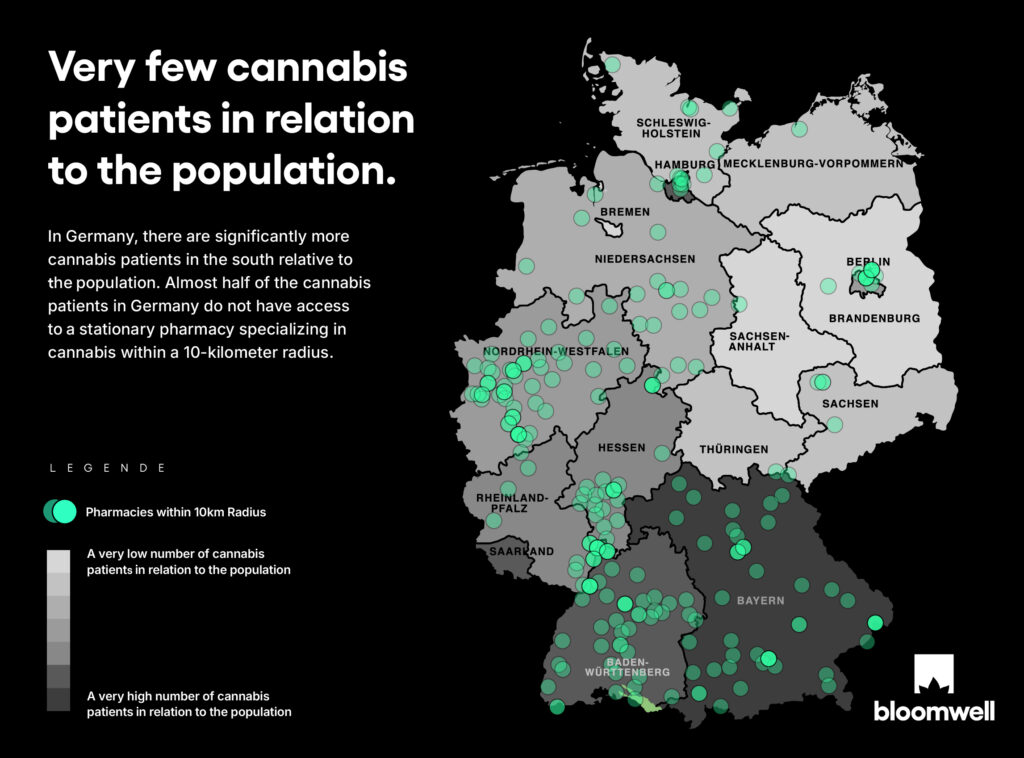
Bloomwell Group released a map outlining the number of medical cannabis patients in Germany in relation to the country’s population, along with which regions have the most, and least, patients. The results suggest that online delivery of medical cannabis is heavily relied upon by German patients who do not have local access to brick-and-mortar pharmacies that can supply cannabis treatment.” stated Bloomwell in a press release obtained by the International Cannabis Business Conference.

bloomwell German Germany medical cannabis patient location map

According to the company’s data analysis, “there are significantly more medical cannabis patients in relation to the population in the South of the country than in the North,” and “almost half of the cannabis patients in Germany do not have access to a brick-and-mortar pharmacy specializing in cannabis treatment within a 10-kilometer radius.”

German medical cannabis telemedicine services help the nation’s most vulnerable patients, including rural patients who live far away from doctors, disabled patients who often cannot travel to complete in-person consultations, and low income patients who may be able-bodied and yet cannot afford to travel to a physical doctors office or pay extra for a doctor to travel to them for in-person consultations. It is paramount for these types of German medical cannabis patients that telemedicine and delivery services be maintained and not banned.

“If half of cannabis patients cannot legally obtain their medication from a pharmacy within a 10-kilometer radius, what alternative remains for these medical patients besides turning to the illicit market? We are only at the very beginning of the legislative process, and given the severe potential consequences of the current draft for limiting the pharmaceutical care access of hundreds of thousands of chronically ill patients, I predict that this amendment will not be passed in its current form. Fortunately, the SPD parliamentary group has already emphasized that without solid evaluation results, they will not jeopardize patient safety through such drastic measures.” states Niklas Kouparanis, Co-Founder and CEO of Bloomwell Group.

Leading international cannabis economist Beau Whitney, founder of Whitney Economics, estimates that Germany is home to between 700k and 900k medical cannabis patients.

Saarland Cannabis Social Club Receives Cultivation Approval

One of the main components of Germany’s adult-use cannabis legalization model is permitting consumers to join a member-based cultivation association. German cultivation associations are also sometimes referred to as ‘cannabis social clubs.’

Per our prior reporting, as of last month, 293 cultivation association applications had been approved by regulators in Germany, and hundreds more applications are pending. At least one application had been approved in every German state except Saarland. The southwestern German state was a notable holdout, but it has reportedly finally approved its first application.

“In Saarland, the first Cannabis Social Club (CSC) has received a permit from the state government to cultivate cannabis communally.” reported Saarbrücker Zeitung in its local reporting (translated from German to English). “The responsible Ministry of the Environment announced this in response to an inquiry by the Süddeutsche Zeitung (SZ).”

“Saarland is thus the last federal state to issue a cultivation permit. The Saarland SPD state government had spoken out against the legalization of cannabis in the Bundesrat (Federal Council).” the outlet also reported.

Starting on July 1st, 2024, adults in Germany can apply to their local authority to launch a cultivation association. Once approved, adult cannabis consumers in Germany can become members of the association and source products legally. German adults can only be members of one association at any given time, and additional association regulations apply.

Whereas current European Union agreements prohibit national adult-use cannabis sales, such as what is occurring in Canada and Uruguay, EU agreements do permit member nations to allow cultivation associations since they fall under the umbrella of boosting public health outcomes. Malta also includes cultivation associations in its national recreational legalization model.

A major premise of the European recreational cannabis policy modernization effort is that when adults consume regulated cannabis or cannabis that they cultivate themselves, it is better for public health outcomes compared to when adults consume cannabis from unregulated sources.

That premise is the basis for the European Union allowing Malta, Luxembourg, Germany, and the Czech Republic to adopt national adult-use cannabis legalization measures. Recreational cannabis legalization measures are also currently being considered in Slovenia and Switzerland.

Germany Imported Over 43 Tonnes Of Cannabis In Q2 2025

Germany’s Federal Institute for Drugs and Medical Devices (BfArM) recently published medical cannabis import data for the second quarter of 2025, and once again, Germany’s emerging legal medical cannabis industry set a new record for import totals.

In the second quarter of 2025, Germany imported 43.257 tonnes of medical cannabis products according to BfArM’s data. That is an increase over the previous record set in Q1 2025 of 37.519 tonnes, and a significant increase compared to Q2 2024 when Germany imported 11.634 tonnes of medical cannabis products. Below is a graph of import totals from BfArM:

germany medical cannabis imports 2024 and 2025

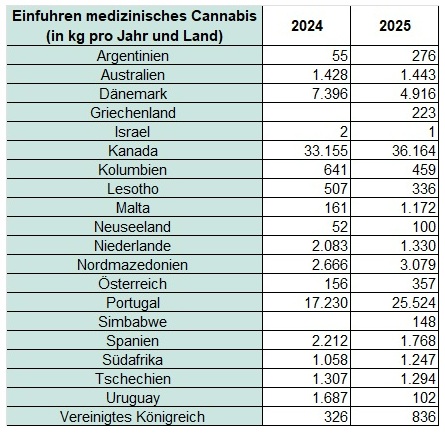
Canada continues to serve as the top source of medical cannabis imports to Germany, with BfArM reporting that Germany has imported 36.164 tonnes of medical cannabis products in the first half of 2025. By comparison, 25.524 tonnes have been imported to Germany from Portugal in the first half of 2025.

Below is a breakdown of countries of origin for medical cannabis imports to Germany in 2024 and the first half of 2025, via BfArM:

germany medical cannabis imports by country 2024 and 2025

Legal sales of medical cannabis products through pharmacies began in Germany in 2017. Back then, the Netherlands served as the top source for medical cannabis imports to Germany. The same was true for 2018. However, in 2019, imports to Germany from Canada topped the Netherlands and every other country of origin, and that has remained the case ever since.

Germany was already home to Europe’s largest legal medical cannabis market before the nation’s CanG law took effect in April 2024, and as the data demonstrates, Germany’s medical cannabis industry has surged since then. Germany is on pace to eclipse 160 tonnes of medical cannabis imports in 2025 if current trends persist, but given the fact that import totals still appear to be climbing, it will be interesting to see what the actual final total for 2025 ends up being.

DHV Issues Statement Against Harmful German Draft Amendment

Last month, Germany’s Ministry of Health released a draft amendment that, if approved, would negatively impact the nation’s medical cannabis program, and with it, Germany’s suffering patients and emerging industry. As proposed, the draft amendment would:

  • Mandate in-person doctor consultations
  • Ban on mail-order medical cannabis dispensing
  • Impose stricter rules for medical cannabis prescriptions

Pushback to the draft amendment by medical cannabis patients, advocates, and industry members was swift. The German Hemp Association (DHV) recently issued its own statement calling for the proposed amendment to be defeated.

“Telemedical prescriptions of cannabis medications and online delivery were already possible before the MedCanG “in the days of the Narcotics Act.” The planned changes would essentially catapult us back to pre-digital times when it comes to cannabis medicine, while the federal government otherwise wants to catch up with its significant lag in digitalization. This not only feels anachronistic for citizens and patients in Germany, but is likely to cause head-scratching abroad as well. No online delivery of (cannabis) medications? Picking everything up in person? In Canada and the USA, this will be hard to believe. This is reminiscent of the strength of the pharmacist lobby, just as it is in Germany.” stated DHV in a recent news release (translated from German to English).

DHV is calling out the apparent selective focus by the Ministry of Health on cannabis flower but not cannabis extracts. Germany has experienced exponential growth in medical cannabis flower imports over the last year. However, the increase in exports has not been directly tied to any increase in public health issues.

“It is unclear why the planned regulations should only apply to cannabis flowers and not to extracts with significantly higher THC concentrations. The justification merely states that the import of flowers has increased significantly. However, it is likely that the import of extracts is also likely to have increased significantly from the first to the second half of 2024. However, the Federal Ministry of Health does not provide any figures on this. The Federal Institute for Drugs and Medical Devices (BfArM) also does not provide any information on the development of extracts. Furthermore, it is unclear whether and to what extent extracts are produced and distributed within Germany after the import of cannabis flowers. ” DHV points out.

“Without data on the import of extracts and the processing of flowers into extracts within Germany, an objective assessment is impossible, and a one-sided restriction on flowers is incomprehensible. For years, we have seen a one-sided negative portrayal of flowers compared to other cannabis medications because they resemble the traditional recreational drug cannabis, even though the flowers certainly have their justification for medical use through simple inhalation.” DHV also stated in its news release.

DHV’s full statement can be read at this link here, and people are encouraged to read it in its entirety. Readers can also check out our previous coverage of statements from other advocates and organizations, as well as information on where to sign petitions against the draft amendment, at this link here.

Lawsuit Filed Against Bavarian Cannabis Consequences Limitation Act

A constitutional complaint and lawsuit were filed today against the Bavarian Cannabis Consequences Limitation Act according to the German Hemp Association (DHV). The Act prohibits cannabis consumption at folk festival events in Bavaria and consumption in outdoor areas of local restaurant establishments.

“The plaintiffs are cannabis patient René Korcak and consumer Emanuel Burghard (both of Bayrisch Kraut), as well as the operator of the Tortuga Bar in Fürstenfeldbrück, Dr. Andreas Rothenberger. The plaintiffs are represented by attorney David Werdermannn (KM8 law firm). The proceedings are coordinated and financed by the German Hemp Association. The constitutional complaint has been filed with the Federal Constitutional Court in Karlsruhe. At the same time, the plaintiffs are challenging the restrictions on their freedoms before the Munich Administrative Court.” DHV stated in a press release announcing the legal actions (translated from German to English).

“While the nationwide Cannabis Act (CanG) has newly regulated adult consumption, the Free State of Bavaria has massively restricted these freedoms with its own law. In particular, the blanket ban on cannabis consumption in the outdoor areas of restaurants (“beer garden ban”) and at folk festivals represents, in our view, an unconstitutional infringement of fundamental rights. It not only curtails the rights of consumers and patients, but also unlawfully interferes with the house rules and entrepreneurial freedom of Bavarian restaurateurs.” the press release also stated.

The press release was also coupled with an online press conference, which is embedded below:

Limiting cannabis consumption to private residences in Bavaria makes life harder for suffering medical patients in particular. It is unfair to expect patients to refrain from consuming their medicine simply because their medicine happens to be medical cannabis.

“As a patient, it would make my life considerably easier if restaurateurs had the freedom to make their own decisions about their businesses.” stated plaintiff and medical cannabis patient René Korcak.

“I’m generally a liberal, politically minded person who has been politically active for a long time and is a champion of civil liberties. But I’m also suing because I fear a loss of revenue if potential guests prefer to stay home and avoid my beer garden because of the cannabis ban.” said Tortuga Bar owner Dr. Andreas Rothenberger.

“With its cannabis ban in beer gardens and at folk festivals, Bavaria is not only ignoring the federal legislature’s decision, but is also disproportionately interfering with the fundamental rights of restaurant owners, patients, and consumers.” attorney David Werdermannn stated about the Bavarian Cannabis Consequences Limitation Act.

“Bavaria, too, must comply with federal laws. It cannot be that the CSU is crafting its own anti-cannabis law for ideological reasons.” Georg Wurth, CEO of DHV, added.

German Cannabis Advocates Push Back On Harmful Amendment

Germany’s medical cannabis community is resiliant, as demonstrated by swift and largely united pushback from medical cannabis advocates against a recently published draft amendment to the country’s Medical Cannabis Act (MedCanG).

The changes are being proposed by Germany’s Ministry of Health despite the effectiveness and safety of telemedicine services. As drafted, the amendment would negatively impact safe access in Germany, and the nation’s most vulnerable medical cannabis patients would suffer as a result. The proposed changes contained within the draft amendment include:

  • Mandatory in-person doctor consultations
  • A ban on mail-order medical cannabis dispensing
  • Stricter rules for medical cannabis prescriptions

“Health Minister Warken sees mail-order sales and anonymous online prescriptions as a gateway for misuse, which is promoted by commercial platforms. However, the draft does not appear to have been agreed upon with the coalition partner, the SPD , yet . The industry is calling for differentiated solutions instead of blanket bans. Reputable providers are advocating for stricter standards in telemedicine, but against a complete ban on digital care. A mail-order ban would once again push patients onto the black market and overburden pharmacies and practices.” stated the German Cannabis Business Association (BvCW) in a recent newsletter (translated from German to English).

“Security of supply, for example through rare varieties or short-term availability, has so far been better ensured through digital processes. In light of the planned evaluation of the Cannabis Act in the fall, platforms and patient representatives are calling for a fact-based dialogue with politicians – otherwise, there is a risk of setbacks in patient care and the re-criminalization of many chronically ill people.” BvCW also wrote.

“Healthcare should never depend on your zip code or bank balance,” said David Barnan, Chief Marketing Officer at DoktorABC, in a press release. “We are watching with great concern as Germany moves toward a two-tier healthcare system. In major cities, those with money receive treatment, while patients in rural areas are left behind. The proposed restrictions on telemedicine prescribing of cannabis and mail-order sales of medicines would push tens of thousands of legitimate medical cannabis patients back to ineffective therapies—or, worse, into the unregulated market.”

“For many patients, a doctor’s visit can cost up to €100 out of pocket—and that doesn’t even include travel expenses, lost time from work, or the cost of caregivers,” Barnan also stated. “And most local pharmacies simply can’t stock the full range of cannabis flowers that doctors prescribe. Patients will be forced to travel from pharmacy to pharmacy just to find their medication. Smaller local stocks also keep prices high. Faced with rising costs and repeated supply shortages, many patients will forgo treatment—or turn to the black market, where there is no medical oversight.”

“Telemedicine is not a loophole—it’s a lifeline that lowers costs, expands access, and keeps patients in regulated care,” Barnan said.

“We call on legislators to protect digital consultation channels and ensure the shipping and delivery of legally prescribed medical cannabis from pharmacies. Where additional security measures are necessary, they should be specifically enhanced—but patients must not be cut off from effective, physician-assisted access.” states a petition started by DoktorABC on Change.org. As of the posting of this article, the petition has been signed by 17,289 people.

“Mail-order sales by German pharmacies should remain possible – especially with regard to chronically ill people who are limited in their mobility.” stated health politician Simone Borchardt (CDU), according to local reporting by Handelsblatt (translated from German to English). “If shipping from abroad is stopped while maintaining domestic shipping, we will strengthen the pharmacy landscape in Germany and improve care, especially in rural areas. A complete ban, however, goes too far.”

“For hundreds of thousands of people, medical cannabis is the only effective treatment. Nevertheless, due to concerns about abuse, centralized care channels such as telemedicine and mail-order delivery are being restricted – contrary to current healthcare practices and without consulting those affected.” states a separate petition launched by Grünhorn Group (translated from German to English). “A telemedicine ban would hurt the wrong people: the patients. The black market would profit.”

“Telemedicine access is to be severely limited, and the shipping of medical cannabis flowers by pharmacies is to be prohibited. This would likely result in at least halving the current market volume. This raises questions about the BMG’s motives.” pointed out krautinvest in a recent article.

“The high demand for online offerings is not the problem, but a symptom of a sick healthcare system that is failing to adequately fulfill its mandate. New hurdles do not lead to better standard care—instead, they lead to fewer options and longer journeys for those affected. A ban on flower shipping threatens conditions that are more restrictive than when cannabis was still a narcotic.” stated Stefan Konikowski, Board Member of Berliner Cannabis Hilfe eV (Berlin Cannabis Help Association).

“In the interest of patients, we demand that the market for medical cannabis, as well as related (tele)medical, pharmaceutical, and other care-related services, be sensibly regulated and controlled through existing laws. Particular consideration must be given to patient welfare, security of supply, and low-threshold access.” Stefan Konikowski also stated (translated from German to English).