Tag: Germany

44% Of German Adult Cannabis Consumers Plan To Join A Social Club

In a recent nationwide survey conducted in Germany by Pronova BKK, 44% of self-reported ‘regular’ cannabis consumers indicated that they plan to join one of the country’s social cannabis clubs once they launch this summer. Another 27% of ‘occasional’ cannabis consumers also indicated that they plan to join a club.

The Pronova BKK survey involved 1,000 people in Germany aged 18 and over and was conducted in May 2024. The survey also determined the following (translated from German to English) about Germany’s cannabis consumer base:

  • Over a quarter of Germans consume cannabis at least occasionally, and one in ten consumes it weekly
  • More than half of Generation Z consumes cannabis at least occasionally
  • For a third of cannabis consumers, legalization does not influence consumption behavior
  • Among younger respondents under 45 years of age, one in ten has increased consumption since legalization
  • Eight percent of non-users are considering growing their own cannabis at home

Among self-reported ‘regular’ cannabis consumers participating in the survey, 51% selected “Yes, I can imagine having my own cannabis to grow at home” when asked about home cultivation. Another 40% of ‘occasional’ cannabis consumers also selected that option in the survey.

The results of the Pronova BKK survey were published shortly after the European Monitoring Centre for Drugs and Drug Addiction (EMCDDA) released its annual European Drug Report. The EMCDDA report lists that 34.7% of German adults have consumed cannabis at least once in their lifetime.

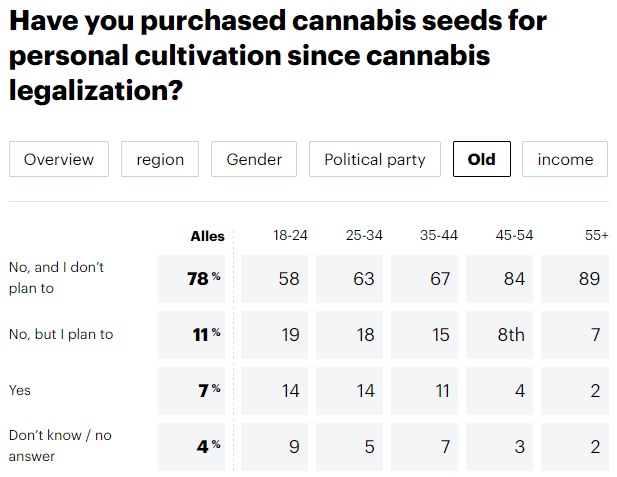
YouGov poll that was also conducted in May 2024 found that 7% of surveyed German adults (consumers and non-consumers) have already purchased cannabis seeds or clones. Another 11% indicated in the YouGov survey that they planned to purchase seeds or clones in the future. The YouGov poll involved 3,375 German adults.

The first provisions of Germany’s CanG law took effect on April 1st, 2024. Adults in Germany can now cultivate up to three plants in their private residences and possess up to 25 grams of cannabis when away from their homes.

Additionally, cannabis was removed from the nation’s Narcotics List which is having an immediate impact on Germany’s medical cannabis industry. Germany was already the largest legal medical cannabis market in Europe, and now domestic production quotas are removed, doctors can prescribe cannabis more easily, and the medical cannabis supply chain has fewer hurdles.

In 2023, Germany imported 31,398 kilograms of medical cannabis products according to data from Germany’s Federal Institute for Drugs and Medical Devices (BfArM), a 26.2% increase compared to the previous year’s medical cannabis imports.

With domestic production quotas removed and many patients now cultivating their own medical cannabis, total imports will presumably lower by a considerable amount in Germany in 2024.

The German Cannabis Industry Continues To Evolve

Germany was already home to Europe’s largest legal medical cannabis market before the first provisions of the nation’s adult-use legalization measure took effect on April 1st, 2024. When the first provisions of Germany’s CanG law were enacted at the start of April, the nation also became the largest country on earth to implement national adult-use reform.

The nation’s cannabis policy and industry landscape will forever be measured as occurring before or after 2024 due to how pivotal the year 2024 is proving to be. Nearly every facet of Germany’s industry and cannabis community is evolving this year, with the most notable items listed and discussed below.

Personal Consumption

People in Germany who are 18 years old or older can now consume cannabis in private settings without the fear of prosecution and can possess up to 25 grams of cannabis when away from their residences. Cannabis consumption is not new in Germany, with 4.3% of German adults reporting that they use cannabis on a monthly basis and 8.8% reporting that they have used cannabis at least once in the last year.

However, the way that people consume cannabis in Germany is undergoing a technological revolution, with many device and gadget makers eyeing the German cannabis consumer market with their latest creations. According to a recent analysis by market researchers, the global handheld cannabis vaporizer market is projected to reach $15.9 billion in value by 2031, and Germany will play a big role in the growth of the sector.

Home Cultivation

On April 1st Germany became home to the largest potential home cultivation market in Europe, with Germany’s roughly 70 million adults becoming eligible to cultivate up to three plants in their private residences. Personal cannabis cultivation is already proving to be very popular with adult consumers in Germany, as reflected by a recent YouGov poll which found that 7% of poll participants indicated they had already purchased cannabis clones or seeds since legalization took effect. Another 11% of poll participants stated that they intend to purchase clones or seeds in the future.

In addition to clones and seeds, Germany’s newly afforded home cultivation freedoms are increasing sales of many other sector products, including growing mediums, nutrients, lighting, environmental control systems, odor control, harvesting tools, and drying equipment. Home cultivation educational programs and materials are also experiencing increased demand in Germany.

Social Clubs

Starting next month, Germany will begin permitting social cannabis clubs in many parts of the country. Social clubs are a key provision of ‘Pillar 1’ of Germany’s CanG law and will play a vital role in legally sourcing adult-use cannabis in Germany. Earlier this month the Bundestag approved new policies that afford states more authority to set limits on social cannabis clubs, so the prevalence and scope of clubs will likely vary throughout the country.

It is going to be very interesting to see how creative social cannabis club operators get once clubs are launched. The basic premise of social clubs is for adults to become members and to source legal cannabis through the social clubs that will cultivate cannabis for members. However, cannabis clubs can employ paid workers to carry out various tasks that are not necessarily directly related to the cultivation or distribution of cannabis, and clubs will likely offer ancillary products and services that could prove to be very engaging (and lucrative). Only time will tell what social club operators come up with, and conversely, what local and national regulators will allow.

Pilot Trials

‘Pillar 2’ of Germany’s cannabis legalization model revolves around the launch of regional adult-use cannabis commerce pilot trials. Pilot trials permit a certain number of entities to cultivate cannabis that is then sold to registered customers at licensed outlets. Such pilot trials are already underway in parts of the Netherlands and Switzerland with no reported issues.

Pilot trials in Germany are expected to be more widespread than what is in place in Switzerland and the Netherlands, both in the number of jurisdictions where they operate and the number of participants they will serve. German pilot trials are expected to begin by the end of the year, and when combined with social clubs and home cultivation, will serve as the foundation for legal adult-use cannabis access in Germany.

Medical Cannabis

Often lost in the hype and chaotic nature of the rise of adult-use cannabis in Europe is the fact that Germany’s medical cannabis industry is currently undergoing dramatic changes. Part of Germany’s new CanG law involved the removal of cannabis from the nation’s Narcotics List and the removal of quota limits for domestic medical cannabis production. Doctors in Germany can prescribe cannabis more easily, the medical cannabis supply chain has fewer hurdles and hoops, and domestic production is set to surge.

As a result, the German medical cannabis industry is projected to experience tremendous growth in the coming years. A February 2024 market analysis by Zuanic & Associates determined that if 1% of Germany’s population became cash-paying medical cannabis patients, the German medical market could reach €1.7Bn in value by the end of 2025. Germany’s medical cannabis industry is a major winner of German adult-use legalization.

Germany’s New Per Se Cannabis Driving Law Is The Wrong Approach

One of the most serious topics in cannabis policy modernization discussions is how to mitigate the dangers of people driving under the influence of cannabis. If there is one thing that cannabis opponents and responsible cannabis advocates agree on, it is that no one should operate a motor vehicle on a public roadway when they are intoxicated.

Yet, whereas opponents and supporters can agree on that basic premise, the two sides diverge when it comes to how cannabis DUI enforcement should be handled. In every jurisdiction that has modernized its cannabis policies to permit adult use, cannabis opponents have pushed for enforcement practices that are not backed by science.

Germany is the latest jurisdiction to experience this scenario. Lawmakers in Germany adopted a per se cannabis DUI law this week, and drivers in Germany will now be subjected to a 3.5 ng/mL THC limit.

“The amendment to the Road Traffic Act is intended to introduce a THC (tetrahydrocannabinol) limit in road traffic and a ban on alcohol for cannabis users.” The Bundestag stated on its website.

“According to the new regulation, the limit will be 3.5 nanograms per milliliter in the future. If the limit is exceeded for the first time, there is a risk of a fine of 500 euros and a one-month driving ban.” the Bundestag also stated about the recently adopted measure.

Per se THC DUI limits are a knee-jerk public policy reaction by cannabis opponents. Opponents spend a considerable amount of time falsely hyping up imaginary ‘terror on the roadways’ doomsday scenarios leading up to legalization, including in Germany, and per se THC limits are their ‘solution’ to the imaginary problem that they themselves established using false pretenses.

Unfortunately, per se THC limits often resonate with many members of society due to per se alcohol limits being common, including in Europe. Per se blood alcohol limits in Europe range from zero tolerance in places like Hungary and the Czech Republic to .08 in the United Kingdom. The United States also has a national .08 limit, although state-level limits can vary in some circumstances.

While per se limits for blood alcohol levels are based on sound science, the same is not true for cannabis due to a multitude of factors, not the least of which is how the human body metabolizes THC. The human body does not metabolize alcohol and THC in the same manner.

According to a 2021 analysis conducted in Australia, cannabis impairment can last “between three and 10 hours” when consumption involves “moderate to high doses of the intoxicating component of cannabis, tetrahydrocannabinol (THC).” The analysis involved data from over 80 different studies spanning a period of over 20 years.

THC impairment may only last 3 to 10 hours, but metabolized THC can stay in a person’s system for as long as 100 days, well beyond the window of impairment. Depending on how much THC the user consumed and their metabolism rate, the consumer could easily have more than 3.5 ng/mL of THC in their system for weeks or months into the future.  Those consumers will not be impaired at all, and yet still run afoul of Germany’s new cannabis law.

The 3.5 ng/mL threshold in Germany is completely arbitrary, as there is no sound science demonstrating that such a limit automatically equates to impairment. In fact, a study conducted in Canada in 2019 found “no evidence of increased crash risk in drivers with Δ-9-tetrahydrocannabinol < 5 ng/ml and a statistically non-significant increased risk of crash responsibility (odds ratio = 1.74) in drivers with Δ-9-tetrahydrocannabinol ≥ 5 ng/ml.”

Another study conducted in Canada (2024) involving simulated driving data found that the presence of THC in blood is not predictive of detriments in psychomotor performance. The findings are in line with a separate government-funded study in the U.S. that also found that “there was no correlation between THC (and related metabolites/cannabinoids) in blood, OF [oral fluid], or breath and driving performance.”

“The complete lack of a relationship between the concentration of the centrally active component of cannabis in blood, OF, and breath is strong evidence against the use of per se laws for cannabis.” the researchers stated about the government-funded study. Researchers at Yale University also arrived at the same conclusions in a study in 2021.

Germany’s 3.5 ng/mL threshold will likely put a massive burden on the nation’s court system, with countless drivers being falsely accused of operating a motor vehicle while intoxicated. Offenders will have an affirmative defense and will be able to point out that just because they had THC in their system did not automatically mean that they were impaired at the time in question.

Cases involving those set of circumstances will presumably be disaffirmed, but only after a considerable amount of time and money was wasted for both the accused and the courts.

The cannabis plant is complex and how it interacts with human biology is dynamic. There is no one-size-fits-all approach to cannabis impairment as it pertains to operating motor vehicles on public roadways. Germany would be far wiser to implement a comprehensive approach to determining impairment, including the incorporation of various field sobriety tests.

They are less intrusive and are more effective at spotting actual impairment. Field sobriety tests, combined with public awareness campaigns educating consumers about the dangers of driving while impaired and the benefits of pursuing public transit options, are a much better strategy than per se limits.

Until Germany implements more sensible cannabis DUI laws, consumers in Germany are encouraged to take public transit as much as possible.

THC Use Associated With Increased Survival Time In German Cancer Patients

Germany first legalized cannabis for medical use in 2017. Since that time, Germany’s medical cannabis program has become the largest in Europe, with the nation’s program serving hundreds of thousands of suffering patients.

Thanks to the recently implemented CanG law in Germany, medical cannabis in Germany is set to undergo a significant transformation in the coming years, with cannabis no longer being on the nation’s Narcotics List, caps on domestic medical cannabis production being removed (Germany imported over 34 tons of medical cannabis in 2023), and the German medical cannabis supply chain being streamlined.

Researchers in Germany recently examined survival time rates among palliative cancer patients who consumed medical cannabis products containing THC. Below is more information about it via a news release from NORML:

Berlin, Germany: The daily use of 5mg of oral THC is associated with increased survival times in palliative cancer patients, according to data published in the journal Medical Cannabis and Cannabinoids.

German researchers evaluated the impact of THC dosing in a cohort of 9,419 advanced cancer patients enrolled in Specialized Palliative Outpatient Care (SAPC). SAPC offers team-based home care for patients with advanced and progressive diseases whose life expectancies are limited to days, weeks, or months.

Researchers reported that patients’ daily use of 4.7mg of THC was associated with significantly increased survival time, whereas lower doses were not.

The study’s authors concluded: “The data … show a significant impact of THC on survival in ambulatory palliative care patients [who] … use more than 4.7 mg/day. Median survival time was prolonged by 15 days – from survival time of 25 days without THC therapy to 40 days with a daily THC dose higher than 4.7 mg per day. This prolongation by more than two weeks can be considered substantial. In addition to mere survival, patients [treated] with THC become more mentally and physically active. … The increased activity and improved quality of life might enable the patients to renew social contact with relatives and friends and to settle essential affairs before dying.”

The study’s findings are consistent with data published in 2021 that similarly reported that THC was associated with increased survival times in German hospice patients, particularly among women ages 75 and older.

Full text of the study, “The use of tetrahydrocannabinol is associated with an increase in survival time in palliative cancer patients: A retrospective multicenter cohort study,” appears in Medical Cannabis and Cannabinoids.

Cannabis Clones And Seeds Are Already Becoming A Huge Industry In Germany

Germany made history on April 1st, 2024 when it became the largest nation to implement provisions of a national adult-use legalization measure. Starting in April, adults in Germany can legally cultivate, possess, and consume cannabis. Social cannabis clubs are set to launch in July, and regional adult-use cannabis commerce pilot trials are expected to launch by the end of the year.

Personal cannabis cultivation is already proving to be very popular with adult consumers in Germany, as reflected by a recent YouGov poll which found that 7% of poll participants indicated that they had already purchased cannabis clones or seeds since legalization took effect.

Commercial sales of cannabis clones and seeds were legalized in Germany as part of the nation’s new cannabis law (CanG). In addition to the 7% of poll participants indicating that they had already purchased cannabis clones or seeds, another 11% of poll participants responded that they plan to purchase cannabis clones or seeds in the future.

When the results are filtered by age, 14% of poll participants aged 18-34 indicated that they had already purchased cannabis clones or seeds. Only 2% of German adults over 55 who participated in the YouGov poll indicated that they had already purchased cannabis clones or seeds.

german cannabis clones seeds purchases

The YouGov poll, which surveyed 3,375 German adults, was conducted on May 13th, 2024. When social cannabis clubs launch in Germany in July, they are expected to be a primary source of cannabis clones and seeds for aspiring German cannabis cultivators, and that will increase access to cannabis genetics.

YouGov’s poll results provide insight into how big the cannabis clones and seeds sector may currently be in Germany, and with it the larger personal cultivation sector. Germany is home to an estimated 70 million adults and if the results of the YouGov poll are indicative of the larger adult German population, that works out to a massive personal cultivation market base.

Cannabis cultivation, even on a small personal scale, requires more than just clones or seeds. Growers need grow mediums for their clones or seeds, nutrients to feed their plants, indoor lighting, environmental control equipment, and/or harvesting and drying equipment too. Many aspiring cultivators also need instructional materials such as books or other educational literature. All of those subsectors create opportunities for entrepreneurs and innovators.

Personal cannabis cultivation is already big business in Germany, and the sector will presumably only get bigger as time goes along. Domestic commercial medical cannabis production is also set to experience tremendous growth in Germany, with historical medical cannabis domestic production quotas being removed as part of the new CanG law.

The rise of personal recreational cultivation and increased domestic commercial medical cannabis production is going to transform Germany’s cannabis industry going forward. In 2023 Germany imported a record 34.6 tons of medical cannabis products from other countries, and clearly, that is going to change.

Major Shift: German Hemp ‘Intoxication Clause’ Expected To End Soon

Cannabis products that contain high percentages of THC generate a lot of headlines in Germany these days, and rightfully so. Germany recently legalized the cultivation, possession, and consumption of high-THC flower by adults, and the nation’s medical cannabis industry continues to thrive as well.

However, Germany’s domestic hemp industry is making strides too, with consumer demand for hemp-derived products trending upward. Some consumers in Germany prefer CBD products with little to no amounts of THC, as well as products derived from hemp containing ‘alternative cannabinoids’ such as delta-8 THC.

Leadership in Germany recently announced that enforcement authority for the “authorization and monitoring of the use of cannabis for scientific purposes” will be vested in the Federal Agency for Food and Agriculture. Cem Özdemir, the current Federal Minister of Food and Agriculture, has indicated that a major hurdle facing Germany’s emerging hemp industry could be going away soon.

“Cem Özdemir, Federal Minister of Food and Agriculture, announced the abolition of the so-called “intoxication clause” at yesterday’s Parliamentary Evening of the Cannabis Industry. This special German rule means that even very low levels of THC in industrial hemp can lead to criminal liability, raids and plant closures.” stated the Cannabis Industry Association (BvCW) in its initial coverage (translated from German to English).

“In conjunction with other bureaucratic hurdles, this has hindered the use and processing of industrial hemp in Germany. This unnecessary competitive disadvantage is now finally being abolished. The cannabis industry association has campaigned intensively for this in recent years.” the Cannabis Industry Association (BvCW) also stated.

“Imagine if dealers and producers of non-alcoholic beer were subjected to raids and punished because they could distill a schnapps from the remaining alcohol. In practice, such a complex extraction does not take place with industrial hemp,” said BvCW managing director Jürgen Neumeyer. “This senseless noise clause has increasingly led to economic damage and bankruptcies in recent years. The abolition is urgently needed and we are therefore very pleased! This is an important step towards re-establishing the German industrial hemp industry. We look forward to a draft from the BMEL and will continue to support the parliamentary process constructively.”

Soon, Germany will launch social cannabis clubs and adult-use cannabis commerce pilot trials. Adult consumers will be able to become members of a social club and/or join a local pilot trial and legally source cannabis products that contain THC.

As previously mentioned, adults in Germany can already cultivate high-THC cannabis in their homes as of April 1st, 2024. Punishing people for cultivating or consuming hemp-derived products is more ridiculous than ever.

Cannabis advocates have long pushed for this type of reform, including in the lead-up to the passage of the new CanG bill. Unfortunately, opponents were able to maintain the status quo under the premise that consumers could make intoxicating products out of hemp.

“If access to THC-containing flowers is to be made possible through clubs and home cultivation anyway, why should anyone go to the trouble of extracting low doses of THC from CBD flowers for several hours in their own home workshop?” Krautinvest.de pointed out in its initial reporting.

“Speaking at the International Cannabis Business Conference Berlin last year, industry veteran and President of EIHA Daniel Kruse said: “I would simply cancel this clause. All stakeholders will advocate for its abolition.” Business of Cannabis stated in its initial reporting.

“The debate about the ‘misuse of hemp’ needs to be brought to an end. Hemp has huge potential if the clause is abolished. Industrial hemp would lead to more sales than medical and recreational put together in Germany.” Daniel Kruse also stated at the International Cannabis Business Conference in Berlin according to Business of Cannabis.

In addition to causing headaches in Germany, the lack of comprehensive hemp and CBD industry reform has also caused similar issues throughout Europe. The European CBD and hemp-derived consumables industries are here to stay, and governments at all levels would be wise to work toward harmonizing related laws, rules, and regulations.

Second Pillar Of German Cannabis Legalization Inches Forward

When lawmakers in Germany agreed to legalize cannabis for adult use they planned on rolling out German legalization in two phases, or ‘pillars.’ The first pillar involved legalizing the cultivation, possession, and consumption of cannabis by adults along with permitting noncommercial cannabis clubs.

The second pillar will involve launching regional adult-use cannabis commerce pilot trials, and according to domestic reporting in Germany, the regulatory body that will oversee the pilot trials was recently identified in a circulated proposal.

A draft regulation is being circulated in German cannabis association circles, and the ministry led by Cem Özdemir (Greens) is proposing that the enforcement authority for the “authorization and monitoring of the use of cannabis for scientific purposes” be vested in the Federal Agency for Agriculture and Food.

“We are hopeful that a practical way will be created to legally sell cannabis products in Germany – at least in some scientific projects,” stated Jürgen Neumeyer from the Cannabis Industry Association according to initial reporting by Spiegel.

“There is great interest among our members,” Neumeyer also stated, “without an opportunity to sell cannabis directly to consumers, we will not be able to push back the black market.”

Whereas the European Union prohibits nationwide recreational cannabis sales, regional adult-use cannabis commerce pilot trials are permitted by the European Union because they are focused on research. Such pilot trials are already underway in Switzerland and the Netherlands, although they are more limited in size and scope compared to what is expected in Germany.

Germany’s regional adult-use cannabis pilot programs cannot launch until rules and regulations are in place, and that cannot happen without a regulatory entity overseeing the nation’s cannabis pilot programs. With that in mind, the proposal for the Federal Agency for Agriculture and Food to be that entity is a significant milestone for Germany’s continued legalization implementation effort.

Cannabis supporters in Germany’s government appear to be pursuing the regulatory route through the Federal Agency for Agriculture and Food rather than pursuing a separate piece of legislation to launch pilot programs. Government officials seem convinced that the agency’s regulatory authority is already established, and that going this route will expedite the launch of pilot trials in Germany.

Meanwhile, the first reading of a ‘readjustment’ measure will occur in the Bundestag this week, with the reading set to occur on Thursday, May 16th, 9:10 p.m.

“Just a few weeks after the adoption of the consumer cannabis law, the coalition factions of the SPD, Alliance 90/The Greens and FDP want to readjust the regulation. The draft law “to amend the Consumer Cannabis Act and the Medical Cannabis Act” is to be discussed in the first reading on Thursday, May 16, 2024 and, after a 30-minute debate, will be referred to the lead health committee for further discussion.” states an announcement on the Bundestag website.

“The coalition factions’ bill “to amend the Road Traffic Act and other road traffic regulations”, which is not yet available but is also up for discussion and is intended to set a cannabis limit in road traffic, should be referred to the Transport Committee.” the Bundestag announcement also states. The announcement also lists the following:

Amendment to the Consumer Cannabis Act
The background to the readjustment is the protocol statement that the federal government made on the Cannabis Act at the meeting of the Federal Council on March 22, 2024. It is said that the changes should take into account the concerns and wishes of the countries. The evaluation provided for in the Consumer Cannabis Act is to be expanded and the control of cultivation associations by the states is to be made more flexible.

In addition, the states should be given room for maneuver when dealing with large-scale cultivation areas. In addition, the Federal Center for Health Education is planning to develop a further training program for addiction prevention specialists in the states and municipalities.

Amendment to the Road Traffic Act
The amendment to the Road Traffic Act is intended to introduce a THC limit (tetrahydrocannabinol) in road traffic and a ban on alcohol for cannabis users.

According to the new regulations, the limit value should in future be 3.5 nanograms per milliliter. If you exceed the limit for the first time, you risk a fine of 500 euros and a one-month driving ban. (hau/04/29/2024)

Noncommercial cannabis clubs, which are part of the first pillar of Germany’s new cannabis law, are still expected to launch in July of this year. A year ago, proposed regulations pertaining to German cannabis clubs were leaked, and included the following:

  • All club properties where cannabis is cultivated and/or stored have to be tightly secured
  • Every club has to have a ‘trained addiction and prevention officer’
  • Must comply with residue limits for pesticides and fertilizers
  • Must track cannabis from seed
  • Annual reporting of crop amounts, including cannabinoid percentage (THC and CBD)
  • Club members only
  • 50 grams per month limit for over 21 years old
  • 30 grams per month limit for 18-20 years old
  • THC percentage cap for 18-20 years old (ten percent THC)
  • Neutral packaging
  • Labeled with specific harvest information

In addition to club provisions, items pertaining to individual use were also reportedly included in the previously leaked draft. Consumption would be prohibited “within a radius of 250 meters from schools, daycare centers, playgrounds, youth facilities or sports facilities” according to the leaked draft regulations. Also, consumption “should also not be permitted in pedestrian zones between 7 a.m. and 8 p.m.”

Recapping The Historic 2024 International Cannabis Business Conference In Berlin

Thousands of leading international cannabis investors, entrepreneurs, inventors, policymakers, regulators, and industry service providers descended upon Berlin, Germany for the annual International Cannabis Business Conference on April 16th-17th, 2024. This year’s two-day International Cannabis Business Conference in Berlin took place at the iconic Estrel Berlin Hotel and was the first major cannabis event to occur after Germany’s new adult-use legalization law took effect.

Germany’s recent adoption of its CanG law loomed large over the event, and rightfully so. Germany became the largest country to ever adopt a national adult-use cannabis legalization measure on April 1st, 2024, and the significance of the policy change cannot be overstated. Germany has ushered in a new era for cannabis policy on the European continent, and the International Cannabis Business Conference continues to be at the heart of it all.

Georg Wurth, leader of the German Hemp Association (DHV), kicked off the two-day conference by providing background information about Germany’s history with cannabis policy, how the cannabis movement arrived at where it is currently, and what people can expect in Germany going forward. Wurth also explained what components are involved in Germany’s legalization model, and what advocates can do to help ensure that Germany has the best cannabis policies possible.

Yoko Miyashita, CEO of Leafly, also provided a keynote address at the event. Miyashita shared observations from Leafly’s 13-year history of tracking and operating in jurisdictions that have modernized their cannabis policies to permit adult use. Yoko Miyashita also discussed what lessons other nations can learn from North America’s legalization journey.

Internationally renowned cannabis expert Peter Homberg, a partner at leading business law firm Dentons, provided an update regarding current cannabis policy modernization efforts underway in European Union member nations. Homberg examined major economic developments in Europe’s emerging legal cannabis industry and provided prognostic outlooks on significant legal trends arising from the continent’s cannabis movement.

Rounding out the rest of the Day 1 curriculum for the event was a series of panel discussions on important topics within the emerging global cannabis industry. Videos of each panel discussion from the Berlin event, as well as videos for past International Cannabis Business Conference events, can be viewed on the International Cannabis Business Conference’s YouTube channel.

In addition to the event’s curriculum, the International Cannabis Business Conference in Berlin featured an exhibition floor where cannabis companies displayed their products and services. The event’s expo floor facilitated a significant amount of industry networking. Against the historical backdrop of legalization in Germany, the excitement level on the expo floor was considerable throughout the two-day event.

No International Cannabis Business Conference event in Berlin would be complete without an after-party, and this year’s conference in Berlin was no exception. The after-party for the International Cannabis Business Conference in Berlin was headlined by Reggae pioneer Rocker-T. It made for the perfect evening for conference participants after a day full of learning and networking.

Day 2 of the conference kicked off with a keynote address by Barinder S. Bhullar, Senior Vice President of Brains Bioceutical Corp. Bhullar discussed advancing the cannabinoid scientific landscape and the challenges and rewards involved. Bhullar provided strategies and necessary considerations to help minimize risk for sound investment decision-making.

A series of expert panel discussions followed throughout Day 2, with topics ranging from regulations and pharmaceuticals to technological advancements, cultivation, and emerging markets. Videos of each panel discussion from day 2 of the Berlin event can be viewed on the International Cannabis Business Conference’s YouTube channel.

The next International Cannabis Business Conference event will be held in Bled, Slovenia on September 13th, 2024 and anyone interested in emerging cannabis science and technology is encouraged to attend. The next International Cannabis Business Conference event in Berlin will be held on April 29th-30th, 2025. Tickets go on sale starting May 22nd, 2024.

German Patients Report Improvements Following Use Of High-THC Flower

Doctors in Germany started legally prescribing cannabis to suffering patients in 2017, and since that time the nation’s medical cannabis program has grown in size by a considerable amount. Germany is now home to the largest legal medical cannabis program in Europe.

Unlike many other nations that only permit access to limited medical cannabis products, such as cannabis-derived pharmaceuticals, Germany allows patients to consume cannabis flower for therapeutic purposes.

An international team of researchers recently conducted a survey of German medical cannabis patients, focusing on the reported effects and benefits of high-THC cannabis flower consumption. Below is information about the survey’s findings via a news release from NORML:

Hannover, Germany: Patients prescribed high-THC prescription-grade cannabis chemovars report them to be safe and effective, according to data published in the journal Pharmacopsychiatry.

An international team of investigators surveyed more than 1,000 German patients authorized to use medical cannabis. (Plant cannabis and cannabinoid treatments, such as dronabinol, were legalized by prescription use in Germany in 2017.) Survey respondents obtained lab-tested cannabis flower from regional pharmacies. Potency of the most frequently used chemovar was 22 percent.

The overwhelming majority of patients surveyed reported medical cannabis to be effective at treating their symptoms. Patients reported no significant differences between chemovars, most of which were dominant in THC and low in CBD content. The most commonly reported side effects were dry mouth, increased appetite, and somnolence.

“Patients self-reported very good efficacy and tolerability [to] medical cannabis,” the study’s authors concluded.

Pharmaceutical-grade cannabis flower in EuropeIsrael, and elsewhere typically contain THC levels of 20 percent or greater.

The study’s findings push back against claims that cannabis strains higher in THC pose unique risks to health or that there is an absence of research supporting the efficacy of medical cannabis chemovars above 10 percent THC.

Full text of the study, “Medical use of different cannabis strains: results from a large prospective study in Germany,” appears in Pharmacopsychiatry.