Tag: Germany

Total Approved German Cultivation Associations Nears 300

The total number of approved adult-use cannabis cultivation associations in Germany continues to increase, with officials having approved nearly 300 applications so far. That total is up from a previously reported 234 approved applications as of mid-June 2025.

“One year after cannabis clubs were permitted, authorities have licensed 293 such associations, according to an investigation by the dpa news agency into the respective state authorities. The clubs are authorized to cultivate cannabis and distribute it to their members.” stated Zeit in its local reporting (translated from German to English).

“According to the German Press Agency (dpa), North Rhine-Westphalia leads the list with 83 approved cultivation associations, well ahead of Lower Saxony with 55.” the outlet also reported. “It is followed by Rhineland-Palatinate with 27 and Baden-Württemberg with 23 approved associations. Saarland is at the bottom of the list – no associations have been approved there yet. There are two approved associations in Bremen, three in Mecklenburg-Western Pomerania, six in Thuringia, and seven in Berlin.”

Starting on July 1st, 2024, adults in Germany can apply to launch a recreational cannabis cultivation association, sometimes referred to as ‘social clubs.’ The associations are member-based, and adults can join the associations and legally source their cannabis from them. It is worth noting that not all approved cultivation associations are operational, with many still in various stages of startup.

Cultivation associations are a key component of Germany’s legalization model. Whereas current European Union agreements still prohibit regulated national adult-use cannabis sales, such as what is occurring in Canada and Uruguay, EU agreements do permit cultivation associations. Malta’s legalization model also involves permitting cannabis cultivation associations.

One of the many ongoing German adult-use cannabis legalization evaluation projects being conducted is the Evaluation of the Consumer Cannabis Act (EKOCAN), led by project manager Dr. Jakob Manthey. Dr. Manthey recently announced some of EKOCAN’s preliminary findings, which included the determination that there aren’t enough cannabis cultivation associations in Germany.

The continued uptick in approved German adult-use cannabis cultivation association applications comes against continued calls by cannabis opponents in Germany to limit the use of medical cannabis telemedicine services.

A draft amendment to Germany’s Medical Cannabis Act (MedCanG) was recently released by Germany’s Ministry of Health and German Health Minister Nina Warken. The proposed changes contained within the draft amendment include:

  • Mandatory in-person doctor consultations
  • A ban on mail-order medical cannabis dispensing
  • Stricter rules for medical cannabis prescriptions

German medical cannabis telemedicine services help the nation’s most vulnerable patients, including rural patients who live far away from doctors, disabled patients who often cannot travel to complete in-person consultations, and low income patients who may be able-bodied and yet cannot afford to travel to a physical doctors office or pay extra for a doctor to travel to them for in-person consultations.

All of those limitations would also apply to the ongoing logistics of acquiring medical cannabis products for the suffering patients who can overcome the arbitrary additional hurdles and gain initial approval from a doctor.

There is still time for medical cannabis advocates to prevent the drastic changes from gaining final approval, which was touched on by leading German cannabis policy expert attorney Peter Homberg of gunnercooke in a recent interview with krautinvest (I encourage everyone to read the interview on krautinvest.de in its entirety).

“I can’t imagine this draft bill being passed in its current form. In my view, it represents the Federal Ministry of Health’s maximum demands, which go far beyond the actual goal.” Peter Homberg said (translated from German to English) in the interview in response to krautinvest’s question, “In your opinion, how realistic is it that these changes will be implemented?”

Mr. Homberg would go on to explain that some changes to Germany’s medical cannabis rules and regulations will likely occur, but not everything that is being proposed in the recently released draft amendment.

“I can imagine that the SPD, as part of the coalition, will work quite hard to prevent this law from being implemented in this form. After all, its contents are counterproductive to what the government implemented during the last legislative period: comprehensive patient care with high-quality cannabis products from pharmacies.” Mr. Homberg also stated in the interview.

German Draft Medical Cannabis Amendment Would Harm Patients

Longtime medical cannabis advocates, myself included, have pointed out for many years that a jurisdiction’s medical cannabis model is only as good as the level of safe access that it provides to suffering patients. That is a true statement, including in Germany, where a draft amendment to the country’s Medical Cannabis Act (MedCanG) was recently released.

As drafted, the amendment would negatively impact safe access in Germany, and the nation’s medical cannabis patients would suffer as a result. The proposed changes contained within the draft amendment include:

  • Mandatory in-person doctor consultations
  • A ban on mail-order medical cannabis dispensing
  • Stricter rules for medical cannabis prescriptions

The changes are being proposed by Germany’s Ministry of Health despite the effectiveness and safety of telemedicine services. Given German Health Minister Nina Warken’s recent negative comments about German medical cannabis since assuming her current position, what is being proposed is not surprising, but no less unfortunate.

German medical cannabis telemedicine services help the nation’s most vulnerable patients, including rural patients who live far away from doctors, disabled patients who often cannot travel to complete in-person consultations, and low income patients who may be able-bodied and yet cannot afford to travel to a physical doctors office or pay extra for a doctor to travel to them for in-person consultations.

All of those limitations also apply to the ongoing logistics of acquiring medical cannabis products for the suffering patients who can overcome the arbitrary additional hurdles and gain initial approval from a doctor.

What is being proposed will place significant burdens on patients who just want to have safe access to effective medications, and if the draft amendment provisions are approved, many will be forced to either go without medical cannabis altogether or seek out unregulated alternatives. According to a recent survey conducted by Bloomwell Group, many medical cannabis patients will choose the latter.

Frankfurt-based Bloomwell Group, Europe’s largest digital platform for medical cannabis-based therapies, surveyed more than 2,500 current medical cannabis patients in Germany. Below are some of the key findings from the survey results:

  • 41.7% of patients would revert to the unregulated market if telemedicine were prohibited
  • Only 7% would consider joining one of Germany’s adult-use cannabis clubs
  • 79% of patients previously relied on unregulated sources prior to benefitting from telemedicine options
  • 47.5% of survey participants indicated that cannabis obtained from pharmacies is less expensive compared to unregulated sources
  • 83% believe medical cannabis from pharmacies is of higher quality than unregulated alternatives

“Respondents in the latest survey have yet again voiced significant concerns about illegal products. However, the majority said that if digital access were restricted—as currently proposed by some politicians—they would have no alternative except to return to obtaining their cannabis from illicit sources.” stated Dr. Julian Wichmann, Co-Founder and CEO of Bloomwell GmbH.

“Ironically, the allegations of misuse relate to prescription medication, where limiting digital access would have only negative consequences—for patients, the economy, the justice system, the state, and public health.” Dr. Wichmann continued.

“At the same time, we see consistent, widespread misuse of numerous other prescription drugs with high dependency potential and serious side effects — but there is currently no comparable evidence that pharmacy-grade medical cannabis poses the same risks. From a medical perspective, a re-criminalization of hundreds of thousands of cannabis patients must be avoided at all costs.” Dr. Wichmann also stated.

“A majority of Germans now support full legalization, and the medical benefits of cannabis are widely accepted across all social strata. The premise that politicians are seriously considering slowing digital innovation in an already overburdened healthcare system, re-criminalizing patients, threatening jobs, and forfeiting tax revenue is beyond absurd—and would be laughable if the consequences for patients and public health weren’t so serious.” stated Niklas Kouparanis, Co-Founder and CEO of Bloomwell Group.

If there is one silver lining to be had right now, it is that the process is not over, and there currently is no final decision. There is still time for medical cannabis advocates to prevent the drastic changes from gaining final approval, which was touched on by leading German cannabis policy expert attorney Peter Homberg of gunnercooke in an interview this week with krautinvest (I encourage everyone to read the interview on krautinvest.de in its entirety).

“I can’t imagine this draft bill being passed in its current form. In my view, it represents the Federal Ministry of Health’s maximum demands, which go far beyond the actual goal.” Peter Homberg said (translated from German to English) in the interview in response to krautinvest’s question, “In your opinion, how realistic is it that these changes will be implemented?”

Mr. Homberg would go on to explain that some changes to Germany’s medical cannabis rules and regulations will likely occur, but not everything that is being proposed in the recently released draft amendment.

“I can imagine that the SPD, as part of the coalition, will work quite hard to prevent this law from being implemented in this form. After all, its contents are counterproductive to what the government implemented during the last legislative period: comprehensive patient care with high-quality cannabis products from pharmacies.” Mr. Homberg also stated in the interview.

The release of the Ministry of Health’s draft amendment comes on the heels of the first findings surfacing from the Evaluation of the Consumer Cannabis Act (EKOCAN) project. The project manager for the EKOCAN research effort, Dr. Jakob Manthey, indicated that many of the concerns expressed by cannabis opponents about cannabis legalization over the last year are proving to be unfounded, at least so far.

All medical cannabis advocates in Germany are encouraged to contact the lawmakers who represent them and let them know that these aggressions against medical cannabis patients will not stand. Educate them on the benefits of telemedicine and the negative impact the proposed changes will have on suffering patients.

If you are a suffering patient who benefits from Germany’s current medical cannabis model, tell your lawmaker that, and urge them to oppose the draft amendment. The future of safe access in Germany depends on it.

Evaluating Germany’s Cannabis Legalization Law

Germany remains the largest country, as measured by population size, to ever adopt a national adult-use cannabis legalization measure. Given Germany’s position as a continental and global political and economic leader, it is easy to make an argument that German legalization is the most significant cannabis policy modernization effort of its kind in history.

While there are various ongoing evaluations of Germany’s CanG law, the Evaluation of the Consumer Cannabis Act (EKOCAN) is a very prominent one that domestic lawmakers are following as they continue to consider potential updates to German cannabis public policy.

The project manager for the EKOCAN research effort is Dr. Jakob Manthey, and according to the Federal Ministry of Health’s website, the goals of the evaluation project are threefold. They include “investigating the impact of the Cannabis Act on”:

  1. Child and youth protection
  2. General health protection
  3. Cannabis-related crime

“To this end, a wide variety of data will be compiled (e.g., from ongoing studies on the topic or from public administration), our own surveys will be conducted (e.g., with public organizations directly involved in the topic, as well as consumers and cultivation associations), and the data will finally be evaluated with regard to the aforementioned overarching objectives.” states the Federal Ministry of Health (BMG) on its website (translated from German to English).

“The evaluation will make an important contribution to answering the question of how the law is being implemented in everyday life and whether the intended effects of the law are being achieved. Furthermore, the evaluation should provide reliable evidence for potentially necessary legislative adjustments.” BMG also states.

With that in mind, the initial findings of the EKOCAN project have surfaced via original reporting by krautinvest. I encourage everyone to read krautinvest’s article, which is very informative and insightful.

One of the major takeaways from the initial findings is that reported cannabis consumption rates were already on the rise in Germany leading up to the enactment of the CanG law, and Dr. Manthy determined that the rise was due to older individuals reporting cannabis use.

Regarding younger consumers, which is a demographic often focused on by cannabis opponents in their talking points, Dr. Manthy “sees no anomalies since the Cannabis Act came into force,” according to krautinvest’s reporting, and that Dr. Manthy doesn’t assume “that any changes can be attributed to the Cannabis Act.”

Other high-level takeaways from the initial evaluation findings are that there aren’t enough cannabis cultivation associations in Germany, that there are no “short-term changes” regarding public roadway safety, legalization has not increased reported mental illnesses, and that the CanG law has significantly lowered cannabis-related criminal offenses in Germany.

DEMECAN Introduces First Live Rosin Products Into German Medical Cannabis Market

DEMECAN is one of the top companies in the German cannabis industry and specializes in the production and distribution of medical cannabis. The company holds a license for the cultivation and processing of cannabis for medical purposes in Germany and operates a production facility that supplies high-quality cannabis products to pharmacies and patients in Germany and Europe.

The company recently announced that it has introduced a line of fresh extract live rosin products into the legal German medical cannabis market, which is a major milestone not only for DEMECAN, but also for the wider German medical industry.

“The Saxon company DEMECAN – the only independent producer of medical cannabis in Germany – is introducing DEMECAN FE 800 No.1, the first fresh extract produced using the Live Rosin process, into regulated medical care in Germany.” the company stated in a press release (translated from German to English). “While this manufacturing process has already established itself as a high-quality alternative in North America, it is a market premiere in Europe.”

“They are obtained exclusively from fresh plant material, avoiding heat, light, and drying to preserve the plant’s complete active ingredient profile. The result is a creamy extract with over 90% active ingredients, consisting of cannabinoids and terpenes. Production is purely mechanical and solvent-free, meaning no butane, ethanol, or CO2 is used. This production method distinguishes the fresh extract from other extracts and makes it the ideal basis for patient-specific formulations, for example, for chronic pain patients or in palliative care.” the company also stated.

Live rosin products are widely available in the United States and Canada, both for medical and recreational use. Other forms of solventless extracts include bubble hash and kief, although live rosin is the most popular among patients and consumers in North America, according to available market data.

“With DEMECAN FE 800 No.1, we are bringing an innovative and internationally proven product into regulated medical care in Germany – safe, effective, and of pharmaceutical quality. As the first and only manufacturer to produce a fresh extract using the Live Rosin process under GMP conditions in Germany, we are setting new standards for therapeutic cannabis extracts. In doing so, we are not only strengthening supply security, but also Germany’s position as a center of innovation in the field of medical cannabis research and application,” explains Dr. Adrian Fischer, CEO of DEMECAN.

“This first market launch demonstrates that we are leading the medical cannabis market in Germany with innovative products,” Fischer continued.

DEMECAN FE 800 No. 1 has a tetrahydrocannabinol (THC) content of 80%, and a cannabidiol (CBD) content of roughly 5%. The terpene content of DEMECAN’s live rosin is approximately 6%.

Youth Cannabis Consumption In Frankfurt Is At An All-Time Low

According to a preliminary evaluation of the 2024 Monitoring System Drug Trends (MoSyD) study, cannabis consumption among young people in Frankfurt has reached an all-time low. The study’s findings provide insight into consumption rates in a post-legalized Germany.

“According to an initial analysis of the Drug Trend Study 2024, only 22 percent of 15- to 18-year-olds have recently tried cannabis at least once in their lives. This means that the number of users has halved over the past ten years and fallen to its lowest level since the study began in 2002.” the City of Frankfurt wrote in a press release on its website (translated from German to English).

“Frankfurt is on the right track,” says Elke Voitl, Head of the Department of Social Affairs and Health. “We have strengthened the city’s prevention and counseling services, especially to inform young people and support them with problems related to cannabis use.”

Germany implemented the first provisions of the nation’s CanG law on April 1st, 2024, as part of a multi-phased adult-use legalization model. The first phase of the model involved permitting adults in Germany to cultivate, possess, and consume personal amounts of cannabis. Starting on July 1st, 2024, adults in Germany can apply to launch a noncommercial cultivation association.

The remaining component of Germany’s legalization model, often referred to as ‘Pillar 2,’ involves launching regional adult-use cannabis commerce pilot research projects. The launch of pilot projects has experienced various delays, although 49 applications have been submitted so far.

“The fears that partial legalization would be accompanied by an increase in consumption among adolescents and young adults have not been confirmed. According to our representative survey, all consumption figures have decreased. This applies to both lifetime prevalence and data on current and frequent consumption.” states the Frankfurt study’s leader Professor Bernd Werse.

“Ever since the traffic light coalition announced its intention to partially legalize cannabis at the end of 2021, the prevalence of the drug among young people has fallen to new lows, a trend that has continued after the introduction of the cannabis law. Fears that legal status would send the ‘wrong signal’ to young people have therefore not been confirmed—quite the opposite,” Professor Werse also stated.

“We welcome the fact that partial legalization for adults has not led to an increase in consumption. Our focus remains on education, dialogue, and destigmatizing users,” emphasized Oliver Müller-Maar, Acting Head of the Drugs Department.

“Decriminalization and controlled distribution offer the opportunity to better reach users and reduce the risks of consumption. The goal remains a responsible approach to cannabis that takes into account both health protection and social reality.” stated Health Minister Voitl, according to the City of Frankfurt’s press release.

Former German Health Minister Continues To Promote Regulation Over Prohibition

Professor Dr. Karl Lauterbach is a German physician, epidemiologist, and health economist who has served as a Social Democrat (SPD) lawmaker since 2005. Dr. Lauterbach also served as Germany’s Federal Minister of Health from 2021 to 2025 before being succeeded by Minister Nina Warken last month.

During his tenure as Germany’s Health Minister, Dr. Lauterbach led the effort to lobby the European Union to allow his country to legalize cannabis for adult use. He advocated for Germany to be able to adopt and implement a legalization model similar to Canada’s recreational legalization model, including national recreational cannabis sales to adults.

Unfortunately, the EU did not allow Germany to proceed with robust nationwide adult-use cannabis sales, citing current European Union agreements that prohibit such commerce. However, Dr. Lauterbach and other German lawmakers did succeed in approving and implementing a scaled-back version of adult-use legalization, the initial provisions of which took effect on April 1st, 2024.

Former Minister Lauterbach continues to advocate for cannabis industry regulation over prohibition in Germany, as evidenced by comments that he made during a recent podcast. The comments were reported in the German Cannabis Business Association’s (BvCW) recent newsletter.

“It would of course be much better if the cultivation associations could offer it [cannabis]. On the other hand, you also have to say the following: a lot of these people who get something prescribed there also have some kind of medical problem and, if that is the case and they have to pay for it themselves, then I prefer that the person with a medical problem gets the cannabis from the pharmacy. […]” BvCW credited Dr. Lauterbach as saying (translated from German to English).

So it’s not perfect, of course, but you have to look at the alternatives. Those who get high-quality cannabis using this prescription […] are otherwise supplied by […] criminals.” Dr. Lauterbach also stated.

Germany’s legal medical cannabis industry continues to expand at a staggering rate, as demonstrated by new medical cannabis import numbers. In the first quarter of 2025, Germany imported over 37.223 metric tonnes of medical cannabis products.

To put that figure into perspective, the total imports for Q1 2025 increased by roughly 14.8% compared to the Q4 2024 total (32.419 metric tonnes), which was itself a record at the time. Q1 2025’s import total is an increase of over 457% compared to the same period one year ago. Germany imported 8.143 metric tonnes of medical cannabis products in Q1 2024.

Since the launch of initial sales in 2017, safe access to medical cannabis via Germany’s pharmacies has increased significantly, as evidenced by statistics previously provided by the German Cannabis Business Association.

“Patients can order cannabis online with a private prescription and have it delivered to their home. Nationwide, around 2,500 of the 17,000 pharmacies now offer medical cannabis,” BvCW stated (translated from German to English). “The industry’s revenue is now estimated at around half a billion euros.”

A recent newsletter by leading international cannabis economist Beau Whitney, founder of Whitney Economics, provides additional German market data. In Beau Whitney’s newsletter, Whitney Wire, he described how Germany has traditionally had a strong legal medical cannabis market. Even before the adoption of the nation’s CanG law in April 2024, which removed cannabis from Germany’s Narcotics List, Germany was already home to the largest legal medical cannabis market in Europe.

But after the CanG law’s adoption, safe access greatly improved for German medical cannabis patients, and thanks in large part to the rise of medical cannabis telemedicine, Germany’s legal patient base has increased exponentially.

“There has been a consistent number of between 200k – 300k medical patients.” Beau Whitney writes. “As a result of this new innovation, there is now an additional 500k – 600k self-paying consumers participating in the legal market.”

“When combined with 100k cultivation association members, there is approximately 800k legal consumers in the German market right now. For perspective, 800k consumers represents between 10% and 20% of the total market, while the supply and capacity at the end of 2024 represented nearly 15% of all of the supply that the market needs.” Whitney stated.

(The featured image for this article is from BMG/Thomas Ecke)

Hemp Geotextiles Hold “Promising Properties” For Stabilizing River Banks

In Germany, Fachagentur Nachwachsende Rohstoffe e.V. (FNR) serves as the central coordinating institution for research, development, and demonstration projects in the field of renewable resources. FNR was originally established in 1993 and is a non-profit organization funded by Germany’s Federal Ministry of Food and Agriculture (BMEL).

An example of recent projects led by FNR includes the Bioshoreline I and II projects, which involve using “new geotextiles made from local, renewable raw materials that can stabilize newly planted banks in their early years.”

Riverbank erosion is a major issue in many parts of the world, and occurs when the natural soil and vegetation holding a river bank in place are weakened or removed. Riverbank erosion can increase the flood risk in the area where the river is located and destroy vital habitats and ecosystems. Stabilizing river banks is an area of research that is increasing in popularity as a result.

The Bioshoreline I and II projects ran in Germany from 2016 to 2024 and involved coconut mats, sheep’s wool, and plastic nonwovens made of polypropylene and polyethylene terephthalate. The researcher determined that “coconut and wool fibers degrade too quickly when used in wet conditions, while plastic nonwovens are not biodegradable at all.”

“Evaluations of the first years of the field trial showed that, as desired, significant degradation did not occur until the third year, but then somewhat too quickly. In addition, root penetration appeared to be in need of improvement in the early years.” reported FNR (translated from German to English).

“Subsequently, the Bioshoreline team produced optimized geotextiles based on 50 percent hemp and flax and 50 percent PLA fibers. These new prototypes have been undergoing practical testing on the banks of the Rhine since 2023. Initial studies indicate promising properties.” FNR also stated. While the initial results from the hemp-based geotextiles are encouraging, further evaluation will need to be conducted.

Separately, a team of researchers based in China recently examined how incorporating a silicone-containing, water-based polyurethane coating impacts hemp fabric and paper’s level of water resistance and their mechanical stability.

“Hemp fabric and cellulose paper are sustainable materials with high application potential – but their limited water resistance and mechanical resilience hinder their wider industrial use.” reported European Coatings in its original coverage of the research. “A research team from China has now developed a functionalised coating that addresses these weaknesses: A water-based polyurethane acrylate coating with silicone components (WPUASi) increases both the hydrophobicity and the strength of the substrates.”

“The emulsion, which is based on an interpenetrating polymer network (IPN), was applied to hemp textiles and filter paper. The water contact angle (WCA) increased from 0° to 127.5° for hemp and to 113.2° for paper. The mechanical characteristics also improved significantly: the tensile strength of the hemp fabric increased by 19 % and the folding strength of the filter paper increased 23-fold.” European Coatings also wrote.

The researchers also applied the protective layer to other materials, including cotton and wood, and it yielded similar results. For hemp specifically, the emulsion seemed to properly adhere, as proven by the treated hemp material retaining ‘most of its hydrophobic and mechanical properties’ after ‘several washing cycles.’

Advances in hemp research increase the potential for the global hemp market. During a recent presentation at the International Cannabis Business Conference in Berlin, leading international cannabis industry economist Beau Whitney, founder of Whitney Economics, provided data demonstrating that the value of the global industrial hemp industry could be as much as $456.2 billion.

Germany: 49 Applications For Cannabis Model Projects Submitted

Regional adult-use cannabis commerce pilot trials are operating in multiple jurisdictions in Europe, and at some point, they are expected to launch in Germany as well. Pilot trials are the primary component of the second phase of Germany’s two-tiered legalization model, which was originally adopted on April 1, 2024.

According to the German Cannabis Business Association’s (BvCW) recent newsletter, over four dozen applications for pilot trials have been submitted so far, although it is worth noting that none of them have received approval to proceed.

“The Federal Office for Agriculture and Food ( BLE ) has responded to a request for information on the FragdenStaat website regarding the processing status of applications under Section 2, Paragraph 4 of the Cannabis Act (KCanG). Accordingly, KCanG-related processes are recorded under the subject unit “Cannabis Research Projects” (No. 06.03).” BvCW stated in its newsletter (translated from German to English).

“A detailed evaluation of applications concerning model projects for the distribution of cannabis to end users for recreational use is not yet available and would involve considerable effort and fees.” BvCW also wrote in its newsletter.

Regional adult-use cannabis commerce pilot trials were originally expected to launch in various jurisdictions in Germany by the end of 2024. However, the prospective pilot trials have experienced several delays due to political reasons.

Currently, pilot trials are operating in several local jurisdictions in both the Netherlands and Switzerland. The largest regional adult-use cannabis pilot trial in Switzerland is operating in Zurich, where a total of 4,400 people between the ages of 18 and 80 are participating.

“Over 90 percent of participants now obtain their cannabis products from legal sources, i.e. from one of the three specialist stores or one of the nine pharmacies taking part.” Blue News reported about Zurich’s pilot trial.

Another jurisdiction in Switzerland participating in regional adult-use cannabis commerce pilot trials is Basel, where researchers are finding benefits to allowing adult-use commerce. The results of a previous study, which was the first academic reporting of its kind, were published on the University of Basel’s website in addition to being published in the academic journal Addiction.

“Public health-oriented recreational cannabis access may decrease cannabis use and cannabis-related harms, especially among those using other drugs.” the researchers of that study concluded.

“Furthermore, the study was able to dispel fears that legalization could exacerbate the psychopathological symptoms associated with cannabis consumption in addition to consumption itself: after the first six months, there was no difference between the two study groups in terms of depression, anxiety or other symptoms.” stated the University of Basel on its website.

“The interim assessment after two years of study shows a significant improvement in the mental state of the approximately 300 or so participants who are still taking part.” the University also wrote.

Earlier this year, Marijuana Moment reported that a government-commissioned report found that  Switzerland’s adult-use cannabis legalization pilot program is “running smoothly,” with “no indication of any disturbances to public order.”

“About two years after the pilot program launched in seven municipalities across the country, the Federal Office of Public Health (FOPH) study—carried out by the University of Lausanne and the University of Applied Sciences Northwestern Switzerland—generally determined that the initiative has been a success.” the outlet also reported.

According to initial reporting by krautinvest from earlier this month, Germany’s Federal Office for Agriculture and Food (BLE) rejected an application for a cannabis pilot project in Central Holstein.

“The first applications were received by the Federal Agency for Food and Agriculture (BLE) in December of last year. However, the BLE only subsequently created application forms and sent them to all applicants in the spring. In mid-May, the BLE announced to krautinvest.de that it was processing 40 applications.” the outlet also reported.

Approved German Cannabis Cultivation Association Total Increases To 234

Starting on July 1, 2024, adults in Germany can apply to launch a member-based cannabis cultivation association. Cultivation associations are one of the main legal channels from which German adults can legally source recreational cannabis, along with home cultivation.

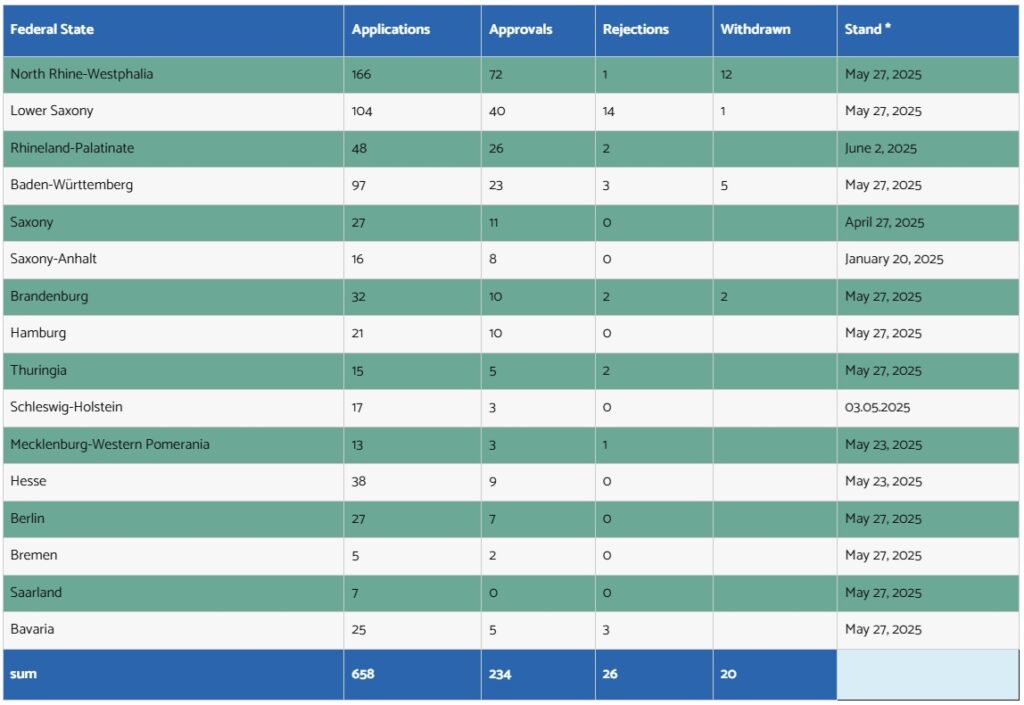
According to the most recent statistics from the Federal Association of Cannabis Cultivation Associations (BCAv), there are now 234 cultivation associations in Germany that have received approval out of 658 applications submitted.

The updated statistic was included in the organization’s most recent newsletter as part of the table below, which provides a breakdown of associations approved by region:

BCAv German cultivation associations approved as of June 13 2025

As you can see from the data listed in the table, North Rhine-Westphalia has issued the most approvals, while Lower Saxony has issued the most rejections. Unfortunately, cultivation association approvals in Bavaria have proven to be a persistent challenge.

“In Bavaria, the licensing process for cannabis clubs remains restrictive. Although more than 200 cultivation associations have already been approved nationwide, the Bavarian State Office for Health and Food Safety has only issued three licenses – including the “CSC Inntal Raubling”“Exotic Kingdom CSC Fulda” and “The Marihuana Club Kirchdorf”according to the FAZ .” BCAv stated.

“The majority of Bavarian applications, however, are still being processed, which is putting financial strain on numerous initiatives or forcing them to abandon them.” BCAv also wrote in its recent newsletter. “Critics accuse the state government of political obstruction. While the number of cannabis offenses in Bavaria has declined significantly, the black market continues to benefit from the lack of legal access.”