Tag: Germany

Adult-Use Sales In Germany May Go Beyond Pharmacy Distribution

Germany is currently home to Europe’s largest legal cannabis industry. Part of that is due to Germany’s population of roughly 83 million people and part of that is also due to Germany being home to the fourth-largest economy on earth.

Another contributing factor is Germany’s approach to medical cannabis policy and the nation’s medical cannabis industry framework. Germany has embraced the medical cannabis industry in ways that most other countries have yet to do, both in Europe and abroad.

Every passing year results in Germany’s medical cannabis industry becoming larger, and that is being accelerated by domestic cannabis production. Initially, Germany imported all of its medical cannabis products which resulted in Germany being the world’s largest importer of medical cannabis (over 9,000 kilograms in 2020 alone).

Germany is no longer the largest importer of medical cannabis. Israel recently took over that title. However, the industry is as strong as ever, and when Germany legalizes cannabis for adult use and launches an adult-use industry in the near future, the nation’s emerging cannabis industry will be enormous.

Hints Of Regulations

Germany’s Federal Justice Minister Marco Buschmann (FDP) recently participated in an interview during which he provided quite a bit of insight into what Germany’s eventual adult-use cannabis industry may look like.

The governing coalition previously indicated a desire to legalize cannabis for adult use, and part of the policy change would include regulations for adult-use sales. Below are additional emerging details via Radio Eins (translated from German):

The goal agreed by the SPD, Greens and FDP in the coalition agreement is clear: “It should be legally possible for adults to buy cannabis in licensed shops,” said the Minister of the German Press Agency. This could be pharmacies, for example, “but we may also continue to draw the circle”. A prerequisite could be a “required expertise of the sales staff”. This would enable the salespeople to “provide information about the products and counteract risky cannabis use, especially in the case of recognizable addicts”.

For him, as Minister of Justice, it is clear: “If there are shops that are legally allowed to sell cannabis, then there must also be producers who are allowed to grow and sell it legally”. Possession must then also be legal for adults up to a maximum limit to be stipulated in the law. And cannabis will be “subject to some form of taxation, like other consumer products”.

Adult-Use Cannabis Taxation

Cannabis taxes were also discussed during the interview, and the Minister indicated that he was not worried about taxation making it harder to compete with the unregulated market.

As long as the taxation is not too burdensome, most consumers will not care about higher prices up to a point. The benefit of being able to go into a fixed location during set business hours to choose from a variety of products in a legal setting is well worth an additional cost within reason.

Removing Cannabis From The German Narcotics Act – Is It A Pipe Dream?

Thailand has just done it, why can’t Germany?

With all the celebratory hoopla that came with the news that Germany would, finally, after experimenting with the medical question during the last four years of the Angela Merkel headed, CDU led government, now move with the new Traffic Light Coalition into the future that includes recreational reform, have now come the inevitable questions.

Namely, for all the excitement, those on the regulatory and legal side of the coin have already been raising red flags about how quickly all of this could move – even if the government does enact formal adult-use legislation next summer or fall.

Namely, cannabis is still listed in the German Narcotics Act. And this still trips up even the CBD industry here. See, if nothing else, the embarrassing police raid on a national grocery store in Munich that may (or even may not) have been selling THC-free, CBD cookies and other “cannabis” products (as advertised by the store themselves) just this year.

However, as Thailand has just proved, this legal doom and gloom may be a bit displaced. See what just happened here. Namely, the government just removed cannabis from their national narcotics act completely.

Is This Realistic in Germany?

There will, no doubt, be a great deal of discussion about how to proceed with a recreational market while preserving the status of cannabis (even the flower) as a medical substance. 

Here is the difference between how things are proceeding in Germany vs. Thailand. The first is that in Thailand, the government has allowed a waiver of GMP standards for medical cannabis if it is grown domestically. Local farmers are allowed to deliver plants directly to hospitals.

This seems highly unlikely aus Deutschland, home of the modern pharmaceutical industry (along with the U.S.), birthed in the 1930s. 

However, one should not entirely count this kind of development out. Indeed, just over DACH border, in Switzerland, authorities are (sort of) doing the same thing as the Thai government with the advent of their own recreational trial. Namely, they are also waiving both EU GMP and Novel Food regulation on early-stage, trial products for adult use market products. 

These, however, in turn, will first be distributed via pharmacies, which themselves are under strict national and international regulatory rules, even if Switzerland is outside of the EU.

Beyond this, the Czech Republic also seems to be going a similar route. So, the idea the Thai government is now implementing is not unknown here.

That said, given the amount of money the government itself stands to make from recreational licensing, it is unlikely. And many questions remain about how the Germans will in fact proceed. It is also unlikely that the plant will be removed from the Narcotics Act completely, but rather provisions made for its use in both medical and non-medical situations, the latter of which could easily resemble the alcohol industry. Then again, this being the cannabis industry, it is impossible to predict what the path will actually be, even after the establishment of the market itself at least on the federal regulatory level.

Be sure to book your tickets early to the International Cannabis Business Conference when it returns to Berlin in the summer of 2022!

Relative Majority Favors Legalizing Cannabis In Germany For The First Time

Cannabis reform has more momentum on the European continent right now than ever before since the start of prohibition, and Germany is at the heart of it.

Medical cannabis is already legal in Germany, and legal sales have been underway for a handful of years now. Every passing year sees a new record set for German medical cannabis sales.

A new type of reform, adult-use legalization, is on the horizon in Germany, with the new coalition government has expressed a desire to legalize cannabis for all adults in the near future.

When news of the legalization plan surfaced it instantly took over the international news cycle, beyond just cannabis news, and that didn’t come as any surprise to long-time cannabis policy observers.

Support For Legalization Is Strong

Many polls have been conducted over the course of several years in Germany to try to gauge public support for full cannabis legalization.

While some of those polls showed strong support for legalization, they almost entirely relied upon online methods for people to participate in the polls.

That methodology is very hard to rely upon and is largely why polling results out of Germany were all over the board, with many polls showing overwhelming support and other polls showing the exact opposite depending on which outlet/entity was conducting the online poll.

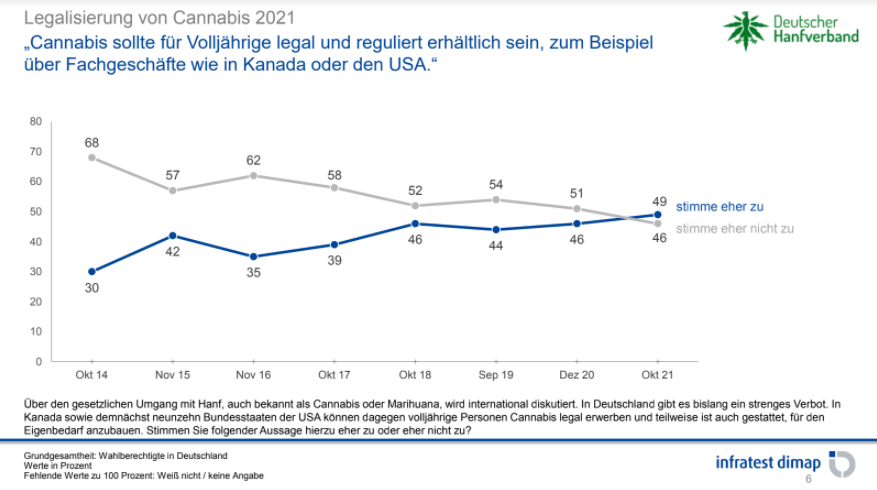
Deutscher Hanfverband recently conducted a poll in conjunction with an established, well-known institute that incorporated both telephone and online polling. 

The poll was part of a similar annual survey, which is an important distinction compared to other polls because it provides tremendous insight regarding shifting views in Germany regarding adult-use legalization.

As you can see from the chart below, provided by Deutscher Hanfverband, support for legalization is now at 49%, which is greater than support for keeping prohibition in place. This is a first for Germany:

Germany Cannabis Legalization Poll

“There is no majority in the population in favor of banning cannabis. For more than 200,000 criminal proceedings per year, not only is there a lack of scientific basis, but also democratic legitimation. It’s time for legalization.” stated Georg Wurth, spokesman for the German Hemp Association.

The Most Significant Legalization Domino So Far

As of this article’s posting, there are only two countries that have legalized cannabis for adult use – Uruguay in 2013 and Canada in 2018.

A laundry list of countries has indicated that they plan to make a major push for legalization in 2022, including Germany.

Malta appears to be on the verge of legalizing cannabis for adult use for cultivation and possession purposes, with the final passage and the president’s signature expected to happen this week. 

If that happens, Malta would become the first country to legalize cannabis for adult use in Europe, and the third country to do so on the planet.

With that being said, legalization in Germany would be a bigger deal from political momentum and emerging cannabis industry standpoints compared to Uruguay, Canada, and Malta combined.

Germany has a population of over 80 million people and is home to the fourth-largest economy on planet earth. By comparison, Canada, Uruguay, and Malta only have a combined population of roughly half that of Germany, and those nations do not wield nearly as much political power as Germany on the international level.

Whereas Malta, and reportedly also Luxembourg, plans on only legalizing cannabis cultivation and possession for adults, Germany is planning on implementing a robust, regulated adult-use industry nationwide.

Given Germany’s place in the political and industry arenas in Europe and throughout the rest of the world, legalization there will be more significant than can be expressed in words, and according to recent polling, it’s a move supported by more Germans than not for the first time in history.

German Coalition Government In Waiting Sends Positive Signal On Recreational Cannabis Reform

The news that the so-called “traffic light” coalition had decided to work together on some kind of recreational cannabis reform is a positive step – but there are many details along the way to be done and dusted.

Last week, the news that the pending coalition government in waiting had come to an agreement on changing German cannabis policy spread, virally, within hours, first from German-language sites to English ones – and from cannabis specialty blogs to mainstream news.

The announcement, no matter how many details remain to be ironed out, is in fact, big news. It signals that the coalition government of the SPD, the Greens and the FDP will prioritize legislation as early as next year to start to tackle the entire recreational cannabis conversation. While the police have recently come out against recreational reform, just on a safety front, the green tide has turned here, and everyone knows it. Further it is a relatively easy lay-up win for a new government which is looking for ways to work together and gain points with an electorate that just voted the CDU out of power for the first time since the end of WWII.

That said, the devil is in the details – and this being Germany, there are a few to think about.

By far, the most important issue is how to redefine cannabis legally – and further to carve out medical versus recreational use starting with the German Narcotics Act. And that is daunting.

Here is why. Cannabis is listed as a narcotic in the Act. This is already problematic as Germany is now out of step with current EU thinking on at least CBD (namely that it is not a narcotic). However, CBD is the least of the problems here. THC is, when used medically, technically a “narcotic” – and further one that fits neatly, and pharmacologically, in the medicine cabinet of definitions that include major pain drugs, starting with opioids. “Legalizing” this as a recreational substance will take some legal eagling and wordsmithing to figure out a new kind of definition for cannabis under German (as well as EU) law. This is particularly challenging when, at an international level at least, cannabis is still defined as a Schedule I drug.

The push towards compromise is also happening at a time when the rumours are that the European Commission may yet rescind its ruling that CBD is not a narcotic.

Given the political winds, it is unlikely that the new coalition, once it formally agrees to work together and takes power in early next year, as widely expected, will backtrack on its promises. But it is also very likely that what may emerge is clear decriminalization and a deliberately small, limited and highly expensive to access market – at least at first. There is precedent. See the German bid.

But then again, see the German bid – which left German firms out of the first iteration of the same. There is hope at least that German politicians might have learned something so far – if not from other countries than the first medical tender.

It is for this very reason that no matter how messy the first iteration of recreational reform is likely to be, that it will change the conversation here and in a meaningful way – not only in Germany but across Europe. And that is significant, indeed.

Book your booths now as the International Cannabis Business Conference begins to gear up for next year’s conferences in Barcelona, Berlin, and Zurich!

Just How Much Would The German Recreational Market Be “Worth?”

A new study by the Institute for Competition Economics at the University of Düsseldorf estimates that the German recreational market could be worth 4.7 billion euros – but what is all this estimating based on?

A new study by the University of Düsseldorf has estimated that legalizing cannabis could bring in as much as 4.7 billion euros a year to the German economy. In Germany, this includes not only the size of the market but the impact on tax revenues, social security contributions from the legalized business, and savings to the police and justice system. The study estimated that 1.8 billion euros of this amount would in fact flow directly into the state treasury.

Of course, all of this is just conjecture at this point. However, given the current furore over the possibility of recreational legalization here of late, a study on the potential worth of said industry was bound to get attention.

But what do such estimates really have to do with reality? After all, when it comes to cannabis, German consumers are just like consumers everywhere else. Not to mention an estimate, before the market has even started, anywhere, is just that. However, here are some contributing factors to consider (beyond the nitty-gritty of getting there).

Size Matters

Here is one way to think about the potential market here. Colorado’s population is just over 5 million and the recreational market there tops $10 billion as of this year (in real-time). Germany has a population of 80 million. It does not take a huge imagination to figure out that Deutschland may turn out to be the EU’s most valuable recreational market, beyond its medical one.

There are a couple of differences to consider right off the bat of course. The first is that there is a real medical market here – and unlike in Colorado, health insurance does cover medical cannabis. Indeed, there are about 100,000 patients in the German system. That number is also going to increase over time – potentially to as much as 10% of the entire population.

What happens beyond that – in other words, a purchase of cannabis without a doctor’s prescription – is literally the great unknown. It is also established that consumers begin to use not only fewer illicit and prescription drugs but drink far less alcohol when cannabis is legal (at least in legalizing states and countries to date). In Germany, this is potentially a huge market – limited at this point by legalization and imagination. Culturally, Germans are ready for something new – particularly a plant they are hearing a great deal more about of late.

Beyond speculation, in other words, however, one thing is very clear. Germans are getting ready for some kind of recreational cannabis reform. And that is pretty massive.

Be sure to stay abreast of breaking European and global cannabis news and developments by following the International Cannabis Business Conference blog!

Why Looming Cannabis Legalization In Germany Is A Very Big Deal

News broke today that an agreement has been struck in Germany to legalize cannabis for adult use and to create a regulated adult-use cannabis industry framework.

Momentum for adult-use legalization in Germany was picking up steam leading up to the last election, which was discussed at length at our last conference in Berlin where we hosted <a href=”https://www.youtube.com/watch?v=8dg-SYV6WmE&amp;t=18s”target=”_blank”>a historic bipartisan discussion about cannabis policy in Germany</a> featuring panelists representing all major political parties in Germany.

Members of the incoming governing coalition comprised of the Social Democratic Party of Germany (SPD), the Free Democratic Party (FDP), and the Greens are reportedly introducing the measure in the upcoming session. Per&#160;<a href=”https://www.spiegel.de/politik/deutschland/ampel-parteien-einigen-sich-auf-legalisierung-von-cannabis-a-216b328b-5746-4eb8-afe6-034ea7a05269″target=”_blank”><em>Spiegel</em></a> (translated from German):
<blockquote><span>According to SPIEGEL information, the traffic light parties want&#160;to legalize&#160;the sale of&#160;</span><a href=”https://www.spiegel.de/thema/cannabis/” data-link-flag=”spon”><span>cannabis</span></a><span>&#160;for consumption purposes.&#160;The coalition working group on health and care agreed on this, as the Funke media group first reported.&#160;”We are introducing the controlled distribution of cannabis to adults for pleasure purposes in licensed shops,”&#160;stated&#160;the negotiators of the&#160;</span><a href=”https://www.spiegel.de/thema/spd/” data-link-flag=”spon”><span>SPD</span></a><span>&#160;, Greens and&#160;</span><a href=”https://www.spiegel.de/thema/fdp/” data-link-flag=”spon”><span>FDP</span></a><span>&#160;in the result paper of the relevant working group.&#160;This controls the quality, prevents the transfer of contaminated substances and guarantees the protection of minors.</span>

<span>According to the report, the relevant law is to be evaluated after four years with a view to its social impact.&#160;So far, the sale of cannabis for consumption purposes has been&#160;banned&#160;in&#160;</span><a href=”https://www.spiegel.de/thema/deutschland/” data-link-flag=”spon”><span>Germany</span></a><span>&#160;.&#160;The Greens and FDP have long been in favor of legal, regulated trade in cannabis.</span></blockquote>
It is significant when any nation moves towards cannabis legalization and away from prohibition. However, Germany is a particularly large domino to fall.

As of right now, only two countries have legalized cannabis for adult use – Uruguay and Canada. A number of countries are moving towards legalization, including Luxembourg which recently announced plans to legalize in 2022.

Switzerland allows low-THC cannabis products to be bought and sold, and court decisions in South Africa, Italy, and Mexico have created quasi-legalization.

Unless another country beats it to it, Germany would be the third country to comprehensively legalize cannabis for adult use, would be only the second G-7 nation to do so, and the first on the European continent to do so.

In the grand scheme of things, legalization in Germany is a much bigger deal compared to Uruguay and Canada because of the economics involved as well as the ripple effect that it will presumably create.

Germany has a population of roughly 83 million people, which dwarfs the populations of Canada (38 million) and Uruguay (3.5 million) combined. Whereas <a href=”https://worldpopulationreview.com/countries/countries-by-gdp”target=”_blank”>Germany</a> is home to the fourth-largest economy on earth, Canada’s economy is ranked 10th and Uruguay is ranked 80th.

Legalization in Uruguay was historic because it was the first country to legalize, and Canada was also historic in its own right for being the first G-7 nation to legalize. However, the global effect from Germany legalizing will almost certainly prove to be more significant.

Germany has long held a significant amount of political influence in Europe and beyond. It is also a major international hub for technological and industrial innovation.

If Germany beats all of its neighbors to adult-use legalization and becomes an adult-use oasis, the profit potential could be enormous. A recent study shed some light on what types of numbers can be expected. Below are excerpts about the study, via <a href=”https://www.reuters.com/world/europe/pot-gold-cannabis-could-bring-germany-5-billion-year-survey-2021-11-16/” target=”_blank” rel=”noopener”><em>Reuters</em></a>:
<blockquote>Legalising cannabis could bring Germany annual tax revenues and cost savings of about 4.7 billion euros ($5.34 billion) and create 27,000 new jobs, a survey said on Tuesday as politicians thrash out rules for the budding sector.

The survey by the Institute for Competition Economics (DICE) at the Heinrich Heine University in Duesseldorf, and commissioned by the German hemp association, found that legalising cannabis could lead to additional tax revenues of about 3.4 billion euros per year.

At the same time, it could bring cost savings in the police and judicial system of 1.3 billion euros per year while creating tens of thousands of jobs in the cannabis economy.</blockquote>
Legalization in Germany is still a work in progress, being that an actual law has not taken effect yet. With that being said, legalization does appear to be inevitable in Germany, and in the meantime, the eyes of the entire cannabis community will be locked on the European country.

How Much Public Revenue Would Cannabis Legalization Generate In Germany?

Germany is home to the largest legal medical cannabis market on the European continent. That is not surprising considering that Germany is home to the fourth-largest economy on the planet behind only the United States, China, and Japan.

Until recently, Germany imported more medical cannabis products than any other country and it was only recently that the country was passed on that front by Israel.

Part of that is due to the rise of domestic production in Germany and it’s also partly due to ongoing issues in Israel that have resulted in a spike in their medical cannabis imports.

It’s likely a safe bet that adult-use legalization in Germany would be huge. Germany is a massive domino and when it falls, the public policy repercussions will be felt throughout Europe and beyond.

A lingering question regarding adult-use legalization in Germany is how much money would such a public policy change yield for public coffers in Germany?

A recent study provides an answer to that very question. Excerpts about the study below, via Reuters:

Legalising cannabis could bring Germany annual tax revenues and cost savings of about 4.7 billion euros ($5.34 billion) and create 27,000 new jobs, a survey said on Tuesday as politicians thrash out rules for the budding sector.

The survey by the Institute for Competition Economics (DICE) at the Heinrich Heine University in Duesseldorf, and commissioned by the German hemp association, found that legalising cannabis could lead to additional tax revenues of about 3.4 billion euros per year.

At the same time, it could bring cost savings in the police and judicial system of 1.3 billion euros per year while creating tens of thousands of jobs in the cannabis economy.

Those numbers are very encouraging, and lead to the next logical question – when will Germany legalize cannabis for adult use? Germany legalized cannabis for medical use in 2017.

Earlier this month Bloomberg broke the news that a legalization coalition in Germany is gaining momentum and that the drafting of a strong legalization measure is nearing completion. Per Bloomberg:

Germany’s likely next ruling coalition is closing in on a deal to legalize cannabis for recreational use, the strongest signal yet that long-awaited growth of Europe’s marijuana market is gaining traction.

Negotiators for the Social Democrats, Greens and pro-business Free Democrats are hammering out the details, including conditions under which the sale and use of recreational cannabis would be allowed and regulated, according to people familiar with the talks, who asked not to be identified because the discussions are private.

At this point, it’s not a question of if Germany will legalize cannabis for adult use, it’s a question of when. Whether this latest measure passes or not, some type of legalization measure is going to pass sooner rather than later in Germany.

Luxembourg has already announced plans to legalize cannabis for adult use in 2022, and Italy also appears to be on a path to legalization in the near future. Countries like Switzerland and the Netherlands have adult-use pilot programs ramping up.

It’s very unlikely that lawmakers in Germany are going to sit by and see other countries reap the benefits of legalization. As we now know from the study cited in this article, there’s way too much money being wasted on prohibition and too much potential profit potential to keep prohibition in place.

The excitement in Germany is enormous, and support for cannabis reform and the emerging cannabis industry grows every day throughout Europe. Join us in Berlin in July 2022 at our flagship conference to get in on the action.

Our conference in Berlin is the largest cannabis industry B2B event on the European continent and the July 2022 conference is going to be the one biggest yet. To find out more info click here.

Potential Legalization In Germany – The Hopeful Response From The Cannabis Industry

By Brautinvest.de Editorial Team

How do Germany’s industry leaders view a potential cannabis legalization? We asked around: In overall, the founders and CEOs of successful cannabis companies are hoping for growth opportunities, more control and thus better prevention than on the black market. They point to tax revenues and falling costs for the public budget. At the same time, they discuss the concrete design: Distribution through specialized stores or pharmacies? Cultivation in Germany or imports? And in view of the half-roll backward in Luxembourg – where only home cultivation is legalized – they also point out that nothing is yet set in stone. Critical voices are also being heard: Cannabis is more of a pharmaceutical product, not one for consumption. We were on the hunt for statements.

Growth market, tax revenues and relief for the state budget

Timo Bongartz, General Manager Fluence: “In Germany, we already have a strong ecosystem of companies that can successfully implement cannabis legalization in a structured way. Whether startup or corporation, whether industry, trade or capital provider, the market participants are ready. Now it’s a matter of sounding out politically and socially whether and how to go down the legalization path.”

Niklas Kouparanis, Co-Founder and CEO of Bloomwell Group: “Legalization is clearly on the horizon, even if cannabis will certainly not be legalized overnight in Germany. After all, it is one of the few issues on which all coalition partners are largely in agreement. The crux is the concrete, regulatory demanding, design – I strongly assume a future recreational sale through pharmacies. Product safety for the consumer must be the top priority here. Remind you, in the event of legalization in Germany, we are talking about the largest legal market in the world to date. From a business perspective, it would be negligent not to develop a strategy for this market. ‘The traffic light is green.'”

Benedikt Sons, co-founder and CEO of Cansativa: “Positive! A real growth driver for Germany as a business location: increasing tax revenues and numerous new jobs could boost the German economy. This is accompanied by the relief of the judiciary and authorities through the elimination of petty cannabis-related offenses – these not only swallow up time and paper, but also cost the state an enormous amount of money. From our point of view, the topic of cannabis will soon be socially acceptable, is gaining more and more support, and the task now is to create good conditions for a successful legal cannabis program with the right regulatory framework. Nevertheless, cannabis is not a product without concerns and it is important that dispensing takes place under certain conditions in order to reduce risks of abuse and, in particular, to protect vulnerable people or educate them about dangers.”

Lars Müller, CEO of Synbiotic: “The new government in Germany now gives us additional tailwind once again. The details are not yet known, but we expect a significant step forward in terms of legalization and commercialization.”

Ensuring individual and entrepreneurial freedom

Kai-Friedrich Niermann, lawyer and industry consultant: “The legalization of cannabis is overdue. A new cannabis policy is essential for the state and societal modernization that the new government is announcing. Individual personal freedom and corporate economic freedom of operation, embedded in a well-regulated framework of social responsibility, must be strengthened and failed government repressive policies replaced.”

Controlled dispensing instead of black market excesses

Finn Age Hänsel, founder Sanity Group: “Of course, a lot depends on the regulatory design of the dispensary, but in general I have been fighting for a liberalization of cannabis use for more than 20 years and I am happy to see something moving in politics now. Controlled dispensing and proper regulation solves more problems than continuing to accept the excesses of a growing black market. And by the way a cannabis tax also to plug Corona-related holes in the federal budget without burdening anyone more.”

Tobias Pietsch, owner: “Cannabis legalization is socially indispensable. We will be able to improve many of the problems that have arisen.”

Dr. Adrian Fischer, physician and natural scientist, co-founder and managing director of Demecan: “Instead of blanket legalization, smart deregulation is needed. This includes education and the protection of minors. In addition, there needs to be strict quality controls on cultivation and production, e.g. by the already existing German cannabis agency, which also controls medical cannabis, and a restriction of production to certified producers, ideally from Germany. Of course, cannabis as a stimulant is also a potential billion-dollar market that promises tax revenues and jobs. And in addition, law enforcement agencies and courts could be relieved. However, it is clear that legalization will also have to answer questions such as how to compensate for the actual risks that the healthcare system would face. Or where consumers should obtain cannabis. In licensed specialist stores or in pharmacies that have been dispensing cannabis as a medicine since 2017? One thing is certain: Pharmacists already have the relevant knowledge about the active ingredients, and can assess dose and purity. Because in the end, the goal must be to give citizens access to a controlled, high-quality product and protect them from dangerous goods from the black market.”

Regulatory challenge

Stephen Murphy, CEO & Co-Founder Prohibition Partners: “I do believe the legalisation will proceed in Germany, but both developing and executing the framework will take some time. This is a public health exercise and not an economic one by the government so it will require a more considered approach which is to say that the supply chain won’t vary too much from current expected standards. I’d place a (small) bet on Germany going legal before the US!

Coordination at the European level

Daniel Kruse, entrepreneur and EIHA President: “EIHA welcomes cannabis legalization in Germany, which will provide another boost to the European hemp industry and help end decades of hemp stigma. However, we urge the German government to closely coordinate the new legal framework with its European partners and to advocate for a harmonized commercial hemp and cannabis strategy across Europe. In addition, legalization must be designed to be as socially responsible and fair as possible, including in terms of youth protection, prevention and participation in road traffic.”

More than home cultivation – skepticism remains

Alfredo Pascual, Vice-President of Investment Analysis at Seed Innovations: “It’s still too early to know with certainty when and how adult-use cannabis will be legalized in Germany.

In neighboring Luxembourg, the government promised full-blown legalization in its 2018 Koalitionsvertrag, yet three years later it looks like they will settle on only allowing to grow a few plants at home for personal use, which is a step in the right direction but far from ideal.

I hope that if German policymakers in the new government agree that cannabis should be legalized, that they will have the courage to go beyond what their peers in Luxembourg did.”

Cannabis is a pharmaceutical product

Linus M. Weber – Founder & M.D.: “Cannabis is a legal pharmaceutical product and we need to enforce that more broadly in Germany so that more patients can be treated. For this, legalization as a stimulant is not conducive, but pushes potential prescribers and patients back again. In my opinion, the only right way is to continue to offer cannabis only pharmaceutically. However, whether it must continue to be prescribed or whether products with low THC content can also be made available in pharmacies without a prescription should be examined in detail.”

This article was first published on krautinvest.de in German: https://krautinvest.de/potenzielle-legalisierung-das-hoffnungsvolle-echo-aus-der-cannabis-industrie/

“Trivializing The Joint?” German Police Unions Speak Out Against More Legalization

Head of Police Union speaks out against recreational reform as coalition talks for new government continue with parties in favour of forward progress on cannabis issues

In a clear clash of values as well as a sign that German politics are changing, the head of the country’s police union, GdP, Oliver Malchow, spoke out against the further legalization of cannabis. The police are mostly concerned with road accidents and are comparing recreational cannabis’ intoxication impact to that of alcohol.

Such remarks come at a time when the Social Democrats (SDP), the Greens and the Free Democrats (FDP) are caucusing in discussions about ruling the country in a coalition government – and further all parties are clear that they want more cannabis reform.

The FDP for example is very excited about the tax revenue the legal cannabis industry could create. The Greens want to eliminate the black market and reduce organized crime. The least pro-cannabis reform group, the SPD has at least called for a recreational trial.

Something green is going down in Deutschland. The question is when and in what form.

A National Recreational Trial

There are several theories that are highly popular in the cannabis industry. One is that the new coalition, when it finally forms, will at least agree on decriminalization. Beyond this, however, the roadmap is not so clear, even with recreational reform now on the docket in Europe.

Several countries – including Portugal and Luxembourg, are now discussing how to legally implement recreational markets in an environment, regionally, where cannabis is still considered a Schedule I drug (even if its component cannabinoids are slowly being defined otherwise). Indeed, some of the opposition in Luxembourg against the implementation of a recreational market is the fear of “unrest” on the country’s borders with the rest of Europe. Namely, cannatourists from other places, starting with Deutschland.

Whatever happens in Germany, however, will clearly affect the discussion across such countries if not others in the EU region.

What Is Possible Beyond Decriminalization?

There are several options. The world is not where it was on cannabis issues even four years ago – the year of the German bid. Countries all over Europe (see Malta and Italy for starters) are beginning to accept home grow legislatively.

The most likely options -  beyond decrim for that reason, are recreational trials in major cities and some kind of amended home grow option.

One thing is also for sure. The German police will be on the hunt for state-of-the-art cannabis breathalysers used in legalizing US states. 

To keep up to date on emerging market cannabis news and events, be sure to stay tuned to the International Cannabis Business Conference blog.