Tag: Germany

LEAP Germany Calls For Expanding Legal Options For Obtaining Cannabis

The organization Law Enforcement Against Prohibition (LEAP) originated in the United States, where it has been highly effective in advocating for sensible cannabis reform. LEAP is made up of current and former members of law enforcement who recognize that cannabis prohibition is harmful and a failed public policy, and that regulation is a better approach.

LEAP has expanded internationally and launched chapters in other countries, including Germany, where leadership recently issued a public letter addressed to the nation’s new Federal Government Commissioner for Addiction and Drugs, Hendrik Streeck. Below is LEAP Germany’s letter (translated from German to English):

Dear Mr. Streeck,

on behalf of the entire board of LEAP Germany, I, along with many others, congratulate you on your appointment as the new Federal Government Commissioner for Addiction and Drugs and wish you every success and every success in this role. We would be delighted to continue the constructive and trusting collaboration we began with your predecessor in shaping addiction and drug policy in Germany.

LEAP Germany is a non-profit association founded in 2015 that recruits its members primarily from law enforcement agencies, the criminal justice system, and the criminal justice system.

With this professional background, we advocate for an evidence-based addiction and drug policy that recognizes that prosecuting drug users is the wrong approach to adequately protect the health of this group of people. There is broad consensus among experts that drug policy based on prohibition
has completely failed in terms of its own objectives. In particular, the general preventive effect intended by criminal prosecution has not been achieved, according to all available figures and findings.

The Consumption Cannabis Act, which came into force on April 1, 2024, and the further development of the use of cannabis for medicinal purposes were a first, albeit insufficient, step towards a
scientifically sound drug policy. As LEAP Germany, we had numerous opportunities to contribute our professional expertise during this legislative process. In just the first nine months, this law resulted in more than 110,000 fewer police investigations being initiated by the police nationwide than in the previous year, according to the police crime statistics. 110,000 fewer suspects and thus those affected by stigmatization – a true success.

Much remains to be done, not only with regard to the upcoming evaluation of the Consumption Cannabis Act. As law enforcement officials, we have a strong interest in significantly expanding the options for legally obtaining cannabis for consumers. Effectively reducing the black market in a context of continued high demand is urgently needed for criminological and health policy reasons.

We would be happy to discuss these and other issues with you, Mr. Streeck, in due course. Since you have advocated for an evidence-based addiction and drug policy without a warning finger in your initial public statements, we see a good basis for professional exchange. We would be pleased to receive an invitation to your office in Berlin.

Sincerely,

Hubert Wimber for the board of LEAP Germany

German Lawmaker: Raising THC Limit For CBD Flowers Is “A Sensible Step”

As governments and courts around the world seem to continue to struggle with policies and regulations pertaining to hemp-derived cannabidiol (CBD) products, especially ‘cannabis light’ flowers, one lawmaker in Germany recently expressed her support for raising the THC limit for CBD flowers in her country.

Carmen Wegge is a German politician from the Social Democratic Party (SDP). Ms. Wegge has served as a member of the Bundestag since 2021. She was recently asked a question about Germany’s THC limit for CBD flowers on the platform Abgeordnetenwatch.

“What is the current position of the federal government on CBD flowers with tax stamps?” asked Johannes H. “Furthermore, the question arises as to whether an increase in the maximum permitted THC content in CBD flowers to 1% is being considered – as is already the practice in Switzerland and Italy.”

The individual posing the questions pointed out that “around 95% of the natural CBD flowers” being sold in Germany originate from Switzerland or Italy, and that increasing the THC limit for CBD flowers in Germany “would make sense both from a health policy and economic perspective.”

Late last month, a company in Germany (Sanaleo) received the nation’s first-ever tax stamp from the General Customs Directorate of Neustadt an der Weinstraße for its THC-free flowers. Sanaleo’s CBD flower products are now subject to Germany’s tobacco tax in addition to the 19% VAT. However, it remains to be seen what impact the tax stamp issuance will have on the wider CBD flower sector.

Germany implemented the first provisions of its CanG adult-use legalization law on April 1st, 2024, which permits the nation’s adults to cultivate, possess, and consume cannabis flowers with no THC limit. However, CBD flowers remain popular in the European country.

“Personally, I consider the scientifically justified increase in the permissible THC content in industrial hemp products – including CBD flowers – to 1% to be a sensible step. The example of Switzerland shows that such a limit is possible without creating a significant potential for abuse. The EU Commission has also already decided to increase the permissible THC content for industrial hemp grown in the field from 0.2% to 0.3% – which was a first small step in the right direction.” Ms. Wegge stated in her response to the inquiry (translated from German to English).

“I believe legally secure and health-oriented regulation for CBD products is urgently needed. This includes a discussion about raising the THC limit for industrial hemp if scientific findings show that this does not pose an increased potential for abuse. Such an adjustment could not only create legal clarity but also strengthen the domestic economy and facilitate imports – without compromising consumer safety. I will therefore continue to advocate in parliament for a coherent, fact-based, and Europe-compatible hemp policy in Germany.” Carmen Wegge concluded.

(The featured image of this article of Bundestag member Carmen Wegge is a photo by Anna Voelske.)

Discussing Advanced Cannabis Cultivation Technologies

Advanced cannabis cultivation has come a long way in recent years. Humans have cultivated the cannabis plant for centuries. However, much of it was outdoors under the sun without the use of technology.

In recent decades, cannabis cultivators have produced crops indoors or in greenhouses at an increasing rate, largely out of necessity due to global prohibition policies. The rise of the legal cannabis industry has been paralleled by an increased use of cultivation technology, as well as advances in that technology. It is truly exciting times for the legal cannabis cultivation sector.

Long gone are the days of simply yielding a cannabis harvest. Successful cultivation is more methodical than ever, with commercial cultivators having to produce harvests at scale in a cost-effective manner, all while being mindful of yielding crops that are compliant with market regulations and capable of being used in an ever-expanding list of end products for patients and consumers.

At the recent International Cannabis Business Conference in Berlin, a panel moderated by Quinn Shiskin, President of McIntyre Creek Cannabis Inc., discussed advanced cannabis cultivation technologies. Mr. Shiskin was joined by:

  • Franz Josef Sima, Horticulture Service Specialist in the EMEA Region for Fluence
  • Albert Eppinga, Entrepreneur and Philanthropist, Founder of BC Cann
  • Max Majot, Technical Manager and Cultivation Expert at Royal Queen Seeds
  • Rui Soares, Founder and CEO of Paralab
  • Mikhail Sagal, President of TSRgrow

Technological innovation is reshaping cannabis cultivation, from automated systems to AI-driven analytics. This panel explored how tech solutions can boost yields, improve quality, and reduce costs. Panelists also discussed modern ways of energy storage, innovations in cultivation lighting, and high-efficiency cannabis cultivation techniques. You can watch the panel at this link here.

German Survey: 70% In Favor Of Prescribing Cannabis Via Online Questionnaire

Germany’s medical cannabis industry is booming, thanks in large part to the rise of telemedicine. Telemedicine involves a potential medical cannabis patient using an online platform to seek approval for medical cannabis rather than going to a physical doctor’s office. It is a more convenient option for many patients, particularly those in rural areas and/or individuals with mobility issues.

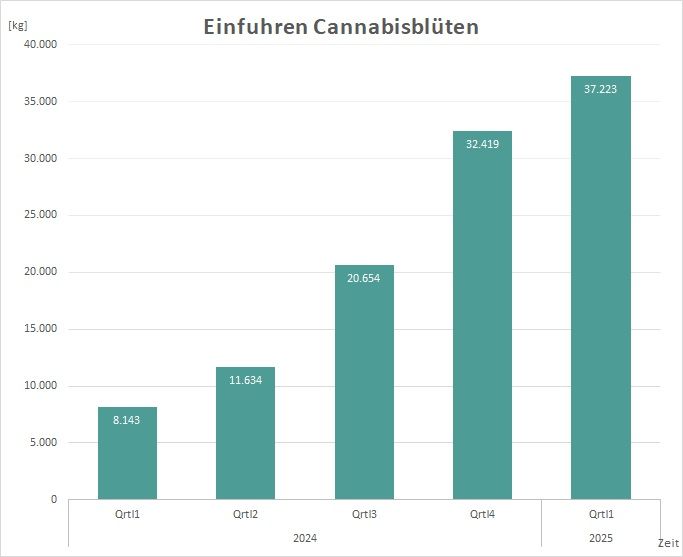
Recent medical cannabis product import data demonstrates how fast Germany’s medical cannabis industry is growing. In the first quarter of 2025, Germany imported over 37.223 metric tonnes of medical cannabis products, a 457% increase compared to the same period from the prior year.

Medical cannabis telemedicine has become a popular target for lawmakers in Germany who are opposed to modernized medical cannabis policies, with many of those lawmakers expressing a desire to abolish the concept.

The German Cannabis Business Association (BvCW) recently conducted a survey asking, “What is your opinion on the possibility of obtaining prescription drugs by completing an online questionnaire?” The survey was conducted from May 26, 2025, to June 2, 2025.

“The majority of respondents support the option of obtaining prescription drugs via an online questionnaire. The survey responses were as follows: 49% support this procedure for both cannabis and other prescription drugs. 21% support it exclusively for cannabis.” BvCW stated in its recent newsletter (translated from German to English).

“Overall, 70% are in favor of prescribing cannabis via online questionnaire. 9% expressed a partly positive, partly critical attitude. 16% reject the approach in principle – regardless of the drug. 2.5% either rejected it only for cannabis or were undecided. No one expressed support exclusively for other drugs.” BvCW also wrote.

The survey was conducted following a major court decision in Germany, in which the North Rhine Chamber of Pharmacists successfully pursued a lawsuit in the Cologne Regional Court against a pharmacist who worked with a telemedicine platform.

“The AKNR considers the entire business model in this form to be illegal and has issued a warning to a pharmacist whom it believes to be the operator of the platform, a claim he denies. Among other things, the chamber sees this as impermissible advertising for remote treatment: According to Section 9 of the German Medicines Advertising Act (HWG), advertising for such treatment is only permitted in exceptional cases if, according to generally accepted professional standards, personal contact with the patient being treated is not necessary.” reported Pharmazeutische Zeitung in its local coverage (translated from German to English).

“However, the questionnaire is not a communication medium, and remote treatment is ruled out for the prescription of medical cannabis anyway, as it does not meet recognized professional standards.” the outlet also reported.

Germany’s Federal Health Minister Nina Warken (CDU) previously indicated that she intends to restrict online medical cannabis prescriptions, but as BvCW pointed out in their newsletter, “whether providers based abroad can be effectively stopped remains open.”

Exploring Global Cannabis Industry Horizons

The emerging legal cannabis industry continues to be the most exciting space for entrepreneurs and investors around the world. Every passing year seems to result in new markets either launching or new jurisdictions being approved for some form of cannabis commerce, adding to the industry’s economic potential.

At the recent International Cannabis Business Conference in Berlin, leading international cannabis economist Beau Whitney, founder of Whitney Economics, estimated that the potential global medical and adult-use cannabis market is roughly $237.8 billion, in addition to his projected value of the global industrial hemp industry of $456.2 billion.

For many years, the emerging legal cannabis industry was a network of siloed markets, each operating only within its own borders. However, that has changed in recent years with the industry experiencing a larger volume of international legal imports and exports.

Germany is arguably the best example of this, with the legal industry having imported over 37.223 metric tonnes of medical cannabis products in just the first quarter of 2025 alone. To put that figure into perspective, the total imports for Q1 2025 increased by roughly 14.8% compared to the Q4 2024 total (32.419 metric tonnes), which was itself a record at the time.

Q1 2025’s import total in Germany is an increase of over 457% compared to the same period one year ago. Germany imported 8.143 metric tonnes of medical cannabis products in Q1 2024. Other nations are also importing larger amounts of legal cannabis products, and multinational cannabis companies are becoming more common as time goes by.

Significant regulatory developments in Europe, explosive growth in key global markets, and recent M&A/investment transactions are fueling increased investor interest in global cannabis. As investors enter/re-enter the space, their expectations are increasingly more sophisticated, and competition for investment capital remains intense.

A panel of top cannabis investors and operators recently explored new global cannabis industry opportunities at the International Cannabis Business Conference in Berlin. The panel was moderated by leading international consultant Jamie Pearson of New Holland Group. Ms. Pearson was joined by:

  • Raj Grover, Founder, President, and CEO of High Tide Inc
  • Will Muecke, Co-Founder, Chief Investment Officer of Artemis Growth Partners
  • George Bellow, Co-Founder of SOMAÍ Pharmaceuticals
  • David Hyde, Founder and CEO of Hyde Advisory and Investments Inc
  • Margaret Brodie, CEO of Rubicon Organics

You can view the panel discussion in the embedded video below

European Cannabis Pilot Projects

Certain European markets are home to a unique public policy and commerce concept known as pilot trials. These research-based projects permit regional adult-use cannabis commerce at a local level to help lawmakers and regulators gather data and information to be better informed when crafting national laws and industry policies.

Current European Union agreements prohibit national commerce models like what is found in the Western Hemisphere, however, EU agreements do permit recreational commerce projects for public health research purposes. Pilot trials are currently operating in the Netherlands and Switzerland, and soon, trials are expected to launch in Germany.

In the video at this link, you can watch a recent presentation from the International Cannabis Business Conference in Berlin about European cannabis pilots. The panel was moderated by leading cannabis policy expert and attorney Kai-Friedrich Niermann, Founder of KFN+ Law Office. The panel also included:

  • Daniel S. Hübner, Senior Science Manager at the Cannabis Research Lab Humboldt-Universität zu Berlin
  • Finn A. Hänsel, Managing Director and a Founder of Sanity Group
  • Deepak Anand, Principal at ASDA Consultancy Services

Until EU agreements are modernized, cannabis pilot trials will continue to serve as an important legal commerce concept for EU member nations to consider.

Examining Germany’s Evolving Legal Cannabis Industry

Germany continues to be the continental leader for Europe’s emerging legal cannabis industry. Legal sales of medical cannabis products started in Germany in 2017, and the country’s medical sector has since become an international juggernaut and a top market for medical cannabis exports.

In the first quarter of 2025, Germany imported over 37.223 metric tonnes of medical cannabis products. To put that figure into perspective, the total imports for Q1 2025 increased by roughly 14.8% compared to the Q4 2024 total (32.419 metric tonnes), which was itself a record at the time.

Q1 2025’s import total is an increase of over 457% compared to the same period one year ago. Germany imported 8.143 metric tonnes of medical cannabis products in Q1 2024. The updated import numbers bring the total amount of legally imported medical cannabis products to Germany during the last 12 months to 101.9 metric tonnes.

Around 2,500 of Germany’s 17,000 pharmacies now offer medical cannabis. According to the most recent data from the German Federal Association of Cannabis Cultivation Associations (BCAv), a total of 215 cultivation association applications have been approved out of 626 submissions nationwide.

Business is booming in Germany, although the political and regulatory landscape overseeing Germany’s emerging industry continues to evolve. A panel of leading experts from multiple sectors of Germany’s industry recently participated in a discussion about strategies and approaches for adapting to recent changes in Germany, and what industry members should anticipate in the coming years.

The panel was moderated by Dirk Heitepriem, President and Chairman of the German Cannabis Industry Association (BvCW). Mr. Heitepriem was joined by:

  • Lisa Haag, Founder of MJ_Universe
  • Timo Bongartz, CEO of CANNAVIGIA
  • Marijn Roersch van der Hoogte, Co-Founder of Hemp-Impact.com and Co-Founder and VP of BvCW
  • Henry Wieker, Board Member of BvCW and Coordinator of BCAv
  • Sita Schubert, EUMCA’s General Secretary

The discussion, which was held at the International Cannabis Business Conference in Berlin last month, provided valuable insights to help industry members navigate the future of cannabis in Germany. Click here to watch the panel presentation.

German Medical Cannabis Imports Increased Over 457% In One Year

Germany’s legal medical cannabis industry continues to expand at a staggering rate, as demonstrated by new medical cannabis import numbers. In the first quarter of 2025, Germany imported over 37.223 metric tonnes of medical cannabis products.

To put that figure into perspective, the total imports for Q1 2025 increased by roughly 14.8% compared to the Q4 2024 total (32.419 metric tonnes), which was itself a record at the time. Q1 2025’s import total is an increase of over 457% compared to the same period one year ago. Germany imported 8.143 metric tonnes of medical cannabis products in Q1 2024.

Alfredo Pascual, CFA, Executive Director at Seed Innovations Ltd (LON: SEED), posted the updated statistics on his LinkedIn page earlier today:

germany medical cannabis imports q1 2025

The updated import numbers bring the total amount of legally imported medical cannabis products to Germany during the last 12 months to 101.9 metric tonnes. Demand for medical cannabis continues to increase in Germany, with no slowdown currently in sight.

“A conservative projection, assuming Q1 2025 levels persist through Q2-Q4, would result in ~150 tonnes imported for the full year. However, given the consistent strong quarterly growth observed recently, the actual CY 2025 import volume could be significantly higher.” wrote Alfredo Pascual in his social media post.

“The primary downside risk is the ongoing political discussion in Germany regarding potential restrictions on online medical cannabis prescriptions, which could influence patient access and market development.” Pascual also wrote.

Canada remained the top source for imported medical cannabis products to Germany at 16.1 tonnes during Q1 2025. Portugal was the second leading source for medical cannabis imports during that timeframe at 12.1 tonnes, and Denmark was third at 2.6 tonnes.

A Reversal Of German Cannabis Legalization Is “Off The Table”

The German Cannabis Industry Association (BvCW) recently held a parliamentary evening event, at which current German Bundestag member Carmen Wegge appeared and spoke. Ms. Wegge is a German politician of the Social Democratic Party (SDP) who has served in the Bundestag since 2021. At the event, Ms. Wegge reportedly indicated that abolition of the CanG law is “off the table.”

“At yesterday’s parliamentary evening of the German Cannabis Industry Association (BvCW), Carmen Wegge promised those present that the Cannabis Act would not be repealed. In return, she hoped for improvements in the right direction.” wrote Moritz Förster for Krautinvest (translated from German to English).

“Wegge emphasizes that the SPD “tirelessly” defended the Cannabis Act during the coalition negotiations. She also points to the improvements that have already been made, for example, in terms of prevention, economic development, and greater justice.” Förster stated in his original reporting.

Ms. Wegge’s comments are similar to those made by leading German cannabis policy expert attorney Peter Homberg of gunnercooke at the recent International Cannabis Business Conference in Berlin last month.

“Attorney Homberg predicts that the reversal of partial legalization and thus of the previous measures of the traffic light coalition is unlikely. The effort involved in completely reversing the partial legalization of cannabis and reclassifying cannabis as a narcotic is far too great.” reported Pharmazeutische Zeitung about Mr. Homberg’s presentation at the conference in Berlin.

“And of course, you would need a clear majority, not only in Parliament, but also in the Federal Council.” Homberg stated about a potential reversal. “It’s very difficult to put the genie back in the bottle. Who’s going to monitor this now?”

Leading up to the last German federal election, domestic politicians opposed to modernized cannabis policies expressed a strong desire to completely reverse the CanG legalization measure. However, last month, the new governing coalition announced that, at least for the time being, there would be no changes made to Germany’s cannabis policies, and the CanG law would remain in place as is.

Part of the statements made by the governing coalition last month did involve the announcement of future evaluations, which will occur as part of the coalition agreement. The new governing coalition is expected to revisit the topic when the results of ongoing evaluations become available in Q4 2025.

A complete reversal of the German CanG law is not a popular proposal among German voters. A recent YouGov poll found that a minority (38%) of the nation’s citizens support reversing German adult-use cannabis legalization.

Additionally, according to the results of a Forsa survey commissioned by the KKH Kaufmännische Krankenkasse, 55% of surveyed Germans do not want to repeal the nation’s CanG adult-use legalization law. Only 36% of the Forsa survey respondents indicated that they want to repeal legalization, with the rest being undecided.

Various German organizations have also expressed opposition to a CanG reversal. The New Association of Judges (NRV) in Germany previously expressed a positive conclusion regarding legalization and warned newly elected German lawmakers against reversing the CanG law.

“Rolling back the law would mean that the judiciary would have to pursue small consumers on a large scale again. This would mean there would be no time to take action against organized crime.” reported Deutschlandfunk in its local coverage.

“In addition, according to the NRV, the state faces high compensation payments in the event of withdrawal. If the cultivation and consumption of cannabis were to be completely banned again, this would amount to expropriation of the cannabis clubs, it was said. This would enable the clubs to make claims for compensation against the state. The investment in cannabis cultivation is high and the licenses are valid for seven years according to the law.” the outlet also stated.

The Institute for Competition Economics at the Heinrich Heine University in Düsseldorf previously conducted an analysis, finding that adult-use legalization could yield as much as 1.3 billion euros per year in savings for Germany’s police and judicial system.

German pharmacist Florian Sedlmeier and other members of Germany’s pharmacy industry also publicly pushed back on the effort by cannabis opponents in Germany to reclassify cannabis as a narcotic drug in the European nation.

“Pharmacist Florian Sedlmeier warns against reclassifying medicinal cannabis as a narcotic drug (BtM). Such a step would increase the bureaucratic burden and make it more difficult to provide patients with rapid care, ” stated the German Cannabis Business Association (BvCW) in a recent newsletter, citing an article from apotheke-adhoc. “He considers the concern expressed by SPD Health Minister Clemens Hoch that medicinal cannabis can be ordered too easily online to be understandable, but stresses that pharmacies carefully check prescriptions and licenses.”