Tag: Germany

The German Medical Cannabis Industry Is The Main European Market Driver

Germany first legalized medical cannabis in 2017, and its distribution model involves permitting legal sales at registered pharmacies. Germany’s medical cannabis industry has become the largest legal market in Europe, boosting the nation’s pharmacy sector in the process. Since the launch of initial sales, safe access to medical cannabis via Germany’s pharmacies has increased dramatically, as demonstrated by statistics that were included in a recent newsletter by the German Cannabis Business Association (BvCW).

“Patients can order cannabis online with a private prescription and have it delivered to their home. Nationwide, around 2,500 of the 17,000 pharmacies now offer medical cannabis,” BvCW stated (translated from German to English). “The industry’s revenue is now estimated at around half a billion euros.”

A major contributing factor to Germany’s recent medical cannabis industry growth was the enactment of the CanG law in April 2024, which removed cannabis from the nation’s Narcotics List. The rise of telemedicine has also contributed to the medical cannabis industry’s growth in Germany. A recent newsletter by leading international cannabis economist Beau Whitney, founder of Whitney Economics, provides some reliable market data regarding the current estimated number of medical cannabis patients in Germany.

“There has been a consistent number of between 200k – 300k medical patients.” Beau Whitney writes. “As a result of this new innovation, there is now an additional 500k – 600k self-paying consumers participating in the legal market.”

“When combined with 100k cultivation association members, there is approximately 800k legal consumers in the German market right now. For perspective, 800k consumers represents between 10% and 20% of the total market, while the supply and capacity at the end of 2024 represented nearly 15% of all of the supply that the market needs.” Whitney stated.

At the recent International Cannabis Business Conference in Berlin, a team of experts from Germany’s emerging medical cannabis industry examined how the nation’s medical market is the main overall market driver in Europe. The panel was moderated by Canadian medical cannabis pioneer Alex Revich and included:

  • Torsten Greif, CEO, Four 20 Pharma
  • Benedikt Sons, Co-Founder and CEO, Cansativa Group
  • Matthias Fischer, Founder and Managing Director, Canymed, CCO, Grünhorn
  • Dr. rer. nat. Adrian Fischer, Physician and Natural Scientist, Co-Founder and Managing Director, DEMECAN

Click here to watch a video of the panel discussion.

Excitement Level In Berlin Demonstrates Surging Interest In The Global Industry

On April 29th-30th, 2025, the International Cannabis Business Conference held its flagship event at the Estrel Berlin, Germany’s largest hotel and conference center. The event was nothing short of electric, and it was the conference’s biggest and best event to date.

Interest in the emerging global cannabis industry, particularly in Germany and Europe, is experiencing exponential growth right now, and that was evident throughout the two-day conference in Berlin. Roughly 5,000 people attended the conference, with over 80 countries and every major legal market represented. Click here to see an after-movie video of the conference.

One readily apparent fact at the conference was that Europe has now become the top focus of industry members across the world, particularly for industry members wanting to gain a meaningful footprint in Germany’s market. As leading European policy and legal expert Peter Homberg of gunnercooke pointed out in his keynote presentation, imports of medical cannabis products to Germany nearly quadrupled in the last quarter of 2024 compared to the first quarter.

The expansion of Germany’s legal industry in recent years was accelerated in April 2024 with the adoption of the nation’s CanG law, which legalized personal cannabis cultivation, possession, and consumption by adults. The CanG law also permits adult-use cannabis associations to operate, with 211 associations having already received approval.

Arguably, the most significant component of Germany’s CanG law was the removal of cannabis from the nation’s Narcotics List. The declassification of cannabis dramatically improved Germany’s medical cannabis industry. Germany’s medical cannabis patient base is increasing in size with every passing day, as proven by the fact that more than 1 out of every 7 of the nation’s pharmacies now sell medical cannabis products.

A common theme throughout the Berlin conference was the parallels and interplay of the Western Hemisphere’s legal markets and Europe’s emerging markets. What Europe is currently experiencing is reminiscent in various ways of what happened in North America starting in 2012 with the initial adoption of state-level legalization in the U.S. The ‘green rush’ in the U.S. and Canada provides lessons that entrepreneurs, investors, policymakers, and industry service providers in the Eastern Hemisphere can learn from.

Kicking off the conference was a keynote presentation by Charlie Bachtell, CEO and Founder of Cresco Labs. Charlie Bachtell has served as Cresco Labs’ [CSE:CL] Chief Executive Officer since February 2015 after co-founding the company in 2013. Cresco Labs operates in several U.S. markets, and the insight that Mr. Bachtell provided in his presentation was invaluable for attendees.

Following Bachtell’s presentation was a keynote address by gunnercooke’s Peter Homberg. Mr. Homberg examined the current state of Germany’s industry and political landscape, including the fresh announcement of the appointments of incoming German Minister of Health Nina Warken and Federal Ministry of Food and Agriculture Alois Rainer. Both incoming ministers will play a major role in shaping what happens next for Germany’s emerging industry, and with it, the wider European cannabis economy. Mr. Homberg’s thorough presentation on day 1 of the conference in Berlin could not have been more timely.

Another timely presentation was a panel discussion focusing on European pilot projects. Pilot projects are currently operating in the Netherlands and Switzerland and are also part of Germany’s legalization model. The panel was moderated by German policy expert Kai-Friedrich Niermann, Founder of KFN+ Law Office. Joining Mr. Niermann was:

  • Paul-Lukas Good, President, Swiss Cannabis Research Association
  • Daniel S. Hübner, Senior Science Manager, Cannabis Research Lab Humboldt-Universität zu Berlin
  • Finn A. Hänsel, Managing Director, Sanity Group
  • Deepak Anand, Principal, ASDA Consultancy Services

Current European Union agreements prohibit national commerce models like those found in the Western Hemisphere. However, EU agreements do permit regional adult-use cannabis commerce pilot trials for public health research purposes, and the panel of leading experts analyzed current and future European pilot trials.

The next panel, moderated by Jamie Pearson, President of New Holland Group, focused on investing in the evolving global cannabis industry. Ms. Pearson was joined on the panel by:

  • Raj Grover, CEO, High Tide Inc.
  • Will Muecke, Co-Founder, Artemis Growth Partners
  • George Bellow, Co-Founder, SOMAÍ Pharmaceuticals
  • David Hyde, CEO, Hyde Advisory & Investments Inc.
  • Margaret Brodie, CEO, Rubicon Organics

Effectively investing in the emerging global cannabis industry is more complex than ever, and the panel’s insights were invaluable. Additional day 1 panels and presentations included such topics as:

  • Medical cannabis in Germany
  • Germany’s evolving cannabis industry
  • Advanced cultivation technologies
  • The latest trends and innovations in cannabis logistics
  • German cannabis industry data
  • Establishing international brands
  • Unlocking new markets
  • Cannabis research
  • The evolving industrial hemp industry

The first day of the conference’s curriculum was followed by an intimate VIP after-party headlined by none other than cannabis industry and culture icon DJ Muggs of Cypress Hill and Soul Assassins. International Cannabis Business Conference events are known for combining industry, policy, and entertainment, and the 2025 event in Berlin was no exception. DJ Muggs put on a show for the VIP crowd that will be talked about for years to come.

Day 2 of the Berlin conference started with a keynote presentation by Dr. jur. Can Ansay, CEO of DR. ANSAY LTD. Dr. Ansay is a notable figure in Germany’s medical cannabis sector and the founder of the popular telemedicine platform DrAnsay.com. He examined safe access to medical cannabis in Germany and discussed changes and trends in Europe’s largest medical cannabis market.

Following the day 2 keynote address, the following topics were discussed at length by panels of leading experts:

  • Forming strategic partnerships
  • Industry compliance strategies
  • Cannabis and hemp tourism
  • Genetics
  • Opportunities in emerging markets
  • Compliant cannabinoid importation in Japan’s evolving market
  • Evolving consumer preferences
  • Digital innovation, programmed automation, and virtual trends
  • Cannabis extraction
  • GMP compliance
  • Cannabis packaging

The International Cannabis Business Conference has served as the top gathering place for the emerging global cannabis industry for over a decade, with events being held in several countries on multiple continents. The Berlin installment is the largest cannabis B2B event in the Eastern Hemisphere, and will continue to provide the best opportunity for members of the worldwide cannabis industry to learn, network, and explore potentially lucrative collaborations.

To find out more about upcoming International Cannabis Business Conference events, go to: Internationalcbc.com

Why U.S. MSOs Are Looking To Invest In Germany And Europe

For many years, the emerging legal cannabis industry in the United States has operated in siloed markets, with each jurisdiction having its own laws and regulations. While that is still largely the case from a public policy standpoint, in recent years, larger cannabis companies in the U.S. have expanded to multiple state-level markets.

Multistate operators (MSOs), as they are known, are gaining a larger market share of the cannabis industry in the U.S., with Cresco Labs being one of the most prominent and successful MSOs. Led by CEO Charlie Bachtell, Cresco Labs is a publicly traded, vertically integrated MSO that produces the U.S. industry’s #1 portfolio of cannabis brands. The company also operates licensed dispensaries under the Sunnyside brand.

Mr. Bachtell was named one of Chicago’s most visionary and accomplished business leaders in the Chicago Titan 100 Awards and received the Captains of the Industry Award from the American Trade Association for Cannabis Hemp. Through his leadership of Cresco Labs, the company has been recognized as a Best-Led American Company by Inc. Magazine. Currently, Mr. Bachtell is the Chairman of the National Cannabis Roundtable and is also an adjunct professor at Northwestern University’s Pritzker School of Law, teaching a course on legal and regulatory issues in the cannabis industry.

Charlie Bachtell provided the keynote address at the recent International Cannabis Business Conference in Berlin, focusing on the topic of why U.S. MSOs are looking to invest in Germany and Europe. The cannabis industry is going global, and multistate operators in the U.S. are increasingly identifying expansion opportunities in Europe. Click on this link to see a video of Mr. Batchtell’s insightful presentation via the International Cannabis Business Conference’s YouTube channel.

University Of Göttingen: Hemp Offers Sustainable Prospects For Agriculture

Farmers have cultivated hemp and used the agricultural crop for many centuries. A study from 2023 found that “ancestral archaeological relics date the use of this plant fiber as a fabric to approximately 8000 years before the common era (BCE) as a material in ancient Mesopotamia (present-day Iran and Iraq), and to 4000 years BCE and 3000 years BCE as a material for ropes in China and Kazakhstan, respectively.”

A team of researchers affiliated with the University of Göttingen recently examined industrial hemp from the perspective of its prospects as a sustainable crop for modern agriculture in Germany. Findings from the examination were published by Bauernblatt.

The University of Göttingen team conducted a series of in-depth interviews with 14 farmers based in Northern Germany, discussing and examining ‘their experiences, the economic, ecological, and social dimensions of hemp cultivation.’

“From the farmers’ perspective, hemp cultivation offers significant potential savings in production costs compared to cash crop cultivation due to the elimination of pesticides. The dual use of fiber and seeds opens up additional sources of income, but also presents challenges for harvesting technology and timing.” reported Bauernblatt (translated from German to English).

“Furthermore, some respondents point out that a certain amount of cultivated land is advantageous, for example, to more efficiently utilize harvesting and processing equipment. This can be a hurdle for smaller farms, so cooperation with neighboring farms or contractual agreements with processors can improve profitability.” the outlet also reported.

The farmers who were interviewed touted the benefits of hemp as a winter crop. Whereas many other crops cannot be cultivated during Germany’s winter months, hemp grows well enough during Germany’s winter to make it a viable option, which enables a more efficient use of available land that would otherwise be dormant during the season.

Hemp’s ‘rapid crop development allows for the complete elimination of herbicides in practice,’ according to the farmers who were interviewed, and hemp uses less water to grow compared to other crops, making the farmers’ fields more climate-resilient. The farmers also emphasized that hemp is a great ‘preceding crop’ and ‘has a positive impact on the yields of subsequent crops.’

Other sustainable benefits of cultivating hemp are the crop’s ability to capture CO2 and serve as a component in soil bioremediation strategies. The researchers reported that some of the farmers indicated their intent to explore the possibility of generating revenue through climate protection programs.

“Industrial hemp offers promising prospects for agriculture. Its ecological advantages, such as improved soil structure and CO2 sequestration, as well as the economic potential offered by dual-use land and low or no need for pesticides, make it a sustainable addition to crop rotation.” the researchers concluded. “With the right strategy, industrial hemp can make a valuable contribution to sustainable agriculture, especially when economies of scale, stable sales contracts, and effective integration into crop rotation systems are considered.”

The University of Göttingen’s findings build on other recent hemp-focused sustainability research, including a study led by researchers affiliated with the University of Banja Luka, the University of Belgrade, and the University of Niš, which found that raw hemp can be used as an effective and eco-friendly alternative for removing toxic dye chemicals from wastewater.

During a recent presentation at the International Cannabis Business Conference in Berlin, leading international cannabis industry economist Beau Whitney, founder of Whitney Economics, provided data demonstrating that the value of the global industrial hemp industry could be as much as $456.2 billion.

How Many Legal Medical Cannabis Patients Does Germany Have?

A common question related to Germany’s emerging legal cannabis industry that I see asked online, and hear in person, relates to how many medical cannabis patients the nation’s market serves. The answer to the question ‘how many German medical cannabis patients are there?’ is not as straightforward as some may think due to how the nation’s medical cannabis industry operates.

Medical cannabis is dispensed by German pharmacies, and patients have the option to self-pay or to be reimbursed by insurance companies. Reimbursements are easier to track because of the paper trail that such transactions create. Self-pay transactions are trickier. However, a recent newsletter by leading international cannabis economist Beau Whitney, founder of Whitney Economics, provides some reliable data.

In Beau Whitney’s newsletter, Whitney Wire, he describes how Germany has traditionally had a strong legal medical cannabis market. Even before the adoption of the nation’s CanG law in April 2024, which removed cannabis from Germany’s Narcotics List, Germany was already home to the largest legal medical cannabis market in Europe.

But after the CanG law’s adoption, safe access greatly improved for German medical cannabis patients, and thanks in large part to the rise of medical cannabis telemedicine, Germany’s legal patient base has increased exponentially.

“There has been a consistent number of between 200k – 300k medical patients.” Beau Whitney writes. “As a result of this new innovation, there is now an additional 500k – 600k self-paying consumers participating in the legal market.”

“When combined with 100k cultivation association members, there is approximately 800k legal consumers in the German market right now. For perspective, 800k consumers represents between 10% and 20% of the total market, while the supply and capacity at the end of 2024 represented nearly 15% of all of the supply that the market needs.” Whitney stated.

According to the most recent data published on BCAv’s website, 215 cultivation association applications have been approved so far, out of 626 submitted applications. It is worth noting that not all of the approved cultivation associations are fully operational right now. Presumably, some are in the early stages of launching after receiving approval.

In addition to medical cannabis patients making legal purchases through German pharmacies and/or joining member-based cultivation associations, many adult cannabis consumers in Germany are cultivating their own cannabis in their private residences. Starting on April 1st, 2024, adults in Germany can cultivate up to three plants in their private residences.

The results of a new scientific study, led by Dr. Mira Lehberger and Prof. Dr. Kai Sparke from the Department of Horticultural Economics at Geisenheim University, provide insight into how popular home cultivation is in Germany post-legalization.

The scientific study involved a survey, conducted in December 2024, of 1,500 adults. Study participants were selected from “an existing panel to ensure representation of all age groups and regions of origin (both federal states and urban/rural)” according to initial reporting by Deutscher Hanfverband (DHV), and subjects were divided ‘roughly equally’ between men and women.

Below are key findings from the study:

  • 47% of survey respondents expressed support for legal home cultivation
  • 46.3% indicated agreement with the statement “The legalization of private cannabis cultivation reduces illegal activities in Germany.”
  • 44% of participants see legal home cultivation as ‘an opportunity for better quality control’
  • 41.1% see legal home cultivation as ‘an opportunity for greater sustainability’
  • One in ten participants indicated that they had already legally cultivated cannabis post-legalization
  • 11% of participants who had not cultivated cannabis ‘could imagine’ doing so in the future
  • A majority of participants who stated they had cultivated legal cannabis were male (58.5%)

“Growing supplies and seeds were purchased both online and in-store, but specialized online retailers were used most frequently.” stated DHV in its local reporting.
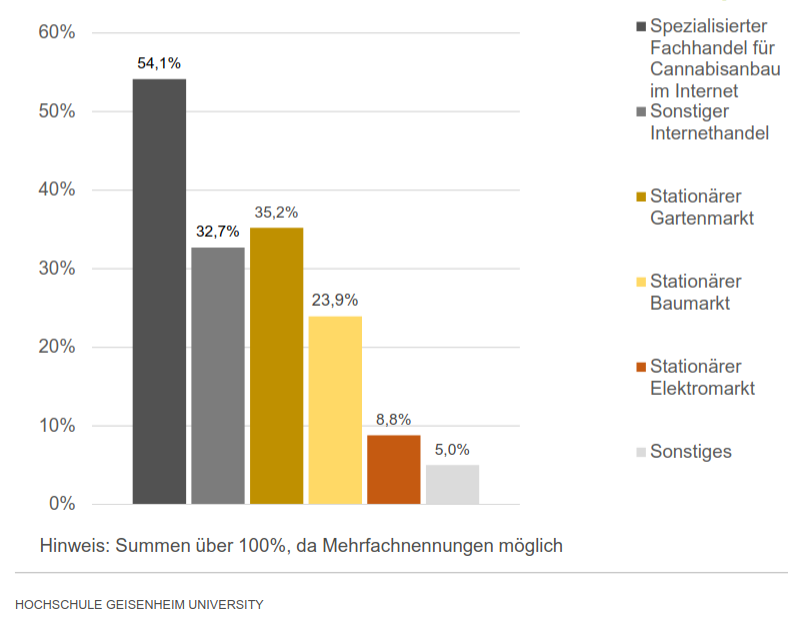
German growing supplies and seeds purchase data

According to DHV’s coverage of the study’s findings, “The median cultivation costs were €30 per plant and €1 per gram of cannabis, which are significantly lower than the prices of cannabis on the black market or medical cannabis in pharmacies.”

A previous YouGov poll in Germany found that 7% of poll participants had already purchased cannabis seeds or cuttings/clones at the time of the polling (May 2024). In addition to the 7% of poll participants indicating that they had already purchased cannabis genetics for their home gardens, another 11% of poll participants responded that they planned to purchase cannabis genetics in the future.

To further economist Beau Whitney’s point mentioned earlier in this article, most of Germany’s cannabis consumer base still relies on the unregulated market. According to data published by Statistisches Bundesamt, Germany’s total population was 84,669,326 at the end of 2023 (the most recent data available). Of that, an estimated 83.1% of the population was of legal cannabis age (18+), or roughly 70.36 million people.

Now, take into consideration data from Germany’s Epidemiological Addiction Survey, which found that roughly 8.8% of Germany’s population reported consuming cannabis at least once within the last year. Applying that percentage to the number of adults in Germany, the total potential legal cannabis consumer base in Germany is nearly 6.2 million people, and that is likely a low-end estimate because presumably some amount of consumers refrained from admitting to the government that they are cannabis consumers out of fear of persecution.

The math is clear – Germany’s legal cannabis market is just scraping the surface from the perspective of gaining potential market share. Until EU agreements are modernized to allow Germany to implement a robust legal commerce model like in Canada, and equally important, domestic German lawmakers adopt such a model when allowed to, the unregulated market will continue to thrive in Germany.

One of the professed goals of German legalization is to sufficiently combat the unregulated market to boost public health outcomes. As demonstrated by a recent data analysis from Canada’s market, consumers and patients will transition to a regulated market when given consistent options to do so, assuming the market provides the types of products that they want.

However, as long as legal purchasing options and product types remain limited in Germany, the European nation will continue to fail at achieving its stated cannabis public policy goals.

Robust Legal Sales Is Vital For Achieving Europe’s Cannabis Goals

The current level of excitement and interest in Europe’s emerging legal cannabis market is remarkable in many ways, as is the interesting public policy model that has developed in Europe in recent years. Whereas current European Union agreements prohibit nationwide adult-use cannabis sales like what is found in Uruguay and Canada, the EU does permit research-based cannabis policies that focus on boosting public health outcomes.

The first European nation to adopt a national adult-use legalization measure was Malta in 2021. Malta’s legalization model is built on allowing adults to cultivate, possess, and consume a personal amount of cannabis in addition to permitting regulated cultivation associations to operate. Malta was followed by Luxembourg in 2023, with Luxembourg adopting a more restrictive model that only permits personal cultivation and possession.

Germany ushered in the next evolution in European cannabis legalization by adopting the historic CanG law in 2024. Germany’s two-pillared approach incorporates personal cultivation and possession freedoms, cultivation associations, and the launch of regional adult-use cannabis commerce pilot trials. The Netherlands and Switzerland also have pilot trials; however, adult-use activity outside of the parameters of the trials remains prohibited in those nations.

In the lead up to Germany adopting the CanG law, German policymakers pushed hard to get the European Union’s permission to let Germany adopt a more comprehensive sales model like what is in place in Canada. In many ways, Germany was not only lobbying on its own behalf, but also on behalf of other European nations that wish to follow in Germany’s policy modernization footsteps.

Unfortunately, the European Union refrained from granting permission for national recreational sales in Germany, thereby limiting the chances of success for Germany and other EU member nations in reaching their cannabis policy goals.

In my ongoing discussions with top European legal cannabis expert Peter Homberg of gunnercooke, he often points out that there are three goals of German cannabis policy modernization efforts. The three goals, which Mr. Homberg touched on in his keynote address on day 1 of the recent International Cannabis Business Conference in Berlin, also extend to other EU markets (paraphrased below):

  1. To protect children.
  2. To boost public health outcomes.
  3. To hinder the unregulated market.

As I have previously stated, the first two items on the above list flow from the third, and success can only be achieved by recognizing the reality that consumers and patients are going to purchase and consume cannabis products, and they must be afforded the legal options to do so. Home cultivation will help alleviate consumer and patient reliance on unregulated sources to a degree, and the same is true for cultivation associations.

However, both of those components of current European legalization models can only go so far. Some amount of consumers and patients will still turn to the unregulated market, either because they do not have the means to cultivate their cannabis at home, or they do not have a sufficient cultivation association option in their area. Even if they do have the ability to cultivate cannabis at home and join a cultivation association, there will no doubt be times when they need to bridge a supply gap.

If they can’t make a legal purchase from a delivery service or brick and mortar, their only option is to turn to the unregulated market. Historical data is clear – most consumers and patients in that situation will not go without, despite what cannabis opponents and certain policymakers would lead people to believe. Until consumers and patients have legal options to purchase the type of cannabis that they prefer, via channels that they prefer, they will continue to turn to the unregulated market, and European cannabis policy modernization goals will never be fully achieved.

Consumers and patients across Europe need to keep the pressure on their policymakers to modernize national laws and EU agreements. They need to educate everyone they can about the harms of cannabis prohibition and the benefits of modernized cannabis policies. Everyone needs to know that cannabis prohibition is a failed public policy, and it harms all members of society, whether they consume cannabis or not. When limited public resources are wasted enforcing failed cannabis prohibition, everyone loses, including taxpayers and members of the criminal justice system.

Individual nations in Europe need to band together and modernize European Union agreements. Additionally, in Germany specifically, domestic policymakers need to allow regional adult-use cannabis commerce pilot trials to proceed. As I previously mentioned, pilot trials are already operating in the Netherlands and Switzerland, and no major issues have been reported. The same will be true in Germany when pilot trials are launched. There is no valid excuse for the continued pilot trial foot-dragging in Germany.

The European Union and European Commission need to recognize that humans are going to consume cannabis, whether it is legal to do so or not. It is clearly better for public health outcomes, taxpayers, local economies, and the criminal justice system when consumers and patients make their cannabis purchases from regulated sources instead of from criminal operations.

European cannabis prohibition has been in place for decades, and it has done nothing to lower consumption rates. All it has done is enrich the unregulated market, much of which is controlled by organized criminal enterprises that do not care about children and public health outcomes. It is beyond time for a more sensible, reality-based public policy approach.

How Common Is Legal Home Cannabis Cultivation In Germany?

Starting on April 1st, 2024, adults in Germany can cultivate up to three plants in their private residences. Before the public policy change and enactment of the nation’s CanG law, cultivating cannabis in Germany was a criminal offense. Home cultivation is one of the major components of Germany’s legalization model.

Until recently, it was largely unclear how many adults in Germany were taking advantage of their new, sensible home cultivation freedom. The results of a new scientific study, led by Dr. Mira Lehberger and Prof. Dr. Kai Sparke from the Department of Horticultural Economics at Geisenheim University, provide insight into how popular home cultivation is in Germany post-legalization.

The scientific study involved a survey, conducted in December 2024, of 1,500 adults. Study participants were selected from “an existing panel to ensure representation of all age groups and regions of origin (both federal states and urban/rural)” according to initial reporting by Deutscher Hanfverband (DHV), and subjects were divided ‘roughly equally’ between men and women.

Below are key findings from the study:

  • 47% of survey respondents expressed support for legal home cultivation
  • 46.3% indicated agreement with the statement “The legalization of private cannabis cultivation reduces illegal activities in Germany.”
  • 44% of participants see legal home cultivation as ‘an opportunity for better quality control’
  • 41.1% see legal home cultivation as ‘an opportunity for greater sustainability’
  • One in ten participants indicated that they had already legally cultivated cannabis post-legalization
  • 11% of participants who had not cultivated cannabis ‘could imagine’ doing so in the future
  • A majority of participants who stated they had cultivated legal cannabis were male (58.5%)

“Growing supplies and seeds were purchased both online and in-store, but specialized online retailers were used most frequently.” stated DHV in its local reporting.

German growing supplies and seeds purchase data

According DHV’s coverage of the study’s findings, “The median cultivation costs were €30 per plant and €1 per gram of cannabis, which are significantly lower than the prices of cannabis on the black market or medical cannabis in pharmacies.”

A previous YouGov poll in Germany found that 7% of poll participants had already purchased cannabis seeds or cuttings/clones at the time of the polling (May 2024). In addition to the 7% of poll participants indicating that they had already purchased cannabis genetics for their home gardens, another 11% of poll participants responded that they planned to purchase cannabis genetics in the future.

Home cultivation provides consumers with numerous benefits, not the least of which is controlling what goes into cultivating the cannabis that they consume. By producing their own cannabis, consumers know exactly what the harvested cannabis contains. Furthermore, home cultivation provides cost savings for experienced home cultivators, as the results of the recent scientific study demonstrate.

Cannabis opponents in Germany are continuing to push for a reversal of the nation’s cannabis legalization law, particularly when it comes to home cultivation. Demands by opponents fail to recognize, either purposefully or out of ignorance, that cannabis is going to be produced in Germany regardless of whether it is legal or not. Allowing personal home cultivation is a more sensible approach to public policy and frees up the nation’s criminal justice system to focus on fighting real crime.

Home cannabis cultivation by adults for recreational purposes is also legal in Uruguay, Canada, Malta, Luxembourg, South Africa, and in many local jurisdictions in the United States. Major court decisions in other nations also provide some level of protection for adults cultivating personal amounts of cannabis.

More Than 1 Out Of Every 7 German Pharmacies Offers Medical Cannabis

Germany has served as the largest legal medical cannabis market in Europe for several years, with cannabis pharmacies being the foundation of Germany’s emerging industry. Legal medical cannabis sales first launched in German pharmacies in 2017.

Since the launch of initial sales, safe access to medical cannabis via Germany’s pharmacies has increased dramatically, as demonstrated by statistics that were included in the German Cannabis Business Association’s (BvCW) most recent newsletter.

“Patients can order cannabis online with a private prescription and have it delivered to their home. Nationwide, around 2,500 of the 17,000 pharmacies now offer medical cannabis,” BvCW stated (translated from German to English). “The industry’s revenue is now estimated at around half a billion euros.”

Having recently traveled to Berlin, Germany, for the International Cannabis Business Conference Week, I witnessed the level of excitement and interest that has engulfed Germany’s emerging medical cannabis industry. Industry members worldwide are clamoring to try to get into the growing German market, and to a lesser extent, other European markets.

Leading international cannabis economist Beau Whitney, founder of Whitney Economics, provided a keynote presentation at the International Cannabis Business Conference in which he highlighted cannabis product import data that helps quantify the level of international interest in Germany’s market:

beau whitney international cannabis business conference 2025 (1)

As large as Germany’s medical cannabis industry is becoming, it is still in the early stages by many measures. Consider the fact that many medical cannabis product sales found in other legal markets, most notably edibles, are not currently permitted in Germany. Only cannabis flower and extracts are being sold in the legal German market.

Cannabis edibles are particularly popular with patients and consumers who would otherwise not consume cannabis. Many consumers and patients prefer edibles and other consumables because they are smokeless cannabis delivery methods.

Typically, when you read about ‘increases in cannabis consumption’ following cannabis policy reform enactment, the increase is due to older individuals who have either never consumed cannabis or are coming back to it after a long hiatus, and their cannabis products of choice are often edibles, drinks, and/or topicals.

To get an idea of what Germany’s industry is currently missing out on when it comes to product variety and availability, consider sales data from the United States. According to a recent article by Honeysuckle Magazine, only 41% of products sold in the U.S. on the cannabis holiday April 20th were for cannabis flower.

Vape products were responsible for 27% of national sales on 4/20, edibles made up 14% of sales, pre-rolls were 10% of sales, and extracts were 6% of sales. The remaining sales were presumably for topical products.

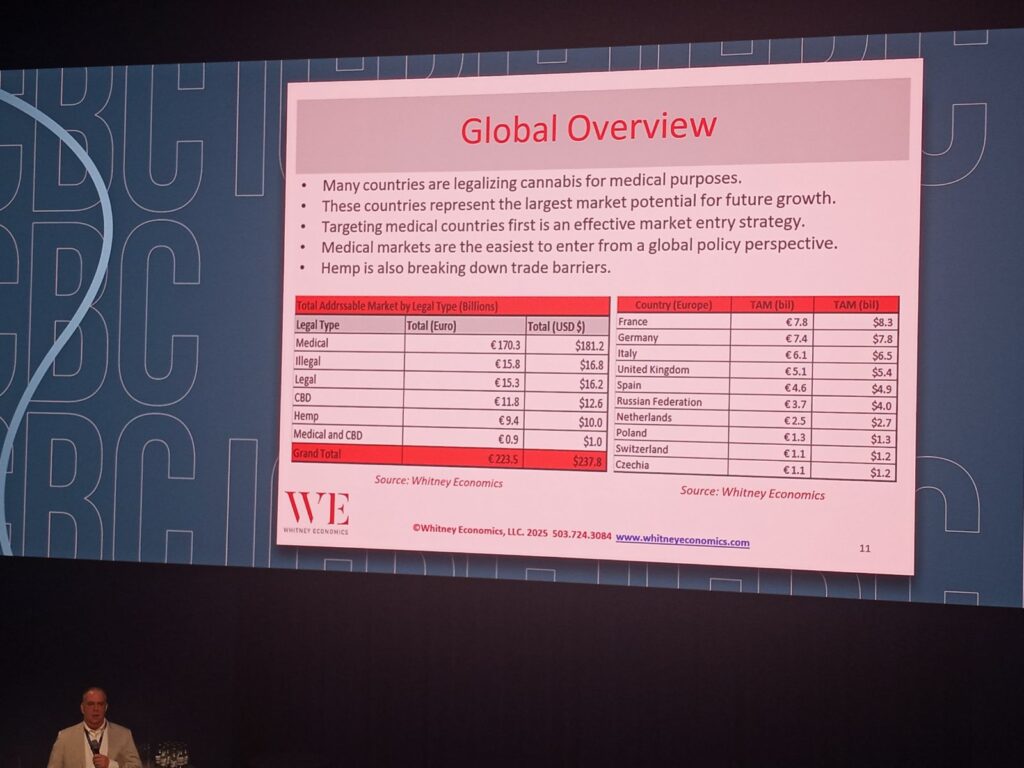
Below is another data chart that Mr. Whitney shared during his presentation in Berlin, which contains the total addressable market for Germany and other European markets. As you can see, the previously cited half a billion euro estimation for Germany’s current industry, referenced earlier in this article, is a mere fraction of the true potential of Germany’s cannabis industry:

beau whitney international cannabis business conference 2025 global market overview

One of the professed goals of German cannabis policy modernization efforts is to sufficiently combat the nation’s unregulated cannabis market to boost public health outcomes. The only way that goal will be achieved is by lawmakers in Europe’s largest market instituting a robust commerce system that allows consumers and patients to legally access the cannabis products that they want to purchase.

Until that happens, the unregulated market in Germany will continue to thrive, the nation will continue to miss out on the economic boost that a sufficient legal market yields, and public health outcomes will pay the price, with consumers and patients making their purchases of untested products from unregulated sources.

One thing is for sure – consumers and patients will not stop consuming cannabis just because such activity is prohibited. History is very clear on that. Lawmakers and regulators in Germany and throughout Europe would be wise to recognize that reality and to pursue sensible, balanced public policies.

Total Number Of German Cultivation Associations Rises To 211

Starting on July 1st, 2024, adults in Germany can apply to launch a member-based cannabis cultivation association. Cultivation associations are a key component of Germany’s adult-use model, and according to a recent newsletter by the German Cannabis Business Association (BvCW), the total number of approved associations has risen to 211.

“So far, out of 624 applications nationwide, 211 have been approved and 25 have been rejected.” stated BvCW in its most recent newsletter (translated from German to English). “A detailed overview can be found on the BCAv website.”

Policymakers and industry members in Germany originally pushed for a national adult-use cannabis legalization model that was broader compared to what is currently in place. However, after discussions and consultations with the European Union, it was determined that nationwide cannabis sales, like what is implemented in Uruguay and Canada, are prohibited under current EU agreements.

What is permitted in EU member nations is the adult-use model that Germany has adopted, which involves permitting personal consumer rights such as the cultivation, possession, and consumption of personal amounts of cannabis, as well as licensing member-based cultivation associations. Both components fall under the ‘boosting public health outcomes’ provisions of the current EU agreements.

Malta also permits cultivation associations as part of its modern adult-use cannabis policy model, and the number of associations there provides some insight into how many cultivation associations may eventually launch in Germany.

Currently, according to the Malta Authority for the Responsible Use of Cannabis’ website, there are 19 ‘cannabis harm reduction associations’ that have obtained an operating permit. It is worth noting that not all of those are dispensing cannabis to members right now, with some still being in the early stages of operation.

Malta has an estimated population of roughly 569,900, which works out to roughly one association for every 29,995 citizens. Germany currently has an estimated population of roughly 84,075,075. If we apply the same association-to-population ratio from Malta to Germany’s population, it would work out to about 2,803 total associations.

There is additional context that must be considered, and Malta and Germany are not an apples-to-apples comparison, so to speak. However, the basic calculation and comparison demonstrate how much potential for growth there is for Germany’s emerging cultivation association sector, at least at a macro level.

Another contextual factor to consider is that Malta’s association numbers are presumably going to rise as time goes on, and are not fixed at 19, so the 2,803 estimate for Germany will likely prove to be a low-end figure.