Tag: Germany

Legal Cannabis Expert Peter Homberg Moves to gunnercooke

Renowned international cannabis policy and industry expert Peter Homberg recently announced that after 12 years at Dentons, he is joining international law firm gunnercooke.

“I’m excited to offer my clients truly exceptional service, leveraging gunnercooke’s flexibility, innovation, and collaborative culture to support them closely through their legal challenges, while also shaping and expanding my practice in a direction I’m passionate about.” Peter Homberg stated in a LinkedIn post over the weekend.

Mr. Homberg specializes in life sciences, IP and corporate law, and M&A transactions. Few people on the planet, if any, possess the extensive experience in advising on medical cannabis compliance as Peter Homberg.

gunnercooke is one of the fastest growing international law firms and has offices in the United States, Germany, CEE, Austria, Scotland, and England. The firm is a team of more than 500 professionals and has a client roster that includes Nike, Mercedes, Lidl, Santander and DHL.

Peter Homberg’s awards and recognitions are numerous, and rightfully so. Peter Homberg was already highlighted by Chambers Europe in 2014 as “a brilliant negotiator” who “has huge experience with biotech companies and is really goal driven.”

JUVE Handbook German Commercial Law Firms, mentioned Peter Homberg in 2015/2016 as a highly recommended practitioner. The international directory Best Lawyers ranked him among the best lawyers for Health Care Law and Pharmaceuticals Law in Germany. Global Law Experts (2015, 2016, 2017, 2018), Legal 100 (2021, 2022, 2023), and Leaders in Law (2020,2021) honored Peter Homberg as “Life Sciences Lawyer of the Year in Germany.”

He is a prolific speaker at cannabis industry and policy seminars and conferences, including being a long-time presenter at International Cannabis Business Conference events, and is the author of numerous articles and other publications on corporate and IP law in the areas of life sciences and medical cannabis.

Peter’s new position at gunnercooke will afford him more freedom and flexibility to focus on cannabis policy, industry, and education, as well as to further pursue his passion for life sciences. Medical cannabis and life sciences involve considerable overlap, but also have their own unique facets separate from each other.

I reached out to Peter Homberg this week to discuss his new endeavor and to pick his brain about what to expect in 2025 for German cannabis and the wider European cannabis industry.

“I am very excited about the recent career change.” Peter Homberg told me about his transition to gunnercooke. “I will be able to continue my work in the fields of cannabis and life sciences, and for cannabis specifically, I will be better suited to focus more on it as the industry continues to expand in Germany and in Europe.”

Peter Homberg is a tremendous resource and figure in the cannabis world, helping educate lawmakers and industry members from around the world about important cannabis matters. The significance of his advocacy is beyond measure in my opinion, and I was very happy to learn that not only will he continue his work in this area now that he is a part of gunnercooke, but he will also have more flexibility than ever to do so, including contributing more to Cannabis Law Journal.

“In my new position, I will continue to be an advocate for medical cannabis policy modernization and industry regulation, and for sensible adult-use cannabis reform.” Homberg stated to me in our discussion.

Homberg pointed out that prohibition does not bring humanity further along, and that it is a failed public policy that does not properly prioritize public health outcomes. He indicated that licensed and regulated cannabis shops are needed in Germany and throughout Europe to sufficiently combat the unregulated market.

“Pilot projects are the logical next step in Germany and in Europe and are needed as a steppingstone towards something more comprehensive. It is important that we gather the right data and use it to go to the European Commission to prove that wider regulated cannabis sales are the best way forward.” Homberg stated.

A topic that was prominent in our discussion was Germany’s Pillar 2 of its cannabis model, and with it, how the shifting political landscape in Germany will presumably be impacted by the upcoming election.

“I am confident that the upcoming election will yield a coalition government, and I am moderately optimistic that while recreational legalization’s progress will likely be slowed, it will not be completely reversed.” Homberg explained to me.

“A lot is still unclear. Many statements being made right now from cannabis opponents are being made in an ‘election mode’ and will not necessarily become reality. I expect extreme positions to level out after the election.” Homberg went on to say.

When I asked Peter Homberg to weigh in on what it will take for EU-level agreements to be modernised to permit wider recreational cannabis reform, he was very adamant that data gathering is key.

“Gathering more data from commerce pilot trials demonstrating that regulation works is vital to convincing the European Commission and skeptical member nations that regulation is better than prohibition. Probably 2-4 years’ worth of data from markets like Germany, Switzerland, the Netherlands, and others.” Peter Homberg explained.

“Medical cannabis is here to stay in Europe, and in my opinion, possesses the most potential for entrepreneurs and investors,” Homberg told me. “Medical cannabis has proven that it has its place in the pharmaceutical arena as time has gone on. There used to be a reluctance to accept that cannabis is medicine, however, it is now widely accepted that cannabis is medicine and truly helps suffering patients.”

“It is much more difficult to anticipate what will happen with the future of the recreational cannabis market due to several factors, both in Germany and throughout Europe. It will further develop, but at what rate and in which way is extremely difficult to predict.” Homberg said.

On behalf of the International Cannabis Business Conference team, I want to congratulate Peter Homberg on his new endeavor, and we look forward to what he does next in his career. You can see Peter Homberg present at upcoming International Cannabis Business Conference events and find out more about when and where he will appear at Internationalcbc.com.

German Trial Finds That CBD Reduces Alcohol Cravings

International researchers estimate that as many as 400 million people worldwide, roughly 7% of the world’s adult population, suffer from alcohol use disorder. Alcohol use disorder is a chronic health condition characterized by uncontrolled drinking and preoccupation with alcohol.

Globally, researchers estimate that around 2.6 million deaths were caused by alcohol consumption in 2019, and of those, 1.6 million were from noncommunicable diseases, 700,000 were from injuries, and 300,000 were the result of communicable diseases.

A team of researchers in Germany, and one from Sweden, recently conducted a clinical trial in which they explored the use of cannabidiol (CBD) by patients who suffer from alcohol use disorder. The clinical trial findings were recently published in the journal Nature: Molecular Psychiatry.

“Here we report data from the double-blind randomized controlled ICONIC trial that compared the effects of a single dose of 800 mg cannabidiol against placebo (PLC) in N = 28 individuals with AUD.” the researchers stated about their trial.

“Cue-induced nucleus accumbens (NAc) activation, alcohol craving during a combined stress- and alcohol cue exposure session, as well as craving during an fMRI alcohol cue-reactivity task and CBD plasma levels served as outcomes.” the researchers stated about the trial’s methodology.

“Individuals receiving CBD showed lower bilateral cue-induced NAc activation (tleft_NAc(23) = 4.906, p < 0.001, d = 1.15; tright_NAc (23) = 4.873, p < 0.001, d = 1.13) and reported significantly lower alcohol craving after a combined stress- and alcohol cue exposure session (Fgroup(1,26) = 4.516, p = 0.043, eta2 = 0.15) and during the fMRI cue-reactivity task (Fgroup(1,24) = 6.665, p = 0.015, eta2 = 0.23). CBD levels were significantly higher in the CBD group (t(25) = 3.808, p < 0.001, d = 1.47) and showed a significant negative association with alcohol craving during the cue exposure experiment (r = -0.394, pFDR = 0.030) and during fMRI (r = -0.389, pFDR = 0.030), and with left and right NAc activation (rleft_NAc = -0.459, pFDR = 0.030; rright_NAc = -0.405, pFDR = 0.030).” the researchers also stated.

“CBD’s capacity to reduce stress- and cue-induced alcohol craving and to normalize NAc activation – a region critical to the pathophysiology of AUD – contribute to understanding the neurobiological basis of its clinical effects and support its potential as a treatment option for AUD. Clinical Trials Registry: DRKS00029993.” the researchers concluded.

Separate studies have also suggested that CBD dosing can reduce cravings for tobaccomethamphetamine, and heroin, among other substances, according to a news release recently published by the cannabis advocacy organization NORML.

Support For Cannabis Legalization In Germany Rises To 59%

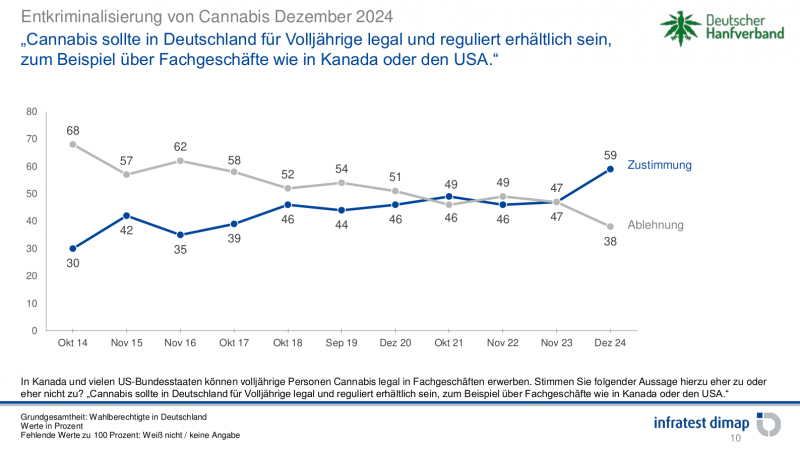
Support for comprehensive adult-use cannabis legalization in Germany has increased to 59% according to the results of a new poll commissioned by the German Hemp Association (DHV). Lawmakers in Germany adopted partial cannabis legalization earlier this year.

“For the first time, according to infratest dimap, an absolute majority of Germans are in favor of legalizing cannabis, i.e. regulated distribution to adults, as originally agreed in the coalition agreement of the traffic light government. A similarly large majority opposes the CDU/CSU’s plans to make possession of small amounts of cannabis and the cultivation of some plants a criminal offense again.” DHV stated in a press release announcing the results of the recent poll (translated from German to English).

“After three years of stagnation in support for legalization at just under 50%, there has now been a spectacular and surprising increase to 59%! This is surprising because since the traffic light government took office, opponents of cannabis legalization, such as the German Medical Association and police unions, have regularly spread negative information about the discussed and implemented Cannabis Act (CanG) with high media reach.” DHV also stated.

Starting on April 1st, 2024, adults in Germany can cultivate a personal amount of cannabis plants in their private residences and possess a personal amount of cannabis for recreational purposes. Additionally, starting on July 1st, 2024, people can apply to start a cultivation association in Germany.

“The CanG, which was drafted under the leadership of Karl Lauterbach and came into force on April 1, 2024, does not involve the legalization of cannabis because it does not provide for legal sales. This is why we commissioned additional questions from infratest dimap this year. And here, too, there is overwhelming agreement in Germany. Only 37% are in favor of making possession of small quantities a criminal offense again (or 41% for home cultivation).” DHV stated about why they commissioned the poll.

“The surveys conducted by infratest dimap for the DHV are the best data basis on the opinion of Germans regarding the legalization of cannabis, because the survey is formulated neutrally in consultation with the institute and, apart from a few small updates, has been carried out almost identically every year since 2014. This not only allows a snapshot, but also a long-term trend to be identified.” DHV stated.

german cannabis legalization poll 2024 dhv

“Looking at the party supporters of those surveyed, it is also clear that the Union is alone in its demand to reverse the reform. The majority of supporters of all potential coalition partners are against a renewed ban on possession and home cultivation. The SPD, which does not comment on cannabis in its current draft program, can also be bolder and stand by its law.” DHV stated.

Alex Rogers Visits Cannabis Pharmacy In Munich

Germany first started legally dispensing medical cannabis products through a pharmacy model back in 2017. Since that time, Germany’s medical cannabis industry has become the largest on the European continent.

Helios Cannabis is one of the leading medical cannabis companies operating in Germany and runs a medical cannabis pharmacy in Munich. Helios is comprised of an enthusiastic, committed team that deals with the topic of cannabis as a medicine and its use in the treatment of suffering patients.

Thanks to their many years of experience and continuous training, Helios provides patients with comprehensive advice and improves their quality of life.

The Munich public prosecutor’s office conducted a search of the Helios pharmacy on Königsplatz on October 24th, 2024, accusing the location of ‘producing hash illegally.’ As legal counsel for Helios pointed out, the company is well within legal parameters to produce necessary medical cannabis products for its patients.

“Pharmacies are allowed to legally manufacture cannabis products for medical and scientific purposes. No special permission is required for this. Ensuring that the population is supplied with medicines – including cannabis – is the legal responsibility of pharmacies.” stated Konstantin Grubwinkler, legal counsel for Helios.

The recent unfounded search of the Helios location in Munich serves as an unfortunate reminder that cannabis opponents will continue to do what they can to try to thwart the progress of entities doing things the right way such as Helios.

Alex Rogers, founder and CEO of the International Cannabis Business Conference, recently visited Helios’ Munich pharmacy location to see their world-class operations firsthand. Below is a video that captures the highlights of the visit, and includes a brief discussion about the recent incident mentioned above.

27 German Jurisdictions Express Interest In Cannabis Model Projects

Germany’s Federal Ministry of Food and Agriculture (BMEL) was recently tasked with the responsibility of overseeing adult-use model project applications. The announcement cleared the way for entities in Germany to start submitting applications for scientific model projects on the legal distribution of recreational cannabis.

The German Cannabis Industry Association (BvCW) called on interested universities and companies to submit applications “as soon as possible” in its newsletter this week. BvCW is pointing interested entities to BMEL’s website to learn more about how to apply.

According to BvCW, the following German municipalities have expressed interest in launching cannabis model projects:

  • Freiburg
  • Munich
  • State of Berlin
  • Pankow
  • Charlottenburg-Wilmersdorf
  • Lichtenberg
  • Friedrichshain-Kreuzberg
  • Neukölln
  • Center (Berlin)
  • Treptow-Köpenick
  • Bremen
  • Hamburg
  • Marburg
  • Wiesbaden
  • Offenbach
  • Darmstadt
  • Groß-Gerau
  • Frankfurt
  • Hanover
  • Cologne
  • Dortmund
  • Bonn
  • Muenster
  • Bielefeld
  • Düsseldorf
  • Mainz
  • Leipzig

“We are very pleased that this important step has been taken. Various research projects are enabling a new range of knowledge on what the best possible future regulation of the recreational cannabis market could look like. This is an essential contribution to significantly reducing the black market in the medium to long term,” said Dirk Heitepriem, President of the Cannabis Industry Association (BvCW), about BMEL’s authority over the application process (translated from German to English).

“No black market dealer asks for ID. However, as part of these model projects, there will be strict age checks – as in the cannabis cultivation associations. Safe sources will guarantee quality and thus exclude the greatest health risks – additives and cutting agents,” added Michael Greif, Managing Director of the BvCW.

BvCW has also published a checklist for model project applications to help potential applicants.

Two Berlin Districts Want To Launch Cannabis Pilot Trials In 2025

Germany’s approach to cannabis legalization implementation is multi-phased. The first phase of German legalization, often referred to as ‘pillar 1,’ took effect earlier this year. As of April 1st, 2024, adults in Germany can cultivate and possess a personal amount of cannabis. Additionally, cultivation associations became legal starting on July 1st, 2024.

‘Pillar 2’ of German legalization involves launching regional adult-use cannabis commerce pilot trials. Two districts in Berlin, Germany’s largest city, announced plans this week to launch their pilot trials next year.

“The Berlin districts of Friedrichshain-Kreuzberg and Neukölln want to start selling cannabis through several specialist stores next year.” the city announced today on its website. “This is made possible by a pilot project that will be scientifically monitored. Customers who want to buy cannabis must take part in the scientific study and register, the districts announced on Wednesday. They must also be resident in one of the two districts.”

“The sale is organized by a company that buys the cannabis from legal producers in Germany or abroad and sells it on to registered consumers in specialist stores.The two districts, Humboldt University and the Danity Group company signed a letter of intent to this effect on Wednesday.” the city also stated (translated from German to English).

“The application for approval of the project is to be submitted to the relevant federal authority as soon as possible. The sale could begin next summer, it was said.” city officials concluded.

As we previously reported, Germany took a major step forward this week in implementing pilot trials by announcing that the Federal Office for Agriculture and Food will help oversee the nation’s adult-use cannabis research projects, part of which includes pilot trials.

“By passing the Consumer Cannabis Act, the Bundestag has given the Federal Ministry of Food and Agriculture (BMEL) was given the task of appointing the responsible body for processing research applications on consumer cannabis and industrial hemp. The regulation that has now been issued – the Consumer Cannabis Science Responsibility Regulation – stipulates that the Federal Office for Agriculture and Food will examine corresponding research applications and monitor the approved projects.” the German government stated in a news release (translated from German to English).

“Previously, this task was carried out by the Federal Institute for Drugs and Medical Devices (BfArM). The BfArM remains the responsible authority for research into medical cannabis.” German officials also stated.

Germany Finalizes Recreational Cannabis Pilot Projects

A major component of Germany’s adult-use cannabis legalization model involves launching regional adult-use cannabis commerce pilot trials. The European nation took a major step forward in implementing pilot trials by announcing that the Federal Office for Agriculture and Food will help oversee the nation’s adult-use cannabis research projects, part of which includes pilot trials.

“By passing the Consumer Cannabis Act, the Bundestag has given the Federal Ministry of Food and Agriculture (BMEL) was given the task of appointing the responsible body for processing research applications on consumer cannabis and industrial hemp. The regulation that has now been issued – the Consumer Cannabis Science Responsibility Regulation – stipulates that the Federal Office for Agriculture and Food will examine corresponding research applications and monitor the approved projects.” the German government stated in a news release (translated from German to English).

“Previously, this task was carried out by the Federal Institute for Drugs and Medical Devices (BfArM). The BfArM remains the responsible authority for research into medical cannabis.” German officials also stated.

Germany enacted the first provisions of the CanG legalization law on April 1st, 2024. Adults in Germany are now allowed to cultivate cannabis in their private residences and to possess a personal amount of cannabis in their homes and while away from their residences.

Starting on July 1st, 2024, adults could apply to start a member-based cultivation association in Germany. Personal cultivation, possession, and consumption combined with cultivation associations were part of ‘pillar 1’ of Germany’s CanG law.

“Research on and with consumer cannabis is now possible again, but requires a permit. Applicants must meet the criteria set out in the Consumer Cannabis Act, demonstrate the required expertise and demonstrate an interest in research. Not only universities, but also companies can submit research applications. Research can help to effectively curb the black market, expand health prevention and make the debate more objective.” the German government stated.

While this week’s announcement gets Germany a step closer to launching pilot trials, more steps are necessary before final implementation.

“The regulation pursuant to Section 2 Paragraph 4 of the KCanG regulates the scientific use of cannabis for consumption. Anyone who wants to possess, cultivate, produce, import, export, acquire, receive, hand over, pass on, extract cannabinoids from the cannabis plant or trade in cannabis for consumption for scientific purposes requires a permit from the Federal Office for Agriculture and Food.” German officials state on a recently published FAQ page.

“This is not the “second pillar” of the key points paper. The “second pillar” should test cannabis specialty stores nationwide in a comprehensive and detailed law. The Federal Ministry of Health is responsible for drafting such a draft law.” the FAQ page also states.

Cannabis Crimes Are Down 68% In Berlin Compared To Last Year

Cannabis-related crimes in Germany’s capital city were significantly lower for the seven months immediately following partial cannabis legalization compared to the same period last year. Cannabis cultivation, possession, and consumption by adults became legal throughout Germany on April 1st, 2024.

“Berlin’s police database recorded 1,685 criminal offences under the Cannabis Act between the beginning of April and the end of October, including illicit trafficking or illicit possession, the agency said in response to questions from local Green Party lawmaker Vasili Franco.” stated Yahoo! News in its reporting.

“By comparison, 5,315 criminal offences were reported in the same period in 2023.” Yahoo! News also reported.

While adult-use cannabis cultivation, possession, and consumption are legal in Germany, other cannabis-related activities remain prohibited such as selling unregulated cannabis, public consumption, and operating a motor vehicle on a public roadway while intoxicated. Adults can possess up to 25 grams of cannabis away from their homes.

“Contrary to all the scaremongering, the cannabis law is already showing initial success after just a few months. Decriminalization should mean that cannabis users are no longer unnecessarily prosecuted, criminalized and stigmatized,” said Vasili Franco.

According to a 2021 report from Heinrich Heine University Dusseldorf, Germany will eventually save 1.05 billion euros annually by no longer enforcing cannabis prohibition, in addition to judiciary savings of 313 million euros per year.

The German cannabis market is home to 4-8 million consumers with a total potential market value of between €7.8 billion and €15.6 billion according to data provided by leading economist firm Whitney Economics.

To completely supply German demand, Germany’s cannabis industry would need to produce over 948,000 kg of flower annually according to Whitney Economics.

German Hospitals Want Greater Medical Cannabis Telemedicine Integration

The German Hospital Association (DKG) and the German Society for Telemedicine (DGTelemed) have issued a joint position paper calling for increased medical cannabis telemedicine in German hospitals and doctors’ offices. The Association and Society cite a shortage of specialized workers, especially in rural regions, as one reason greater integration is warranted.

Telemedicine involves patients visiting a doctor over the internet instead of in the doctor’s office, and DKG and DGTelemed indicated in their joint position paper that it is important “to move away from the idea that good care can only be provided at the location.” The position paper was published earlier this month.

“Telemedicine gives doctors access to specialist knowledge and patients access to care close to their homes. This avoids many transfers. This saves valuable resources at both university hospitals and smaller hospitals,” Gernot Marx, Chairman of the Board of DGTelemed, stated according to local reporting by Ärzteblatt.

“Care should also be able to be provided regardless of location if this benefits the patient,” said Gerald Gaß, Chairman of the Board of the DKG, according to the media outlet.

Demand for medical cannabis in Germany is on the rise after the nation adopted adult-use legalization reform earlier this year. During the first three full months following Germany’s enactment of the CanG adult-use legalization law (Q3), legal medical cannabis imports increased by over 70% compared to the previous period.

The German cannabis market is home to 4-8 million consumers and patients with a total potential market value of between €7.8 billion and €15.6 billion according to data provided by leading economist firm Whitney Economics.

To completely supply German recreational and medical cannabis demand, Germany’s cannabis industry would need to produce over 948,000 kg of flower annually according to Whitney Economics.