Tag: hemp

Study Finds That Hemp Fiber Possesses Antibacterial Properties

Bacterial infections are one of the top public health issues around the world, with bacterial infections being directly responsible for an estimated 1.27 million deaths annually around the globe, and contributing to another 4.95 million deaths.

Even in cases that do not tragically end in the patient dying, bacterial infections still cause a lot of pain and suffering, and in extreme cases have lasting effects on the suffering patient. Fortunately, the hemp plant may be able to help.

A team of researchers affiliated with Tarsus University in Türkiye recently conducted a study that examined hemp fiber’s potential antibacterial properties. The study’s findings were published in the academic journal Cellulose.

“This study focused on the extraction of cellulose from hemp fiber and production of carbonized nanocelluloses (CCN) from cellulose, characterization, antibiotic loading and investigation of antibacterial properties of cellulose and CCN.” the researchers stated about the focus of their study.

“Cellulose with a diameter of approximately 4.5 μm was successfully extracted from the untreated hemp fiber that had an average diameter of approximately 10 μm. After the acid hydrolysis, the dried hemp fiber powders were subjected to preoxidation and carbonization and then CCN with a diameter of 34.7 nm was produced. Ciprofloxacin (CIP) was selected as the model antibiotic for investigation of the antibacterial property of the cellulose and CCN.” the researchers stated about their methodology.

“The antibacterial activity studies showed that although pristine cellulose and CCN had considerable antibacterial property their modification with CIP (C + CIP and CCN + CIP) increased their activity. At 50 mg mL⁻¹ concentrations, the antibiofilm effectiveness for CCN and cellulose were found to be 52.38% and 4.28%, respectively. The antibiofilm activity of CCN + CIP was also found to be higher than that of cellulose + CIP against both P. aeruginosa and Staphylococcus aureus in the concentrations range studied and the antibiofilm activity was observed to be 94.74% and 86.62% for CCN + CIP and cellulose + CIP, respectively, at 50 mg mL⁻¹.” the researchers found.

“All these results showed that CIP could successfully be loaded onto carbonized nanocelluloses extracted from hemp fibers and they showed considerable antibacterial properties.” the researchers concluded.

The recent study conducted in Türkiye builds on previous research focused on the hemp plant’s antibacterial properties, which found that hemp oil “can inhibit or reduce bacterial growth.”

Study Finds Hemp Flour May Be Good For Gluten-Free Baking

Multiple conditions can contribute to a person being gluten intolerant, with a common one being celiac disease. Gluten sensitivity and wheat intolerance are two other contributing health factors resulting in a person needing to avoid consuming gluten.

Celiac disease is a serious digestive and immune disorder that damages the small intestine of people who suffer from it. International researchers estimate that as much as 1% of the world’s population has been diagnosed with celiac disease, although it often goes untreated around the globe, particularly in developing countries.

Gluten intolerance has given rise to an international industry for gluten-free foods, particularly baked goods. Grand View Research estimates that “the global gluten-free products market size was estimated at USD 7.75 billion in 2024 and is projected to reach USD 13.67 billion by 2030, growing at a CAGR of 10.0% from 2025 to 2030.”

Hemp flour is naturally gluten-free, and according to the results of a recent study, it may be a great ingredient for baked goods. Italian researchers affiliated with the University of Calabria examined hemp flour in baked goods, and their findings were published in the academic journal Molecules.

“This study focused on optimizing CBD oil extraction from hemp inflorescences and its incorporation into a gluten-free bakery product for functionalization. Dynamic maceration (DME), assisted by ultrasound and microwave irradiation, was used.” the researchers wrote.

“Our study explored the impact of varying sonication times (three distinct durations) and microwave powers (three levels, applied for two different irradiation times) on the resulting extracts. HPLC analysis was performed on these extracts. Subsequently, we used hemp flour and hemp oil to bake gluten-free cupcakes, which were fortified with the extracted CBD oil.” the researchers also wrote.

“The most effective extraction parameters identified were 30 s of microwave irradiation at 700 W, yielding 45.2 ± 2.0 g of CBD extract, and 15 min of sonication, which resulted in 53.2 ± 2.5 g. Subsequent rheological characterization indicated that the product exhibited mechanical properties and a temperature profile comparable to a benchmark, evidenced by a height of 4.1 ± 0.2 cm and a hardness of 1.9 ± 0.2 N.” the researchers found.

“These promising values demonstrate that hemp oil and hemp flour are viable ingredients for traditional cakes and desserts, notably contributing increased nutritional value through the CBD-enriched hemp oil and the beneficial profile of hemp flour.” the researchers concluded.

The Evolving Industrial Hemp Industry

The hemp plant is arguably the most versatile crop on the planet, and humans have made use of it for thousands of years. Prohibition policies have hindered hemp research and the hemp industry, but thankfully, that is changing as governments modernize their laws and regulations.

Historically, hemp was used for food, fiber, and medicine, and while that is still true, hemp is used for many other things these days, including recreational products and bioremediation strategies.

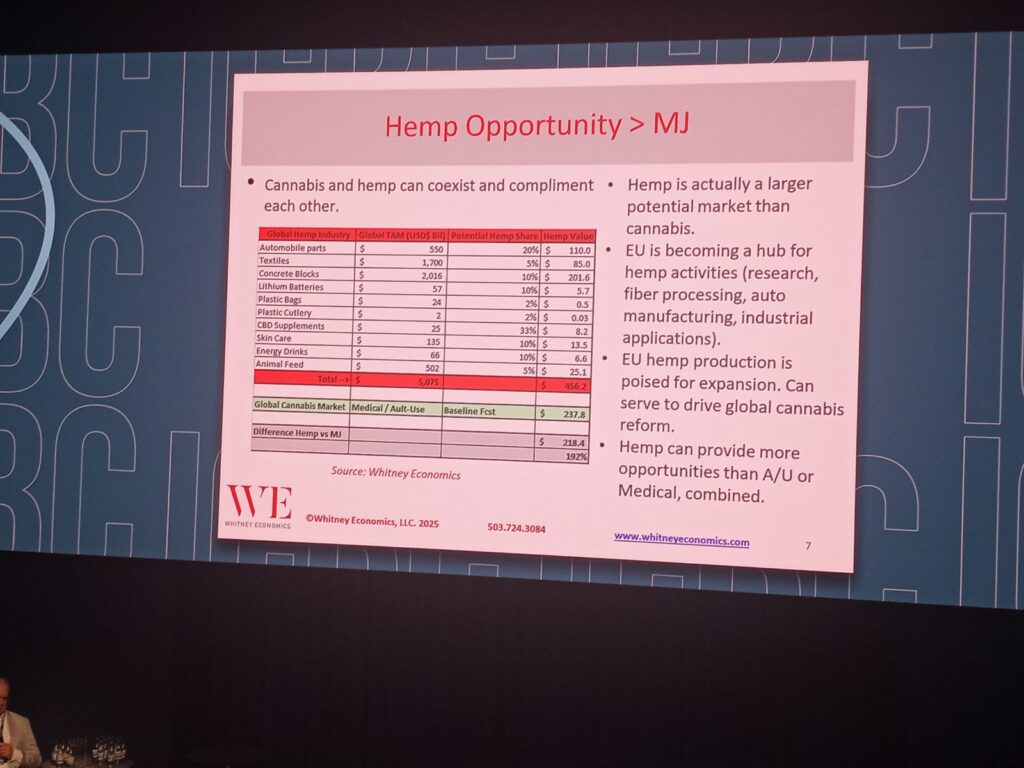
The hemp sector is big business. During a recent presentation at the International Cannabis Business Conference in Berlin, leading international cannabis industry economist Beau Whitney, founder of Whitney Economics, provided data demonstrating that the value of the global industrial hemp industry could be as much as $456.2 billion.

The evolving industrial hemp industry was a major topic at the International Cannabis Business Conference in Berlin. I moderated a panel dedicated to industrial hemp and was joined by the following experts:

  • Morris Beegle, President of We Are For Better Alternatives (WAFBA)
  • Robert T. Hoban, Member and Co-Chair of the Cannabis Industry Group, and Member-In-Charge of the Clark Hill Denver Office
  • Daniel Kruse, CEO of SYNBIOTIC SE
  • Chris Day, CO-Founder of the Global Cannabis Network Collective (GCNC)

You can view the panel discussion at this link here.

Hemp Fiber May Be A Viable Cotton-Compatible Textile Input

The hemp fiber industry holds tremendous economic potential. According to a recent market projection by MarkNtel Advisors, “the global hemp fiber market stood at USD 11 billion in 2024 and is projected to reach USD 36 billion by 2030, growing at a CAGR of 22%.”

“The surge in hemp fiber adoption reflects broader shifts in consumer behavior, policy frameworks, and material science innovation. Hemp’s fast growth rate, minimal pesticide requirements, and carbon sequestration properties are positioning it as a bio-based solution for climate-conscious industries.” MarkNtel Advisors stated.

One logistical issue that is holding the hemp fiber sector back, to some degree, is limited infrastructure. In the wider textile industry, hemp is largely seen as a niche material input requiring specialized machinery to create end products. However, a recent study is providing new insight into hemp’s potential as a cotton-compatible textile input.

A team of researchers affiliated with Universitat Politècnica de Catalunya-BarcelonaTech (Spain) and Dresden University of Technology (Germany) recently conducted a study examining non-textile hemp by using mechanical-chemical cottonization. The results of the study were published in the academic journal Cellulose.

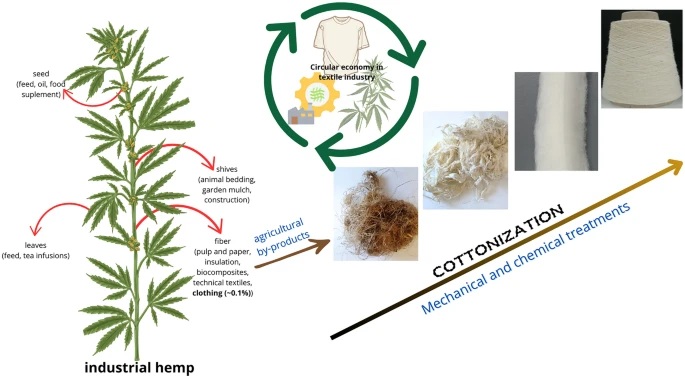
“The raw material used was an agricultural residue that is mainly employed for paper manufacturing. These fibers were subjected to an alkaline chemical treatment followed by an oxidizing treatment (H2O2) to reduce non-cellulosic components.” the researchers stated about their methodology. “Subsequently, a mechanical process was carried out to increase fiber elementarization and obtain suitable slivers for spinning.”

“The potential of open-end rotor spinning was evaluated for both the 100% treated hemp and blends of 25% hemp/75% cotton. The selection criteria included a low reduction of the degree of cellulose polymerization, a low mass loss during the process, an appropriate tensile strength of the resulting yarns, an absence of breakage during spinning, and a low twist.” the researchers also wrote.

Below is a graphical abstract provided in the researchers’ article listed on Springer Nature:

industrial hemp cottonization mechanical and chemical treatments

“The hemp treated with a high level of H2O2 stabilizer, according to the established experimental design for the oxidizing process, exhibited superior performance when blended with cotton and spun with a count of 40 tex and a twist coefficient (αm) of 170. These outcomes are of industrial interest for the production of fine yarns because they can be easily implemented using existing machinery devoted to processing cotton.” the researchers determined.

“Furthermore, it contributes to the circular economy within the textile industry by adding value to a waste material that can serve as an alternative source of more environmentally friendly cellulosic fibers.” the researchers concluded.

The results of this recent study come at a time when Europe’s industrial hemp industry potential is being researched at an increasing rate. For example, a team of researchers affiliated with the University of Göttingen recently examined industrial hemp from the perspective of its prospects as a sustainable crop for modern agriculture in Germany.

“Industrial hemp offers promising prospects for agriculture. Its ecological advantages, such as improved soil structure and CO2 sequestration, as well as the economic potential offered by dual-use land and low or no need for pesticides, make it a sustainable addition to crop rotation.” the researchers concluded. “With the right strategy, industrial hemp can make a valuable contribution to sustainable agriculture, especially when economies of scale, stable sales contracts, and effective integration into crop rotation systems are considered.”

The University of Göttingen’s findings built on other recent hemp-focused sustainability research, including a study led by researchers affiliated with the University of Banja Luka, the University of Belgrade, and the University of Niš, which found that raw hemp can be used as an effective and eco-friendly alternative for removing toxic dye chemicals from wastewater.

During a recent presentation at the International Cannabis Business Conference in Berlin, leading international cannabis industry economist Beau Whitney, founder of Whitney Economics, provided data demonstrating that the value of the global industrial hemp industry could be as much as $456.2 billion.

University Of Göttingen: Hemp Offers Sustainable Prospects For Agriculture

Farmers have cultivated hemp and used the agricultural crop for many centuries. A study from 2023 found that “ancestral archaeological relics date the use of this plant fiber as a fabric to approximately 8000 years before the common era (BCE) as a material in ancient Mesopotamia (present-day Iran and Iraq), and to 4000 years BCE and 3000 years BCE as a material for ropes in China and Kazakhstan, respectively.”

A team of researchers affiliated with the University of Göttingen recently examined industrial hemp from the perspective of its prospects as a sustainable crop for modern agriculture in Germany. Findings from the examination were published by Bauernblatt.

The University of Göttingen team conducted a series of in-depth interviews with 14 farmers based in Northern Germany, discussing and examining ‘their experiences, the economic, ecological, and social dimensions of hemp cultivation.’

“From the farmers’ perspective, hemp cultivation offers significant potential savings in production costs compared to cash crop cultivation due to the elimination of pesticides. The dual use of fiber and seeds opens up additional sources of income, but also presents challenges for harvesting technology and timing.” reported Bauernblatt (translated from German to English).

“Furthermore, some respondents point out that a certain amount of cultivated land is advantageous, for example, to more efficiently utilize harvesting and processing equipment. This can be a hurdle for smaller farms, so cooperation with neighboring farms or contractual agreements with processors can improve profitability.” the outlet also reported.

The farmers who were interviewed touted the benefits of hemp as a winter crop. Whereas many other crops cannot be cultivated during Germany’s winter months, hemp grows well enough during Germany’s winter to make it a viable option, which enables a more efficient use of available land that would otherwise be dormant during the season.

Hemp’s ‘rapid crop development allows for the complete elimination of herbicides in practice,’ according to the farmers who were interviewed, and hemp uses less water to grow compared to other crops, making the farmers’ fields more climate-resilient. The farmers also emphasized that hemp is a great ‘preceding crop’ and ‘has a positive impact on the yields of subsequent crops.’

Other sustainable benefits of cultivating hemp are the crop’s ability to capture CO2 and serve as a component in soil bioremediation strategies. The researchers reported that some of the farmers indicated their intent to explore the possibility of generating revenue through climate protection programs.

“Industrial hemp offers promising prospects for agriculture. Its ecological advantages, such as improved soil structure and CO2 sequestration, as well as the economic potential offered by dual-use land and low or no need for pesticides, make it a sustainable addition to crop rotation.” the researchers concluded. “With the right strategy, industrial hemp can make a valuable contribution to sustainable agriculture, especially when economies of scale, stable sales contracts, and effective integration into crop rotation systems are considered.”

The University of Göttingen’s findings build on other recent hemp-focused sustainability research, including a study led by researchers affiliated with the University of Banja Luka, the University of Belgrade, and the University of Niš, which found that raw hemp can be used as an effective and eco-friendly alternative for removing toxic dye chemicals from wastewater.

During a recent presentation at the International Cannabis Business Conference in Berlin, leading international cannabis industry economist Beau Whitney, founder of Whitney Economics, provided data demonstrating that the value of the global industrial hemp industry could be as much as $456.2 billion.

European Study Explores Hemp Blocks And Compaction Direction

Does the direction that hemp hurd is compacted into blocks make a difference in how well the blocks insulate and hold up under stress? That was the focus of a recent study conducted by a team of European researchers affiliated with Riga Technical University in Latvia and Lublin University of Technology in Poland. The study’s findings were published in the Journal of Natural Fibers.

“The study aims to assess the impact of variable binder content and the direction of compaction on the properties of the hemp-magnesium composites.” the researchers stated about the goal of their study. “These two factors may influence the scope of application of the developed composites (e.g. as a lightweight insulating filling of a frame wall, or a heavier material for load-bearing applications or in prefabrication).”

“Capillary rise, thermal conductivity, compressive and flexural strength in two directions, as well as the absorbability were tested. An analysis of the environmental impact of the composites was also prepared.” the team stated about their methodology.

“When a magnesium binder is used, it is possible to produce lightweight composites with low thermal conductivity (0.07 W/(m∙K)), but also heavier ones with high compressive (1.73 MPa) and flexural (0.98 MPa) strength. It is possible to improve selected parameters after changing the direction of compaction. The thermal conductivity of composites compacted in a direction parallel to the heat flow was lower by 17–25% compared to a perpendicular direction.” the researchers stated.

“The positive effects of changing the direction of compaction can be used in prefabrication by adjusting the compaction process. The impact on climate change varies significantly due to the proportion of these materials from 55.07 kg CO2 eq. to 358.64 kg CO2 eq.” the team concluded.

The study’s findings build on other recent research conducted by the Cologne University of Applied Sciences, which reportedly developed new hemp-lime building blocks potentially capable of being used as a material for load-bearing structures.

“These zones, like conventional hemp limestone blocks, are to be composed exclusively of biomass and mineral binders. According to the project participants, the aim is to create a climate-positive alternative to aerated concrete blocks or lightweight vertically perforated bricks, enabling single-shell masonry construction from rapidly renewable raw materials.” reported Allgemeine Bauzeitung in its local coverage (translated from German to English).

The Institute for Construction and Agricultural Machinery Technology at the Cologne University of Applied Sciences is developing a device that will be designed to produce compacted bricks made of hemp on a large scale. The resulting bricks will undergo testing to further explore their efficiency and application feasibility.

“In the second half of our project, we will devote ourselves to practical tests with our masonry blocks. We will erect several wall modules and examine their structural properties. In addition to properties such as load-bearing capacity, thermal insulation, and moisture behavior, we want to determine which materials, such as plaster and mortar, are compatible with the blocks and demonstrate that the blocks can be easily processed using conventional tools,” said project leader Prof. Dr. Arne Künstler from the Faculty of Architecture at the Cologne University of Applied Sciences according to Allgemeine Bauzeitung.

During a recent presentation at the International Cannabis Business Conference in Berlin, leading international cannabis industry economist, Beau Whitney, founder of Whitney Economics, provided data demonstrating that the value of the global industrial hemp industry could be $456.2 billion. Hemp being increasingly used for construction would further bolster the international hemp market’s potential.

Study Finds Hemp Is An Eco-Friendly Alternative For Dye Removal

The textile industry often uses toxic chemicals to prepare fabric, especially in fabric dyeing and finishing processes. Industrial dyes, which can create environmental issues, are commonly used because of their intense coloration properties and durability.

A team of researchers affiliated with the University of Banja Luka, the University of Belgrade, and the University of Niš recently collaborated on a study examining if hemp could be used as an effective, eco-friendly alternative for dye removal as a biosorbent for removing Congo Red (CR) and Remazol Brilliant Blue R (RBBR) from wastewater. The study’s findings were published in the academic journal Coatings.

“Due to their toxicity and resistance to degradation, synthetic dyes pose significant environmental challenges, impairing the esthetic quality of aquatic ecosystems, reducing light penetration, inhibiting photosynthesis in algae and plants, and entering the food chain, potentially causing toxicity, mutagenicity, and carcinogenicity.” the researchers pointed out.

“Batch tests were performed in aqueous solutions of CR and RBBR (50–750 mg/L) at an unadjusted pH of 5 under static conditions with magnetic stirring (300 rpm). All experiments were conducted in triplicate, and the results were statistically processed, with the standard error of the mean (SEM) calculated using Microsoft Excel.” the researchers stated about their methodology.

“Unmodified industrial hemp demonstrates moderate but practically relevant adsorption capacities for Congo Red (Qmax = 4.47 mg/g) and Remazol Brilliant Blue R (Qmax = 2.44 mg/g). While these values are lower than specialized adsorbents, hemp offers compelling sustainable advantages as a renewable agricultural byproduct. Compared to other farm residues, raw hemp offers superior structural integrity and stability in aqueous systems, along with native -OH/-COOH functional groups enabling chemical-free dye binding. Versus processed adsorbents, it provides significant cost and energy savings and lower CO2 emissions due to eliminated activation requirements.” the study’s authors wrote.

“This molecular-level understanding highlights the critical roles of cellulose’s hydroxyl groups and lignin’s aromatic domains in enabling distinct binding modes. Such insights pave the way for the targeted optimization of biosorbents for specific pollutant classes, advancing the development of cost-effective and sustainable water treatment solutions.” the researchers concluded.

During a recent presentation at the International Cannabis Business Conference in Berlin by leading international cannabis industry economist, Beau Whitney, founder of Whitney Economics, provided data demonstrating that the value of the global industrial hemp industry could be $456.2 billion.

Hemp being increasingly used for bioremediation and other sustainability practices would further bolster the international hemp market’s potential, including the use of hemp as a biosorbent for removing toxic dye chemicals from wastewater.

Industrial Hemp’s Market Potential Is Nearly Double Consumable Cannabis’ Potential

One of the most insightful moments for me at the recent International Cannabis Business Conference in Berlin occurred during leading international cannabis economist Beau Whitney’s presentation. Mr. Whitney, founder of Whitney Economics, provided a keynote address at the event in which he examined a multitude of important industry data points.

As part of his presentation, Beau Whitney compared the market potential of industrial hemp to the market potential for the medical and adult-use cannabis consumables sectors. Industrial hemp has historically been, and continues to be, an important source of material for several large industries.

Whitney listed several major industries that currently rely on industrial hemp as a source material, or that may in the future, including the automotive industry, textiles, building materials, batteries, shopping bags, cutlery equipment, health supplements, skin care, energy drinks, and animal feed.

Industrial hemp can also be used for many other purposes, including such things as bioremediation efforts. However, relying on just the previously mentioned large industries and combining hemp’s potential industry share of each of them, Mr. Whitney projected that the value of the global industrial hemp industry could be $456.2 billion.

Whitney compared that market potential to his estimated potential global market value for medical and adult-use cannabis consumables, as seen in the image below:

beau whitney economics hemp opportunities international cannabis business conference berlin 2025

As you can see, Beau Whitney’s estimate for the potential global medical and adult-use cannabis market is roughly $237.8 billion, and the market potential for industrial hemp is about 192% greater in comparison.

Whitney’s presentation slide references the increasing opportunities for industrial hemp in Europe, and many other regions of the world are also experiencing an increase in industrial hemp industry opportunities.

“A new era has begun for Kazakhstan’s agricultural and industrial policy, as the government officially approved the cultivation of industrial hemp and launched a pilot initiative that aims to encourage wider adoption among farmers and manufacturers.” Hemp Today recently reported on the Central Asia nation.

“A source of great anxiety for the cannabis sector, the regulation of hemp cultivation will be published by May 19, confirmed a member of the Ministry of Agriculture and Livestock,” reported Sechat in recent days regarding Brazil’s efforts to boost its domestic industrial hemp industry in South America (translated from Portuguese to English).

On the African continent, Botswana continues to take steps to build its industrial hemp industry, with the nation’s Director of Institute of Energy and Technology Development, Charity Kennedy, recently touting the ‘job creation and environmental healing’ potential of a thriving domestic industrial hemp industry, and that industrial hemp can benefit the nation’s ‘engineering, agriculture, construction, manufacturing, mining rehabilitation, pharmaceuticals, and climate-smart innovations’ industries.

Global Industrial Hemp Market To Experience Continued Growth

The global market for industrial hemp and hemp-related products is far from being a new thing. Humans have valued hemp fibers and hemp seeds for thousands of years. It wasn’t until the 20th century that policies prohibiting the hemp plant were implemented.

Thankfully, more and more nations are realizing that hemp prohibition makes no sense and that it is time for a more sensible approach. Hemp policy and regulatory modernization efforts are spreading across the globe, and with it, tremendous economic opportunities are being created.

According to a recent market analysis by Technavio, “the global industrial hemp market size is estimated to grow by USD 13.90 Billion from 2024 to 2028,” and “the market is estimated to grow at a CAGR of over 25.25% during the forecast period.”

“The APAC region is a major player in the industrial hemp market, with China, Japan, and South Korea being key producers and consumers. The region’s market growth is driven by increasing product adoption in various industries and legalization of hemp cultivation in countries like China, India, Bangladesh, Japan, and Australia. China, as the largest producer, contributes significantly to the global market, with a long history of hemp use in papermaking, textiles, and medicine.” Technavio stated in its market analysis.

In a separate analysis, market analysts at Research and Markets determined that “the global market for Industrial Hemp was estimated at US$7.5 Billion in 2023 and is projected to reach US$23.3 Billion by 2030, growing at a CAGR of 17.7% from 2023 to 2030.”

“The growth in the industrial hemp market is driven by several factors, including the increasing demand for sustainable and biodegradable materials, favorable regulatory changes, and the rising popularity of CBD-based products. As industries such as automotive and construction seek eco-friendly alternatives to traditional materials, hemp’s versatility and low environmental impact make it an attractive choice. Regulatory shifts, especially the legalization of hemp cultivation in many regions, have opened new market opportunities for hemp-derived products.” Research and Markets stated about the global industrial hemp market.

In yet another market analysis, Allied Analytics found that “The global industrial hemp market size was valued at $4.9 billion in 2019, and is projected to reach $18.6 billion by 2027, registering a CAGR of 22.4% from 2021 to 2027.”

The Business Research Company also recently published a global industrial hemp market analysis, finding that, “the hemp market size is predicted to see exponential growth in just a few short years, reaching a staggering $15.08 billion by 2028, a CAGR of 20.6%.”

In its market analysis, the IMARC Group determined the following about the emerging global industrial hemp market:

  • The market is expected to reach USD 20.9 Billion by 2033, exhibiting a growth rate (CAGR) of 14.5% during 2025-2033.
  • Asia Pacific holds the largest share of the industry, driven by a large agricultural workforce, growing hemp product acceptance, and rising demand for eco-friendly, sustainable materials.
  • Hemp seeds lead the market, accounting for the majority of the market share owing to their high protein, fiber, and essential fatty acid content, appealing to health-conscious consumers.
  • Food and beverages represent the leading application segment spurred by increasing consumer demand for plant-based, sustainable, and nutrient-rich alternatives in diets.
  • The rise of hemp-based cosmetics in the beauty industry, due to its anti-inflammatory properties, is boosting the market demand.

For the hemp seed market specifically, The Business Research Company has determined that the sector “will grow from $6.71 billion in 2023 to $7.48 billion in 2024 at a compound annual growth rate (CAGR) of 11.6%.”

“The growth in the historic period can be attributed to growing demand for plant-based protein, increasing awareness of health benefits, rising use in cosmetics and personal care products, expansion of industrial applications, and rising popularity of organic and natural products.” the researchers stated about the hemp seed market.

Regarding the global hemp protein powder market, Global Market Insights estimates that “market valuation is predicted to exceed USD 530 million by 2032.” The market analysis determined that “growth is largely fueled by the increasing demand for plant-based protein options among health-conscious consumers, including vegans and vegetarians.”

Lastly, hemp clothing continues to experience increased demand around the globe, with market researchers affiliated with Allied Analytics estimating that “the global Hemp Clothing Market Size was valued at $2.29 billion in 2021, and is projected to reach $23.02 billion by 2031, growing at a CAGR of 27.1% from 2022 to 2031.”