Tag: slovenia

Adult-Use Cannabis Policy Modernization Measure Introduced In Slovenia

Lawmakers in Slovenia are continuing their push to modernize the European nation’s cannabis policies, with a measure being recently introduced that would permit certain adult-use cannabis activity.

“We are implementing the will of the voters,” said Natasa Sukic, a member of parliament for the co-governing Left Party, this week in support of a bill introduced in parliament together with Prime Minister Robert Golob’s social-liberal Freedom Movement (GS), per original reporting by Salzburger Nachrichten. “According to analyses, cannabis is no more dangerous than other already legalized drugs—such as tobacco and alcohol.”

“The proposed bill on private cannabis consumption, which may be revised again after a public debate, is based – with some deviations – on the regulations in Luxembourg, Germany, and Malta.” the outlet also wrote.

Below are reportedly some of the components of the adult-use cannabis policy modernization proposal being considered in Slovenia:

  • Individual adults would be permitted to cultivate up to 4 cannabis plants in private residences, and a maximum of up to 6 plants in households where multiple adult residents live.
  • Adults would be allowed to possess up to 7 grams of cannabis when away from their residences.
  • Individual adults would be permitted to possess up to 150 grams of cannabis in their private residences, and a maximum of 300 grams in households where multiple adult residents live.
  • Gifting cannabis to other adults would be legal in certain circumstances.
  • Selling cannabis, driving under the influence, and public consumption would all remain prohibited.
  • A 3 ng/mL THC per se limit would be the minimum threshold for driving under the influence violations, and penalties would increase for violations involving 3-5 ng/mL test results and test results over 5 ng/mL.
  • Employers would be prohibited from testing their employees for cannabis use.

The recently introduced measure in Slovenia is just the beginning of the political process, and certain provisions may be changed if/when the proposal reaches its conclusion. The introduction of the adult-use cannabis policy modernization measure comes mere days after Slovenia’s National Assembly approved a historic medical cannabis measure.

Last year, Slovenia’s voters approved both a medical cannabis referendum measure and an adult-use referendum measure. The vote on medical cannabis received 66.71% approval from Slovenia’s voters, with the measure being approved in every voting district in the country. The only other vote that received that level of unified approval in the European country was Slovenia’s vote for independence.

Additionally, the adult-use measure received 51.57% approval from Slovenian voters. While neither referendum vote was legally binding, it is clear that Slovenia’s lawmakers have acknowledged the will of the nation’s voters, and that is encouraging.

Slovenia’s National Assembly Approves Historic Medical Cannabis Measure

Nearly three months after Slovenia’s Parliament introduced a medical cannabis policy modernization measure, the European nation’s National Assembly voted to officially approve the measure.

Out of the 90 members of the legislative body, 81 lawmakers were present for the historic vote, with 50 voting in favor of the medical cannabis legalization measure, 29 voting against it, and 2 refraining from voting on the measure.

“Today, Slovenia stepped up on the international stage of cannabis by passing one of the most progressive national medical cannabis laws in the world.” stated International Cannabis Business Conference CEO Alex Rogers, who resides in Slovenia.

Those who voted in favor of the measure included members of the governing coalition, the representatives of the Italian and Hungarian national communities, and one unaffiliated MP (nepovezan poslanec). Below are the major components of the approved legislation:

  • The bill legalizes the cultivation, production, distribution, and use of Cannabis sativa L. for medical and scientific purposes, under a regulated and controlled system.
  • The measure introduces a non-restrictive licensing system: any individual or company that fulfills the conditions can obtain a license. There will be no public tender and no state monopoly. Both public and private entities can produce and distribute medical cannabis.
  • All cannabis for medical use must be grown and processed according to GACP (Good Agricultural and Collection Practice), GMP (Good Manufacturing Practice), and European Pharmacopoeia standards, ensuring high-quality, safe products for patients.
  • Cannabis (plant, resin, extracts) and THC will be removed from Slovenia’s list of prohibited substances within the regulated medical and scientific framework within 90 days as part of a government mandate.
  • Medical cannabis can be prescribed for any condition the doctor deems appropriate for the suffering patient.
  • Medical cannabis will be available on regular medical (MD and DMD) or veterinary prescriptions, like other medications. Special narcotic prescription protocols will no longer be required, and approved patients will be issued a ‘cannabis card’ when picking up their prescription in the pharmacy, which protects the patient from any police or other intervention.
  • The law ensures a stable and continuous supply of cannabis through pharmacies, licensed wholesalers, and healthcare providers, so that patients are not dependent on imports or irregular access.

The approval of the medical cannabis policy modernization measure comes after many years of hard work and dedication by Slovenian cannabis advocates. Slovenia’s patients will finally have improved safe access, and the nation’s reform victory will further similar efforts elsewhere in Europe and the rest of the world.

Slovenia’s medical cannabis market is projected to grow by 4% annually, reaching over €55 million by 2029. The bill opens the sector to domestic innovation, job creation, and export potential. Slovenia has long been home to a thriving scientific research and development community and an international hub for such activity, and now medical cannabis will be part of it.

(This is breaking news, and this article will be updated as any further details are identified.)

Slovenian Parliament Introduces Europe’s Most Progressive Medical Cannabis Law

The International Cannabis Business Conference team has received confirmation that Slovenia’s Parliament has officially introduced a medical cannabis policy modernization measure that, once adopted, will make Slovenia home to Europe’s most progressive medical cannabis model. Below are components of the proposed model:

Full Legalization for Medical and Scientific Use
The bill legalizes the cultivation, production, distribution, and use of Cannabis sativa L. for medical and scientific purposes, under a regulated and controlled system.

Open Licensing: Everyone Who Qualifies Can Apply
The bill introduces a non-restrictive licensing system: any individual or company that fulfills the conditions can obtain a license. There will be no public tender and no state monopoly. Both public and private entities can produce and distribute medical cannabis.

Strict Quality and Production Standards
All cannabis for medical use must be grown and processed according to GACP (Good Agricultural and Collection Practice), GMP (Good Manufacturing Practice), and European Pharmacopoeia standards, ensuring high-quality, safe products for patients.

Cannabis and THC Removed From Prohibited Drugs List for Medical and Scientific Purposes
Cannabis (plant, resin, extracts) and THC will be removed from Slovenia’s list of prohibited substances within the regulated medical and scientific framework.

Standard Prescription Process
Medical cannabis will be available on regular medical (MD and DMD) or veterinary prescriptions, like other medications. Special narcotic prescription protocols will no longer be required.

Ensured Patient Access
The law ensures a stable and continuous supply of cannabis through pharmacies, licensed wholesalers, and healthcare providers, so that patients are not dependent on imports or irregular access.

Recognizing Public Support For Referendum
The law follows the results of the 2024 advisory referendum, where 66.7% of voters supported medical cannabis cultivation. It received majority support in every voting district, indicating strong public backing.

Economic Opportunity
Slovenia’s medical cannabis market is projected to grow by 4% annually, reaching over €55 million by 2029. The bill opens the sector to domestic innovation, job creation, and export potential.

In Line With International Law and European Practices
The bill is aligned with UN drug conventions and builds on successful models from countries like Germany, the Netherlands, Austria, and the Czech Republic, ensuring legal sufficiency and international compatibility.

(This is breaking news, and this article will be updated as further details of the coalition agreement are identified.)

Cannabis Policy Modernization Measure Expected In Slovenia By End Of Year

According to Dr. Metka Paragi, a leading international microbiologist who currently serves as the Secretary for Health in the Cabinet of the Prime Minister of the Republic of Slovenia, lawmakers will introduce a cannabis policy reform measure in the Central European nation by the end of this year.

Dr. Paragi made the announcement at the recent International Cannabis Business Conference held in Bled Slovenia on September 13th, 2024. Earlier this year voters in Slovenia approved two cannabis referendum measures – one focusing on personal adult use decriminalization and another dealing with medical cannabis.

“We fulfill our promise with full responsibility and prepare modern European legislation that will give our citizens access to safe and professionally supported hemp products for health and well-being,” Dr. Paragi stated according to local reporting by N1 SLO. “The current Slovenian legislation allows the use of hemp products for medical purposes, but it has never really taken off. In practice, this manifests itself to a very limited extent and with many obstacles.”

Currently, cannabis is legal for adult use in Uruguay, Canada, Malta, Luxembourg, Germany, and South Africa. Recreational pilot trials are also in operation in a limited number of jurisdictions in the Netherlands and Switzerland. Cannabis is also legal for adult use in two dozen states in the U.S. as well as in Washington D.C. Medical cannabis laws have been adopted by at least 57 countries around the world.

Slovenia is uniquely positioned to fill a substantial void in the international cannabis industry’s research and development sector. Slovenia is already a top global hub for research and development efforts for other large industries, including the pharmaceutical industry, and the nation’s university facilities and leading researchers could develop cannabis products and delivery methods that would revolutionize the cannabis space.

“We should not underestimate how valuable a niche this activity can be for Slovenia,” said International Cannabis Business Conference co-founder and Executive Producer Alex Rogers. The International Cannabis Business Conference event held days ago in Bled was focused on emerging cannabis science and technology.

“In conjunction with the European elections on June 9, Slovenia also held three consultative referendums, including on cannabis. 66.71 percent voted for the cultivation and processing of cannabis for medical purposes, and 51.57 percent of the voters who submitted a valid ballot voted for the cultivation and possession of cannabis for limited personal use.” reported N1 SLO in its coverage.

The legal global cannabis industry is set for significant expansion in the coming years according to a recent market analysis by Skyquest Technology Consulting. The market researchers are projecting that the regulated worldwide cannabis market will surpass $148.4 billion in value by 2031.

“Cannabis market was valued at USD 36.4 Billion in 2022 and is poised to grow from USD 42.6 Billion in 2023 to USD 148.4 Billion by 2031, growing at a CAGR of 16.9% during the forecast period (2024-2031).” the company stated in a press release.

Suffering patients in Slovenia deserve to have safe access to medical cannabis therapies if their doctor deems it appropriate, just as they do in every other country around the world. Additionally, taxpayers in Slovenia deserve to not have precious public resources wasted on enforcing failed cannabis prohibition policies on consumers, and decriminalization is warranted.

Entrepreneurs and innovators in Slovenia should have the right to gain their share of the next great industry and to compete with other markets on a level playing field, which would, in turn, provide a major boost to Slovenia’s economy. Cannabis policy modernization in Slovenia is a win-win situation, and hopefully lawmakers recognize that as the political process moves along.

Renowned Czech Cannabis Expert To Keynote International Cannabis Business Conference In Slovenia

The European continent, and much of the rest of the world, is undergoing a historic shift when it comes to cannabis policy and industry. After many decades of failed cannabis prohibition policies, a growing number of jurisdictions are finally pursuing a more sensible approach.

Jindřich Vobořil is at the forefront of Europe’s cannabis policy revolution. Vobořil is one of the leading world experts on drug policy and proponents of rational regulation and harm reduction. He has lectured and developed community and social projects in Hungary, Afghanistan, Great Britain, Bolivia, Columbia, Ecuador, and Peru.

The International Cannabis Business Conference is pleased to announce that Jindřich Vobořil will provide a keynote address at its upcoming cannabis science and technology event in Bled, Slovenia on September 13th, 2024. Vobořil’s keynote address will focus on exploring the relationship between international, EU, and national laws, and examining the ongoing dynamic between the EU and its member states when it comes to cannabis policies.

Vobořil has also worked as a consultant for the European Union, the UN, and the Open Society Foundations. Between 2010 and 2024, he served twice as a national drug coordinator of the Czech Republic. In that role Jindřich Vobořil worked on a draft bill to regulate cannabis in Czechia and stop the criminalization of consumers. The policy modernization measure is now ready to be introduced by Czechia’s Parliament.

In September 2024, Jindřich Vobořil became a strategic adviser to Czech Prime Minister Petr Fiala which should further boost the Czech Republic’s cannabis policy modernization efforts.

“The new position will allow Mr. Voboril to be closer to the PM whose support is crucial for any meaningful reform of Czech cannabis laws, at the same time freeing him from pressure from conservative forces in the ruling coalition because as a national drug coordinator he was their subordinate (employee of the whole government), whereas strategic advisor is not a full-time job and his employer will be only the PM himself, not all five coalition parties.” states Lukáš Hurt, co-founder of NGO Rational Regulation which is working closely with Voboril on regulation efforts.

“Also, Voboril has many friends and supporters among MPs and Senators and his influence on legislative processes related to cannabis will thus remain strong.” Lukáš Hurt also stated.

The International Cannabis Business Conference will be held in Bled, Slovenia on September 13th at the iconic Rikli Balance Hotel. The conference will also feature an after-party hosted by acclaimed multi-Grammy winning DJ and producer Native Wayne. The conference after-party is sponsored by Metaflora and will be held at the Grand Hotel Toplice.

The conference in Bled is the first major cannabis event to be held in Slovenia after the nation’s historic cannabis votes in June. A majority of voters in Slovenia selected ‘yes’ when asked, “Should the Republic of Slovenia allow the cultivation and possession of cannabis for limited personal use on its territory?”

Additionally, a super-majority of Slovenian voters (66.71%) selected ‘yes’ during the June election when asked, “Should the Republic of Slovenia allow the cultivation and processing of cannabis for medical purposes on its territory?”

Cannabis and hemp science and technology are expansive topics involving ecological remediation, biology, horticulture, chemistry, and nearly every other scientific field of study. Leading regional and international experts will participate in keynote presentations and panel discussions as part of the event’s curriculum.

The conference, which is a recent addition to the International Cannabis Business Conference series, is expecting attendees and speakers from all over the world to participate in the science and technology event. The title sponsor for the Slovenia conference is global hemp industry leader Laurelcrest.

As the emerging international cannabis industry continues to expand in size and scope, the demand for research and development is increasing. As an established international leader in research and development, Slovenia is uniquely positioned to gain a meaningful market share in the sector, and this event will explore potential options that the nation and region can pursue.

“With so much going on, it is vital for the future success of the industry, and for unlocking the full potential of the cannabis plant, that leading scientists, researchers, and innovators network with and learn from each other. I am excited for my team to facilitate this conference in Slovenia and to bring the world’s leading minds together to help push cannabis science and technology forward.” states Alex Rogers, co-founder, and CEO of the International Cannabis Business Conference.

Visit the International Cannabis Business Conference’s website for a full list of speakers and the conference schedule. Conference topics will include:

  • Endocannabinoid research
  • Emerging cultivation science
  • Technology industry sector trends
  • Global policy modernization efforts
  • Regulations and compliance
  • Business opportunities for the Balkan region
  • The current state of international markets

A limited number of tickets are still available to the International Cannabis Business Conference in Bled, Slovenia on September 13th. Find out more information, including how to purchase tickets, at Internationalcbc.com/slovenia.

Voters Approve Adult-Use Cannabis Legalization Measure In Slovenia

(*Editorial note – this article was updated from its original version to reflect updated voting results*)

Support for adult-use cannabis policy modernization continues to gain momentum in Europe, with the latest example occurring on Election Day in Slovenia this weekend with voters in the Central European country approving a personal cannabis cultivation and use referendum measure.

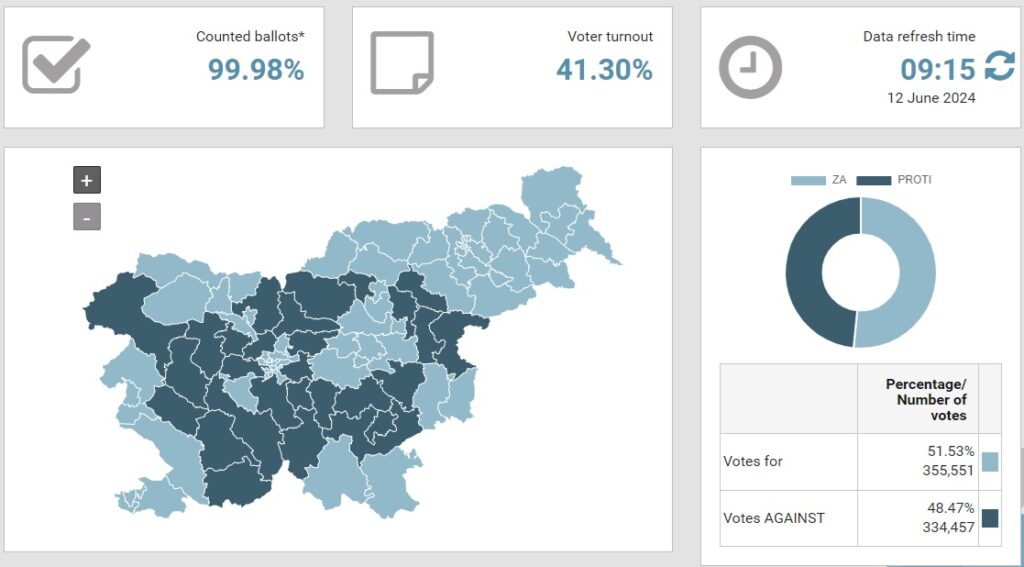
Voters in Slovenia were asked, “Should the Republic of Slovenia allow the cultivation and possession of cannabis for limited personal use on its territory?” With a voter turnout of over 41%, and nearly 700,000 votes cast, the referendum measure was approved.

adult cannabis use slovenia election 2024 results

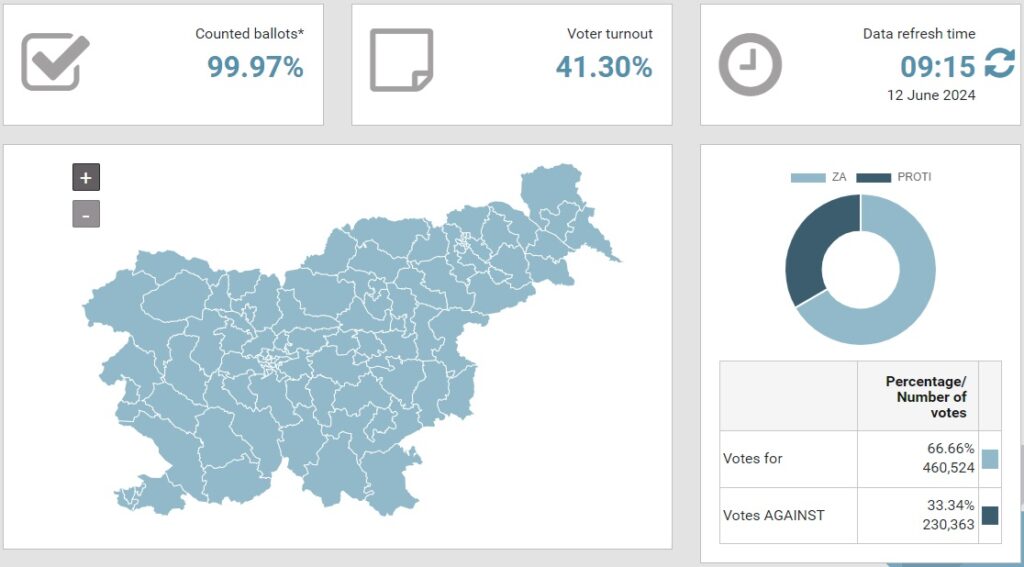
The adult-use referendum measure was one of two measures considered by Slovenia’s voters. A separate measure asked the question, “Should the Republic of Slovenia allow the cultivation and processing of cannabis for medical purposes on its territory?” The medical cannabis measure was overwhelmingly approved by Slovenian voters.

medical cannabis production slovenia 2024 election results

Both measures were consultation measures and are not legally binding. However, the voting results of both referendums send a clear and significant message to lawmakers in Slovenia that it is time to modernize the nation’s cannabis policies.

The historic votes in Slovenia come on the heels of other successful recent cannabis policy modernization efforts in other nations. Last month, South Africa’s President signed a measure that legalized private cannabis cultivation, possession, and use by adults.

On April 1st, 2024 the first provisions of Germany’s adult-use cannabis legalization measure went into effect. Adults in Germany can now cultivate up to three plants in their private residences. Social cannabis clubs are expected to launch in July in Germany, and regional adult-use cannabis commerce pilot trials are expected to begin by the end of the year.

Cannabis is also currently legal for adult use in Uruguay, Canada, Malta, Luxembourg, and in two dozen states in the U.S. Additionally, adult-use cannabis commerce pilot trials are underway in several jurisdictions in the Netherlands and Switzerland.

Slovenia Voters Overwhelmingly Approve Medical Cannabis Referendum Measure

(*Editorial note – this article was updated from its original version to reflect updated voting results*)

Voters in Slovenia appear to have overwhelmingly voted in favor of a medical cannabis referendum measure today. Today’s cannabis vote in Slovenia occurred alongside the wider 2024 European election.

With 92.84% of the votes counted, 65.41% answered ‘for’ when asked the question (translated from Slovenian to English), “Should the Republic of Slovenia allow the cultivation and processing of cannabis for medical purposes on its territory?”

The medical cannabis referendum question was one of two cannabis questions placed before Slovenia’s voters. The second one asked the question, “Should the Republic of Slovenia allow the cultivation and possession of cannabis for limited personal use on its territory?”

The personal adult cultivation and use question was passing by a slim margin with 92.74% of the vote counted, with 50.93% of voters answering ‘for’ and 49.07% answering ‘against’ the adult-use measure. With such a razor-thin margin, the vote is still too close to call. Local cannabis advocates are celebrating the results of today’s vote in Slovenia.

“People are clearly not satisfied with this drug policy. However, problems are not solved by the same people who created the problems. If only half of the voters are in favor of greater use of cannabis, it will be a big eavesdrop on the counter-propaganda financed by the Ministry of Health and doctors,” stated Božidar Radišič according to domestic reporting by Delo (translated from Slovenian to English).

Both cannabis referendum measures are consultation referendums and are not binding. What happens after all of the votes are counted and recorded is up to lawmakers in Slovenia.

Limited medical cannabis activity is currently permitted in Slovenia, although the nation’s program is more restrictive compared to other European nations, with countries such as Germany having incorporated a wider list of qualifying conditions, regulated domestic production, and regulated commerce.

Slovenia already serves as an international research and development hub for several large industries, and the favorable medical cannabis production and processing vote combined with an already existing infrastructure makes Slovenia well-positioned to do the same for the emerging international cannabis industry.

“Thanks to researchers and laboratories, Slovenia could become an intellectual superpower in the field of cannabis according to Alex Rogers,” Delo also stated in its original coverage.

Today’s vote in Slovenia comes on the heels of other successful recent cannabis policy modernization efforts in other nations. Last month, South Africa’s President signed a measure that legalized private cannabis cultivation, possession, and use by adults.

On April 1st, 2024 the first provisions of Germany’s adult-use cannabis legalization measure went into effect. Adults in Germany can now cultivate up to three plants in their private residences. Social cannabis clubs are expected to launch in July in Germany, and regional adult-use cannabis commerce pilot trials are expected to begin by the end of the year.

Cannabis is also currently legal for adult use in Uruguay, Canada, Malta, Luxembourg, and in two dozen states in the U.S. Additionally, adult-use cannabis commerce pilot trials are underway in several jurisdictions in the Netherlands and Switzerland.

***

Update: The medical cannabis production measure was officially approved after receiving 66.66% ‘for’ votes and the adult-use measure was also officially approved after receiving 51.53% ‘for’ votes. Voting turnout was roughly 41.3% for both measures.

Cannabis Referendums In Slovenia Deserve A Serious Discussion

Slovenia’s voters will decide on two consulting referendum measures on June 9th pertaining to cannabis policy modernization proposals. The referendum questions were approved for voter referral by Slovenia’s National Assembly in April. Neither measure is binding, however, successful votes for either will help further build upon increasing momentum for Slovenian cannabis reform.

One of the consulting referendum measures involves modernizing Slovenia’s medical cannabis policies. Limited medical cannabis commerce and use are already permitted in Slovenia, however, domestic production is not. Patient advocates are seeking to expand the nation’s medical cannabis program to boost domestic production and safe access, increase product variety selection, improve research policies, and expand the list of Slovenia’s qualifying conditions.

The second consulting referendum measure asks voters about the “cultivation and possession of cannabis for limited personal use” by adults. Personal cultivation, possession, and use by adults are already legal in Malta, Luxembourg, and Germany. Courts in other European countries have also issued rulings that provide similar personal cannabis consumer protections.

Cannabis policy modernization proposals in Slovenia are important topics worthy of constructive public policy conversations. Unfortunately, cannabis opponents in Slovenia seem to prefer using delay tactics and spreading incomplete/misleading information.

An example can be found in a recent article published by Slovenia’s National Institute of Public Health in which the entity expresses opposition to cannabis use and reform in general, but does not specifically call out the upcoming referendum votes. Still, the aim of the article is glaringly obvious.

The Institute’s opposition article largely relies on anti-cannabis talking points that have been recycled for decades and completely disregards very important facts and realities, which makes the Institute’s position come across as disingenuous and unauthentic. The article clearly comes across as more of a political document than it does serving as an objective analysis.

The authors of the article begin by oversimplifying the state of Slovenia’s medical cannabis program and disregarding the ineffectiveness of current medical cannabis policies in Slovenia. The article’s authors are presumably mischaracterizing Slovenia’s current medical cannabis policies to distract and/or confuse the nation’s voters, which is a common cannabis opponent tactic deployed all over the globe.

Yes, technically Slovenia currently permits limited medical cannabis use. However, domestic medical cannabis production is currently limited at best in Slovenia, successfully obtaining effective and regulated medical cannabis products is hard for many patients, and a vast majority of the nation’s suffering citizens do not qualify for legal medical cannabis access under the current policies.

Medical cannabis advocates in Slovenia are seeking to implement medical cannabis policies, rules, and regulations similar to what is already in place in many other parts of the European Union. If other EU member nations can successfully expand their domestic medical cannabis programs without significant issues, so can Slovenia.

The Institute’s article places a heavy emphasis on the harms of adolescent use despite the fact that neither of the referendum measures proposes any changes to Slovenia’s cannabis policies that pertain to adolescent use or furnishing cannabis to minors. The ‘what about the children’ talking point is as old as cannabis prohibition itself, and is nothing more than a scare tactic.

Malta, Luxembourg, and Germany now permit adults to cultivate, possess, and consume cannabis in addition to legalized medical use, and there are no reported major issues in those nations pertaining to youth consumption due to the adult-use policy changes.

The same is true for other scare tactic talking points that the Institute incorporated in its article, such as “passive cannabis use” (public use around others) and driving under the influence. Neither referendum measure proposes changes to Slovenia’s public cannabis use or driving under the influence laws. Both would remain prohibited.

A major macro-level reality that the Institute completely disregards in its positions is that there is no proof that cannabis prohibition lowers cannabis consumption rates. Adults are consuming cannabis in Slovenia every day, just as they have done for many years. The Institute would be well served to acknowledge that reality and advocate for regulation and education instead of continuing to metaphorically stick their heads in the sand and pretend that prohibition works.

Leaders in Malta, Luxembourg, and Germany have taken the position that it is better for public health outcomes when cannabis consumers use home-grown and/or regulated cannabis products versus consuming cannabis products that are sourced from criminal enterprises. Leaders in those nations have also taken the position that it is better to stop wasting precious public resources to enforce failed prohibition policies and instead use those same resources to boost fact-based education and other public programs.

It’s unfortunate that in 2024 cannabis opponents would still rather spread incomplete/misinformation to try to maintain the failed status quo rather than have a constructive public conversation about a more sensible, modern approach to cannabis policies.

With that being said, it is up to cannabis advocates in Slovenia to educate themselves about the true facts regarding cannabis, to tell everyone that they know that the consulting referendum votes will be held on June 9th, and inform them about the objective benefits of modernizing Slovenia’s cannabis policies.

Slovenia does not need to reinvent the wheel. Rather, the Central European nation needs to look to some of its continental peers for policy measures that are already succeeding, such as the policies found in Malta, Luxembourg, and Germany. Cannabis opponents in Slovenia largely benefitted for many years from a lack of successful examples from other EU nations. Those days are now gone, and just as modernized cannabis policies are succeeding in other parts of the EU, the same will prove to be true in Slovenia once lawmakers get the country on the right side of history.

Slovenia Cannabis Referendum Votes Set For June 9th

Slovenia’s Freedom Movement, the largest party of the current ruling coalition, was successful in its push to place consulting referendums related to medical and non-medical cannabis use before Slovenian voters. Slovenia’s voters will decide on a medical cannabis referendum question and a “cultivation and possession of cannabis for limited personal use” question on June 9th.

The referendum questions were approved by Slovenia’s National Assembly on April 25th and voting on them will occur alongside the vote for the European Parliament. Opponents of the referendum sought to delay the votes until November, however, the push to delay the vote was unsuccessful.

According to initial domestic reporting by The Slovenia Times, the cannabis referendum questions evolved during the parliamentary process, “from the initial proposal to inquire about support for the cultivation, processing, sale and use of cannabis for medicinal purposes” to two separate questions.

“The question was changed after the parliamentary legal service reminded the initiators that the sale and use of cannabis for medicinal purposes is allowed already, but not the cultivation.” The Slovenia Times reported in its coverage.

It is worth noting that the referendum questions are not legally binding, and even if the votes are successful, it’s possible that Slovenia’s governing coalition will not adopt them. However, approval of one or both referendum questions would place considerable political pressure on Slovenia’s lawmakers to respect the will of its constituents.

Per an analysis conducted by Marihuana Marš, Študentska Organizacija Univerze v Ljubljani and published in November 2023, Slovenia is home to over 200,000 cannabis consumers. The same researchers determined that roughly 2,000 criminal offenses involving cannabis occur every year in Slovenia.

Slovenia’s recent cannabis referendum vote approval comes amidst a renewed push by local cannabis advocates to work with lawmakers to modernize Slovenia’s cannabis policies. Slovenia is already an international research and development hub for several industries, including the pharmaceutical industry, and local advocates believe that the same could be true for the emerging global cannabis industry.

“Slovenia has a research and development sector framework in place that few other countries have,” stated Alex Rogers, CEO of the International Cannabis Business Conference and co-founder of the Talman Group. “Slovenia’s research facilities, academic institutions, and product development experts are unrivaled, making Slovenia the perfect place for international cannabis entities to conduct their research and development. It’s a matter of modernizing the nation’s policies and regulations to permit such activity for the legal international cannabis industry.”

Medical cannabis is currently permitted in Slovenia, although domestic production is not allowed, as previously noted in coverage by The Slovenia Times. Still, despite Slovenia’s current limited medical cannabis policies, the use of medical cannabis in Slovenia is already proving to be successful in some cases.

“For the past ten years, we have been treating more than 300 children and adolescents with resistant epilepsies/encephalopathies with add-on cannabidiol and medicinal cannabis with great success, as nearly half of them are seizure-free and the rest reduced the number and severity of their seizures thus improving the quality of life of these patients and their families,” stated Dr. David Neubauer who works at the Department of Child, Adolescent and Developmental Neurology at the University of Ljubljana.

The referendum votes in Slovenia come at a time when many nations in Europe are working to reform their cannabis policies and regulations, with the most noteworthy example being in Germany where a new adult-use cannabis legalization measure took effect on April 1st, 2024.

As of April 1st, adults in Germany can cultivate up to three plants in their private residences and possess up to 25 grams of cannabis while away from their homes. Noncommercial cannabis clubs are expected to launch in Germany in July, and eventually, the nation will also be home to regional adult-use cannabis commerce pilot projects.

Regional adult-use cannabis commerce pilot projects are already in operation in Switzerland and the Netherlands, and cannabis cultivation, possession, and consumption are currently legal in Malta and Luxembourg. Only time will tell if the same eventually proves to be true for consumers in Slovenia.