Tag: spain

Spain Resumes Reviewing Medical Cannabis Regulation Proposals

Spain, like every other populated country on earth, is home to suffering patients, many of whom use various forms of medical cannabis to treat their condition(s). How many such patients there are in Spain is nearly impossible to determine, largely because the nation does not have a comprehensive medical cannabis program.

For several years lawmakers in Spain have tried to pass meaningful medical cannabis regulations, just to see medical cannabis measures repeatedly hit dead ends. The most recent example can be found last year when draft medical cannabis legislation was circulated and then tabled.

The Spanish government is reportedly reviving efforts to review medical cannabis regulation proposals, which are desperately needed in a country that has arguably the most active unregulated medical cannabis market on the planet. Per The Local:

Sources from the Ministry, headed by Sumar’s Mónica García, have confirmed to various outlets in the Spanish press that they intend to press on with draft legislation and relaunch the creation of a medical programme from mid-January.

The government had previously looked into the issue and the Spanish Parliament even approved a draft document that urged for cannabis regulation for medicinal purposes, but with the rush of elections at the end of the last legislature the issue was ultimately side-lined.

Now the Health Ministry wants to reignite the process and is reviewing the existing draft legislation, which was drawn up on the basis of findings by a Congressional committee and was something backed by all parties besides right-wing Partido Popular (PP) and Vox, who voted against.

According to a poll cited by The Local, 84% of Spaniards support regulating medical cannabis per CIS data. A majority of lawmakers in Spain’s Parliament also reportedly support medical cannabis reform.

There is a clear disconnect between cannabis opponents in Spain’s Parliament and what is actually going on in Spain’s communities. Spain’s cannabis consumption rate is greater than nearly every other nation on Earth, and hundreds of private cannabis clubs populate various parts of the country.

The absence of a regulated domestic medical cannabis program has done nothing to deter people from consuming cannabis. Rather, it forces suffering patients to source their medicine from unregulated sources, which is far from an optimal situation.

It remains unclear if/when medical cannabis legislation will receive a vote in Spain’s Parliament, and for that matter, whether such a vote would prove to be favorable or not. However, momentum does appear to be gaining in Spain, and it’s largely a matter of supporters in parliament overcoming the constant hurdles that are set up by opponents.

Meanwhile, the effort to shut down cannabis clubs in Barcelona continues, although, the odds of it succeeding seem grim at best. Lawmakers at the local and national levels need to work together in Spain to regulate cannabis products and commerce, rather than continue to stick their heads in the ground and let organized crime fill the void at the expense of public health outcomes.

Cannabis Clubs Are Here To Stay In Barcelona, Spain

Barcelona Mayor Jaume Collboni and the Barcelona City Council are ramping up efforts to close down the city’s famed cannabis clubs, with the City Council recently launching a new inspection campaign. The effort is aimed at ‘putting an end’ to clubs in the city, with city leadership stating that “It is a model that we do not want in our city.”

Cannabis clubs in Barcelona have long benefitted from a favorable tolerance of cannabis clubs, which operate in a legal ‘grey area’ of sorts. Commercial adult-use cannabis is still prohibited in Spain, however, it is unconstitutional for Spain’s government to prohibit private cannabis use.

Law enforcement in the Barcelona region of Spain estimates that the area is home to roughly 450 clubs, all of which are essentially unregulated. The clubs are very popular, and even if one is closed down another one pops up to take its place in short order. An effort to close down all of them is an untenable goal by every measure.

Cannabis prohibition is a failed public policy, with no hard evidence existing to back up the claim that it works. Prohibition does not lower consumption rates. Humans have made use of the cannabis plant for thousands of years, and that will never cease to be the case. Barcelona is no exception.

Cannabis is so engrained into the culture of the Barcelona region that it is home to the largest cannabis super-conference on the planet, a collaborative effort between the world’s largest cannabis gathering, Spannabis, and the world’s leading B2B series, the International Cannabis Business Conference.

Barcelona is one of the top international cannabis destinations on earth, with people flocking to the city from all corners of the globe every spring. It’s one of the only places on the planet where cannabis consumers of all backgrounds agree about the quality of the cannabis being amazing, with the same being true about the interesting places in which to consume it in a private setting.

Nowhere else on earth can the same cannabis scene be found that exists in Barcelona, which is why people go there. It is arguably the number one cannabis tourist destination on earth right now.

Barcelona doesn’t have a cannabis use problem. Rather, Barcelona has a cannabis regulation problem, and that problem increases in size and scope with every passing year. Barcelona’s unregulated cannabis market is enormous, and it is largely controlled by organized crime right now.

That, in turn, creates public health outcome concerns with people consuming products that are not tested for contaminants, in addition to public safety concerns.

The best thing that Barcelona policymakers can do is to work to transition cannabis clubs in Barcelona into a regulated system, yet, that is not something that Barcelona politicians can do unilaterally. At one point Barcelona had a regulatory program, however, the Spanish Supreme Court halted the local program.

Ultimately, regulations need to be passed at the national level in Spain. Lawmakers need to recognize the reality of the situation, that cannabis clubs in Spain are here to stay, and that it is better from a public health strategy standpoint to regulate the cannabis industry rather than leaving it to organized crime to continue to fill the void.

Power Outages In Spain Supports Cannabis Regulation, Not Prohibition

Earlier this month power outages were reported in parts of Spain, including in the Spanish city of Granada. While the outages are not necessarily a new thing in Spain, they are reportedly increasing in frequency and severity in multiple parts of the European nation.

Endesa, which is Spain’s largest electric company, attributes the reported increase in outages to unregulated cannabis cultivation operations, and that one-third of the electricity consumed in Granada’s northern district last year was reportedly connected to such operations.

The true cause of the power outages is open for debate. Many authorities are echoing what Endesa is claiming, and yet many residents are pointing to what they claim is a failing electrical grid. Unregulated cannabis operations may be contributing to the problem, however, they may also only play a small role in what seems to be an increasing issue for Spain.

Regardless, a point that seems to be lost in the larger discussion is that Spain’s approach to cannabis is completely outdated and in desperate need of sensible modernization. Cannabis is largely tolerated in Spain, however, legalization is not the law of the land.

Cannabis clubs are very common in parts of Spain, particularly in Barcelona, and all of the cannabis that supplies those clubs comes from unregulated sources. It’s a complete free-for-all, and as such, no one truly knows how much cannabis is being cultivated and sold in Spain every year.

What we do know is that the current approach to cannabis policy in Spain is insufficient, to put it lightly. Licensing and regulating cannabis cultivation would not guarantee that Spain’s power outages would be resolved, however, it would give lawmakers, regulators, and electricity providers something to work with.

The only way to properly address Spain’s unregulated cannabis cultivation energy consumption concerns is to transition the unregulated market to a regulated one in which cannabis is cultivated in more sustainable ways, and in a manner that balances the cannabis industry’s energy needs with the rest of society’s.

In regulated jurisdictions, many cannabis cultivators now rely entirely on the sun to grow their crops, or they only use artificial lighting to supplement sunlight. The cannabis is cultivated in state-of-the-art greenhouses that easily regulate temperature and airflow. As such, they consume very little energy.

Compare that to illegal cultivation operations that are almost always reliant solely on artificial lighting and use a significant amount of energy because they are located out of sight in an enclosed facility to avoid detection. ‘The win’ would be if consumers in Spain made their purchases from the former, not the latter.

That only happens if/when lawmakers in Spain reform the nation’s laws to permit legal cannabis cultivation for adult-use purposes and permit those cultivators’ crops to be sold at regulated outlets. Regulations have to be sensible to ensure that prices for legal products are competitive with unregulated products, otherwise, the unregulated market will continue to thrive in Spain.

Spain’s Minister Of Health Says Medical Cannabis Regulations Are On The Way

Spain has long served as a unique home for cannabis public policy. Technically, medical cannabis is prohibited in many instances in Spain, with the nation’s legal medical cannabis industry largely built around research and exports.

Domestic medical cannabis patients are almost always left on the outside looking in and have to resort to unregulated sources for their medicine. Fortunately for patients, medical cannabis is fairly easy to acquire in Spain from private cannabis clubs, however, the situation highlights that Spain’s cannabis model is in desperate need of improvement.

When patients and providers have to operate in an unregulated environment, there is a considerable amount of uncertainty involved and that makes it difficult to keep things going at times. Unregulated industries are ripe for selective enforcement towards providers, and patients may end up buying untested products that are not as ‘clean’ as they could be.

Advocates have pushed for reform in Spain for many years, and yet, success has remained elusive. Medical cannabis patients and industry members were hopeful that 2022 would be the year for a regulation bill to get to the finish line just to see their hopes dashed. Fortunately, the nation’s Minister of Health is signaling that movement is on the way. Per El Planteo:

The Minister of Health of Spain, José Manuel Miñones , announced that before the end of May he will present a report that will allow the regulation of the use of medicinal cannabis in the National Health System (SNS) . The news came after some parliamentarians have claimed the delay in the analysis of the Spanish Agency for Medicines and Health Products (Aemps), whose term ended in 2022.

Miñones also apologized for the delay in his first appearance before the Health Commission of the Lower House. Congress had ruled in favor of regulating medical cannabis in June 2022, and the subcommittee in charge had given Aemps a period of six months to issue recommendations.

What is being proposed is instead of regulating the nation’s private cannabis clubs, patients will be able to legally acquire medical cannabis and products derived from medical cannabis via one of Spain’s licensed pharmacies.

In some countries, such as the United States, pharmacies are not used to dispense medical cannabis outside of a handful of pharmaceutical-grade products. In other countries, such as Germany, pharmacies are used to serve as the backbone of safe access for suffering patients. Whether something meaningful comes out of Spain or not is something that we will all have to wait and see.

Agreement Reached In Spain For Future Regulation Of ‘Cannabis Light’

Spain is home to one of the most unique approaches to cannabis policy out of any nation on the planet. The nation has one of the most robust and vibrant cannabis communities on earth, yet the cannabis public policies in Spain are very outdated.

Anyone with internet access and the ability to use a popular online search engine can see that private cannabis clubs are located throughout Spain, with huge clumps of them being located in Barcelona in particular. Unfortunately, Spain’s laws and regulations are such that all of those clubs operate in a legal grey area versus being licensed and outright accepted.

Cannabis advocates inside and outside of Spain were hopeful that the start of 2023 would see a cannabis regulatory measure finally reach the finish line and get the nation’s laws to match reality, however, that has yet to materialize.

What has materialized is an agreement in Spain’s Congress to, eventually, regulate low-THC cannabis. Low-THC cannabis is often referred to as ‘cannabis light’ and is very popular in many European nations. Perhaps someday Spain will join those nations in regulating such products. Per Europa Press (translated to English):

The PSOE has agreed on an initiative in Congress with Unidas Podemos, Esquerra (ERC) and Bildu that opens the door to a future regulation of non-psychoactive cannabis, that whose percentage of tetrahydrocannabinol (THC), the euphoric drug, is less than 1% .

Unidas Podemos and the two pro-independence allies of the Government presented an initiative this Wednesday in the Congressional Agriculture Commission demanding the regulation of the production and commercialization of this crop in order to offer legal certainty to producers and marketers.

It will be interesting to see if 1) this type of reform actually gets adopted in the near future, and 2) if it will have any meaningful impact on Spain’s cannabis industry. To be clear – providing this type of reform to the nation’s emerging cannabis industry is helpful, although, exactly how helpful it would be is open for debate.

What Spain really needs is a comprehensive cannabis policy and regulatory overhaul. Cannabis products containing all types of THC percentages, including concentrates that contain large amounts of THC, are being consumed every day in Spain. It’s a reality that lawmakers and regulators ignore at a cost to public health.

Consumers and patients in Spain deserve safe access to tested cannabis. Entrepreneurs in Spain deserve to operate in a business landscape that affords them every reasonable opportunity to supply the nation’s demand in a way that boosts public health and generates revenue for public coffers.

The Global Cannabis Industry’s Increasing Momentum Was On Full Display In Barcelona

The emerging legal international cannabis industry is stronger now than at any other time since the dawn of prohibition so many decades ago, and that was on full display last week in Barcelona where leading cannabis investors, entrepreneurs, activists, policymakers, and industry service providers from all over the planet gathered at the International Cannabis Business Conference on March 9th.

March in Barcelona has largely developed into the start of ‘cannabis event season’ for the international cannabis community in recent years, with the International Cannabis Business Conference partnering once again with Spannabis (held March 10th-12th) to put on the world’s largest cannabis super-event in 2023.

The two events combine for what is likely the closest thing in this world to an international cannabis community reunion, and it’s always heartwarming and inspiring to see old friends connecting (in addition to new friendships being created).

International Cannabis Business Conference Barcelona 2023

The International Cannabis Business Conference is Spain’s largest cannabis B2B event and this year’s installment came at a very crucial time for cannabis policy in Spain, as well as for cannabis policy at the continental level. Lawmakers and regulators in Spain are working harder than ever to pass meaningful legislation that will help Spain’s emerging cannabis industry reach its full potential. The same can also be said about many other parts of Europe right now.

With that in mind, it was tremendously beneficial to bring not only leaders from throughout Spain to one venue to network and discuss cannabis policy, but also leaders from other nations that are either working towards the same end goal as Spain or are farther along in the process and were able to impart their wisdom. Those leaders were able to network with each other and additionally were able to network with industry members, which is important for a multitude of reasons.

Cannabis policy reform is still a relatively new phenomenon at the international level and the global cannabis ecosystem is still largely a patchwork of laws, rules, and regulations, and that patchwork extends to efforts to reform and improve current public policies. The saying, ‘teamwork makes the dream work’ is as applicable to global cannabis efforts as anything you will ever find, so seeing leaders from all sectors of society (law, government, industry, activism) networking with each other was very encouraging and uplifting.

The International Cannabis Business Conference’s next event will be in Berlin in June. Buy your tickets today before prices go up!

International Cannabis Business Conference Barcelona 2023

As is always the case, the curriculum at the International Cannabis Business Conference in Barcelona was packed with world-class speakers who are all global leaders in their particular fields. We will be publishing videos of the panel discussions on the event’s YouTube channel, so make sure to check them out in the near future.

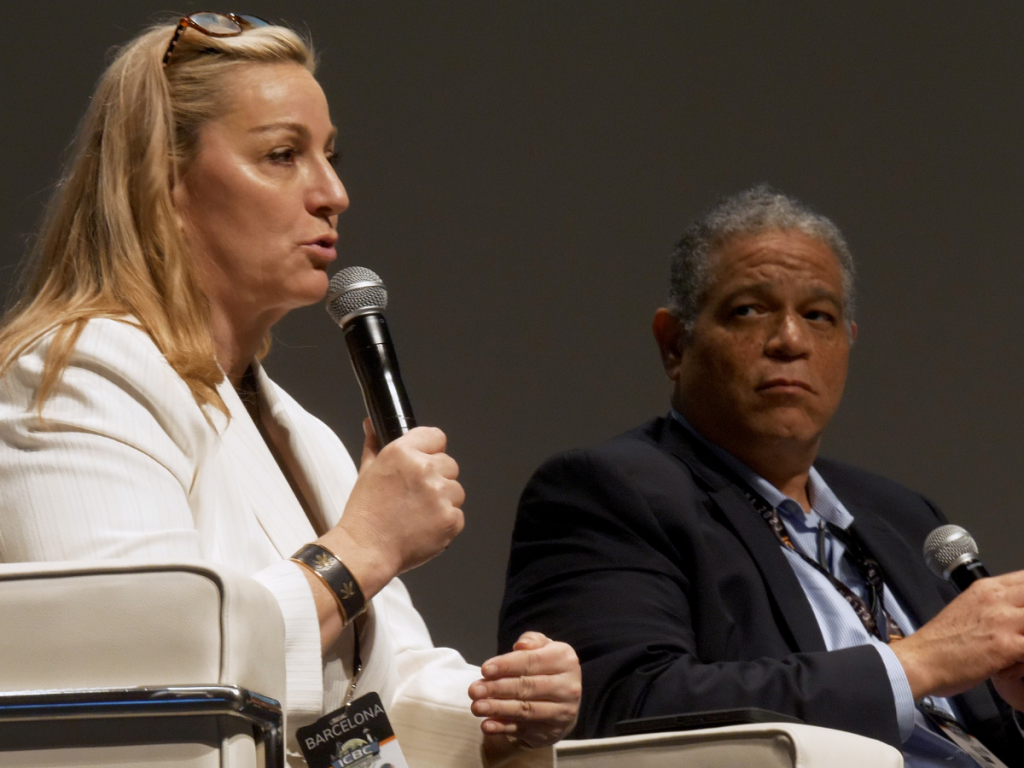
Below is a small sampling of photos from some of the many insightful panel discussions that took place at the 2023 International Cannabis Business Conference Barcelona B2B event:

International Cannabis Business Conference Barcelona 2023

No International Cannabis Business Conference event would be complete without an epic after-party, and this year’s event in Barcelona was no exception.

Below is a sampling of pictures demonstrating the ‘work hard, play hard’ mentality that makes the International Cannabis Business Conference’s events so special:

Spain To Quadruple Legal Medical Cannabis Production This Year

Late last month lawmakers in Spain considered a cannabis reform measure, and while the measure did not pass, Spain’s emerging legal cannabis industry will undergo a fairly substantial expansion this year regardless. The Spanish Medicines Agency recently notified the International Narcotics Control Board that it plans to (roughly) quadruple the amount of legal medical cannabis grown within its borders.

As verified by Público, Spain’s Ministry of Health “has forecast a production of 23.43 tons of medical cannabis in Spain this year.” As required by international agreements, Spain has to notify the International Narcotics Board of the United Nations every year regarding how much domestic medical cannabis it projects it will produce. This year’s notification from Spain is obviously a considerable increase compared to last year.

Why It’s Not Enough

For some historical context, consider that in 2019 and 2020 Spain reported to the International Narcotics Board that it would cultivate 500 kilos each year. That figure increased in 2021 to a reported 600 kilos. The following year in 2020 the figure grew exponentially to a reported 6,000 kilos. This year’s reported forecast of 23.43 tons compared to just two years ago highlights how fast Spain’s medical cannabis industry is expanding. And yet, it’s not enough. Not even close.

The boost in cannabis production in Spain will benefit exports and research, however, it’s not going to help Spain’s regulated domestic medical cannabis industry being that Spain doesn’t really have one, at least not compared to many other nations. As pointed out by Público, only two medical cannabis pharmaceutical products are authorized in Spain right now (Sativex and Epidiolex).

As such, most patients rely on the unregulated market to source their medical cannabis products, including from unregulated clubs that operate in a ‘grey area’ of the law. Spain doesn’t just need a boost in domestic medical cannabis production – it also needs to reform its laws to embrace and develop the domestic medical cannabis industry in a way that helps as many patients as possible.

A Boost For Reform Efforts

Increasing domestic medical cannabis production in Spain is generally a good thing. If it helps suffering patients abroad via direct access to medical cannabis, that is still beneficial, and if it contributes to groundbreaking research that helps suffering patients around the world, that is also beneficial. With that being said, clearly, there is still a lot more that can and should be done.

Fortunately, Spain is about to receive a boost for reform efforts via the world’s largest cannabis super-event that starts later this week. On March 9th policymakers, industry leaders, and cannabis advocates from all over the globe will descend on Barcelona, first for the International Cannabis Business Conference (March 9th), and then for Spannabis (March 10th-12th). A limited number of tickets are still available for both events.

The two events have once again teamed up to create an opportunity for thought leaders from around the world to discuss cannabis policy inside and outside of Spain. Whenever the world’s smartest cannabis brains get together amazing things happen, and this month in Barcelona will be no exception.

March 2023 Is Set To Be A Historic Month For European Cannabis

The next 32 days on the European continent could prove to be one of the most historic stretches of time for cannabis public policy and the continent’s emerging legal cannabis industry. Starting tomorrow, Malta’s government will begin accepting applications for non-profit cannabis clubs.

It’s a major milestone not just for Malta, which is the only country in Europe to pass a national adult-use legalization measure, but it’s also a major milestone for the greater European industry being that Malta is the first nation in Europe to set up this kind of national adult-use licensing system. It will be very interesting to see how many applications Malta receives next month.

Malta is not the only nation set to experience a historic March 2023. As every global cannabis observer already knows, lawmakers in Germany have worked very hard to make good on their coalition agreement component relating to legalizing cannabis for adult use and implementing a regulated adult-use industry.

Germany’s Health Minister Karl Lauterbach made a formal presentation of a legalization plan back in October 2022 and has since lobbied the European Union for its permission to proceed with an official introduction of a legalization measure.

What some observers seem to have overlooked, or perhaps forgotten about, is that roughly a month ago Minister Lauterbach reportedly confirmed a timetable for a formal introduction of a legalization measure and indicated at the time that he had ‘no reason to doubt’ that a legalization measure would be introduced ‘in the first quarter of this year.’

With February drawing to a close that puts the German adult-use legalization bullseye squarely on the month of March. Whether or not Minister Lauterbach’s reported timeline proves to be accurate or not is something that time will have to determine, although, there have been no meaningful setbacks reported from what I can tell as of the posting of this article.

Additionally, cannabis enthusiasts, entrepreneurs, investors, policymakers, and industry service providers are set to flock to Barcelona, Spain in March as part of the world’s largest super-event collaboration. The International Cannabis Business Conference has once again partnered with Spannabis, Europe’s top cannabis expo, to form another super-event that is a must-attend for anyone that is serious about succeeding in the emerging cannabis industry.

The International Cannabis Business Conference will host Spain’s largest cannabis B2B event on March 9th at the L’Auditori de Cornellà, with the after-party being held at the Hotel Arts (Ritz-Carleton) Barcelona. Spannabis will follow on March 10-12th at Fira de Cornellà. The super-event is the first large cannabis conference collaboration of the year. Whenever thousands of cannabis supporters get together and network good things happen, and that will surely be the case in Barcelona next month.

Cannabis policy and industry in Europe are both at pivotal points, and being that a legal industry cannot come into existence without reform occurring first, the two are directly tied to each other. If Germany does witness the formal introduction of an adult-use legalization measure next month, it will likely set off a wave of similar political activity in other parts of Europe and that will be good news for the continent’s emerging industry.

The same goes for Malta’s cannabis club application rollout. If Malta can successfully gather, review, and approve non-profit cannabis club applications, it will have set up a bureaucratic blueprint for other nations to copy. It’s nuanced but very significant.

We will all have to wait and see what happens for cannabis in Europe in March while doing our best to temper our excitement and expectations.

A Missed Opportunity In Spain

Yesterday was a potentially big day for cannabis policy reform in Spain, however, a bill that would have set up long-needed medical and adult-use regulations failed to pass in Parliament on Tuesday. For now, the status quo remains.

As we have reported several times in recent months, Spain’s emerging cannabis industry is in desperate need of reform in order to reach its full potential. Reform would, in turn, help consumers and patients across the country.

Unfortunately, that will not happen in the immediate future, although the fight to reform Spain’s cannabis laws is far from over. Still, yesterday’s vote was indeed unfortunate, with blame being warranted towards those that voted in support of prohibition. Per Noticias Sin (translated to English):

A comprehensive legalization of cannabis, both for therapeutic and recreational use , was rejected this Tuesday in the Spanish Parliament.

The socialist party PSOE, which is part of the coalition government in Spain with the left-wing formation United We Can, was one of those who voted against it , along with part of the right-wing opposition.

His partner in the Executive supported the initiative along with other leftist forces or formations such as the liberals of Ciudadanos, in their vote in the Congress or lower house of the Spanish Parliament.

Yesterday’s vote was definitely a missed opportunity, however, cannabis advocates will never give up. Hopefully certain reasonable tweaks can be made to proposed legislation in order to get it to the finish line.

Meanwhile, the unregulated market continues to thrive in Spain. Cannabis laws may not be as bad in Spain as they are in other countries, yet even lukewarm prohibition is still prohibition, and as long as people are being harmed by Spanish prohibition there will always be a need for reform.